

5 Elements Feng Shui: Wood, Fire, Earth, Metal, Water Career Guide (2026)
Looking for a suitable Chinese astrology elements career element, whether you are looking for wood, metal, water, earth and fire elements, based on 5 element Feng Shui also known as Chinese astrology elements.
Below are some recommended jobs, career and business for you based on Chinese astrology elements.
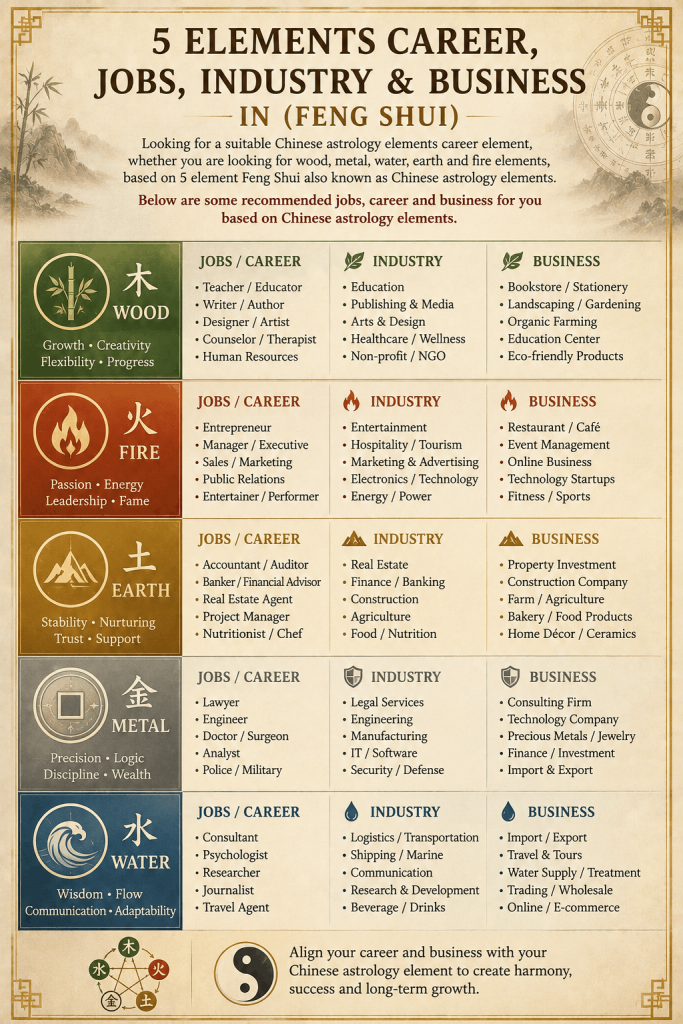
Join our Telegram Chat!
Career, Jobs, industry and Business for 5 Elements, Wood, Water, Fire, Earth & Metal.
Wood Element Career, Jobs, Business & Industries
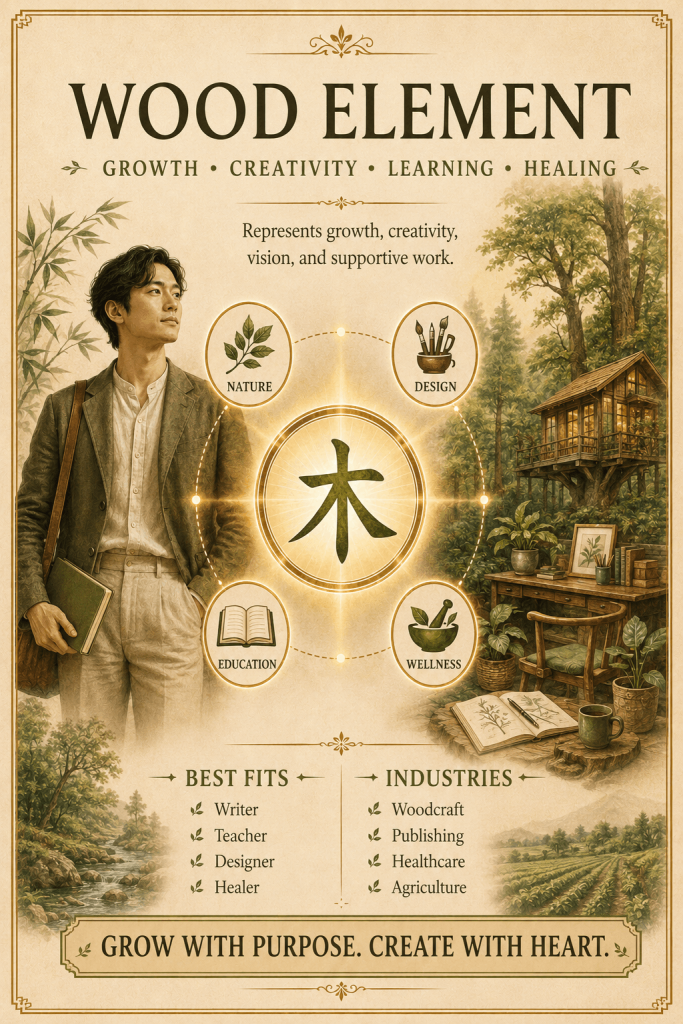
Timber, forestry, plastics, interior design, furniture’s, woodwork, paper, florists, textile, fashion, tailor, rubber, pale oil, culture, artist, publishers, writing, copywriting, editor, teacher, police force, principal, bookstores, agriculture, civil servants, healthcare, plantation, fruits. Planting, Farming, Gardening Business, Landscaping, woodcraft, wood furniture, Medical, Doctor, Dentist, Pharmacist, Herbal Food, Healer, Herbalist. Books Paper Industry, Bookstore, and Librarian. Teacher, Lecturer, and Professor. Arts and Artistic industry.
Other wood industry career can be involved in raw natural material (lumber, cotton, leather, etc.), biology, herbal medicine, natural food, nursery, office supplies, design (interior, exterior, fashion, art, illustration, software, web, cartoon, animation, etc.), photography, astrology, charity, religion, culture and education, mentoring, psychiatry, wooden tools, wooden furniture, garment, paper craft, books and newspapers, handicrafts, bamboo and rattan, medicinal ingredients, medical therapy.
Some of the other list of career for wood under Chinese astrology elements are:
- Entrepreneur
- Marketing and Advertising
- Sales and Business Development
- Creative Director
- Graphic Designer
- Art Director
- Writer
- Editor
- Film Director
- Music Composer
- Fashion Designer
- Interior Designer
- Landscape Designer
- Architecture
- Journalist
- Public Relations
- Human Resource
- Management Consulting
- Event Planner
- Fundraiser
- Coach
- Trainer
- Therapist
- Counselor
- Teacher
- Mentor
- Social Worker
- Non-Profit Manager
- Community Organizer
- Politician
- Lawyer
- Environmentalist
- Biologist
- Ecologist
- Botanist
- Zoologist
- Forester
- Wildlife Biologist
- Wildlife Rehabilitator
- Marine Biologist
- Astronomer
- Geologist
- Meteorologist
- Physicist
- Chemist
- Mathematician
- Software Developer
- Computer Engineer
- Network Administrator
- Web Developer
- Florist
- Nursery Owner
- Horticulturist
- Gardening Consultant
- Landscape Contractor
- Woodworker
- Carpenter
- Furniture Maker
- Cabinet Maker
- Timber Merchant
- Paper Manufacturer
- Bookstore Owner
- Publisher
- Printing Press Operator
- Librarian
- Archivist
- Curator
- Art Gallery Manager
- Textile Designer
- Weaver
- Tailor
- Fashion Stylist
- Pattern Maker
- Garment Manufacturer
- Leather Goods Maker
- Rubber Products Manufacturer
- Organic Farmer
- Herbalist
- Naturopathic Doctor
- Acupuncturist
- Traditional Chinese Medicine Practitioner
- Nutrition Consultant
- Yoga Instructor
- Meditation Teacher
- Wellness Coach
- Camp Director
- Outdoor Education Instructor
- Environmental Educator
- Sustainability Consultant
- Renewable Energy Analyst
- Forest Ranger
- Conservation Officer
- Park Naturalist
- Botanical Garden Curator
- Plant Breeder
- Seed Scientist
- Arborist
- Tree Surgeon
- Bamboo Products Manufacturer
- Cork Producer
Water Element Career, Jobs, Business & Industries
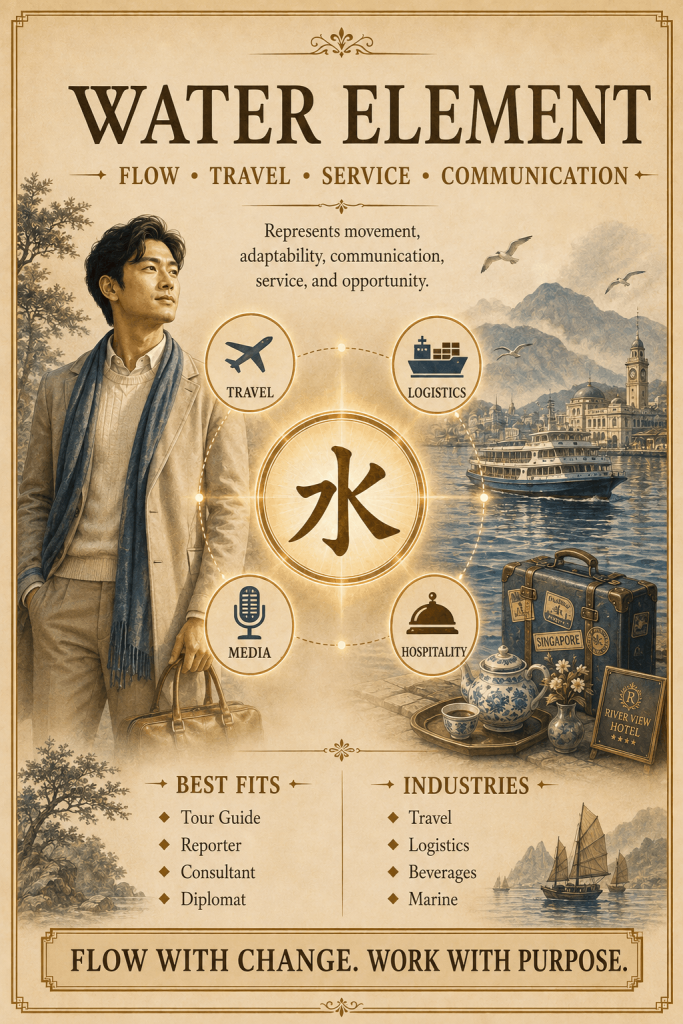
Tea house, wine, beverages, chemical, pharmacy, fish farming, fishing equipment, aquarium, plumbing, laundry, marine, clean water, aquaculture, water sports, tourism, transport, travel, hotel, logistics, sports, magic, detectives, reporter, trading, import and export, all service line, including lawyers, agents, consultation, accounting, art and dance, show businesses, singing. Tour Guide, Travel Agency, diplomat. Shipping Plumber, Aquarium Business, Water Filter Business, Pub, Maid Agency, manpower Supply, recruitment agencies. Media related career or industry, Reporter, Newscaster.
Some other water industry business you can go into are semi-conductor, laser, fuel, gas or oil company, firearm, firework, cigarette, photography, movie production, beauty maker, light manipulator, stove, oven, baker, charcoal, barber, makeup, cosmetology, technology art, machining.
- Tea House Owner
- Wine Merchant
- Beverage Distributor
- Chemical Engineer
- Pharmaceutical Researcher
- Fish Farmer
- Aquaculture Manager
- Fishing Equipment Supplier
- Aquarium Store Owner
- Plumber
- Plumbing Contractor
- Laundry Business Owner
- Dry Cleaning Service
- Marine Biologist
- Marine Engineer
- Water Treatment Specialist
- Water Quality Analyst
- Desalination Plant Operator
- Aquaculture Technician
- Water Sports Instructor
- Surf Instructor
- Diving Instructor
- Swimming Coach
- Tourism Operator
- Travel Agent
- Hotel Manager
- Logistics Manager
- Supply Chain Coordinator
- Shipping Company Owner
- Port Manager
- Customs Officer
- Freight Inspector
- Import/Export Manager
- Trade Consultant
- International Trade Specialist
- Detective
- Private Investigator
- Intelligence Analyst
- Reporter
- Journalist
- Newscaster
- Broadcaster
- Media Consultant
- Public Relations Executive
- Diplomat
- Foreign Service Officer
- Consul
- Ambassador
- Negotiator
- Mediator
- Maid Agency Owner
- Manpower Supply Manager
- Recruitment Consultant
- Headhunter
- Staffing Agency Manager
- Accounting Firm Partner
- Business Consultant
- Art Dealer
- Dance Studio Owner
- Entertainment Agent
- Talent Manager
- Show Business Producer
- Singer
- Musician
- Voice Coach
- Beverage Manufacturer
- Distillery Owner
- Brewery Operator
- Bottled Water Company Owner
- Juice Bar Owner
- Coffee Shop Owner
- Bar Owner
- Nightclub Manager
- Cruise Ship Manager
- Ferry Operator
- Canal Engineer
- Dam Operator
- Hydroelectric Plant Manager
- Maritime Lawyer
- Shipping Broker
- Charter Boat Captain
- Fishery Manager
- Pearl Diver
- Salt Producer
- Ice Manufacturer
- Swimming Pool Designer
- Spa Owner
- Wellness Retreat Manager
- Water Park Operator
- River Guide
- Rafting Tour Operator
- Waterfront Property Developer
- Harbor Master
- Marine Surveyor
- Oceanographer
- Meteorological Analyst
- Flood Risk Consultant
- Irrigation Specialist
- Hydroponic Farmer
- Water Conservation Specialist
Fire Element Industry, Career, Jobs & Business
Jobs and business related to Fire Element
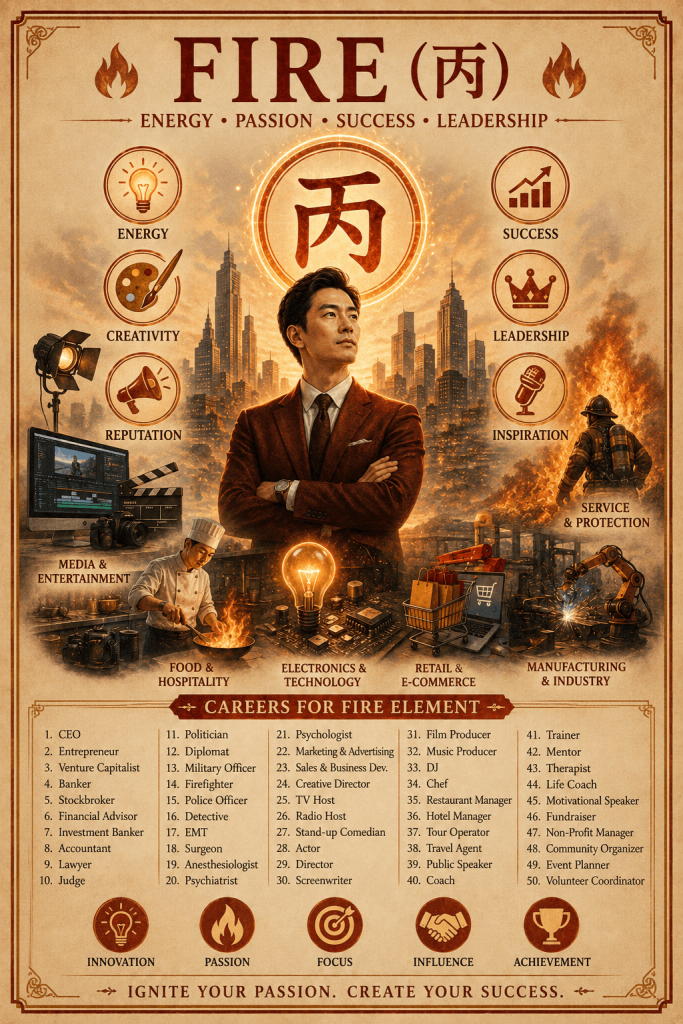
Lighting, LED lights, electronics, electrical appliances, batteries, computer, IT, videos, advertising, marketing, videos, chef, cooking, hair salon, cooking gas suppliers, welding engineering, optical, arts, glass, general merchandise, shopping, retailers, online shopping, ecommerce website, psychologists, orator, manufacturing, factories, military, designing. Electrical and Electronic related career or industry: Electrical Engineer, Electronic Engineer, Electronic Shops and Mobile Phone Shop, Computer Programmer, Network and Multimedia, Information Technology, Graphic Designer. Fashion and Beauty related career or industry: Fashion Designer, Departmental Store. Food, Restaurant, Café, Canteen.
Other fire element industries jobs, business, industry and career you can get involved are, glass/crystal manufacture, medicine and health care, cashier, human resources, professional consulting (such as an attorney), and personal services (such as moving, cleaning), irrigation, aquatic products, fishing gear, swimmers, motels, frozen, salvage, fireman.
Some other careers for Chinese astrology Fire element industry:
- CEO
- Entrepreneur
- Venture Capitalist
- Banker
- Stockbroker
- Financial Advisor
- Investment Banker
- Accountant
- Lawyer
- Judge
- Politician
- Diplomat
- Military Officer
- Firefighter
- Police Officer
- Detective
- Emergency Medical Technician
- Surgeon
- Anesthesiologist
- Psychiatrist
- Psychologist
- Marketing and Advertising
- Sales and Business Development
- Creative Director
- TV Host
- Radio Host
- Stand-up Comedian
- Actor
- Director
- Screenwriter
- Film Producer
- Music Producer
- DJ
- Chef
- Restaurant Manager
- Hotel Manager
- Tour Operator
- Travel Agent
- Public Speaker
- Coach
- Trainer
- Mentor
- Therapist
- Life Coach
- Motivational Speaker
- Fundraiser
- Non-Profit Manager
- Community Organizer
- Event Planner
- Volunteer Coordinator
- Electrician
- Electrical Contractor
- Lighting Designer
- LED Technician
- Solar Panel Installer
- Solar Energy Engineer
- Power Plant Operator
- Energy Consultant
- Battery Technology Engineer
- Electronics Technician
- Computer Hardware Developer
- IT Systems Administrator
- Data Center Manager
- Telecommunications Engineer
- Broadcast Engineer
- Camera Operator
- Video Editor
- Sound Engineer
- Lighting Technician
- Stage Manager
- Theater Director
- Makeup Artist
- Hair Stylist
- Beauty Consultant
- Cosmetic Chemist
- Perfumer
- Glassblower
- Glass Manufacturer
- Optician
- Optical Engineer
- Laser Technician
- Photonics Engineer
- Photographer
- Photojournalist
- Social Media Manager
- Digital Marketing Strategist
- Content Creator
- Influencer
- Brand Ambassador
- Advertising Executive
- Copywriter
- Public Relations Manager
- Crisis Management Consultant
- Negotiator
- Mediator
- E-commerce Manager
- Online Retail Entrepreneur
- Auctioneer
- Sales Engineer
- Business Development Director
Metal Element Career, Jobs, Business & Industries
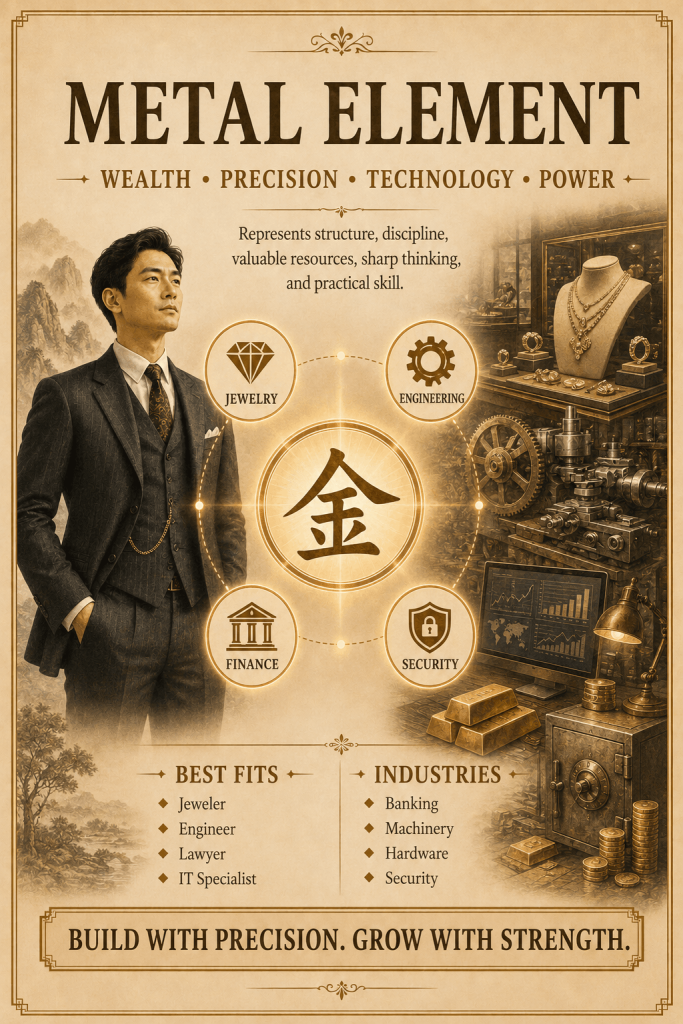
Jewelry industry, such as gold, silver. Aluminum, steels, metal processing, steel product, tin, finance, banking, insurance, wealth planning, future trading, hardware supplies, supply of machinery, selling or manufacturing of watches, keys, automobile, car sales or rental. Judge, legal professional such as lawyer, litigation, scientist.
Some other interesting industries for metals are mechanic engineering, electric engineering, computer hardware, transportation equipment (automobile, ship, bike, etc.), health care equipment, police, guard, martial art, surgeon, technicians, appliances, military, security, internet network, the financial industry, music instruments, TV, video games, watches, cutlery, molds, casting, vehicles, jewelry stores, pawn shops, securities, banking, insurance, martial arts.
Some of the metal careers are:
- Jeweler
- Goldsmith
- Silversmith
- Blacksmith
- Toolmaker
- Machinist
- Welder
- Sheet Metal Worker
- Steelworker
- Structural Iron and Steel Worker
- Heat Treating Equipment Setter
- Quality Control Inspector
- Aerospace Engineer
- Mechanical Engineer
- Industrial Designer
- Manufacturing Engineer
- Robotics Engineer
- Electrical Engineer
- Computer Hardware Engineer
- Information Security Analyst
- Database Administrator
- Network and Computer Systems Administrator
- Computer Network Architect
- Computer and Information Research Scientist
- Software Developer
- Web Developer
- Computer Programmer
- Computer Systems Analyst
- Computer Support Specialist
- Computer and Information Systems Manager
- IT Project Manager
- Network and Data Communications Analyst
- IT Sales Representative
- IT Support Technician
- IT Operations Manager
- IT Business Analyst
- IT Service Desk Manager
- IT Support Manager
- IT Business Systems Analyst
- IT Consultant
- IT Trainer
- IT Project Coordinator
- IT Procurement Specialist
- IT Auditor
- IT Quality Assurance Specialist
- IT Portfolio Manager
- IT Procurement Manager
- IT Contract Manager
- IT Service Management Specialist
- IT Operations Analyst
- Coin Dealer
- Precious Metals Trader
- Commodity Broker
- Futures Trader
- Forex Trader
- Investment Analyst
- Financial Planner
- Wealth Manager
- Tax Accountant
- Auditor
- Actuary
- Insurance Underwriter
- Risk Manager
- Compliance Officer
- Legal Counsel
- Patent Attorney
- Contract Administrator
- Procurement Manager
- Supply Chain Manager
- Logistics Coordinator
- Operations Manager
- Factory Manager
- Production Planner
- Quality Assurance Manager
- Six Sigma Consultant
- Lean Manufacturing Specialist
- Process Engineer
- Automation Engineer
- CNC Programmer
- Tool and Die Maker
- Precision Grinder
- Metal Stamping Operator
- Foundry Engineer
- Metallurgical Engineer
- Materials Scientist
- Nanotechnology Researcher
- Semiconductor Engineer
- Chip Designer
- Circuit Board Designer
- Hardware Test Engineer
- Firmware Developer
- Embedded Systems Engineer
- Cryptocurrency Analyst
- Blockchain Developer
- Cybersecurity Specialist
- Cryptographer
- Data Scientist
- Machine Learning Engineer
- Artificial Intelligence Researcher
- Robotics Programmer
Earth Element Career, Jobs, Business & Industries
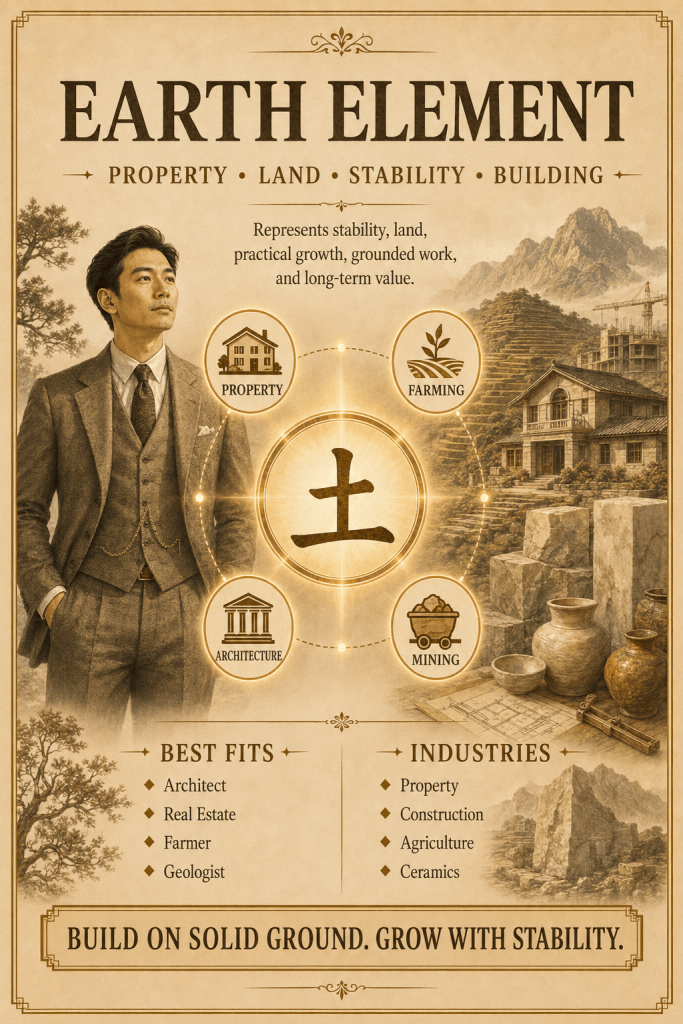
Property agent, land, civil engineering, building materials, marble, tiles, animal farming, farming, horticulture, fertilizer, natural resources, ceramics, mining ,antiques, archaeologists, waterproof materials, secretaries, minimart, constructions. Gardener, Mining business, Archeologist, Gemstone Trading, Marble Business, and Pottery.. Land and Estate Development, Architect, Civil Engineer, Developer, Real Estate, Land Banking, Contractor, Building firm, Renovator. Farming, Recycling and metaphysics.
Other Earth related industries and jobs are landscaping, nursery/gardening, demolition, warehousing, sports like track racing and rock climbing, burial, funeral services, minerals, cegment, agriculture and livestock, architecture, earthworks work, fodder production. Relatively stable occupations such as opening shops, sand warehouses.
Others Jobs for Earth Elements are:
- Agriculture and Farming
- Geologist
- Archaeologist
- Paleontologist
- Environmental Scientist
- Conservation Biologist
- Botanist
- Zoologist
- Veterinarian
- Park Ranger
- Real Estate Agent
- Property Manager
- Interior Designer
- Landscape Architect
- Architect
- Construction Manager
- Civil Engineer
- Geotechnical Engineer
- Surveyor
- Urban Planner
- Geographer
- Cartographer
- GIS Analyst
- Mineralogist
- Geochemist
- Geophysicist
- Soil Scientist
- Hydrologist
- Environmental Health and Safety Specialist
- Toxicologist
- Medical Laboratory Technician
- Dietitian
- Nutritionist
- Food Scientist
- Agricultural Engineer
- Agricultural Technician
- Agricultural Economist
- Agricultural Extension Agent
- Agricultural Educator
- Agricultural Research Scientist
- Agricultural Sales Representative
- Agricultural Manager
- Agricultural Consultant
- Agricultural Inspector
- Agricultural Photographer
- Agricultural Writer
- Agricultural Advocate
- Agricultural Volunteer
- Agricultural Activist
- Agricultural Philanthropist
- Real Estate Developer
- Real Estate Investor
- Property Developer
- Land Agent
- Estate Manager
- Facilities Manager
- Building Inspector
- Construction Foreman
- Bricklayer
- Stone Mason
- Concrete Specialist
- Foundation Contractor
- Excavation Contractor
- Demolition Specialist
- Road Construction Engineer
- Bridge Engineer
- Dam Engineer
- Tunnel Engineer
- Mining Engineer
- Quarry Manager
- Ceramics Manufacturer
- Pottery Maker
- Tile Manufacturer
- Brick Manufacturer
- Cement Producer
- Gravel Supplier
- Sand Supplier
- Clay Products Manufacturer
- Warehouse Manager
- Storage Facility Operator
- Distribution Center Manager
- Supply Chain Director
- Customs Broker
- Freight Forwarder
- Trucking Company Owner
- Moving Company Operator
- Pest Control Specialist
- Land Reclamation Specialist
- Environmental Remediation Consultant
- Waste Management Manager
- Recycling Plant Manager
- Composting Facility Operator
- Landfill Engineer
- Soil Conservationist
- Land Trust Director
- Community Garden Coordinator
- Cooperative Extension Officer
- Rural Development Specialist
- Agricultural Loan Officer
- Farm Equipment Dealer
The Five Element, in-depth Details
According to ancient Chinese philosophy, all things on earth are born from the five basic elements: Metal, Wood, Water, Fire, and Earth. In this article of the Definition of Five Elements & the Five States of Change in Qi Men Dun Jia “The Five Elements in Qi Men Dun Jia“, you will have a better understanding of the concept, personality, characteristics, and meaning of each element in the Five Elements.
A General Overview of The Five Elements
1. Metal Meaning & Definition
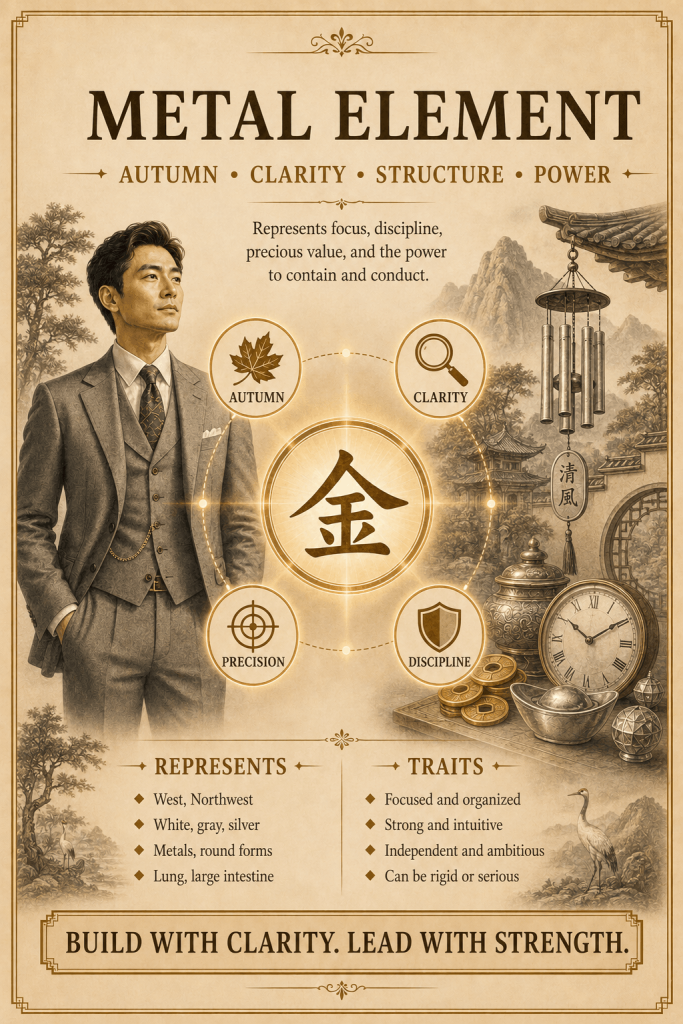
Metal represents autumn. Metal color represented by white color and other representation, rounded fonts, round shape, metallic display, metallic sound (wind chimes).
This element symbolizes power, and solid objects have the ability to contain, things that are pure, collected, and brought down. On the other hand, Metal is also a conductor. When Metal is positive, it can be a good source of information, shrewd ideas, and justice. When Metal is negative, it can be destructive, dangerous, and distressing.It can be said that Metal is both a beautiful and precious item, but it can also be a sword.
Metal personality: This is an extremely domineering and determined person. They dedicate themselves to pursuing money and ambition. People with Metal destiny are good organizers, they are independent and happy with their own achievements. Because of their belief in their own abilities, they are less flexible even though they are promoted because of change. This is the kind of person who is serious and does not accept help easily. Metal people, like everyone else, have a positive and negative side. When positive, they are strong, intuitive, and charismatic; when negative, they are rigid, melancholy, and serious.
The colors representing the element of Metal are white and gray. All metals, round shapes, domes, metal utensils, doors and steps, kitchen utensils, white, gray, silver, and gold, copper coins, and clocks belong to the element of Metal.
Metal Meaning in Point Form:
- Represents clarity, focus, and structure.
- Associated with the west and northwest directions and the autumn season.
- Corresponds to the lung and large intestine organs.
- Refers to the color white.
- Supports organization, clarity, and efficiency.
- Encourages focus and discipline.
- Promotes self-reflection and introspection.
- Supports personal and professional growth.
- Enhances decision-making skills and problem-solving abilities.
- Promotes a strong and stable foundation in personal and professional life.
- Supports financial stability and success.
- Encourages personal and professional stability.
- Enhances mental clarity and decision-making skills.
- Supports relationships and communication.
- Promotes growth and success in personal and professional life.
- Supports clarity and stability in spiritual practice.
- Enhances mental clarity and concentration.
- Supports self-reflection and self-awareness.
- Encourages personal growth and development.
- Supports stability and structure in all areas of life.
2. Wood Meaning & Definition
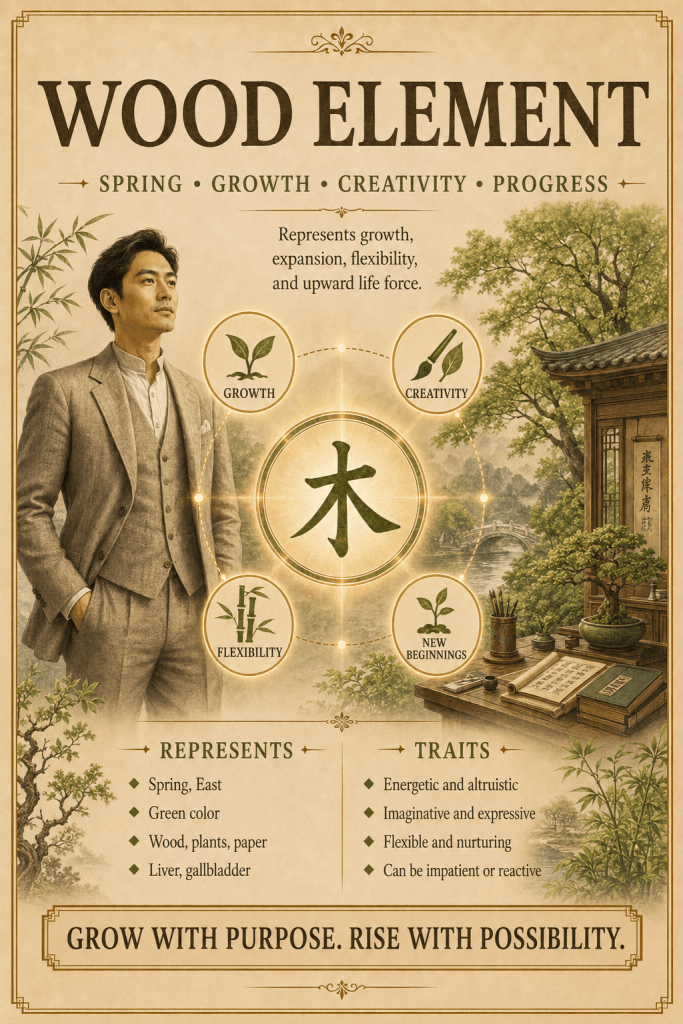
Wood is the representative form of spring, the growth of trees and plant life. They develop upward and outward. Wood are representation of growing, upward, progress. Color representation will be Green color. Other representation will be rectangle, thin narrow font, long and vertical objects, plant with leaves and stem.
Because it is viewed under the image of a tree, Wood’s energy is prolific, nurturing, and flexible.
Wood personality: This is an altruistic and energetic person. People with many ideas and an outgoing personality are loved and supported by many people. They have imaginations that are sometimes far from reality. The positive sides of this person are that they have an artistic nature and work enthusiastically. On the contrary, the negative side is impatient people, easily angered, often abandoning work.
Wood represents green, herbs, wooden furniture, paper, pillars, decorations, and landscape paintings.
Wood Meanings in Point Form:
- Represents growth, expansion, and new beginnings.
- Associated with the east direction and spring season.
- Corresponds to the liver and gallbladder organs.
- Refers to the color green.
- Supports personal and professional growth.
- Encourages creativity and self-expression.
- Promotes new beginnings and opportunities.
- Supports self-confidence and assertiveness.
- Enhances problem-solving skills and decision-making abilities.
- Promotes growth and success in personal and professional life.
- Supports healthy relationships and communication.
- Encourages personal and professional advancement.
- Enhances flexibility and adaptability.
- Supports personal and professional growth and development.
- Promotes financial stability and success.
- Encourages personal growth and development.
- Supports creativity and self-expression in personal and professional life.
- Enhances opportunities for growth and advancement.
- Supports personal and professional growth and success.
- Encourages embracing change and new opportunities in life.
3. Water Meaning & Definition
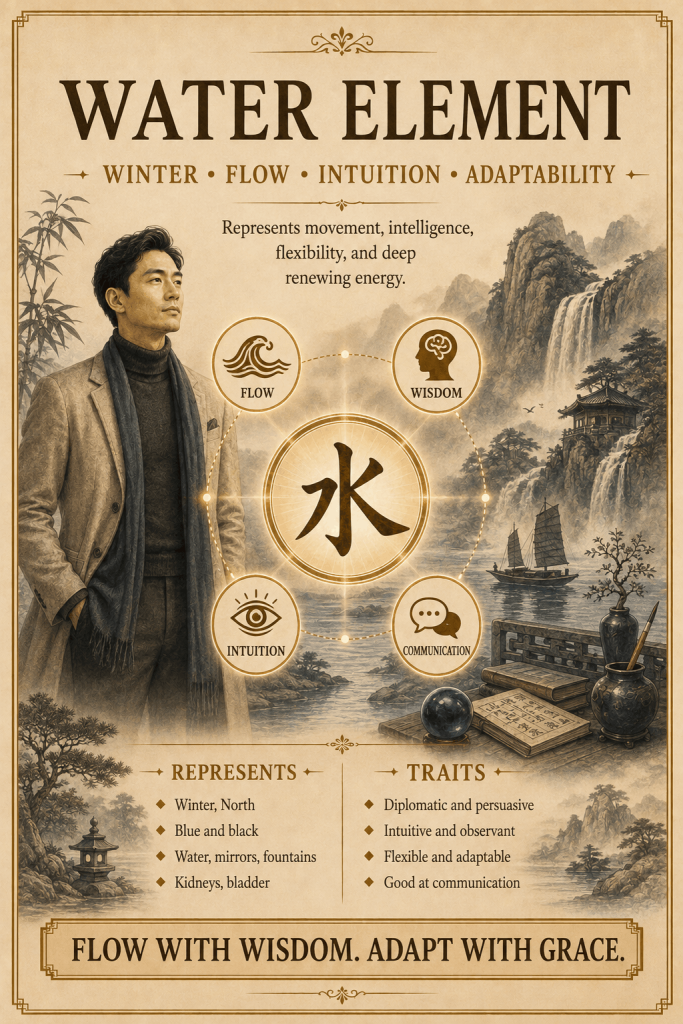
Water is a characteristic of winter, means movements, intelligence with creativity; always moving; deep and powerful; cleansing. Colors are Blue or black,. Other represents for water elements are wavy, cursive fonts, curve object, water feature, fish tank
Water personality: This is a person with diplomatic talent, good communication skills, and a talent for persuading others. They are people who are open to hearing what others have to say.People with Water destiny also have good intuition and are good at negotiation. Flexibility and adaptability, seeing things as a whole, are also characteristics of them.
The colors representing the element Water are black and blue. Rivers, streams, ponds, mirrors, glass, meandering lines, fountains, are all things that belong to this element.
Water Meanings in Point Form:
- Represents flow, fluidity, and flexibility.
- Associated with the north direction and winter season.
- Corresponds to the kidneys and bladder organs.
- Refers to the color black.
- Supports personal and professional growth and development.
- Encourages adaptability and flexibility.
- Promotes financial stability and success.
- Supports intuition, empathy, and emotional intelligence.
- Enhances personal and professional relationships.
- Promotes healthy communication and interpersonal skills.
- Supports personal growth and self-discovery.
- Encourages understanding and compassion in personal and professional relationships.
- Enhances the ability to handle change and uncertainty.
- Supports personal and professional growth and success.
- Promotes wisdom, self-awareness, and introspection.
- Encourages personal and professional stability.
- Supports stability and growth in personal and professional life.
- Enhances personal and professional growth and success.
- Supports personal and professional growth and development.
- Encourages adaptability, fluidity, and flexibility in personal and professional life.
4. Fire Meaning & Definition
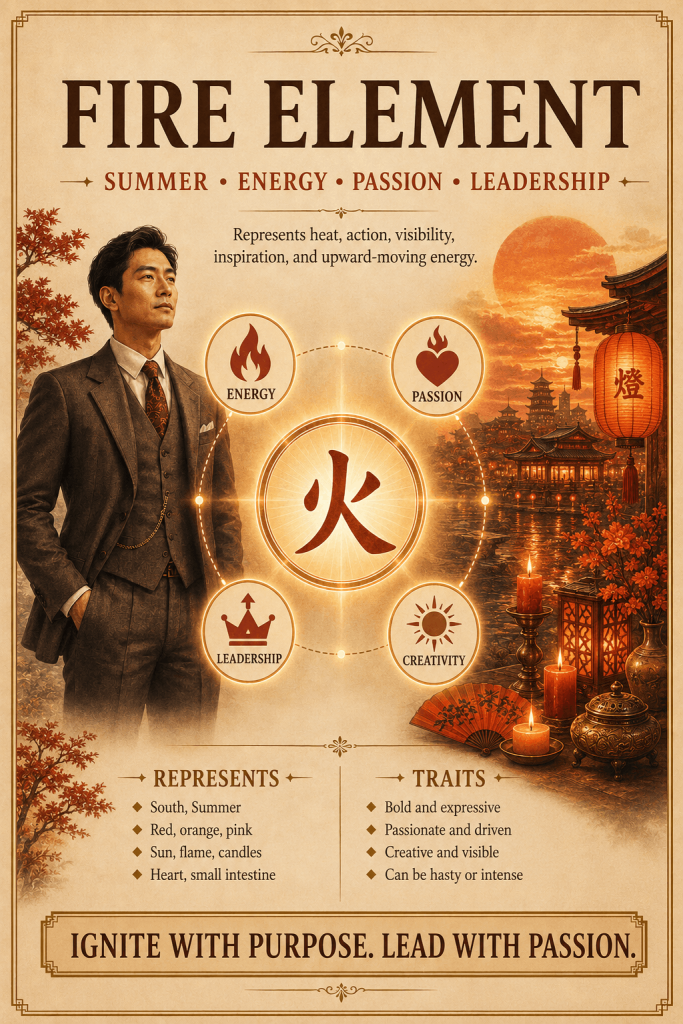
Fire represents summer, fire and heat.
Fire is directed upwards. Things that have a thermogenic property. On the positive side, Fire represents honor and justice; on the negative side, Fire symbolizes aggression and war.
Fire personality: This is a person who loves action and often takes leadership roles. They manipulate others and often get into trouble because they don’t like the rules and ignore the consequences. The positive side of this person is that he has a sense of humor and passion. On the contrary, they are easily hasty, take advantage of others, and do not care much about emotions. This will be the negative side of Fire people.
Representing the element Fire has four colors, respectively: red, orange, purple, and pink. In addition, there are images of the sun, candles and triangles, handicrafts, and pictures of the sun and fire. Fire represent heat; warmth; illumination; exuberance; beauty. Other representation are triangle shape, lighting, electrical appliances, burning candle and angular fonts.
Fire Meanings in Point form:
- Represents energy, enthusiasm, and passion.
- Associated with the south direction and summer season.
- Corresponds to the heart and small intestine organs.
- Refers to the color red.
- Enhances motivation, drive, and ambition.
- Fosters creativity, inspiration, and expression.
- Supports success, recognition, and achievement.
- Encourages self-expression and individuality.
- Promotes leadership and confidence.
- Supports personal growth and development.
- Helps to overcome shyness and insecurity.
- Enhances relationships, both personal and professional.
- Supports career advancement and business growth.
- Promotes communication and self-expression.
- Encourages exploration and adventure.
- Supports personal transformation and growth.
- Enhances enthusiasm, excitement, and passion in life.
- Helps to overcome boredom and apathy.
- Supports passion and creativity in personal and professional life.
- Encourages taking risks and pursuing personal and professional goals.
5. Earth Meaning & Definition
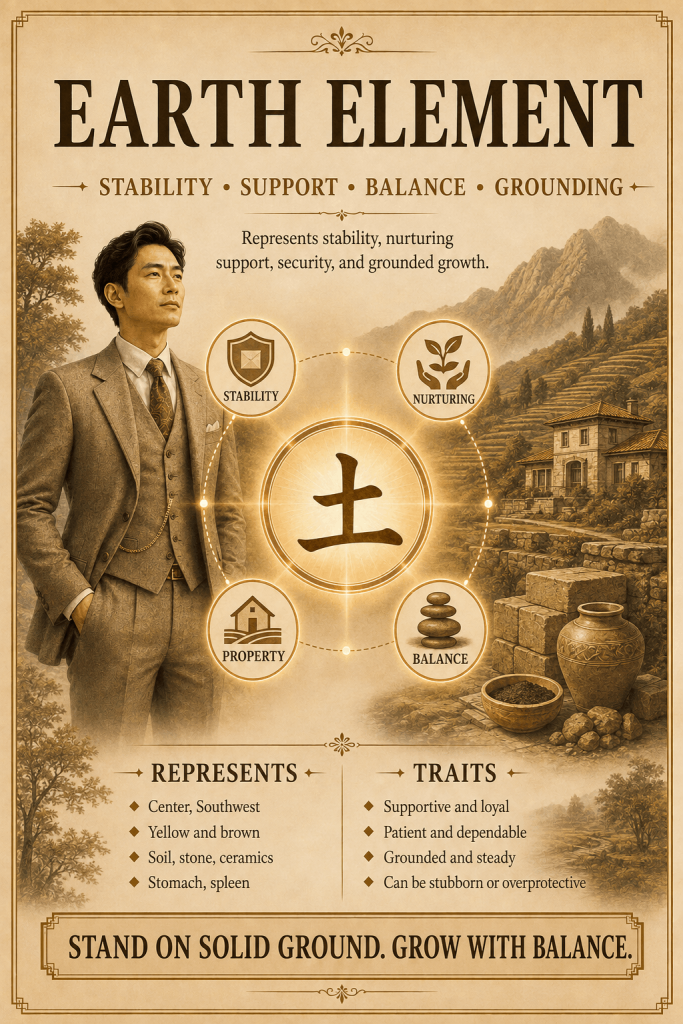
Earth is a biochemical thing that has the effect of transmitting and absorbing. It is only about the environment that nurtures, nurtures and develops, where all living things live. Earth nurtures, supports, and interacts with other planets. When positive, the Earth signifies fairness, wisdom, and instinct, while negative, the Earth creates suffocation or preoccupation with non-existent difficulties.
Earth can represent: steadfastness, solid, firm, dependability, nurturing, trustworthiness and reliable. Color representation are Khaki brown, yellow, brown. Other representation for earth are square, rectangle shape, porcelain objects, soil, square fonts.
Earth personality: This is a supportive and loyal person. They are also a strong support for the people around them because they are very persistent when helping others. also, by being patient and steadfast, they develop inner strength. The positive side is that they are very loyal, patient, and dependable. And the negative is that they will be prejudiced and have a tendency to “find the hair”.
Earth is represented by the colors brown and yellow. Besides, clay, brick, crockery, concrete, stone, and square also belong to this element.
Earth meaning in point form:
- Symbolizes stability, support, and balance.
- Associated with the center and southwest directions.
- Represents the late summer season and the color yellow.
- Corresponds to the stomach and spleen organs in the body.
- Provides grounding, stability, and security.
- Reflects a nurturing and supportive energy.
- Promotes stability and grounding in personal and professional life.
- Encourages growth and stability in relationships.
- Supports personal and financial security.
- Creates a harmonious and balanced environment.
- Enhances productivity and efficiency.
- Fosters stability in career and personal life.
- Supports emotional stability and mental clarity.
- Promotes overall well-being and health.
- Supports physical and mental grounding.
- Helps to overcome fear and anxiety.
- Encourages stability and structure in personal and professional life.
- Supports balance and harmony in relationships.
- Promotes stability and grounding in spiritual practice.
- Enhances personal growth and development.
The Five Element Relationships
What is a Producing relationship?
A Producing relationship is one in which this mutualistic process repeats endlessly.
The relationship begins with the water nourishing and growing the plants (Water produces Wood). Wood helps to create fire (Wood produces Fire) and fire burns to ashes and becomes earth (Fire produces Earth). Next is the metal that will be found in the soil when excavated (Earth produces Metal). Finally, during condensation, the metal will absorb water (Metal produces Water). However, the energy of the receiver will be increased while the energy of the giver will decrease.
In conclusion.
- Water produces Wood.
- Wood produces Fire.
- Fire produces Earth.
- Earth produces Metal.
- Metal produces Water.

What is a clashing relationship?
The relationship of incompatibility will be similar to the law of compatibility. The process of incompatibility is also cyclical, again and again.
The relationship begins with water putting out fire (Water clashes with Fire). The second is the fire that melts metal (Fire clashes with Metal) and metal cuts wood (Metal clashes with Wood). Next, the tree crosses the earth (Wood clashes with Earth). Finally, soil holds water in a dam or natural reservoir (Earth clashes with Water). Note that in this relationship, the receiver will lose a lot of energy.
In conclusion.
- Water clashes with Fire.
- Fire clashes with Metal.
- Metal clashes with Wood.
- Wood clashes with Earth.
- Earth clashes with Water.

It is very important to understand the relationship, or in other words, the interaction between factors. What factors are compatible and support each other? What factors are incompatible, even hindering each other’s development? This is the foundational knowledge for learners to apply to the Qi Men Dun Jia chart, thereby finding suitable solutions to develop their Five Elements in issues such as health, wealth, and health, finance, career, relationships, etc.
Many people believes that the 5 elements Feng Shui, when used correctly, will bring better wealth, health and harmony to themselves and the families. However, Feng Shui and 5 elements is 2 different subject all together and it can be pretty confusing as different school of Feng Shui, Bazi and Qi men Dun jia masters who learn different Chinese metaphysics could gets the basic concept wrong the in 5 elements.
Learn the 5 elements and become an expert in Chinese Metaphysics over here.
Related Resources on Chinese Metaphysics: To deepen your understanding of how the Five Elements connect with other Chinese metaphysics systems, explore our comprehensive Qi Men Dun Jia guide, learn about BaZi Reading and Analysis, discover Face Reading techniques, and explore our BaZi course and Zi Wei Dou Shu course.
{ “@context”: “https://schema.org”, “@type”: “FAQPage”, “mainEntity”: [ { “@type”: “Question”, “name”: “How do the Five Elements affect career choices?”, “acceptedAnswer”: { “@type”: “Answer”, “text”: “Each of the Five Elements (Wood, Fire, Earth, Metal, Water) resonates with specific industries, career types, and business activities. By understanding your dominant element, you can align your career with industries that naturally support your strengths and energy.” } }, { “@type”: “Question”, “name”: “What careers are best for each Feng Shui element?”, “acceptedAnswer”: { “@type”: “Answer”, “text”: “Wood suits education and consulting. Fire suits marketing and technology. Earth suits real estate and agriculture. Metal suits finance and engineering. Water suits communications and logistics. Each element has multiple compatible career paths.” } }, { “@type”: “Question”, “name”: “How do I know which Five Element I belong to?”, “acceptedAnswer”: { “@type”: “Answer”, “text”: “Your dominant element is determined through BaZi (Four Pillars of Destiny) analysis based on your birth date and time. A qualified practitioner can analyze your chart to identify your primary and secondary elements.” } }, { “@type”: “Question”, “name”: “Can the Five Elements help with business decisions?”, “acceptedAnswer”: { “@type”: “Answer”, “text”: “Yes, understanding the Five Elements can guide business partnerships, industry selection, and timing for important decisions. The productive and destructive cycles between elements help identify favorable combinations and potential conflicts.” } }, { “@type”: “Question”, “name”: “What is the difference between the productive and destructive cycles?”, “acceptedAnswer”: { “@type”: “Answer”, “text”: “The productive cycle shows how elements nourish and support each other (e.g., Water feeds Wood). The destructive cycle shows how elements control or weaken each other (e.g., Fire melts Metal). Both cycles are essential for understanding balance in Five Elements theory.” } } ] } { “@context”: “https://schema.org”, “@type”: “Article”, “headline”: “5 Elements Career, Jobs & Business in Feng Shui – Complete Guide”, “url”: “https://dougleschan.com/5-elements/5-elements-feng-shui-the-complete-guide/”, “author”: { “@type”: “Person”, “name”: “Dougles Chan”, “url”: “https://dougleschan.com” }, “publisher”: { “@type”: “Organization”, “name”: “Dougles Chan”, “logo”: { “@type”: “ImageObject”, “url”: “https://dougleschan.com/wp-content/uploads/2023/01/cropped-douglas-chan-logo.png” } }, “articleSection”: “Five Elements Career Guide”, “about”: [“Five Elements”, “Feng Shui”, “Chinese Metaphysics”, “Career Guidance”] } { “@context”: “https://schema.org”, “@type”: “BreadcrumbList”, “itemListElement”: [ { “@type”: “ListItem”, “position”: 1, “name”: “Home”, “item”: “https://dougleschan.com” }, { “@type”: “ListItem”, “position”: 2, “name”: “5 Elements”, “item”: “https://dougleschan.com/5-elements/” }, { “@type”: “ListItem”, “position”: 3, “name”: “5 Elements Career Guide”, “item”: “https://dougleschan.com/5-elements/5-elements-feng-shui-the-complete-guide/” } ] }Related: Wu Xing (5 Elements) in Bazi
For a deeper understanding of how the five elements interact in Bazi analysis, read our comprehensive guide on the components of Wu Xing (5 Elements) in Bazi. This guide breaks down Wood, Fire, Earth, Metal, and Water in the context of Chinese astrology and destiny reading.
Related Guides
Frequently Asked Questions
What are the five elements in feng shui?
The five elements in feng shui are Wood, Fire, Earth, Metal, and Water. Each element represents different energies, personality traits, career directions, and life aspects that interact through generating and controlling cycles.
How do the five elements affect my career?
Each element corresponds to specific industries and career paths. Wood relates to education and growth, Fire to technology and visibility, Earth to real estate and stability, Metal to finance and precision, and Water to communication and trade.
Can I use the five elements to improve my business?
Yes. Understanding your dominant element helps you choose the right industry, business partners, and timing for important decisions. The five elements framework is widely used in Chinese business metaphysics.
Related reading: five element personality.
The Origins of Wu Xing: What the Five Elements Actually Are
Before I understood the Five Elements, I understood them as a list: Wood, Fire, Earth, Metal, Water. Five words, five pictures in the mind, and if you had asked me to explain them I would have given you the version most people carry, which is that they are materials. Wood is wood. Fire is fire. That is the surface reading, and it is technically present, but it misses the entire architecture. Wu Xing is not a classification of materials. The word xing means movement, phase, process, and that word choice is the key to everything that follows.
The Five Elements are five phases of change. Each one describes a quality of energy in motion, a stage in a cycle, a way that qi behaves when it is doing a particular thing. Wood is the energy of expansion, sprouting, pushing outward, the force of spring. Fire is the energy of ascent, radiance, peak activity, the fullness of summer. Earth is the energy of stabilization, centring, the transitional pause where one phase hands off to the next. Metal is the energy of contraction, consolidation, gathering inward, the harvest logic of autumn. Water is the energy of descent, stillness, storage and potential, what winter does before spring remembers how to move. Learn the Five Elements as verbs, not nouns, and the entire system opens up.
Where the System Came From
The earliest coherent articulation of Wu Xing appears in texts from roughly two and a half millennia ago, though the underlying observations are older and likely predate writing. The Shangshu, the Book of Documents, contains a chapter called Hong Fan, the Great Plan, that lays out the Five Elements in their first systematic form and lists their associations: water moistens and descends, fire blazes and ascends, wood can be bent and straightened, metal can be moulded and cast, earth can be sown and reaped. Already in this earliest text the pattern is observable behaviour, not abstract category.
What makes the Wu Xing system genuinely powerful is that it was never a static list. It was immediately paired with a theory of relationships, the cycles, which I will cover in detail below. The elements do not sit in isolation. They talk to each other, feed each other, control each other, and the relationships are what let a practitioner read a situation or a chart. The five phases give you the vocabulary. The cycles give you the grammar.
Why Five and Not Four or Six
People sometimes ask why the Chinese system landed on five. The answer connects to observation of natural cycles and the yin-yang logic I have written about in the complete yin yang guide. The year has a natural five-phase rhythm if you watch what the land actually does: spring pushes forth, summer peaks, late summer holds and transitions, autumn pulls back, winter stores. Four seasons miss the transitional pause, the late-summer earth phase that stands between the peak of fire and the beginning of contraction. Six would split what is a unified process into artificial segments. Five is the minimum number that captures the full cycle without redundancy, which is why the same five-phase structure appears in the I Ching tradition, in Chinese medicine, in Feng Shui, and in the destiny arts like BaZi.
The Deeper Reading: Wu Xing as a Language of Relationship
What I tell my students is that Wu Xing is a language. You learn it so you can read the relationships between things, between a person and their environment, between a season and an organ, between a direction and a colour, between one phase of a life and the next. The five phases are the vocabulary. The cycles are the grammar. Everything else, the career advice, the Feng Shui cures, the health recommendations, the BaZi readings, is application built on top of that grammar.
The reason this matters for the rest of this guide is simple. If you memorize the associations without understanding the relational logic, you end up with a cookbook: put metal here, add water there, remove fire from that corner. It works sometimes, by accident. If you understand the logic, you can diagnose a situation you have never encountered before, because you understand why the system says what it says. That is the difference between following a recipe and being able to cook.
The Generating and Controlling Cycles: The Engine That Drives Wu Xing
Two cycles make the Five Elements a system instead of a list. If you only learn one thing from this entire guide, learn these two cycles, because every application of Wu Xing in Feng Shui, BaZi, medicine and date selection traces back to them.
The Generating Cycle (Sheng)
The generating cycle, also called the nourishing or creation cycle, describes the sequence in which each element feeds the next. Wood generates Fire, because wood is fuel for fire. Fire generates Earth, because fire reduces to ash, which is earth. Earth generates Metal, because metal is found in ore within the earth. Metal generates Water, through condensation on metal surfaces and the classical observation that metal elements are associated with the gathering of water. Water generates Wood, because water nourishes the growth of plants. The cycle is continuous and unidirectional, each phase handing energy to the next in a circle that never stops.
I want you to feel this cycle as a year. Spring’s expansion (Wood) feeds the full blaze of summer (Fire). Summer’s peak burns down to the soil’s richness (Earth). The soil concentrates into mineral and ore (Metal). The mineral-rich ground holds the water table (Water). The water table feeds the roots of next spring’s growth (Wood). When you can read the generating cycle as a seasonal loop, it stops being a diagram and becomes something you feel in the body. That is when Wu Xing starts to work for you intuitively.
In Feng Shui practice, the generating cycle tells you how to build up an element that is weak. If a room or a person needs more Wood, you can add Wood directly, or you can add Water, because Water generates Wood. If a chart needs more Fire, you can add Fire directly, or add Wood, because Wood feeds Fire. The generating cycle is the supportive, nourishing path, the one you use to build and strengthen.
The Controlling Cycle (Ke)
The controlling cycle, also called the destructive or overcoming cycle, describes how each element restrains another. Wood controls Earth, because roots break and deplete soil. Earth controls Water, because earth absorbs and contains water, think of a dam holding back a river. Water controls Fire, because water extinguishes fire. Fire controls Metal, because fire melts metal. Metal controls Wood, because metal tools cut and shape wood.
The controlling cycle is not evil or bad. It is necessary. Without control, the generating cycle would run unchecked, each phase producing the next without limit, which means exhaustion. The controlling cycle is the brake system. It keeps the generative process balanced. A good practitioner uses both cycles together: generate where support is needed, control where excess must be contained.
In practice, if a room has too much Fire energy, you can add Water to control it directly, or you can add Earth, because Fire generates Earth and thereby drains its excess. This is the reducing approach, and it is often gentler than direct control. Add Water to fight Fire is a blunt instrument. Add Earth to drain Fire is a subtler one. Both are valid. The choice depends on what else is happening in the space and in the chart.
The Overacting and Insulting Cycles: When the System Breaks
Classical theory adds two pathological cycles for cases where the normal relationships go wrong, and any serious practitioner needs to know them. The overacting cycle occurs when a controlling element is too strong and damages the element it controls beyond healthy restraint. Wood overacts on Earth: instead of roots gently aerating soil, they strip it bare. Fire overacts on Metal: instead of refining, it destroys. The insulting cycle is the reverse, when the controlled element rebels and attacks its destroyer. Earth insults Wood, Water insults Earth, and so on. The insulting cycle is a sign of severe imbalance, the body or the space or the chart has lost its normal hierarchy, and recovery requires restoring the relationships, adding or removing alone cannot fix an element.
Reading the Cycles in Practice
Here is how I use these cycles in a Feng Shui consultation. I look at a space and identify what elements are present, which are strong, which are weak or absent. Then I ask two questions. First, is anything generating too much of something else? If Wood is overwhelming and Fire is out of control, the generating cycle is feeding a fire that does not need feeding, and I need to introduce Metal to control Wood or Earth to absorb Fire. Second, is anything being excessively controlled? If Water is dominating and Fire is nearly extinguished, the controlling cycle has gone too far, and I need to add Wood to generate Fire, or add Fire directly to rebuild it.
This is the diagnostic engine. Element present, element strong or weak, cycle that connects them, and then the remedy. It sounds simple, and the logic is simple. The complexity comes from reading real spaces and real charts, where elements do not announce themselves cleanly. A red wall is obviously Fire, but is a set of bookshelves Wood, or are they merely wooden in appearance? Is a mirror Water, because of its reflective quality, or Metal, because of its material? These judgement calls are where the practitioner’s training shows, and they are why no automated tool can fully replace a human reading. The tool can list the associations. The practitioner reads the room. For the deeper work on how these cycles interact with personal destiny, the BaZi guide shows how the same five phases map onto a birth chart’s strengths and weaknesses.
Five Elements in Space: Directions, Colours, Shapes and Seasons
Every element carries a set of correspondences that let you translate qualitative energy into practical design decisions. This is the layer of Wu Xing that makes it immediately useful for Feng Shui, because each element maps to a direction, a colour family, a set of shapes, a season, and a cluster of materials. Once you know these correspondences, you can look at any room and read its elemental balance in a few minutes.
The Correspondence Table
Let me lay out the full set. Wood corresponds to the East and Southeast, the colour green, tall columnar shapes, the season of spring, and living plants, wooden furniture, and paper products. Fire corresponds to the South, the colour red and its family of oranges and purples, triangular and pointed shapes, the season of summer, and lighting, candles, electronics, and anything that produces heat or light. Earth corresponds to the Centre, the Southwest and Northeast, the colours yellow, brown, and earth tones, square and flat shapes, the transitional late-summer season, and ceramics, stone, brick, and crystal. Metal corresponds to the West and Northwest, the colours white, gold, silver, and metallic tones, round and spherical shapes, the season of autumn, and metal objects, mirrors, coins, and wind chimes. Water corresponds to the North, the colours black and deep blue, wavy and flowing shapes, the season of winter, and water features, glass, mirrors, and anything transparent or flowing.
How to Use the Correspondences
The practical method is simple. Identify the dominant element in a space by looking at its direction, its colours, its shapes, and its materials. Then check whether that dominant element is in a healthy relationship with the area’s natal element, the element that the compass direction naturally carries. If the Southeast is loaded with red candles, metal sculptures, and a white colour scheme, then Fire and Metal are dominating a direction that should be Wood, and both are in controlling or draining relationships with the native element. The correction is to add Wood: green plants, wooden furniture, columnar shapes, and natural light.
The correspondence system also lets you do something useful in BaZi-driven Feng Shui, which is personalizing a space to the occupant’s chart. If a person’s chart is weak in Fire, then their workspace benefits from Fire correspondences: warm lighting, red accents, a south-facing desk if possible, and objects with pointed or triangular form. If a chart is strong in Metal and needs Wood to balance, then the workspace gets plants, green tones, and an east-facing orientation. I cover the full personalization logic in the complete Feng Shui guide, but the Five Elements correspondence table is the translation layer between a person’s chart and their physical environment.
The Seasonal Aspect and Why It Matters for Timing
Each element is at full strength during its corresponding season. Wood peaks in spring. Fire peaks in summer. Metal peaks in autumn. Water peaks in winter. Earth peaks in the transitional periods between seasons, which is why late summer is the Earth season and why every seasonal transition has an Earth component. This seasonal cycle matters for date selection, for Feng Shui activation timing, and for understanding when a person’s weak or strong element is getting natural support from the environment.
If someone’s chart is weak in Water and we are choosing when to launch a venture or make an important move, winter is when Water is naturally strongest, and a winter activation will have more elemental backing. If someone needs Fire and we are scheduling a consultation or a home activation, summer and late summer are the supportive windows. This is the layer where Wu Xing meets the calendar, and for the full system behind those timing decisions, the Tong Shu almanac guide covers how the traditional calendar organizes elemental time.
Five Elements in Health: The Body as a Wu Xing System
Chinese medicine and Wu Xing theory grew from the same root, and the connection between the Five Elements and the human body is one of the oldest and most practical applications of the system. Each element governs a pair of organs, a sense, a tissue type, an emotion, and a set of health tendencies. Understanding this mapping lets you see your health through a relational lens rather than an isolated-list-of-symptoms lens, and I have found it genuinely useful for understanding patterns that conventional medicine treats one at a time.
The Organ Associations
Wood governs the liver and the gallbladder. The liver is responsible for the smooth flow of qi throughout the body, and when Wood energy is congested, whether from stress, frustration, or environmental factors, the first signs are often tension, irritability, and digestive sluggishness. The Wood sense is sight, and the Wood tissue is the tendons and ligaments. Chronic eye strain or tendon issues often signal a Wood element that needs attention.
Fire governs the heart and the small intestine. The heart houses the spirit, the shen, and Fire imbalance shows up as sleep disturbance, anxiety, and palpitations. The Fire sense is the tongue, and the Fire tissue is the blood vessels. Someone with a Fire pattern that is out of balance will often have speech that runs too fast or too slow, colour that rises to the face easily, and a pulse that reveals the excess in its rhythm.
Earth governs the spleen and the stomach, the digestive system in its energetic sense. Earth imbalance appears as worry, fatigue after eating, and a tendency to overthink. The Earth sense is taste, and the Earth tissue is the flesh and muscles. A person whose Earth is weak will often crave sweet foods, feel heavy in the body, and have trouble converting what they eat into energy.
Metal governs the lungs and the large intestine. Metal imbalance shows up as respiratory issues, skin problems, and grief that does not resolve. The Metal sense is smell, and the Metal tissue is the skin. The lungs and skin are both surfaces where the body meets the outside world, which is why they sit together under Metal’s governance of the boundary between inner and outer.
Water governs the kidneys and the bladder. The kidneys are the storage of vital essence, jing, and Water imbalance appears as fear, exhaustion that sleep does not fix, and issues with the lower back, bones, and teeth. The Water sense is hearing, and the Water tissue is the bones. Deep, chronic fatigue that sits in the lower back and the bones is the signature of a Water element that is depleted.
Reading the Emotional Layer
The same organs that govern physical functions also govern emotional patterns, and this is where the Five Elements become a genuinely useful diagnostic tool for understanding yourself. Wood’s emotion is anger, which in its healthy form is the energy of assertiveness and boundary-setting. Fire’s emotion is joy, which healthy is enthusiasm and warmth, and unhealthy is mania or inability to settle. Earth’s emotion is worry and pensiveness, healthy as contemplation and care, unhealthy as rumination and stuckness. Metal’s emotion is grief, healthy as the capacity to let go, unhealthy as chronic sadness that cannot release. Water’s emotion is fear, healthy as caution and respect for danger, unhealthy as anxiety and paralysis.
The cycle tells you how one emotion feeds or depletes another. If you sit in chronic anger, Wood overacts on Earth, and your digestion suffers. If grief is prolonged, Metal overacts on Wood, and you lose the energy of forward movement. If fear is chronic, Water insults Fire, and the heart’s joy is suppressed. This is why emotional patterns and physical symptoms often travel together in patterns that the Five Elements system can read, where a symptom list would see random coincidence.
The Practical Application
I use this layer in three ways. First, for self-knowledge: understanding my own elemental tendencies helps me recognize why certain stresses hit me the way they do and what I can adjust. Second, for timing: knowing the seasonal and elemental cycles of the body tells me when to push and when to rest, when to detox and when to build. Third, as context for working alongside medical professionals. Five Elements theory is not a substitute for clinical medicine. It is an additional framework for understanding patterns and rhythms, and at its best it makes you a more informed participant in your own health decisions. For the deeper work on how personal elemental balance is read from a birth chart, the BaZi guide carries the full system, and for the calendar of when elemental energies shift through the year, the Five Arts overview situates Wu Xing within the broader classical curriculum.
Five Elements and Personal Destiny: Reading Your Chart
One of the most common questions I get is: which element am I? The answer is more nuanced than the popular framing suggests. In the BaZi system, your day master, the heavenly stem of your day pillar, is your primary element, but your full chart contains all five elements in varying proportions. You are never one element. You are a composition, and the relationships between the elements in your chart are what a practitioner actually reads. For the complete system behind this, the BaZi guide covers how the four pillars are constructed and read, while here I want to focus on what the Five Elements layer means for your life patterns.
The Day Master: Your Core Element
Your day master is the element of the heavenly stem on the day you were born. If you were born on a Wood day, your core element is Wood, and the way Wood manifests in your chart, strong or weak, supported or challenged, tells the story of your temperament and tendencies. A strong Wood day master tends to show the positive qualities of Wood at their best: forward momentum, growth orientation, the capacity to push through obstacles, a direct and assertive communication style. A weak Wood day master shows Wood under strain: frustration, feeling blocked, a sense of potential that cannot find its outlet.
What makes the BaZi approach different from popular personality typing is that the chart is relational. Your Wood day master does not exist in isolation. It exists in relationship with the other elements present, and those relationships change across time as the luck pillars cycle through. You might have a strong Wood chart with plenty of Water to feed it, which means your assertiveness has backing and flow. You might have a strong Wood chart with heavy Metal, which means your assertiveness is under constant pressure from authority, criticism, or structure, and your life involves learning how to work within constraints rather than pushing through them. Same element, different life.
Strong and Weak: What Those Words Actually Mean
Strong and weak in BaZi do not mean good and bad. A strong chart means your day master element is well supported by the other elements in the chart, through generating elements that feed it or through the presence of many of your own element. A weak chart means your day master lacks support, because the generating element is absent or the controlling element is dominant. Both configurations can produce excellent lives or difficult ones, depending on the luck pillars and the choices made. What matters is the strategy each configuration calls for.
A strong chart generally benefits from elements that drain or control the day master, because the excess energy needs an outlet. If your Wood is strong, Fire and Metal are your useful elements: Fire to channel Wood’s energy into productive output, Metal to give it structure and discipline. A weak chart generally benefits from elements that generate or reinforce the day master. If your Wood is weak, Water and Wood are your useful elements: Water to nourish, additional Wood to reinforce. This is the practical formula, and it translates directly into Feng Shui recommendations, career choices, health practices, and timing decisions.
The Luck Pillars: Elements Across Time
Your birth chart is the terrain. The luck pillars are the weather. Every ten years, the dominant elemental energy shifts, bringing a new decade element that interacts with your chart in its own way. A strong Wood chart entering a Water decade gets more fuel, which can mean either expanded capacity or overflow, depending on the chart’s overall balance. The same chart entering a Metal decade faces control and constraint, which can mean either productive discipline orsuppression, depending on the chart’s resilience.
This is why the same person can have a difficult decade followed by an effortless one, without changing anything fundamental about who they are. The chart is the same. The elemental environment changes. Understanding your chart and your current luck pillar lets you work with the energy rather than against it, which is the entire practical value of the system. For the operational layer of choosing when to act within that flow, the Qi Men Dun Jia system provides the strategic timing instrument.
Five Elements in the Home: Room by Room
Let me get practical. The Five Elements apply to spaces in a way you can use immediately, and the most accessible entry point is the room-by-room approach. Each room in a home has a primary function, and each function aligns with an element, which gives you a framework for what that room should emphasize and what it should avoid.
The Kitchen: Fire and Water in Tension
The kitchen is the most elementally complex room in any home, because it pits Fire and Water against each other. The stove is pure Fire. The sink is Water. The refrigerator is Metal and Water. If the stove and sink are directly opposite or immediately adjacent, the controlling cycle (Water controls Fire) is physically enacted in the room, and the classical recommendation is to create separation: a metal surface between them, an earth element to bridge, or physical spacing. The kitchen also needs Wood, because Wood generates Fire and keeps the cooking energy nourished, so a small plant or wooden cutting boards serve a practical function beyond decoration.
The Bedroom: Water and Wood for Rest
The bedroom’s function is rest, recovery, and intimacy, and the element that governs those is Water, the phase of stillness, storage, and descent. A bedroom benefits from quiet, yin, Water and Earth energies: soft lighting, muted colours, heavy stable furniture, and a minimum of Fire (bright lights, red colours, electronics) and minimal Metal (mirrors, sharp angular furniture) that can make the space feel sharp when it should feel soft. The headboard should be solid and preferably wooden, which connects to Wood’s generating relationship with Water: the trees protect the water table. Keep work and exercise out of the bedroom if possible, because those activities bring Fire and Metal energy into a space that should be Water.
The Living Room: Earth for Gathering
The living room is the gathering space, and Earth governs gathering, centring, and the family unit. Earth energy in the living room means comfortable, stable seating, earth tones, ceramic and stone elements, and a layout that encourages people to sit and talk rather than face a screen. A square or rectangular coffee table (Earth shapes), a central rug that defines the space, and warm, grounded colours all support the room’s function. Avoid too much Metal, which can make the space feel cold and transactional, and avoid excessive Water features, which can dispersing the centring energy.
The Home Office: Wood for Growth, Metal for Focus
The home office needs a balance of Wood and Metal. Wood provides the growth energy: the push of new ideas, the expansion of projects, the drive to build. Metal provides the focus: the capacity to cut away distractions, to refine, to produce finished work. A room that is all Wood feels expansive but undisciplined. A room that is all Metal feels efficient but lifeless. The productive combination is Wooden furniture and shelving (growth) with Metal accents and organizational tools (focus). Natural light from the east or southeast supports Wood, and a clean desk surface in a light colour supports Metal. For a deeper treatment of each room in the home, the complete Feng Shui guide covers the full spatial system.
The Entrance: Metal for Welcome and Clarity
The entrance sets the tone for the entire home, and it benefits from Metal energy: clarity, welcome, the quality of a clean threshold. A clear, uncluttered entrance with good lighting, a mirror (Metal), and perhaps a metal bell or wind chime creates the elemental signature of a space that receives well. Avoid excessive Water near the entrance (shoes piled up, dampness, dark corners) because Water’s descending energy works against the welcoming, ascending quality you want at the threshold. The entrance is also where the protective function of Metal is most useful, the classical use of metal objects at doorways to cut negative energy before it enters the home.
Five Elements in Relationships and Compatibility
The generating and controlling cycles apply to people as well as spaces. When two people’s charts interact, their day master elements are in a cycle relationship, and that relationship is one factor among several in how the connection plays out. I want to be clear: element compatibility is one layer of a multi-layered reading, never the whole story. But it is a useful layer, and it is the one most people can grasp quickly.
Generating Relationships: The Nourishing Connection
If person A’s day master generates person B’s, the dynamic is one of nourishment and support. A Wood person with a Fire partner generates Fire, which means the Wood person naturally feeds the Fire person’s energy, provides fuel, supports their expression. This can be a warm, generous dynamic, with the generating partner feeling fulfilled by the act of supporting and the receiving partner feeling nourished. The risk is exhaustion: if the generating relationship runs only one way, the generating partner can deplete over time. The healthy version is mutual, where both partners contribute through other elements in their charts.
Controlling Relationships: The Structured Tension
If person A’s day master controls person B’s, the dynamic involves structure and authority. An Earth person with a Water partner controls Water, which can manifest as the Earth partner providing containment, boundaries, and stability for the Water partner’s flowing, sometimes scattered energy. This can be productive: the controlling partner provides form, the controlled partner provides substance. It can also be stifling, if the control runs too strong, and the controlled partner feels managed rather than supported. The key in controlling relationships is conscious balance, making the structure explicit and agreed upon rather than implicit and resented.
Same Element Relationships: The Mirror
Two people with the same day master element share a fundamental temperament, and the connection is usually easy and immediate because they speak the same elemental language. Two Fire people understand each other’s intensity. Two Metal people respect each other’s standards. The risk in same-element relationships is that strengths and weaknesses are amplified rather than balanced: two Wood people both push, and neither wants to yield; two Water people both go deep, and neither wants to surface. The successful same-element relationships I have seen involve a conscious division of roles, where one partner handles the areas the element is naturally good at and the other brings complementary energy from other elements in their chart.
Beyond the Day Master: Full Chart Compatibility
I want to caution against reading element compatibility from the day master alone. Two people whose day masters are in a controlling relationship may have excellent compatibility because other elements in their charts generate each other beautifully. Two people whose day masters generate each other may struggle because their charts contain clashes in other pillars. The day master relationship is the opening line of the reading, not the conclusion. For the full system, the zodiac compatibility guide shows how the twelve animal signs interact, and the BaZi guide covers how the complete chart structure determines relationship dynamics at a deeper level.
What It Means for You in Practice
When I consult with people about relationships, the element layer tells me where the friction is likely to come from and where the natural support is. If I see a controlling relationship between day masters, I am not predicting failure. I am flagging the area where conscious work is needed, the place where the structure needs to be made explicit and consensual. If I see a generating relationship, I am flagging the risk of depletion, the place where the generous partner needs to make sure their own reserves are being maintained. The Five Elements do not decide whether a relationship succeeds. They tell you which kind of work the relationship requires.
Five Elements in Career and Business: Finding Your Element’s Working Style
The career section earlier in this guide gives the practical recommendations: which industries suit which elements, which jobs align with which phases. Here I want to go deeper into the working style each element produces, because the same element can manifest as a brilliant solo operator or a terrible team member depending on how the energy is channelled. The element tells you the style of work, the environment where it thrives, and the kind of role that lets it reach its full expression.
Wood: The Builder and the Pioneer
Wood is the energy of growth, expansion and pushing through. A Wood-dominant person in their career tends to be the one who starts things: new projects, new departments, new ventures, new approaches. They are at their best in environments that reward initiative and in roles that involve building from scratch, developing ideas, or pioneering into uncharted territory. Industries aligned with Wood include education, publishing, agriculture, environmental work, textiles, furniture, and anything involving growth or cultivation.
The shadow side of Wood in career is impatience and overextension. A Wood-dominant person can start ten projects and finish two, because the energy that makes them a great starter also makes them restless once the initial growth phase is over. The solution is not to suppress the Wood energy but to build structure around it: partnerships with Metal people who provide the discipline to finish, or organizational systems that create milestones and deadlines. The Wood person who learns to channel their growth energy into sustained projects rather than constant new starts builds something lasting.
Fire: The Communicator and the Performer
Fire is the energy of visibility, warmth, and peak expression. A Fire-dominant person thrives in roles that involve communication, performance, visibility and connection. They are natural presenters, marketers, motivational speakers, and front-facing leaders. Industries aligned with Fire include entertainment, media, advertising, hospitality, lighting, energy, and anything that involves being seen or inspiring others.
The shadow of Fire in career is burnout and scattering. Fire energy is intense and cannot sustain at peak indefinitely. A Fire-dominant person who tries to operate at full blaze all the time will exhaust themselves and produce work that is flashy but shallow. The management of Fire energy is the management of intensity: cycles of visibility and recovery, periods of performance followed by periods of privacy. A Fire person who builds in recovery time, and does not treat rest as failure, sustains a career that a constant-burn Fire person cannot.
Earth: The Stabilizer and the Supporter
Earth is the energy of patience, reliability and nourishment. An Earth-dominant person is the backbone of any organization: steady, dependable, the one who holds things together when the more volatile elements are flying in every direction. They are at their best in roles involving management, support, real estate, architecture, human resources, food, ceramics, and anything involving foundation, structure or care.
The shadow of Earth is stagnation and excessive worry. An Earth-dominant person can become so stable that they stop moving, so responsible that they cannot delegate, so caretaking that they exhaust themselves. The cure for excess Earth is Wood: growth, movement, new challenges, the push of expansion to break up the settling. An Earth person who deliberately takes on new learning, new environments, or new challenges every year prevents the stability from becoming a trap.
Metal: The Refiner and the Standard-Setter
Metal is the energy of precision, structure and quality. A Metal-dominant person is the one who sets the standards, who cuts away what does not meet them, who refines rough material into finished product. They are at their best in roles involving finance, engineering, law, jewellery, manufacturing, mechanical work, computing, and anything demanding precision, quality control or structural integrity.
The shadow of Metal in career is rigidity and excessive criticism. A Metal-dominant person can hold others to standards that are correct but unlivable, and their refinement instinct can become a cutting instinct that damages morale and relationships. The cure for excess Metal is Fire: warmth, spontaneity, the willingness to celebrate before everything is perfect. A Metal person who builds in moments of generous, unrefined appreciation prevents the standard-setting instinct from becoming a wall between themselves and their team.
Water: The Strategist and the Deep Thinker
Water is the energy of depth, stillness, storage and potential. A Water-dominant person is the strategist, the one who sees the long game, who stores information and resources, who understands flows and currents. They are at their best in roles involving research, strategy, logistics, shipping, communication, travel, psychology, healing, and anything requiring deep analysis or the management of flows.
The shadow of Water is passivity and isolation. A Water-dominant person can go so deep that they lose contact with the surface, can strategize so thoroughly that they never act, can store so much that they never spend. The cure for excess Water is Fire: action, visibility, the willingness to move before every detail is clear. A Water person who builds in accountability structures, deadlines that force action, and regular social contact prevents the deep-thinking gift from becoming a withdrawal pattern.
Putting It Together: The Element-Balanced Team
The most effective teams I have built or consulted on contained a balance of all five elements. The Wood starter, the Fire communicator, the Earth stabilizer, the Metal refiner, the Water strategist. When all five are present and in productive relationship, the team has the capacity to start, communicate, sustain, refine, and strategize, which is the complete cycle of organizational health. When one element is missing, the team’s performance has a blind spot. No Wood means no new ideas. No Fire means no energy. No Earth means no follow-through. No Metal means low quality. No Water means poor timing. It maps precisely onto the generating cycle’s logic, because it is the generating cycle’s logic, applied to human talent rather than to abstract energy. For more on how this applies to strategic timing and planning, the Qi Men Dun Jia system operates on the same elemental foundation, and the Five Arts overview situates this career framework within the broader metaphysics curriculum.
The Five Elements in Daily Practice: Habits, Diet and Personal Alignment
The Five Elements system is not only for charts, consultations and career planning. It has a daily practice layer that anyone can apply immediately, and it is the layer that gives the system its staying power. The general principle is simple: support your weak elements, moderate your excessive elements, and follow the seasonal and daily rhythms that naturally support each phase.
Diet by Element
Food carries elemental energy, and the classical dietary recommendations align each element with specific foods and flavours. Wood corresponds to sour flavours and green foods: leafy greens, sprouts, citrus, anything with the upward-growing energy of spring. Fire corresponds to bitter flavours and red foods: bitter greens, roasted foods, anything with the warming, ascending energy of summer. Earth corresponds to sweet flavours and yellow-gold foods: grains, root vegetables, legumes, the nourishing, stabilizing foods of late summer. Metal corresponds to pungent and spicy flavours and white foods: garlic, onions, white radish, pears, the refining, descending foods of autumn. Water corresponds to salty flavours and dark foods: seaweed, black beans, dark berries, anything with the deep, storing, descending energy of winter.
The practical approach is not to eat only your useful elements’ foods. It is to ensure your useful elements are adequately represented and to moderate the elements that are excessive. A person whose chart is weak in Fire should include warming foods, cooked rather than raw, and bitter greens alongside their regular diet. A person whose chart has excessive Fire should moderate the heavy spicy and roasted foods and include more Water-element foods for balance. The system is a dietary lens, not a restrictive regimen, and it works best as a gentle adjustment to what you already eat.
Exercise and Movement by Element
The elements also map onto types of movement, and matching your exercise to your elemental needs is a surprisingly effective practice. Wood corresponds to stretching, yoga, and expansive movement: the body reaching outward, the tendons lengthening. Fire corresponds to cardiovascular exercise, high-intensity intervals, and expressive movement: the heart rate rising, the energy ascending. Earth corresponds to walking, hiking, and grounding movement: the body in contact with the earth, the pace steady. Metal corresponds to strength training, precision sports, and structured movement: the body being refined, cut, shaped. Water corresponds to swimming, flowing movement, and internal practices like qigong or tai chi: the body moving with the water’s quality of yielding depth.
A person weak in Wood benefits from morning stretching and growth-oriented movement. A person with excessive Fire benefits from calmer, grounding practices that do not add more intensity. A person weak in Water benefits from swimming or tai chi. The mapping is not rigid, but it gives you a framework for choosing activities that support your balance rather than depleting it further. For more on the health system’s foundations, this page’s earlier section on Five Elements in Health covers the organ associations in detail.
Living With the Seasons
The most powerful daily practice is the simplest: live with the seasons. Spring is the Wood season, and it is the time for new beginnings, forward momentum, and the energy of pushing forth. Summer is the Fire season, and it is the time for visibility, connection, and the expression of what spring started. Late summer is the Earth season, and it is the time for consolidation, digestion, and the processing of what the year has produced. Autumn is the Metal season, and it is the time for refinement, letting go, and the harvesting of what is valuable. Winter is the Water season, and it is the time for rest, storage, and the gathering of strength for the next cycle.
The discipline of living with the seasons means adjusting your rhythm, your diet, your activity, and your focus as the elemental energy shifts. Start projects in spring. Express and celebrate in summer. Consolidate and process in late summer. Refine and complete in autumn. Rest and plan in winter. It sounds obvious, and it is, but almost nobody does it, because the modern calendar ignores the seasonal cycle entirely. The Five Elements system gives you a framework for reclaiming that cycle, and the Tong Shu almanac guide provides the calendar instrument for tracking it through the year.
Five Elements in Wealth and Prosperity: How Each Element Attracts, Holds and Loses Money
I have spent enough years in business to know that wealth is not one skill. Making money, keeping money and growing money are three different disciplines, and they call on different strengths. When I started reading the Five Elements through a financial lens, I found that the system maps onto these disciplines with surprising precision. Each element has a natural relationship with money, and most financial struggles I see in consulting come from working against your element rather than with it.
I want to be clear: no element is destined to be rich or poor. What differs is the channel through which prosperity flows most easily, the way money tends to leave if you are not careful, and the habits that protect what you have built. If you know your dominant element from a BaZi chart, the sections below give you a practical financial map.
Wood: Wealth Through Growth
Wood energy is expansive. People with strong Wood make money through growth: growing a business, growing a team, growing an investment portfolio. The archetype is the farmer who plants seeds and waits. Wood-dominant people are usually most prosperous when they reinvest profits rather than sitting on them, because money that is not growing feels dead to the Wood temperament.
The danger is overextension. Wood reaches upward and outward, and a Wood person who is not careful will fund too many projects, back too many people, or expand into territory they cannot sustain. I have seen Wood-strong entrepreneurs build brilliant businesses and then lose the gains by funding a second venture before the first is stable. The remedy is structure. If you carry dominant Wood, your wealth needs rails. Set hard caps on reinvestment, keep a cash reserve that you treat as untouchable, and let someone with strong Metal energy review your expansion plans. Metal cuts Wood, and a healthy Metal influence will trim the dead branches.
Fire: Wealth Through Visibility
Fire makes money through attention, reputation and speed. The Fire-dominant person thrives where others see them: on stages, in marketing, in public-facing roles, in time-sensitive deals that reward quick decisions. Fire generates wealth by being seen and being fast, which is why so many successful performers, marketers and negotiators carry strong Fire in their charts.
The risk is burn rate. Fire burns fuel, and a Fire person who is not tracking expenses will spend what they earn. The temperament tends to live in the present; saving for a future that does not exist yet feels abstract. I advise Fire-dominant clients to automate their savings before the money reaches their hands. Direct allocations into investment accounts, automatic transfers on payday, and a rule about never carrying the full balance in a spending account. The money should be moved before the Fire temperament can spend it, because willpower alone rarely works for long with Fire energy. Fire also needs a cooling channel. A partnership with someone strong in Water helps balance the tendency to act on impulse.
Earth: Wealth Through Accumulation
Earth is the accumulator. Earth-dominant people build wealth through patience, consistency and compounding. They are the ones who buy a property and hold it for twenty years, who invest steadily through good markets and bad, and who rarely make spectacular gains but almost never make catastrophic losses. If you carry strong Earth, your financial strength is your ability to hold. You do not need to chase returns; you need to avoid interruptions to the compounding process.
The challenge is opportunity cost. Earth can hold too tightly. I have seen Earth-dominant people keep money in low-yield accounts for years because moving it felt risky, or hold properties long past the point where selling and reinvesting would have been smarter. The remedy is education. The more an Earth person understands about their investments, the more confident they feel making changes. A relationship with someone strong in Wood helps, because Wood pushes Earth to grow. Without that push, Earth can sit still and let inflation erode what patience built.
Metal: Wealth Through Precision
Metal people make money through systems, analysis and discipline. The Metal temperament excels at budgeting, at identifying waste, and at cutting what does not serve the bottom line. Metal-dominant individuals tend to be excellent savers and careful investors, and they are the most likely to have a clear financial plan with defined targets.
The vulnerability is rigidity. Metal can cut too deeply, and a Metal person who is not careful will underinvest in relationships, marketing and personal development because the return is hard to measure. I have watched Metal-strong business owners run lean operations so aggressively that their best people leave for better-resourced competitors. The remedy is warmth. If you carry dominant Metal, build a budget line for things that feel wasteful but are actually investments in people and visibility. A Fire influence in your team or advisory circle will help you see the value in spending that does not have an immediate, measurable return.
Water: Wealth Through Flow
Water makes money through networks, information and timing. Water-dominant people are the ones who always seem to hear about an opportunity before everyone else, who connect the right people and take a share of the value created, and who profit from understanding trends and currents before they become obvious. Water is the most financially unpredictable element, capable of large gains and large losses in the same year.
The risk is leakage. Water flows through cracks, and a Water person who is not tracking where money goes will find it draining away in small amounts they barely notice. Subscriptions, informal loans to friends, impulse purchases during travel. The remedy is structure without rigidity. Water cannot tolerate a tight budget the way Metal can, but it responds well to flexible systems: percentage-based allocation rather than fixed amounts, and visible tracking dashboards that satisfy the Water need for information without the Metal need for control. A partnership with Earth energy helps, because Earth gives Water a container, and water in a container is power.
Element Combinations in Joint Finances
In marriages and business partnerships, element combination matters financially. The most common problem I see is a Fire personality managing joint finances without a Metal or Earth partner providing discipline, or a Metal personality cutting so tightly that the Fire partner feels suffocated and eventually rebels with a large purchase. The solution is always the same: divide responsibilities by element. Let the element best suited to each task handle it. Wood grows the income, Fire drives the marketing and outward-facing revenue, Earth manages the core holdings, Metal handles the budget and quality control, and Water manages the network and information flow. When one person tries to do all five, they struggle; when each contributes their strength, the financial machine runs smoothly.
The Five Elements in Nature and Landscape: Reading the Land
The Five Elements were not invented in a study. They were observed in the world. The ancients who formalised Wu Xing were reading nature first, and everything else, the medicine, the feng shui, the destiny work, came later. I want to bring the system back to its origin for a moment, because when you learn to read the landscape through the Five Elements, the abstract theory falls into place.
Every landscape is a conversation between the five energies. Mountains are Earth. Rivers and streams are Water. Forests and vegetation are Wood. The sun, the dry winds and the summer heat are Fire. Rock faces, ore deposits and exposed stone are Metal. When you stand in any natural environment and ask which element is dominant and which is missing, you are doing Wu Xing in its original form.
Reading a Landscape for Dominant Element
In my consulting work I visit properties and sites, and the first thing I do is read the land before I look at any building. A site with heavy tree coverage, tall timber and lush undergrowth is Wood-dominant. This kind of environment supports growth, new projects and creative work, but it can feel scattered if the Wood energy is unchecked. A site with strong water features, lakes, rivers or proximity to the sea is Water-dominant. It supports deep thinking, networking and long-term strategy, but it can feel cold and isolating for someone who needs warmth.
A site on high ground with exposed rock, cliffs or mountain ridges is Metal-dominant. It supports precision, discipline and focus, but it can be harsh and unforgiving for people whose temperament needs more warmth and nurture. A flat, open agricultural plain with rich soil is Earth-dominant. It supports stability, patience and accumulation, but without water and wood nearby it can feel stagnant. A south-facing site with strong sun exposure, dry climate and wide open skies is Fire-dominant. It supports visibility, enthusiasm and fast action, but it can be draining for people who need quiet and depth.
The Productive Combination: What Makes a Site Prosperous
The classical feng shui ideal is a site where the elements are present and in correct relationship, not a site that is purely one element. A mountain (Earth) with a river (Water) flowing past it, with trees (Wood) on the lower slopes, sun (Fire) reaching the south face, and rock (Metal) forming the foundation, is a complete landscape. Every element feeds the next in the generating cycle: Metal generates Water, Water generates Wood, Wood generates Fire, Fire generates Earth, Earth generates Metal. This is why the most prosperous settlements in history were built where mountains meet rivers with forests and good sun. The geography itself was running the generating cycle.
You can read this in any city. The cities that thrived for centuries were positioned where the elements naturally cycled: a defensible high point (Metal/Earth), a water source (Water), arable land (Wood/Earth) and enough warmth and light (Fire). Cities built on a single element with no generating cycle often struggle. A desert city with only Fire needs imported Water and Wood to survive. A mountain fortress with only Metal and Earth is defensible but rarely prosperous.
Correcting Element Imbalance in a Landscape
If your home or workspace sits in a landscape that is missing an element, you can add it. A flat, treeless site (Earth-dominant, no Wood) benefits from planting, which introduces the Wood energy and starts the generating cycle moving. A rocky, barren site (Metal-dominant) benefits from a water feature or pond, because Water softens Metal and begins to generate Wood. A site that is too wet and cold (Water-dominant) benefits from lighting, warm colours and south-facing openings to introduce Fire. The principle is always the same: identify what is missing, add the element that feeds the next one in the cycle, and let the natural relationship do the work.
I once visited a property that puzzled its owner. The house was well-designed, on a good road, with a solid structure. But every business venture started from that home stalled. Reading the landscape: the site was tucked into a narrow valley with dense tree coverage on all sides and a cold stream running through. Wood and Water were overwhelming, Fire was almost absent. The house never received direct sunlight after midday. The remedy was practical: we cleared a section of trees on the south side to let afternoon light reach the house, added warm-toned paint to the south-facing rooms, and installed a fire pit visible from the main workspace. Within two months the owner described a visible change in energy and motivation. The Fire element, physically restored to the landscape, did what Fire does: it warmed everything up.
The Five Elements and the Five Landforms
The classical texts describe five landform types that correspond to the five elements, and I use these when assessing larger sites. A pointed, sharp, pyramid-shaped hill is Fire energy. A round, dome-shaped hill is Metal. A flat-topped plateau is Earth. A irregularly shaped ridge with multiple peaks and valleys is Water. A tall, column-like peak with a broad base is Wood. When these landforms are present in the correct generating cycle around a site, the classical texts rate the location as highly auspicious.
You can see this tested in the great imperial cities of China. The ideal was always a site with a round mountain behind (Metal, providing support), a winding river in front (Water, providing flow and wealth), flat agricultural land to the sides (Earth, providing stability), a pointed peak in the distance (Fire, providing visibility and inspiration), and a tall mountain beyond (Wood, providing growth). The arrangement maps perfectly onto the generating cycle: Metal feeds Water, Water feeds Wood, Wood feeds Fire, Fire feeds Earth. The geography itself was seen as a Wu Xing chart written in stone and water.
When Elements Clash: Understanding Imbalances and Their Real-World Remedies
The generating cycle gets most of the attention in introductory Wu Xing teaching because it is positive and encouraging. The controlling cycle gets less attention because it sounds harsh. But in practice, the controlling cycle is where most of the useful work happens, because most of the problems people bring to me are imbalances. They have too much of one element or not enough of another, and the system is out of balance. Restoring balance means understanding both the generating and the controlling cycles, and knowing how to apply them.
The Four Pathologies Types of Imbalance
Classical Wu Xing medicine identifies four distinct types of imbalance, and I find these useful far beyond health. They describe what happens when a relationship between elements goes wrong.
First, when the controlling element is too strong, it suppresses the element it controls beyond what is healthy. Metal controls Wood, and excessive Metal will cut Wood down to nothing. In a person, this looks like a perfectionist (Metal) who has killed all their creative drive (Wood). In a business, it looks like a compliance department (Metal) so aggressive that innovation (Wood) cannot breathe. The remedy is to strengthen the element between them in the generating cycle. Water generates Wood, so strengthen Water when Metal is over-controlling Wood.
Second, when the controlled element is too strong, it rebels against its controller. Wood normally responds to Metal, but if Wood is overwhelming, it overruns Metal. In a person, this looks like creativity and enthusiasm (Wood) so unchecked that discipline and quality (Metal) collapse. In a business, it looks like a marketing team that launches campaign after campaign without any quality control. The remedy is Fire: Fire drains Wood back into the cycle, redirecting the excess energy productively rather than trying to suppress it further with more Metal.
Third, when the generating element is too strong, it floods the element it feeds. Earth generates Metal, but excessive Earth will bury Metal rather than nourish it. This looks like a parent or mentor who gives so much support that the receiver becomes dependent and never develops their own strength. The remedy is to introduce the element that controls the over-giver. Wood controls Earth, so strengthen Wood to limit the Earth flooding.
Fourth, when the element that should receive is too weak, the generating cycle stalls. Water generates Wood, but if Wood is exhausted, Water pools up. This looks like someone providing resources, energy or money to a project or person that has no capacity to use them. The remedy is to strengthen the weak receiving element directly so it can accept the nourishment.
Diagnosing Your Own Imbalance
My BaZi analysis will show you which elements are strong and weak in your chart. But you can also read your current imbalance from your symptoms. Too much Wood: scattered energy, too many projects started and not finished, stretched commitments. Too much Fire: anxiety, insomnia, irritability, spending impulse purchases, talking faster than thinking. Too much Earth: sluggishness, resistance to change, attachment to comfort, weight gain and procrastination. Too much Metal: harshness, cutting people off, perfectionism that blocks completion, rigidity in plans that no longer serve. Too much Water: excessive daydreaming, avoidance of action, information gathering without decision, feeling cold and socially withdrawn.
The same diagnosis applies to organisations. A company stuck in committee meetings has too much Earth. A company constantly firing and rehiring has too much Metal. A company that launches products without testing has too much Fire. A company with beautiful strategy documents and no execution has too much Water. The remedy is always the same: identify the excess, find the element that absorbs it in the generating cycle, and strengthen that element.
Practical Remedies for Each Excess
For excess Wood: introduce Metal. Set deadlines, create structure, finish one project before starting the next. Decluttering, cutting back commitments, and saying no are all Metal activities. Alternatively, let Fire drain the Wood by channelling the creative energy into visible output: publish, perform, speak, ship the product.
For excess Fire: introduce Water. Slow down, sleep more, spend time near water, meditate, reduce stimulants. Read instead of watching. Listen instead of talking. Put the phone in another room. Water cools Fire by returning depth and stillness to a system that has been running hot.
For excess Earth: introduce Wood. Start something new. Break routine. Travel, exercise, take a class, plant a garden. Wood breaks up compacted Earth by introducing growth and movement. The hardest thing for an Earth-excess person to do is start, and that is exactly the medicine.
For excess Metal: introduce Fire. Warm the environment, spend time with people, laugh, create without judging the quality, brighten the colours around you, allow imperfection. Fire melts Metal by returning warmth and joy to a system that has become too precise and cold.
For excess Water: introduce Earth. Create structure, establish routines, make a schedule, set boundaries. Earth gives Water shape. Without Earth, Water spreads thin. With Earth, it becomes a river that powers something.
The Principle Behind Every Remedy
Every remedy in the Five Elements follows one principle: restore the cycle. You never simply remove an excess. You redirect it through the generating cycle so the excess energy feeds something productive. Wood feeds Fire, so excess Wood is resolved by channelling it into Fire expression. Earth feeds Metal, so excess Earth is resolved by channelling it into Metal refinement. The system is always moving, and the cure is always to restart the movement, not to apply force against the current. This is the deepest wisdom of Wu Xing, and it applies to health, to business, to relationships and to any living system.
Advanced Wu Xing: The Deeper Cycles and Their Practical Applications
Most people who study the Five Elements learn the generating cycle and the controlling cycle and stop there. Those two cycles are enough to get started, but the classical system contains more. There are deeper relationships that surface when elements are under stress, and these advanced patterns explain why obvious remedies sometimes fail and why the same problem can need different solutions at different times.
The Insulting Cycle (Wu)
The insulting cycle, sometimes called the reverse controlling cycle, is the rebellion that happens when a weak element is pushed beyond its limits by the element it should be controlling. In the normal controlling cycle, Metal controls Wood. But if Wood becomes so powerful that it turns back on Metal, Wood insults Metal. In health, this looks like a liver (Wood) disorder damaging the lungs (Metal). In life, it looks like a subordinate (the controlled element) who suddenly overturns the authority above them, because the authority was too weak to contain them any longer.
I see this in business partnerships. A founder (Metal, the controlling element) becomes exhausted or loses focus, and the operations team (Wood, the element being controlled) gradually takes over every decision. The handover is not the problem. The problem is when the Wood energy, now unchecked, starts dismantling the systems and standards (Metal) that the business was built on. The insulting cycle explains why the takeover feels destructive rather than generative: the element is actively attacking the structure that once held it.
The remedy for an insulting pattern is always the same: strengthen the element that should be doing the controlling, and redirect the rebellious element into the generating cycle so its excess energy flows somewhere productive. If Wood is insulting Metal, strengthen Metal (restore standards, recommit to discipline) and simultaneously let Fire drain the excess Wood by channelling it into visible output and creative expression. You fix the rebellion from both ends: restore the authority and give the rebel a productive channel.
The Mother-Child Imbalance
The generating cycle is called the mother-child cycle for a reason. Metal is the mother of Water (Metal generates Water). When the mother is exhausted, the child goes hungry. When the child is over-demanding, the mother is drained. This relationship has two pathologies and I see both in consulting work.
The exhausted mother: Earth generates Metal, but if Earth is depleted (poor digestion, chronic fatigue, lack of grounding), Metal cannot be properly nourished. The remedy is not to supplement Metal directly but to restore the mother, Earth. This means rebuilding the foundation rather than addressing the surface symptom. In a business context: if your quality control (Metal) is failing, do not hire more inspectors. Ask what is wrong with the foundation (Earth): are people burned out, is the culture unstable, is there a stability problem underneath the quality problem? Fix the mother and the child recovers.
The over-demanding child: Water is the child of Metal, but if Water becomes excessive (too many projects, too many directions, too much expansion), it drains Metal faster than Metal can regenerate. The remedy is to reduce the drain, not to increase the supply. Stop taking on new commitments, let the existing ones mature, and let Metal (the mother) recover. This is the hardest instruction for ambitious people to follow, because it means saying no to growth for a season. But the Wu Xing logic is clear: an over-demanding child will kill the mother if you try to feed the demand rather than reduce it.
Seasonal Timing for Element Remedies
The Five Elements are not static. They move through the seasons, and the effectiveness of a remedy depends partly on timing. Spring is Wood season. Summer is Fire season. Late summer (the transition period between seasons) is Earth season. Autumn is Metal season. Winter is Water season. In the season of your dominant element, that element is at its strongest. In the season of its controller, it is at its weakest.
For practical purposes, this means the best time to strengthen a weak element is in its own season, when nature is already supporting it. If your Wood is weak, spring is the time to start new projects, take classes, and make growth-oriented moves. If your Metal is weak, autumn is the time to restructure, cut waste, and install new disciplines. The remedy lands more easily because the season is working with you rather than against you.
Conversely, the season of your controlling element is the hardest time of year. If Wood is your dominant element, autumn (Metal season) is when you feel the most pressure, the most criticism, and the most cuts. Plan for it. Do not schedule major launches, important negotiations or exposed public events in the season that controls you. Save that season for internal work, planning and consolidation. This is not superstition. It is the same principle that governs farming: you do not plant in winter and you do not harvest in spring. The timing matters because the energy is different.
Element Layering in Complex Readings
In practice, a person is never a single element. A BaZi chart contains all five elements in different strengths, and the dominant element is only the top note. A full reading looks at the layering: which element is strongest, which is second, which is weakest, and how the relationships between them play out. The interplay between the top two elements often tells you more than either one alone.
For example, a person with strong Wood (first) and strong Fire (second) is a creative force who ships output, because Wood feeds Fire and Fire makes the output visible. The same Wood strength with Metal second creates internal tension, because Metal controls Wood, and the person alternates between creative explosion and rigid perfectionism. Knowing this, the person can arrange their life to accommodate both: creative sprints followed by quality control passes, rather than trying to create and edit simultaneously, which is like pressing the accelerator and the brake at the same time.
This is the level where Wu Xing stops being a personality test and becomes a diagnostic instrument. The elements are describing actual energetic dynamics, and the remedies are genuine interventions designed to restore a system that is stuck. For a human body, a marriage, a team or a business, the Five Elements give you a language for what is happening and a toolkit for changing it. That is why the system has survived for two thousand years. Not because it is mystical, but because it is practical, and because it works.
When Remedies Fail: The Missing Dimension
I want to close with the most common reason element remedies fail, because it is the one I see most in practice. The remedy is correct, but it is applied in the wrong context. You strengthen Water to balance excess Fire, but the Fire was actually a reaction to a deeper Earth weakness that you ignored. The symptom improves briefly and then returns, because the root cause is still there. This is why I always read the full chart before recommending remedies, and why self-prescribing from a Five Elements quiz can create more problems than it solves. The elements are interdependent, and changing one changes all five. The art is not in knowing which element to boost. It is in understanding the system well enough to know what else will move when you touch it.
If there is one thing I want you to take from this section, it is this: the Five Elements are a system of relationships, not a set of boxes. You do not have a Wood personality or a Fire personality. You have a unique pattern of five energies in dynamic relationship, and that pattern shifts with time, season and life circumstance. The system describes the movement, and the remedies are designed to restore healthy movement, not to impose a static balance. When you understand it this way, Wu Xing is not a category scheme. It is a living map of how energy moves through everything, including you.
Five Elements in Education and Learning: How Each Element Absorbs Knowledge
Education is not one process. It looks different depending on who is learning and how they learn, and the Five Elements give me a useful framework for understanding this. I have taught enough students over the years to see that the same teaching method that transforms one person will leave another completely cold, and the difference is often elemental. When you know your dominant element, you can choose learning environments, study methods and teaching styles that actually work for your temperament instead of fighting against it.
Wood: Learning Through Doing
Wood-dominant people learn by building. They cannot absorb a concept by hearing it described; they need to construct something with it, test it, watch it grow or fail. The Wood learner is the one who skips the instructions and starts assembling the furniture, who opens the software and clicks around rather than reading the manual, who starts the business before finishing the course.
If you carry strong Wood, your best learning happens through projects, experiments and real-world application. Reading theory feels like watching someone else garden. You need your hands in the soil. I tell Wood-dominant students: do not try to learn the whole system before you begin. Learn enough to start, then learn the next piece when you hit the wall. Your understanding will grow organically, like a tree, branching outward as it reaches for light. The danger is that Wood learners start many things and finish few. Pair yourself with a Metal study partner who insists on completion and quality.
Fire: Learning Through Inspiration
Fire-dominant people learn through enthusiasm. A lecture that ignites their interest will be absorbed instantly and retained for years. A subject presented without energy will be forgotten before the class ends. Fire learners need to feel excited about what they are studying, and their retention tracks their passion, not their effort.
If you carry strong Fire, your best learning happens with dynamic teachers, interactive environments and subjects that have visible, exciting outcomes. You will learn more from a one-hour conversation with a passionate practitioner than from a month of textbook reading. I recommend Fire-dominant students seek mentors, attend workshops and immerse themselves in the culture of what they are learning rather than trying to grind through self-study. The danger is inconsistency. When the initial spark fades, Fire learners lose interest. The remedy is variety: rotate subjects, teachers and environments to keep the flame alive, and accept that your learning will be broad and passionate rather than narrow and systematic.
Earth: Learning Through Repetition and Trust
Earth-dominant people learn through steady repetition within a trusted environment. They are the most reliable students, the ones who do every exercise, attend every session and build knowledge layer by layer. Earth learners do not leap to conclusions. They need to sit with new information, let it settle, compare it to what they already know, and integrate it into a stable framework before they trust it.
If you carry strong Earth, your best learning happens in structured programs with clear curricula, regular meetings and a teacher you trust. You may feel slow compared to Fire learners who grasp concepts instantly, but your understanding will be deeper because you build from the ground up. I advise Earth-dominant students to avoid the trap of endlessly reviewing without ever progressing. Set a schedule and stick to it: one module per week, one exercise per day. Trust the process and keep moving, even when you do not feel fully confident. Confidence comes from accumulation, and Earth energy is the master of accumulation.
Metal: Learning Through Structure and Precision
Metal-dominant people learn through systems. They want the framework before the details, the principle before the example. A Metal learner will study the grammar of a language before trying to speak it, the theory of music before picking up an instrument, the architecture of a system before writing a line of code. They learn top-down, and they need to understand the structure before the content makes sense.
If you carry strong Metal, your best learning happens through well-organised curricula, clear textbooks and teachers who explain the why before the how. You will excel at anything that rewards precision and systematic thinking. The danger is analysis paralysis. Metal learners can spend months studying the theory without ever practicing the skill. I tell Metal-dominant students: set a hard deadline for study, after which you must produce output. Quality matters, but output matters more. A Metal learner who never acts on their knowledge is like a sword that is never drawn, sharp but useless.
Water: Learning Through Immersion and Reflection
Water-dominant people learn through deep immersion and quiet reflection. They are the students who sit in the back of the class, say little and understand everything. Water learners absorb information osmotically, picking up patterns and connections that others miss. They need time alone with the material, not to study it actively but to let it percolate through their mind until understanding emerges.
If you carry strong Water, your best learning happens in self-directed environments with access to deep resources and minimal structure. You will learn more from reading ten books on a subject than from attending ten lectures. I advise Water-dominant students to honour their need for solitude and depth. Do not try to compete with Fire learners in fast-paced classroom discussions. Let them talk; you will understand the subject more deeply by the end. The danger is isolation. Water learners can disappear into their own minds and lose connection with the practical world. Schedule regular intersections with other people to share what you have learned. Water that never reaches the sea becomes a swamp.
Teaching With the Five Elements
If you teach, coach or mentor, the Five Elements help you adapt your method to your student. A Wood student needs assignments and projects. A Fire student needs inspiration and visible outcomes. An Earth student needs structure and repetition. A Metal student needs the theoretical framework first. A Water student needs time and autonomy. When you teach one way to all five, you lose three of them. When you adjust your method to the element, your reach expands dramatically. This is not a personality test. It is a pedagogical framework grounded in a system that has been observing human temperaments for millennia.
Five Elements in Creative Work: Writing, Art and Expression
Every creative act is a meeting of element and medium. The element you carry shapes the art you make and the way you make it. I have watched enough creative people in my career to see the pattern clearly: Wood creators grow their work, Fire creators perform it, Earth creators build it, Metal creators refine it and Water creators dream it. Understanding your creative element does not limit your art. It gives you the channel through which your creative energy flows most freely.
Wood: The Growers
Wood creativity is generative and organic. Wood-dominant creators produce volume. They start projects, grow ideas, draft freely and iterate. The Wood writer fills notebooks, the Wood painter covers canvases, the Wood musician writes songs in batches. The creative energy of Wood is upward and outward, always pushing toward more growth and more output.
The challenge for Wood creators is finishing. Every project generates three new ideas, and the temptation to pursue them all means that many works are started and never completed. I advise Wood-dominant creators to establish a completion ritual: a deadline, a publication date, a performance. Without external pressure to finish, Wood will keep growing forever. The second challenge is editing. Wood grows, but Metal prunes. A Wood creator who cannot edit their own work needs a Metal editor who can. The collaboration between Wood generation and Metal refinement produces the highest quality output. Jack Kirby drawing (Wood) and Stan Lee scripting (Metal) is an example from popular culture. One explodes with ideas, the other shapes them into form.
Fire: The Performers
Fire creativity is performative and immediate. Fire-dominant creators thrive on audience energy. They are the live performers, the charismatic speakers, the artists whose work is inseparable from the act of presentation. Fire creators are at their best when the energy is high and the feedback is instant.
The risk for Fire creators is that the work depends on the flame. When the Fire is burning, the output is brilliant. When it cools, there is nothing. This makes Fire creativity inconsistent, with peaks and valleys. I advise Fire-dominant creators to capture the fire while it burns: record the performance, write down the idea while excited, make the prototype while the energy is hot. Do not assume you will feel the same way tomorrow. The second challenge is depth. Fire moves fast on the surface. Fire creators who want lasting work need to develop Water, the capacity for depth and patience. A Fire performer who also studies deeply, reads widely and reflects quietly will produce work that lasts beyond the performance moment.
Earth: The Builders
Earth creativity is constructed and architectural. Earth-dominant creators build things that last. They are the craftspeople, the world-builders, the novelists who construct entire universes with consistent rules and deep foundations. Earth creativity is patient, structural and built to endure.
The strength of Earth creators is solidity. Their work is substantial, grounded and complete. The challenge is pace. Earth creators can spend years on a single project, building and rebuilding the foundation, refining the structure, adding another layer. I advise Earth-dominant creators to set shipping dates and honour them. Your work will always feel unfinished because Earth can always add another stone to the wall. At some point, the building must open its doors. The second challenge is surprise. Earth creativity is strong but predictable. Introduce Wood (new ideas, unexpected elements) to break your own patterns and surprise your audience.
Metal: The Refiners
Metal creativity is precise and polished. Metal-dominant creators are the perfectionists, the minimalists, the artisans who reduce their work to its essential form. Metal creativity is about cutting away everything that is not necessary, and what remains is pure and sharp.
The strength of Metal creators is quality. Every piece is crafted, every detail deliberate. The challenge is production rate. Metal creators produce slowly because every piece must meet their standards. I advise Metal-dominant creators to develop a fast-draft practice: produce work quickly without judging it, then refine in a separate pass. Separating generation from refinement lets Metal work at two speeds instead of one. The second challenge is warmth. Metal art can be cold, precise and technically perfect but emotionally distant. Introduce Fire: add passion, vulnerability, and personal story. A Metal creator who can be both precise and warm produces work that is both beautiful and moving.
Water: The Dreamers
Water creativity is deep, intuitive and transformative. Water-dominant creators work from the unconscious. They are the surrealists, the visionaries, the artists whose work seems to emerge from another dimension. Water creativity does not follow a plan. It follows a current.
The strength of Water creators is depth and originality. Their work accesses places that other creators cannot reach, because Water goes where other elements cannot go. The challenge is form. Water without structure floods. A Water creator who never imposes form will produce vast amounts of amorphous material that never coheres into a finished piece. I advise Water-dominant creators to use Earth as a container: set a format, a length, a deadline. The container does not restrict the water. It gives it shape. A river needs banks to be a river. The second challenge is visibility. Water creators tend to work in private and share reluctantly. Introduce Fire: perform, publish, show. Creative work that is never shared is like water that never reaches the sea. It evaporates.
Element Collaboration in Creative Teams
The most productive creative teams contain multiple elements. Wood generates the ideas. Fire sells them. Earth builds the infrastructure. Metal ensures quality. Water provides the deep insight that the others miss. When one element dominates a creative team, the work becomes one-dimensional. A team of all Wood will start everything and finish nothing. A team of all Metal will perfect one thing forever. The magic happens when elements complement each other, each contributing their strength and compensating for the others’ limitations. I have built creative teams this way for years, and the Five Elements framework is the most reliable tool I have for predicting who will work well together and who will clash.
Finding Your Creative Element
If you do not know your BaZi chart yet, you can identify your creative element by asking a simple question: what part of the creative process do you enjoy most? If you love starting new projects, you are Wood. If you love presenting the finished work, you are Fire. If you love building the structure piece by piece, you are Earth. If you love refining and polishing, you are Metal. If you love the ideation and dreaming phase, you are Water. There is no best element for creativity. There is only the element that is yours, and the art that emerges when you stop fighting your nature and start working with it.
Five Elements in Parenting: Raising Children According to Their Dominant Element
Parenting is the most demanding application of Wu Xing I know. Every child carries a different elemental pattern, and the parenting approach that helps one child thrive will actively harm another. I do not mean this metaphorically. I have seen parents who raised one child beautifully and completely mishandled the second, using exactly the same methods, because the two children needed different things. The Five Elements help you see what your child actually needs rather than what you assume they need based on your own temperament.
I want to be honest about the limits here. You cannot reliably identify a child’s dominant element from a quick observation. A proper BaZi chart casting based on birth data gives you the elemental profile. But you can make a working hypothesis from behaviour, and refine it as the child grows.
Raising a Wood Child
Wood children are constantly growing, reaching and testing boundaries. They are the ones who climb everything, start projects and abandon them, argue about rules and push back against limits. A Wood child needs space to grow and room to experiment, but also needs firm, flexible boundaries. The mistake most parents make with Wood children is either crushing their growth with excessive rules (too much Metal) or giving them no structure at all (no Earth to anchor the roots).
With a Wood child, give them projects rather than commands. Instead of saying clean your room, say I need you to organise your bookshelf by this afternoon. Give them a growing thing to tend: a plant, a pet, a garden plot. Channel the growth energy into construction rather than destruction. The Wood child who has nothing to build will tear something down just to see how it works. Enrol them in activities that reward progression: martial arts, music lessons with graded levels, gardening, building kits. The key is growth with structure, not restriction.
Raising a Fire Child
Fire children are bright, loud and emotionally intense. They light up a room and burn through patience. They are the performers, the social butterflies, the ones who feel everything at maximum volume and express it at maximum volume. The mistake with Fire children is either dampening their flame with criticism (too much Water) or feeding it with excessive stimulation (too much Wood) until they become overwhelmed and erratic.
With a Fire child, give them an audience. Let them perform, show off, and be seen. Praise their efforts publicly and correct them privately, because public criticism wounds Fire children deeply. Channel their energy into performance activities: drama, dance, debate, competitive sports. The Fire child needs movement, social interaction and visible achievement. A Fire child forced to sit quietly at a desk for hours is not learning discipline; they are learning to suppress their nature, and the suppressed fire will eventually erupt. Give them breaks, movement and expression, and they will learn better in shorter, more intense bursts.
Raising an Earth Child
Earth children are steady, nurturing and home-oriented. They are the ones who want everything to stay the same, who bond deeply with routines and rituals, and who struggle with transitions. The mistake with Earth children is pushing them too hard (too much Wood disruption) or overprotecting them (too much Earth stagnation).
With an Earth child, honour their need for stability. Maintain consistent routines, give them warning before transitions, and let them keep their familiar objects and spaces. Earth children thrive with predictable schedules, regular meals at the same table, and a home base that feels safe. The challenge is growth. Earth children will resist new experiences, new foods, new people and new activities. Do not force them, but do not let them stagnate. Introduce new things gently, one at a time, with a familiar anchor. A new school is easier if they bring their favourite lunchbox. A new activity is easier if a friend joins. Earth needs patience, not pressure, but it also needs occasional, gentle disruption to grow.
Raising a Metal Child
Metal children are precise, particular and sensitive to order. They notice when something is out of place, they want to know the rules, and they become distressed when standards are not met. The mistake with Metal children is dismissing their sensitivity as fussiness (too much Fire mockery) or using their compliance as an excuse to demand more (too much Earth burden).
With a Metal child, respect their standards. If they want their books arranged by colour, let them. If they are upset because the picture is crooked, straighten it. Their sensitivity to order is not a flaw; it is a gift that will serve them throughout life. The challenge is flexibility. Metal children can become rigid and anxious when things do not go according to plan. Teach them that mistakes are part of learning and that the world will not end when the rules bend. Give them activities that reward precision: music, chess, mathematics, calligraphy. But also give them activities where the outcome is unpredictable and the goal is joy rather than correctness: playing in mud, painting without a plan, roughhousing. Metal needs warmth and imperfection to stay flexible, just as metal needs heat to bend.
Raising a Water Child
Water children are deep, quiet and observant. They are the ones who watch before joining, who speak rarely but say something memorable when they do, and who seem to understand things they have never been told. The mistake with Water children is either flooding them with social demands (too much Fire stimulation) or misreading their quietness as disconnection and isolating them further.
With a Water child, give them time and privacy. They need solitude to process, and they need to be allowed to watch before they participate. Do not push them to be more social, louder or more visible. The Water child’s depth is their strength. Provide them with books, access to nature, and quiet spaces. The challenge is connection. Water children can drift into isolation, especially during difficult periods. Check in regularly, not to demand participation but to maintain the channel. A Water child who knows the door is open will come through it when they are ready. Give them activities that reward depth: reading, research, strategic games, swimming, art. Water needs flow and depth, not surface and speed.
Five Elements in Conflict Resolution: Resolving Disputes by Element
Most conflicts I mediate, whether in families or businesses, come down to an elemental clash that neither side understands. Two people are fighting not because they are wrong for each other but because their elemental patterns push against each other in a predictable way. When you can name the pattern, the conflict loses its charge. It stops being personal and becomes structural, and structural problems have structural solutions.
Wood vs Metal: The Grower and the Cutter
The most common conflict pairing I see is Wood against Metal. Wood wants to grow, expand, try new things and break through barriers. Metal wants to cut, refine, impose standards and maintain quality. When a Wood person and a Metal person work together, the Wood person feels like the Metal person is always saying no, and the Metal person feels like the Wood person is always making messes.
The solution is Fire. Fire is the element between Wood and Metal in the generating cycle, and it transforms the conflict into a productive channel. Wood feeds Fire, and Fire melts Metal. In practice, this means the Wood person needs to produce visible output (Fire) that the Metal person can then refine, rather than bringing raw ideas to the Metal person for judgement. Give Wood the space to create, and give Metal the finished product to polish. They should not be in the same room during the creative phase. The Wood person creates, the Fire phase produces a visible result, and the Metal person improves what exists.
Fire vs Water: The Performer and the Deep Thinker
Fire and Water clash because they operate at different speeds and depths. Fire wants action, visibility and speed. Water wants reflection, patience and depth. A Fire person feels like the Water person is always stalling, and the Water person feels like the Fire person is always rushing.
The solution is Wood. Water generates Wood, and Wood generates Fire. In practice, this means giving the Water person time to reflect, and then converting their insights into a plan (Wood) that the Fire person can execute. The Water person thinks, the Wood phase organises the thinking into a strategy, and the Fire person acts on the strategy. When they try to interact directly, they frustrate each other. When the Wood phase sits between them, the pipeline works.
Earth vs Wood: The Holder and the Grower
Earth and Wood clash because Wood grows through Earth and disrupts its stability. An Earth person values what already exists, while a Wood person wants to change, grow and build something new. The Earth person feels like the Wood person is always uprooting things, and the Wood person feels like the Earth person is always holding them back.
The solution is Metal. Earth generates Metal, and Metal controls Wood. In practice, this means the Earth person needs to set the standards and boundaries (Metal) that the Wood person operates within. Rather than trying to stop the Wood person from growing, the Earth person should define the edges of the garden. Within those boundaries, the Wood person can grow freely. The Metal boundary gives Earth the stability it needs and gives Wood the structure it needs. Without Metal, it becomes a fight between roots and concrete.
Metal vs Fire: The Refiner and the Performer
Metal and Fire clash because Fire melts Metal. The Metal person wants precision, quality and control. The Fire person wants expression, speed and impact. The Metal person feels like the Fire person is sloppy and careless, and the Fire person feels like the Metal person is cold and critical.
The solution is Earth. Fire generates Earth, and Earth generates Metal. In practice, this means giving the Fire person space to create and express, while the Earth phase captures the output and holds it for the Metal person to refine. The Fire person performs, the Earth person records and organises, and the Metal person polishes. This is the production pipeline for all performance industries: the performer (Fire), the producer (Earth) and the editor (Metal). When they work in sequence rather than simultaneously, each element’s strength contributes to the final product.
Water vs Earth: The Dreamer and the Builder
Water and Earth clash because Earth controls Water. The Earth person wants structure, stability and clear boundaries. The Water person wants flow, flexibility and openness. The Earth person builds a dam, and the Water person either finds a way around it or builds up pressure until it bursts.
The solution is Fire. Water generates Wood, and Wood generates Fire, but the direct bridge is through Metal: Earth generates Metal, and Metal generates Water. In practice, this means the Earth person needs to create structured containers (Metal) that allow controlled flow rather than trying to block the Water person entirely. Instead of saying no, set parameters: here is the budget, here is the timeline, here is the scope. Within these parameters, flow freely. Earth provides the riverbed; Water gets to be the river. When Earth tries to be a wall instead of a riverbed, the Water builds up pressure behind it and eventually overflows. When Earth provides a channel with clear banks, the Water energy flows productively and powerfully.
The Universal Principle in Element Conflicts
Every elemental conflict has the same structure: two elements that either control each other or skip steps in the generating cycle. The solution is always the same: find the element that bridges them in the generating cycle and strengthen it as an intermediary. The intermediary element transforms the energy of one into a form the other can accept. This works because the Five Elements are a cycle, not a battle. When any two elements clash, the cycle has broken, and the remedy is to restore the cycle by inserting the missing step. Whether the conflict is in a marriage, a team or an internal struggle between your own competing tendencies, the pattern holds. Restore the cycle, and the friction resolves.
The Five Elements in Travel and Environment: How Different Places Feed Different Elements
I travel for work, and over the years I have noticed that certain places energise me and others drain me. When I started reading this through the Five Elements, the pattern became clear. Every environment carries a dominant elemental energy, and when your environment matches your weak elements and challenges your dominant one in a healthy way, you feel alive. When your environment amplifies your dominant element further, you feel overwhelmed or exhausted. Understanding this lets you choose travel, homes and workspaces that actually support your wellbeing rather than undermining it.
Elemental Environments Around the World
Tropical environments near the equator are Fire-dominant: intense sun, warmth, visible energy, fast pace. These environments energise people with weak Fire and overwhelm people who already carry strong Fire. Forested, misty, mountainous environments are Wood-dominant: growth, green, organic shapes, cool and damp. These support Wood-deficient people and can feel oppressive to those with Wood overload. Coastal and island environments are Water-dominant: vast horizons, flowing tides, deep mystery, constant movement. These energise Water-deficient people and can feel destabilising to those who need more Earth. Desert and high-altitude mountain environments are Metal-dominant: dry, precise, sparse, clean edges. These support Metal-deficient people and can feel harsh and lonely to those who need warmth. Agricultural plains and flat, settled countryside are Earth-dominant: stable, nurturing, slow, abundant. These support Earth-deficient people and can feel stagnant to those who need more movement and challenge.
Choosing a Home Environment
When choosing a place to live, consider your elemental chart. If your chart is Fire-deficient, you will thrive in warm, sunny environments with visible energy and social activity. If Wood is weak, you need access to nature, trees and growing things. If Water is deficient, you need proximity to water: a lake, river, sea or even a good park with fountains. If Metal is weak, you need clean, well-organised spaces with clear structure. If Earth is weak, you need a stable home base with deep community roots.
The complement principle also applies. Your dominant element does not need more of itself. It needs its balancing partner. A Fire-dominant person should not live in a purely Fire environment; they need Water (depth, quiet, a home near water) to balance the heat. A Metal-dominant person should not live in a purely Metal environment; they need Fire (warmth, colour, social energy) to soften the edge. You grow strongest when your environment feeds your weak elements, not when it amplifies your strengths.
Travel as Element Therapy
I use travel as an element-balancing practice. When I feel too much Fire (overstimulated, restless, burning out), I travel to water environments: coastlines, lakes, rainforests. When I feel too much Earth (stuck, heavy, resistant to change), I travel to mountain environments or new cities where everything is unfamiliar and I must adapt. When I feel too much Metal (overly critical, rigid, cut off from feeling), I seek warm, social, culturally vibrant places where I can reconnect with people and colour. When I feel too much Water (drifting, unfocused, lost in reflection), I go to bustling markets, busy cities, anywhere with structure and action. When I feel too much Wood (scattered, too many projects, spreading thin), I retreat to clean, simple, minimalist spaces where I can focus on one thing.
This is not a luxury. It is an application of a principle the ancients understood well: the environment is the largest and most constant input to your elemental balance. You can adjust your diet, decorate your home and choose your activities, but nothing matches the power of physically placing yourself in a different elemental environment. The effect is immediate and undeniable. The same person who feels stuck in a city can feel liberated on a mountain, and the same person who feels adrift in the countryside can feel energised in a bustling market. The difference is not them. It is the element of the place.
Designing Your Workspace by Element
Your workspace should support the dominant element of the work you do. Creative work needs Wood: plants, organic shapes, windows with views of trees or sky, spaces that grow and change. Performance and sales work needs Fire: visibility, energy, warm colours, dynamic spaces with people and movement. Analytical and financial work needs Metal: clean lines, minimal clutter, white and metallic tones, quiet precision. Strategic and research work needs Water: depth, privacy, comfortable seating, access to information, blue and black tones. Management and operational work needs Earth: stability, solid furniture, earth tones, organisation, continuity with the past.
If your work requires an element you are weak in, you can support yourself with environmental design. A Water-dominant person doing Metal-type analytical work should introduce Water elements to the workspace: a small fountain, deep blue accents, comfortable seating, and a clear view of the door so the Water temperament feels in control of its environment. You are not fighting the work. You are creating a workspace that supports your nature while you do the work. The elements work together, and a well-designed workspace is one where your personal element and the work element are in a generating relationship, not a controlling one.
The Element of Your Home Base
Your home is your Earth. It is the place you return to, the stable ground that everything else is measured against. No matter what your dominant element, your home should have a strong Earth foundation: stability, comfort, a sense of belonging and continuity. A home that is too perfectly organised (too much Metal) feels like a showroom, not a home. A home that is too dynamic and stimulating (too much Fire) feels like a workplace, not a refuge. A home that is too untamed and overgrown (too much Wood) feels chaotic. A home that is too mysterious and dim (too much Water) feels unwelcoming.
Earth is the container that holds everything else. Your home should be solid, warm, reliable and constant, with the other elements present as accents rather than dominant forces. The living room can have Fire energy for gathering. The study can have Metal energy for precision. The bedroom can have Water energy for depth and rest. The garden or balcony can have Wood energy for growth. But the foundation of the home is Earth: solid walls, comfortable furniture, a kitchen that nourishes, a bed that restores. When the Earth foundation of your home is strong, all the other elements have a stable base to express through. When it is weak, every other element feels unstable. Build the Earth first, then layer the others. That is the practice of feng shui through the Five Elements, and it is the practice of making a home that holds you.
Five Elements in Spiritual Practice: Meditation, Qi Gong and Internal Cultivation
The Five Elements are not just a diagnostic system. They are also a map for inner work. Every spiritual tradition that grew from the Chinese classical roots, from Daoist internal alchemy to Qigong practice to traditional Chinese medicine, uses the Five Elements as the framework for understanding what happens inside the body when you turn attention inward. I want to share what I have found useful in my own practice, because the elemental framework made my meditation and energy work concrete in a way that pure instruction never did.
Elemental Meditation Practices
Each element has a meditation that cultivates its quality. Wood meditation is sitting outdoors among trees, breathing the green, feeling the growth energy of the natural world move through the body. The practice is simply being present with growing things and letting their upward energy remind your body what it feels like to grow. This is especially valuable when you feel stuck or stagnant, when you have been in one role, one project or one phase of life too long.
Fire meditation is gazing at a candle flame, or sitting in sunlight, and letting the warmth penetrate. The practice is absorbing light and letting it fill the chest, where Fire energy lives. This is valuable when you feel cold, disconnected or invisible. The flame reminds your body what it feels like to radiate, and the body responds by reactivating that capacity.
Earth meditation is sitting on the ground, ideally in physical contact with soil, sand or rock. The practice is feeling the weight of your body settle, feeling gravity as a nurturing force rather than a burden, and letting your awareness sink down rather than rise up. This is valuable when you feel scattered, ungrounded or overwhelmed. Earth meditation is the most accessible of the five and the one I recommend to beginners, because stability is the foundation everything else builds on.
Metal meditation is breathing in a clean, well-ordered space with minimal distraction, and letting each exhalation release something unnecessary. The practice is subtraction, not addition. Each breath out lets go of one thing: a tension, a thought, a habit, a fear. This is valuable when you feel cluttered, hooked on too many things, carrying more than you need. Metal meditation empties the space so something clean can take its place.
Water meditation is sitting near a body of water, or listening to water sounds, and letting the mind flow without holding. The practice is non-grasping: thoughts arise and dissolve, feelings come and go, and you do not hold any of them. This is valuable when you feel rigid, stuck in a fixed perspective or unable to let go of something. Water teaches the mind to flow, and flowing water eventually wears through any obstacle.
Qi Gong and the Five Elements
Qi Gong practice is organised around the Five Elements more explicitly than any other discipline I know. Each element has corresponding organs, sounds, colours, seasons and movements. A complete Qi Gong practice cycles through all five, strengthening each element in turn and bringing the system into balance. The Qi Men Dun Jia system I teach uses the same elemental framework for its strategic work, which is why it integrates so naturally with the internal practices.
The Liver and Gallbladder are Wood. The Heart and Small Intestine are Fire. The Spleen and Stomach are Earth. The Lungs and Large Intestine are Metal. The Kidneys and Bladder are Water. Qi Gong movements for each element target these organ systems through posture, breath and sound. The Liver sound is a horizontal shhh, releasing anger. The Heart sound is a laughing haa, releasing anxiety. The Spleen sound is a resonant hoo, releasing worry. The Lung sound is a sssss, releasing grief. The Kidney sound is a deep chway, releasing fear. The complete practice cycles through all five, clearing each emotional residue and restoring the elemental flow through the corresponding organ system.
The Internal Five Element Cycle
The most advanced practice I have been taught involves running the generating cycle intentionally through the body. You begin in the Kidneys (Water, the source), move the attention up to the Liver (Wood, the first generation), then to the Heart (Fire, the second generation), then to the Spleen (Earth, the third generation), then to the Lungs (Metal, the fourth generation), and finally back down to the Kidneys (Water again, completing the cycle). The practice is simple to describe and takes years to feel. When the cycle moves smoothly, the body feels lit up and alive in a way that is hard to describe but unmistakable when it happens.
I am not going to pretend this is easy. It took me years of daily practice before I could feel the elements moving in this cycle, and some days I still cannot. But the framework gives you the map, and the map is what makes the journey possible. Without the Five Element cycle as a structure, internal practice becomes vague. With it, you know exactly where you are going, what each stage feels like, and what to do when the energy gets stuck.
The Five Elements in Aging and the Life Cycle: How Energy Changes Over Time
The Five Elements are not static within a person. They move through the life cycle just as they move through the seasons. Understanding this timeline is one of the most valuable applications of Wu Xing, because it gives you a map of what to expect at each stage and how to work with your energy rather than against it. I wish someone had explained this to me in my twenties; it would have saved me a great deal of frustration and self-judgment.
Spring: Early Life (Wood)
The first phase of life, roughly birth through the early twenties, is the Wood phase. The energy is growth, expansion, reaching upward and outward. The body is growing, the mind is exploring, the personality is experimenting with different versions of itself. This is the spring of the life cycle, and everything about it is designed for growth.
In the Wood phase, trying to specialise too early, commit too firmly or restrict growth too tightly will backfire. The young person needs to grow, and growth requires space, variety and the freedom to make mistakes. The Wood energy is not wasteful; it is preparatory. The branching in early life becomes the trunk that supports everything later. I see parents who try to force their Wood-phase children into narrow paths and the result is either rebellion (Wood overrunning the restriction) or stunted growth (Metal killing Wood). Let the Wood phase grow. The pruning comes later, naturally, when the Metal phase arrives.
Summer: Building Phase (Fire)
The second phase, roughly the mid-twenties through the late thirties, is the Fire phase. The growth energy of Wood converts to the radiant energy of Fire. This is when people make their mark, build their visibility, establish their reputation and pursue their most ambitious goals. The Fire phase is about maximum output, maximum visibility and maximum impact.
In the Fire phase, you are meant to be seen. Do not hold back. This is the time to take risks, pursue ambitious goals and put yourself in positions where your performance is visible. The mistake I see most often is people in their Fire phase playing it safe, saving their energy for later, when the truth is that the Fire energy does not come back in the same form. You get one Fire phase. Use it. The caution is burnout. Fire burns fuel, and if you do not manage your physical and emotional reserves, you will arrive at the next phase exhausted. Work hard, but sleep, eat well and maintain relationships that ground you. The Fire needs its fuel.
Late Summer: Consolidation Phase (Earth)
The third phase, roughly the forties and early fifties, is the Earth phase. The fire begins to cool and the energy shifts from radiating to accumulating. This is when the harvest comes in, when the work of the Wood and Fire phases begins to yield sustained results. The Earth phase is about stabilising, consolidating and building a foundation that will last.
In the Earth phase, the temptation is to keep running at Fire-phase speed, but the energy has shifted. You can still work hard, but the work should be focused on building stability rather than chasing new flames. This is the time to deepen your roots: buy the home, build the team, establish the systems, create the structures that will support you through the later phases. People who skip the Earth work, chasing Fire indefinitely, arrive in the Metal phase with nothing to refine. Everything they built was momentum, not substance.
Autumn: Refinement Phase (Metal)
The fourth phase, roughly the mid-fifties through the sixties, is the Metal phase. The harvest of the Earth phase is now cut, refined and distilled into its essential form. The Metal phase is about quality, not quantity. What remains after the cutting is what actually matters.
In the Metal phase, the work is subtraction. You identify what has lasting value, let go of what does not, and focus your energy on the few things that deserve your full attention. This is the phase of mastery, teaching and distillation. Your earlier scattered interests converge into a few deep commitments. The mistake is resisting the cutting. People who cling to everything they built in the earlier phases, refusing to let anything go, arrive in the Metal phase overloaded and unable to refine. Metal must cut. Let go of the projects, roles and identities that were right for earlier phases but no longer serve. What remains is pure and strong, and that is enough.
Winter: Depth Phase (Water)
The fifth phase, from the late sixties onward, is the Water phase. The Metal has been cut, the essence extracted, and now the energy sinks into depth. The Water phase is about wisdom, stillness and the return to the source. TheSurface activity decreases; the inner depth increases. The Water phase is not decline. It is dormancy, the winter of the life cycle, when the seeds of the next spring are quietly growing in the dark.
In the Water phase, the work is internal. Share what you have refined in the Metal phase. Reflect on what the Metal distillation revealed. Connect with the deep current that runs beneath all the earlier phases. The mistake is fighting the depth, trying to maintain Fire or Earth energy when the body and spirit are calling for Water. The Water phase is powerful: water wears through stone, and the wisdom of this phase is the quiet force that shapes the next generation. When you honour the Water phase, the depth becomes a source, and the cycle begins again through those you teach and influence. The Five Arts are designed to be studied across this whole cycle, each art deepening as you move through the phases, the same text revealing new meaning at each stage.
Using the Timeline in Practice
I use this timeline in two ways. First, for self-understanding: knowing which phase I am in helps me choose what to invest in and what to let go. Second, for consulting: when I read a client’s chart and listen to their current challenges, I check what life phase they are in and what elemental energy that phase carries. A client struggling with feeling stuck at forty is often an Earth-phase person trying to run Fire-phase behaviour. The remedy is not to push harder but to shift the mode: consolidate rather than chase, deepen rather than expand, build the foundation rather than light a new fire. The elements do not control the schedule, but they describe the natural rhythm of energy through a life, and working with that rhythm is much easier than working against it.
This is the deepest gift of Wu Xing. It does not just tell you who you are. It tells you where you are, in the cycle, in the season, in the phase. And when you know where you are, you know what to do next, because the energy is already showing you. The Five Elements are a map of movement, and the map is always more useful than the territory when the territory keeps changing, because it always does.
Five Elements in Modern Architecture and Urban Planning
The five elements were never just a metaphysical concept sitting apart from daily life. They were a practical vocabulary for designing and arranging physical space. The builders who designed the temples, palaces, and garden estates of classical China worked with Wu Xing as their organizing grammar, and when I look at modern architectural practice, I see the same principles arriving again under different names: passive solar design, biophilic architecture, thermal mass theory. The old system and the new one are describing the same physical realities.
Wood, in both classical and modern terms, means structures that breathe and flex. Timber framing, bamboo, living walls, and flexible partition systems all belong to the Wood element. A building heavy in Wood feels alive and warm, but Wood without sufficient Fire or Metal can feel structurally unstable or visually busy. The classical remedy was to introduce Metal (precise joinery, clean structural lines) to contain and shape the Wood, and Fire (light, warmth, south-facing orientation) to activate it. In modern practice, architects who trim heavy timber with steel connectors and orient for solar gain are applying exactly this combination.
Fire governs light, heat, and vertical energy. A building with strong Fire has generous glazing, good solar exposure, and a sense of upward movement. Fire without Water creates spaces that overheat and glare; the remedy is Water in the form of shaded courtyards, reflecting pools, and deep eaves. The classical courtyard house with its central water feature and shaded perimeter rooms is a perfect Fire-Water balance, and contemporary architects in hot climates rediscover this pattern every generation.
Earth is mass, stability, and groundedness. Rammed earth, stone, brick, and thick walls carry Earth energy. A building with strong Earth feels secure and permanent, but Earth without Wood becomes heavy and inert, producing spaces that feel like bunkers. The classical answer was to introduce Wood through gardens, courtyards, and flexible interior spaces, a solution that modern earth-sheltered and green-roof architecture echoes precisely.
Metal brings precision, definition, and boundary. Steel structure, glass curtain walls, and clean geometric forms are Metal. Metal is the element of the modern commercial skyline, and its overuse produces the cold, sterile environments that many people find draining in modern offices. The remedy is Earth (warm materials, textured surfaces) or Water (flexible circulation, softer furnishing). The most successful contemporary workplaces already do this: they pair hard structure with warm finishes and soft furniture, and the people who work there feel the difference without knowing the elemental grammar behind it.
Water in architecture is about flow, adaptability, and the management of energy movement. Open floor plans, fluid circulation paths, and the literal presence of water features all express Water. Water without Earth produces spaces that feel directionless, where people wander without anchoring. The classical garden designers knew this: they always grounded their water features with stone, earth, and structural planting, giving the water a containing edge that made the movement legible and restful rather than chaotic.
The Generating Cycle in Site Planning
When I read a site plan, I look for the generating cycle as a diagnostic check. A site with Wood (trees and planting) feeding Fire (south-facing exposure and warmth) feeding Earth (thermal mass and grounding walls) feeding Metal (structural precision) feeding Water (drainage, flow, and circulation) is a site that works. The cycle should be visible as a circuit, each element present and each element feeding the next. When a site is missing an element, you can feel it: a barren concrete plaza with no Wood feels harsh; a glass tower with no Earth feels rootless; a dark, heavy building with no Fire feels oppressive. The five elements give you a language for diagnosing what is wrong, and the generating cycle gives you the sequence for fixing it.
Zoning and the Five Element District Model
At the urban scale, the same logic applies. A neighborhood needs all five elements to function as a living system. Wood is the green infrastructure: parks, street trees, and community gardens. Fire is the social and cultural heart: plazas, markets, performance spaces, and south-facing public gathering areas. Earth is the residential core: stable, grounded housing with enough mass to carry a sense of permanence. Metal is the infrastructure of precision: transport, utilities, and the structural grid that gives the city its legibility. Water is the flow system: the network of paths, waterways, and the circulation patterns that connect everything. A city plan that builds all five and arranges them in mutual support is a city that people find comfortable without necessarily knowing why. A plan that leaves one out produces a district that is technically functional and intuitively uncomfortable, and the five element vocabulary lets you name exactly what is missing before anyone builds a wall.
Closing Reflection: Five Elements as a Living Grammar
After years of working with the five element system, what strikes me most is not its profundity but its practicality. Wood, Fire, Earth, Metal, and Water are not abstract concepts to argue about. They are observable qualities in every space, every meal, every relationship, and every decision. You can see Wood in a young tree pushing through concrete. You can feel Fire in the warmth of a south-facing room. You can sense Earth in the weight of a stone wall. Metal is visible in the precise edge of a well-made tool. Water is present in the flow of a conversation that moves naturally from one person to the next.
The system works because it describes real things. When the classical texts said Wood generates Fire, they were not making a mystical claim; they were observing that dry wood burns and produces heat and light. When they said Water controls Fire, they were watching water extinguish flame. The five elements are a grammar of observable transformation, and once you learn to read that grammar, you begin to see it everywhere: in the way a garden is arranged, in the way a meal is balanced, in the way a team is built, in the way a room makes you feel the moment you walk into it.
I encourage anyone drawn to this system to start with observation rather than theory. Walk through your home and identify the dominant element of each room. Notice which spaces feel good and which feel uncomfortable, and check whether the uncomfortable ones are missing an element or have too much of one. Cook a meal with all five elements present: a root vegetable for Earth, a green vegetable for Wood, something roasted for Fire, something mineral or salty for Metal, and a soup or tea for Water. Eat it and notice the difference. The five element system rewards practice over study, and the practice begins the moment you decide to look at the world through its lens.
Leave a Reply
You must be logged in to post a comment.