In this practical Qi Men Dun Jia lesson, Mr. Dougles Chan guides students through a real chart-reading exercise connecting birth information, personality, career direction, business potential, and investment behavior. The focus is on how the palaces, Doors, elements, and chart interactions work together.
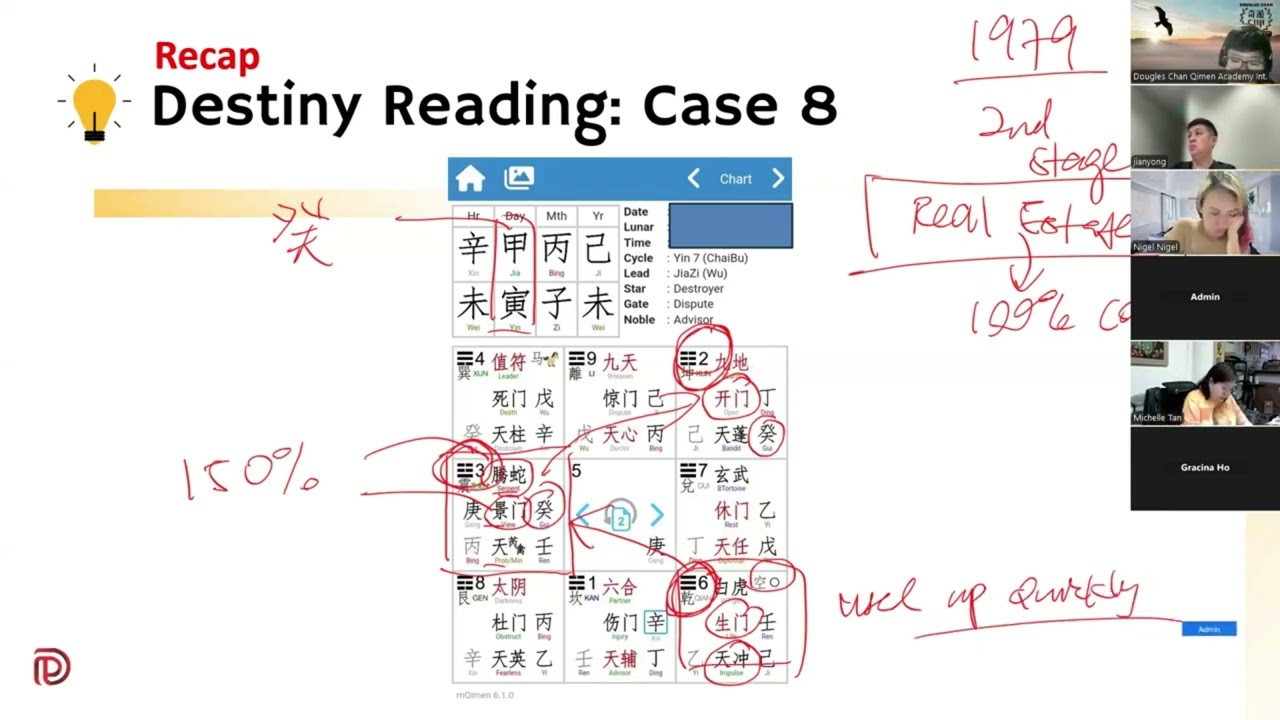
Using a person born in 1979 as the example, Mr. Dougles Chan explains how to identify the correct reference point in a Destiny Chart. Students locate the younger self and older self positions and decide which one should be used. Choosing the wrong position can change the entire interpretation.
The lesson then moves into character analysis. Students assess the strength of the energies and explain what each combination means in real life. Mr. Dougles Chan points out that the strongest or “true” energy may not be the most obvious symbol. When supported by the larger chart structure, its influence becomes much stronger.
In this case, the Serpent and View Door combination is highlighted as a major influence on the person’s personality and decision-making style. It may describe someone who thinks deeply, becomes mentally occupied easily, and feels stressed by uncertainty, pressure, or complicated information. This shows why an opportunity that looks favorable in theory may still be unsuitable for a particular person. The chart must be interpreted together with the individual’s character and behavior.
Mr. Dougles Chan next examines the person’s employment situation. The Day Stem clashes with the job direction, showing tension between the individual and her working environment. This does not mean she is lazy or incapable. It may suggest that she dislikes working under other people, feels restricted in a conventional role, or repeatedly considers leaving her job to pursue something independently.
The person also has a real estate license and has thought about becoming a property agent. Real estate is associated with the Earth element, so it may appear suitable at first. However, industry compatibility alone is not enough. Students must also examine the business and income indicators, whether the relevant palace is Empty, how the elements interact, and whether the opportunity supports or controls the person.
An Empty palace can delay action or weaken certainty. Even when the person becomes motivated, other interactions may indicate difficulty securing deals, attracting clients, or converting effort into results. A controlling or clashing relationship can show that the business environment pressures the individual instead of supporting her.
One key principle is the difference between “being clashed” and “clashing something.” Mr. Dougles Chan explains that he would generally prefer to be the active side creating the clash rather than the side receiving it. Being heavily clashed may indicate pressure, instability, obstacles, or reduced control. This is one reason he advises the person to remain in her current job instead of rushing into full-time real estate.
The chart is also used to explore investment potential. The Injury Door produces the person’s palace, which may be supportive in certain situations. However, the strong Serpent and View Door characteristics can make data-heavy investments, stock-market analysis, and rapid financial decisions feel stressful. Although the investment indicator may technically support her, her character may prevent her from using that advantage confidently.
This illustrates an essential Qi Men principle: favorable energy does not guarantee favorable action. A person must still be willing, emotionally prepared, knowledgeable, and comfortable enough to use an opportunity. Mr. Dougles Chan therefore suggests focusing on familiar and understandable assets rather than forcing a strategy that creates unnecessary stress. Gold or other areas the person already understands may be more realistic for her temperament.
A proper Qi Men Dun Jia analysis requires several layers: identifying the correct self palace, measuring energy strength, studying elemental production and control, checking clashes and Emptiness, understanding the relevant Door, and matching the technical reading with real-life behavior. This is why one symbol should never be used to give a fixed answer.
This case study helps students analyze career choices, job dissatisfaction, business opportunities, property-related work, personality patterns, and investment tendencies through a Qi Men Destiny Chart. It also shows why people facing similar opportunities can achieve very different outcomes.
Watch the lesson and follow the reasoning step by step. The goal is not to copy an answer, but to understand how Mr. Dougles Chan connects the symbols and turns chart information into practical guidance for real-life decisions.
To learn Qi Men Dun Jia directly from Mr. Dougles Chan and develop your chart-reading skills through structured coaching, click the link below:
Leave a Reply
You must be logged in to post a comment.