
The Complete Guide to Chinese Face Reading (Mian Xiang)
Introduction
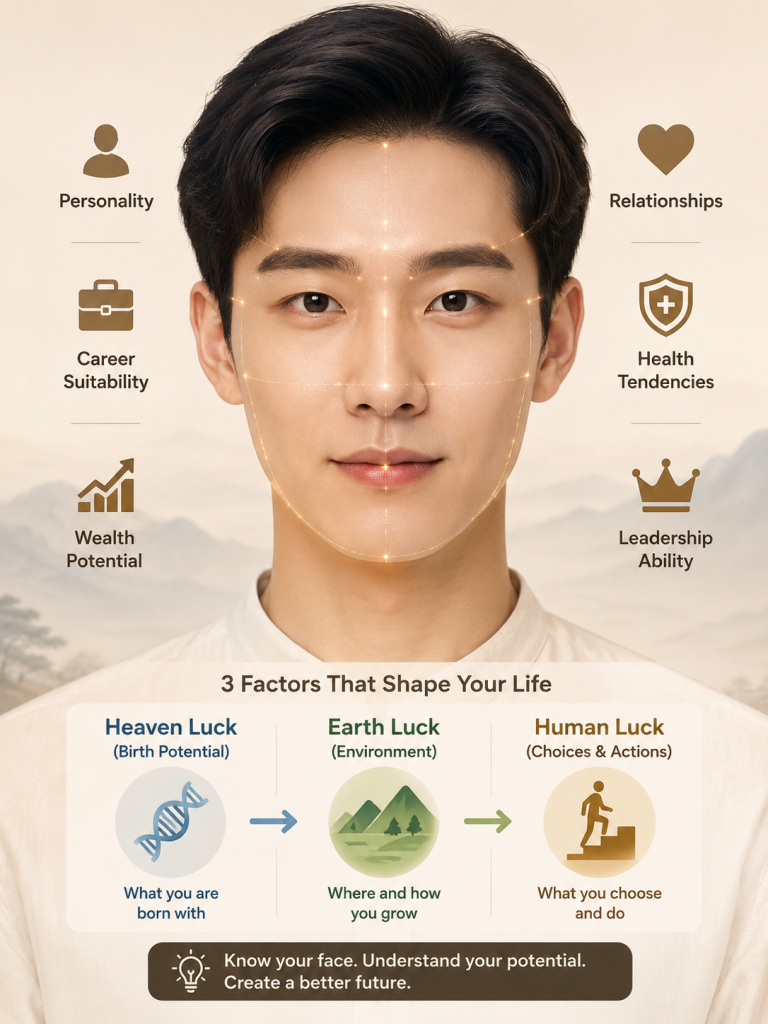
Face Reading, known as Mian Xiang (面相), is one of the oldest branches of Chinese Metaphysics. It has been studied and practised for thousands of years to understand a person’s character, strengths, weaknesses, opportunities and life tendencies through observation of facial features.
Many people mistakenly believe Face Reading predicts an unchangeable destiny. This is incorrect.
Face Reading is a system of observation. It identifies natural tendencies, behavioural patterns and potential life outcomes based on a person’s facial structure, complexion and expressions. It provides valuable insights into personality, career suitability, wealth management, relationships, health tendencies and leadership ability.
A person’s destiny is influenced by three major factors:
- Heaven Luck (Birth Potential)
- Earth Luck (Environment)
- Human Luck (Choices and Actions)
Face Reading primarily reveals Heaven Luck. Through awareness and correct decision-making, Human Luck can improve many aspects of life.
What Makes Dougles Chan’s Face Reading Different
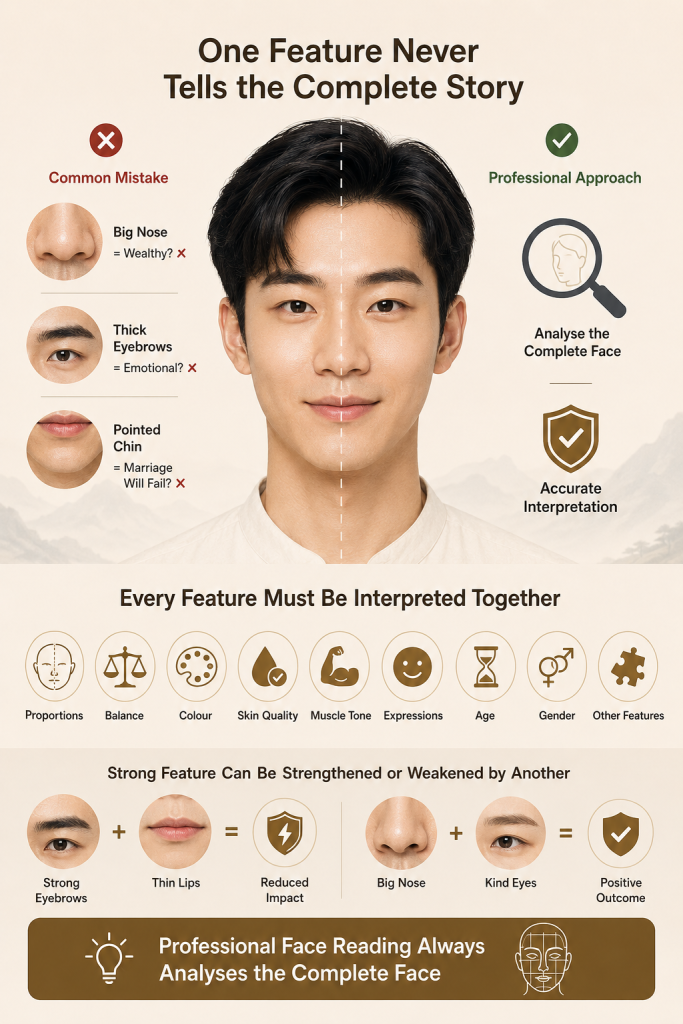
Many beginners make one common mistake.
They see one feature and immediately make a conclusion.
Examples include:
“He has a big nose, therefore he is wealthy.”
“She has thick eyebrows, therefore she is emotional.”
“He has a pointed chin, therefore marriage will fail.”
This is not professional Face Reading.
One feature never tells the complete story.
Every facial feature must be interpreted together with:
- facial proportions
- facial balance
- colour
- skin quality
- muscle tone
- expressions
- age
- gender
- other supporting features
A strong feature can be strengthened or weakened by another feature.
Professional Face Reading always analyses the complete face.
The Philosophy Behind Face Reading
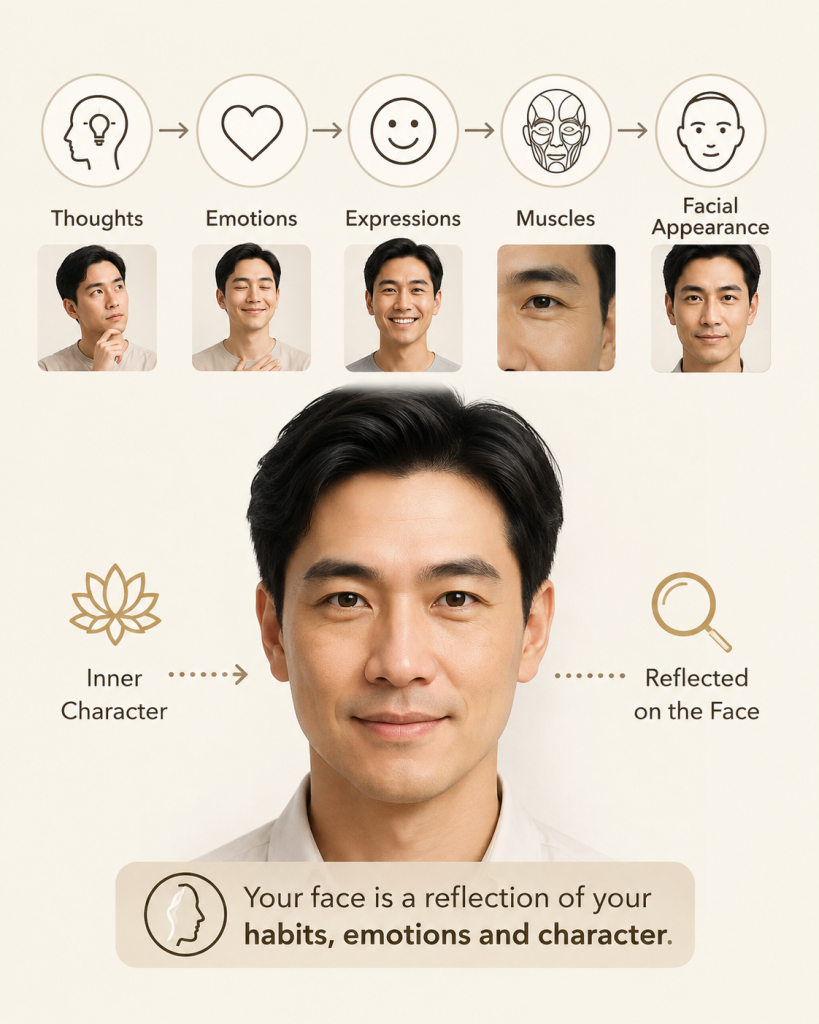
Every facial feature represents accumulated behavioural habits over many years.
Your thoughts influence your emotions.
Your emotions influence your expressions.
Your repeated expressions gradually shape your muscles.
Your muscles gradually influence your facial appearance.
Therefore, your face becomes a reflection of your inner character.
Face Reading does not simply observe appearance.
It studies repeated behavioural patterns reflected through the face.
Can Face Reading Change?
Yes.
This is one of the biggest misunderstandings.
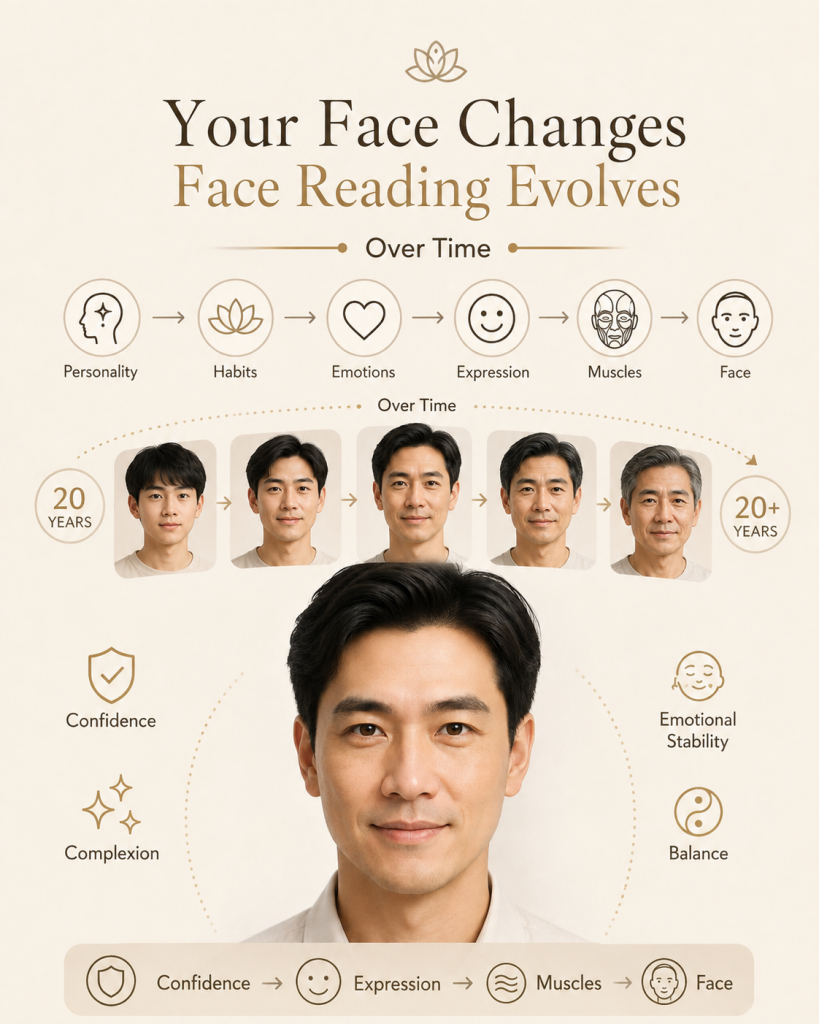
Your face changes throughout your life.
As your personality develops…
your facial muscles change.
As your habits improve…
your complexion improves.
As your emotional stability increases…
your facial balance changes.
This explains why many successful people look different after twenty years.
Success changes confidence.
Confidence changes expression.
Expression changes facial muscles.
Facial muscles gradually change facial appearance.
Face Reading therefore evolves with your life.
The Five Fundamental Principles
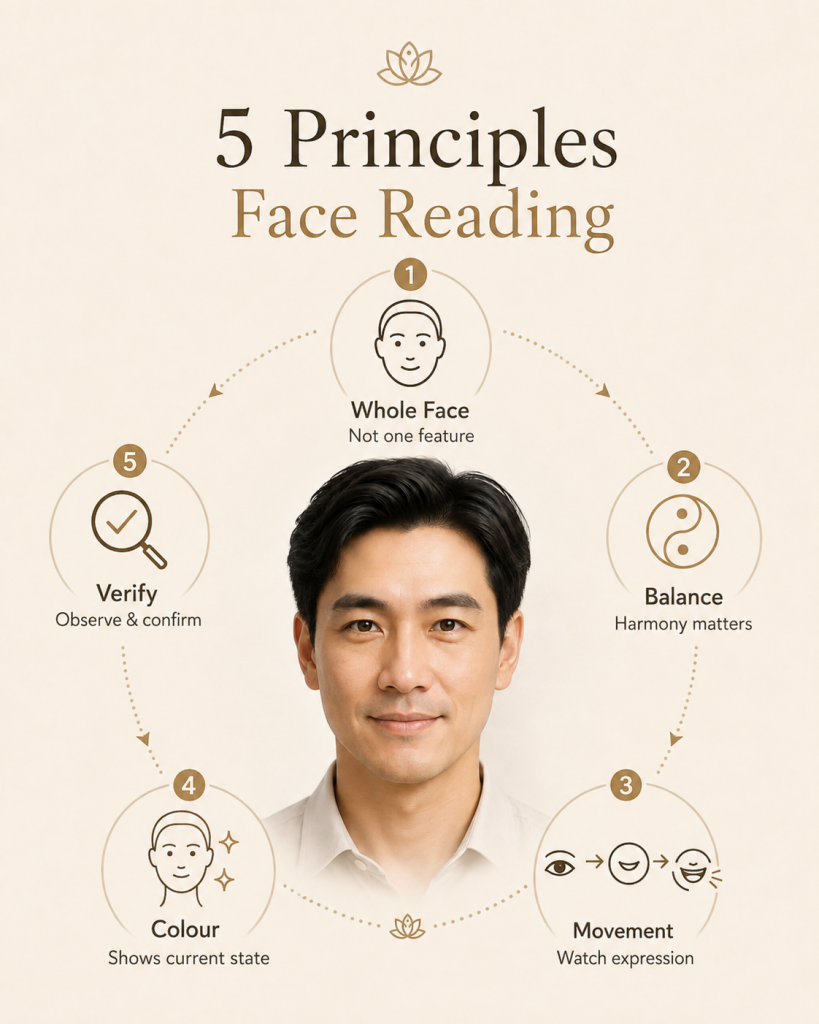
Before analysing any feature, understand these five principles.
Principle 1
Never judge one feature alone.
Every feature must support other observations.
Principle 2
Balance is more important than perfection.
A perfectly shaped nose with weak eyes may not indicate great success.
Likewise, average facial features working harmoniously often outperform one outstanding feature.
Principle 3
Movement is more important than still photographs.
Observe:
- smiling
- speaking
- blinking
- eye movement
- body posture
Static photographs reveal only part of the story.
Principle 4
Colour changes faster than structure.
Structure represents long-term tendencies.
Colour often reflects current circumstances.
A bright complexion usually indicates good momentum.
A dull complexion may suggest fatigue, stress or temporary challenges.
Principle 5
Always verify.
Professional Face Reading requires observation, questioning and verification.
Never assume.
The purpose is understanding, not guessing.
The Three Levels of Face Reading
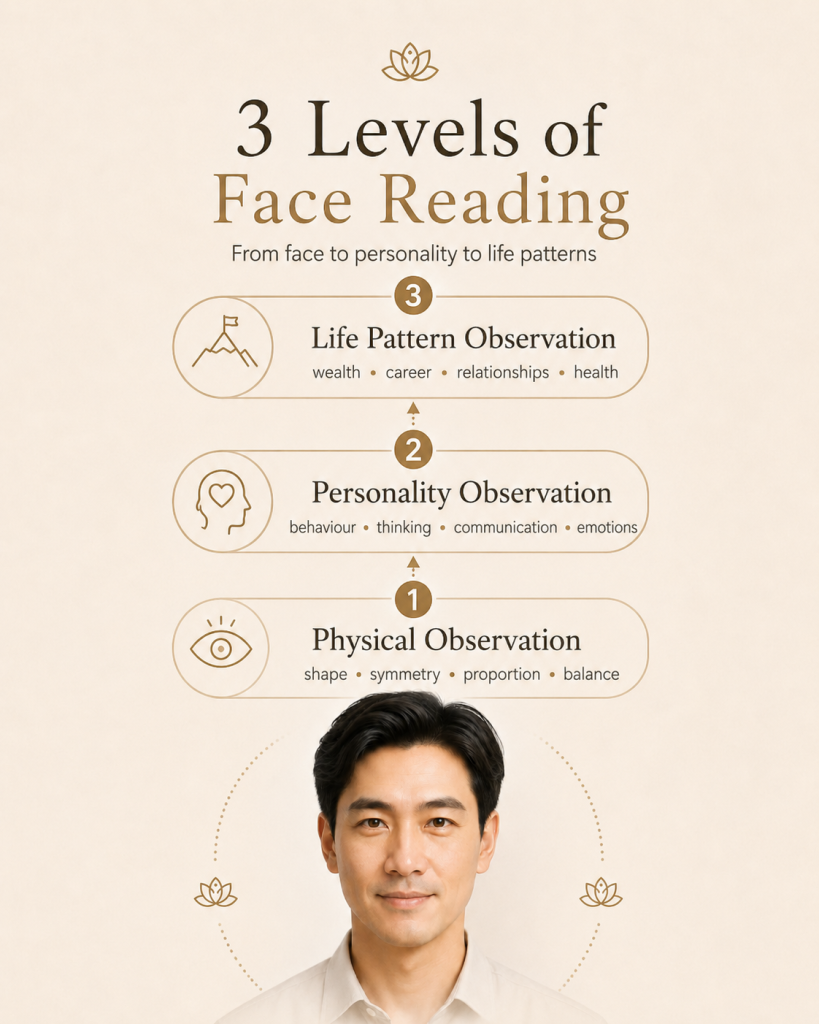
Professional Face Reading can be divided into three levels.
Level One
Physical Observation
Observe:
- facial shape
- symmetry
- proportions
- size
- balance
This level can be learned by beginners.
Level Two
Personality Observation
Study:
- behaviour
- thinking style
- communication
- leadership
- emotions
- discipline
This requires experience.
Level Three
Life Pattern Observation
At this level, the reader studies:
- wealth tendencies
- career development
- relationship patterns
- authority
- health tendencies
- life cycles
This requires integration of multiple facial systems rather than isolated features.
Understanding Facial Balance
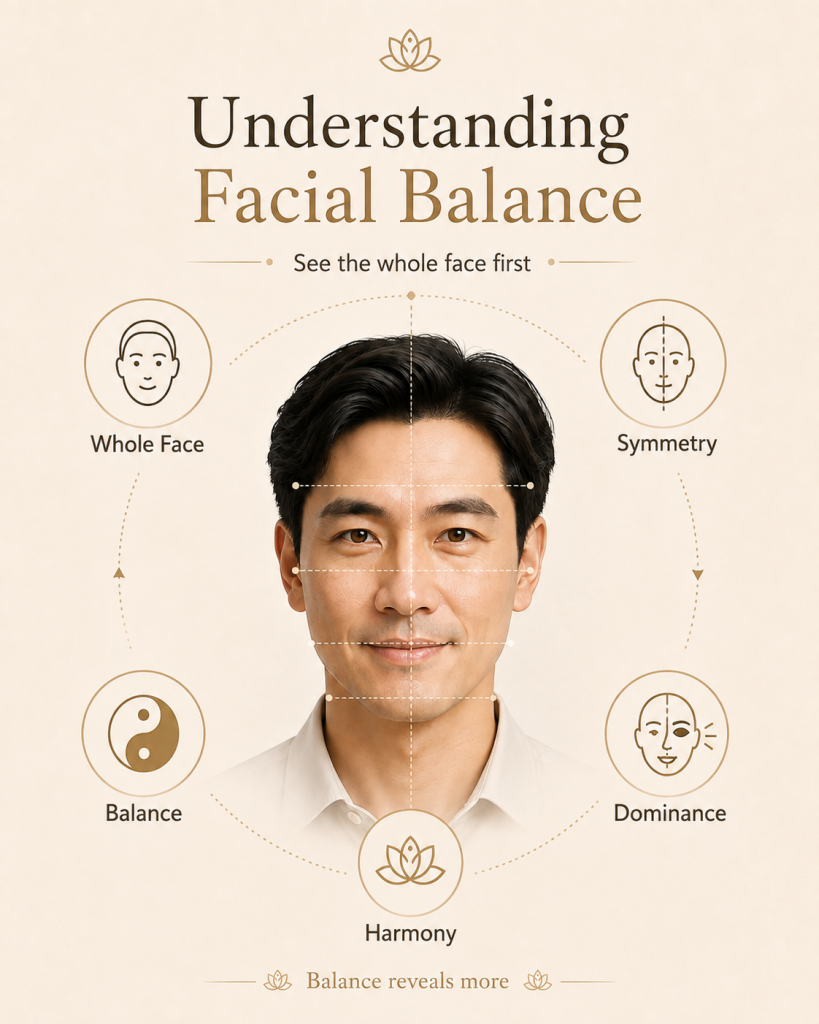
Professional readers first observe the entire face.
Questions include:
Is the face balanced?
Are both sides similar?
Is one area overly dominant?
Does one feature overpower the others?
Balance often reveals more than any single feature.
Yin and Yang in Face Reading
Every face contains Yin and Yang qualities.
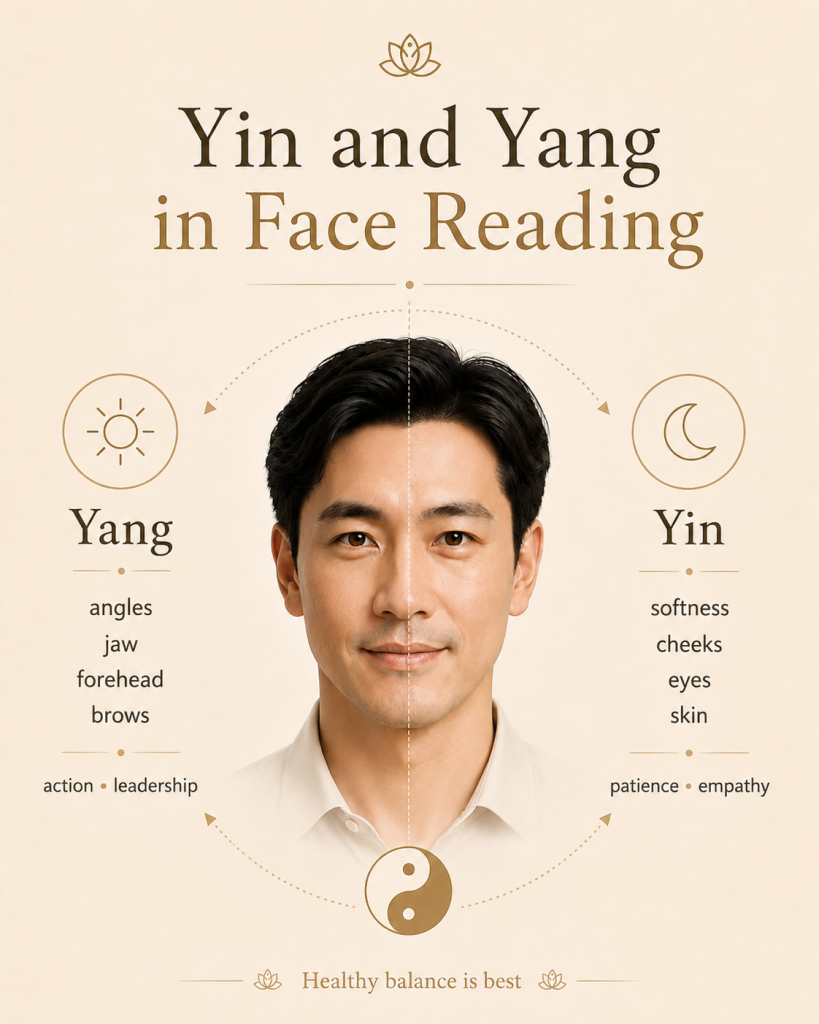
Yang characteristics:
- prominent bones
- sharper angles
- stronger jaw
- larger forehead
- deeper eye sockets
- stronger eyebrows
Usually associated with:
- decisiveness
- leadership
- competitiveness
- action
Excessive Yang may indicate:
- impatience
- aggression
- stubbornness
Yin characteristics:
- softer features
- rounded cheeks
- gentle eyes
- smoother skin
- rounded jaw
Usually associated with:
- empathy
- patience
- diplomacy
- creativity
Excessive Yin may indicate:
- indecisiveness
- emotional sensitivity
- avoidance of conflict
The most favourable faces usually show a healthy balance between Yin and Yang.
The Five Elements in Face Reading
The Five Elements also influence facial structure.
Wood Face
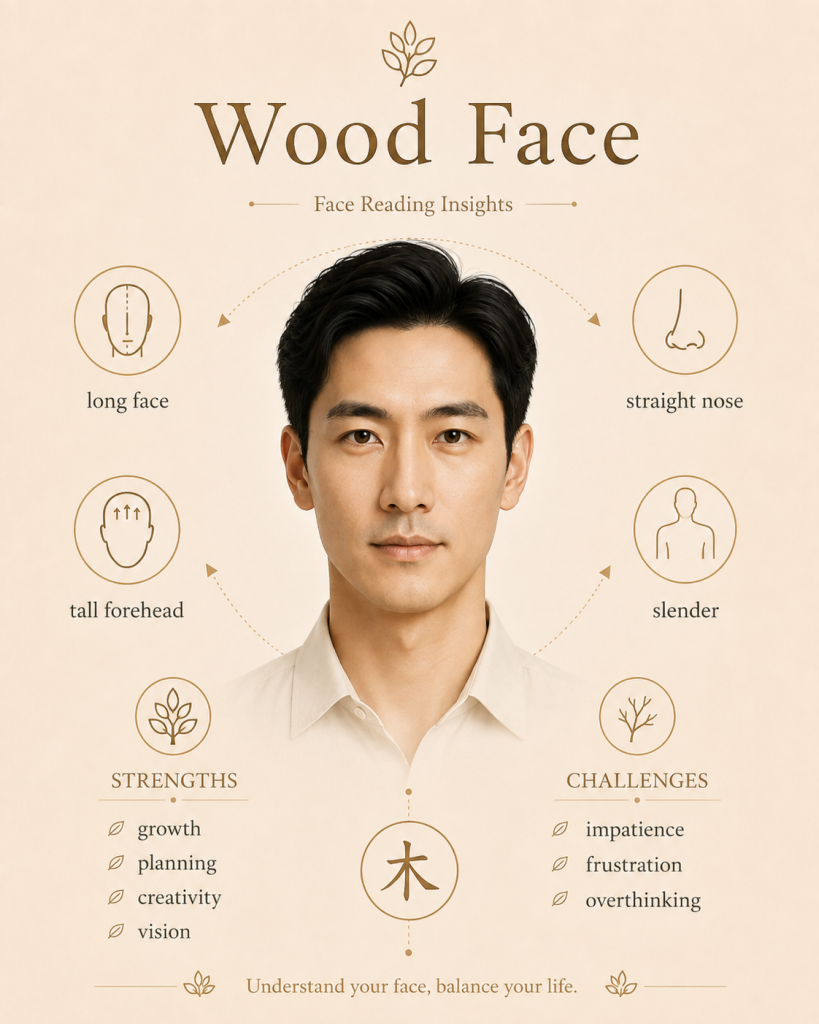
Characteristics:
- long face
- tall forehead
- straight nose
- slender appearance
Strengths:
- growth
- planning
- creativity
- vision
Challenges:
- impatience
- frustration
- overthinking
Fire Face
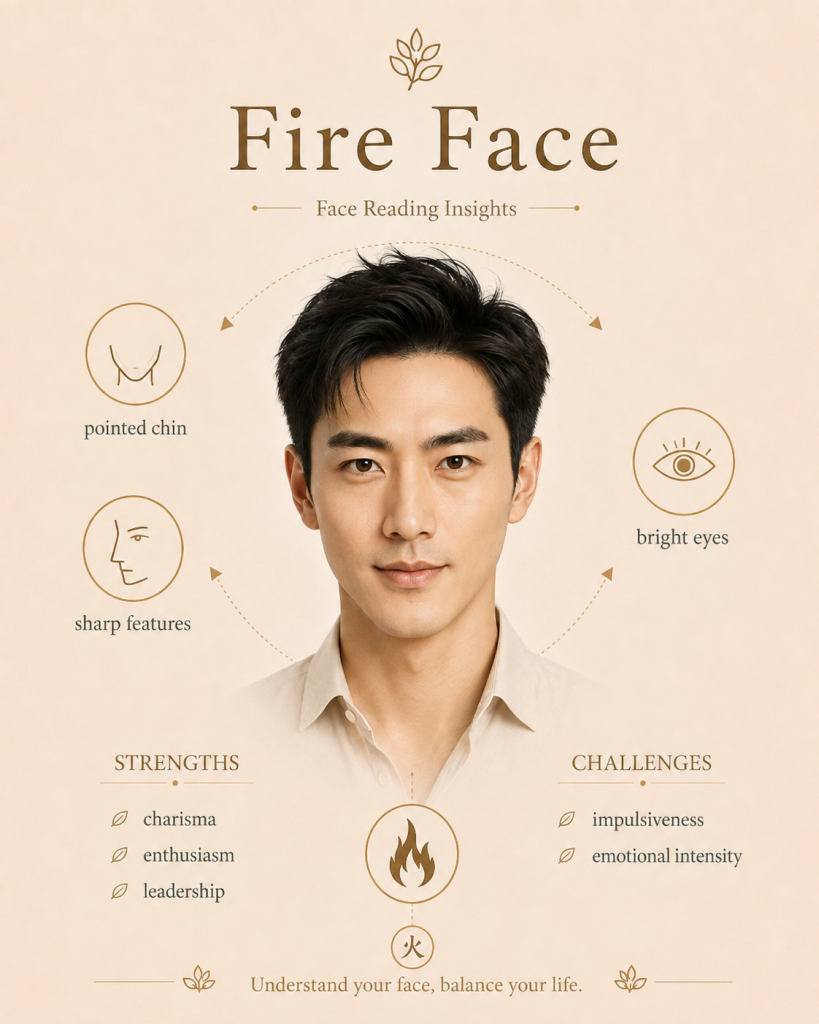
Characteristics:
- pointed chin
- sharp features
- bright eyes
Strengths:
- charisma
- enthusiasm
- leadership
Challenges:
- impulsiveness
- emotional intensity
Earth Face
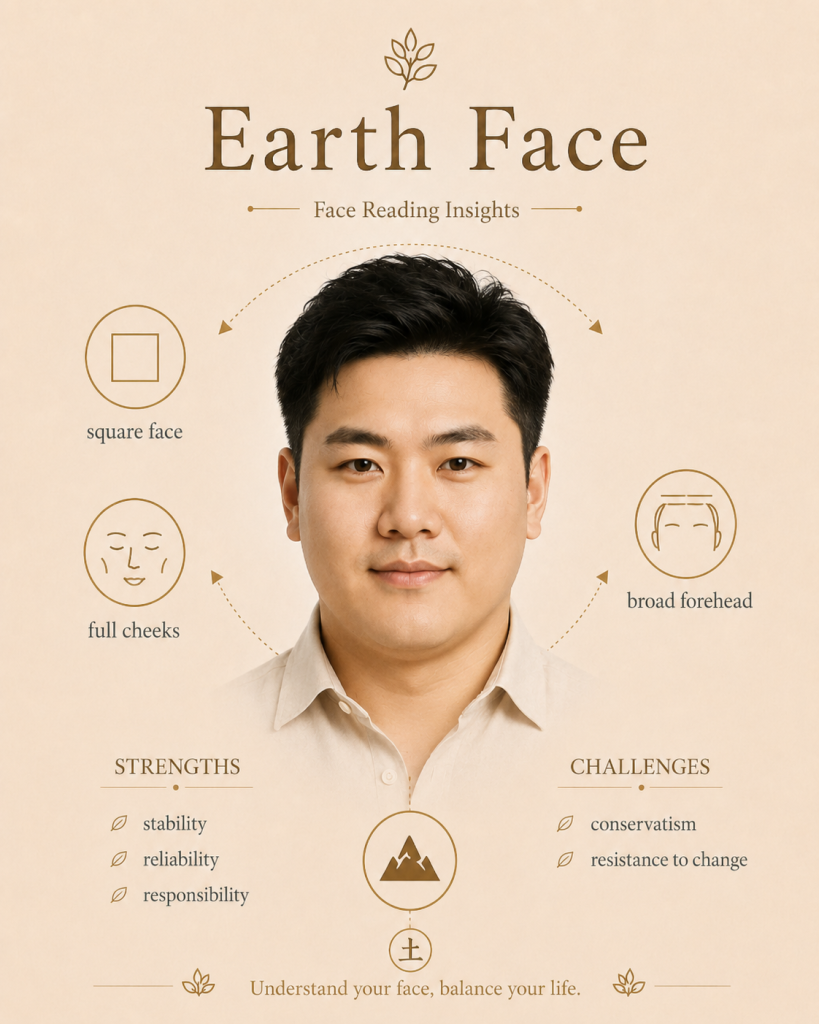
Characteristics:
- square face
- full cheeks
- broad forehead
Strengths:
- stability
- reliability
- responsibility
Challenges:
- conservatism
- resistance to change
Metal Face
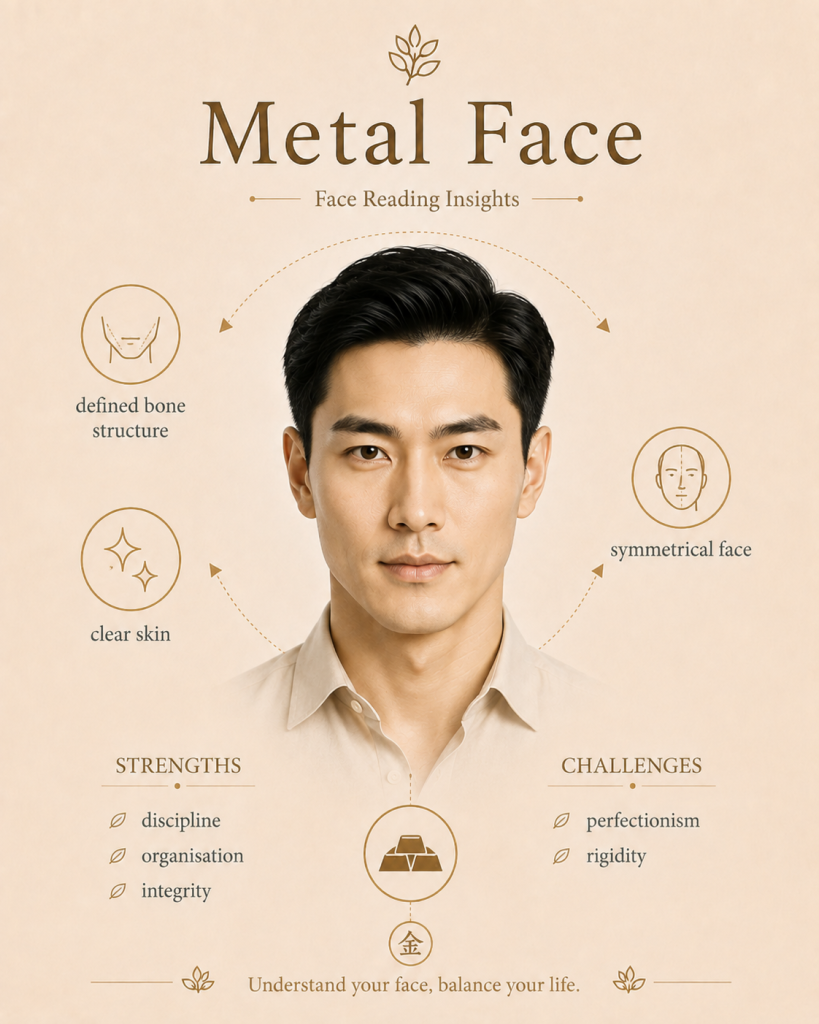
Characteristics:
- defined bone structure
- clear skin
- symmetrical face
Strengths:
- discipline
- organisation
- integrity
Challenges:
- perfectionism
- rigidity
Water Face
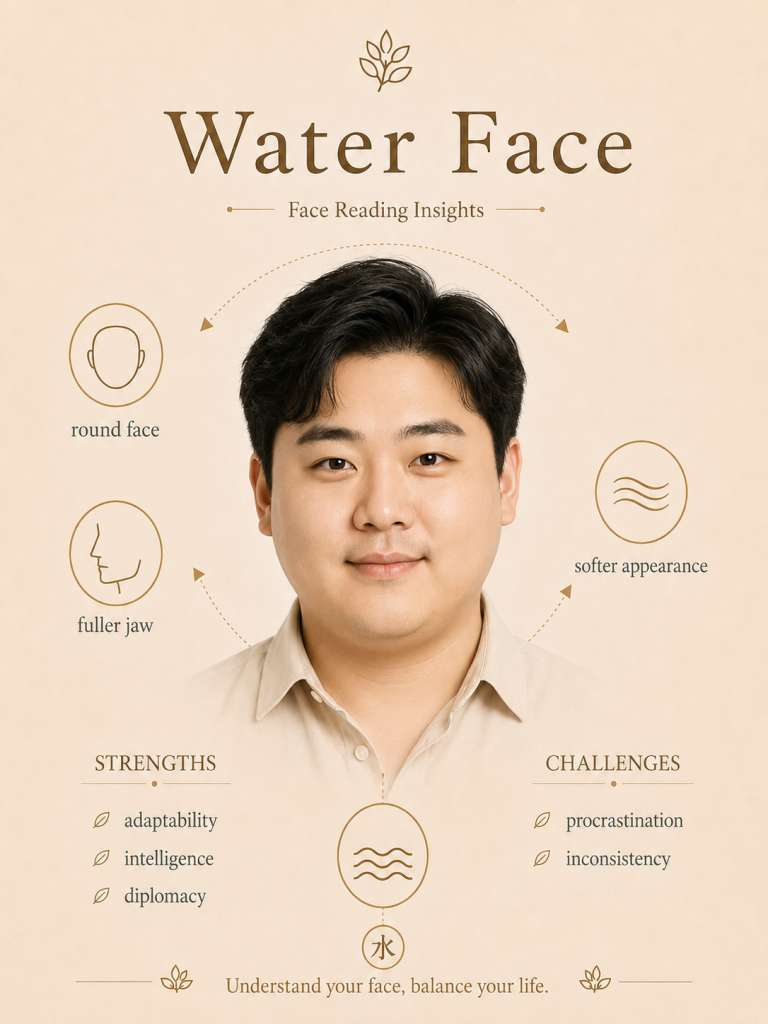
Characteristics:
- round face
- fuller jaw
- softer appearance
Strengths:
- adaptability
- intelligence
- diplomacy
Challenges:
- procrastination
- inconsistency
How Professional Face Reading Is Conducted
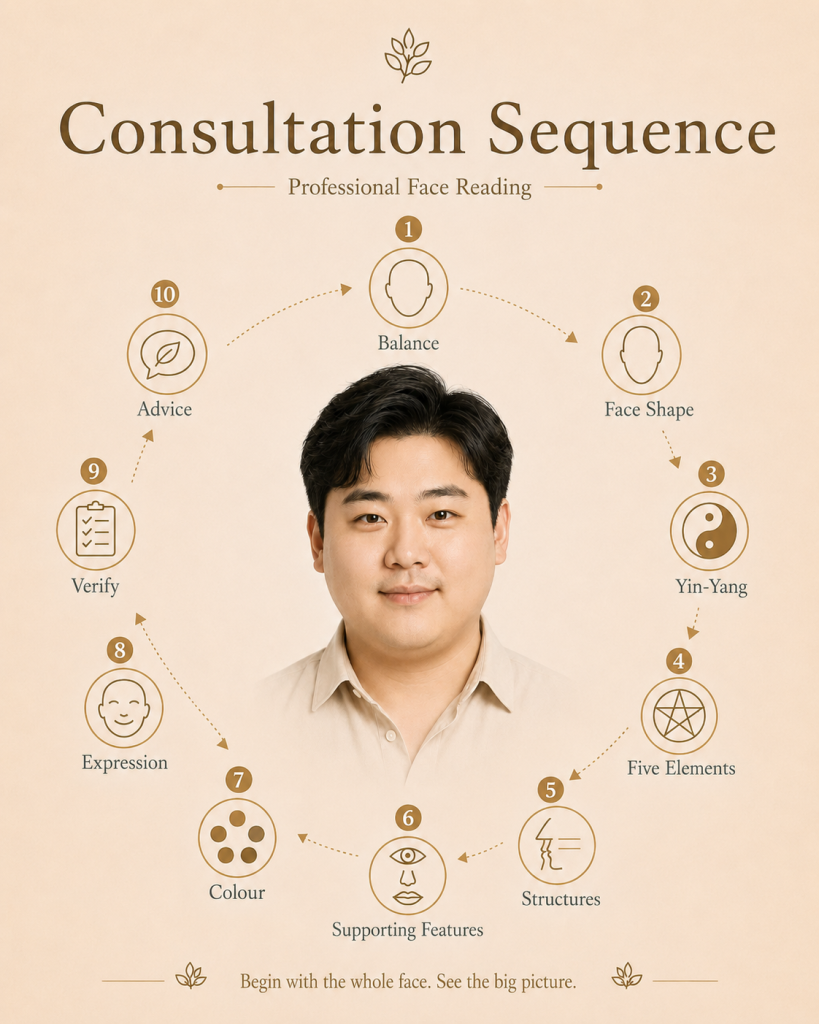
A professional consultation does not begin by analysing the nose or eyes.
The sequence is generally:
- Overall facial balance.
- Face shape.
- Yin-Yang balance.
- Five Elements.
- Major facial structures.
- Supporting features.
- Facial colour.
- Facial expressions.
- Verification with life history.
- Practical recommendations.
The Three Courts (三停)
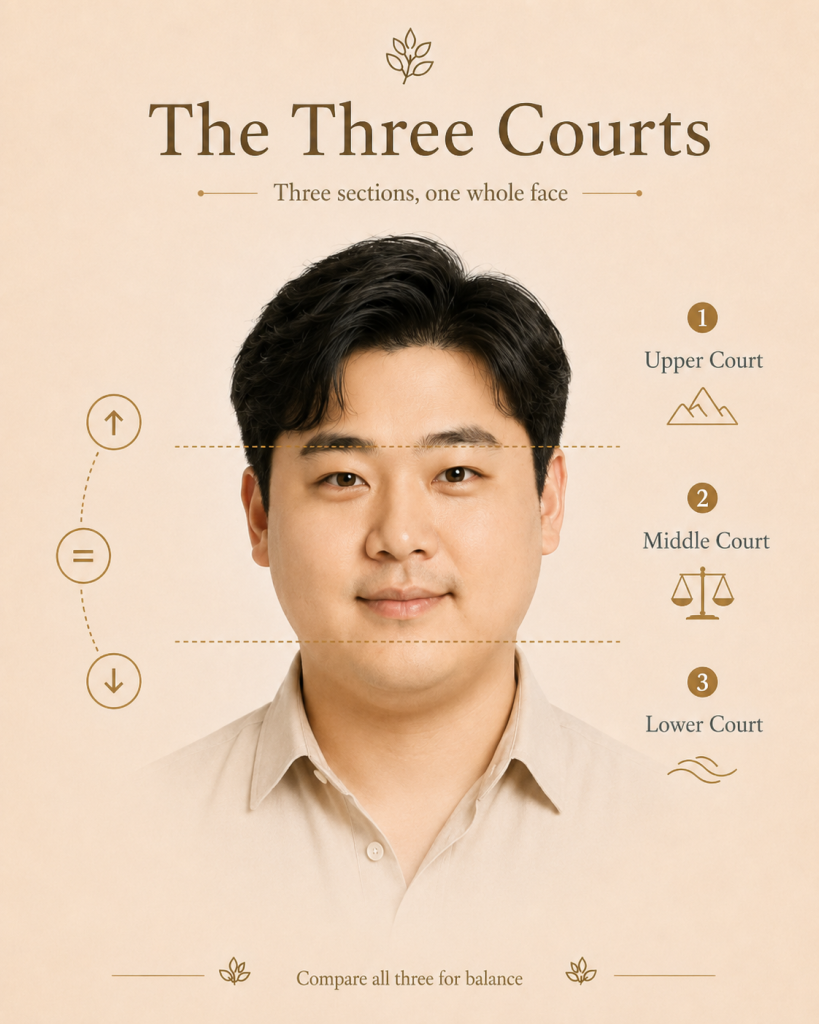
One of the first observations in professional Face Reading is the Three Courts.
The face is divided horizontally into three equal sections.
Each section represents different stages of life, different abilities and different aspects of destiny.
Professional Face Reading never judges only one court. Instead, all three courts are compared for harmony and balance.
Upper Court (Heaven Court)
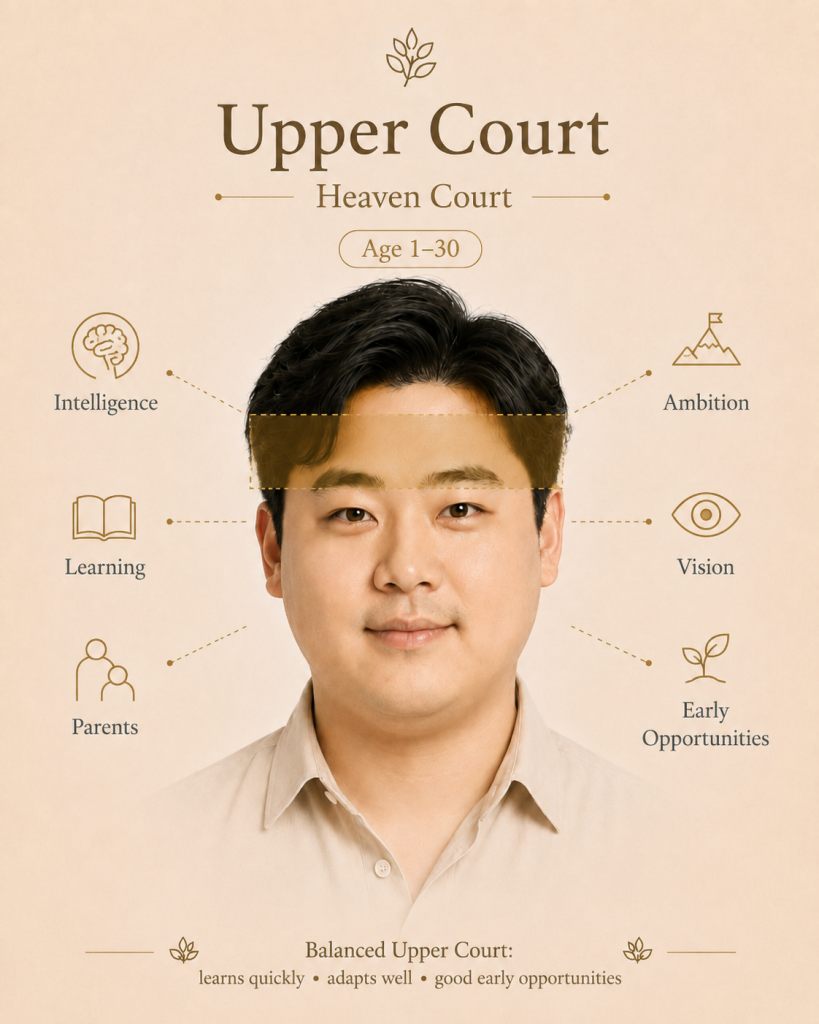
The Upper Court extends from the hairline to the eyebrows.
It represents approximately:
Age 1-30
It also reflects:
- Intelligence
- Learning ability
- Parents
- Childhood environment
- Ambition
- Vision
- Planning ability
- Opportunities during younger years
A balanced Upper Court often suggests that a person learns quickly, adapts well and receives reasonable opportunities during early life.
Positive Upper Court
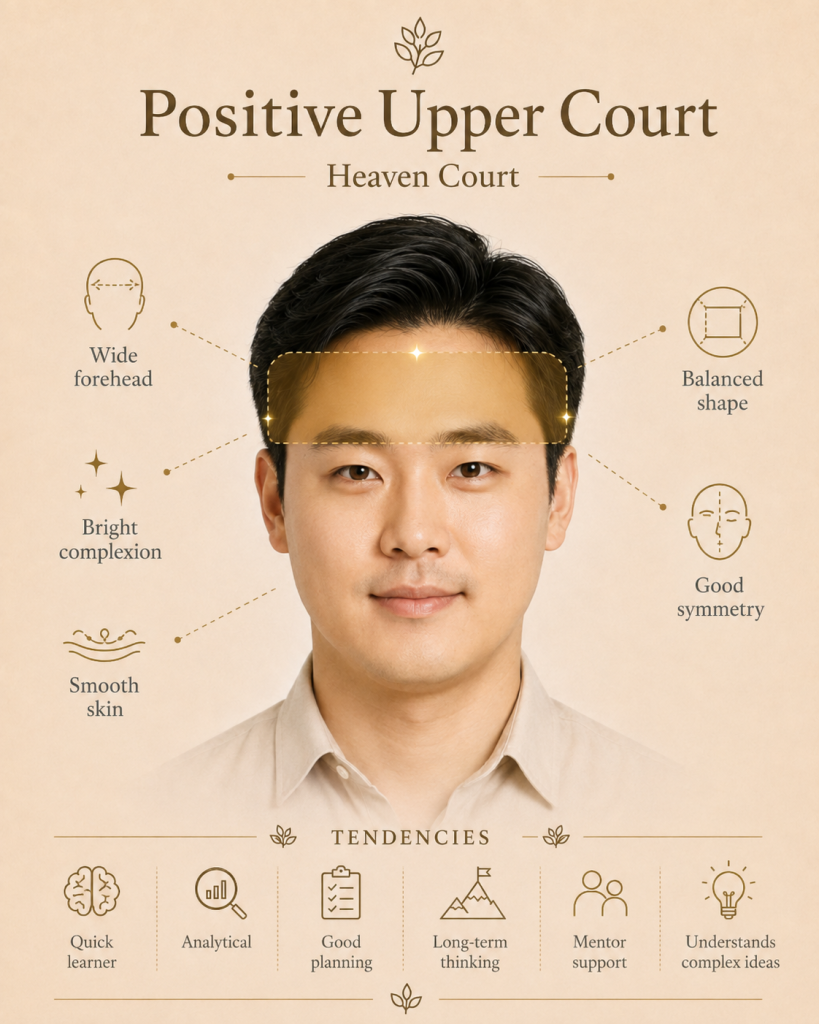
Characteristics include:
- Wide forehead
- Bright complexion
- Smooth skin
- Balanced shape
- Good symmetry
Possible tendencies:
- Quick learner
- Strong analytical ability
- Good planning
- Long-term thinking
- Receives support from mentors
- Able to understand complex ideas
Negative Upper Court
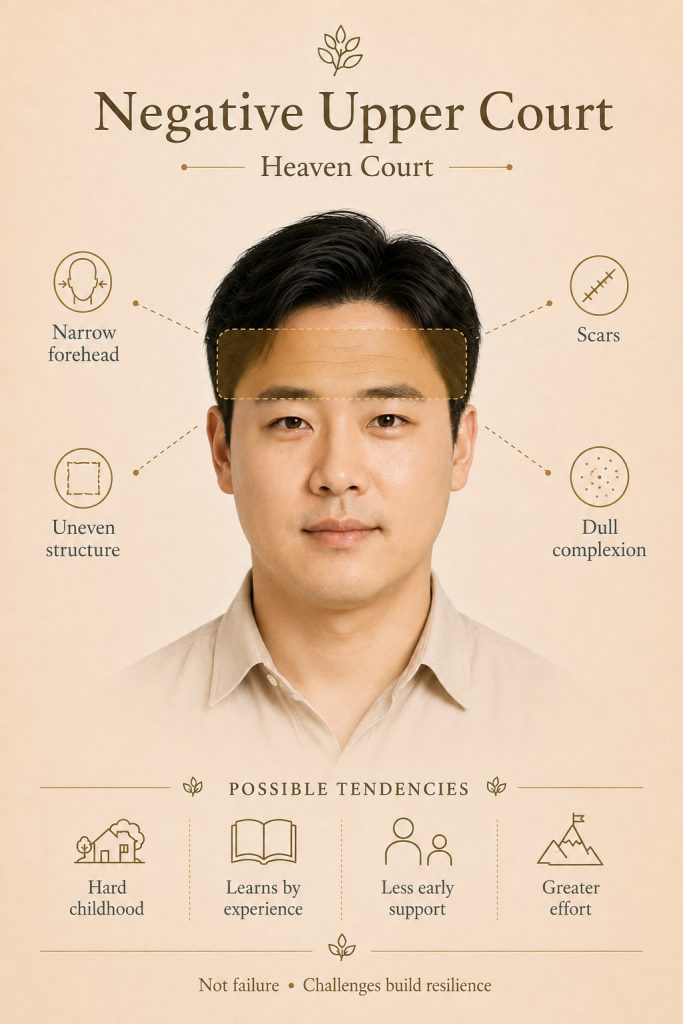
Possible observations:
- Extremely narrow forehead
- Deep scars
- Uneven structure
- Permanent dull complexion
Possible tendencies:
- Difficult childhood
- Learns through experience rather than theory
- Limited support during younger years
- Requires greater personal effort to succeed
This does not mean failure.
Many successful entrepreneurs had difficult childhoods.
Challenges often build resilience.
Middle Court (Human Court)
The Middle Court extends from the eyebrows to the base of the nose.
This is the most important area during adulthood.
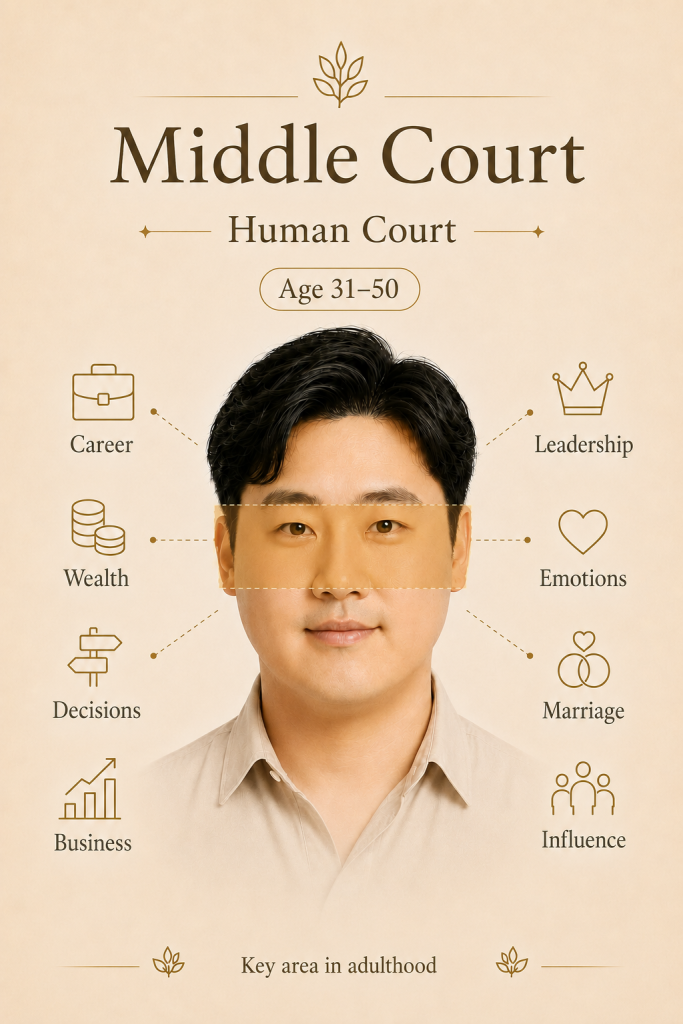
It represents approximately:
Age 31-50
It reflects:
- Career
- Wealth accumulation
- Decision making
- Leadership
- Emotional control
- Business ability
- Marriage stability
- Social influence
Most professional consultations spend significant time analysing this section.
Positive Middle Court
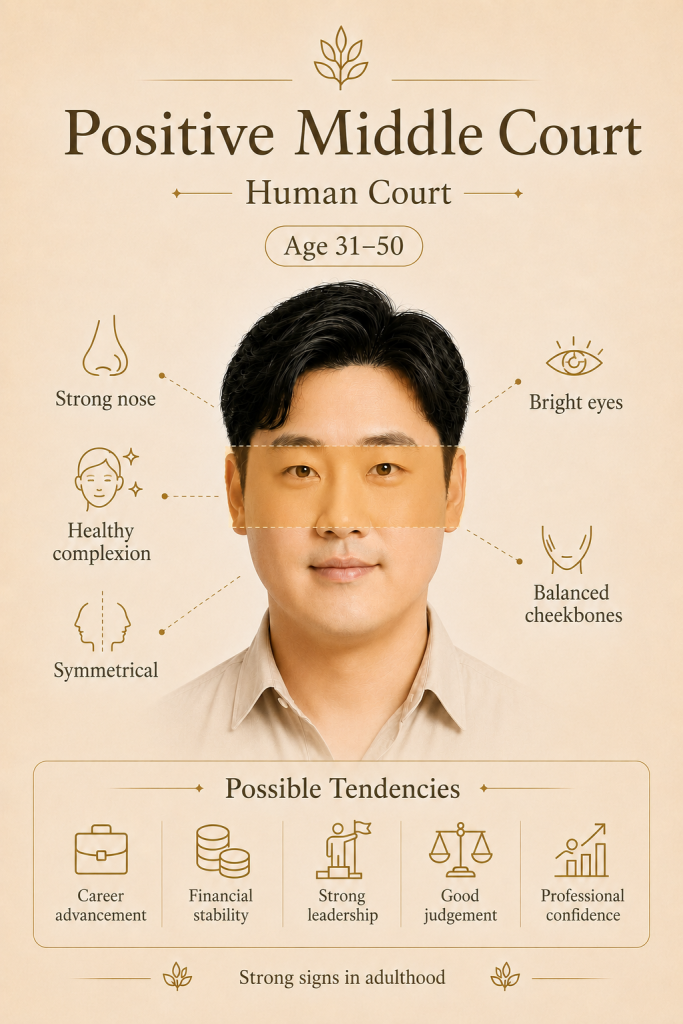
Features include:
- Strong nose
- Bright eyes
- Healthy complexion
- Balanced cheekbones
- Symmetrical appearance
Possible tendencies:
- Career advancement
- Financial stability
- Strong leadership
- Good judgement
- Professional confidence
Negative Middle Court
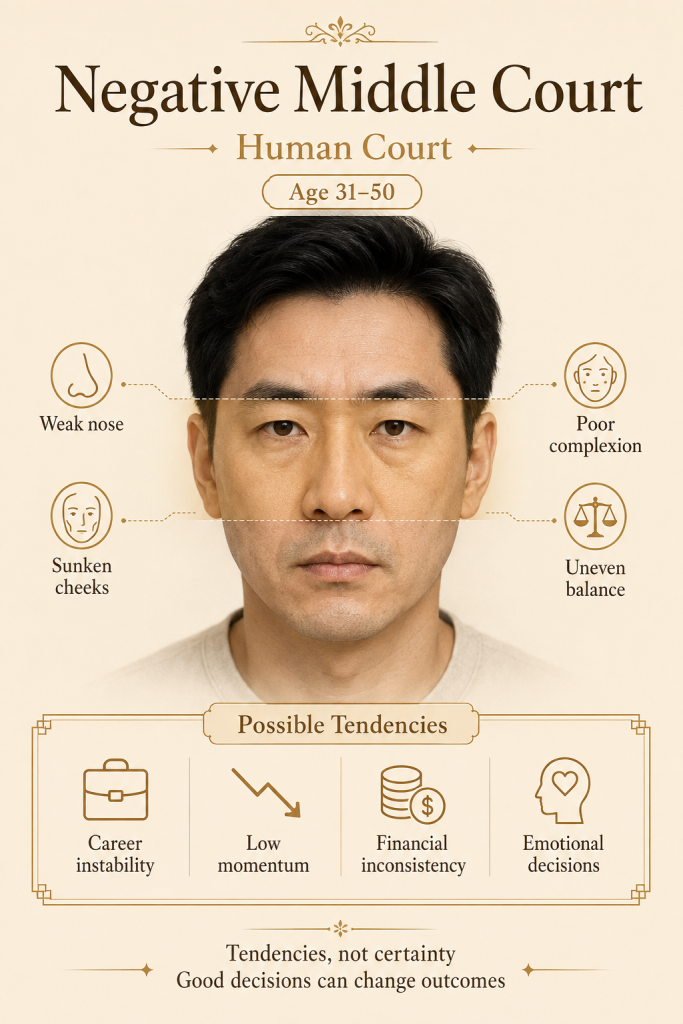
Possible observations:
- Weak nose
- Sunken cheeks
- Poor complexion
- Uneven facial balance
Possible tendencies:
- Career instability
- Difficulty maintaining momentum
- Financial inconsistency
- Emotional decision making
Again, this indicates tendencies rather than certainty.
Good decisions can change outcomes.
Lower Court (Earth Court)
The Lower Court extends from the base of the nose to the chin.
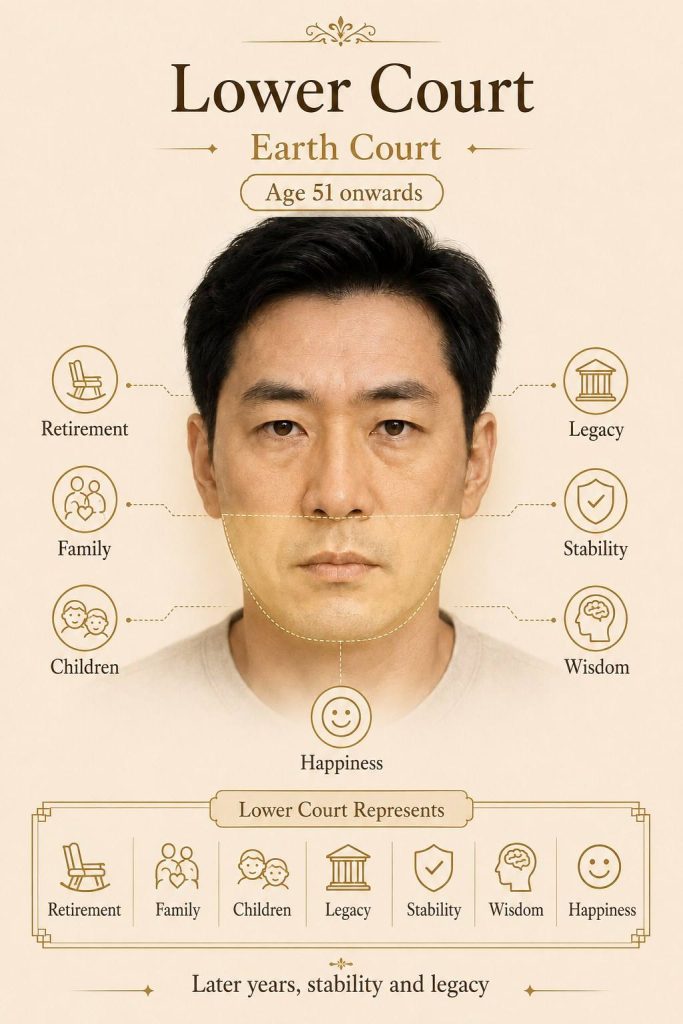
It represents approximately:
Age 51 onwards
It reflects:
- Retirement
- Family
- Children
- Legacy
- Stability
- Wisdom
- Happiness during later years
Positive Lower Court
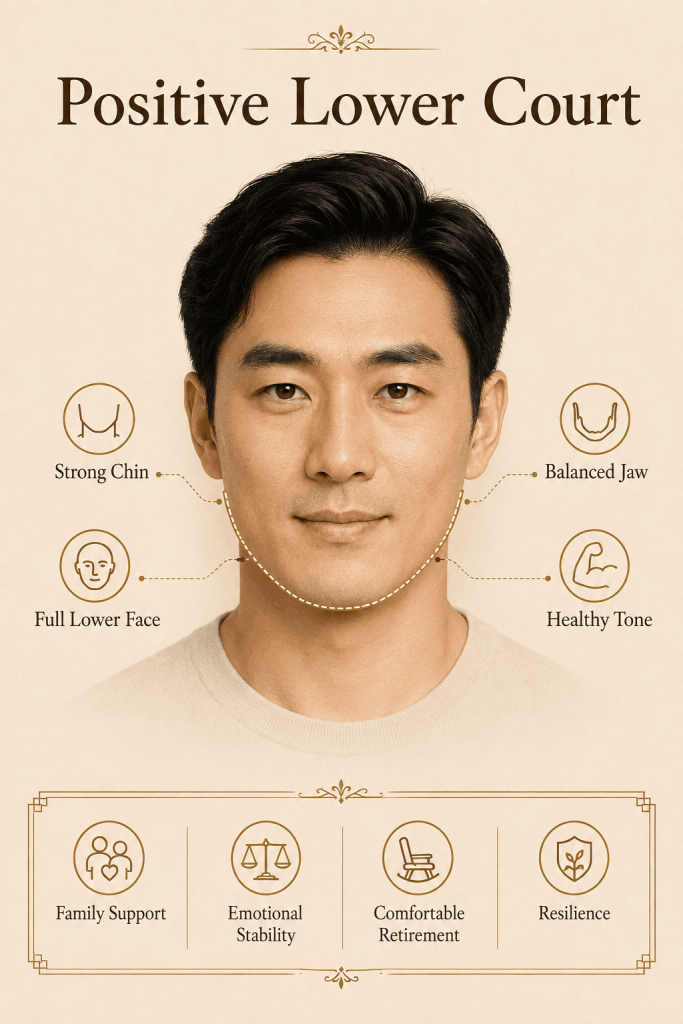
Characteristics:
- Strong chin
- Balanced jaw
- Full lower face
- Healthy muscle tone
Possible tendencies:
- Family support
- Emotional stability
- Comfortable retirement
- Good resilience
Negative Lower Court
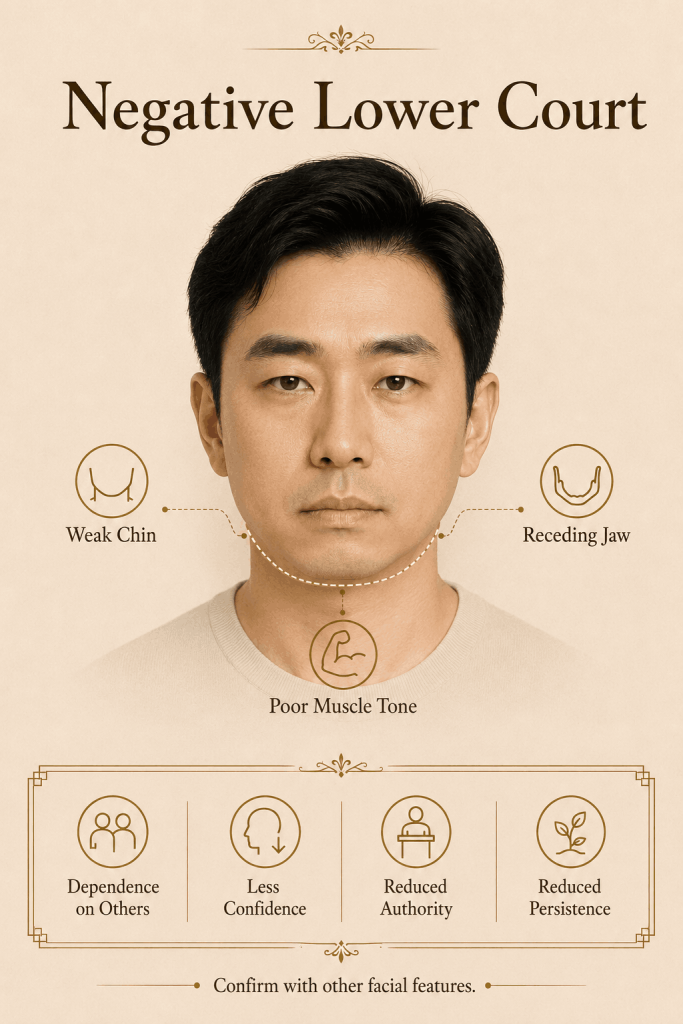
Possible observations:
- Weak chin
- Receding jaw
- Poor muscle tone
Possible tendencies:
- Dependence on others
- Less confidence
- Difficulty maintaining authority
- Reduced persistence
Professional Face Reading always confirms these observations with other features.
Balance Between the Three Courts
The ideal face shows harmony among all three courts.
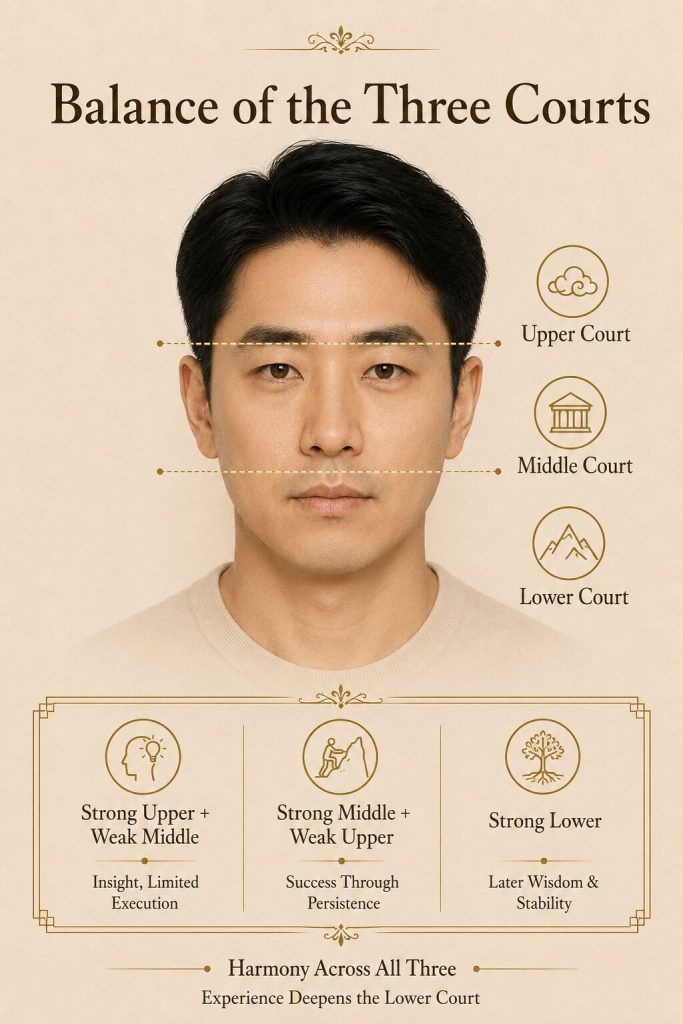
Examples:
Excellent Upper Court + Weak Middle Court
The person may possess intelligence but struggle with practical execution.
Strong Middle Court + Weak Upper Court
The person may achieve success through persistence rather than academic ability.
Strong Lower Court
Often indicates increasing wisdom and stability later in life.
Many business leaders improve significantly after middle age because their Lower Court develops with experience.
The Five Officers (五官)
The Five Officers are among the oldest systems in Chinese Face Reading.
Each major facial feature represents different qualities.
Professional readers study how they work together.
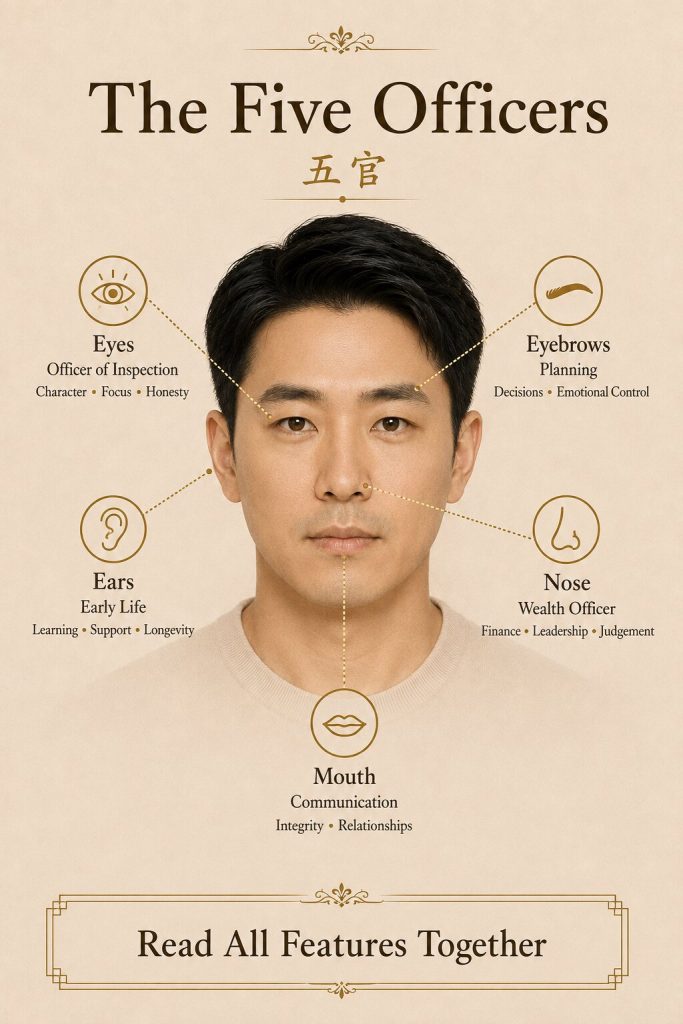
Officer One – The Eyes
The Eyes are called the Officer of Inspection.
The eyes reveal:
- Character
- Intelligence
- Emotional stability
- Honesty
- Confidence
- Mental focus
Many beginners focus only on eye size.
Professionals observe:
- brightness
- movement
- focus
- eyelids
- pupil direction
- eye spacing
- emotional expression
The eyes often reveal the person’s true thoughts before they speak.
Healthy eyes generally suggest:
- awareness
- alertness
- confidence
- sincerity
Dull eyes may suggest:
- fatigue
- stress
- emotional burden
- lack of motivation
Observation should always consider temporary factors such as illness or lack of sleep.
Officer Two – The Ears
The ears represent:
- Early life
- Intelligence
- Learning ability
- Family support
- Longevity
Professional readers examine:
- size
- thickness
- colour
- position
- shape
Large ears alone do not automatically indicate wealth.
The complete structure must be analysed.
Officer Three – The Nose
The nose is regarded as the Wealth Officer.
It represents:
- Financial management
- Responsibility
- Confidence
- Career stability
- Leadership
- Practical judgement
Professional observation includes:
- bridge
- tip
- nostrils
- symmetry
- colour
- proportion
The nose should never be interpreted without considering the eyes and cheekbones.
Officer Four – The Mouth
The mouth represents:
- Communication
- Relationships
- Integrity
- Emotional expression
- Leadership influence
Observation includes:
- lip thickness
- symmetry
- corners
- width
- colour
A person’s words often reflect the qualities shown by the mouth.
Officer Five – The Eyebrows
The eyebrows represent:
- Friends
- Siblings
- Planning
- Emotional control
- Decision making
Professional readers observe:
- thickness
- direction
- spacing
- density
- length
Healthy eyebrows often suggest organised thinking.
Disorganised eyebrows may indicate inconsistent planning.
Again, supporting features must always be considered.
The Twelve Palaces (十二宫)
The Twelve Palaces divide the face into different life categories.
Professional readers combine information from multiple palaces rather than relying on a single one.
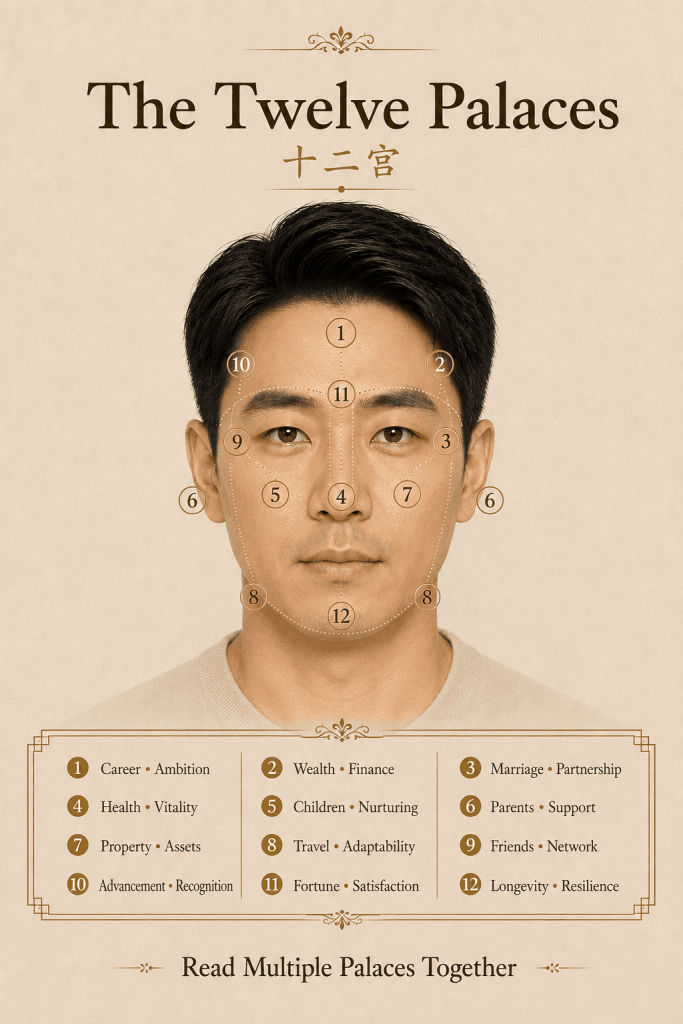
1. Career Palace
Usually centred around the forehead.
Reflects:
- career opportunities
- ambition
- leadership potential
2. Wealth Palace
Mainly associated with the nose.
Reflects:
- wealth management
- financial discipline
- business ability
3. Marriage Palace
Located around the outer eye area.
Reflects:
- relationship tendencies
- emotional compatibility
- partnership dynamics
It should never be interpreted alone.
4. Health Palace
Centred around the nose bridge and complexion.
Professional readers observe:
- colour
- texture
- vitality
This reflects tendencies rather than providing a medical diagnosis.
5. Children Palace
Located beneath the eyes.
Reflects:
- relationship with children
- nurturing tendencies
6. Parents Palace
Located near the forehead.
Reflects:
- relationship with parents
- support during early years
7. Property Palace
Reflects stability regarding assets and long-term accumulation.
8. Travel Palace
Indicates adaptability and opportunities away from one’s hometown.
9. Friends Palace
Shows social influence and quality of support network.
10. Career Advancement Palace
Represents recognition and promotion opportunities.
11. Fortune Palace
Reflects overall life satisfaction rather than only financial wealth.
12. Longevity Palace
Associated with vitality and resilience throughout life.
Professional readers never predict lifespan from one feature.
Instead, they assess overall vitality and health tendencies.
The Golden Rule of Professional Face Reading
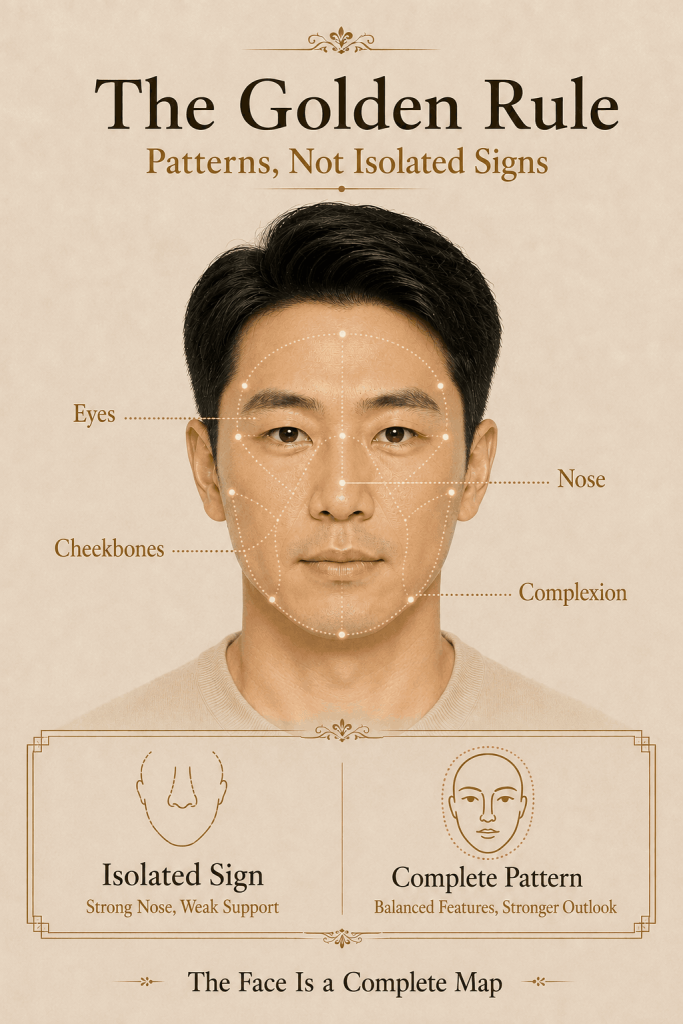
A single facial feature should never determine the final conclusion.
For example:
A strong nose may indicate excellent financial management.
However, if combined with weak eyes, unstable cheekbones and poor complexion, the person may struggle to maintain long-term success.
Likewise, someone with an average nose but exceptional eyes, balanced cheekbones and strong facial harmony may become far more successful.
Professional Face Reading is about understanding patterns, not isolated signs.
The face is like a complete map.
Each feature contributes one part of the story.
Only when all the pieces are interpreted together can a meaningful and balanced reading be made.
The Forehead
The forehead is one of the most important areas in Chinese Face Reading.
It belongs to the Heaven Court and represents approximately the first thirty years of life.
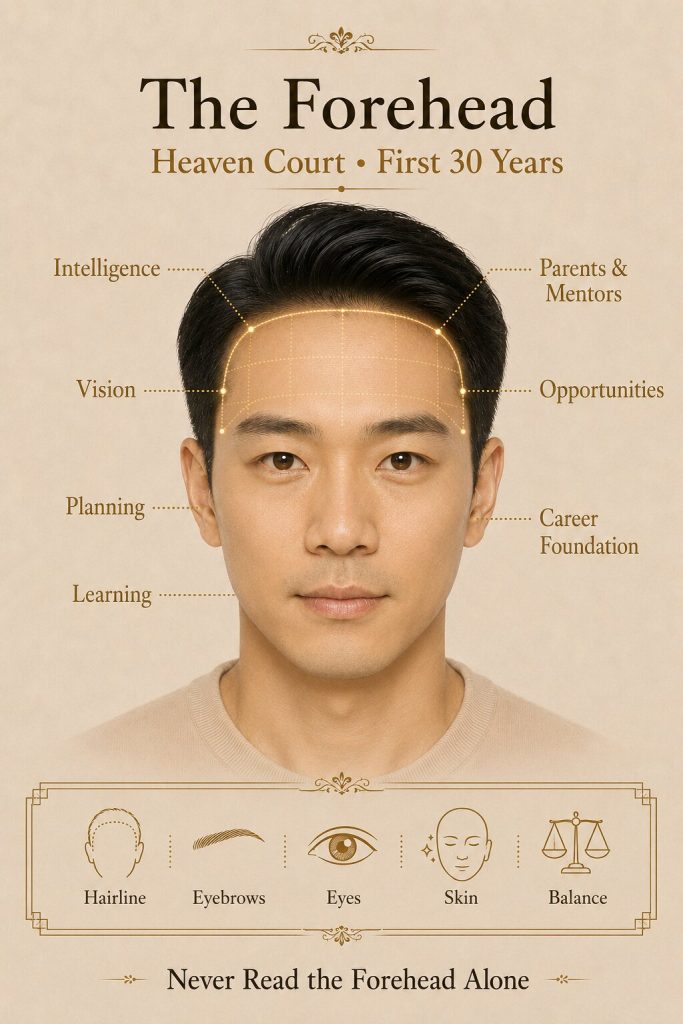
The forehead reflects:
- Intelligence
- Vision
- Planning
- Learning ability
- Parents
- Mentors
- Opportunities
- Career foundation
- Ambition
- Long-term thinking
Many beginners immediately judge whether a forehead is “good” or “bad.”
Professional Face Reading never works this way.
The forehead must always be evaluated together with:
- Hairline
- Eyebrows
- Eyes
- Skin quality
- Facial balance
- Age
- Overall proportions
What Makes a Good Forehead?
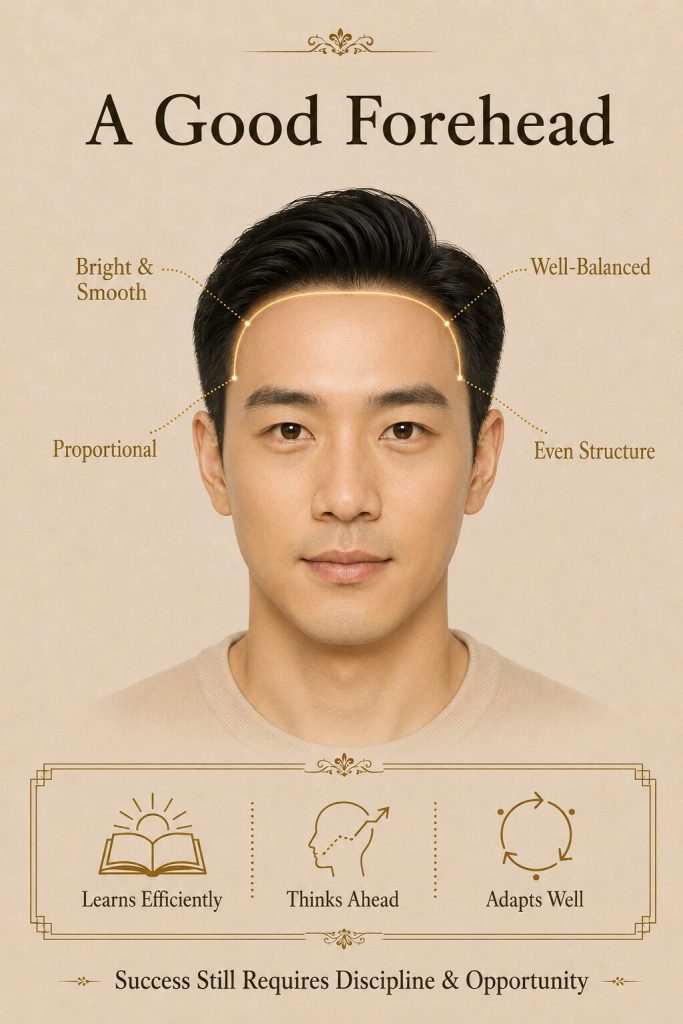
A favourable forehead is usually:
- Bright
- Smooth
- Well-balanced
- Neither excessively high nor low
- Proportional to the rest of the face
- Free from major structural deformities
This often indicates a person who learns efficiently, thinks ahead and adapts well to new situations.
It does not automatically mean the person will become wealthy.
Success still depends on discipline, decisions and opportunities.
What Does the Forehead Represent?
The forehead often answers questions such as:
How quickly does this person learn?
Can they plan long-term?
Do they think strategically?
Will they benefit from mentors?
Can they see opportunities before others?
These qualities frequently influence career progression.
Wide Forehead
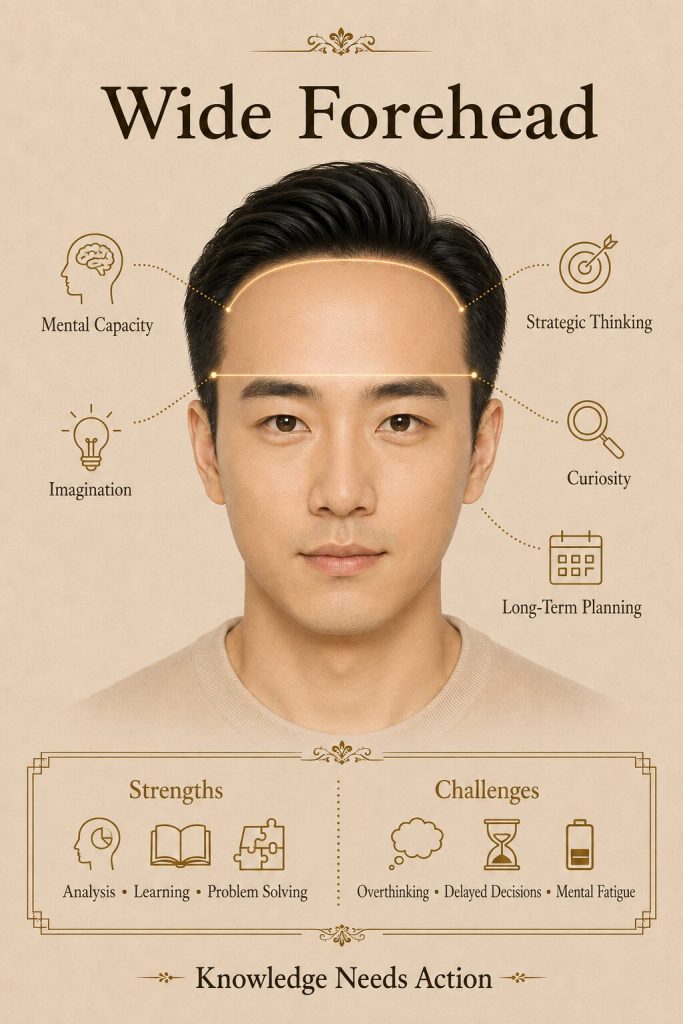
A wide forehead generally suggests mental capacity.
Positive tendencies include:
- Strategic thinking
- Strong imagination
- Curiosity
- Long-term planning
- Interest in learning
- Ability to analyse situations
Such individuals often enjoy solving complex problems.
Possible challenges:
- Overthinking
- Delayed decision making
- Excessive analysis
- Mental fatigue
Knowledge without action rarely produces results.
Narrow Forehead
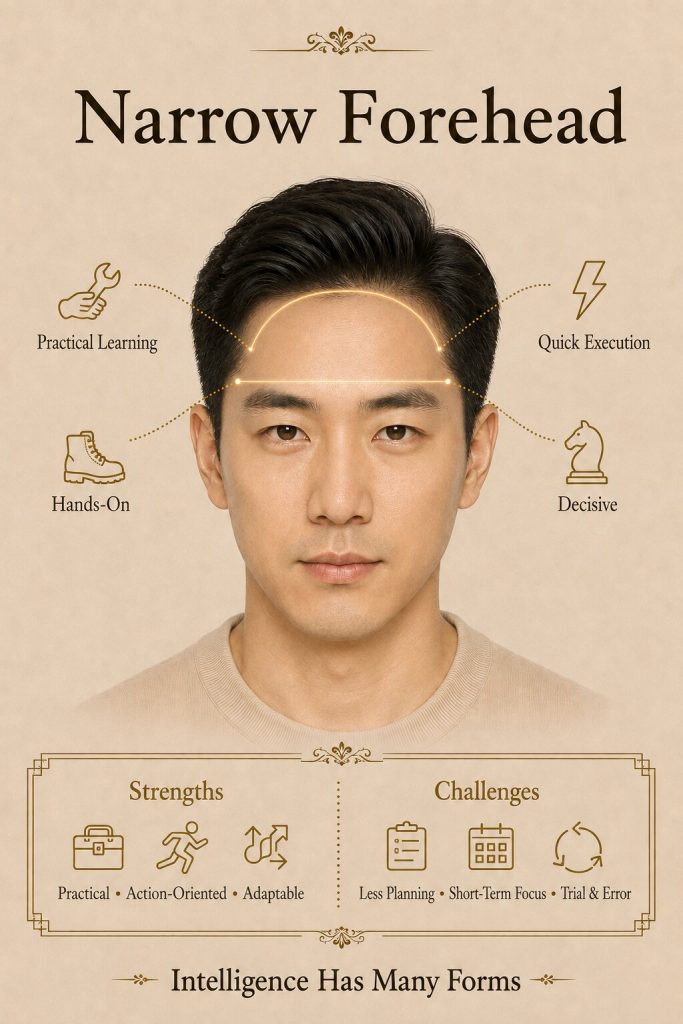
A narrow forehead does not indicate low intelligence.
Instead, many individuals learn through practical experience rather than theory.
Positive tendencies:
- Practical
- Hands-on
- Quick execution
- Decisive
Possible challenges:
- Less patience for detailed planning
- May overlook long-term consequences
- Learns after making mistakes
Many entrepreneurs possess average or narrow foreheads but succeed because of decisive execution.
High Forehead
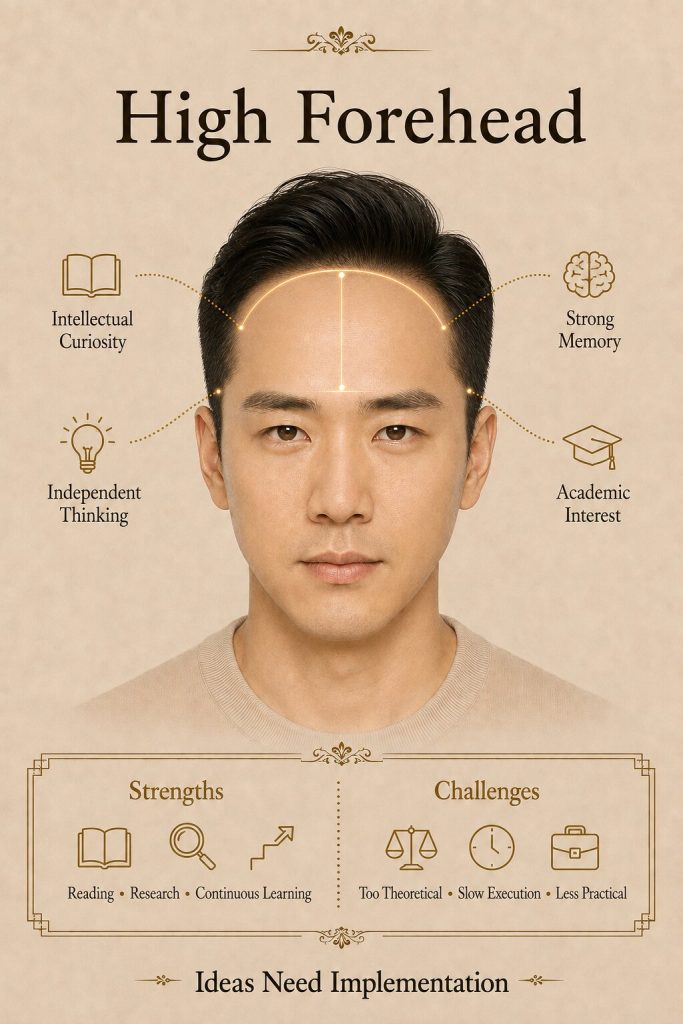
A high forehead often reflects:
- Intellectual curiosity
- Independent thinking
- Strong memory
- Academic interest
Such individuals usually enjoy reading, research and continuous learning.
Potential challenges:
- Living too much in theory
- Difficulty implementing ideas
- Becoming disconnected from practical realities
Low Forehead
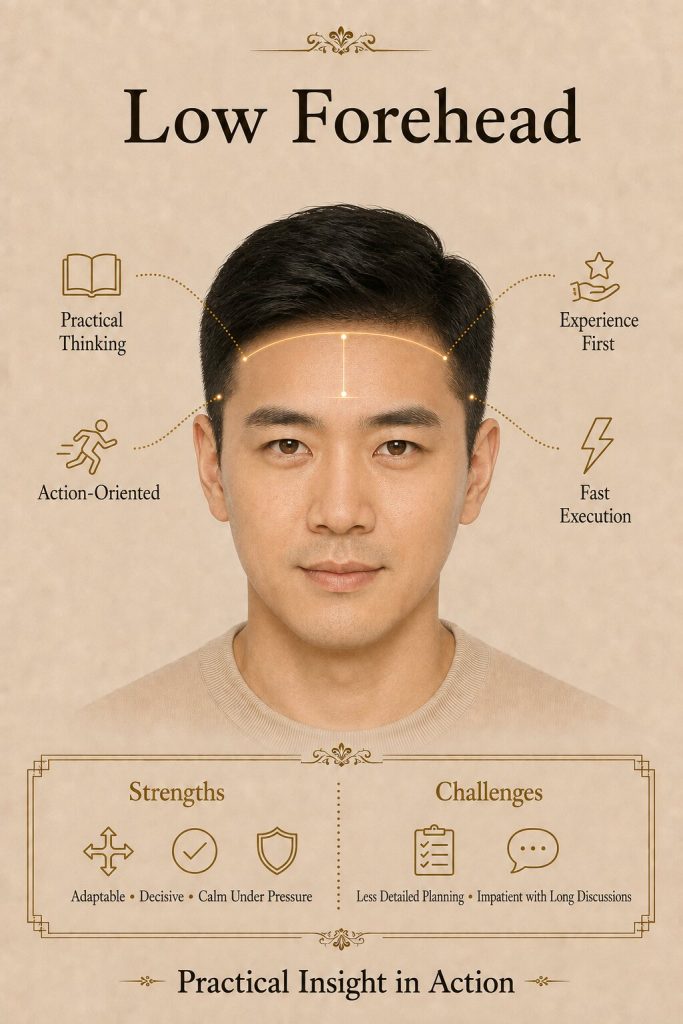
A lower forehead often indicates:
- Practical thinking
- Action-oriented personality
- Preference for experience over books
Advantages include:
- Fast execution
- Adaptability
- Confidence under pressure
Challenges:
- Less interest in detailed planning
- Can become impatient with lengthy discussions
Rounded Forehead
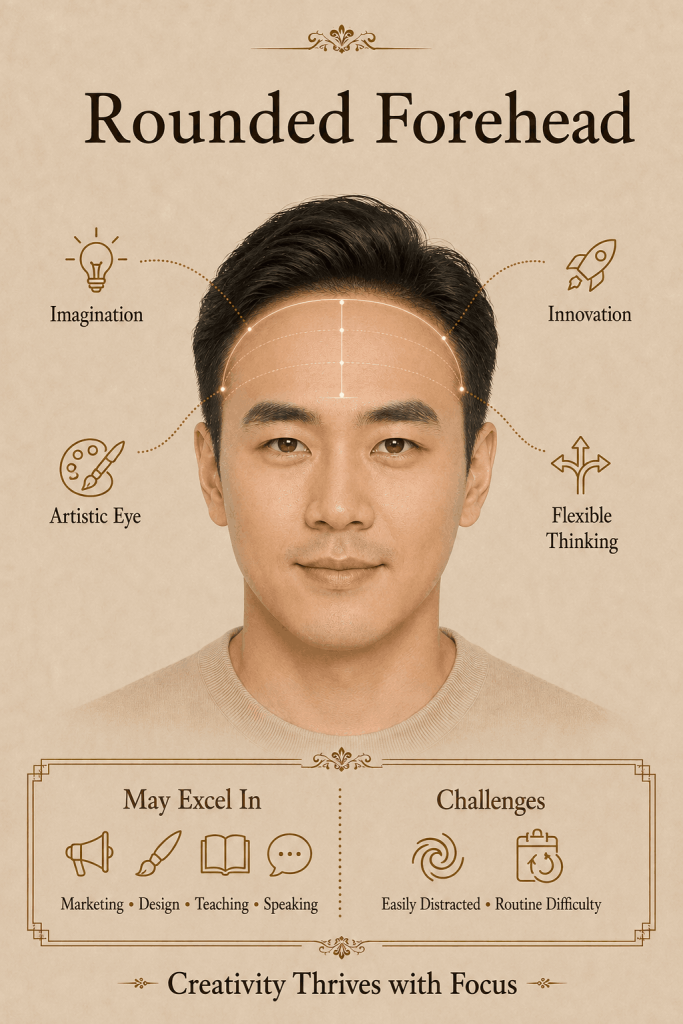
A rounded forehead usually reflects creativity.
These individuals often possess:
- Imagination
- Innovation
- Artistic appreciation
- Flexible thinking
They may excel in:
- Marketing
- Design
- Teaching
- Public speaking
Challenges:
- Easily distracted
- Difficulty maintaining routines
Square Forehead
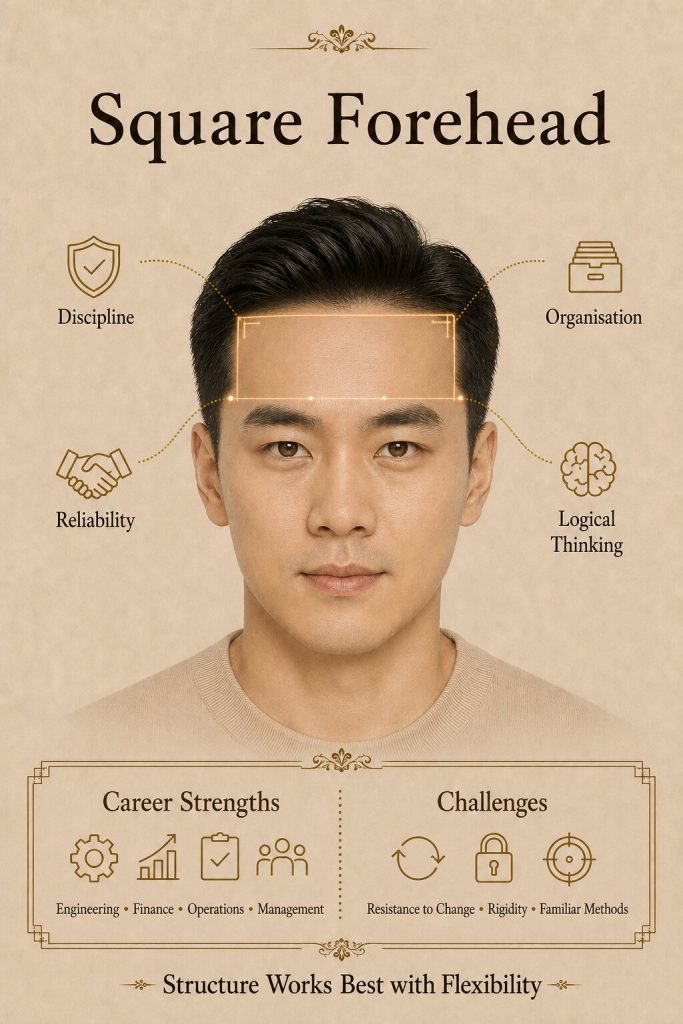
A square forehead often represents structure.
Positive tendencies:
- Discipline
- Organisation
- Reliability
- Logical thinking
Common career strengths include:
- Engineering
- Finance
- Operations
- Management
Challenges:
- Resistance to change
- Rigidity
- Preference for familiar methods
Sloping Forehead
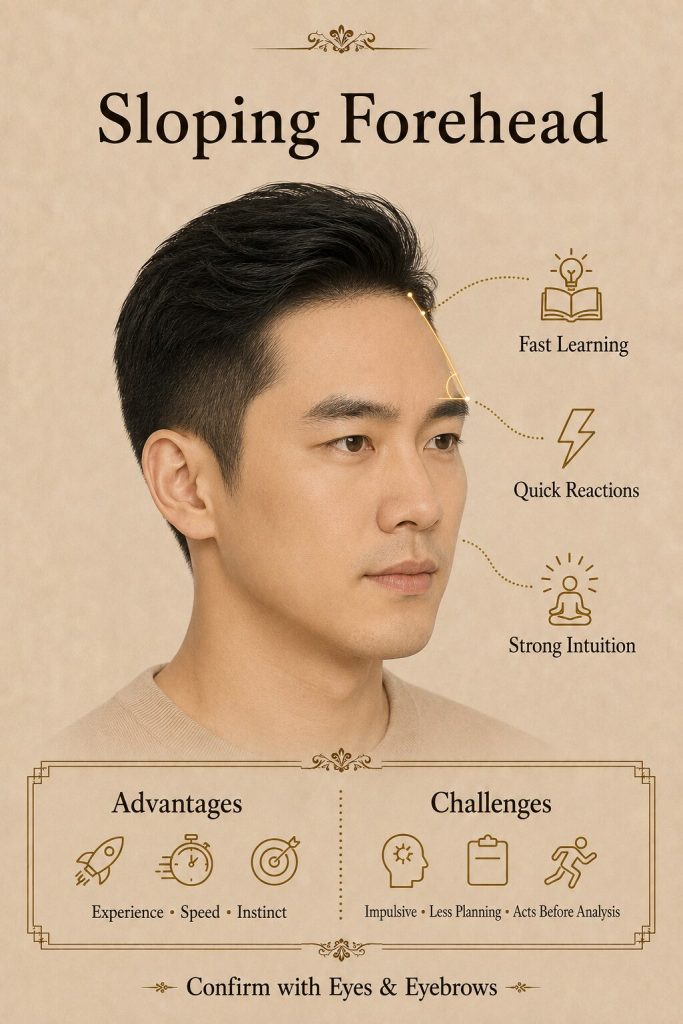
A forehead that slopes noticeably backward often suggests rapid decision making.
Advantages:
- Fast learner through experience
- Quick reactions
- Strong intuition
Challenges:
- Impulsiveness
- Less detailed planning
- Acting before analysing
Professional readers verify this using the eyes and eyebrows.
Flat Forehead
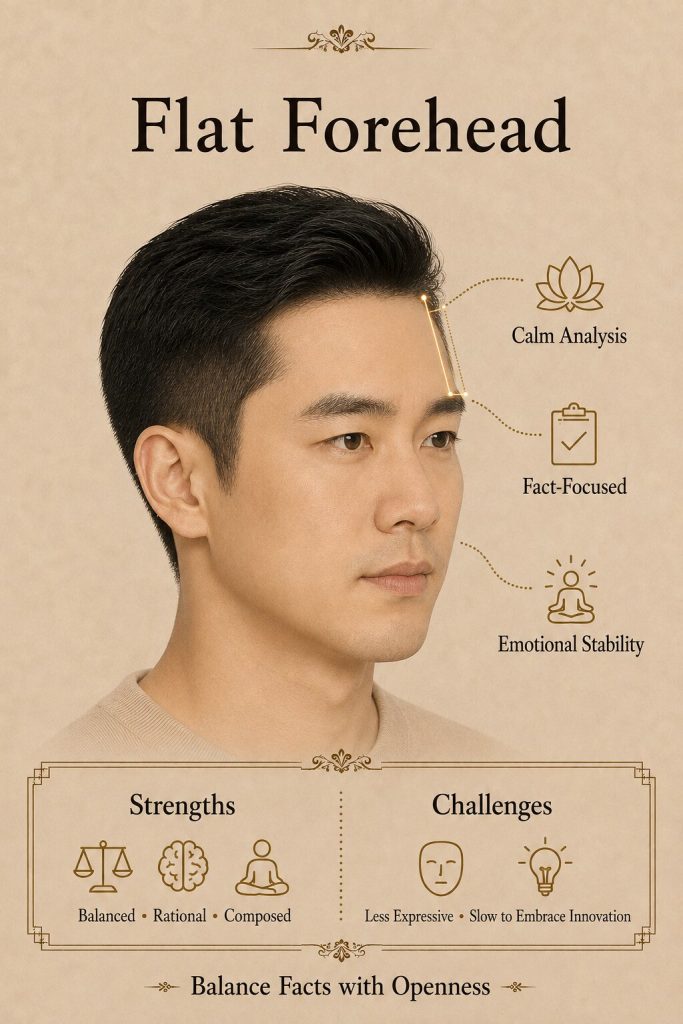
A flatter forehead often indicates balanced thinking.
The person may:
- Analyse situations calmly
- Prefer facts
- Remain emotionally stable
Challenges:
- May appear less expressive
- Sometimes slow to embrace innovation
Protruding Forehead
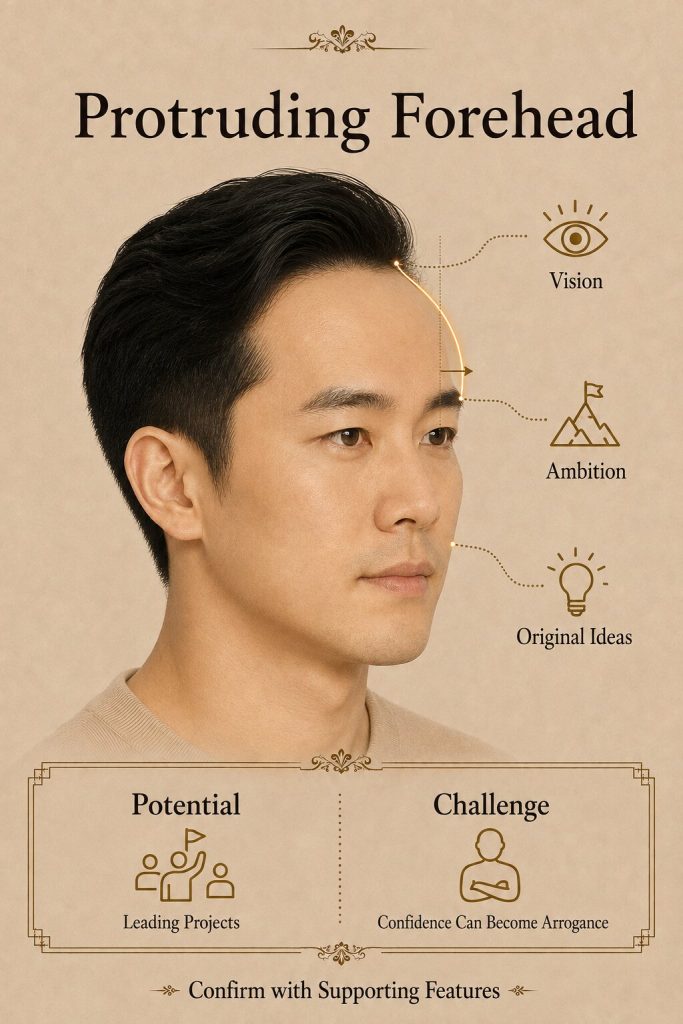
A prominently protruding forehead often suggests:
- Vision
- Ambition
- Original ideas
These individuals frequently enjoy leading projects.
Challenges:
- Confidence may become arrogance if unsupported by other favourable features.
Uneven Forehead
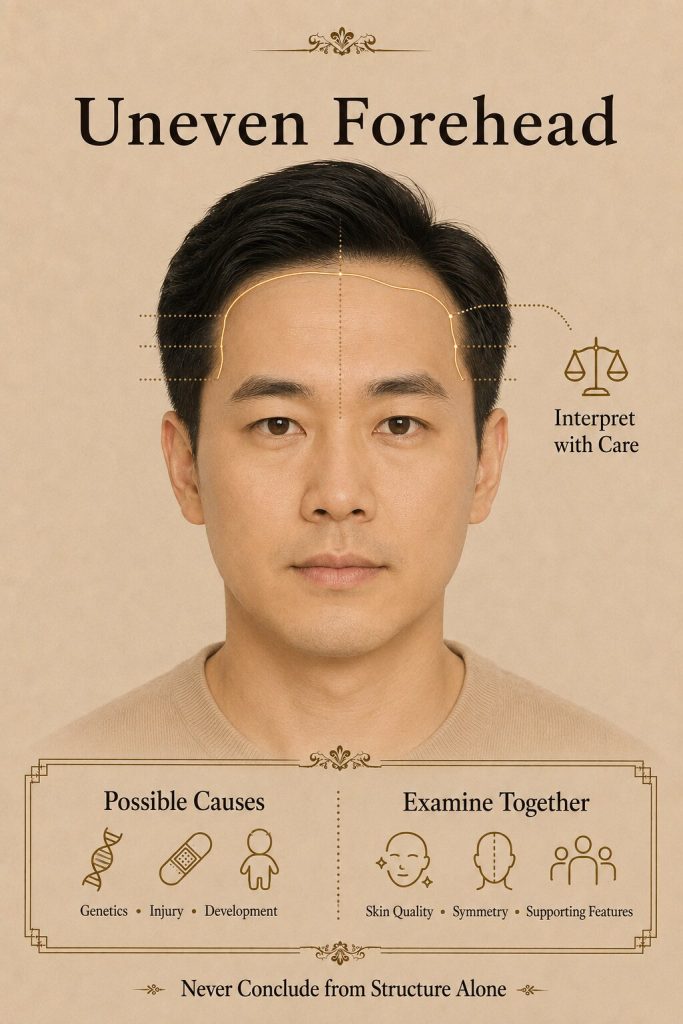
An uneven forehead requires careful interpretation.
Possible causes include:
- Genetics
- Injury
- Facial development
Professionals avoid making conclusions solely from uneven structure.
Instead they examine:
- Skin quality
- Symmetry
- Other supporting features
Forehead Height and Career
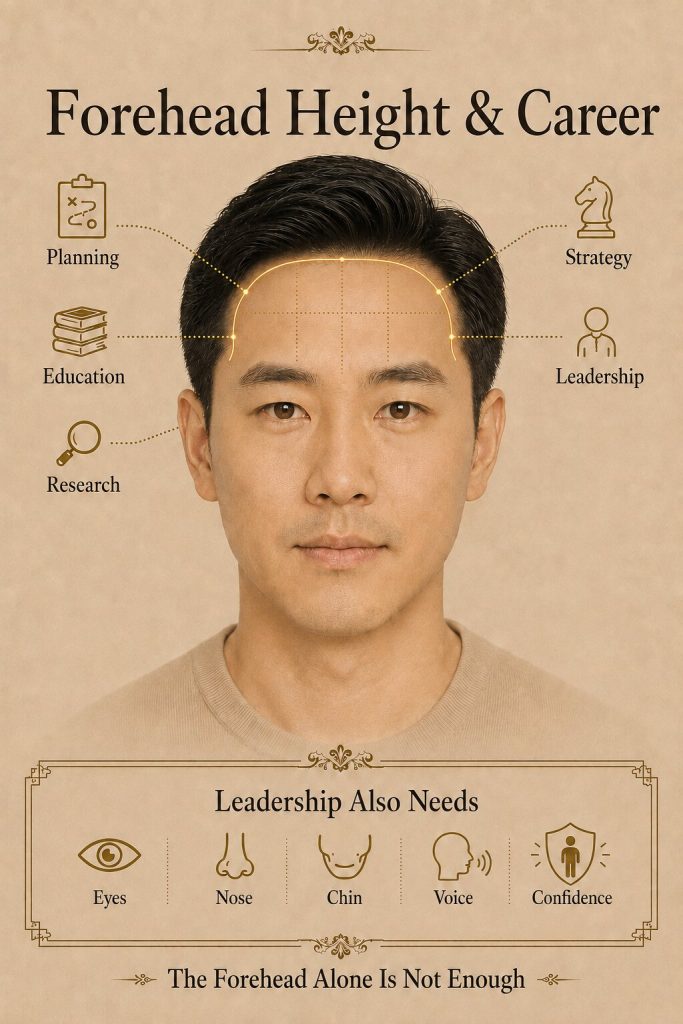
A well-developed forehead often supports careers requiring:
- Planning
- Strategy
- Education
- Research
- Leadership
However, leadership also depends on:
- Eyes
- Nose
- Chin
- Voice
- Confidence
The forehead alone cannot determine leadership ability.
Forehead and Wealth
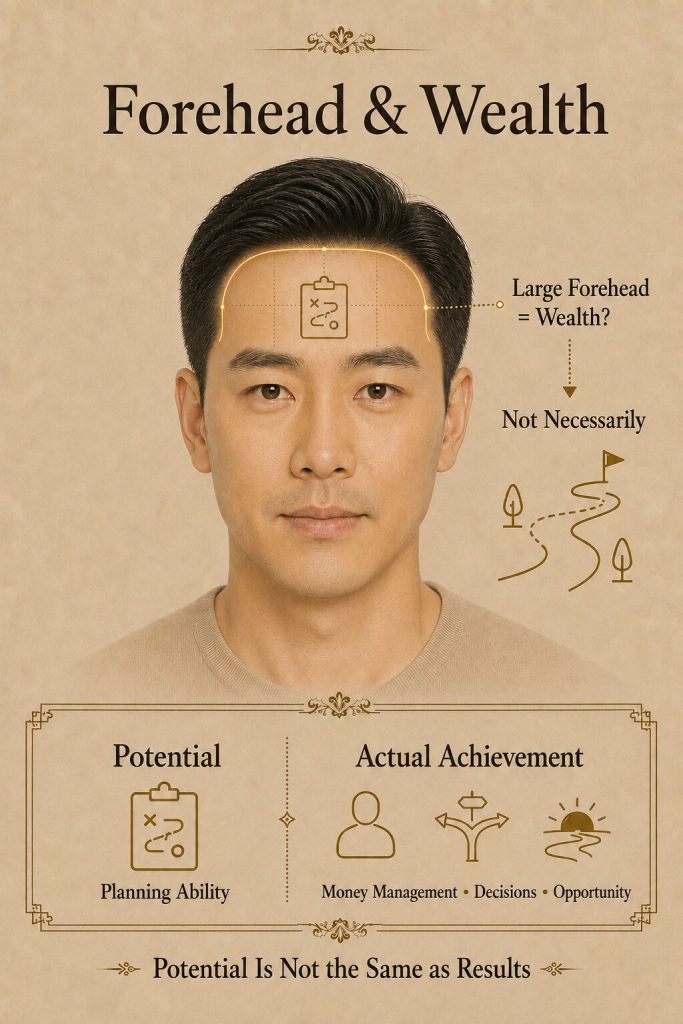
Many people ask:
“Does a large forehead mean wealth?”
The answer is:
Not necessarily.
A favourable forehead may indicate stronger planning ability.
Planning may contribute to financial success.
However:
Poor money management can still lead to financial difficulties.
Professional Face Reading always separates:
Potential
from
Actual achievement.
Forehead and Relationships
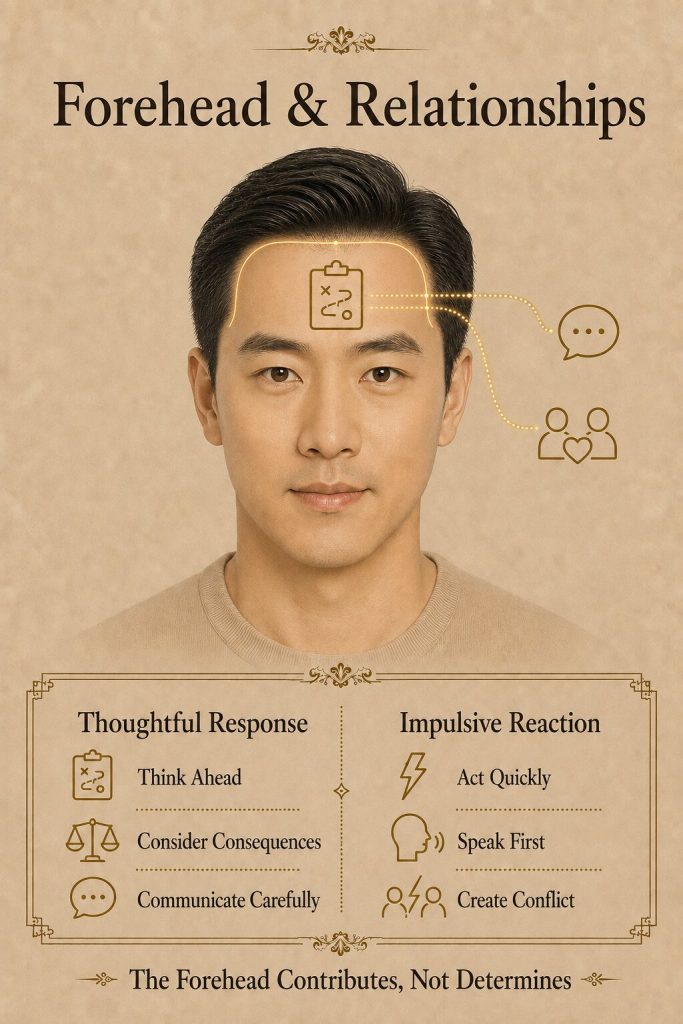
The forehead can influence relationships through personality.
Someone with excellent planning ability may:
- Think ahead
- Consider consequences
- Communicate carefully
Another person may:
- Act impulsively
- Speak without thinking
- Create unnecessary conflict
The forehead contributes to these behavioural tendencies.
Hairline
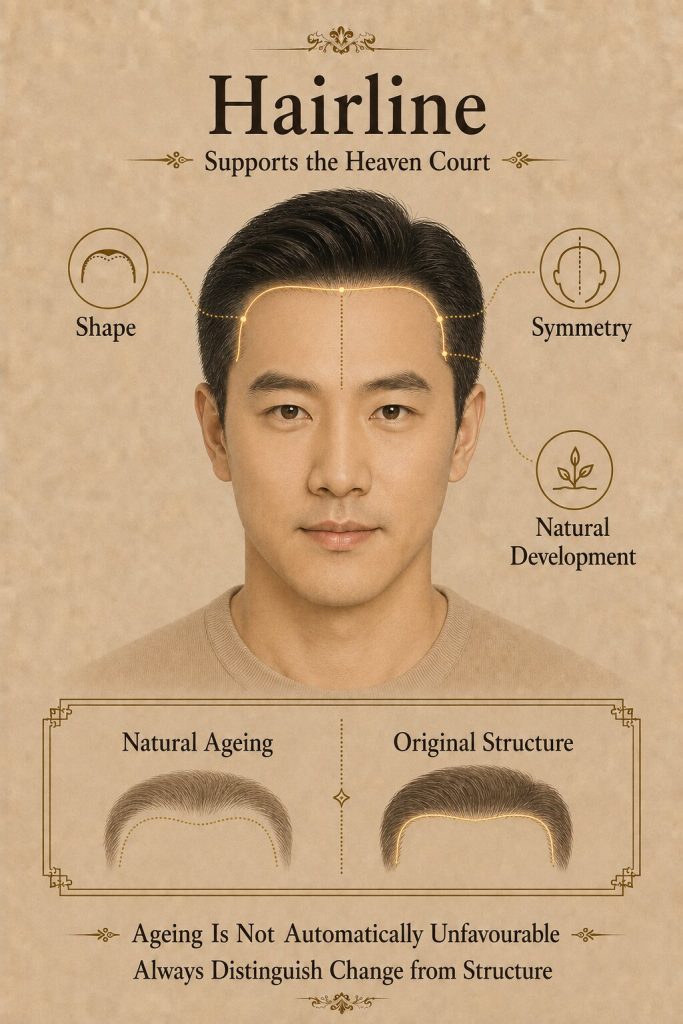
The hairline deserves separate observation.
A balanced hairline often supports a balanced Heaven Court.
Professional readers examine:
- Shape
- Symmetry
- Natural development
A receding hairline caused by ageing should not automatically be interpreted as an unfavourable sign.
Always distinguish between:
Natural ageing
and
Original facial structure.
Scars on the Forehead
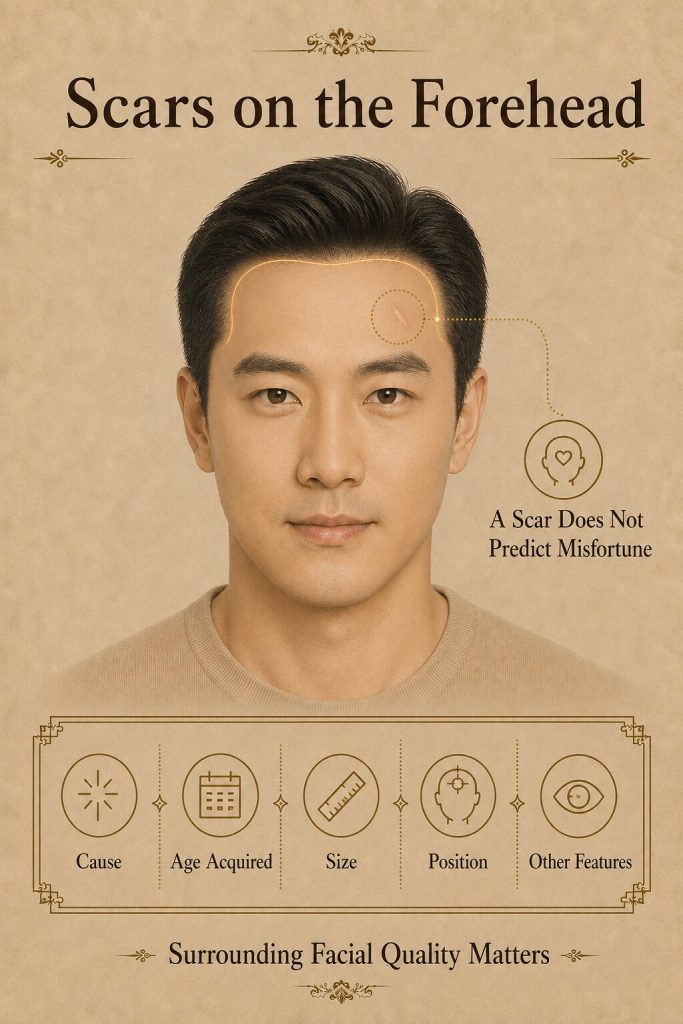
Many students ask about scars.
Professional interpretation depends on:
- Cause
- Age when acquired
- Size
- Position
- Other facial features
A scar does not automatically predict misfortune.
Many successful people have visible scars.
The surrounding facial quality is equally important.
Moles on the Forehead
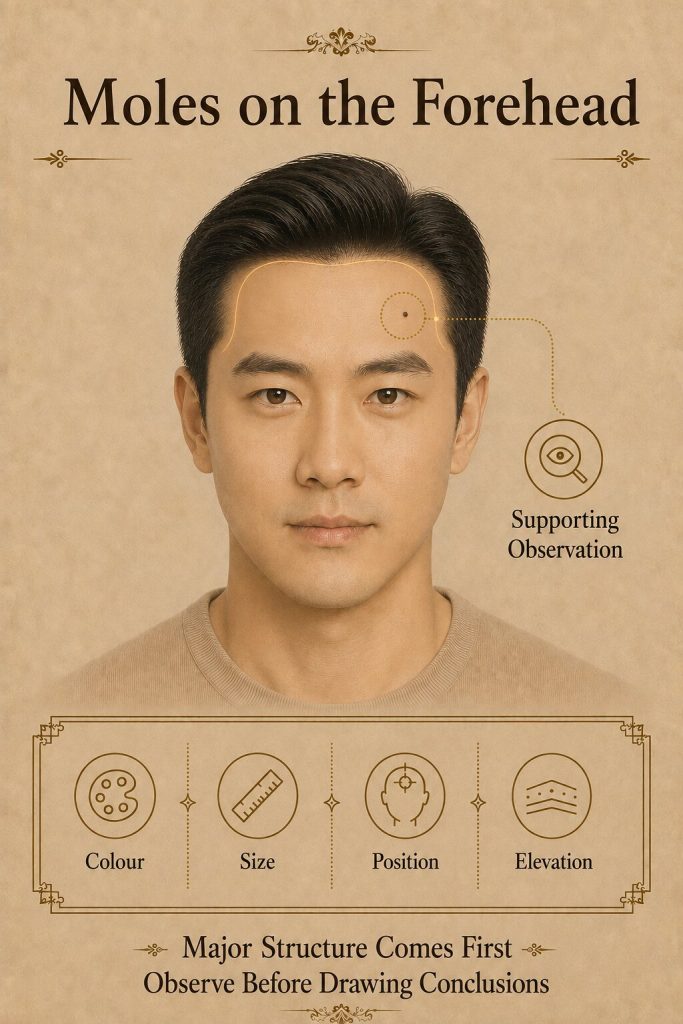
Moles are considered supporting observations.
They should never override major structural features.
Professionals consider:
- Colour
- Size
- Position
- Elevation
before drawing conclusions.
Colour of the Forehead
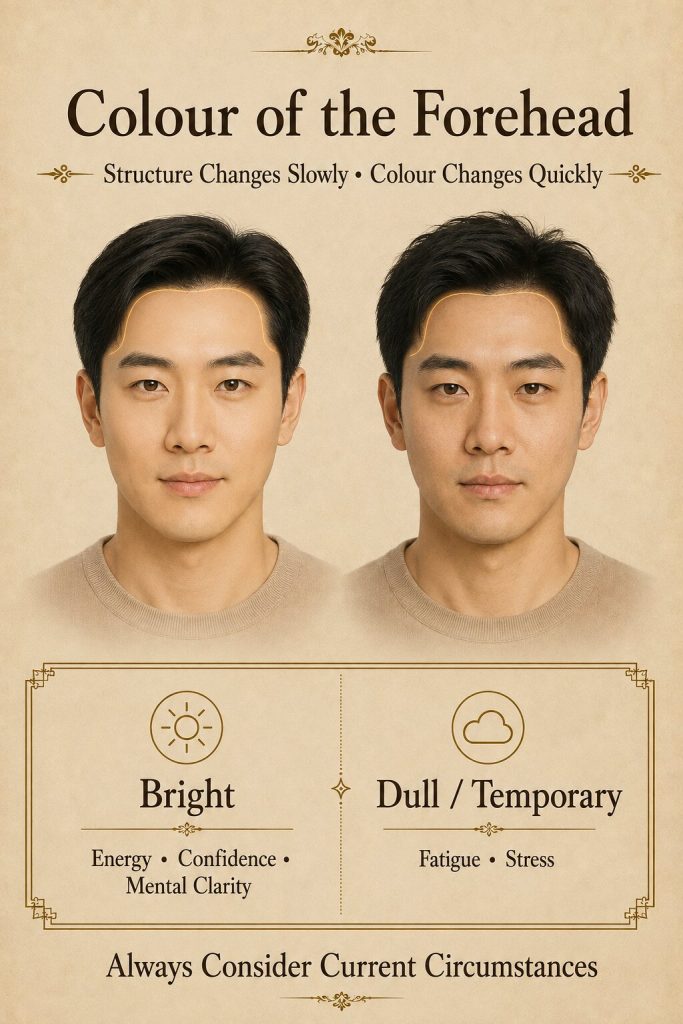
Structure changes slowly.
Colour changes quickly.
Professional readers therefore observe complexion carefully.
A bright forehead often reflects:
- Good energy
- Confidence
- Mental clarity
A dull forehead may indicate temporary fatigue or stress.
Observation should always consider current circumstances.
Wrinkles on the Forehead
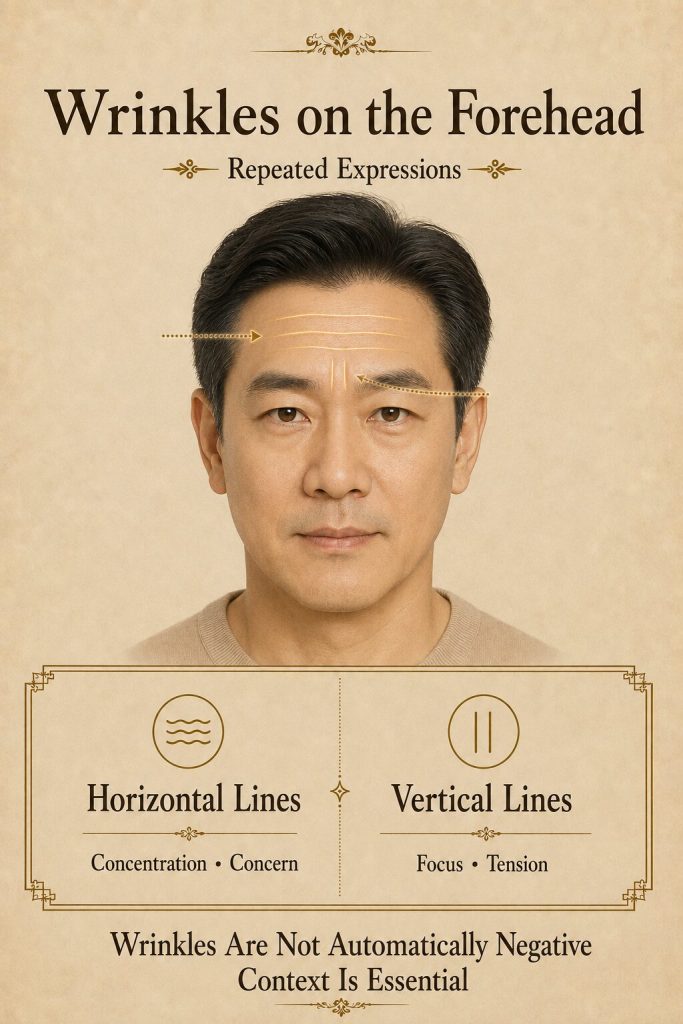
Wrinkles often reflect repeated expressions.
Horizontal lines may indicate years of concentration or concern.
Vertical lines may reflect habitual focus or tension.
Wrinkles alone should never be interpreted negatively.
Context is essential.
Common Beginner Mistakes
Incorrect:
Wide forehead = rich.
Correct:
A wide forehead may indicate stronger planning ability.
Whether that planning leads to wealth depends on:
- Discipline
- Opportunities
- Financial habits
- Decisions
- Other facial features
Incorrect:
Scar = bad luck.
Correct:
A scar is only one observation.
The complete facial structure determines its significance.
Incorrect:
High forehead = genius.
Correct:
Learning ability, memory and thinking style must all be supported by other features.
Dougles Chan’s Professional Observation
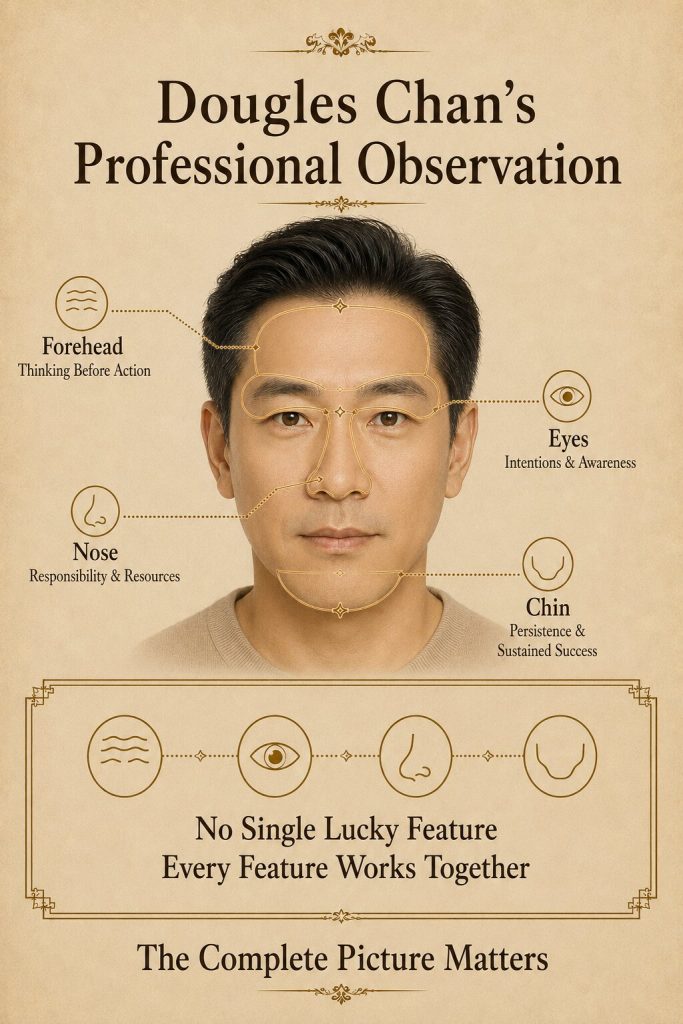
The forehead tells us how a person thinks before taking action.
The nose often shows how they manage responsibility and resources.
The eyes reveal their true intentions and awareness.
The chin reflects their persistence and ability to sustain success.
If only one feature is strong while the others are weak, the person’s potential may not be fully realised.
Professional Face Reading is never about finding a single “lucky” feature.
It is about understanding how every feature works together to form a complete picture of the individual.
The Importance of Eyebrows
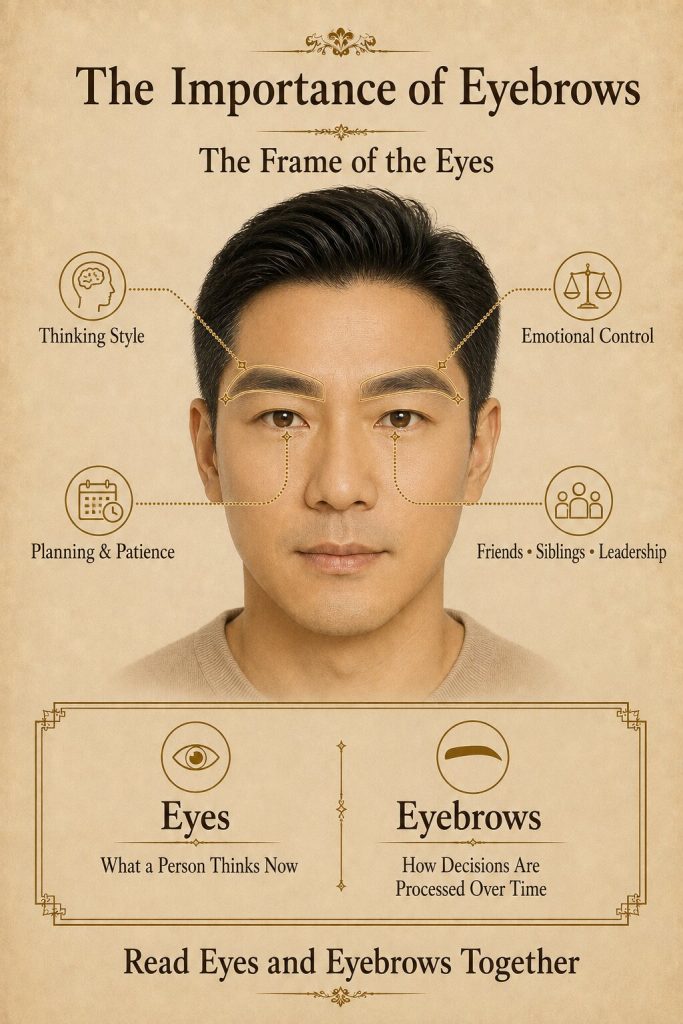
Many beginners pay attention to the eyes but overlook the eyebrows.
In professional Face Reading, the eyebrows provide valuable information about:
- Thinking style
- Emotional control
- Planning ability
- Friendships
- Siblings
- Leadership style
- Patience
- Character
The eyebrows are like the “frame” protecting the eyes.
While the eyes reveal what a person is thinking now, the eyebrows often reveal how they naturally process decisions over time.
The Golden Rule of Reading Eyebrows
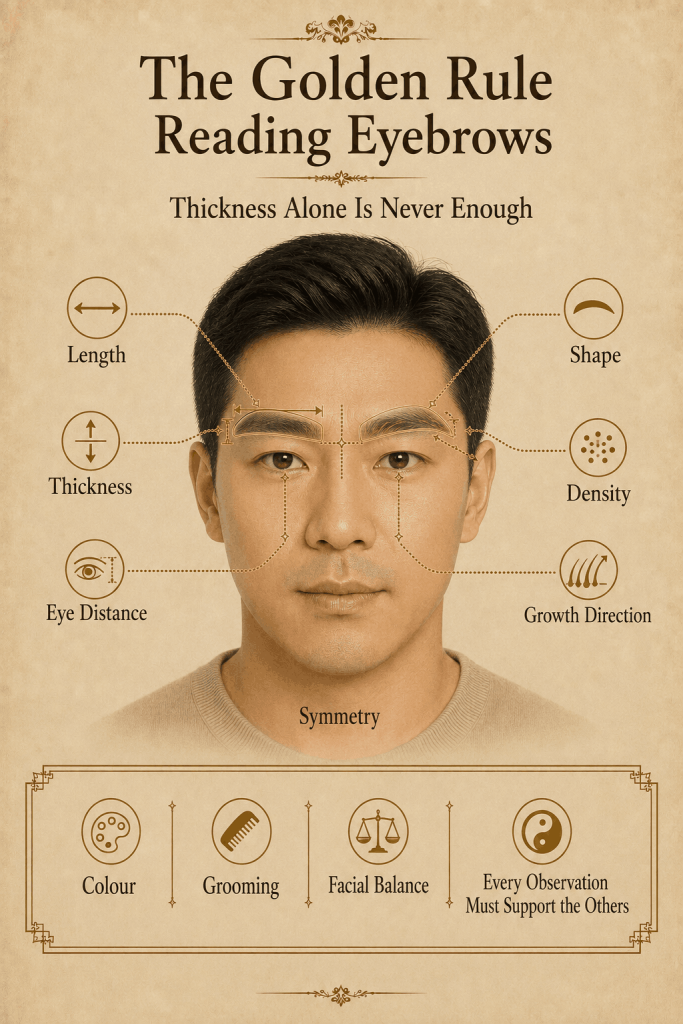
Professional Face Reading never judges eyebrows by thickness alone.
Instead, observe:
- Length
- Thickness
- Shape
- Density
- Direction of growth
- Distance from the eyes
- Symmetry
- Colour
- Grooming
- Balance with the rest of the face
Every observation should support one another.
Ideal Eyebrows
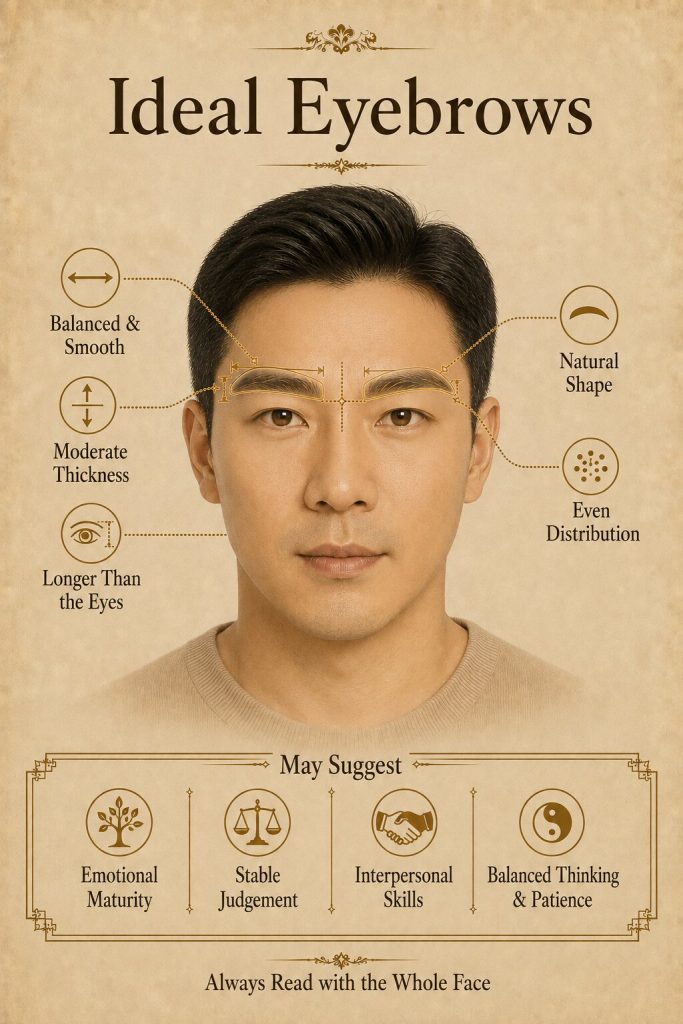
Traditionally, favourable eyebrows are:
- Balanced
- Smooth
- Naturally shaped
- Moderate thickness
- Evenly distributed
- Slightly longer than the eyes
These often suggest:
- Emotional maturity
- Stable judgement
- Good interpersonal skills
- Balanced thinking
- Reasonable patience
Thick Eyebrows
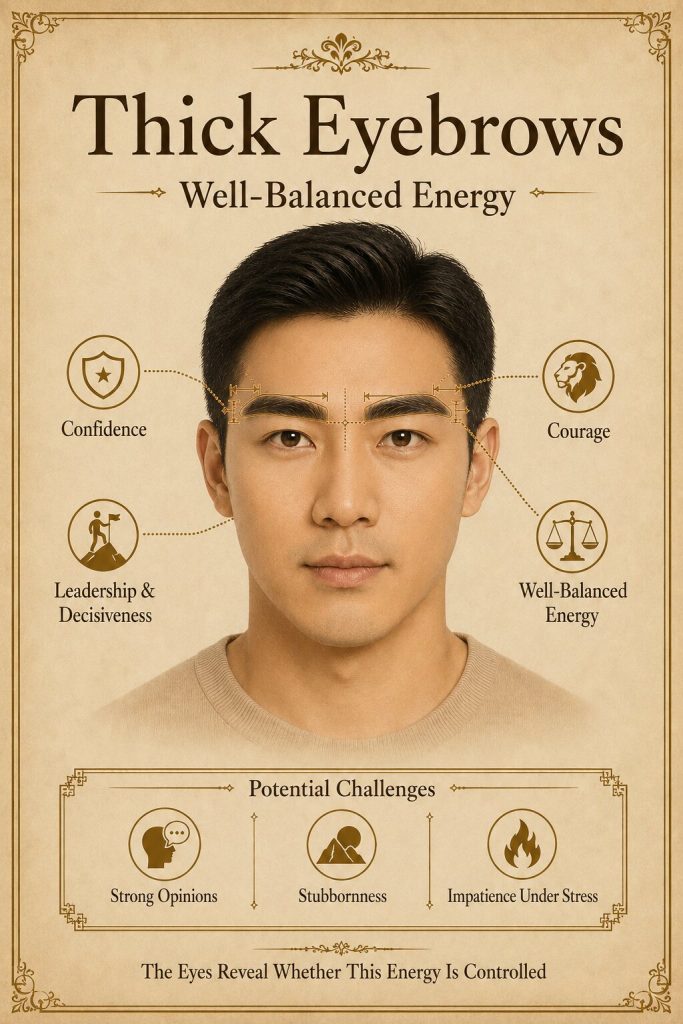
One of the most misunderstood features.
Many people immediately assume:
“Thick eyebrows mean a bad temper.”
This is incorrect.
Well-balanced thick eyebrows may indicate:
- Strong energy
- Confidence
- Courage
- Leadership
- Decisiveness
- Protective nature
Potential challenges:
- Stubbornness
- Strong opinions
- Less willingness to compromise
- Can become impatient under stress
The eyes must always confirm whether this energy is controlled or excessive.
Thin Eyebrows
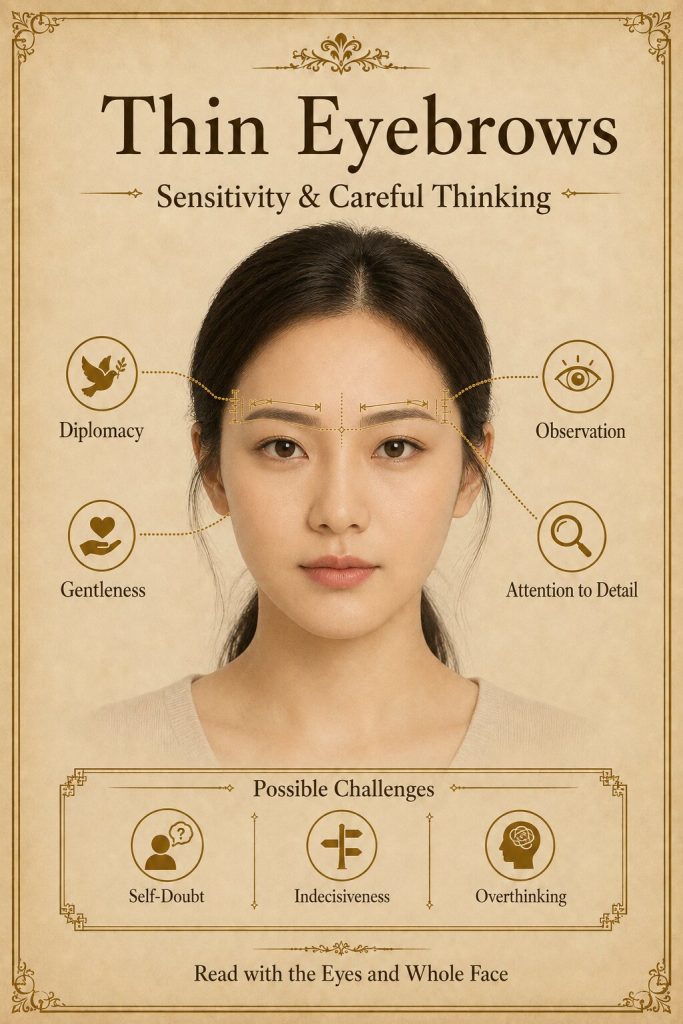
Thin eyebrows often indicate:
- Sensitivity
- Careful thinking
- Diplomacy
- Gentleness
- Observation
Possible strengths:
- Good communication
- Attention to detail
- Emotional awareness
Possible challenges:
- Self-doubt
- Indecisiveness
- Avoiding confrontation
- Overthinking
Long Eyebrows
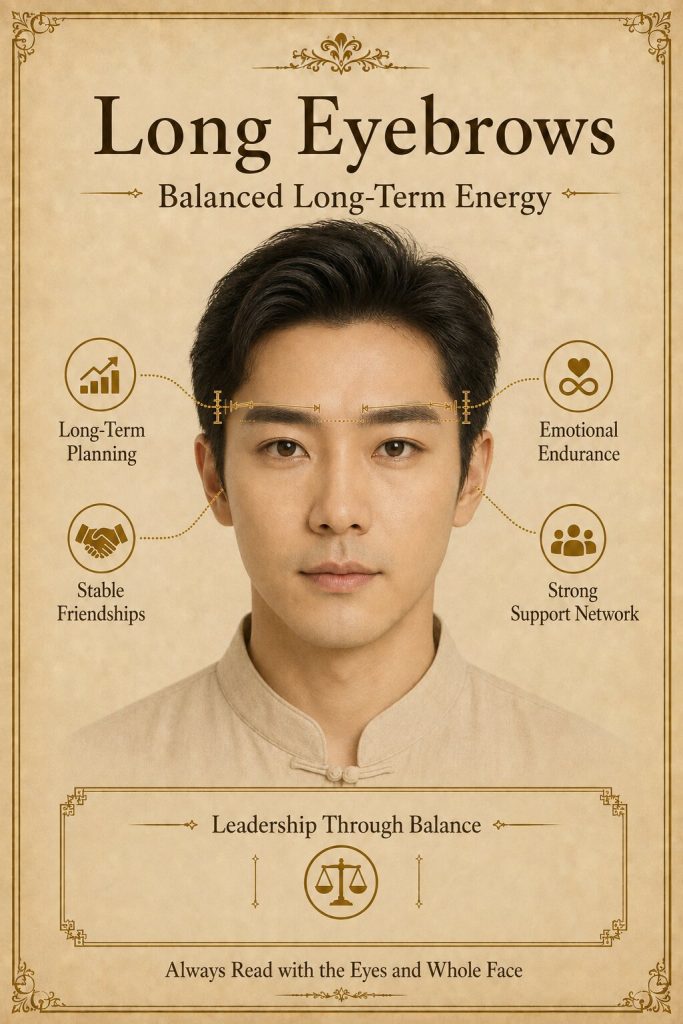
Long eyebrows are generally favourable.
They often suggest:
- Long-term planning
- Stable friendships
- Good emotional endurance
- Strong support network
Many experienced leaders possess balanced, longer eyebrows.
Short Eyebrows
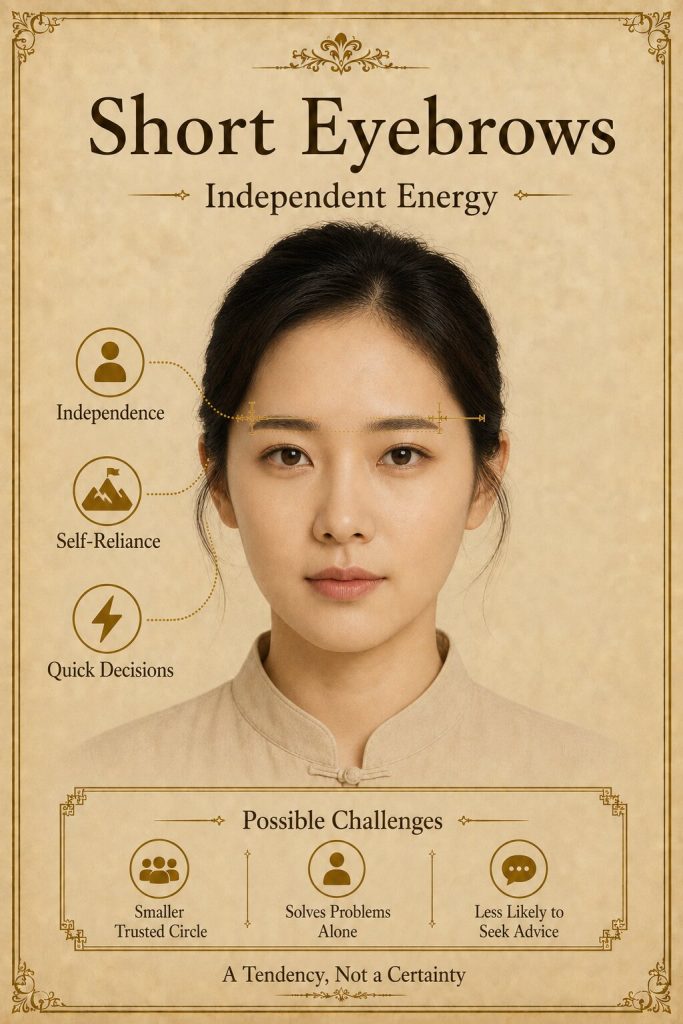
Short eyebrows may indicate:
- Independence
- Self-reliance
- Quick decision making
Challenges:
- Smaller trusted circle
- Prefers solving problems alone
- Less likely to seek advice
Again, this is a tendency, not a certainty.
Straight Eyebrows
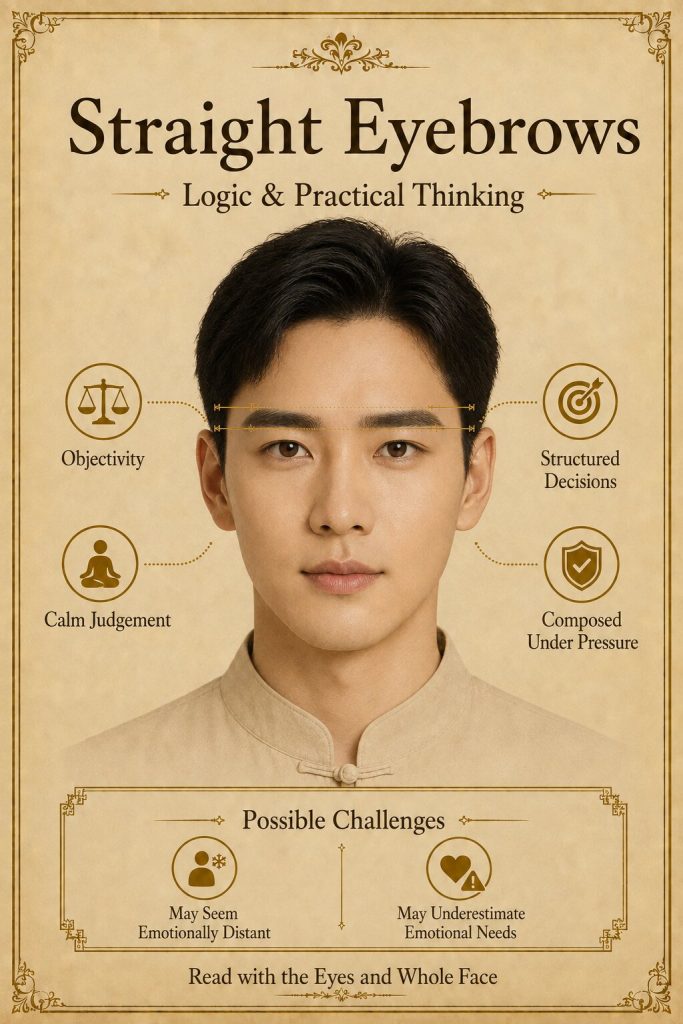
Straight eyebrows often reflect:
- Logic
- Objectivity
- Practical thinking
- Calm judgement
These individuals usually:
- Prefer facts over emotions
- Make structured decisions
- Remain composed under pressure
Possible challenges:
- May appear emotionally distant
- Can underestimate emotional needs
Curved Eyebrows
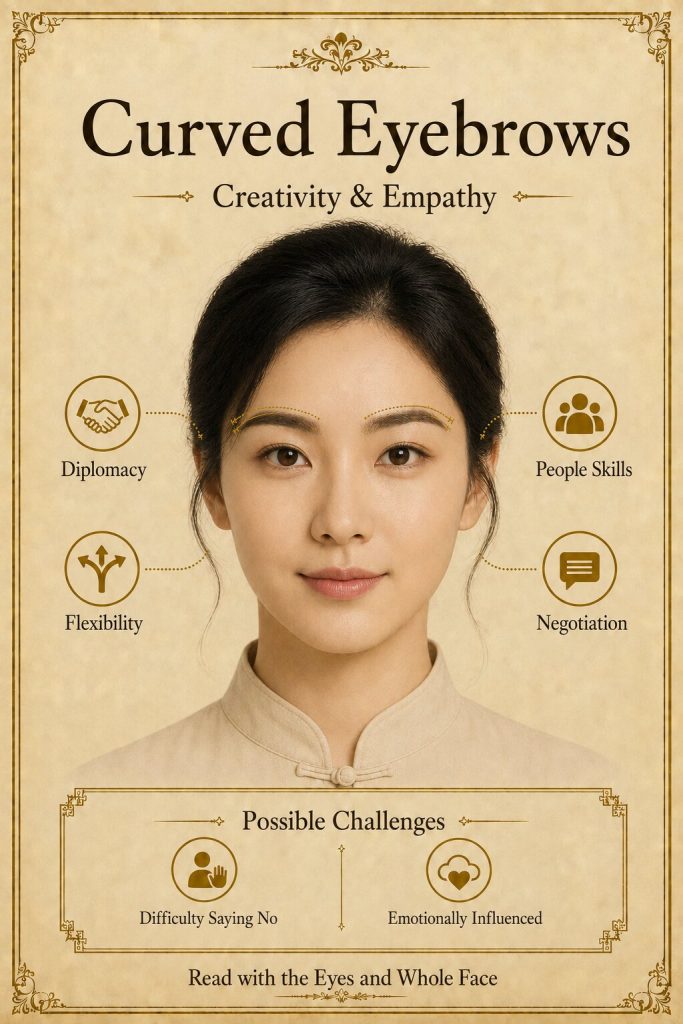
Curved eyebrows generally indicate:
- Creativity
- Empathy
- Diplomacy
- Flexibility
Strengths:
- Excellent people skills
- Good negotiation ability
- Builds relationships easily
Challenges:
- Difficulty saying “no”
- May become emotionally influenced
High Eyebrows
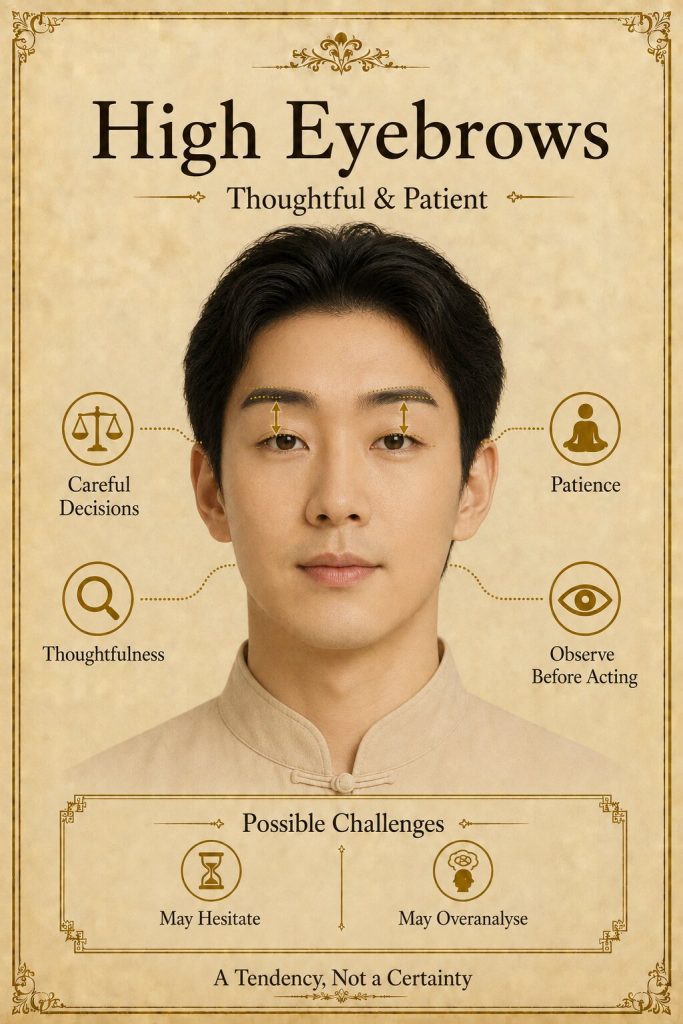
Eyebrows positioned further from the eyes often suggest:
- Careful decision making
- Thoughtfulness
- Patience
- Observation before action
Challenges:
- May hesitate
- Sometimes overanalyse situations
Low Eyebrows
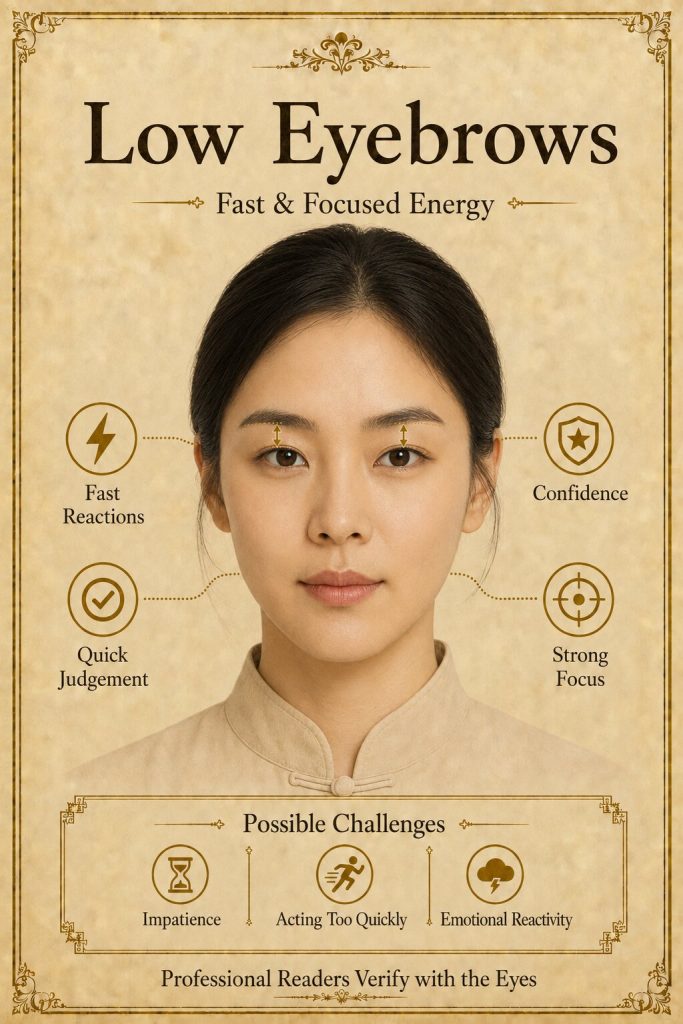
Eyebrows closer to the eyes often indicate:
- Fast reactions
- Quick judgement
- Confidence
- Strong focus
Challenges:
- Impatience
- Acting too quickly
- Becoming emotionally reactive
Professional readers verify this using the eyes.
Wide Space Between Eyebrows
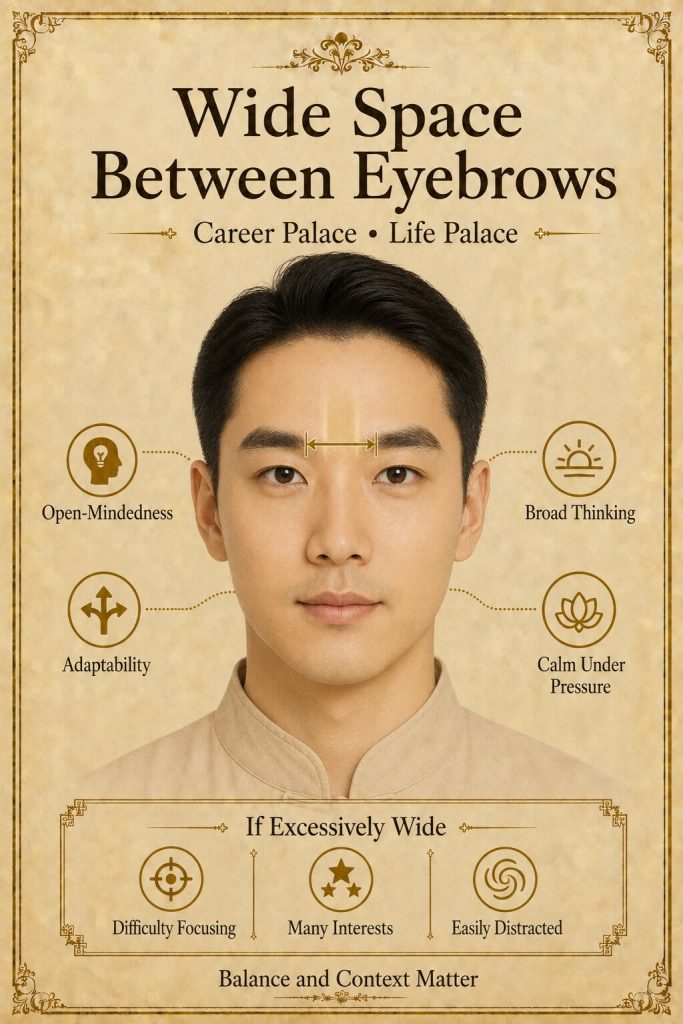
The area between the eyebrows is often called the Career Palace or Life Palace in traditional face reading.
A balanced, open space may suggest:
- Open-mindedness
- Good adaptability
- Broad thinking
- Calm under pressure
If excessively wide, it may indicate:
- Difficulty focusing
- Too many interests
- Easily distracted
Narrow Space Between Eyebrows
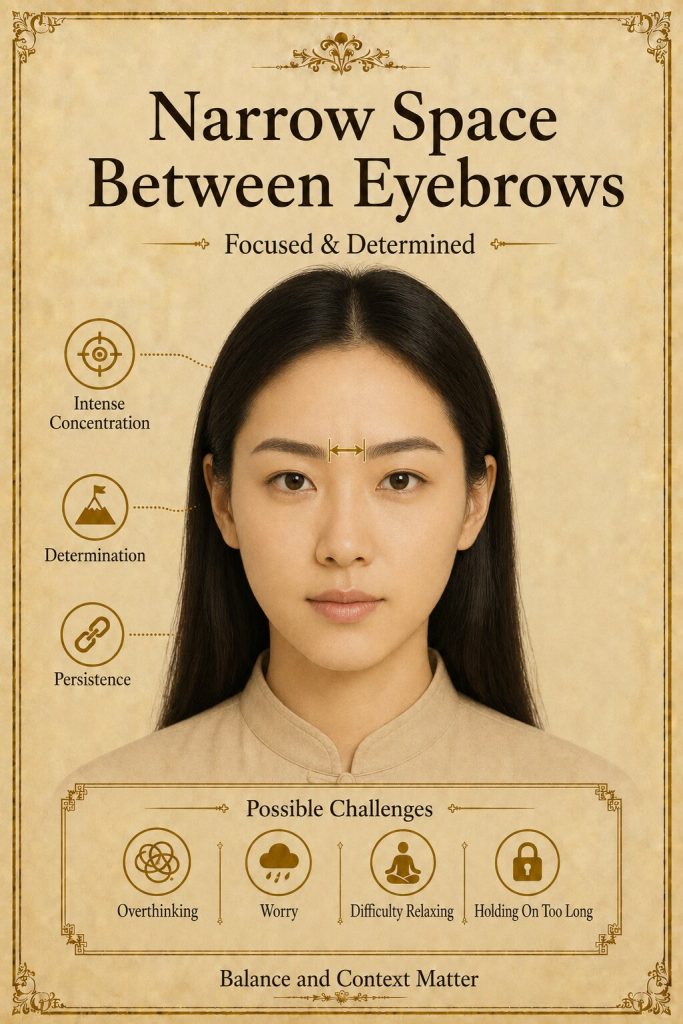
A narrower space may indicate:
- Intense concentration
- Determination
- Persistence
Possible challenges:
- Overthinking
- Worry
- Difficulty relaxing
- Holding onto problems too long
Bushy Eyebrows
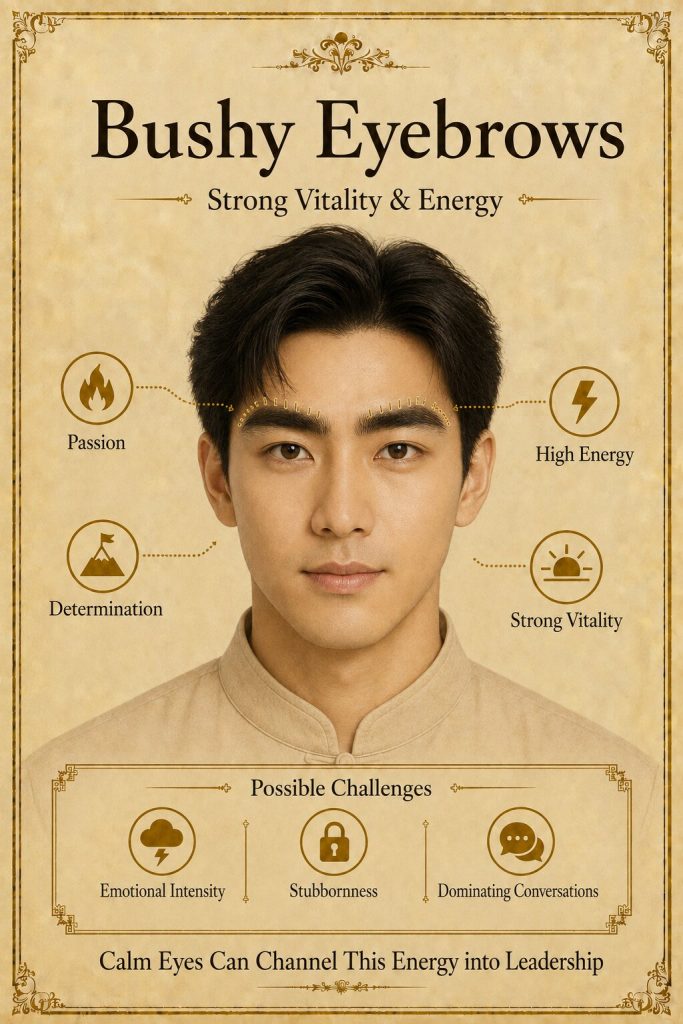
Bushy eyebrows often indicate:
- Strong vitality
- Passion
- Determination
- High energy
Challenges:
- Emotional intensity
- Stubbornness
- Dominating conversations
If balanced by calm eyes, this energy can become excellent leadership.
Sparse Eyebrows
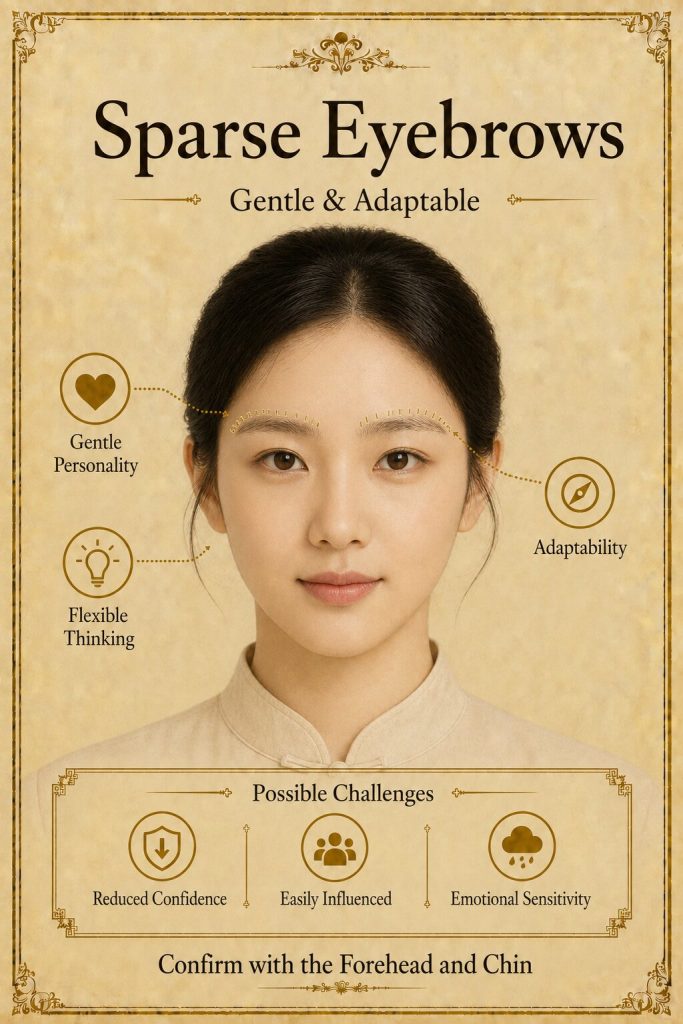
Sparse eyebrows may suggest:
- Gentle personality
- Flexible thinking
- Adaptability
Challenges:
- Reduced confidence
- Easily influenced
- Emotional sensitivity
Professionals always confirm this using the forehead and chin.
Broken Eyebrows
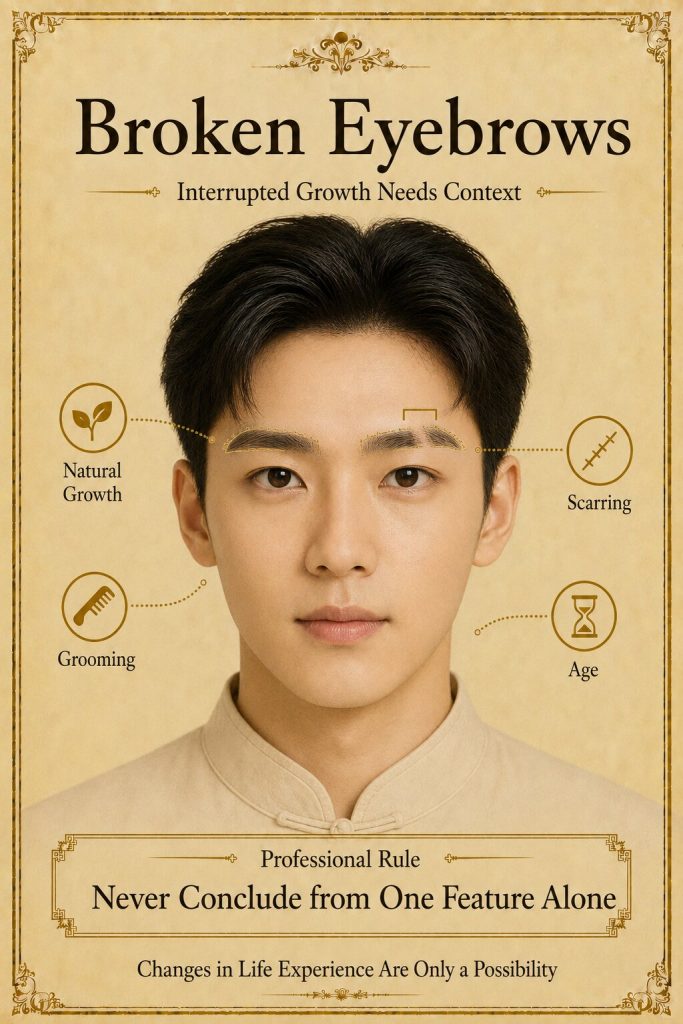
Interrupted eyebrow growth may indicate changes in life experiences.
Professional readers never make conclusions based solely on broken eyebrows.
They first determine:
- Natural growth
- Scarring
- Grooming
- Age
Uneven Eyebrows
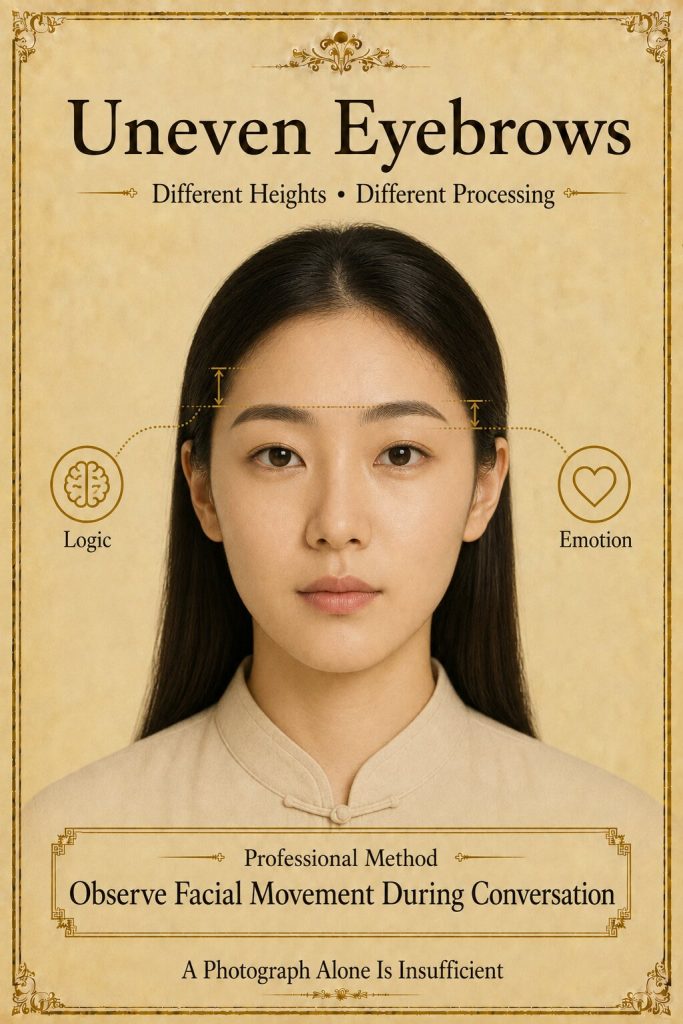
Different eyebrow heights may suggest different ways of processing information.
One side may represent:
- Logic
The other:
- Emotion
Professional interpretation requires observing facial movement during conversation.
A photograph alone is insufficient.
Eyebrow Colour
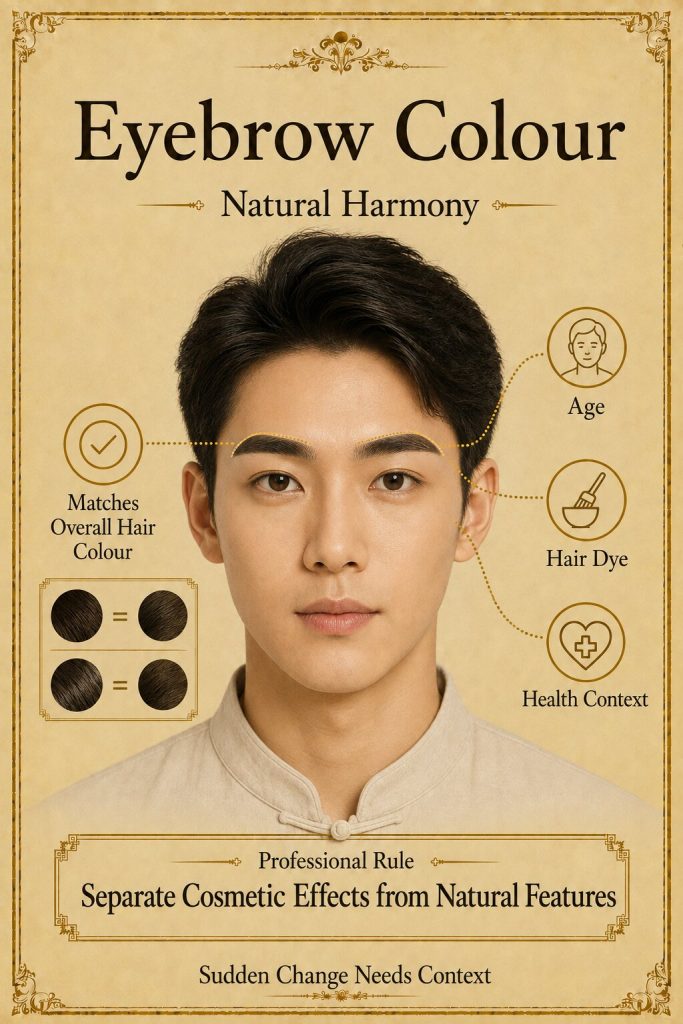
Healthy eyebrows usually match the overall hair colour.
Sudden changes may simply reflect:
- Age
- Hair dye
- Medical conditions
Professionals separate cosmetic effects from natural facial characteristics.
Groomed Eyebrows
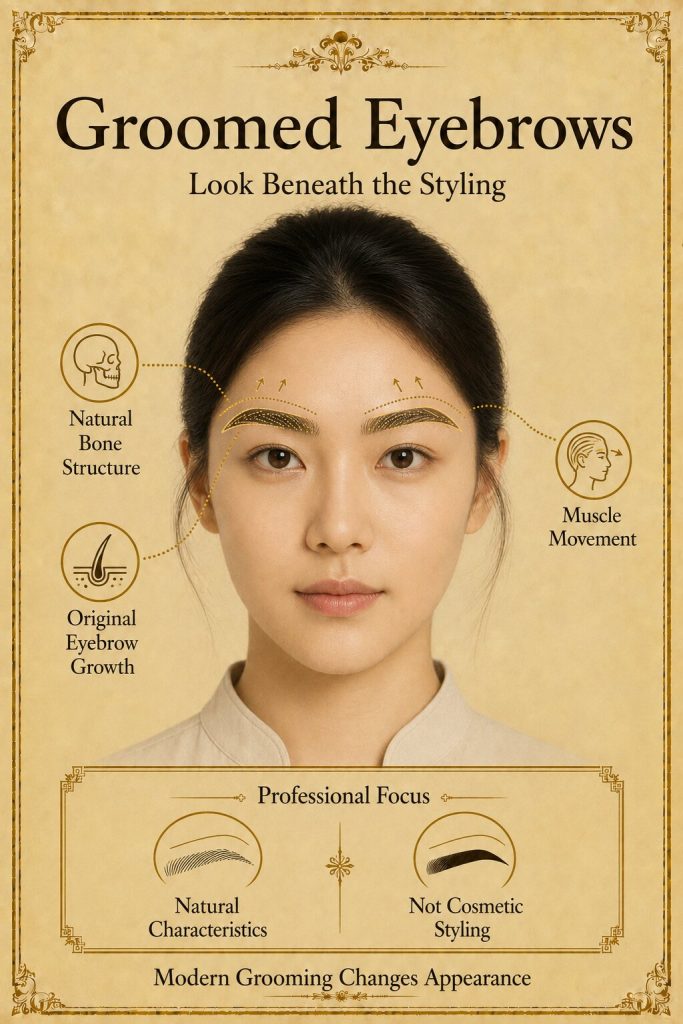
Modern eyebrow grooming has changed traditional observations.
Professional readers focus primarily on:
- Natural bone structure
- Original eyebrow growth
- Muscle movement
Rather than cosmetic styling.
Eyebrows and Leadership
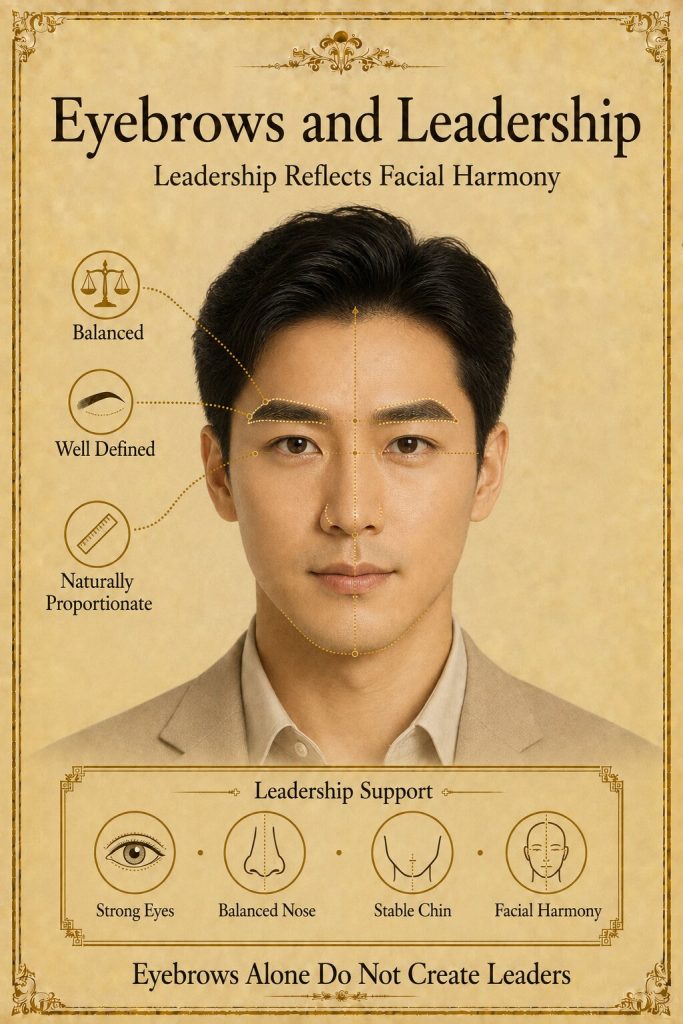
Good leaders often display eyebrows that are:
- Balanced
- Well defined
- Naturally proportionate
Leadership is further supported by:
- Strong eyes
- Balanced nose
- Stable chin
- Good facial harmony
Eyebrows alone do not create leaders.
Eyebrows and Friendships
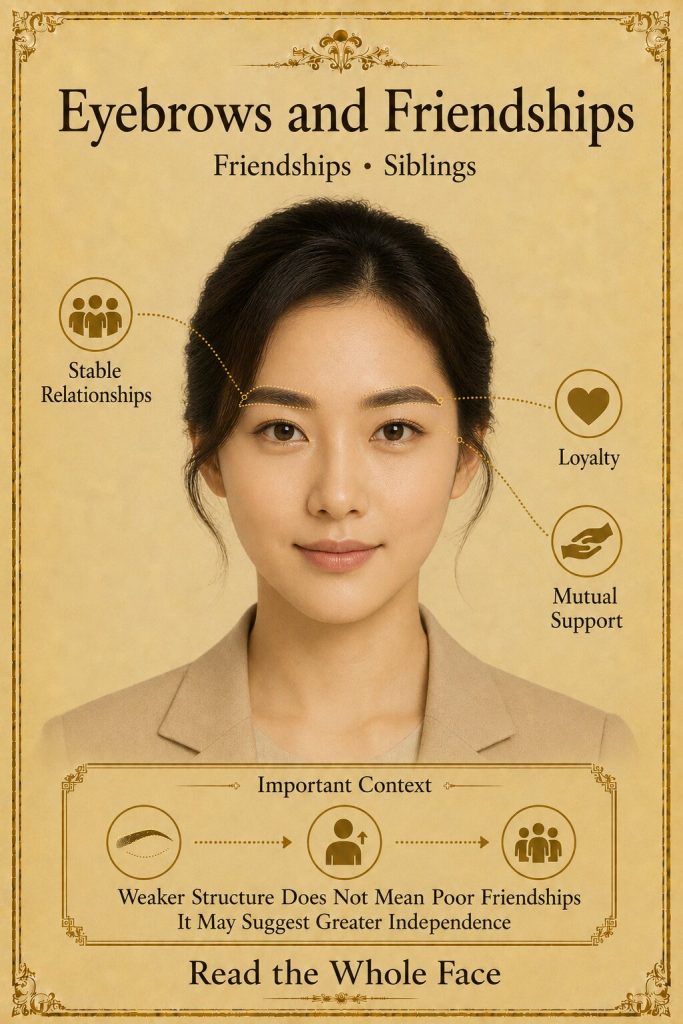
Traditionally, eyebrows are associated with friendships and siblings.
Healthy eyebrows may indicate:
- Stable relationships
- Loyalty
- Mutual support
Weak eyebrow structure does not necessarily mean poor friendships.
It may simply suggest greater independence.
Eyebrows and Decision Making
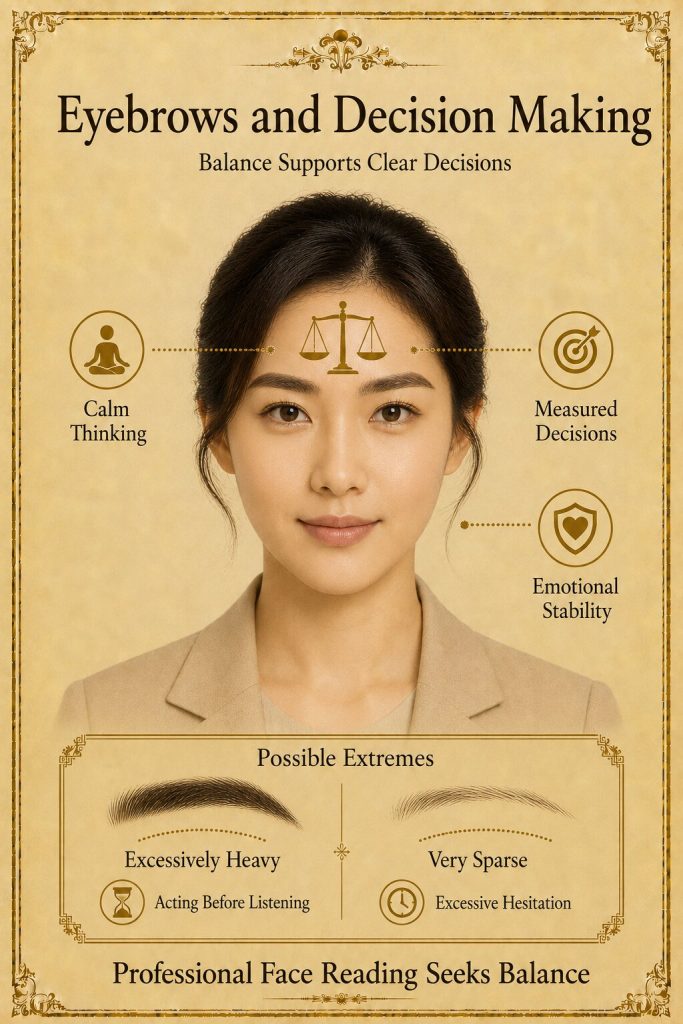
One of the most valuable observations.
Balanced eyebrows often indicate:
- Calm thinking
- Measured decisions
- Emotional stability
Excessively heavy eyebrows may indicate:
- Acting before listening
Very sparse eyebrows may indicate:
- Excessive hesitation
Professional Face Reading always seeks balance.
Common Beginner Mistakes
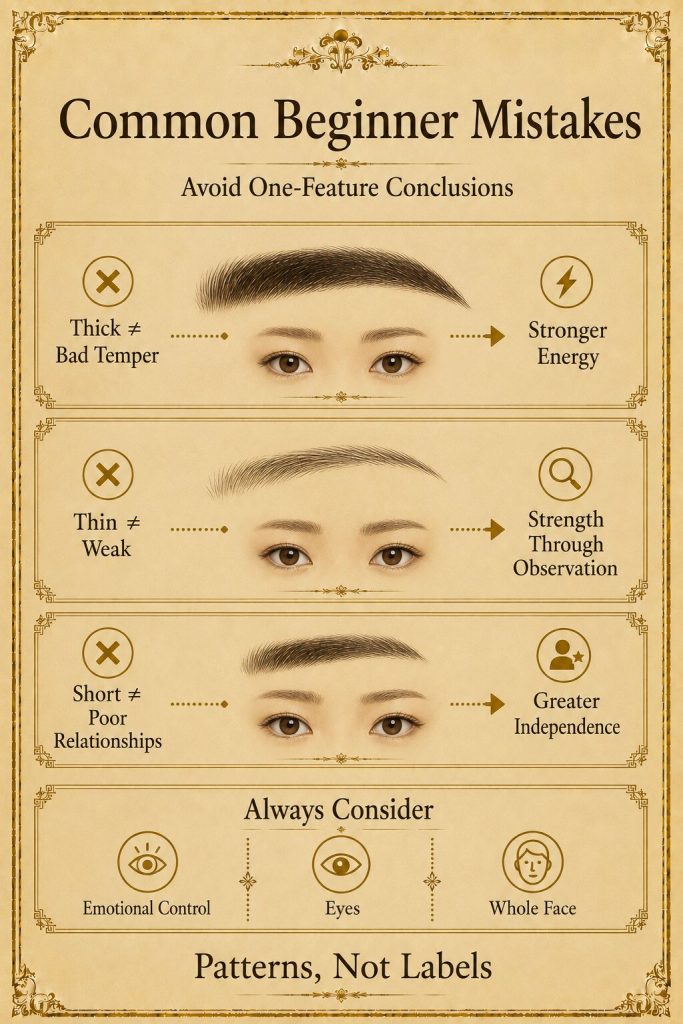
Incorrect:
Thick eyebrows = bad temper.
Correct:
They indicate stronger energy.
Whether that becomes confidence or aggression depends on emotional control, the eyes, and the overall facial balance.
Incorrect:
Thin eyebrows = weak personality.
Correct:
Many highly intelligent negotiators, diplomats and counsellors have naturally thin eyebrows.
Their strength lies in observation rather than dominance.
Incorrect:
Short eyebrows = poor relationships.
Correct:
Short eyebrows often reflect greater independence, not necessarily weaker relationships.
Dougles Chan’s Professional Observation
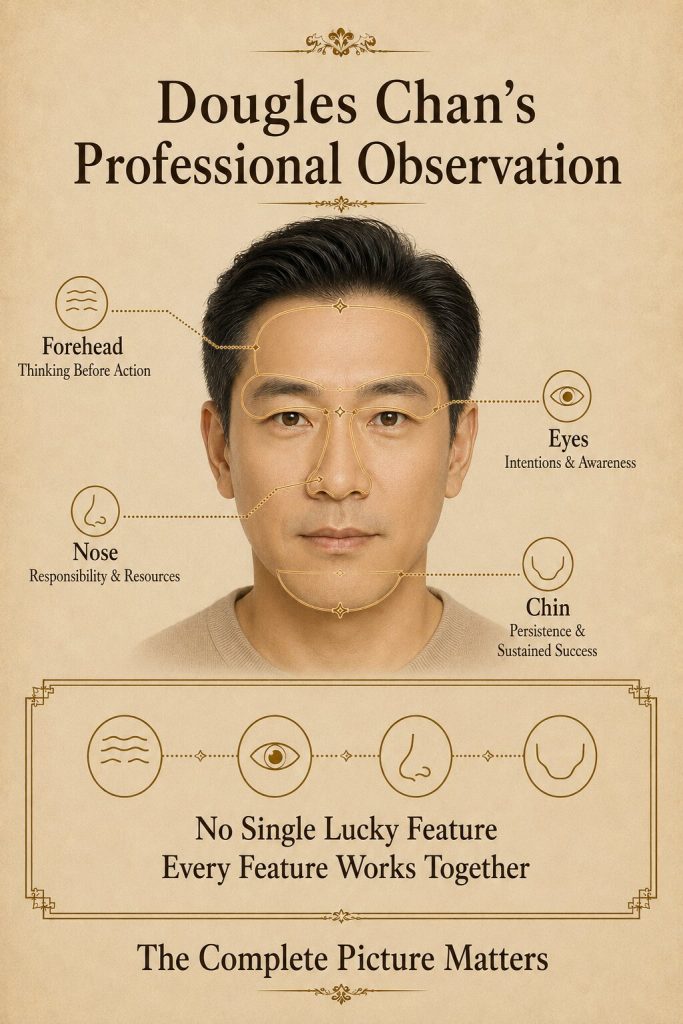
The eyebrows reveal how a person prepares before making a decision.
The eyes reveal whether that decision is emotionally stable.
The nose reveals whether the person can carry responsibility after making the decision.
The chin reveals whether the person has the persistence to complete what they started.
When these four areas work together harmoniously, they often indicate someone who is capable of making sound decisions and following through consistently.
No single eyebrow shape determines success or failure.
Professional Face Reading is about recognising patterns of behaviour, not attaching permanent labels to people.
The Eyes
Among all facial features, the eyes are regarded as the most important in professional Face Reading.
There is an old Chinese saying:
“The eyes are the windows of the spirit.”
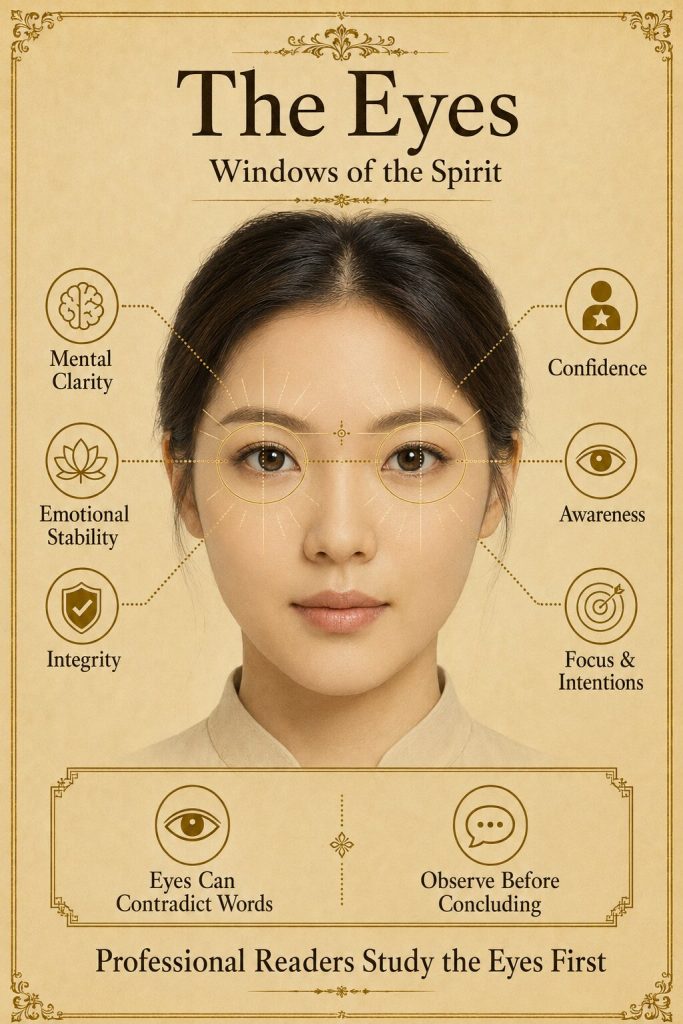
This statement is more accurate than many people realise.
The eyes reveal what no other facial feature can fully reveal:
- Mental clarity
- Emotional stability
- Integrity
- Confidence
- Awareness
- Intentions
- Wisdom
- Courage
- Focus
The eyes can often contradict what the mouth says.
A person may smile, yet their eyes reveal worry.
Another person may speak confidently, yet their eyes reveal fear.
This is why professional Face Readers spend significant time observing the eyes before making conclusions.
The Golden Rule of Reading Eyes
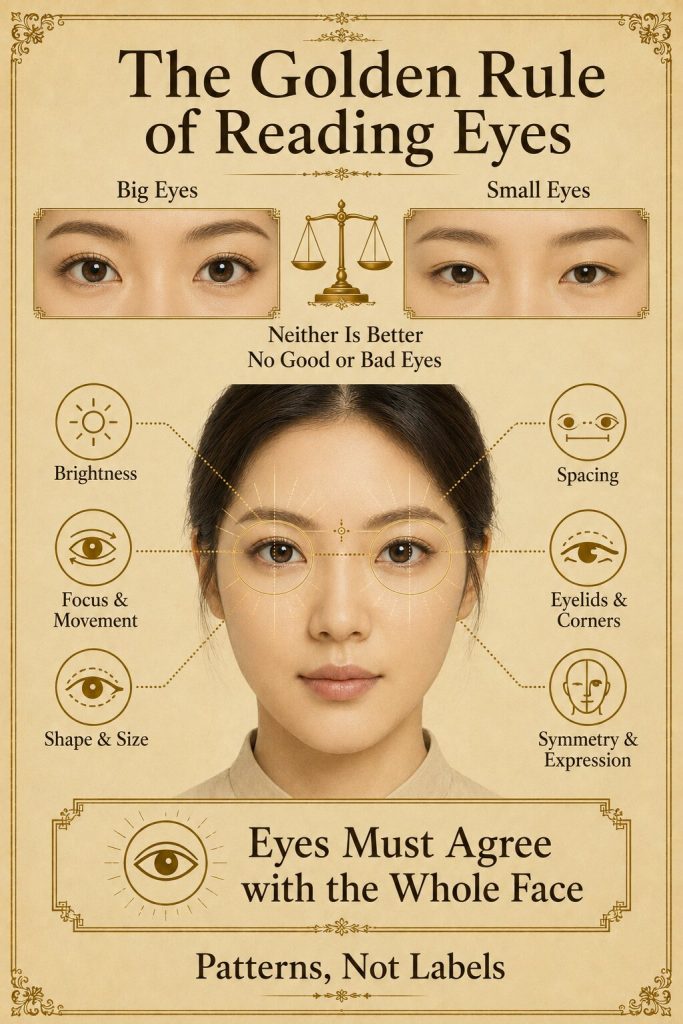
Many beginners ask:
“Are big eyes better than small eyes?”
The answer is simple.
Neither.
There are no universally “good” or “bad” eyes.
Professional Face Reading evaluates:
- Brightness
- Focus
- Movement
- Eye shape
- Eye size
- Eye spacing
- Eyelids
- Eye corners
- Symmetry
- Facial expressions
Most importantly…
The eyes must agree with the rest of the face.
Bright Eyes
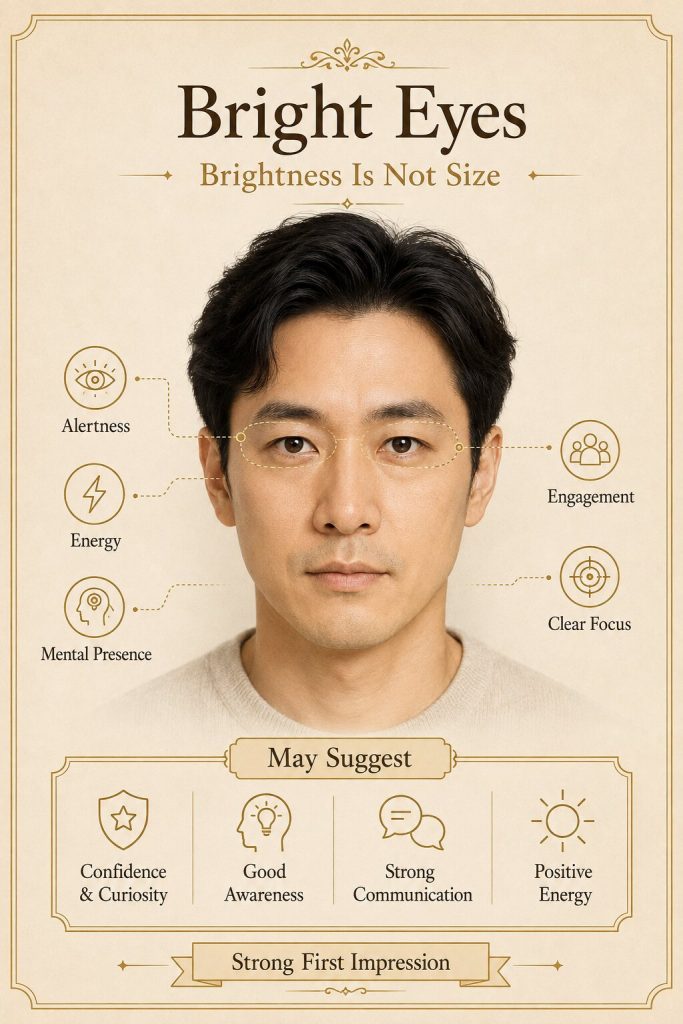
Bright eyes are one of the strongest positive indicators.
Bright does not mean physically large.
Bright refers to:
- Alertness
- Energy
- Mental presence
- Engagement
- Clear focus
People with bright eyes often display:
- Confidence
- Curiosity
- Good awareness
- Strong communication
- Positive energy
Bright eyes frequently leave a strong first impression.
Dull Eyes
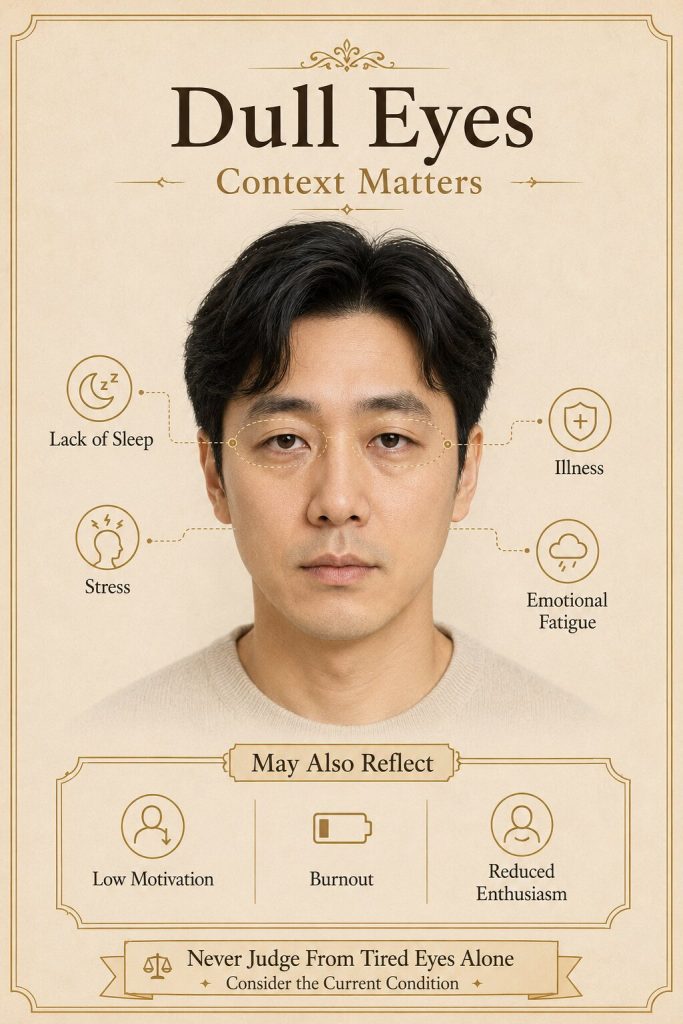
Dull eyes may indicate temporary or long-term conditions.
Possible temporary causes:
- Lack of sleep
- Stress
- Illness
- Emotional fatigue
Possible long-term tendencies:
- Low motivation
- Burnout
- Reduced enthusiasm
Professional Face Reading never assumes personality based on tired eyes alone.
Always consider the person’s current condition.
Large Eyes
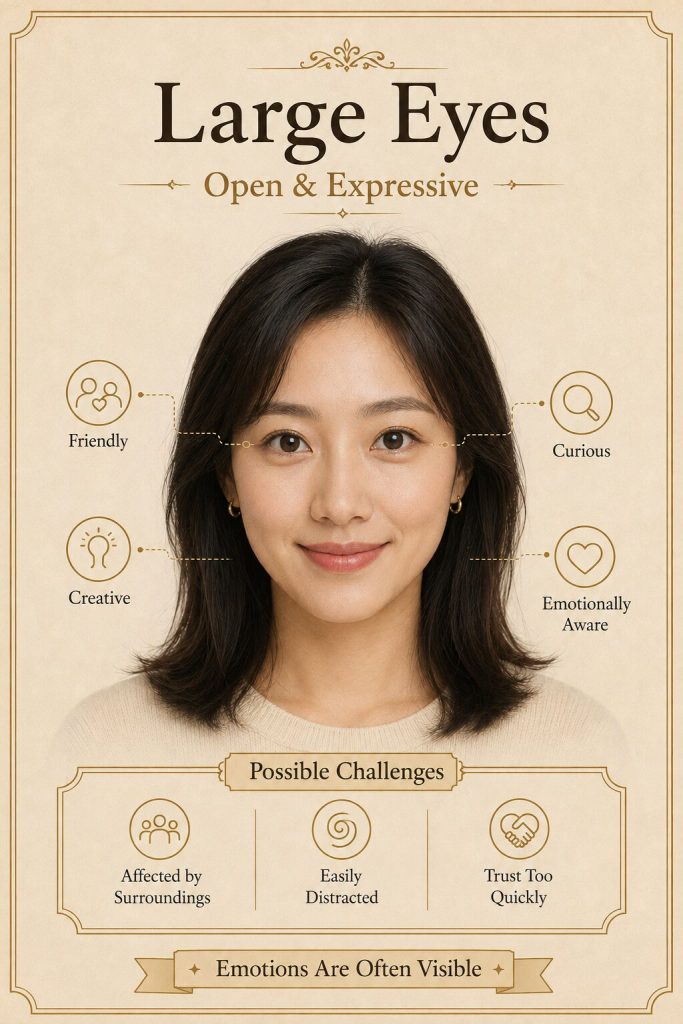
Large eyes often suggest openness.
Positive tendencies:
- Expressive
- Friendly
- Curious
- Creative
- Emotionally aware
Such individuals usually enjoy interacting with others.
Possible challenges:
- Emotionally affected by surroundings
- Easily distracted
- Sometimes trust too quickly
Large eyes reveal information more easily because emotions are often visible.
Small Eyes
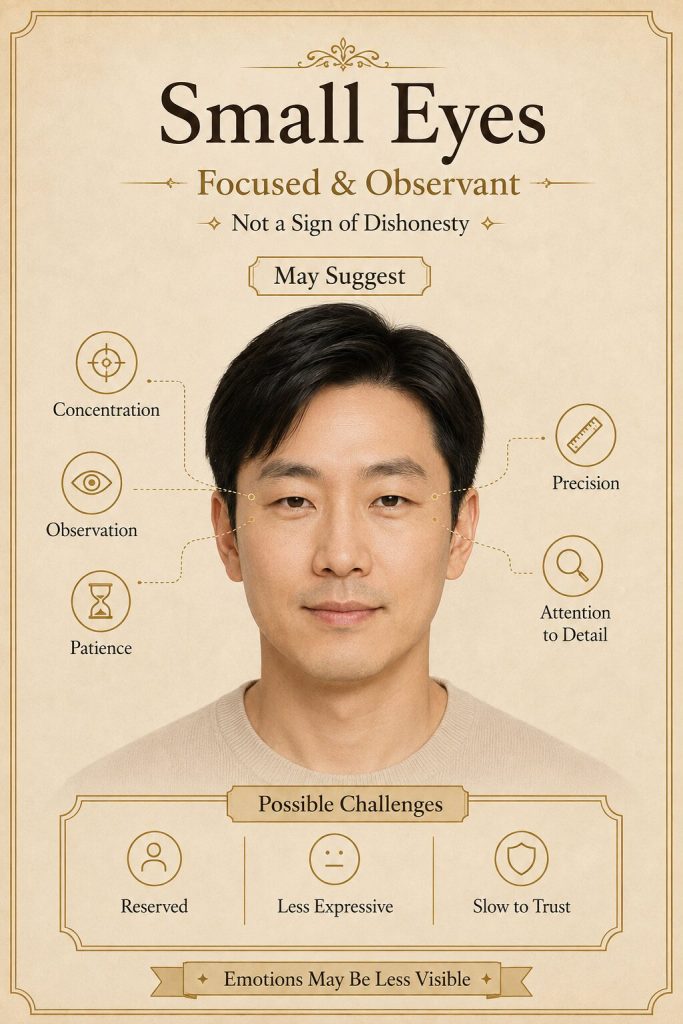
Small eyes are frequently misunderstood.
Many assume they indicate dishonesty.
This is incorrect.
Balanced small eyes often indicate:
- Strong concentration
- Excellent observation
- Patience
- Precision
- Attention to detail
Many accountants, engineers, surgeons and researchers possess relatively smaller eyes.
Possible challenges:
- Reserved personality
- Less emotionally expressive
- Takes longer to trust others
Small eyes often hide emotions well.
Deep-Set Eyes
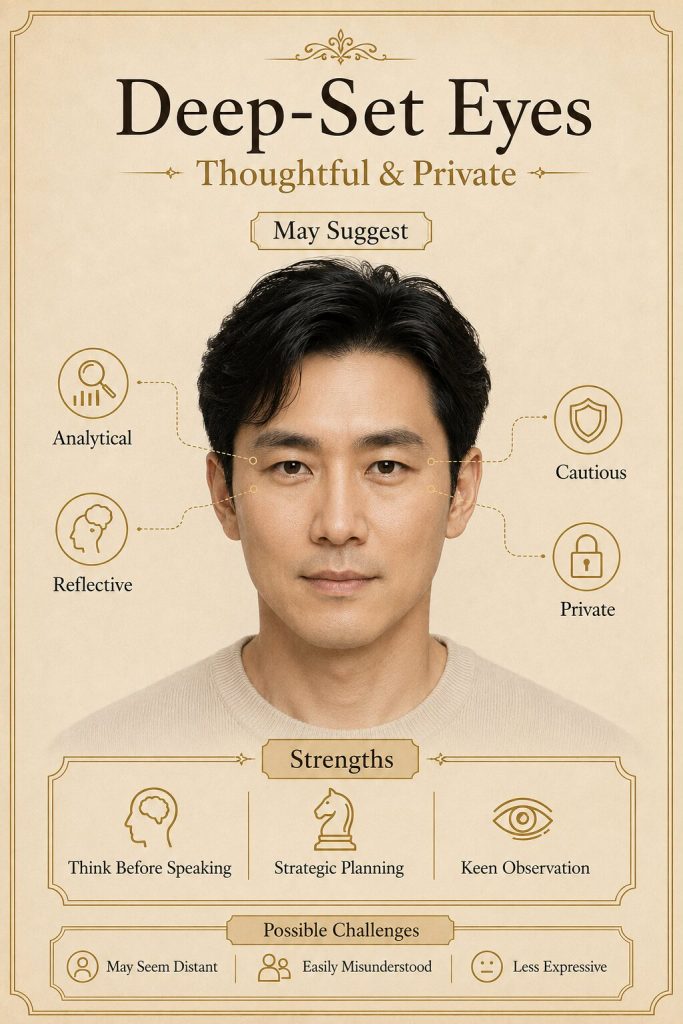
Eyes positioned deeper within the eye sockets often suggest:
- Analytical thinking
- Reflection
- Caution
- Privacy
Strengths:
- Think before speaking
- Good strategic planning
- Excellent observation
Challenges:
- May appear distant
- Others may misunderstand their intentions
- Less emotionally expressive
Protruding Eyes
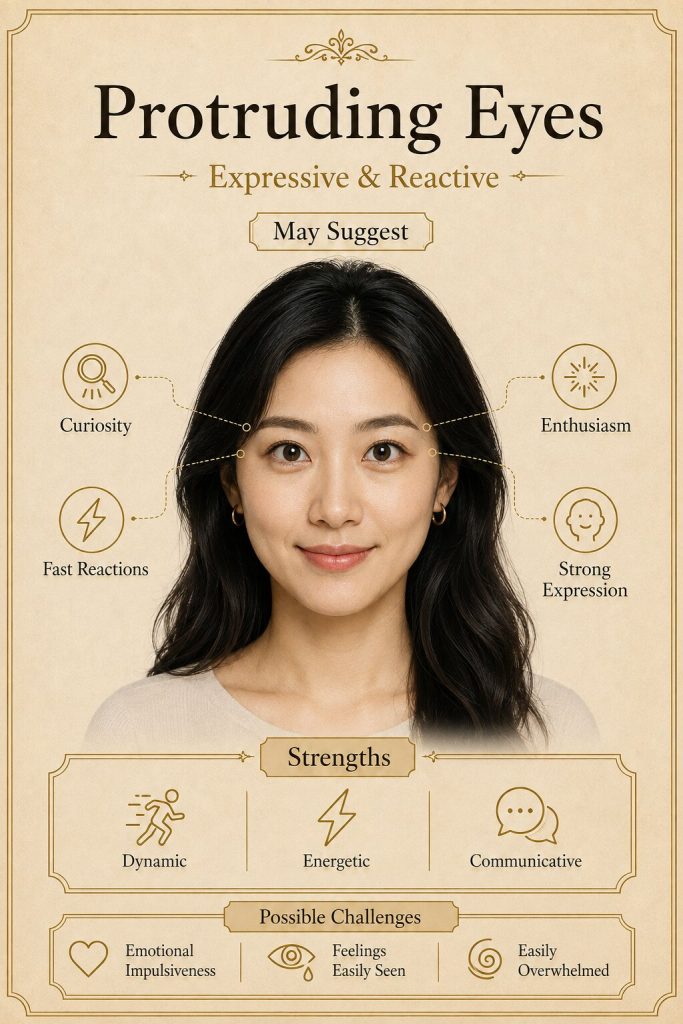
More prominent eyes often indicate:
- Curiosity
- Enthusiasm
- Fast reactions
- Strong emotional expression
Strengths:
- Dynamic
- Energetic
- Communicative
Challenges:
- Emotional impulsiveness
- Difficulty hiding feelings
- Can become overwhelmed
Almond-Shaped Eyes
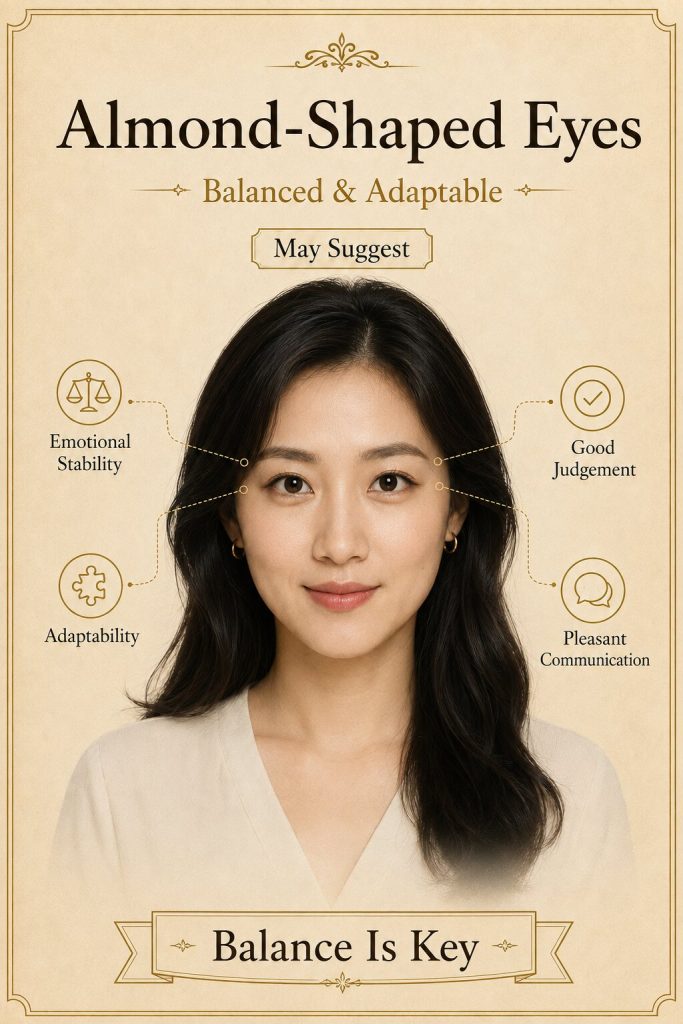
Traditionally regarded as one of the more balanced eye shapes.
Possible strengths:
- Emotional stability
- Adaptability
- Good judgement
- Pleasant communication
Balance remains the key.
Round Eyes
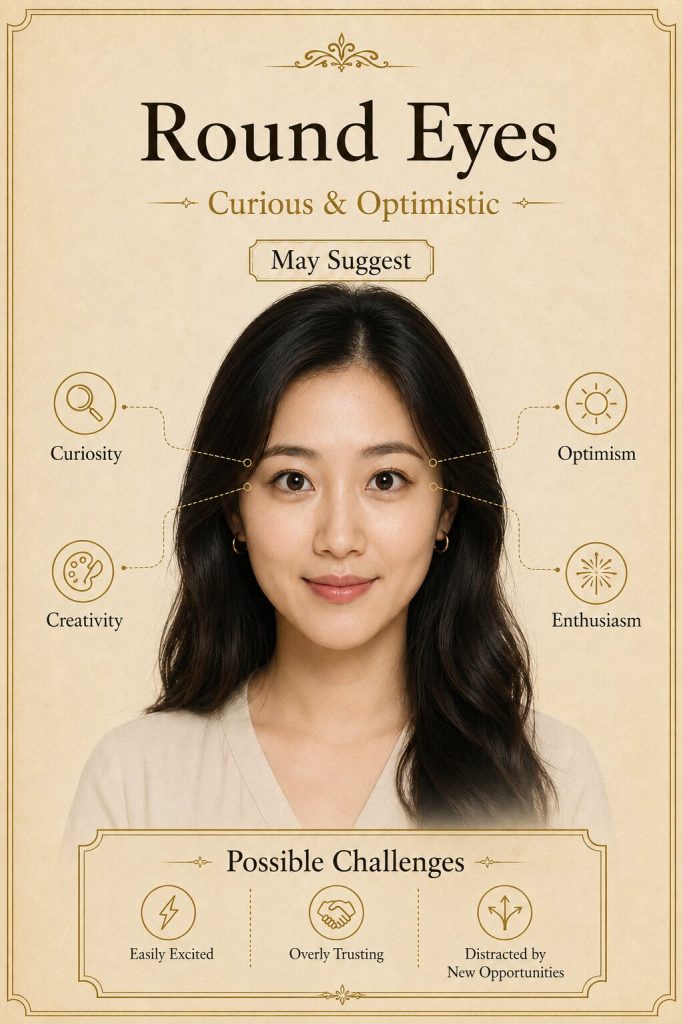
Round eyes often indicate:
- Curiosity
- Optimism
- Creativity
- Enthusiasm
Challenges:
- Easily excited
- Sometimes overly trusting
- May become distracted by new opportunities
Narrow Eyes
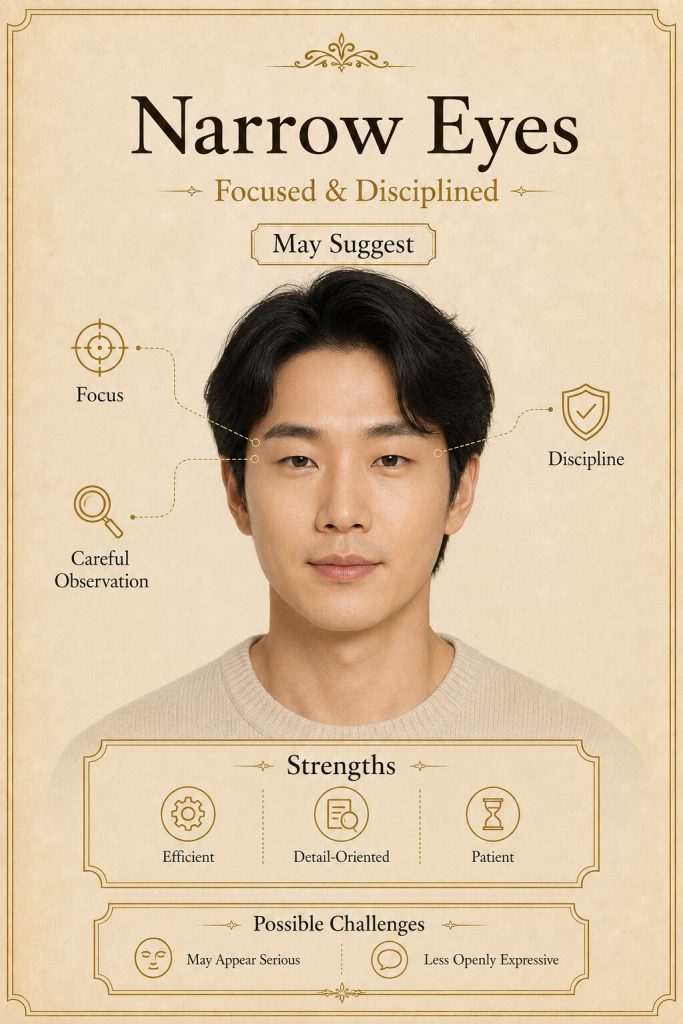
Narrow eyes often suggest:
- Focus
- Discipline
- Careful observation
Strengths:
- Efficient
- Detail-oriented
- Patient
Challenges:
- Appearing serious
- Difficulty expressing emotions openly
Upward-Tilting Eyes
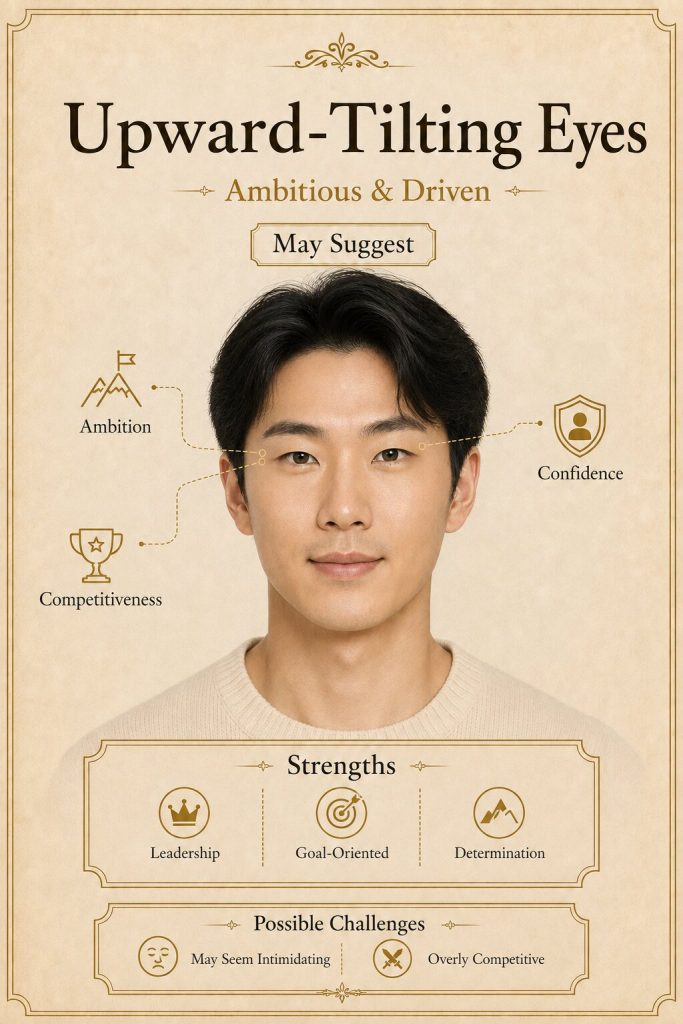
Eyes that naturally rise towards the outer corners may suggest:
- Ambition
- Confidence
- Competitiveness
Strengths:
- Leadership
- Goal-oriented
- Determination
Challenges:
- Can appear intimidating
- May become overly competitive
Downward-Tilting Eyes
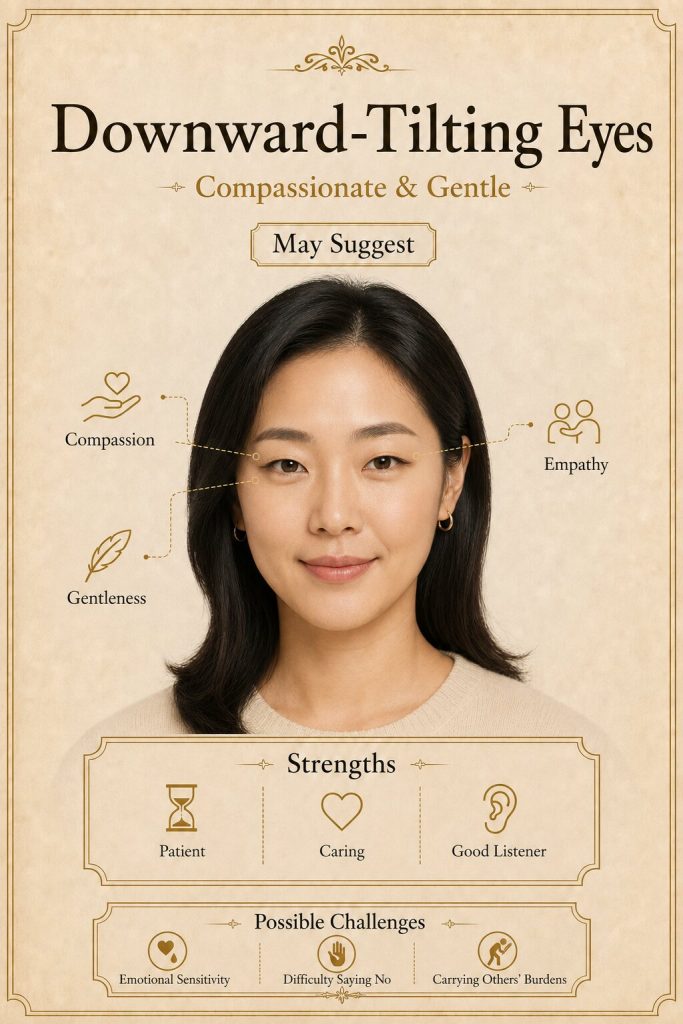
Eyes that slope slightly downward often indicate:
- Compassion
- Empathy
- Gentleness
Strengths:
- Patient
- Caring
- Good listener
Challenges:
- Emotional sensitivity
- Difficulty saying no
- Carrying others’ burdens
Wide-Set Eyes
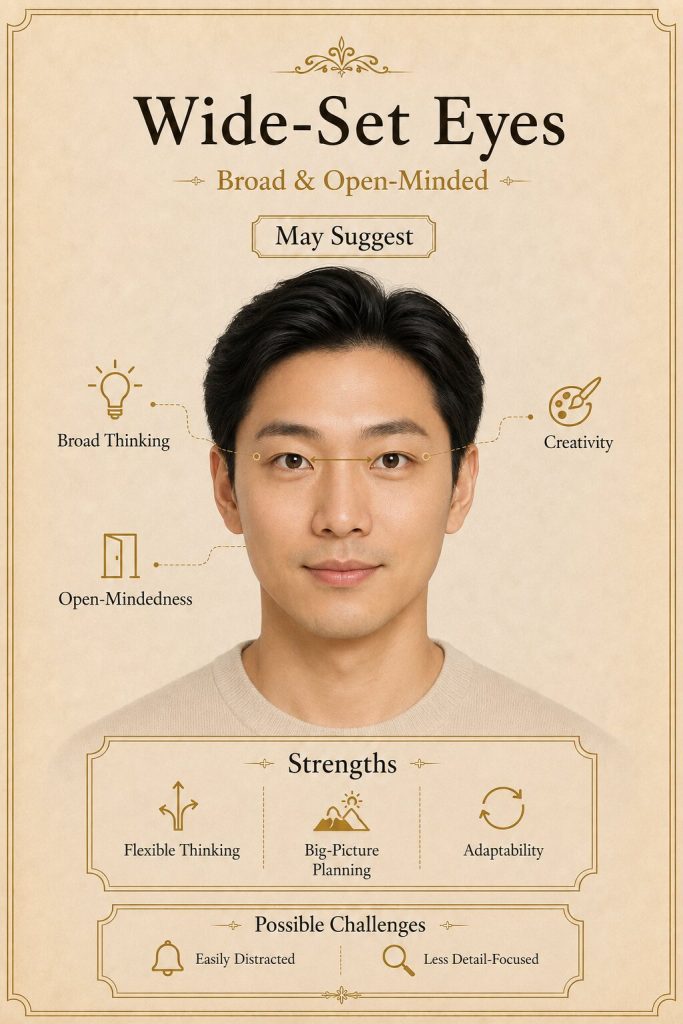
Eyes positioned slightly further apart often suggest:
- Broad thinking
- Creativity
- Open-mindedness
Strengths:
- Flexible thinking
- Big-picture planning
- Adaptability
Challenges:
- Easily distracted
- Less attention to fine details
Close-Set Eyes
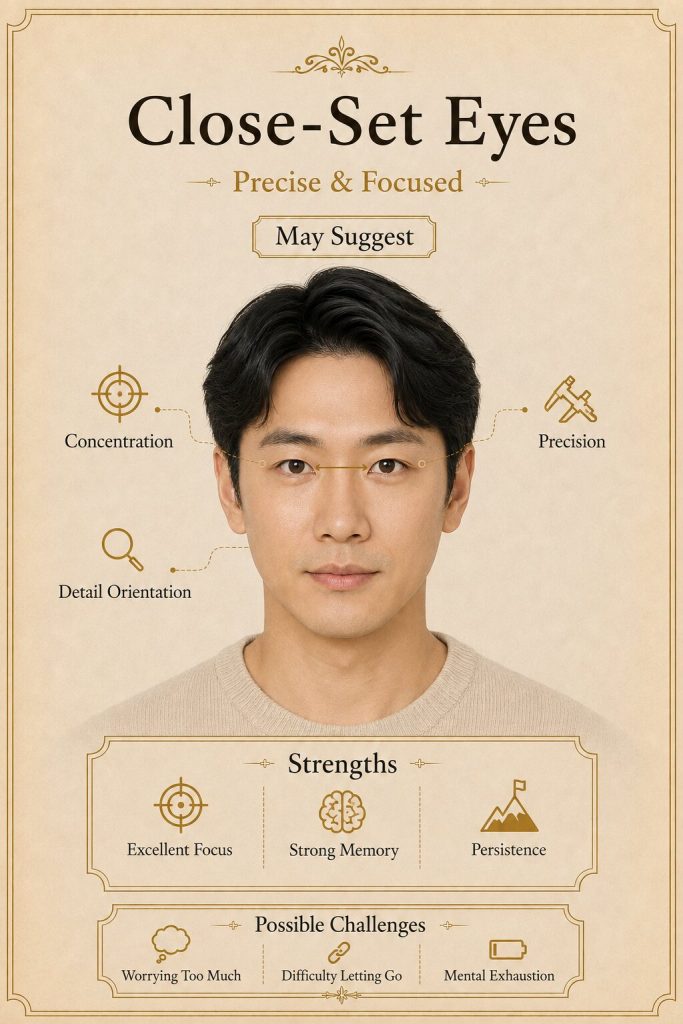
Eyes positioned closer together often indicate:
- Concentration
- Precision
- Detail orientation
Strengths:
- Excellent focus
- Strong memory
- Persistence
Challenges:
- Worrying too much
- Difficulty letting go
- Becoming mentally exhausted
Eyelids
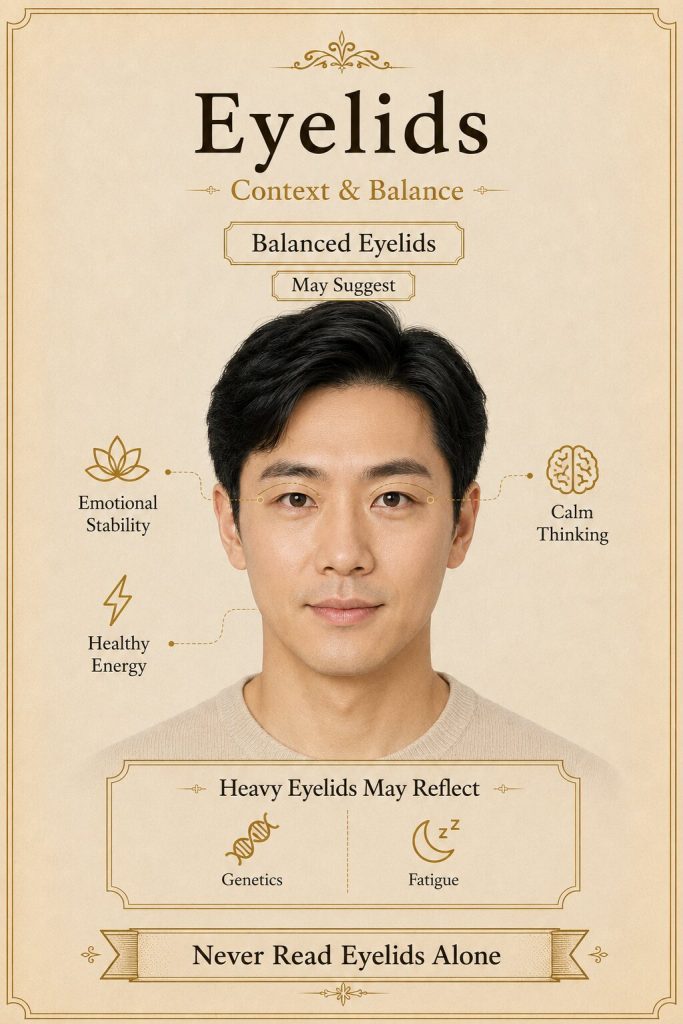
Professional readers observe eyelids carefully.
Well-balanced eyelids often indicate:
- Emotional stability
- Calm thinking
- Healthy energy
Heavy eyelids may simply reflect genetics or fatigue.
Never make conclusions from eyelids alone.
Eye Bags
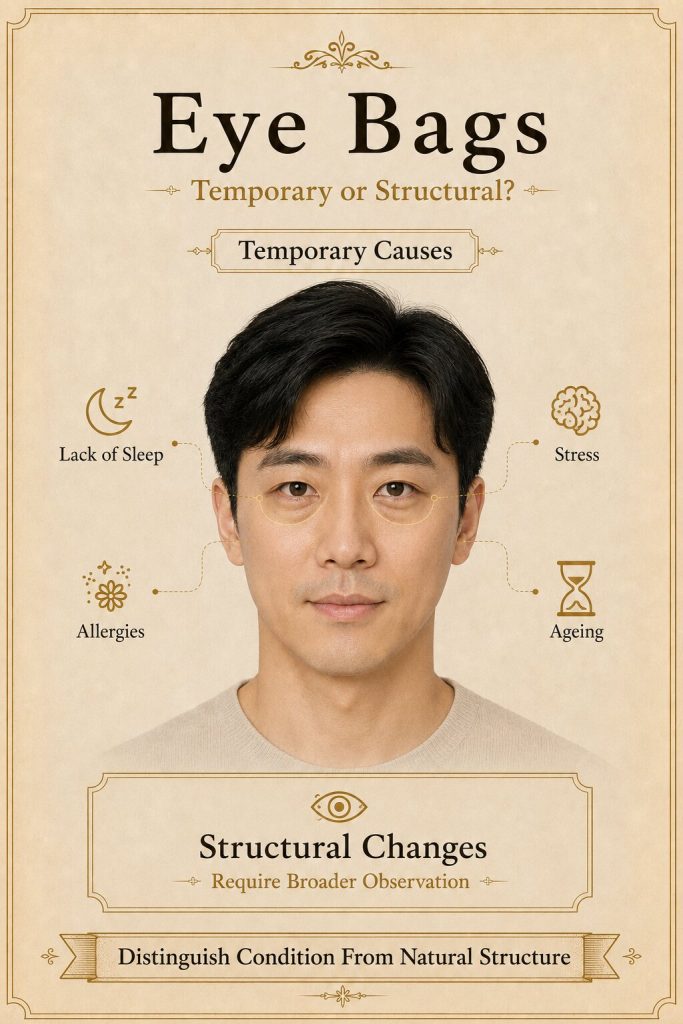
Eye bags are commonly misunderstood.
Temporary causes include:
- Lack of sleep
- Stress
- Allergies
- Ageing
Permanent structural changes require broader observation.
Professional readers distinguish temporary conditions from natural facial characteristics.
Eye Movement
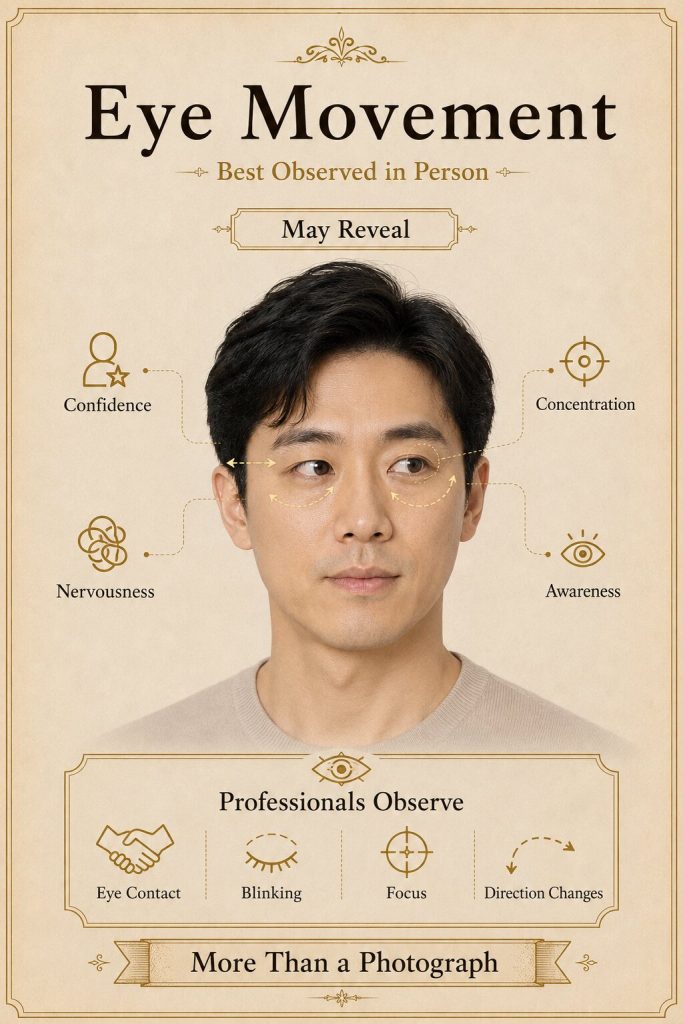
One of the most important observations.
The way a person moves their eyes often reveals:
- Confidence
- Nervousness
- Concentration
- Awareness
Professionals observe:
- Eye contact
- Blinking
- Focus
- Direction changes
This is why Face Reading is much more accurate in person than from a photograph.
Blinking
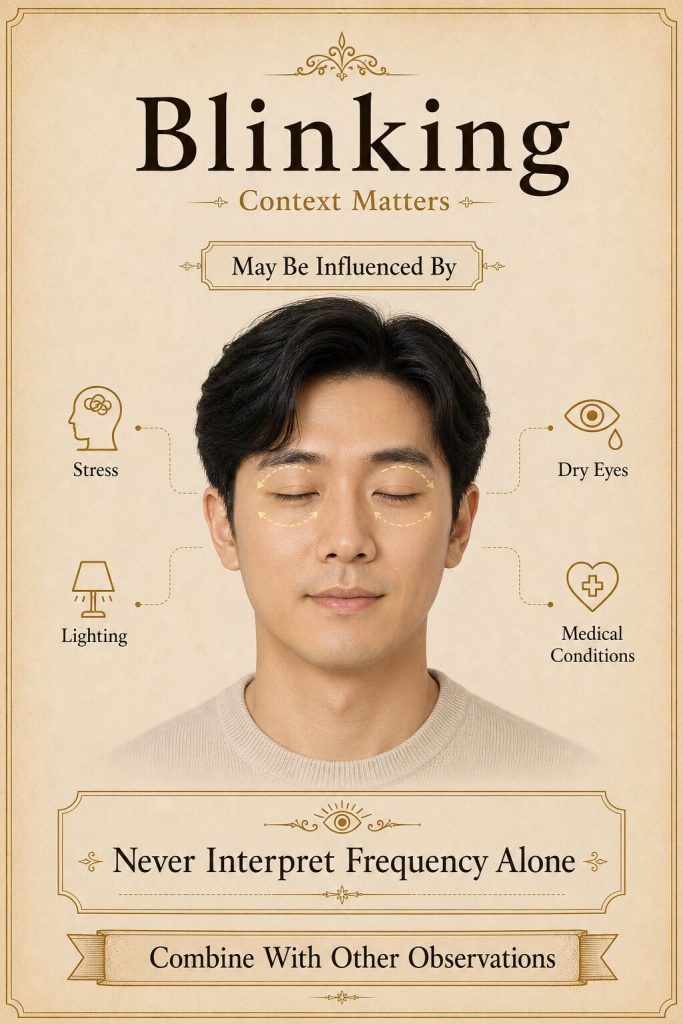
Blinking frequency alone should never be interpreted.
Stress…
Dry eyes…
Lighting…
Medical conditions…
All influence blinking.
Professional readers consider blinking only together with other observations.
Eye Contact
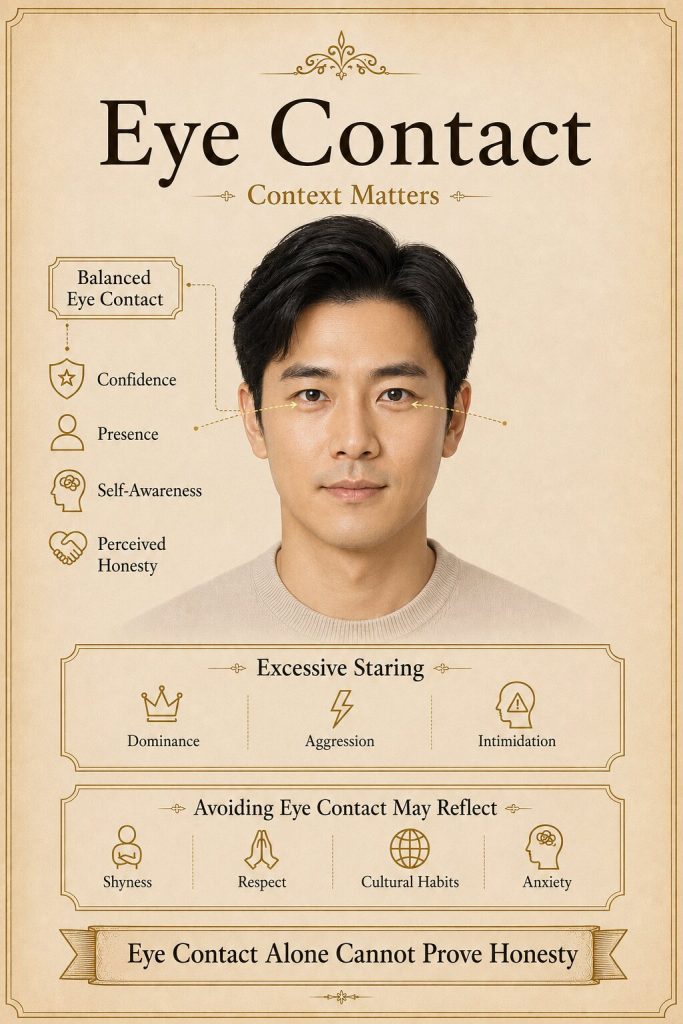
Balanced eye contact often indicates:
- Confidence
- Honesty
- Presence
- Self-awareness
Excessive staring may suggest:
- Dominance
- Aggression
- Intimidation
Avoiding eye contact does not necessarily indicate dishonesty.
It may reflect:
- Shyness
- Respect
- Cultural habits
- Anxiety
Context matters.
Eye Colour
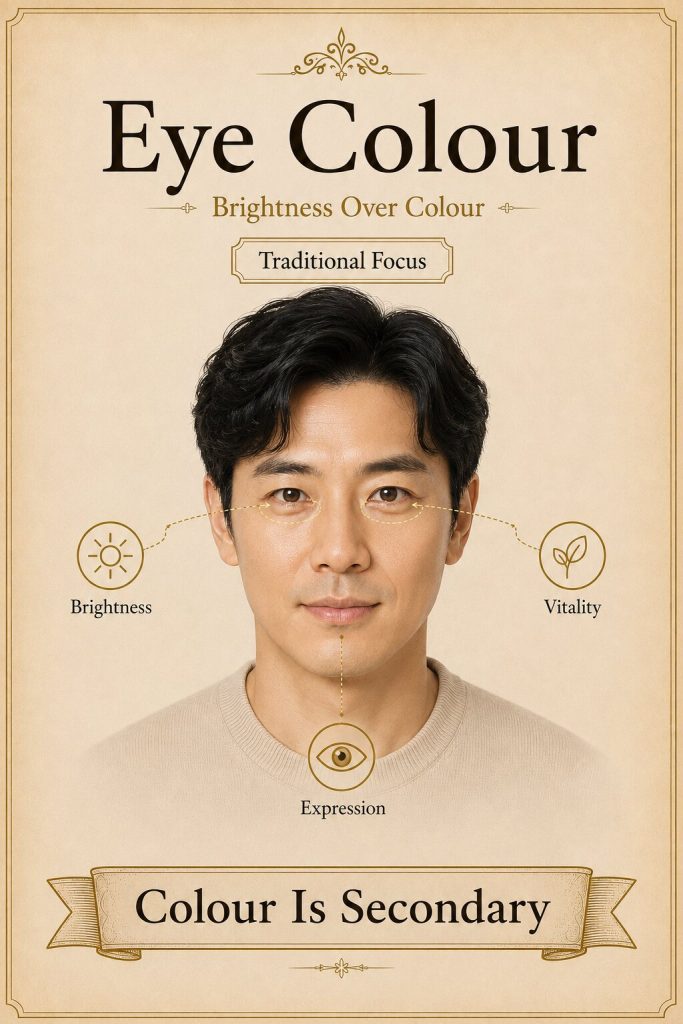
Traditional Chinese Face Reading focuses far more on:
- Brightness
- Vitality
- Expression
than on eye colour.
The Spirit Behind the Eyes
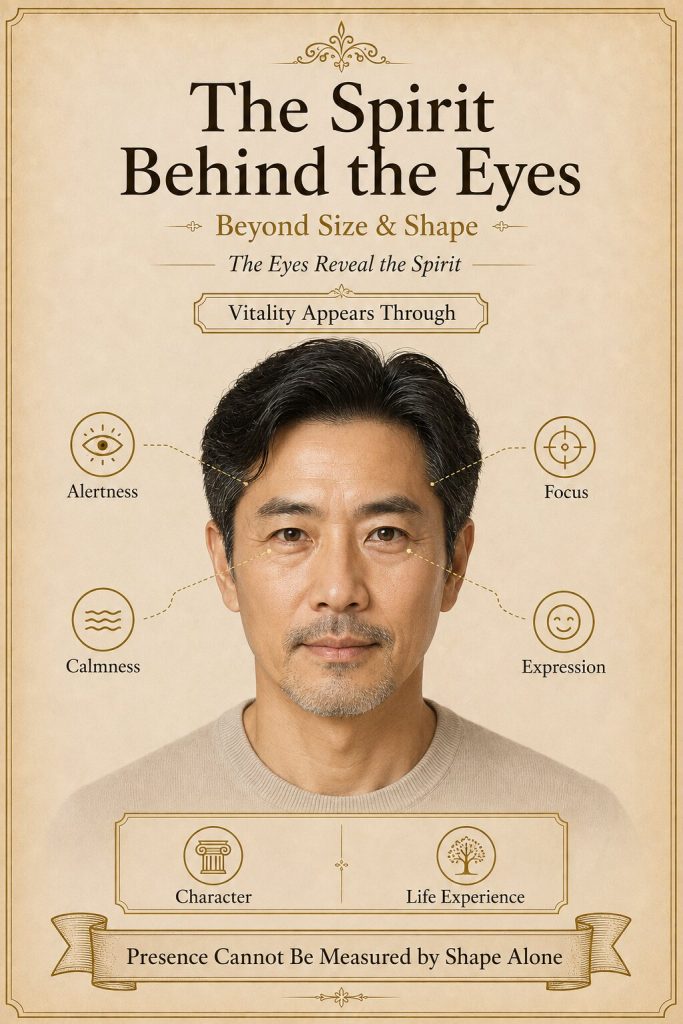
Experienced Face Readers often say:
“The eyes reveal the spirit.”
This refers to the overall vitality observed through:
- Alertness
- Focus
- Calmness
- Expression
Two people may have identical eye shapes…
Yet one immediately appears trustworthy while the other appears unsettled.
The difference lies in the spirit.
This cannot be measured by size or shape alone.
It develops through character and life experience.
Eyes and Leadership
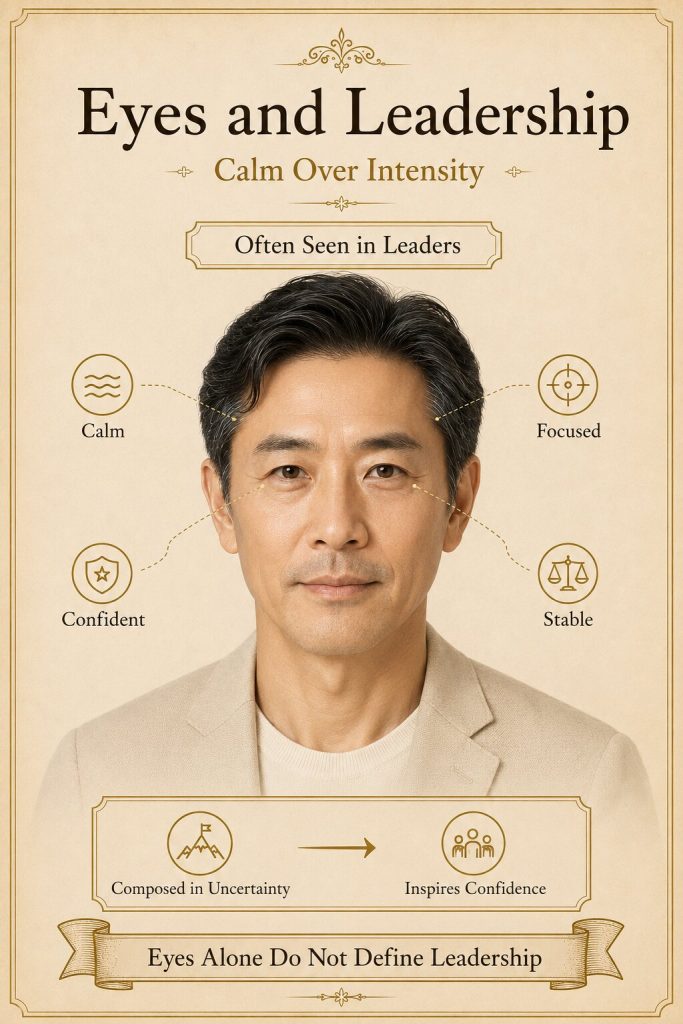
Leaders frequently display eyes that are:
- Calm
- Focused
- Confident
- Stable
Notice that calmness is more important than intensity.
A leader who remains composed during uncertainty often inspires greater confidence than one who reacts emotionally.
Eyes and Wealth
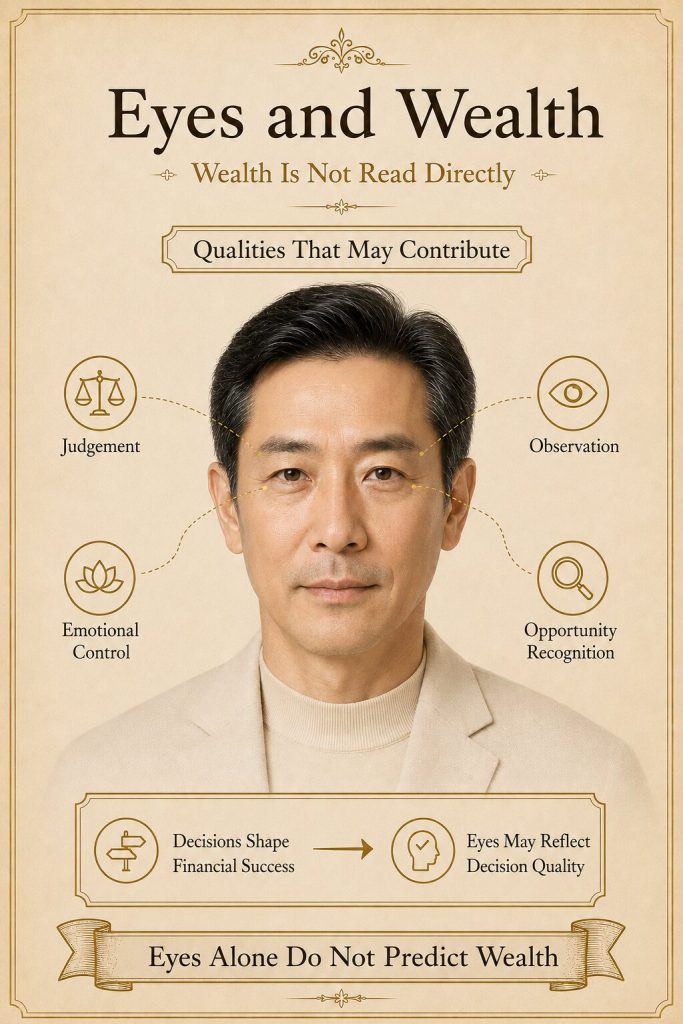
The eyes do not directly indicate wealth.
Instead…
They reveal qualities that often contribute to wealth:
- Judgement
- Observation
- Emotional control
- Opportunity recognition
Financial success usually comes from decisions.
The eyes reveal the quality of those decisions.
Eyes and Relationships
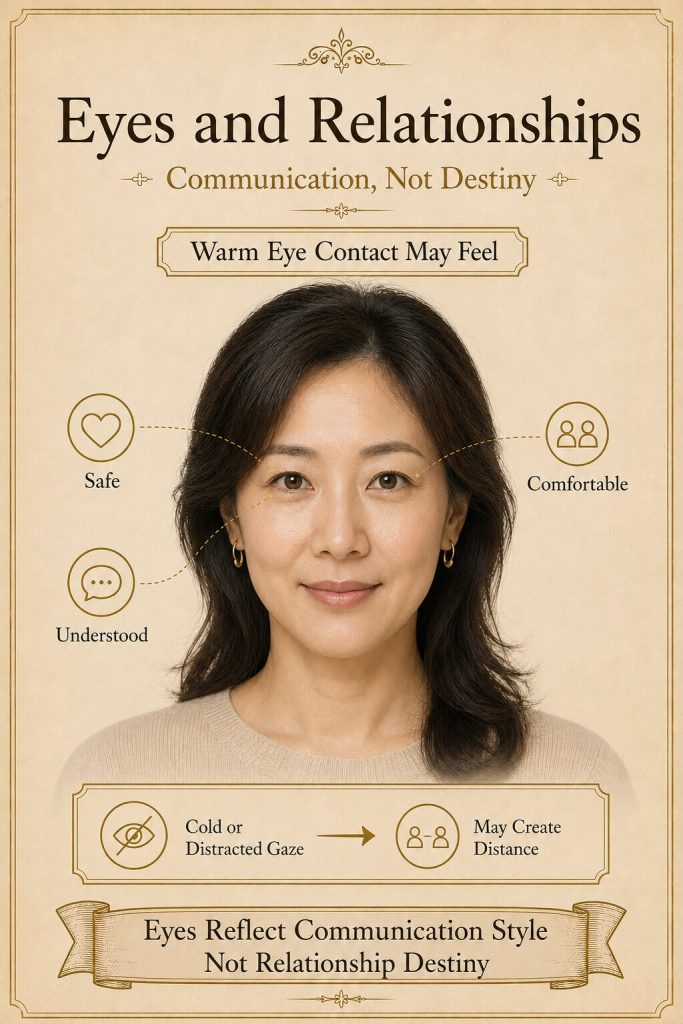
The eyes are often the first feature people subconsciously notice.
Warm eyes generally make others feel:
- Safe
- Comfortable
- Understood
Cold or distracted eyes may unintentionally create distance.
Again…
This reflects communication style rather than destiny.
Common Beginner Mistakes
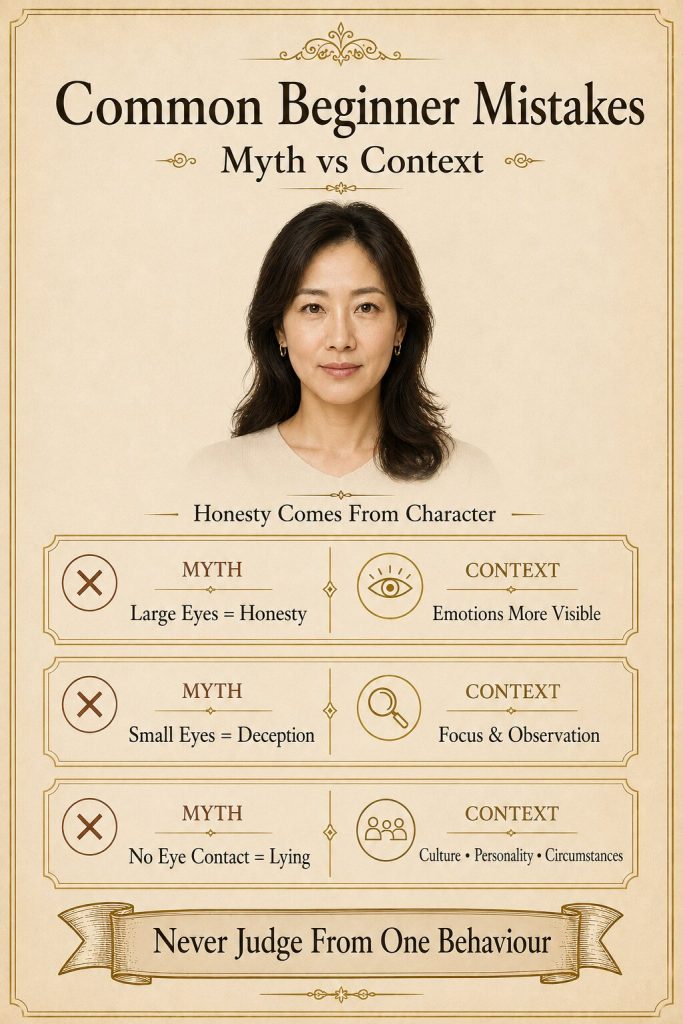
Incorrect:
Large eyes mean honesty.
Correct:
Large eyes often reveal emotions more openly.
Honesty depends on character, not eye size.
Incorrect:
Small eyes mean deception.
Correct:
Small eyes often indicate concentration and observation.
Many highly trustworthy people naturally have smaller eyes.
Incorrect:
No eye contact means lying.
Correct:
Culture, personality, confidence and circumstances all influence eye contact.
Professional Face Reading never reaches conclusions from one behaviour.
Dougles Chan’s Professional Observation
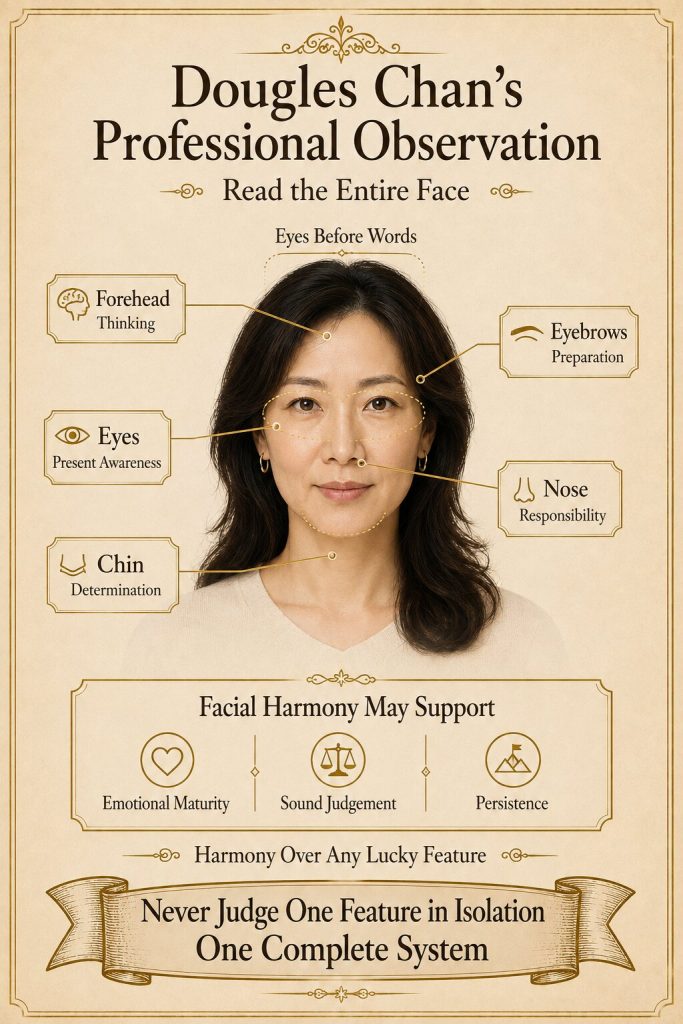
When reading a face, the eyes are observed before the mouth speaks.
The forehead reveals how a person thinks.
The eyebrows reveal how they prepare.
The eyes reveal who they truly are in that moment.
The nose reveals how they carry responsibility.
The chin reveals whether they have the determination to complete what they begin.
A person with bright, calm eyes, balanced eyebrows, a proportionate nose and a stable chin often demonstrates emotional maturity, sound judgement and persistence.
This combination is generally far more significant than any single “lucky” facial feature.
The most important lesson in Face Reading is this:
Never judge one feature in isolation. Read the entire face as one complete system.
The Nose
If the eyes are regarded as the spirit of the face, then the nose is regarded as the centre of responsibility and wealth.
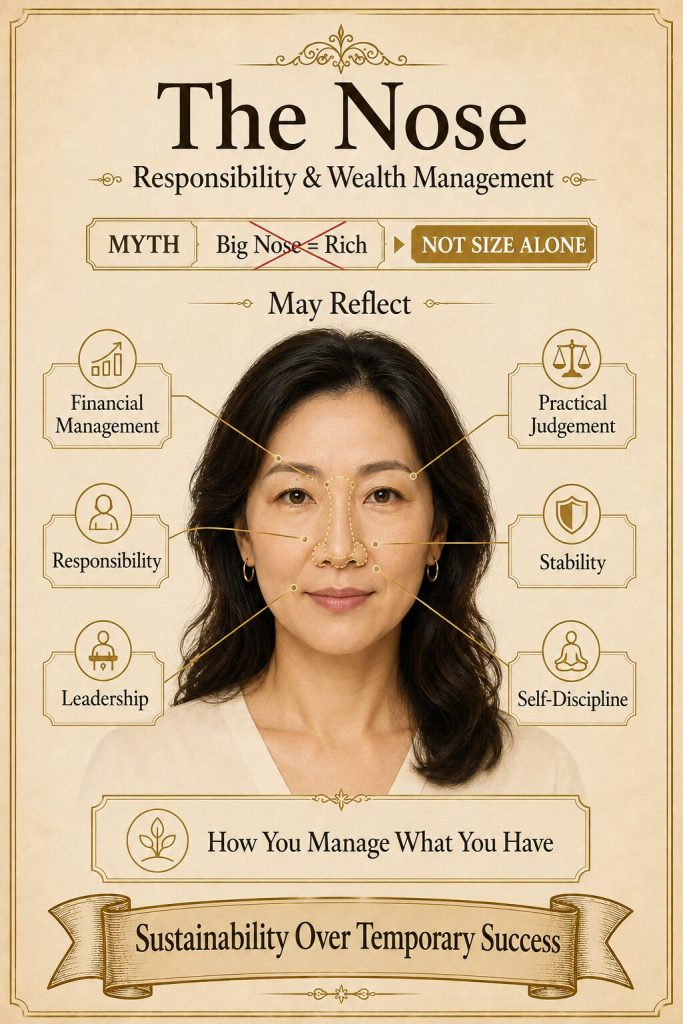
Many people have heard the statement:
“A big nose means you will become rich.”
This is one of the biggest misconceptions in Face Reading.
A professional Face Reader never judges wealth by nose size alone.
The nose reveals much more than money.
It reflects:
- Financial management
- Responsibility
- Leadership
- Confidence
- Practical judgement
- Decision-making
- Business ability
- Stability
- Self-discipline
The nose often tells us how well a person manages what they have, rather than simply whether they will become wealthy.
A person who earns S$50 million but loses everything through poor decisions does not possess true wealth management.
Likewise, someone who steadily grows a modest business over decades may demonstrate excellent wealth management.
Professional Face Reading focuses on sustainability rather than temporary success.
The Nose Is the Centre of the Face
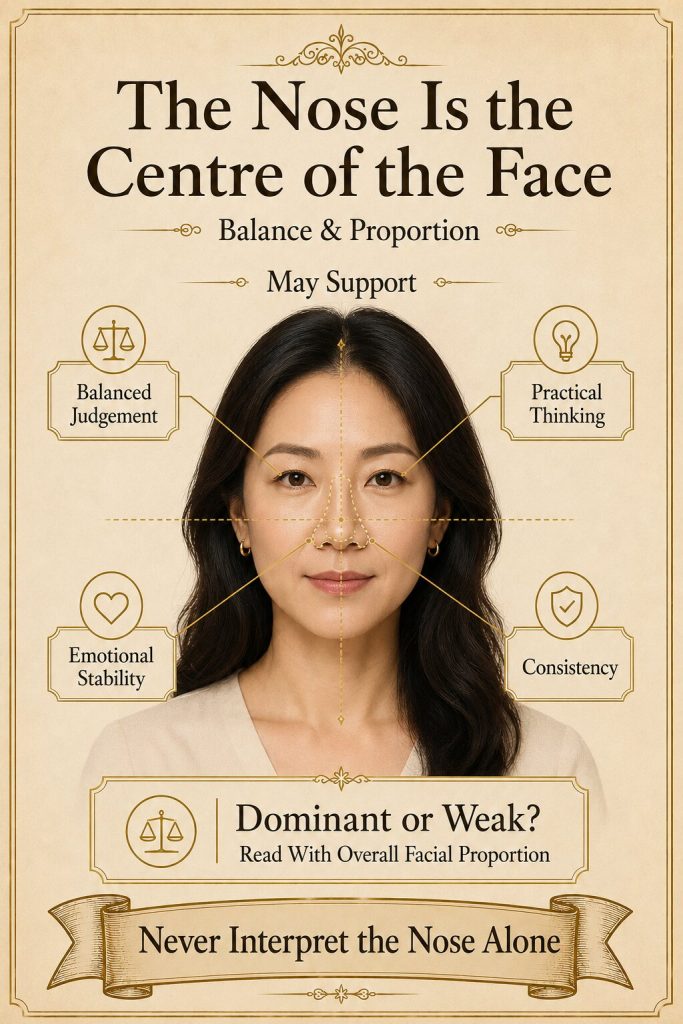
The nose sits almost exactly in the middle of the face.
This is significant.
It symbolises balance.
A well-balanced nose often supports:
- Balanced judgement
- Practical thinking
- Emotional stability
- Consistency
An extremely dominant nose or an extremely weak nose should always be interpreted together with the overall facial proportions.
The Five Parts of the Nose
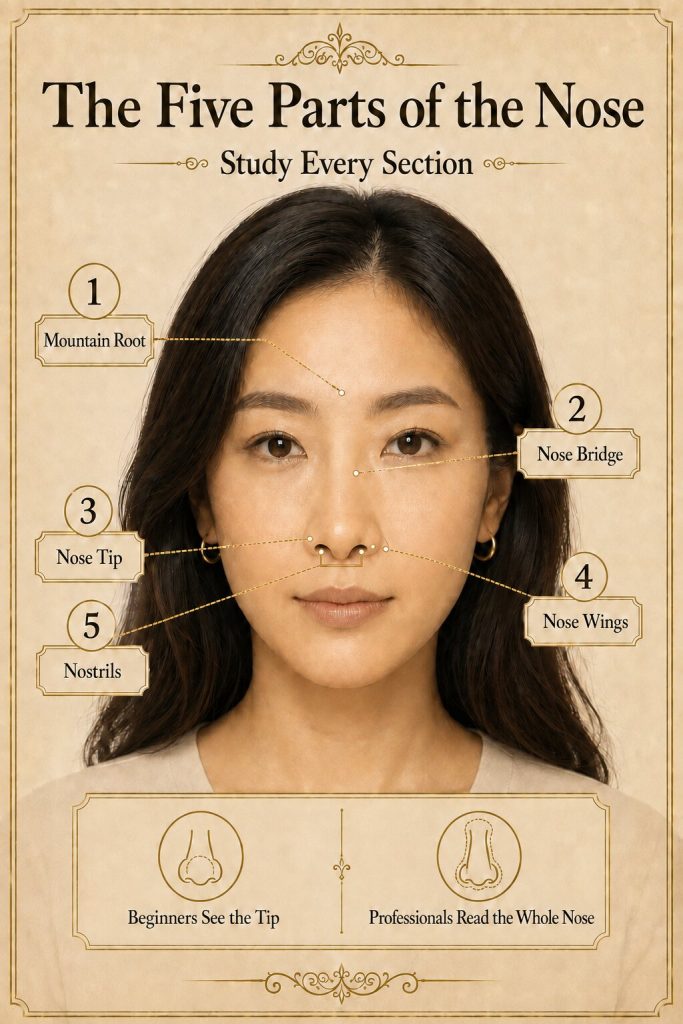
Professional Face Reading divides the nose into five sections.
- Mountain Root
- Nose Bridge
- Nose Tip
- Nose Wings
- Nostrils
Each section reveals different qualities.
Beginners usually observe only the nose tip.
Professionals study every section.
The Mountain Root (Shan Gen)
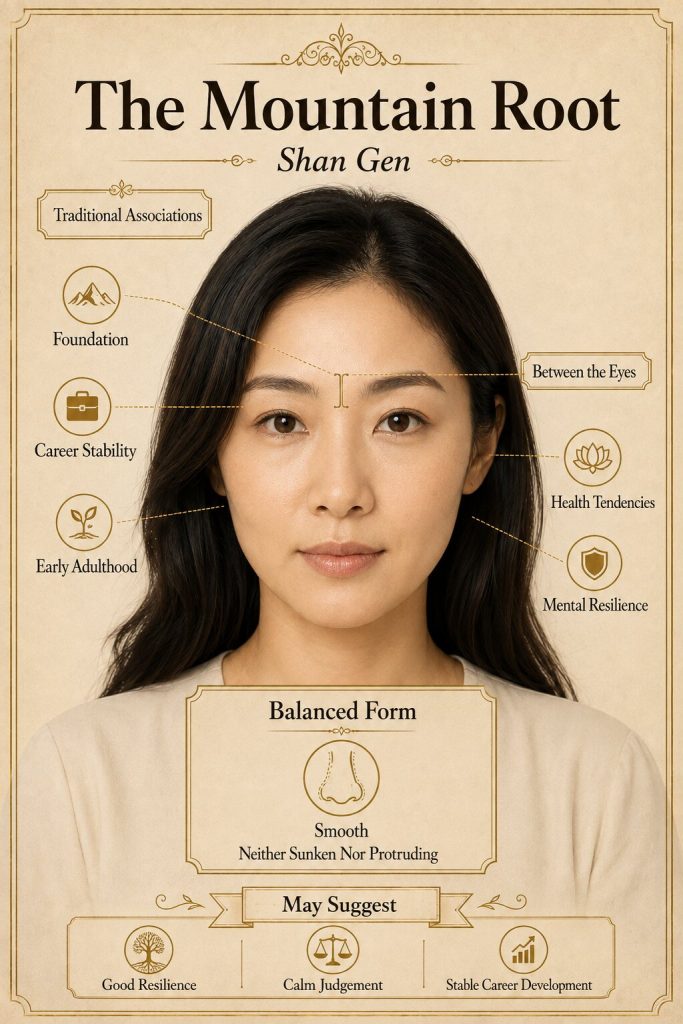
The Mountain Root is located between the eyes.
It represents:
- Foundation
- Health
- Career stability
- Early adulthood
- Mental resilience
A healthy Mountain Root is usually:
- Smooth
- Balanced
- Neither excessively sunken nor protruding
It often indicates:
- Good resilience
- Calm judgement
- Stable career development
Low Mountain Root
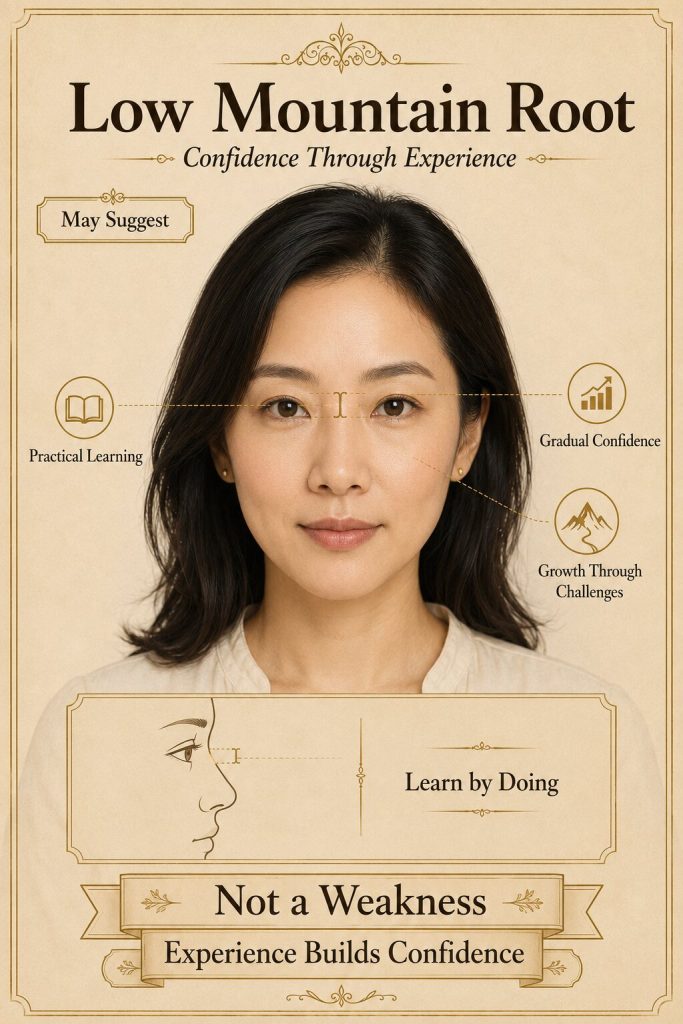
A lower Mountain Root may indicate:
- Greater dependence on experience
- Slower confidence development
- Learning through practical challenges
This is not a weakness.
Many entrepreneurs build confidence through repeated experience rather than natural confidence.
High Mountain Root
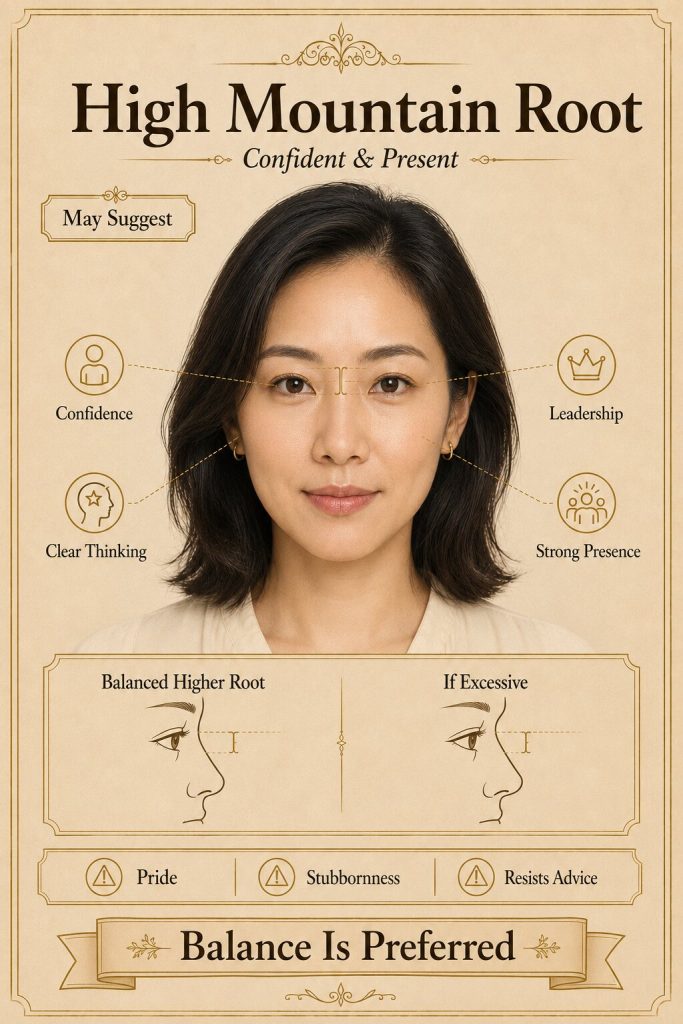
A balanced higher Mountain Root often indicates:
- Confidence
- Leadership
- Strong presence
- Clear thinking
If excessively high, it may suggest:
- Pride
- Stubbornness
- Difficulty accepting advice
Balance is always preferred.
The Nose Bridge
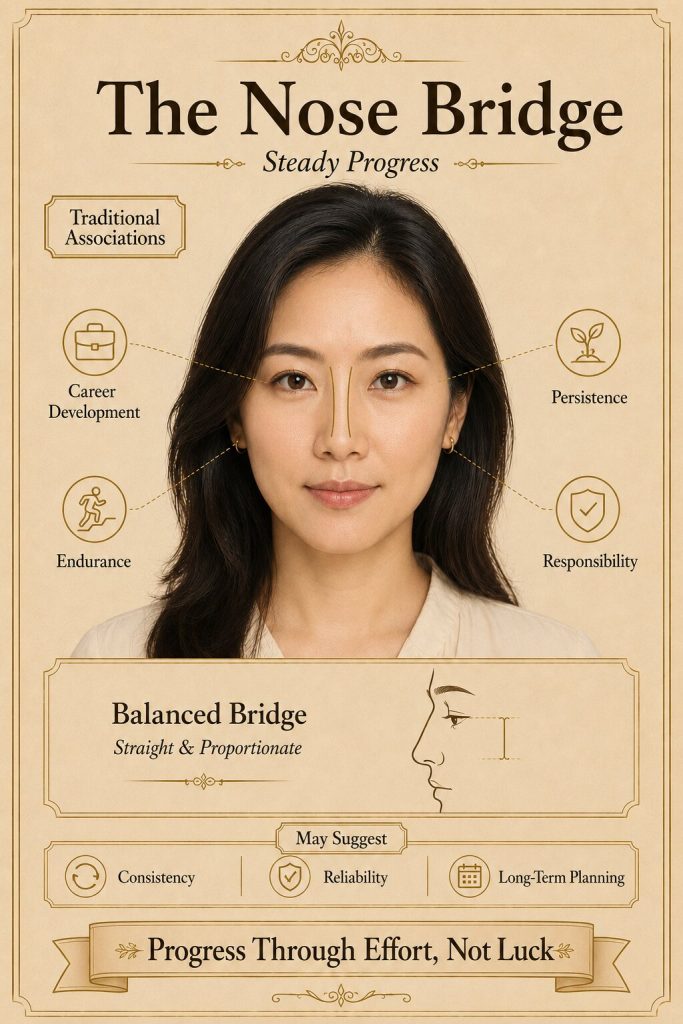
The bridge represents:
- Career development
- Endurance
- Persistence
- Responsibility
A straight, proportionate bridge often indicates:
- Consistency
- Reliability
- Long-term planning
A person with a balanced bridge usually progresses steadily rather than relying on luck.
Crooked Nose Bridge
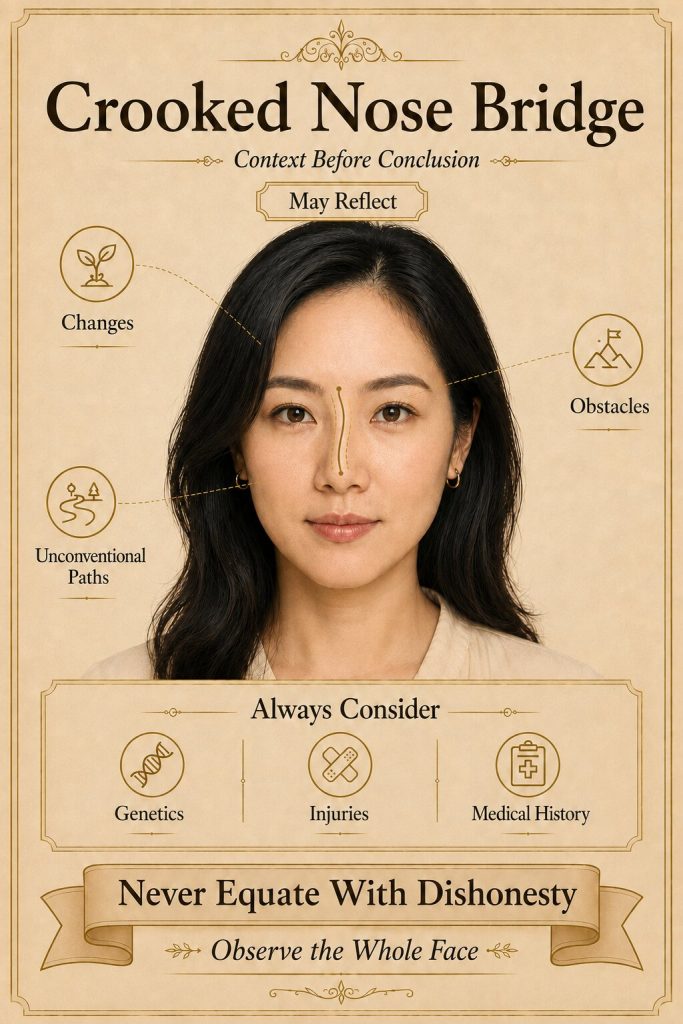
A naturally uneven bridge may suggest that the person has experienced changes, obstacles or unconventional paths.
Professional readers never conclude dishonesty simply because the bridge is crooked.
Medical history, injuries and genetics must always be considered.
The Nose Tip
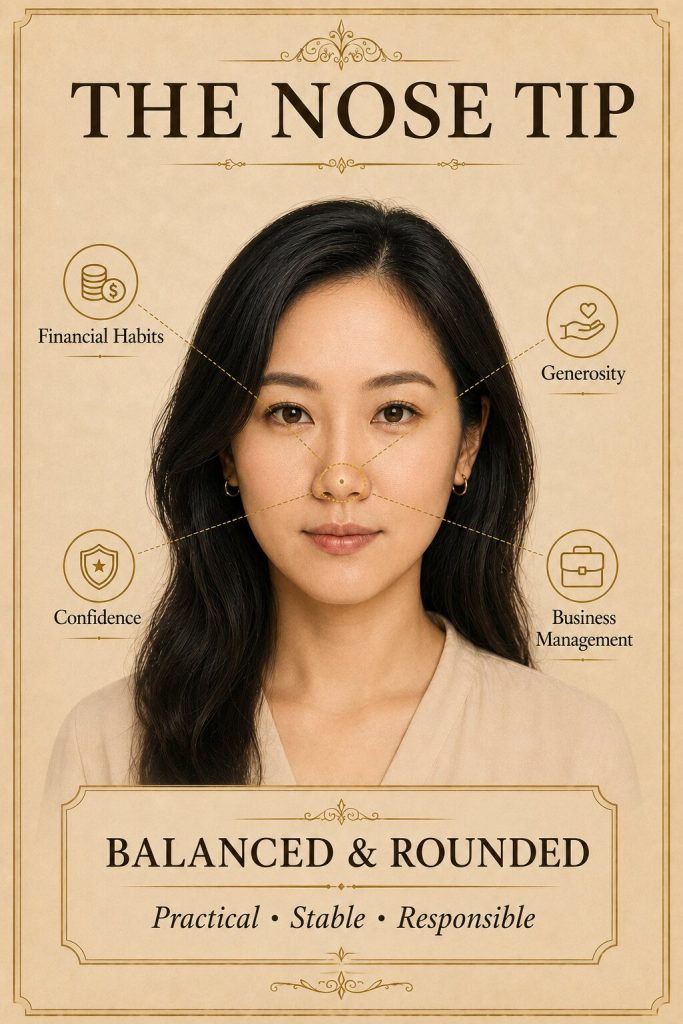
The nose tip is often associated with:
- Financial habits
- Generosity
- Confidence
- Business management
A balanced, rounded nose tip often suggests:
- Practical financial decisions
- Stability
- Responsible behaviour
Sharp Nose Tip
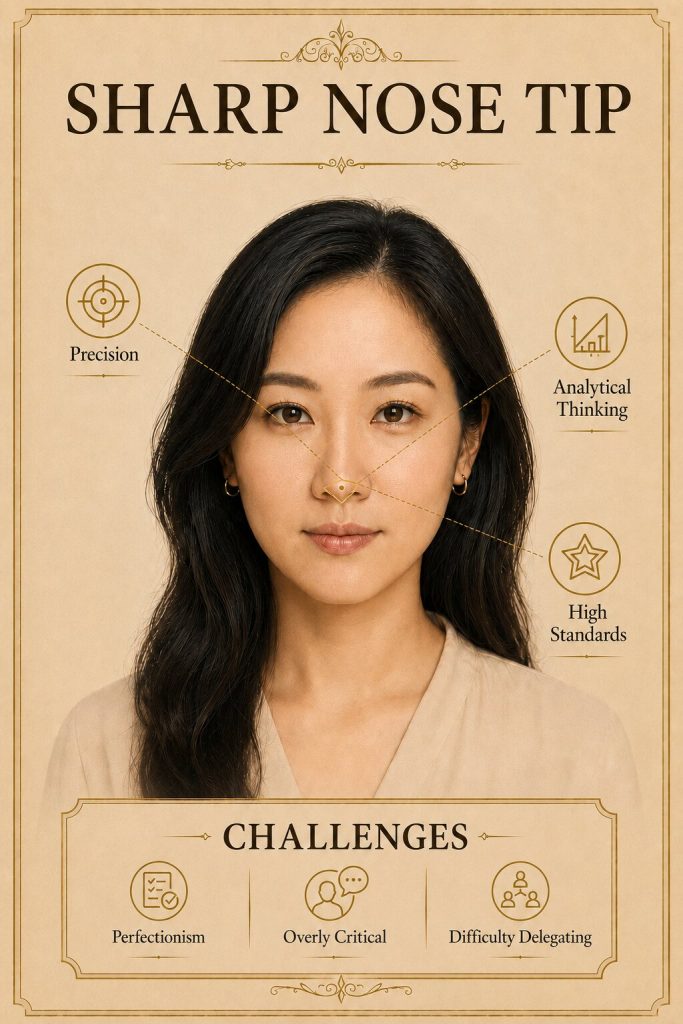
A sharper nose tip may indicate:
- Precision
- Analytical thinking
- High standards
Challenges:
- Perfectionism
- Being overly critical
- Difficulty delegating
Rounded Nose Tip
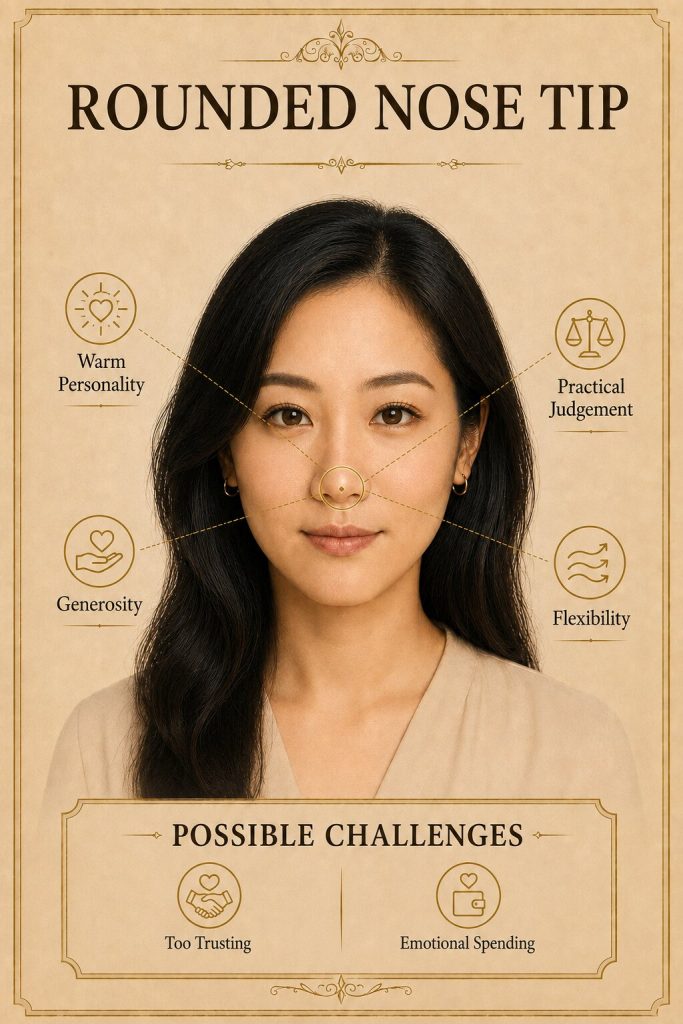
A rounded tip often reflects:
- Warm personality
- Practical judgement
- Generosity
- Flexibility
Possible challenges:
- Sometimes too trusting
- May spend emotionally
Nose Wings
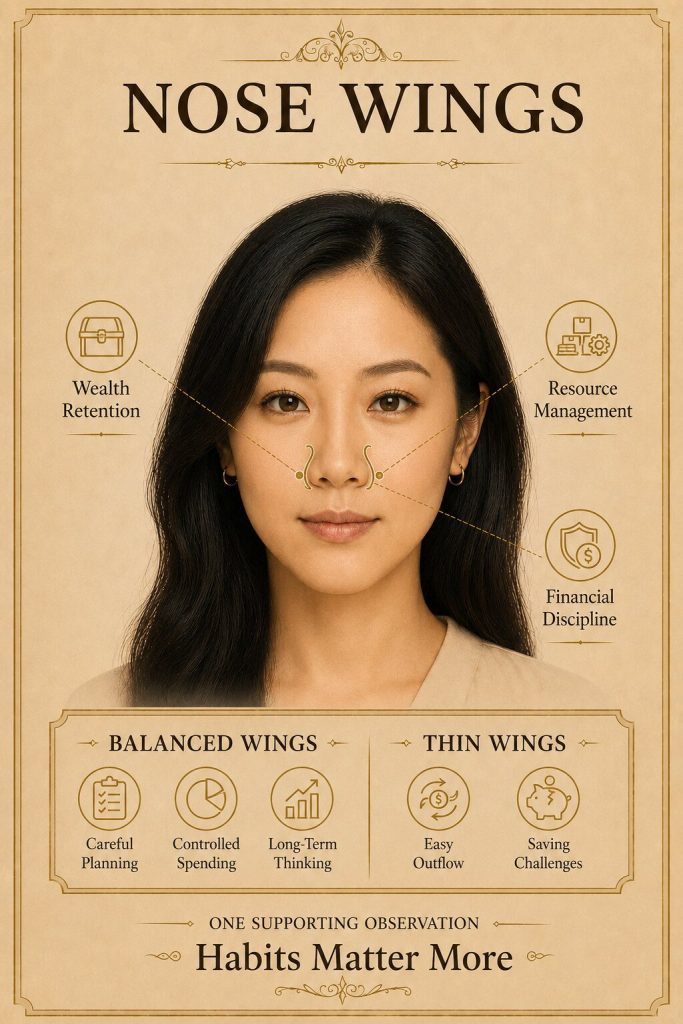
The wings of the nose represent:
- Ability to retain wealth
- Resource management
- Financial discipline
Balanced wings often indicate:
- Careful planning
- Controlled spending
- Long-term financial thinking
Thin nose wings may suggest:
- Money flows out easily
- Difficulty maintaining savings
This is only one supporting observation.
Financial education and habits remain far more important.
Nostrils
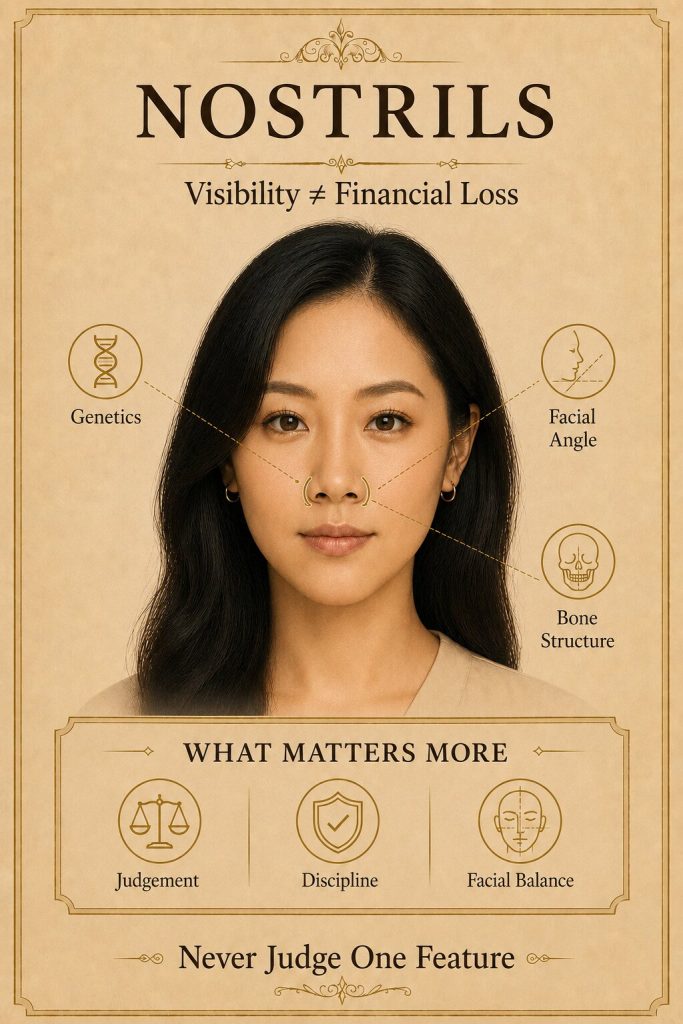
Many people ask whether visible nostrils mean money “leaks away.”
This is one of the most commonly repeated myths.
Professional interpretation is much more balanced.
Visible nostrils may simply reflect:
- Genetics
- Facial angle
- Bone structure
If a person has:
- excellent judgement
- strong discipline
- balanced facial structure
they may still become highly successful financially.
Never judge a person based solely on nostril visibility.
Large Nose
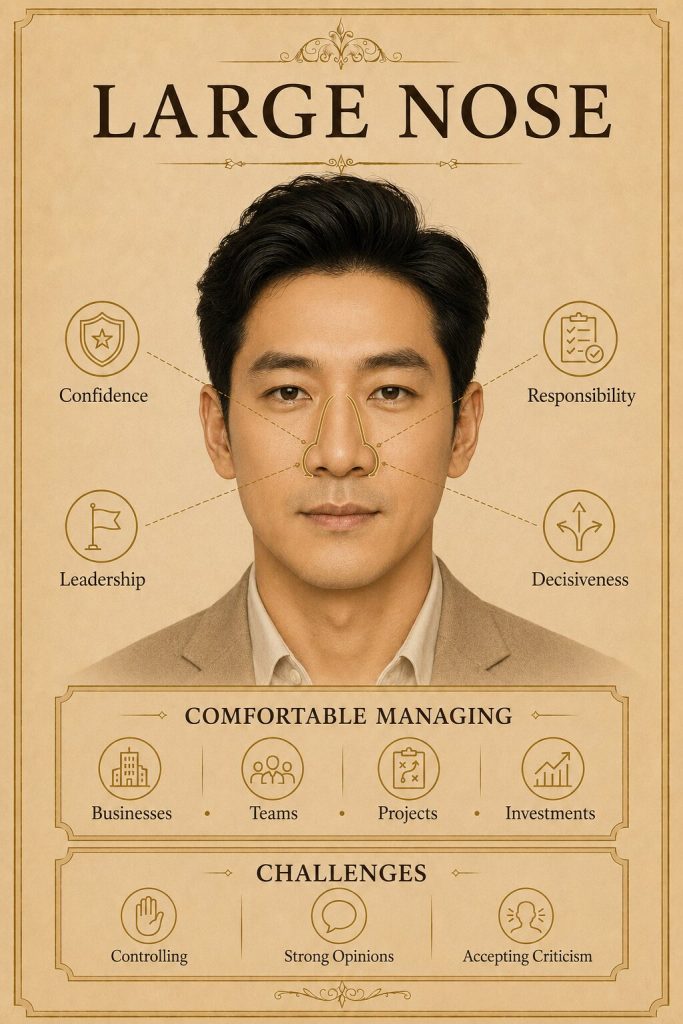
A larger nose often indicates:
- Confidence
- Responsibility
- Leadership
- Willingness to make decisions
These people often feel comfortable managing:
- Businesses
- Teams
- Projects
- Investments
Challenges:
- Can become controlling
- Strong opinions
- Difficulty accepting criticism
Small Nose
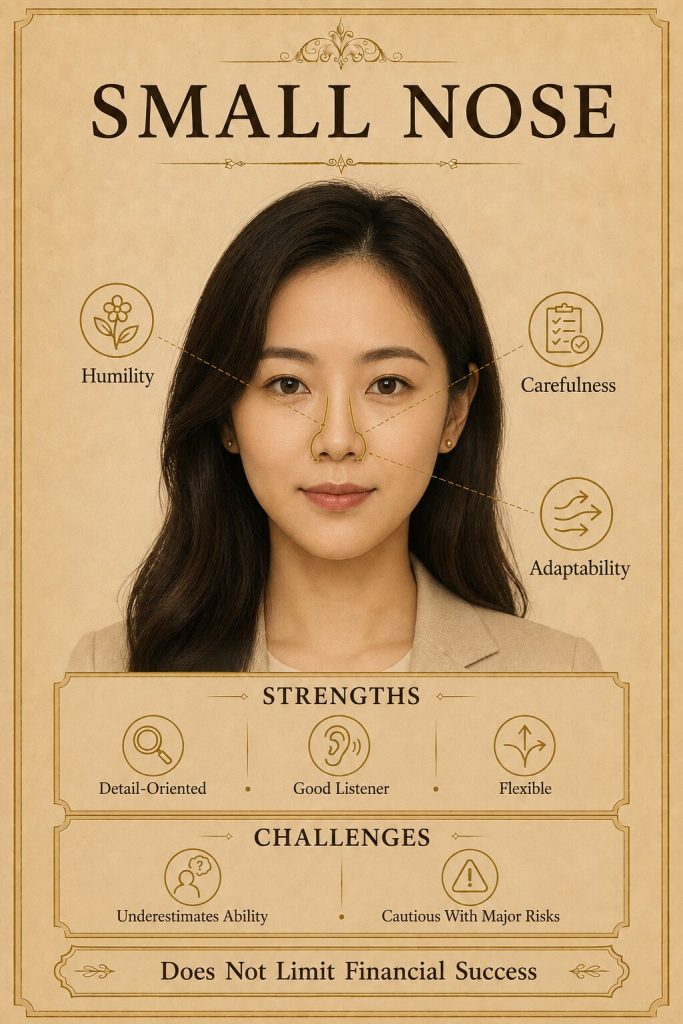
A smaller nose often suggests:
- Humility
- Carefulness
- Adaptability
Strengths:
- Detail-oriented
- Good listener
- Flexible
Challenges:
- May underestimate own ability
- Less comfortable taking major risks
Again…
This does not limit financial success.
Long Nose
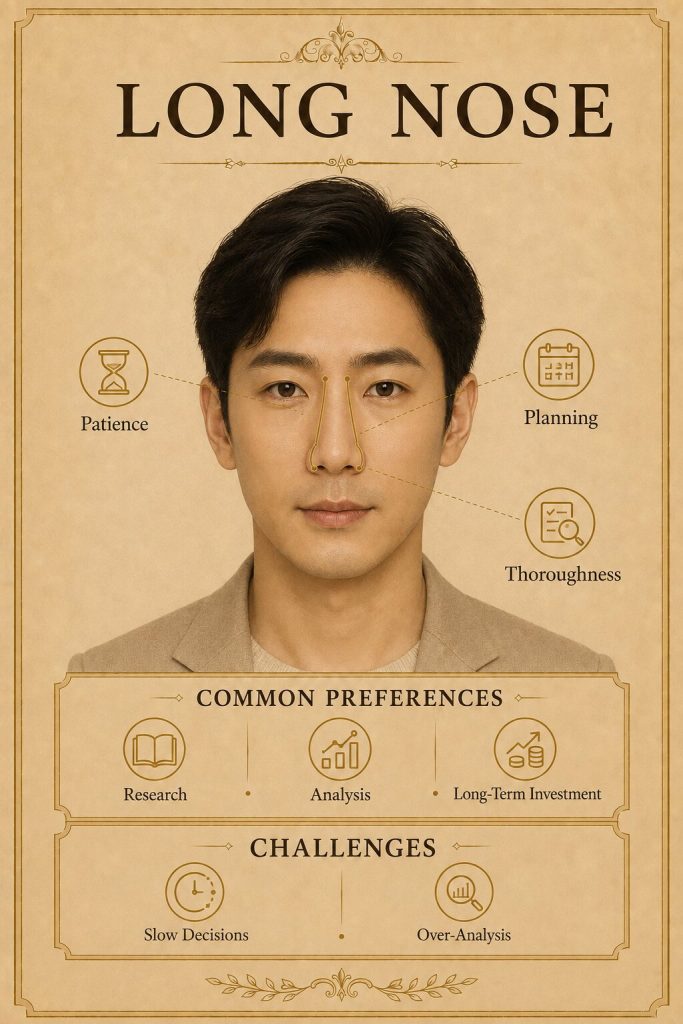
A longer nose often reflects:
- Patience
- Planning
- Thoroughness
These individuals usually prefer:
- Research
- Analysis
- Long-term investment
Challenges:
- Slow decision making
- Over-analysis
Short Nose
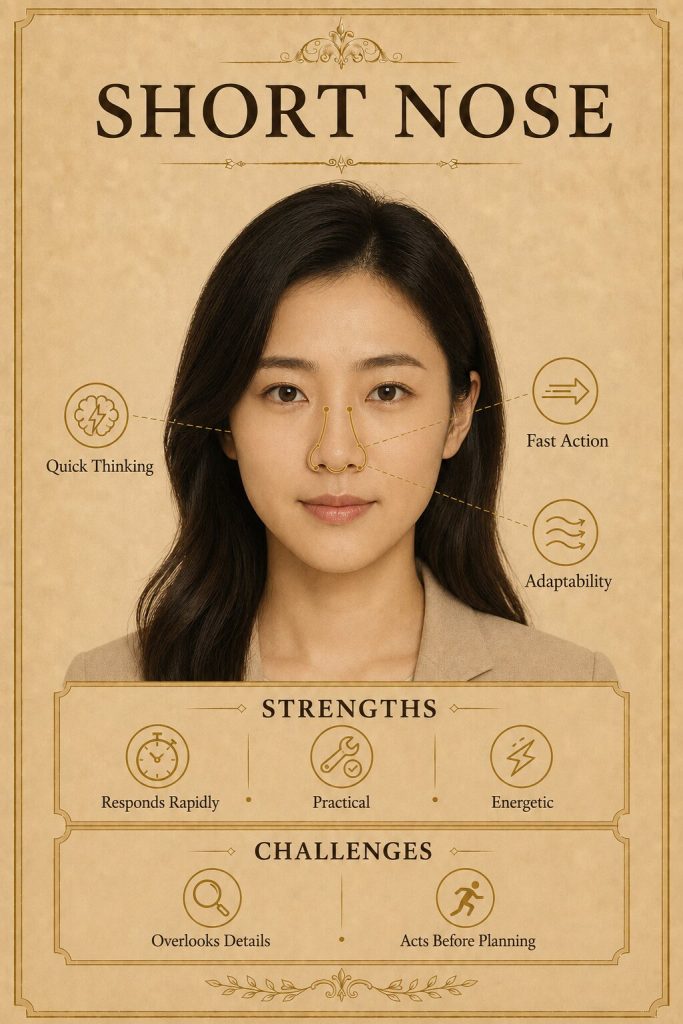
A shorter nose often indicates:
- Quick thinking
- Fast action
- Adaptability
Strengths:
- Responds rapidly
- Practical
- Energetic
Challenges:
- May overlook details
- Sometimes acts before planning
Straight Nose
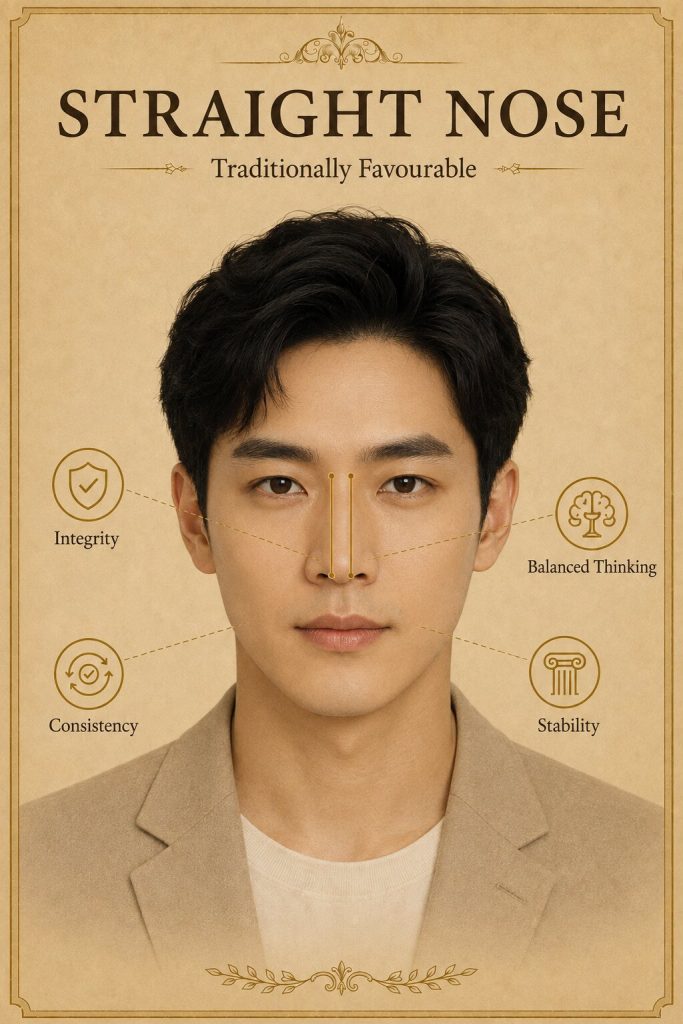
Traditionally considered favourable.
It often indicates:
- Integrity
- Balanced thinking
- Consistency
- Stability
Hooked Nose
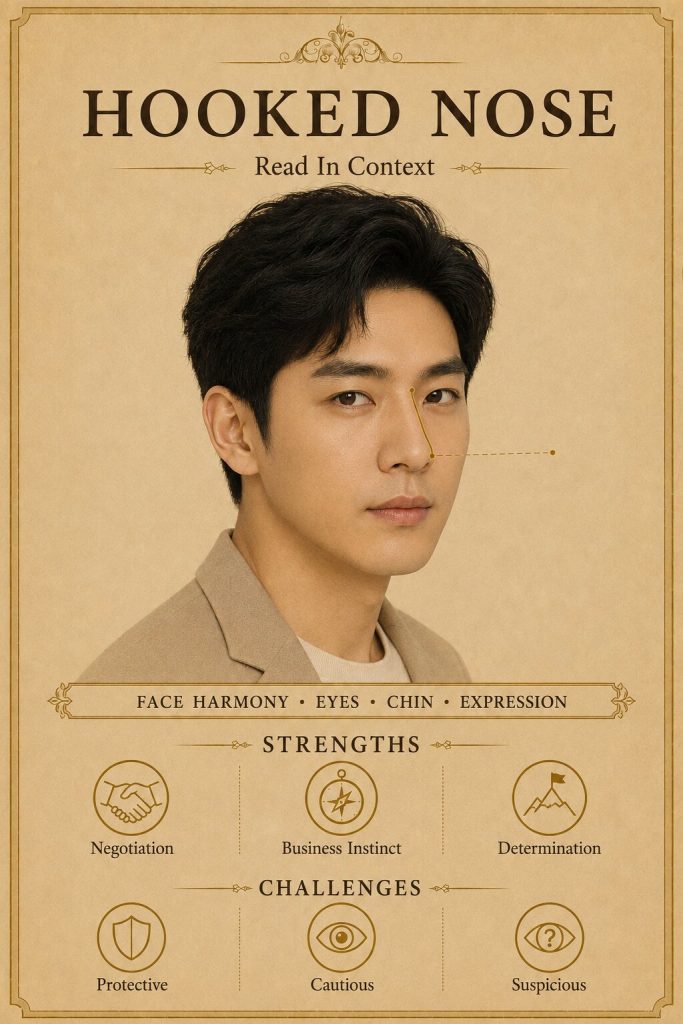
A hooked nose is frequently misunderstood.
Professional interpretation depends on:
- Overall facial harmony
- Eye quality
- Chin
- Facial expressions
Possible strengths:
- Strong negotiation ability
- Business instinct
- Determination
Possible challenges:
- Highly protective
- Cautious
- Can become suspicious
Flat Nose
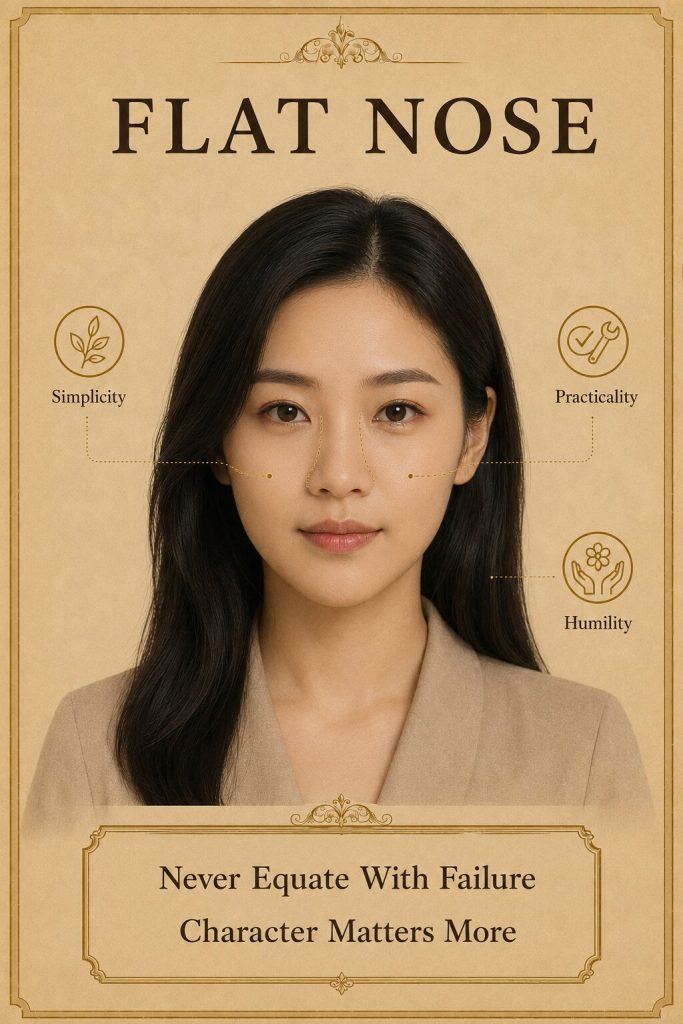
A flatter nose may indicate:
- Simplicity
- Practicality
- Humility
Professional readers never associate a flat nose with failure.
Character always matters more.
Nose and Leadership
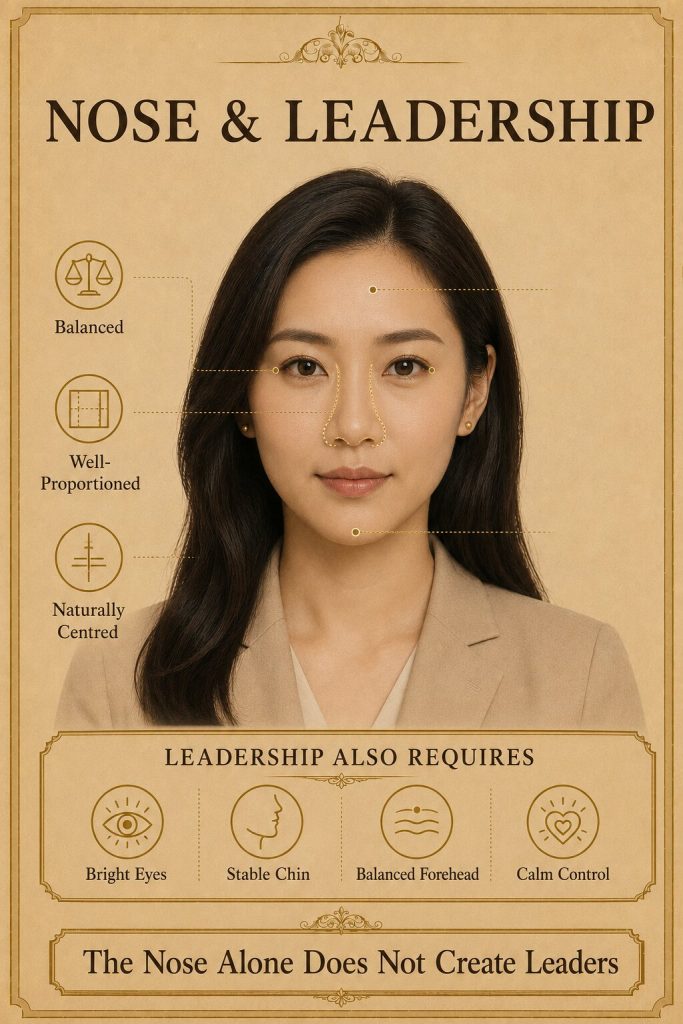
Many business owners possess noses that are:
- Balanced
- Well proportioned
- Naturally centred
Leadership also requires:
- Bright eyes
- Stable chin
- Balanced forehead
- Calm emotional control
The nose alone does not create leaders.
Nose and Business
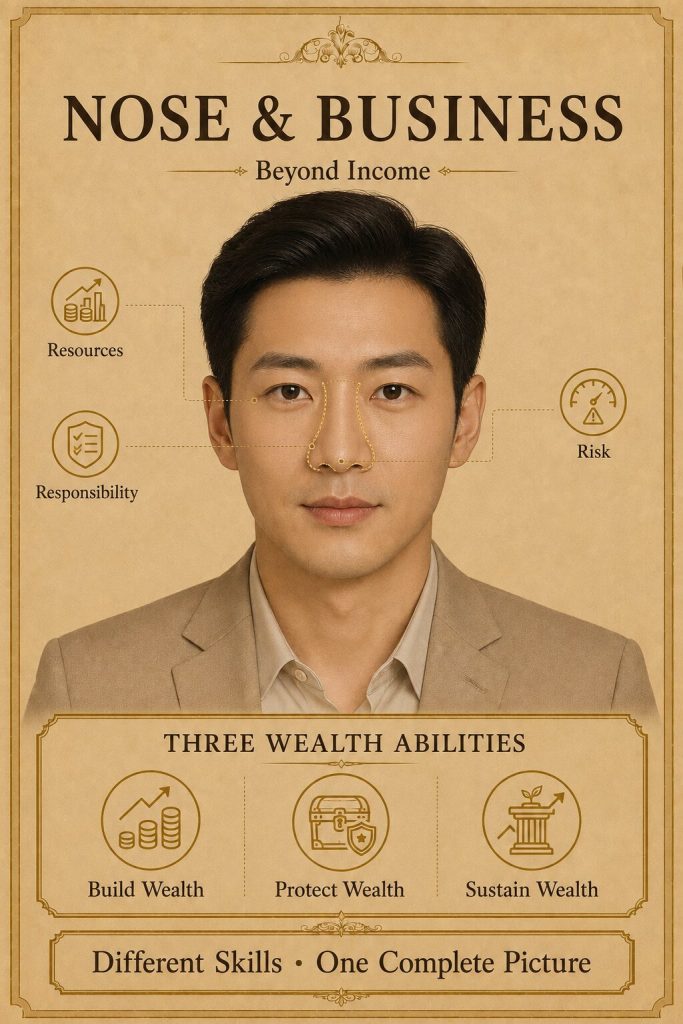
The nose often reveals how a person manages:
- Resources
- Responsibility
- Risk
Professional Face Reading looks beyond income.
It examines whether a person can:
- Build wealth
- Protect wealth
- Sustain wealth
These are very different abilities.
Nose and Confidence
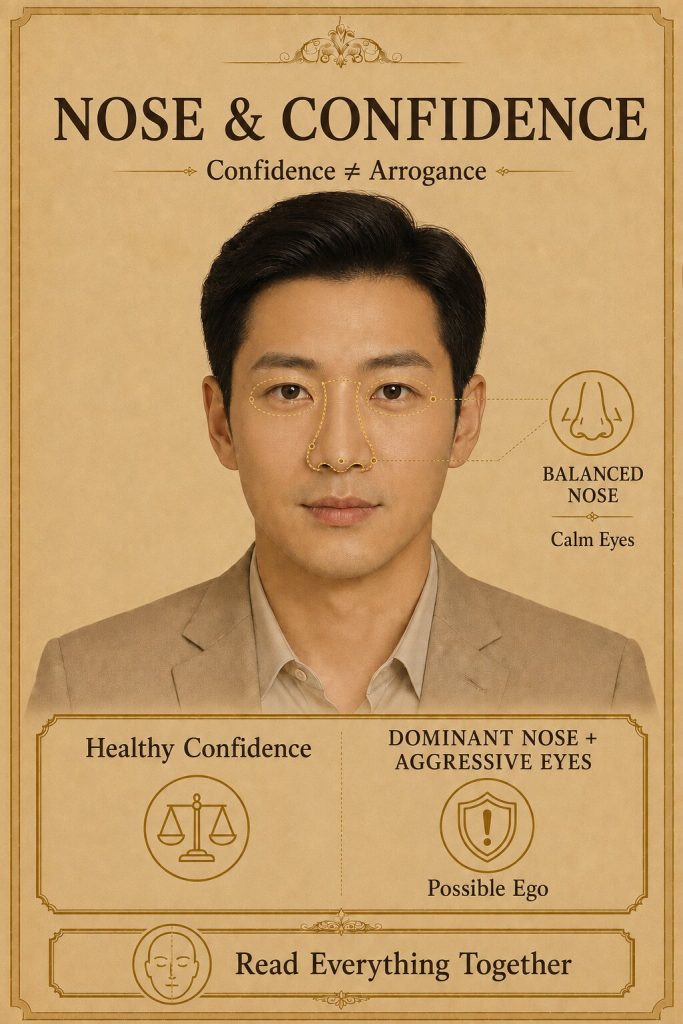
Confidence should never be confused with arrogance.
A balanced nose often reflects healthy confidence.
An overly dominant nose combined with aggressive eyes may suggest excessive ego.
Everything must be read together.
Common Beginner Mistakes
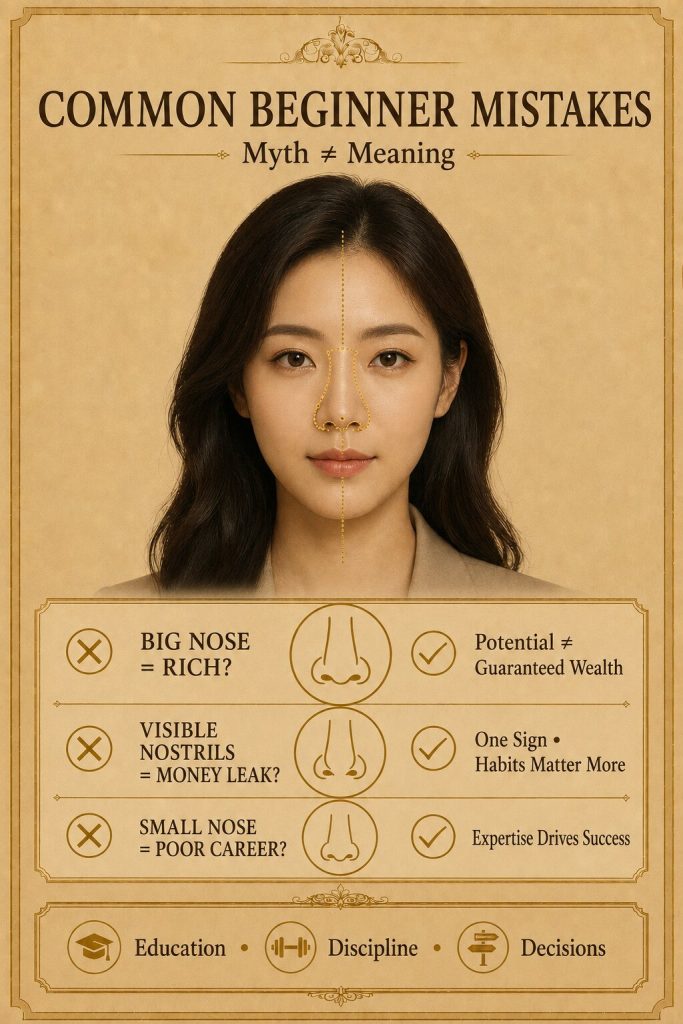
Incorrect:
Big nose equals rich.
Correct:
A larger, balanced nose may indicate stronger financial management potential.
Wealth still depends on education, discipline and decisions.
Incorrect:
Visible nostrils mean money always leaks away.
Correct:
Visible nostrils are only one observation.
Many highly successful business owners naturally have visible nostrils.
Financial habits matter far more.
Incorrect:
Small nose means poor career.
Correct:
Many outstanding professionals have smaller noses because they succeed through expertise rather than dominance.
Dougles Chan’s Professional Observation
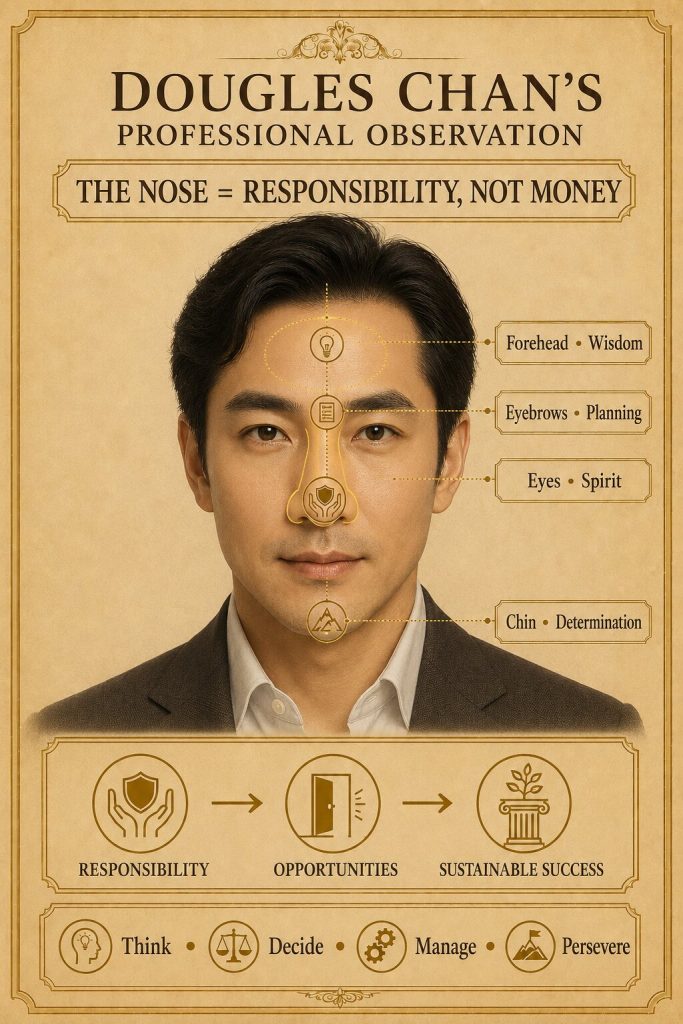
The nose is not a symbol of money.
It is a symbol of responsibility.
People who manage responsibility well often attract greater opportunities.
Greater opportunities often produce greater wealth.
This is why professional Face Reading studies how a person thinks, decides, manages and perseveres, rather than searching for one “lucky” feature.
The nose should always be confirmed by:
- The wisdom of the forehead.
- The planning shown by the eyebrows.
- The spirit revealed in the eyes.
- The determination reflected by the chin.
When these features support one another, they often indicate a person who is capable of building sustainable success through sound judgement and consistent action.
The Mouth
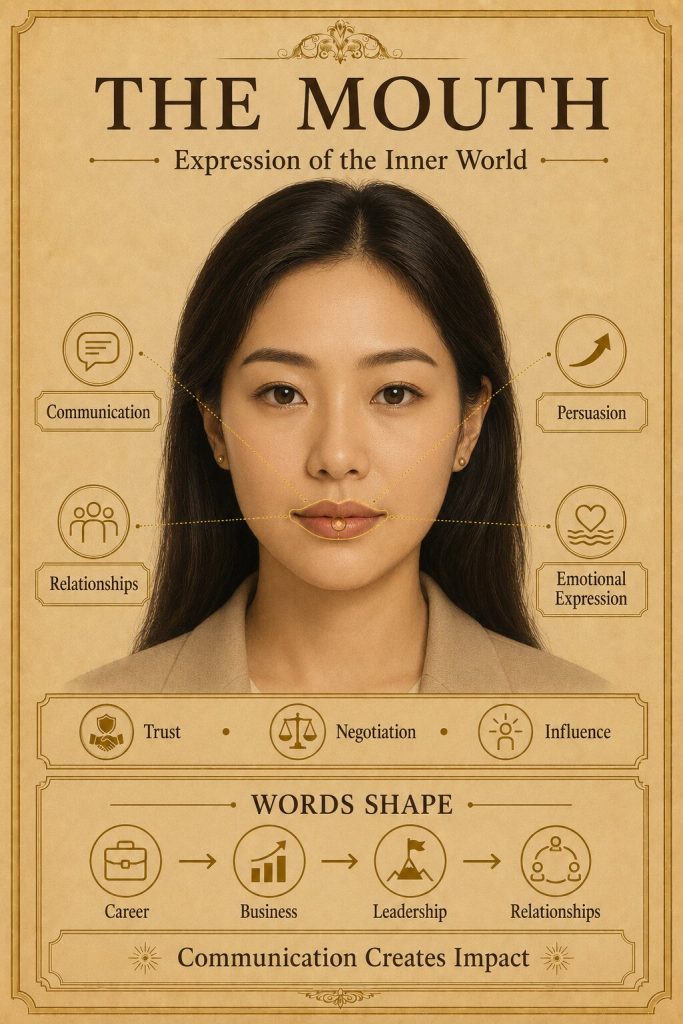
If the eyes reveal a person’s spirit…
and the nose reflects responsibility…
then the mouth reveals how a person expresses their inner world to others.
The mouth is one of the most active parts of the face.
It influences:
- Communication
- Leadership
- Persuasion
- Relationships
- Emotional expression
- Trustworthiness
- Negotiation
- Personal influence
Many successful people possess average facial features.
However, they achieve extraordinary success because of their ability to communicate effectively.
A person’s words often determine:
- Career advancement
- Business growth
- Leadership influence
- Relationship quality
This is why the mouth deserves careful observation.
The Golden Rule of Reading the Mouth
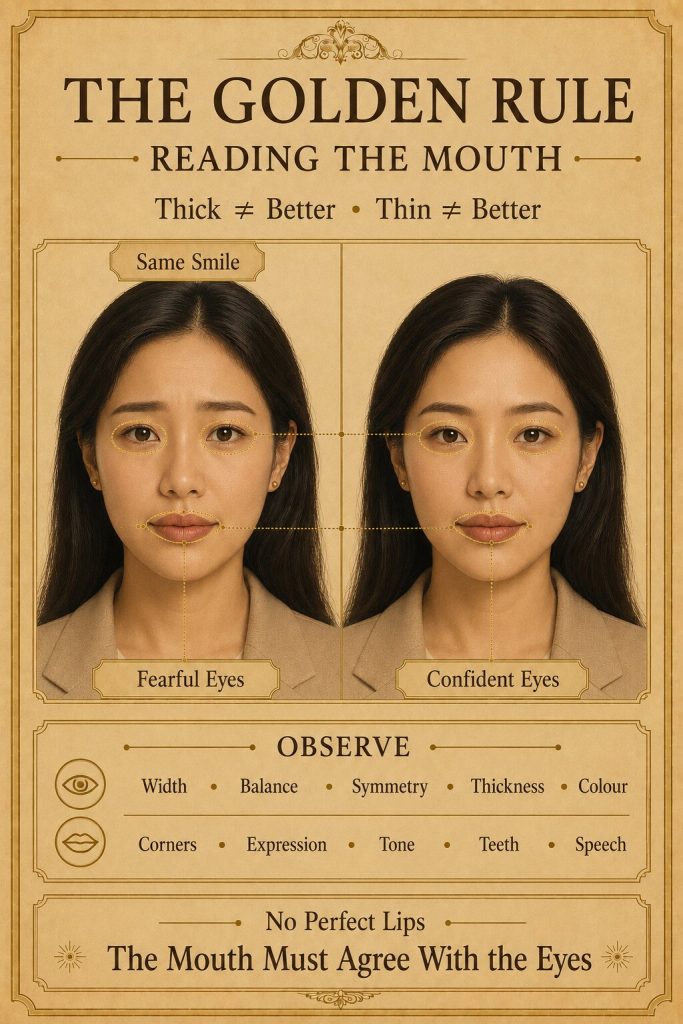
Many beginners immediately ask:
“Are thick lips better than thin lips?”
The answer is exactly the same as every professional observation.
Neither.
There are no perfect lips.
Professional Face Reading evaluates:
- Width
- Balance
- Symmetry
- Lip thickness
- Lip colour
- Corners of the mouth
- Natural expressions
- Muscle tone
- Teeth
- Speech patterns
The mouth must always agree with the eyes.
A smiling mouth with fearful eyes tells a very different story from a smiling mouth with confident eyes.
The Ideal Mouth
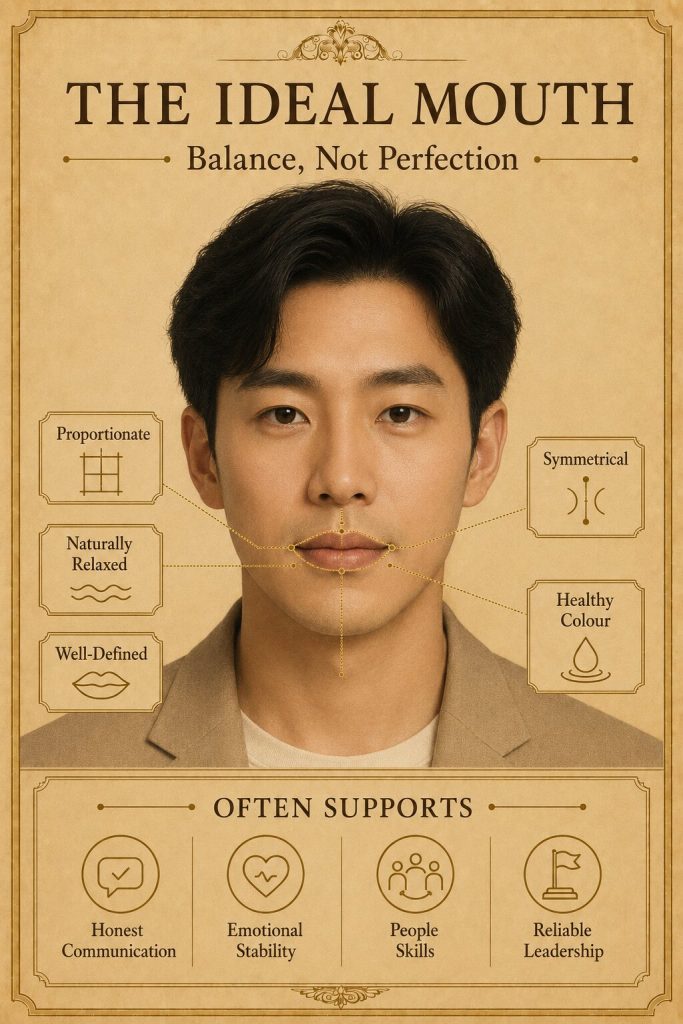
Traditionally, a balanced mouth is:
- Proportionate to the face
- Symmetrical
- Naturally relaxed
- Healthy in colour
- Well-defined
Such individuals often display:
- Honest communication
- Emotional stability
- Good interpersonal skills
- Reliable leadership
Large Mouth
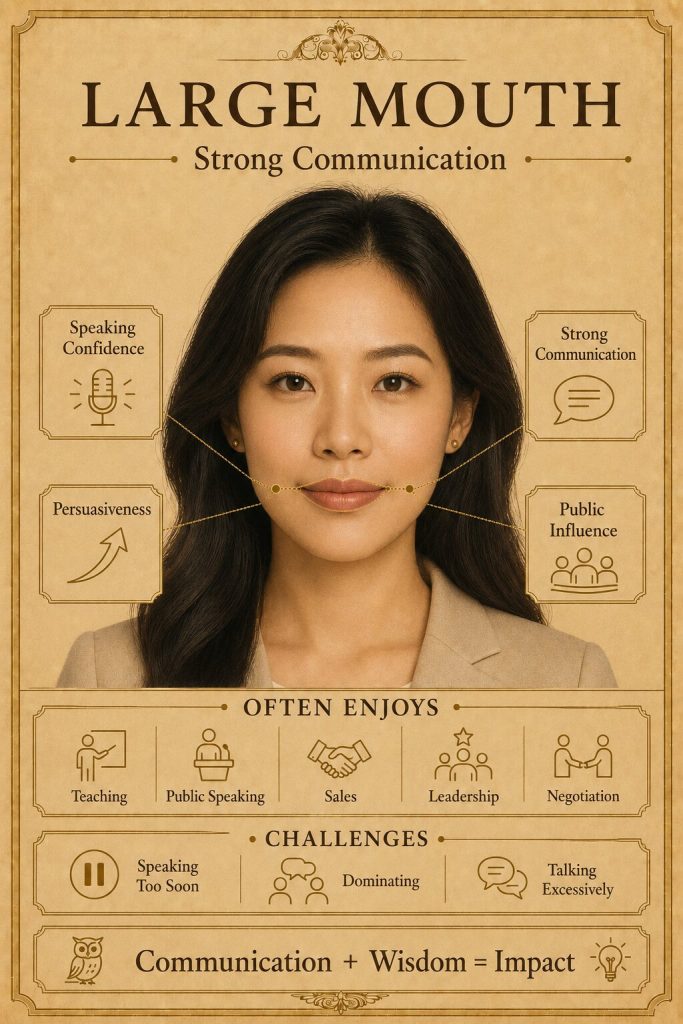
A larger mouth often indicates:
- Strong communication
- Confidence in speaking
- Persuasiveness
- Public influence
Such individuals frequently enjoy:
- Teaching
- Public speaking
- Sales
- Leadership
- Negotiation
Challenges:
- Speaking before thinking
- Dominating conversations
- Talking excessively
Communication becomes powerful only when combined with wisdom.
Small Mouth
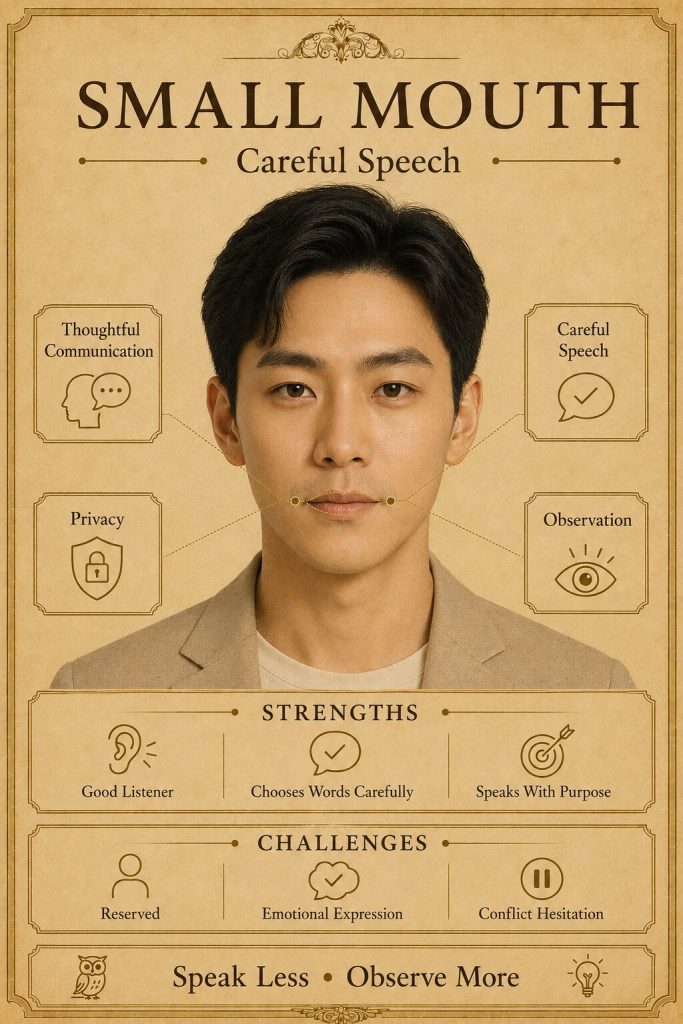
A smaller mouth often reflects:
- Careful speech
- Thoughtful communication
- Privacy
- Observation
Strengths:
- Good listener
- Chooses words carefully
- Speaks with purpose
Challenges:
- Reserved personality
- Difficulty expressing emotions
- May hesitate during conflict
Many excellent consultants naturally speak less and observe more.
Wide Mouth
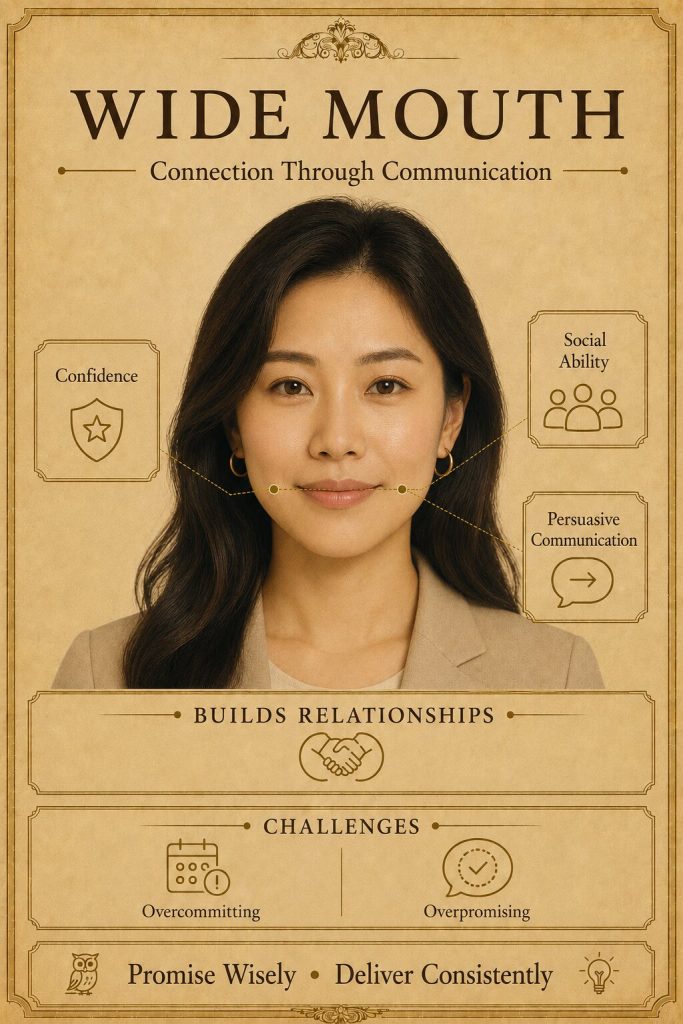
A wider mouth often indicates:
- Confidence
- Social ability
- Persuasive communication
People with balanced wide mouths often enjoy building relationships.
Challenges:
- Overcommitting
- Promising more than can realistically be delivered
Narrow Mouth
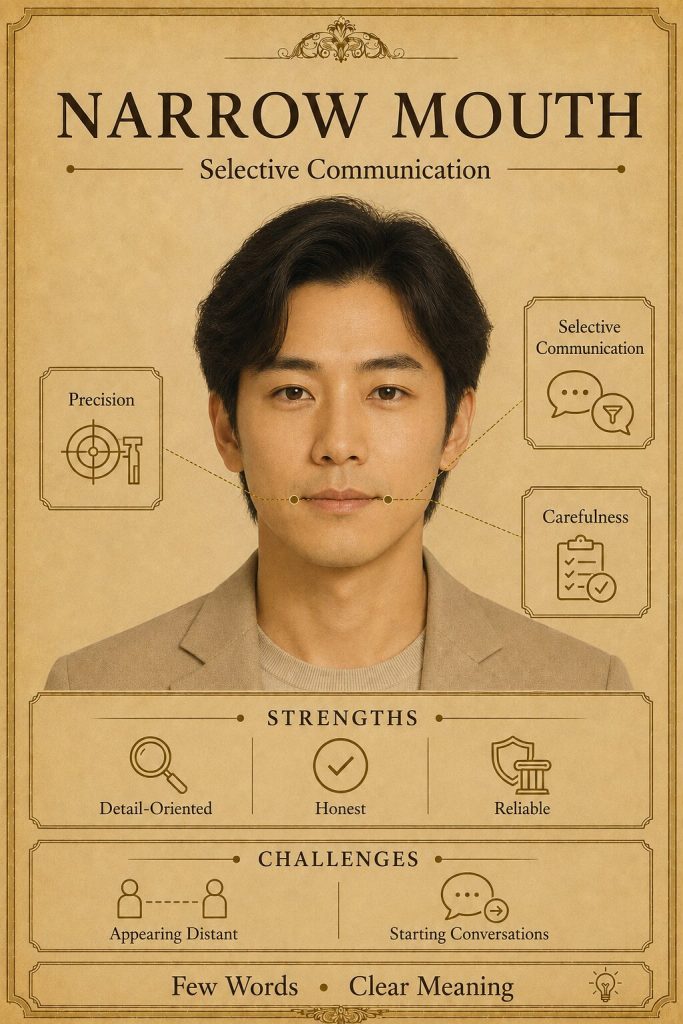
A narrower mouth may suggest:
- Selective communication
- Precision
- Carefulness
Strengths:
- Detail-oriented
- Honest
- Reliable
Challenges:
- Appearing distant
- Difficulty initiating conversations
Thick Lips
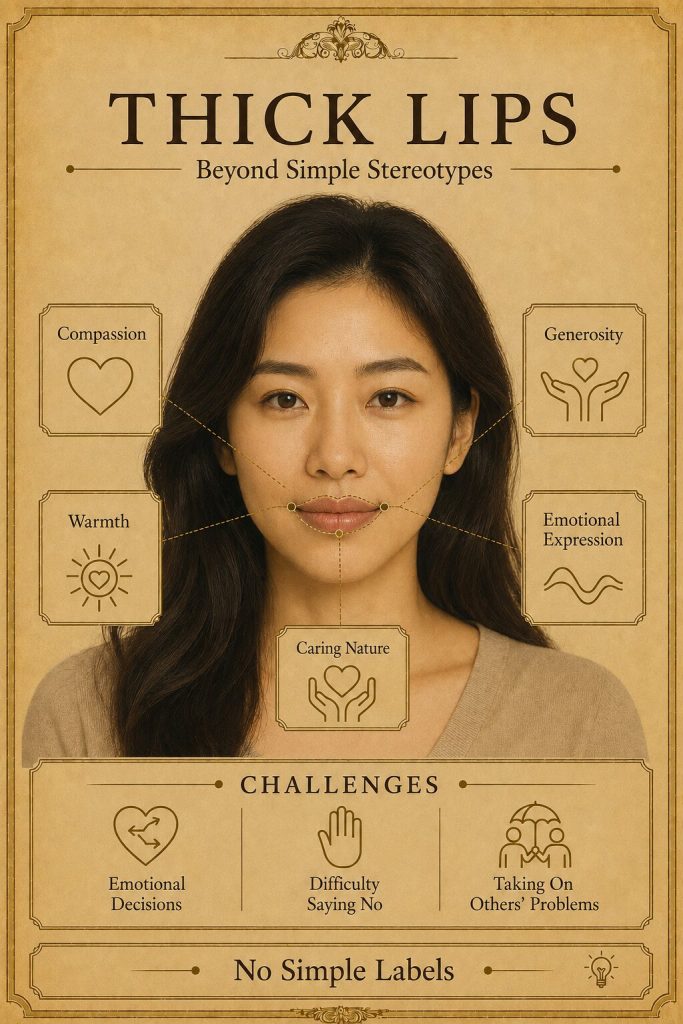
Thick lips are often misunderstood.
Many people immediately associate thick lips with romance or desire.
Professional Face Reading does not make such simplistic conclusions.
Balanced thick lips often suggest:
- Compassion
- Generosity
- Warmth
- Emotional expression
- Caring nature
Challenges:
- Emotional decision making
- Difficulty saying no
- Taking on other people’s problems
Thin Lips
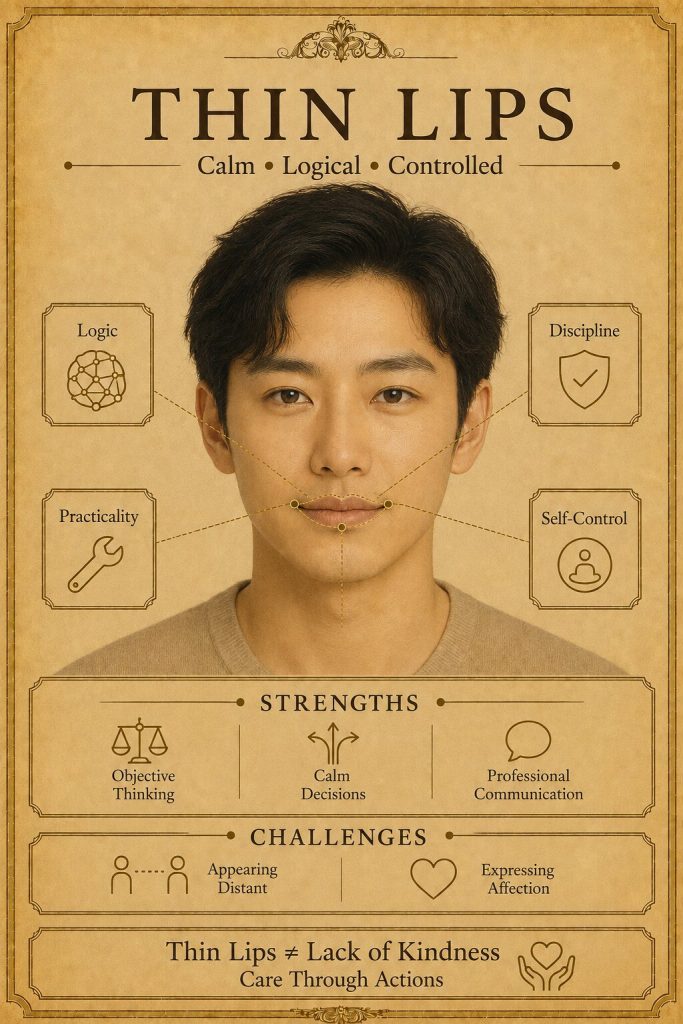
Thin lips often indicate:
- Logic
- Discipline
- Practicality
- Self-control
Strengths:
- Objective thinking
- Calm decision making
- Professional communication
Challenges:
- Appearing emotionally distant
- Difficulty expressing affection openly
Thin lips do not indicate a lack of kindness.
Many simply express care through actions rather than words.
Uneven Lips
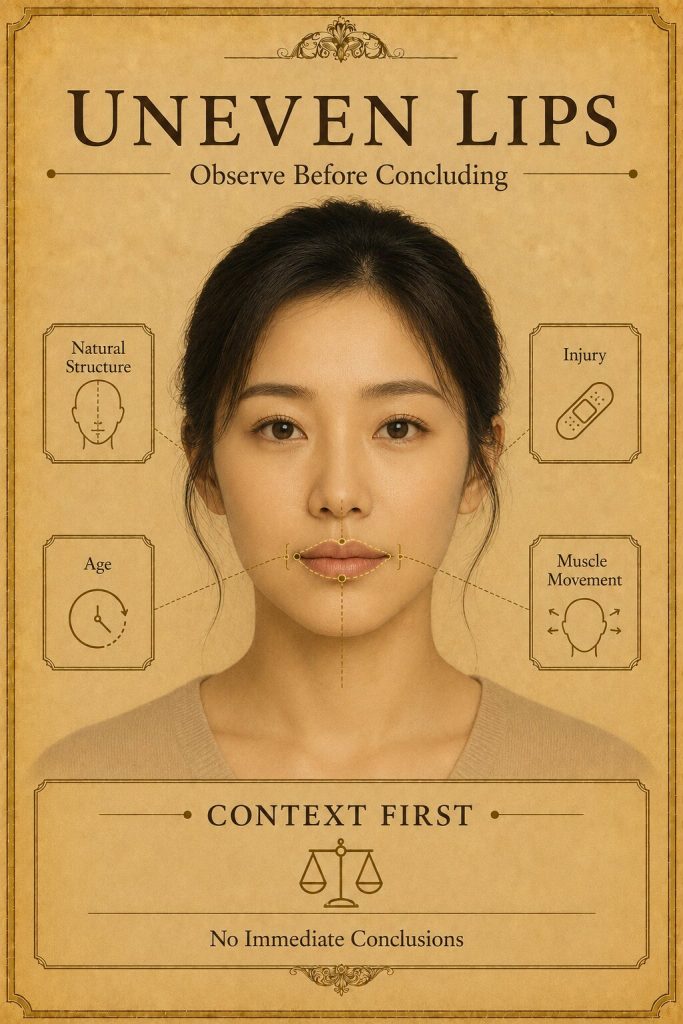
Uneven lips require careful observation.
Professionals consider:
- Natural structure
- Injury
- Age
- Muscle movement
Rather than making immediate conclusions.
Well-Defined Lips
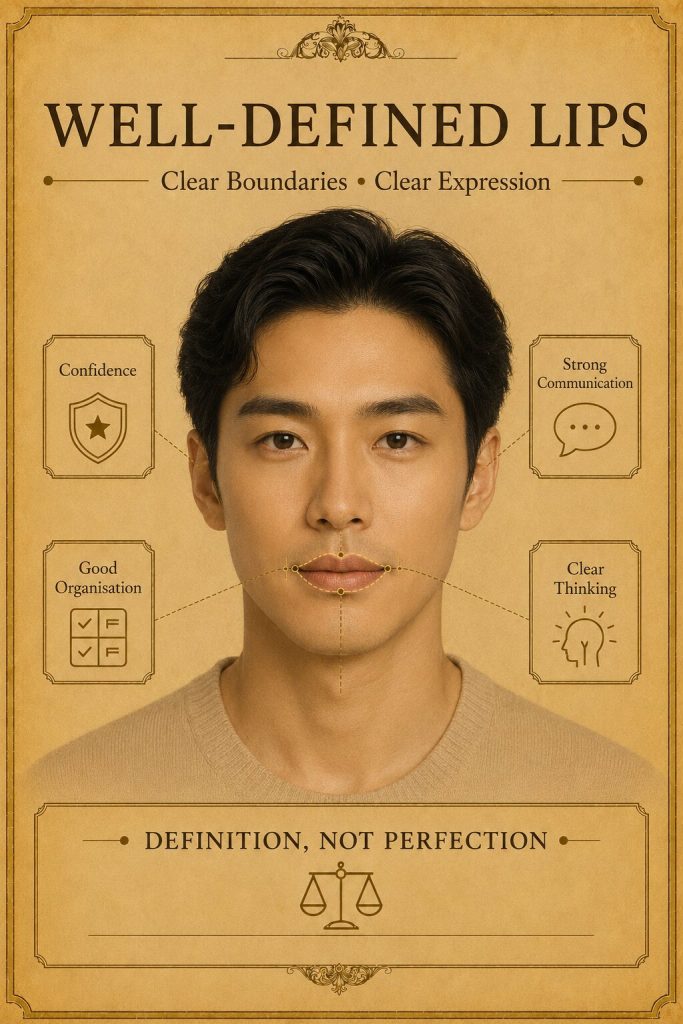
Clear lip boundaries often indicate:
- Confidence
- Strong communication
- Good organisation
- Clear thinking
Poorly Defined Lips
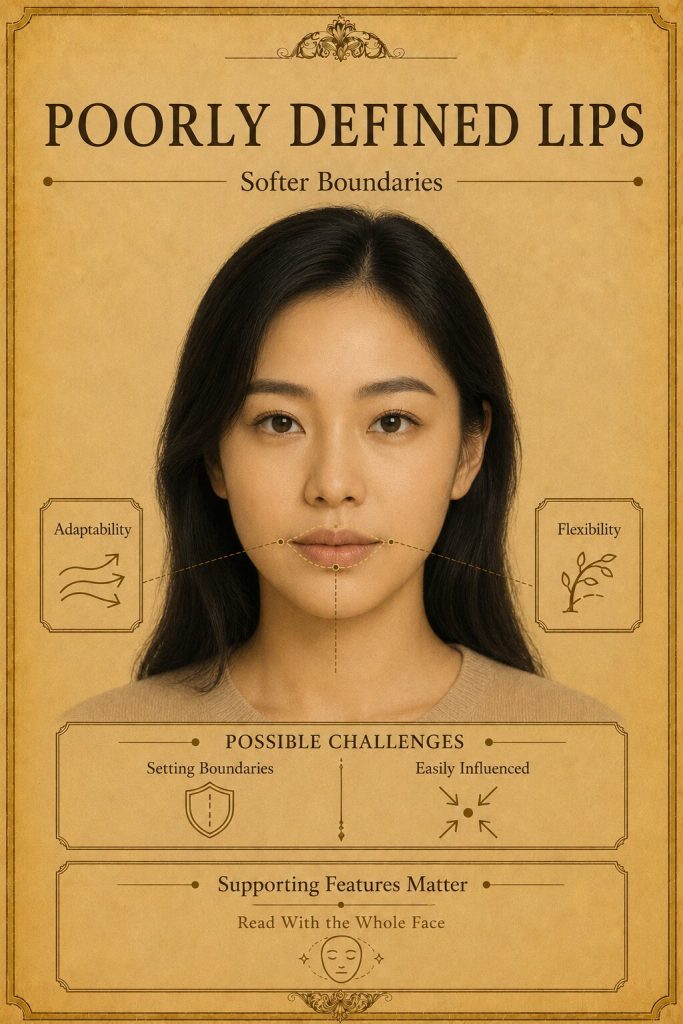
May suggest:
- Adaptability
- Flexibility
Possible challenges:
- Difficulty setting boundaries
- Easily influenced by others
Again…
Supporting features must always be considered.
Corners of the Mouth
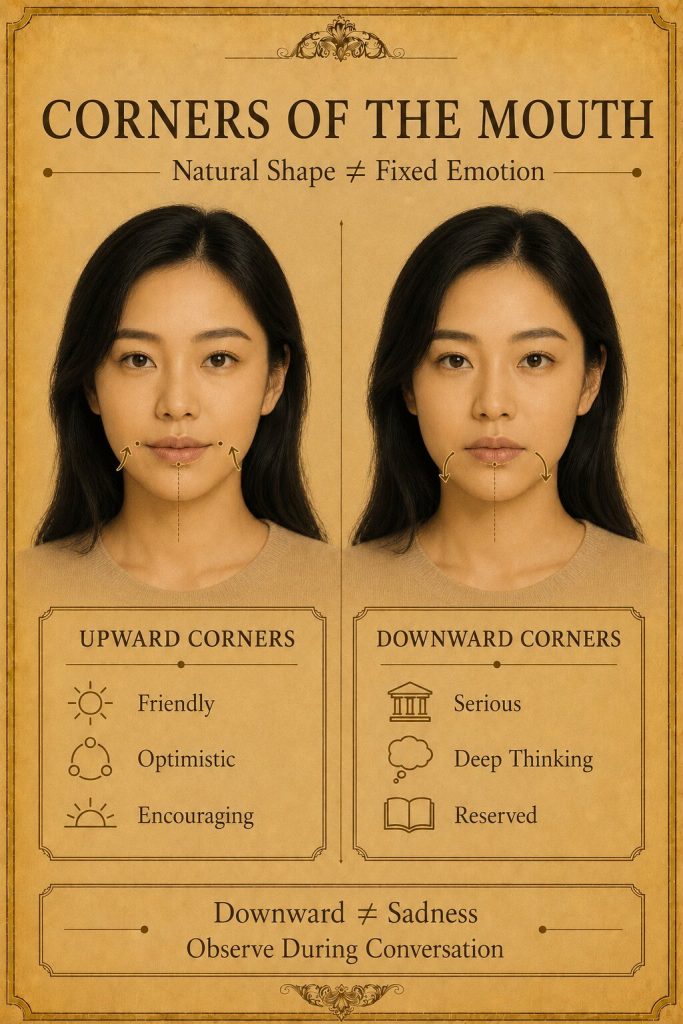
One of the most overlooked observations.
Naturally upward corners often create an approachable appearance.
These individuals may appear:
- Friendly
- Optimistic
- Encouraging
Naturally downward corners do not automatically indicate sadness.
They may simply reflect:
- Seriousness
- Deep thinking
- Reserved personality
Professional readers observe natural expressions during conversation.
Lip Colour
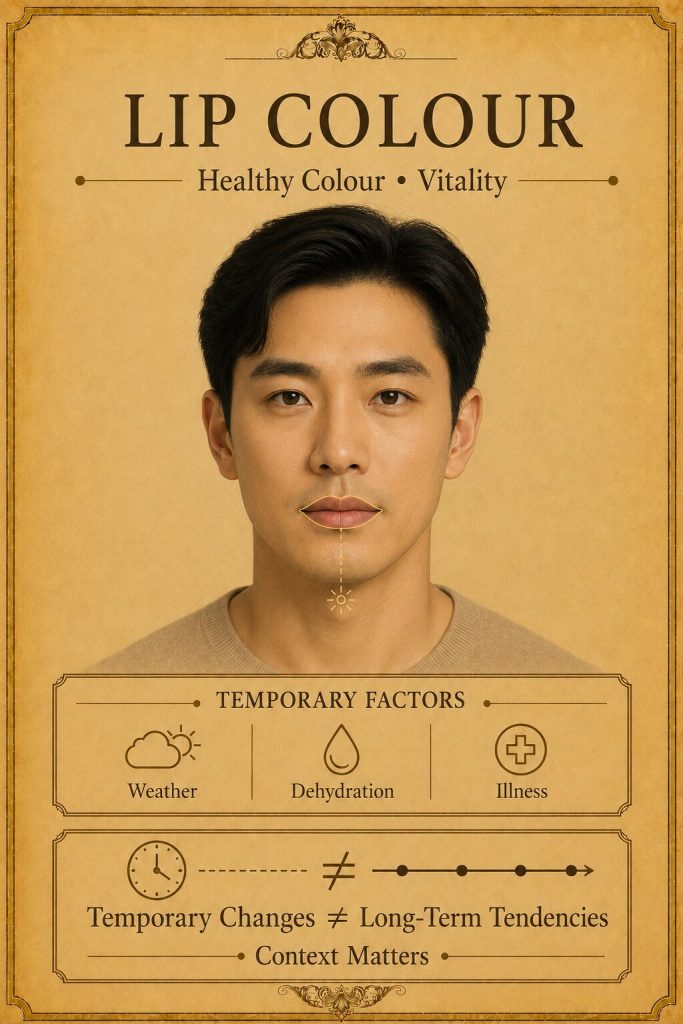
Healthy lip colour often reflects vitality.
Temporary changes may result from:
- Weather
- Dehydration
- Illness
Professionals distinguish temporary conditions from long-term tendencies.
The Upper Lip
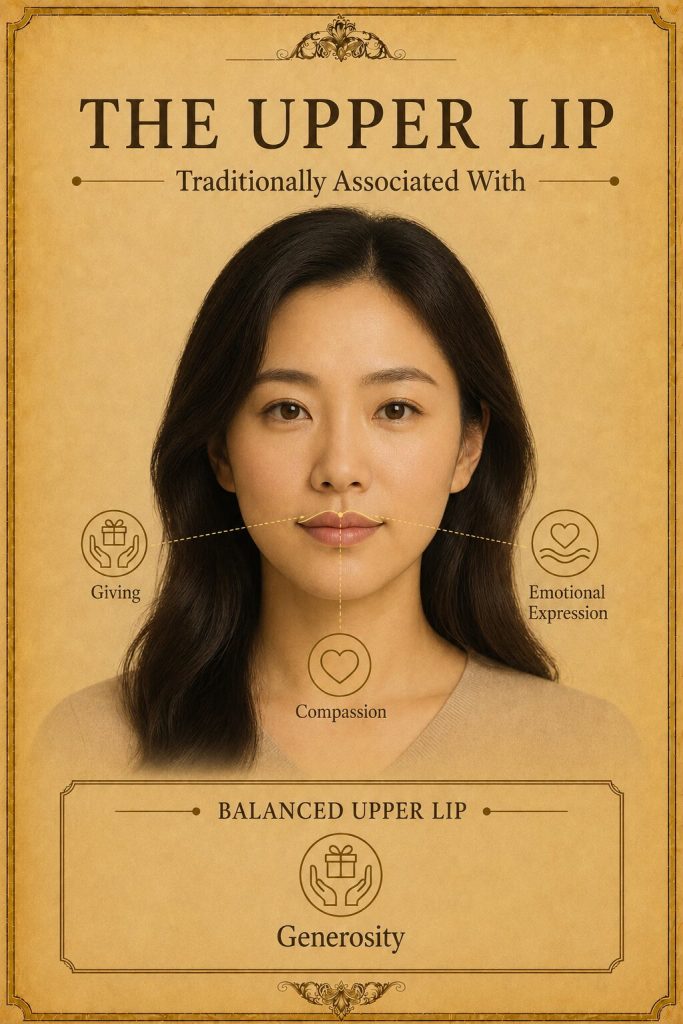
The upper lip is traditionally associated with:
- Giving
- Compassion
- Emotional expression
Balanced upper lips often indicate generosity.
The Lower Lip
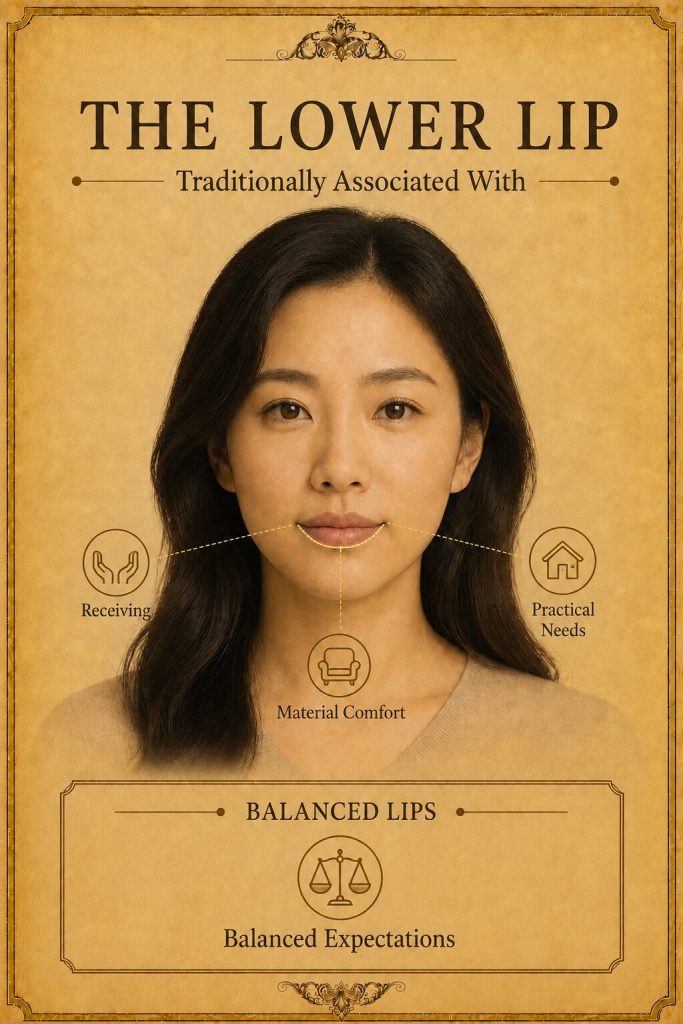
The lower lip is associated with:
- Receiving
- Practical needs
- Material comfort
Balance between the upper and lower lips often reflects balanced emotional expectations.
The Smile
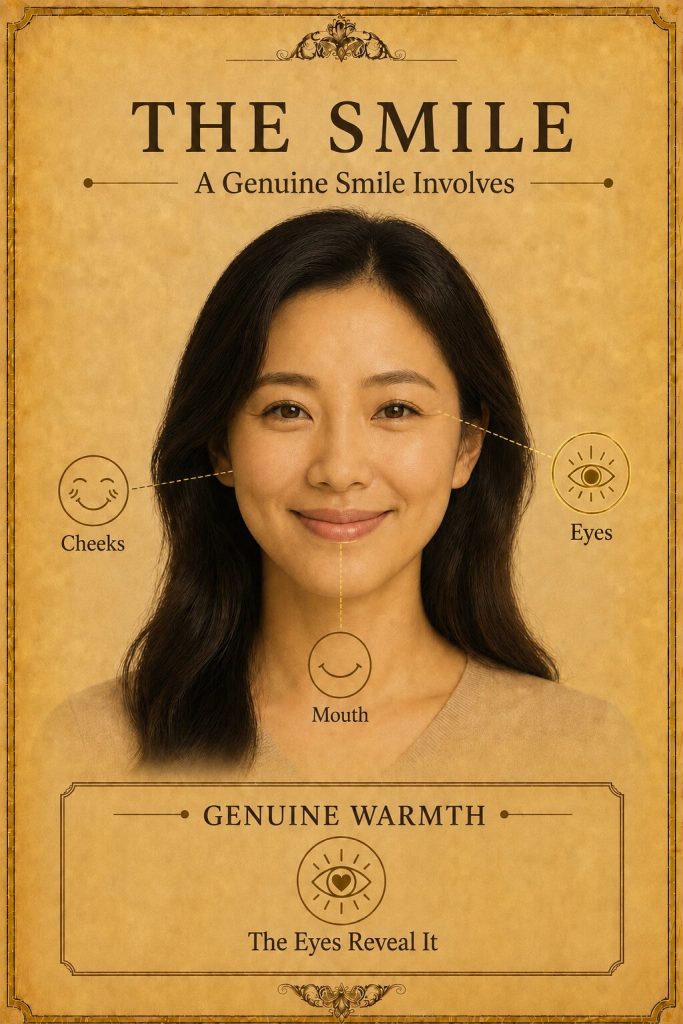
A genuine smile involves:
- The mouth
- The cheeks
- The eyes
Professional Face Reading places greater importance on the eyes than the mouth.
Many people can smile naturally.
Very few can create genuine warmth in the eyes without sincere emotion.
Teeth
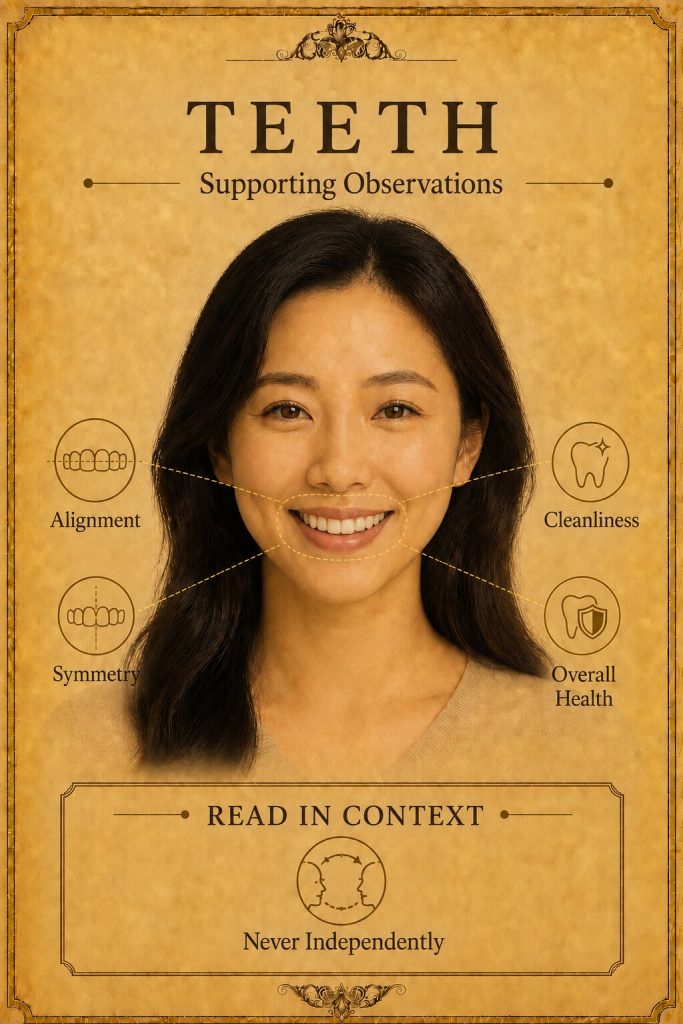
The teeth provide supporting information.
Professionals observe:
- Alignment
- Cleanliness
- Symmetry
- Overall health
Teeth should never be interpreted independently.
Well-Aligned Teeth
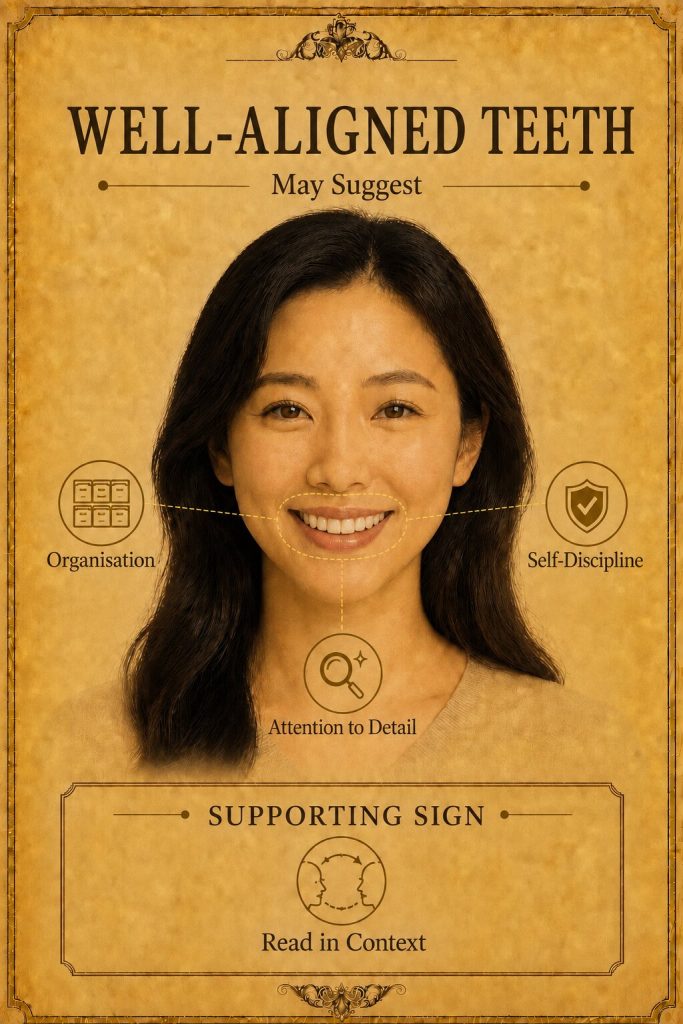
May indicate:
- Organisation
- Self-discipline
- Attention to detail
Uneven Teeth
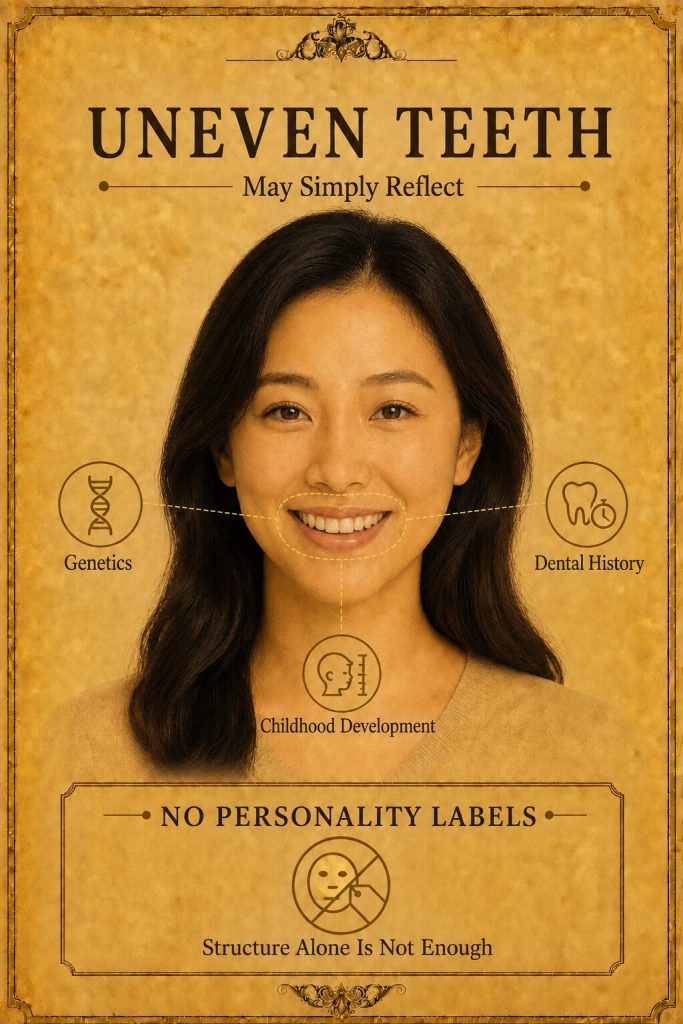
May simply reflect:
- Genetics
- Dental history
- Childhood development
Professional readers avoid attaching personality labels to dental structure alone.
Speaking Style
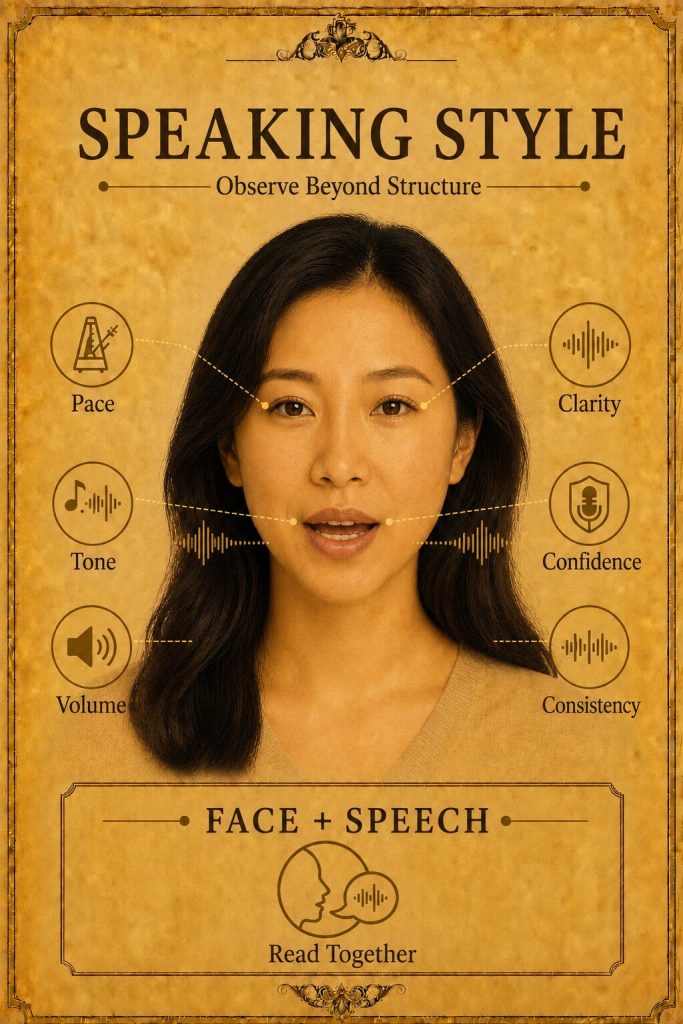
Professional Face Reading does not stop at facial structure.
Speech itself reveals character.
Observe:
- Pace
- Clarity
- Tone
- Confidence
- Volume
- Consistency
The face and speech should support each other.
A confident face with uncertain speech creates inconsistency.
Likewise…
A humble face combined with calm, confident speech often reveals hidden strength.
Mouth and Leadership
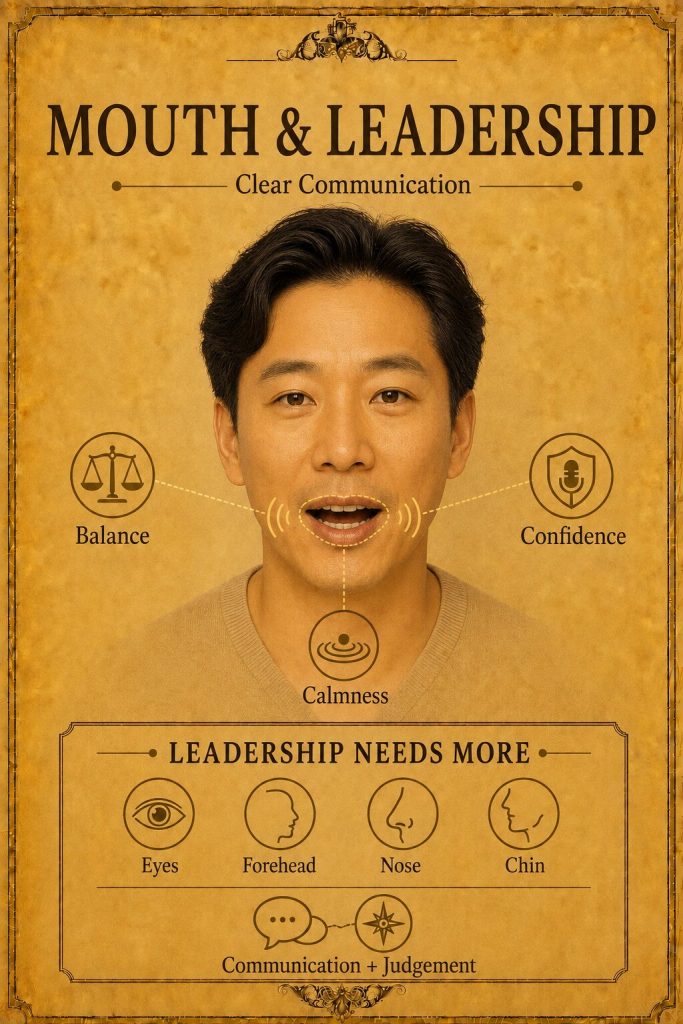
Great leaders communicate clearly.
Their mouths often display:
- Balance
- Confidence
- Calmness
However…
Leadership depends equally on:
- The eyes
- The forehead
- The nose
- The chin
Communication without judgement may create followers.
Judgement without communication rarely creates leaders.
Mouth and Wealth
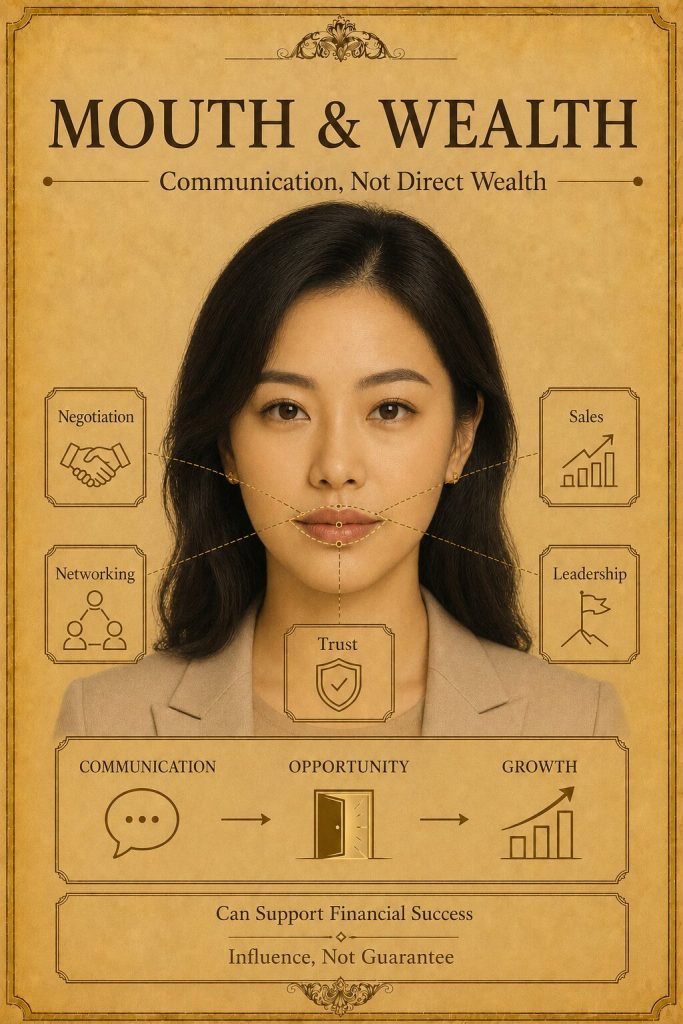
The mouth does not create wealth directly.
Instead…
It influences:
- Negotiation
- Sales
- Networking
- Leadership
- Trust
These abilities often contribute to financial success.
Many businesses succeed because the owner communicates effectively.
Mouth and Relationships
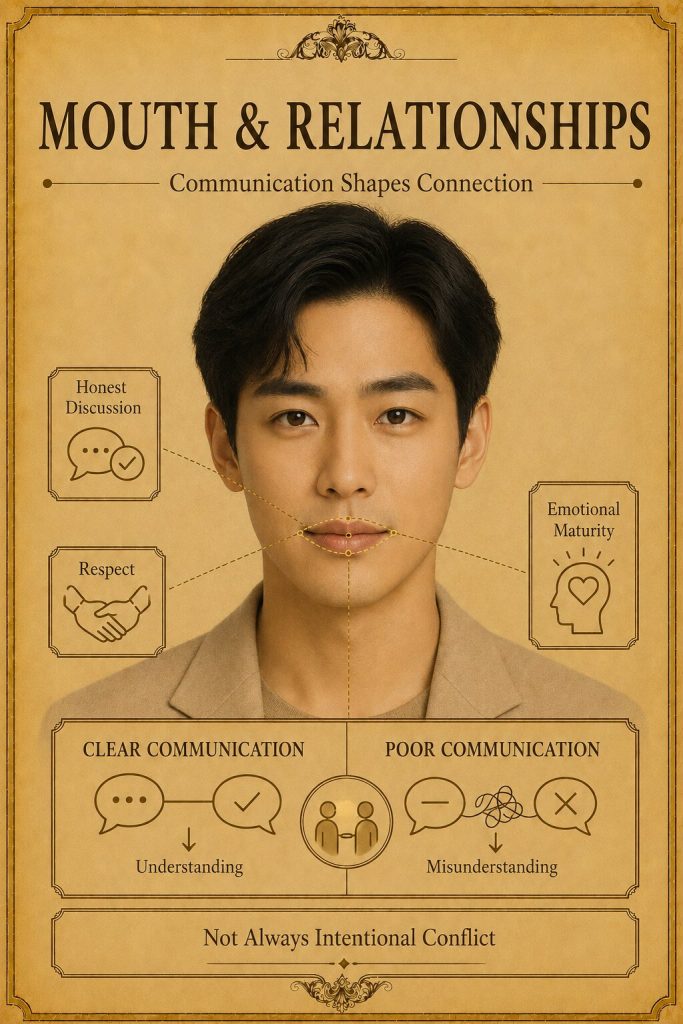
Healthy communication remains one of the strongest predictors of relationship quality.
A balanced mouth often reflects:
- Honest discussion
- Respect
- Emotional maturity
Poor communication frequently creates misunderstanding rather than intentional conflict.
Common Beginner Mistakes
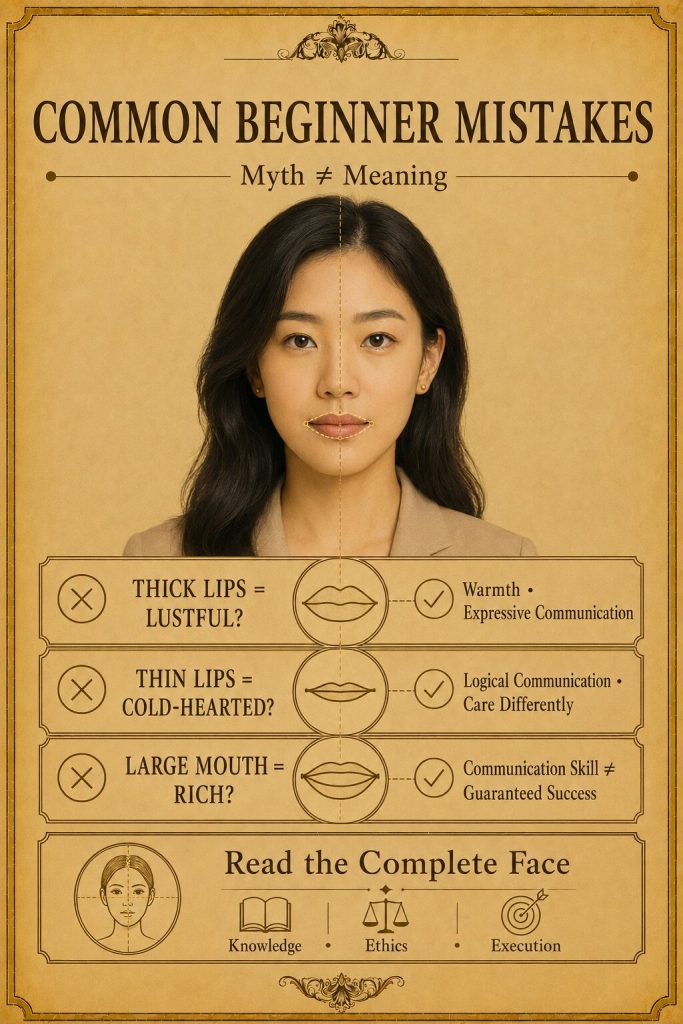
Incorrect:
Thick lips mean lustful behaviour.
Correct:
Thicker lips more commonly indicate emotional warmth and expressive communication.
Character depends on the complete face.
Incorrect:
Thin lips mean cold-hearted.
Correct:
Thin lips often indicate logical communication rather than emotional expression.
Many deeply caring individuals simply express affection differently.
Incorrect:
Large mouth means rich.
Correct:
A larger mouth often supports stronger communication skills.
Success still depends on knowledge, ethics and execution.
Dougles Chan’s Professional Observation
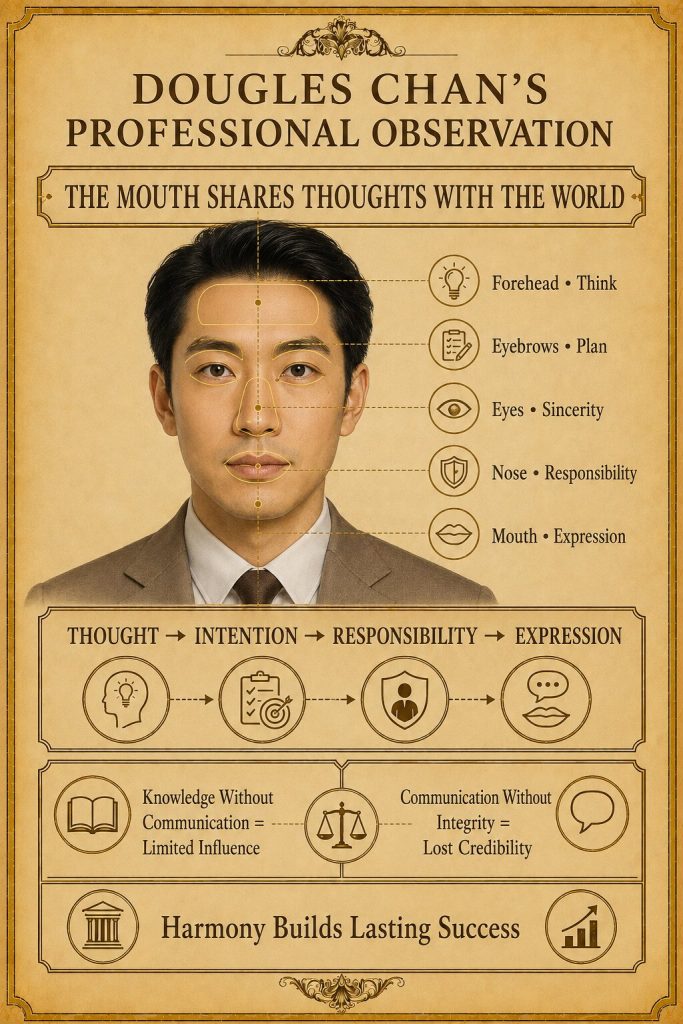
The mouth tells us how a person shares their thoughts with the world.
The forehead shows how they think.
The eyebrows show how they plan.
The eyes reveal their sincerity.
The nose reflects how they manage responsibility.
The mouth determines whether others will understand, trust and follow them.
Knowledge that cannot be communicated has limited influence.
Likewise…
Excellent communication without integrity eventually loses credibility.
Professional Face Reading therefore seeks harmony between thought, intention, responsibility and expression.
When these qualities work together, they often form the foundation of lasting personal and professional success.
The Chin, Jaw and Cheeks
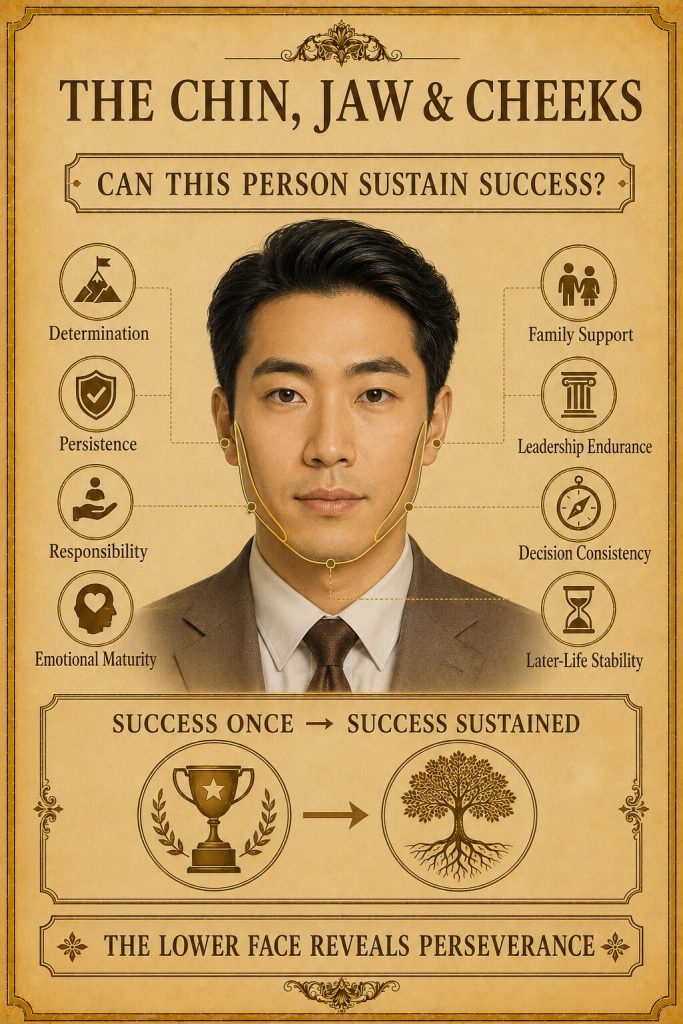
Many people are fascinated by the eyes or the nose.
Professional Face Readers, however, often spend considerable time observing the lower face.
Why?
Because the lower face answers one very important question:
Can this person sustain success?
It is relatively easy to achieve success once.
It is much more difficult to maintain success over decades.
The lower face often reflects:
- Determination
- Persistence
- Responsibility
- Emotional maturity
- Family support
- Leadership endurance
- Decision consistency
- Later-life stability
Many successful entrepreneurs possess average intelligence but extraordinary perseverance.
The lower face frequently reveals this quality.
The Lower Court
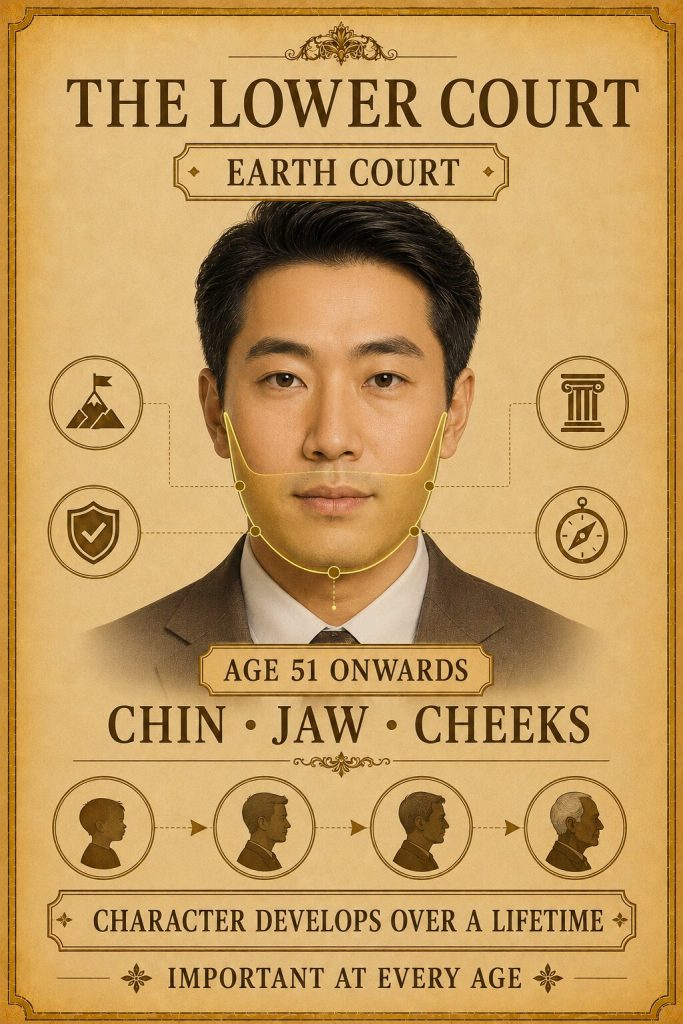
The chin and jaw belong to the Lower Court (Earth Court).
Traditionally, they represent approximately:
Age 51 onwards
However, this does not mean they are unimportant before that age.
Instead, they reveal how a person’s character develops over an entire lifetime.
The Chin
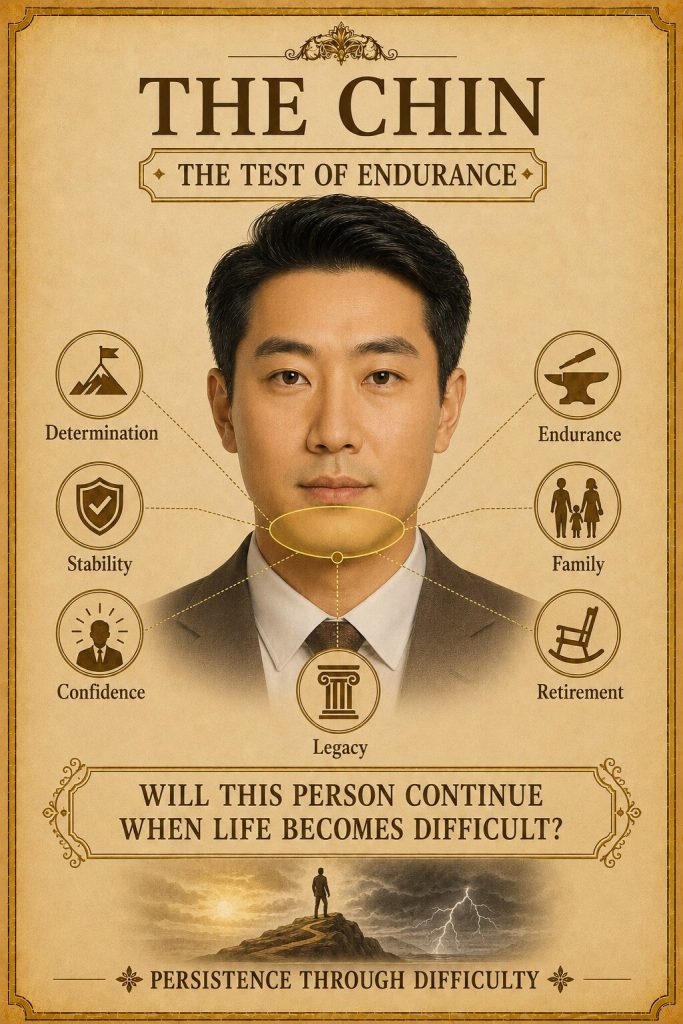
The chin is often associated with:
- Determination
- Stability
- Confidence
- Endurance
- Family
- Retirement
- Legacy
The chin answers an important question:
Will this person continue when life becomes difficult?
The Ideal Chin
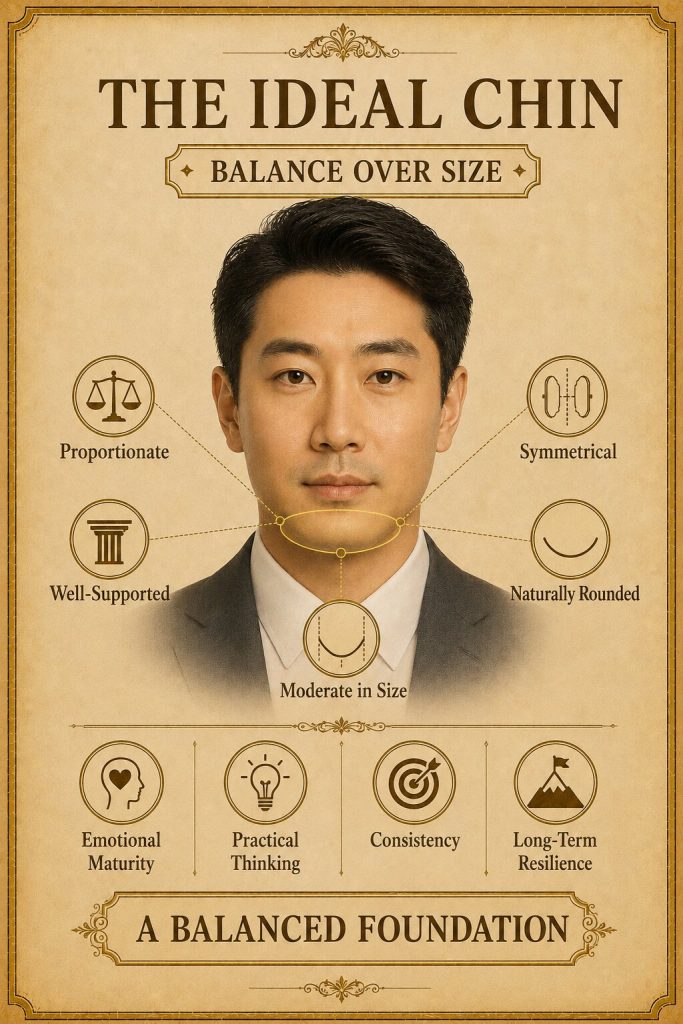
A balanced chin is:
- Proportionate
- Well-supported
- Symmetrical
- Naturally rounded
- Neither excessively large nor extremely small
This often suggests:
- Emotional maturity
- Practical thinking
- Consistency
- Long-term resilience
Strong Chin
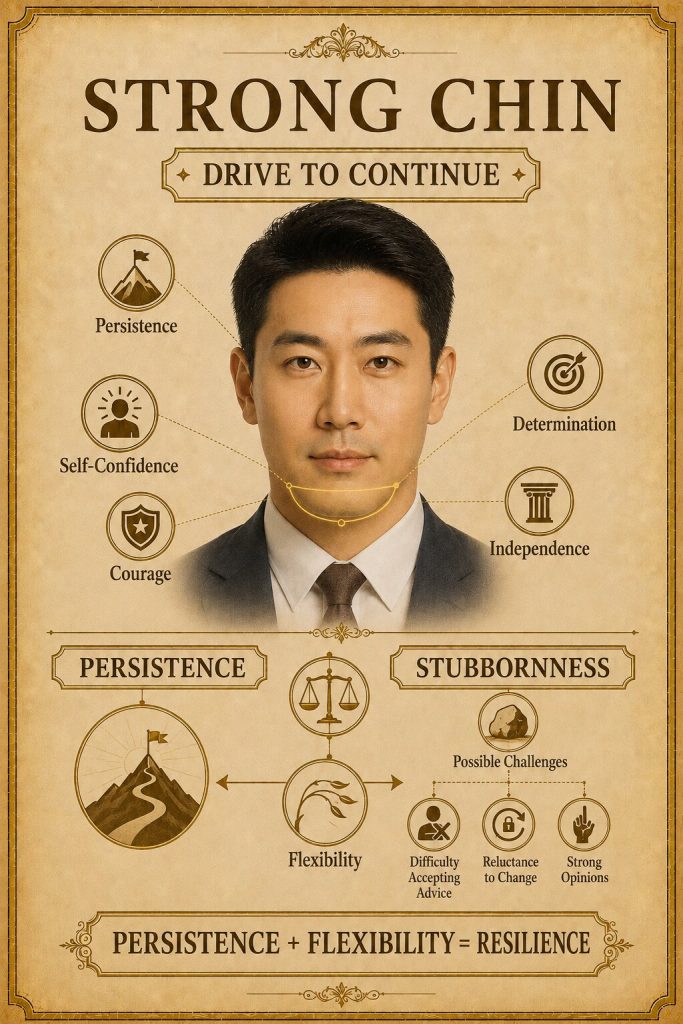
A stronger chin frequently indicates:
- Persistence
- Self-confidence
- Determination
- Independence
- Courage
These individuals often continue working towards goals after others have given up.
Possible challenges:
- Stubbornness
- Difficulty accepting advice
- Reluctance to change direction
Persistence is valuable.
Stubbornness is persistence without flexibility.
Professional Face Reading distinguishes between the two.
Weak Chin
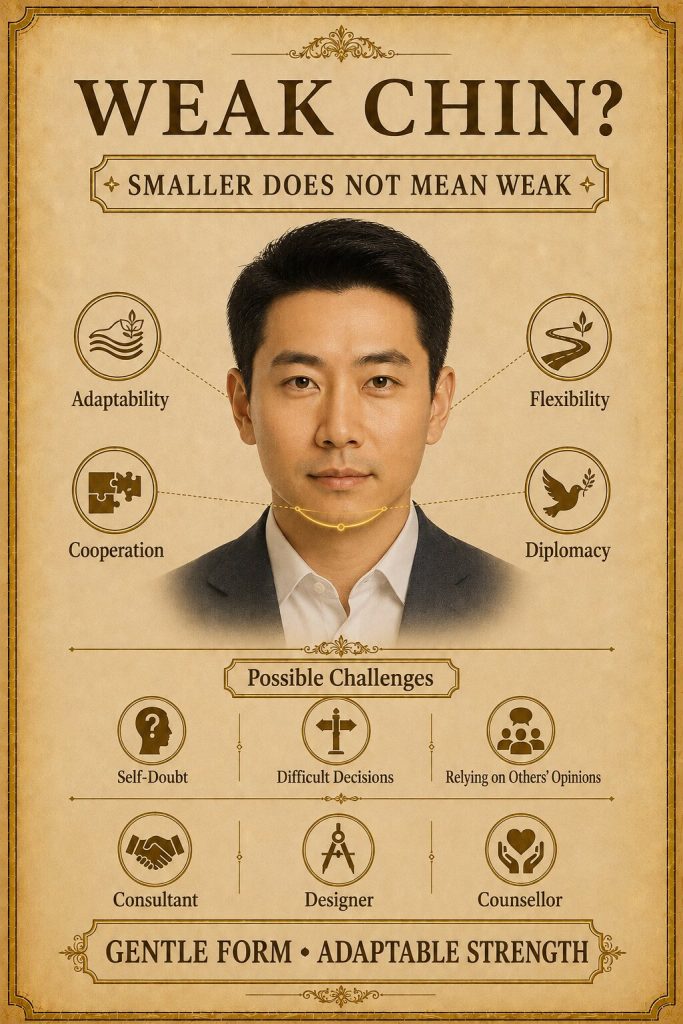
One of the most misunderstood observations.
A smaller chin does not indicate weakness.
Instead, it may suggest:
- Adaptability
- Cooperation
- Flexibility
- Diplomacy
Possible challenges:
- Self-doubt
- Difficulty making difficult decisions
- Relying too heavily on others’ opinions
Many outstanding consultants, designers and counsellors possess relatively gentle chins.
Receding Chin
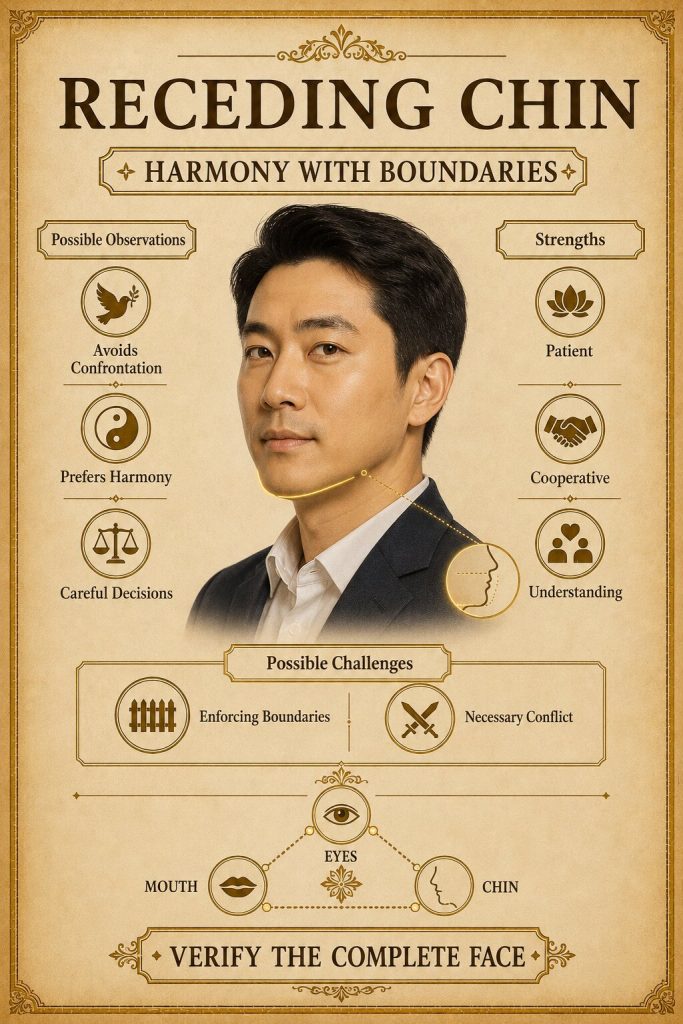
A receding chin may indicate:
- Avoidance of confrontation
- Preference for harmony
- Careful decision making
Strengths:
- Patient
- Cooperative
- Understanding
Challenges:
- Difficulty enforcing boundaries
- Avoiding necessary conflict
Professional readers always verify this through the eyes and mouth.
Protruding Chin
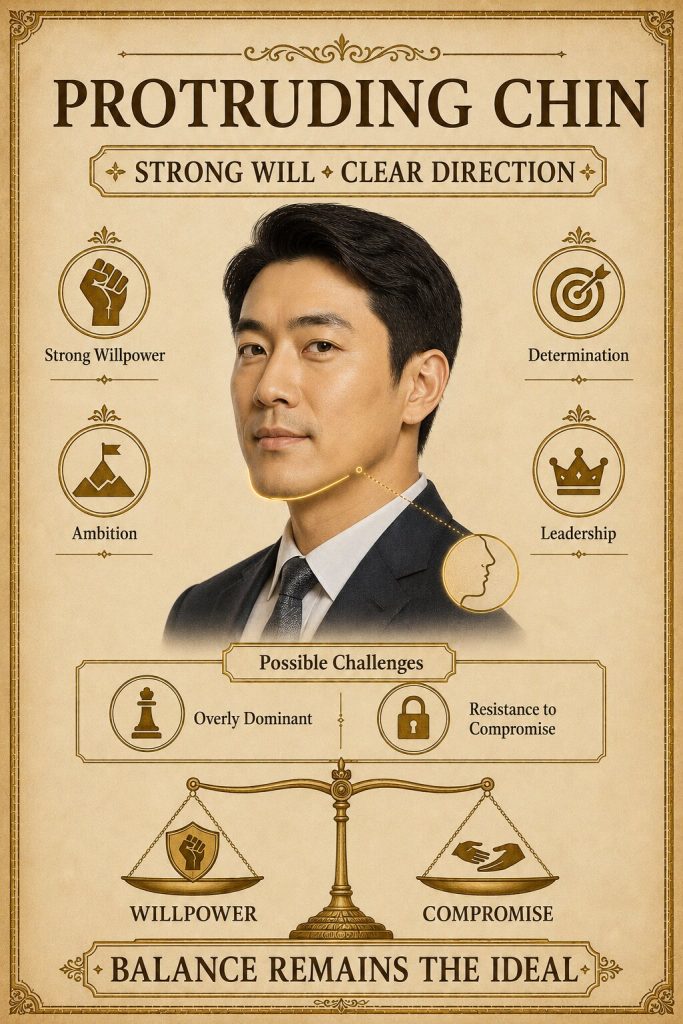
A prominent chin often reflects:
- Strong willpower
- Determination
- Ambition
- Leadership
Challenges:
- Becoming overly dominant
- Resistance to compromise
Balance remains the ideal.
Rounded Chin
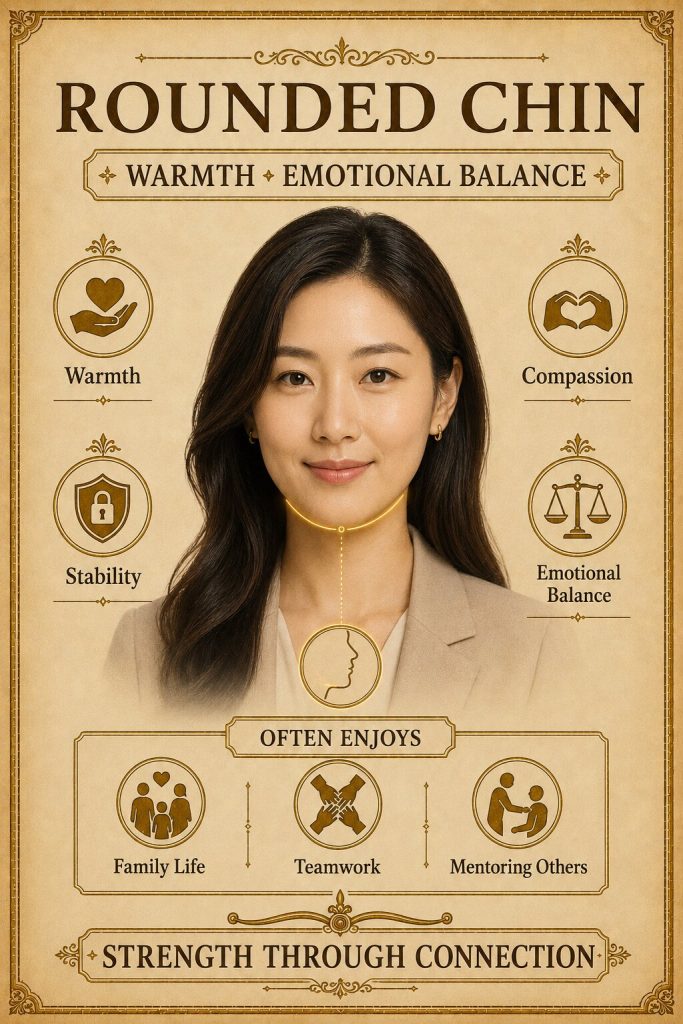
A rounded chin usually indicates:
- Warmth
- Compassion
- Stability
- Emotional balance
These individuals often enjoy:
- Family life
- Teamwork
- Mentoring others
Pointed Chin
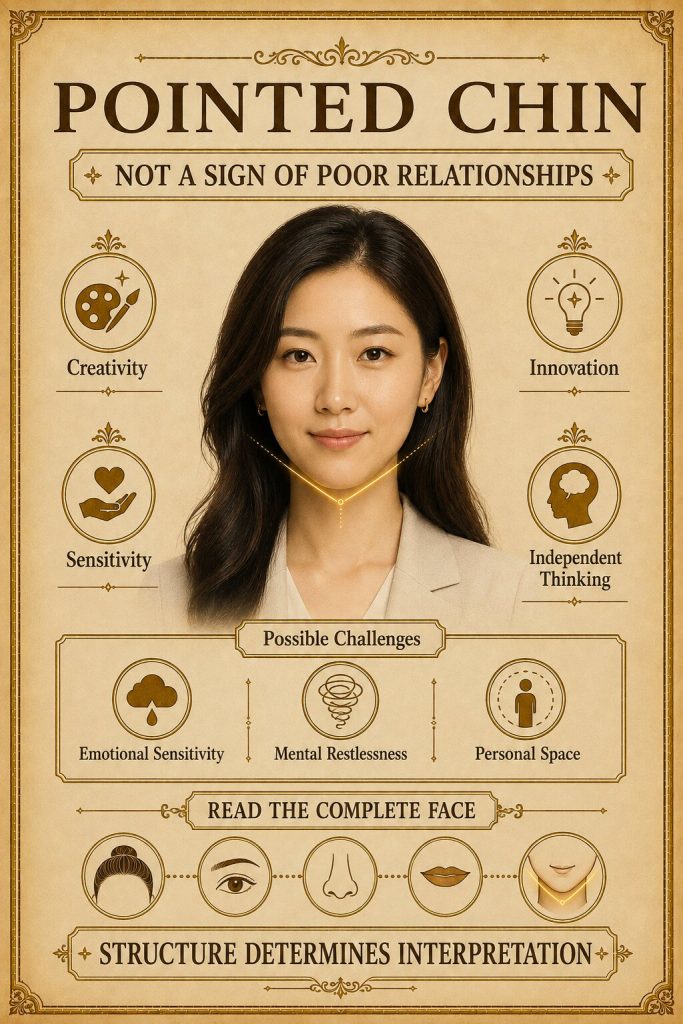
A pointed chin is frequently misunderstood.
It does not automatically indicate poor relationships or difficult marriages.
Possible strengths:
- Creativity
- Innovation
- Sensitivity
- Independent thinking
Challenges:
- Emotional sensitivity
- Mental restlessness
- Preferring personal space
The complete facial structure determines the final interpretation.
Square Chin
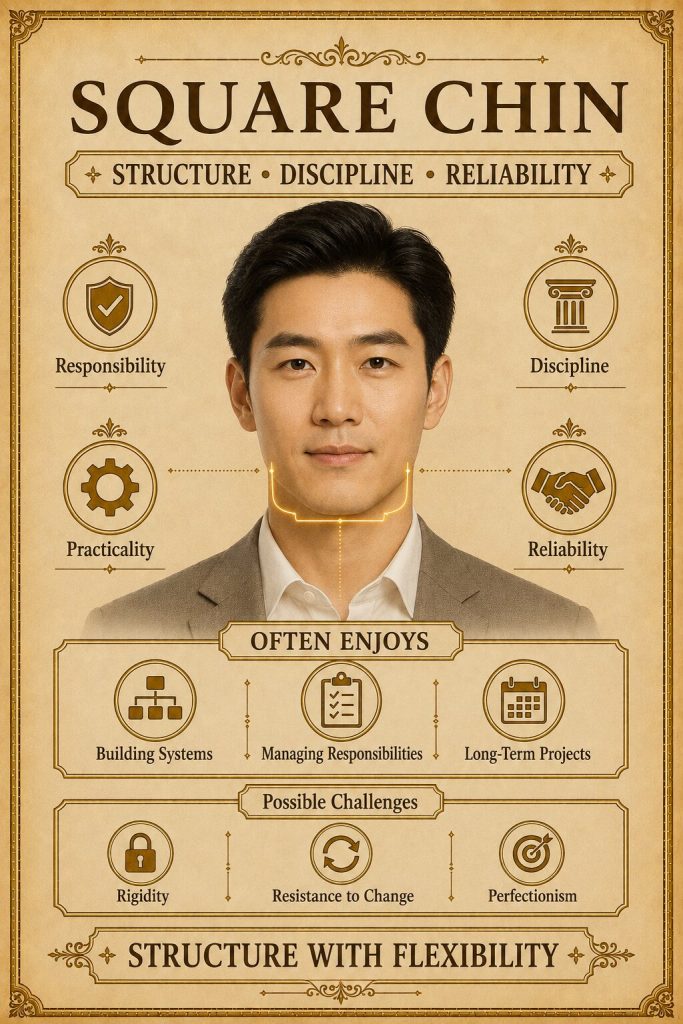
A square chin often reflects:
- Responsibility
- Discipline
- Practicality
- Reliability
Such individuals usually enjoy:
- Building systems
- Managing responsibilities
- Completing long-term projects
Possible challenges:
- Rigidity
- Resistance to change
- Perfectionism
The Jaw
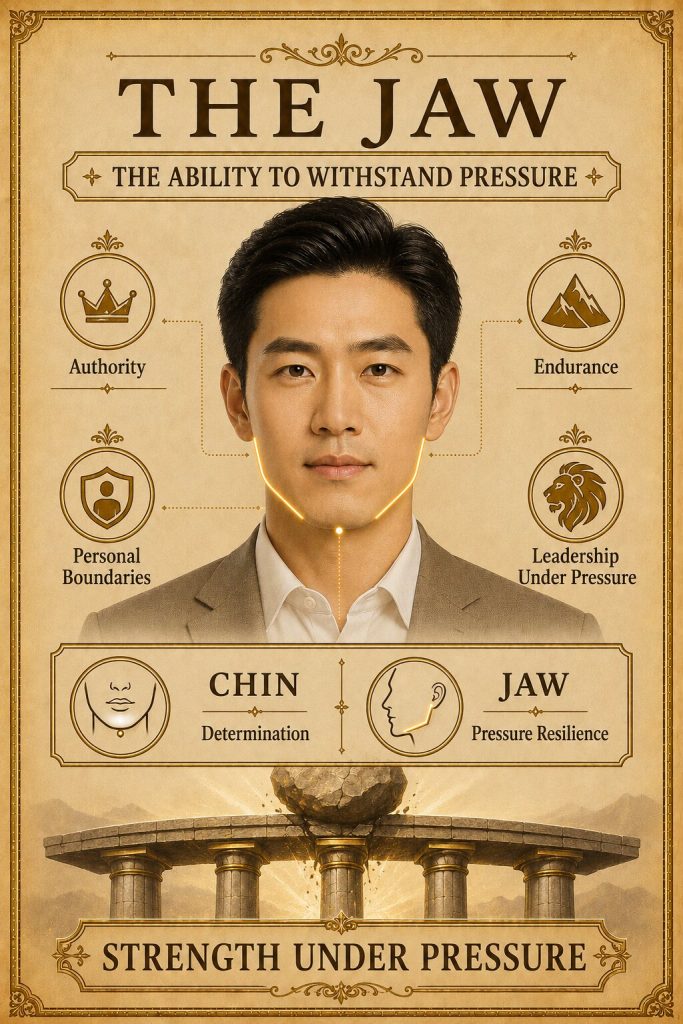
The jaw represents:
- Authority
- Endurance
- Personal boundaries
- Leadership under pressure
Unlike the chin, which reflects determination,
the jaw reflects the ability to withstand pressure.
Strong Jaw
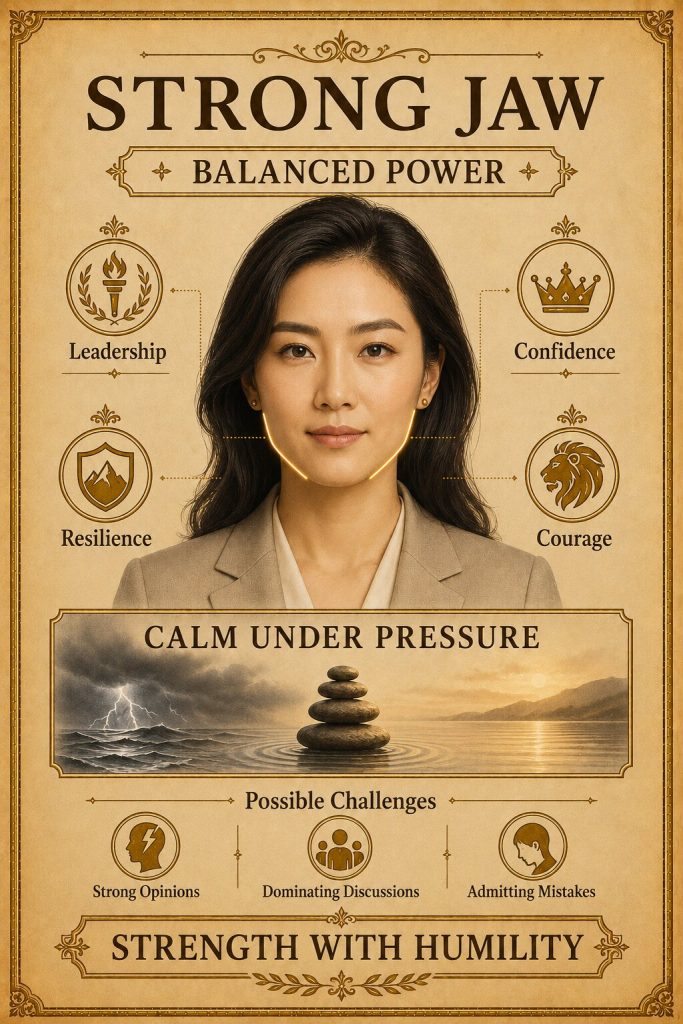
A balanced strong jaw often indicates:
- Leadership
- Confidence
- Resilience
- Courage
These individuals generally remain calm during difficult situations.
Possible challenges:
- Strong opinions
- Dominating discussions
- Difficulty admitting mistakes
Soft Jaw
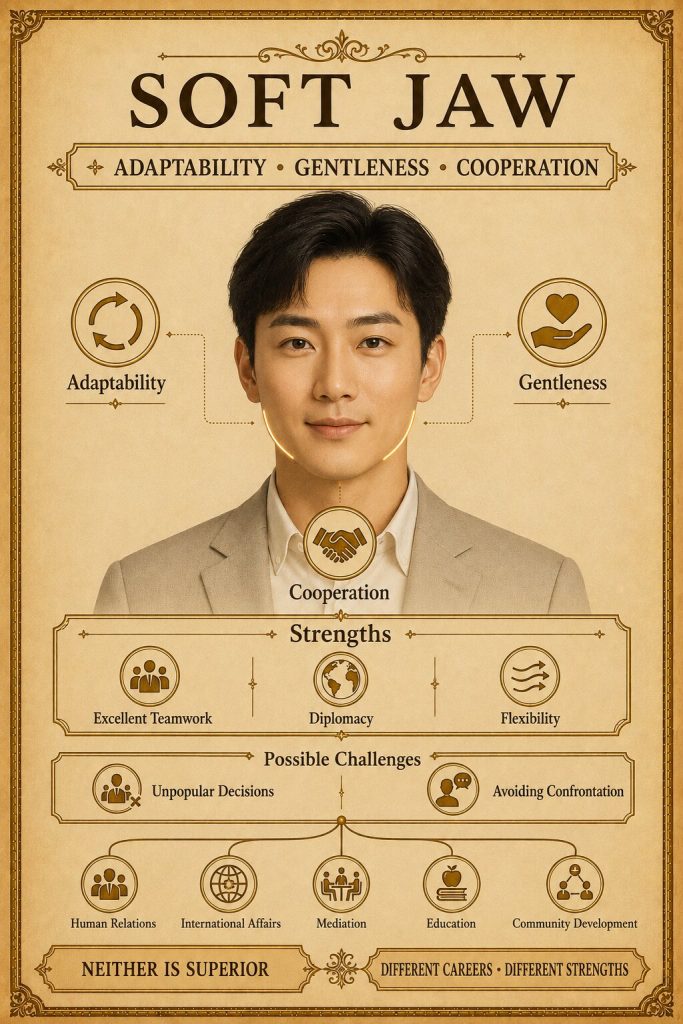
A softer jaw often reflects:
- Adaptability
- Gentleness
- Cooperation
Strengths:
- Excellent teamwork
- Diplomacy
- Flexibility
Challenges:
- Difficulty making unpopular decisions
- Avoiding confrontation
Again…
Neither is superior.
Different careers require different strengths.
The Cheeks
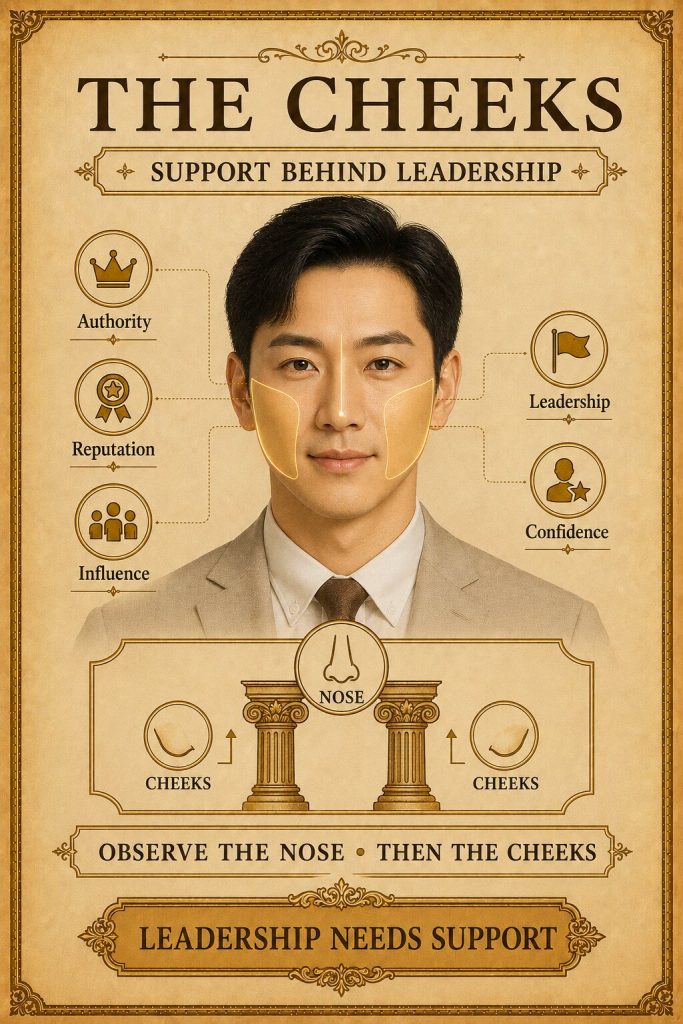
The cheeks are closely associated with:
- Authority
- Reputation
- Influence
- Leadership
- Confidence
Many experienced Face Readers observe the cheeks immediately after studying the nose.
This is because the cheeks support the nose.
Without strong support,
even excellent leadership qualities may become difficult to maintain.
Full Cheeks
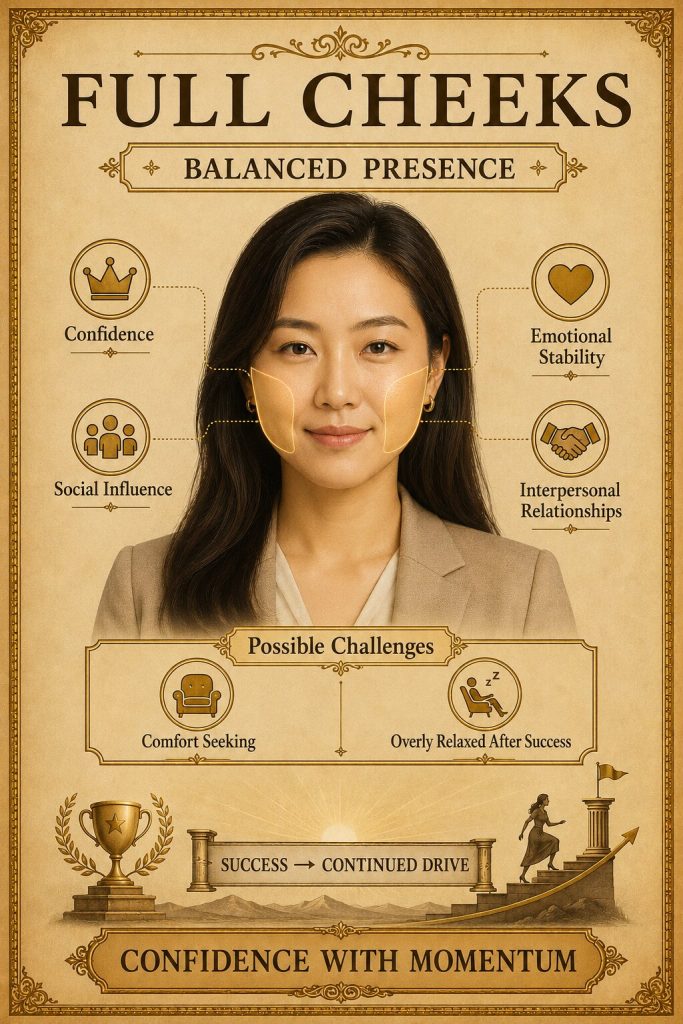
Balanced full cheeks often indicate:
- Confidence
- Social influence
- Emotional stability
- Good interpersonal relationships
Challenges:
- Comfort seeking
- Becoming overly relaxed after success
Flat Cheeks
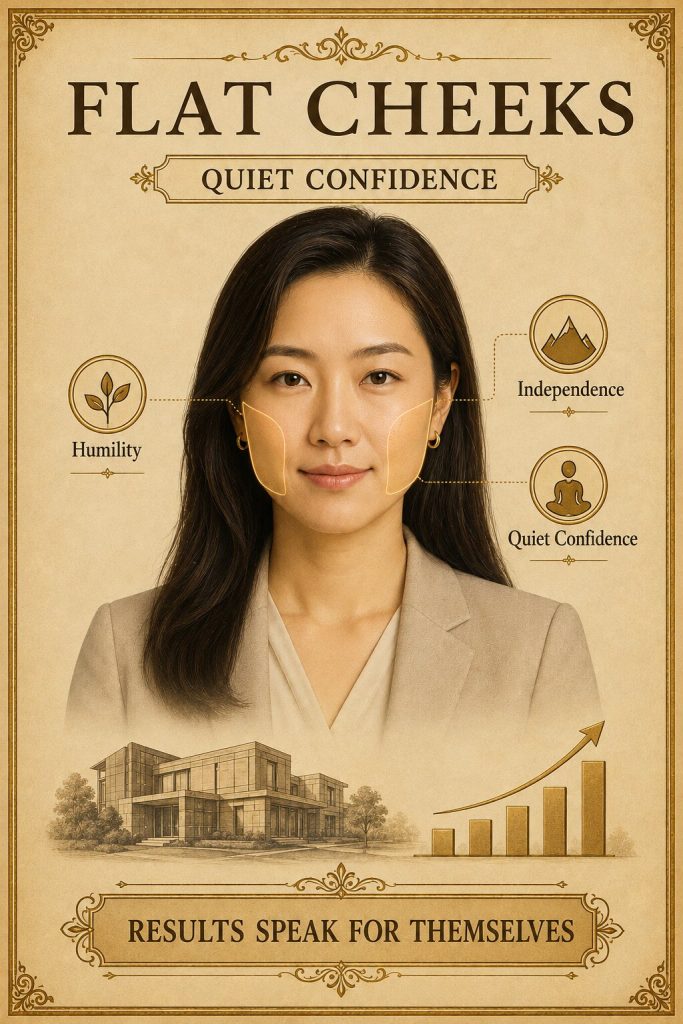
Flatter cheeks may suggest:
- Humility
- Independence
- Quiet confidence
These individuals often allow results to speak for themselves.
High Cheekbones
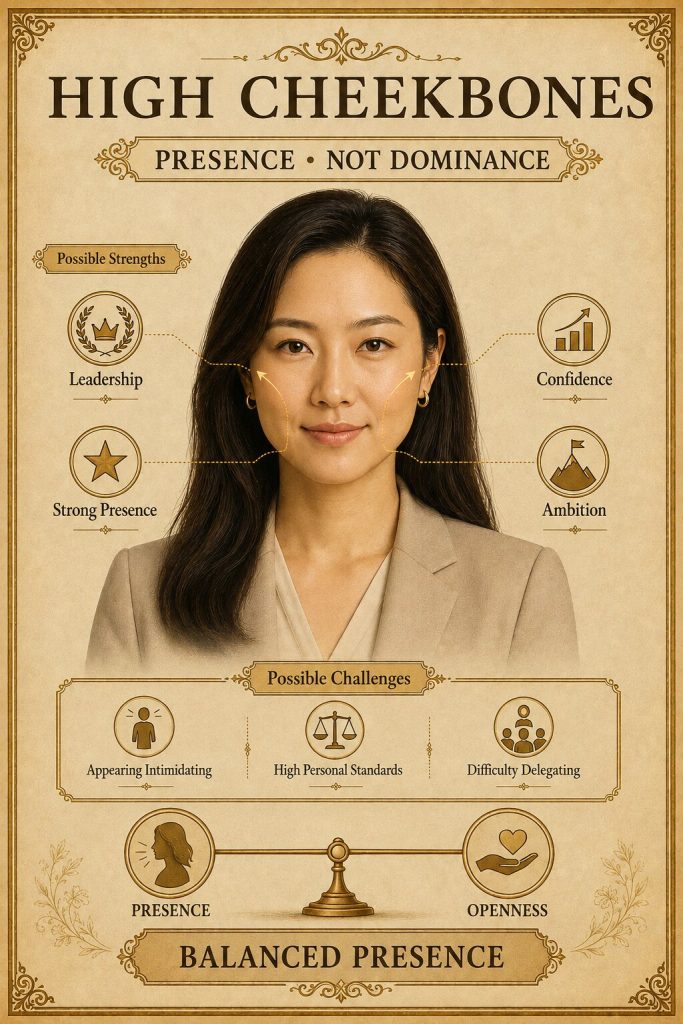
One of the most misunderstood facial features.
High cheekbones do not automatically indicate dominance.
Balanced high cheekbones may suggest:
- Leadership
- Confidence
- Strong presence
- Ambition
Challenges:
- Appearing intimidating
- High personal standards
- Difficulty delegating
Low Cheekbones
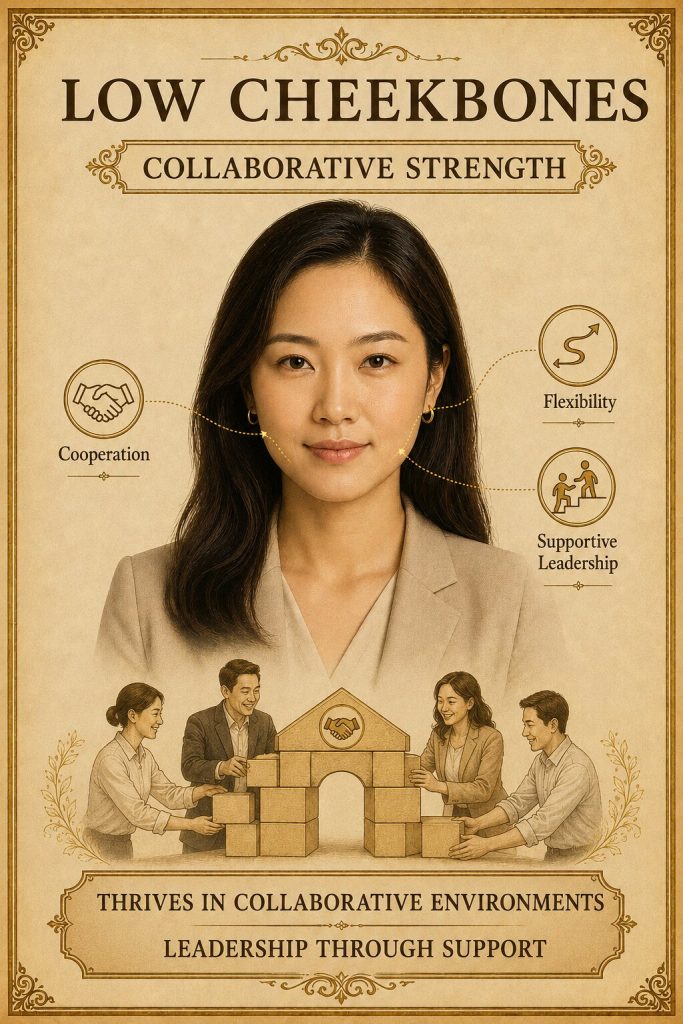
Lower cheekbones often indicate:
- Cooperation
- Flexibility
- Supportive leadership
These individuals frequently perform well in collaborative environments.
Hollow Cheeks
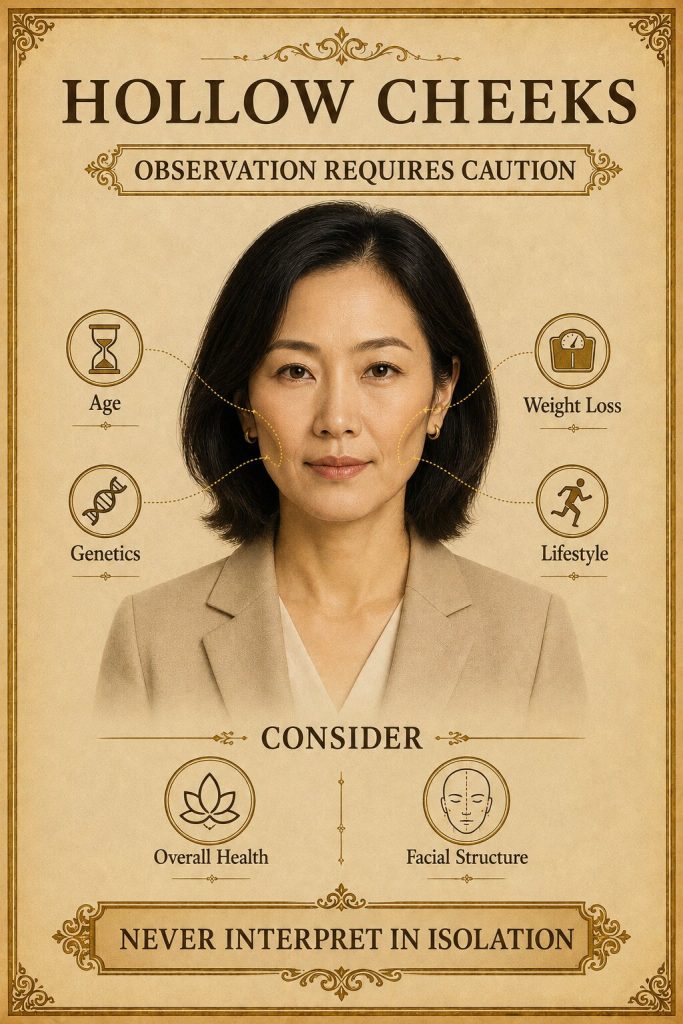
Professionals exercise caution here.
Hollow cheeks may result from:
- Age
- Weight loss
- Genetics
- Lifestyle
They should never be interpreted without considering the person’s overall health and facial structure.
Chin and Wealth
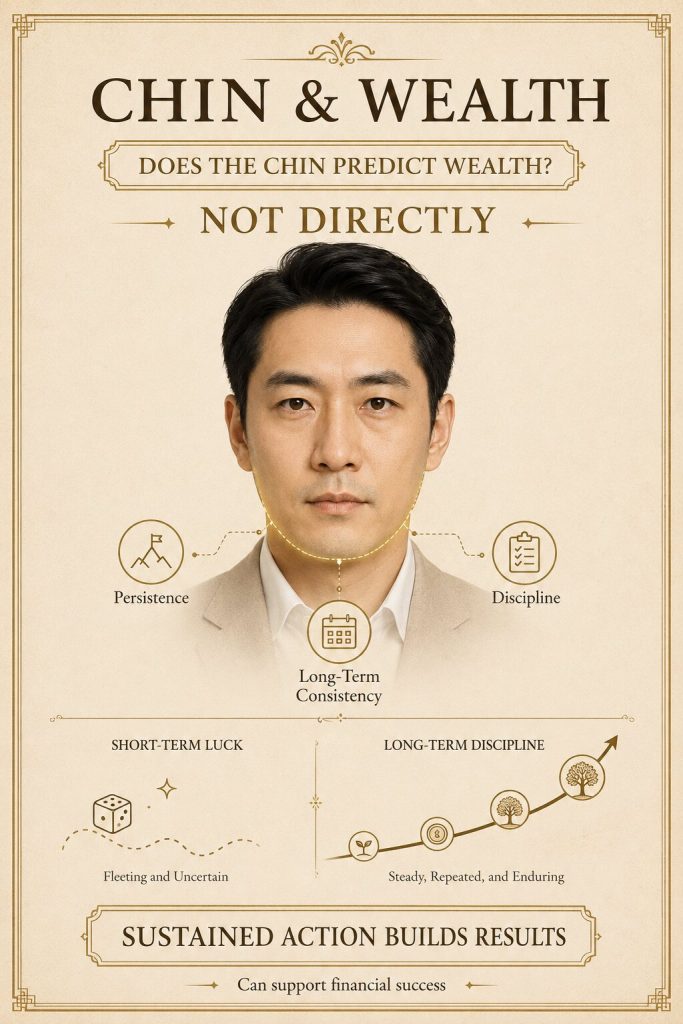
Many people ask:
“Can the chin predict wealth?”
Not directly.
Instead, the chin often reveals:
- Persistence
- Discipline
- Long-term consistency
These qualities frequently contribute to financial success.
People who remain disciplined for decades usually outperform those relying on short-term luck.
Chin and Relationships
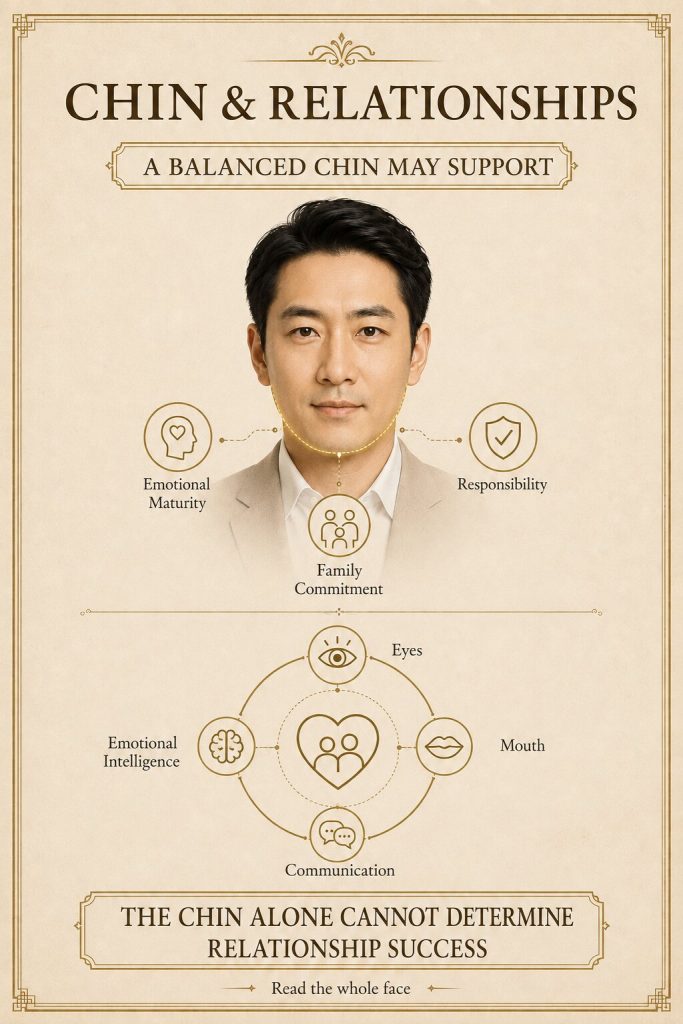
A balanced chin often supports:
- Emotional maturity
- Responsibility
- Family commitment
However…
Relationships depend equally on:
- Eyes
- Mouth
- Emotional intelligence
- Communication
The chin alone cannot determine relationship success.
Jaw and Leadership
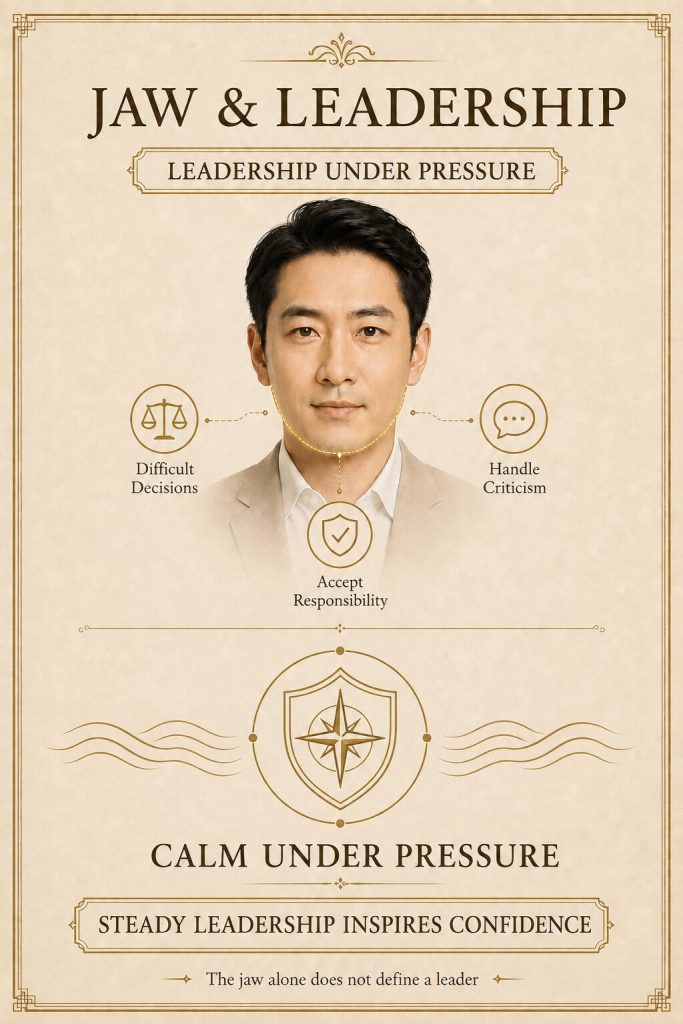
Leaders are often required to:
- Make difficult decisions
- Handle criticism
- Accept responsibility
The jaw frequently reflects how comfortably a person carries these responsibilities.
A calm leader with a balanced jaw often inspires greater confidence than someone who appears emotionally unstable.
Retirement and Later Life
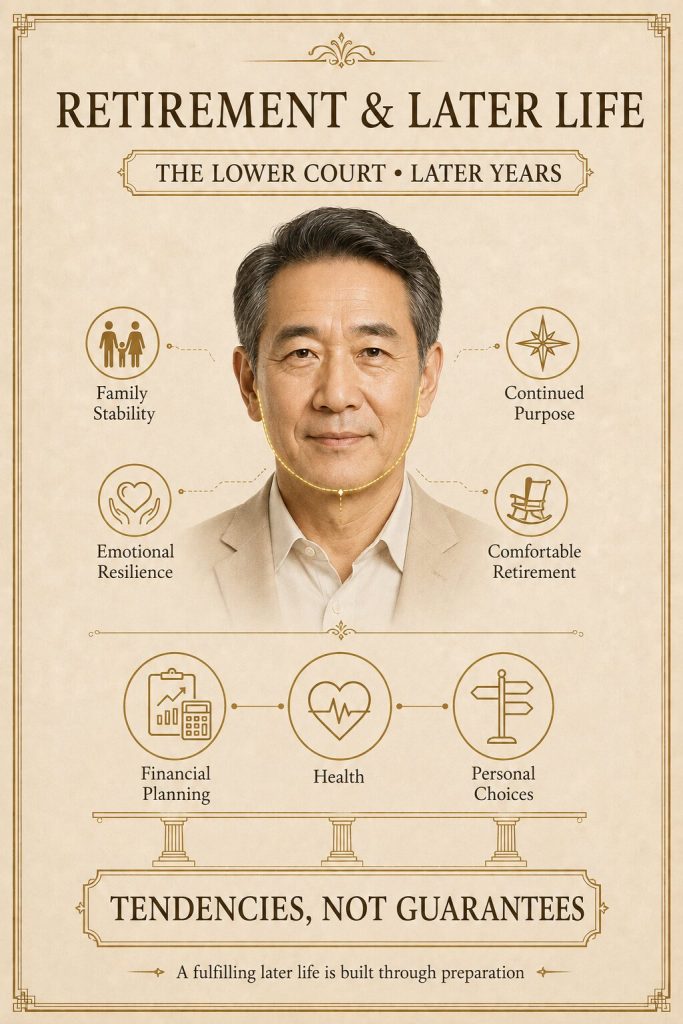
Traditional Face Reading associates the Lower Court with later years.
A balanced lower face may indicate:
- Stable family relationships
- Continued purpose
- Emotional resilience
- Comfortable retirement
This reflects tendencies rather than guaranteed outcomes.
Financial planning, health and personal choices remain essential.
Common Beginner Mistakes
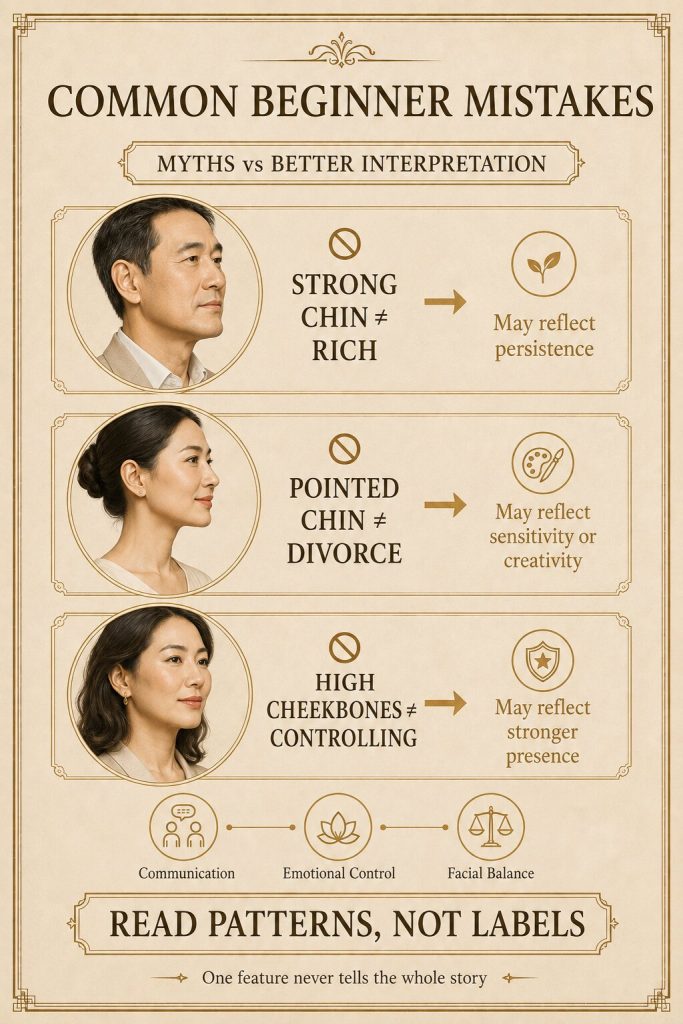
Incorrect:
Strong chin means rich.
Correct:
A strong chin often reflects persistence.
Persistence may contribute to wealth over time.
Incorrect:
Pointed chin means divorce.
Correct:
A pointed chin may simply indicate greater sensitivity or creativity.
Relationship success depends on communication and emotional maturity, not one facial feature.
Incorrect:
High cheekbones mean controlling personality.
Correct:
High cheekbones often indicate stronger presence.
Whether that becomes leadership or domination depends on emotional control and the overall facial balance.
Dougles Chan’s Professional Observation
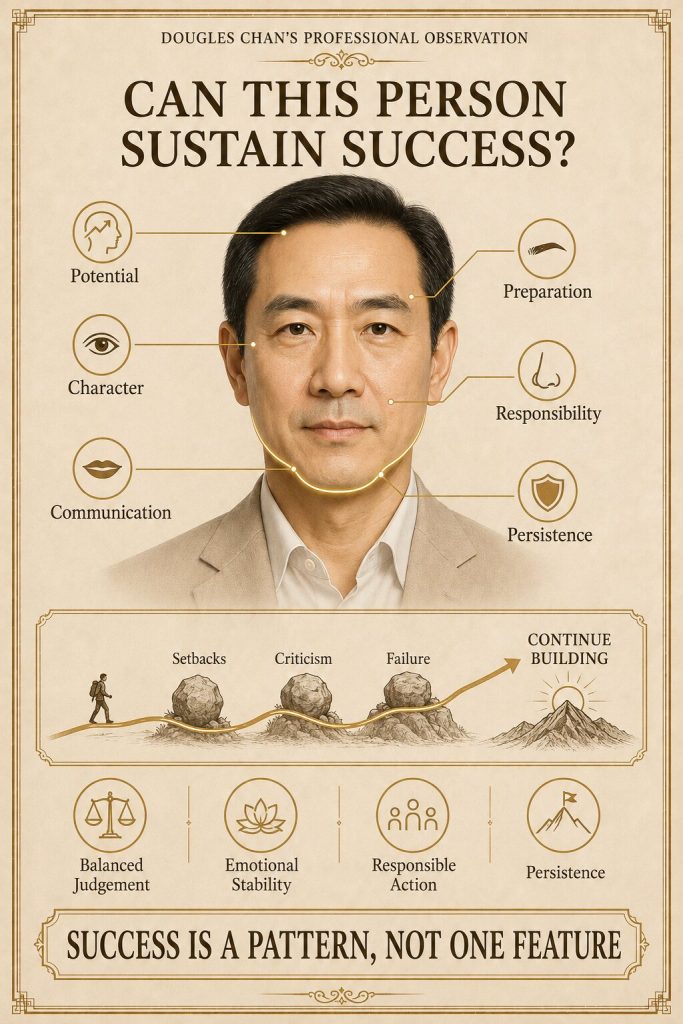
The lower face answers one of the most important questions in Face Reading:
Can this person sustain success?
Many people possess intelligence.
Many possess talent.
Many receive opportunities.
Yet only a smaller number continue when life becomes difficult.
The forehead reveals potential.
The eyebrows reveal preparation.
The eyes reveal character.
The nose reveals responsibility.
The mouth reveals communication.
The chin and jaw reveal whether the person has the inner strength to continue building after setbacks, criticism and failure.
In my observation, long-term success is rarely determined by one outstanding facial feature.
It is more often the result of balanced judgement, emotional stability, responsible action and unwavering persistence.
That is what the lower face helps us understand.
The Ears
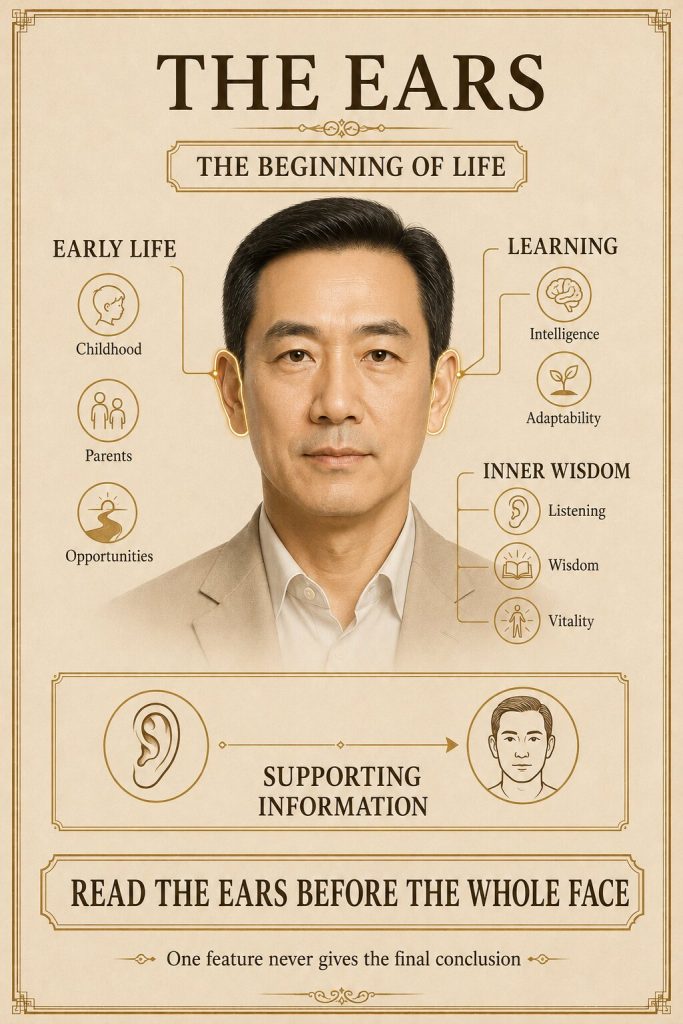
The ears are one of the earliest facial features to develop.
In traditional Chinese Face Reading, they represent the beginning of life and are closely associated with:
- Childhood
- Intelligence
- Learning ability
- Adaptability
- Parents
- Early opportunities
- Listening skills
- Wisdom
- Vitality
Many beginners ignore the ears because they appear less expressive than the eyes or mouth.
Professional Face Readers do the opposite.
The ears often provide valuable supporting information before analysing the rest of the face.
The Golden Rule of Reading Ears
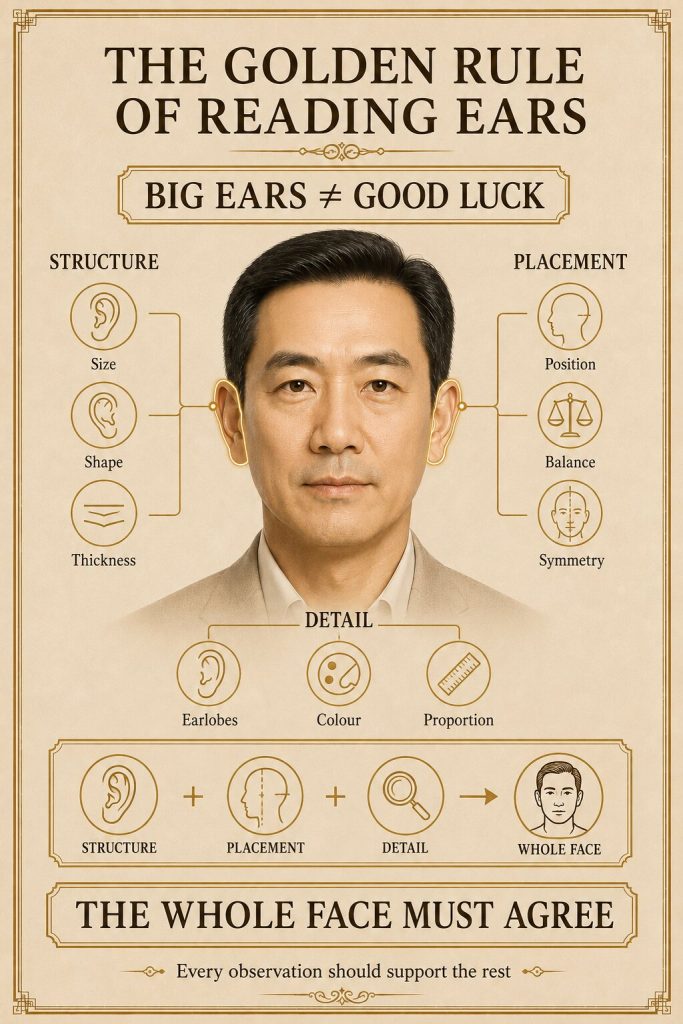
One of the biggest mistakes beginners make is believing:
“Big ears mean good luck.”
Professional Face Reading does not work that way.
The ears should always be evaluated based on:
- Size
- Position
- Shape
- Thickness
- Balance
- Ear lobes
- Colour
- Symmetry
- Overall proportion
Every observation must support the rest of the face.
What Do the Ears Represent?
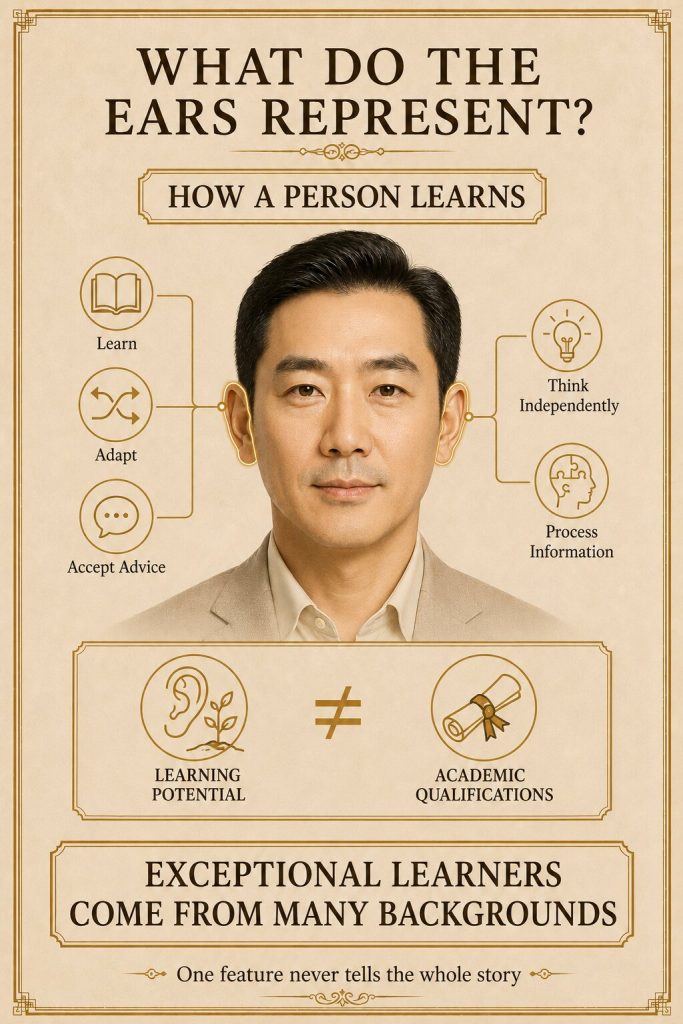
The ears answer questions such as:
- How does this person learn?
- How quickly do they adapt?
- Do they accept advice?
- Are they independent thinkers?
- How do they process information?
The ears reveal learning potential.
They do not measure academic qualifications.
Many successful entrepreneurs were average students but exceptional learners.
Large Ears
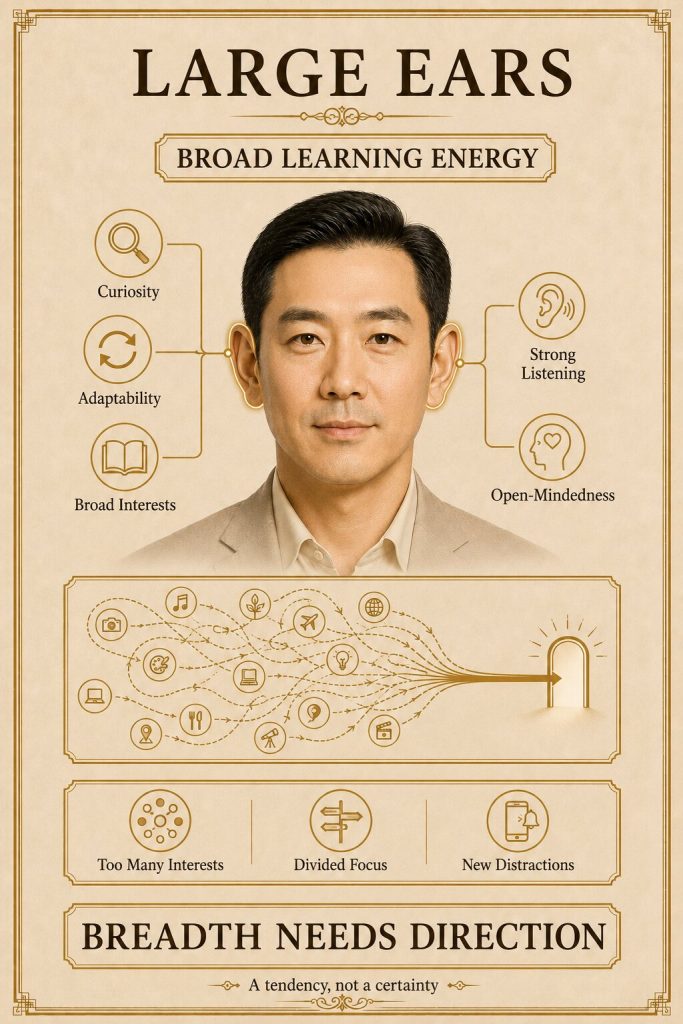
Balanced larger ears often indicate:
- Curiosity
- Adaptability
- Broad interests
- Strong listening ability
- Open-mindedness
These individuals usually enjoy learning from different experiences.
Possible challenges:
- Too many interests
- Difficulty focusing on one path
- Easily distracted by new opportunities
Small Ears
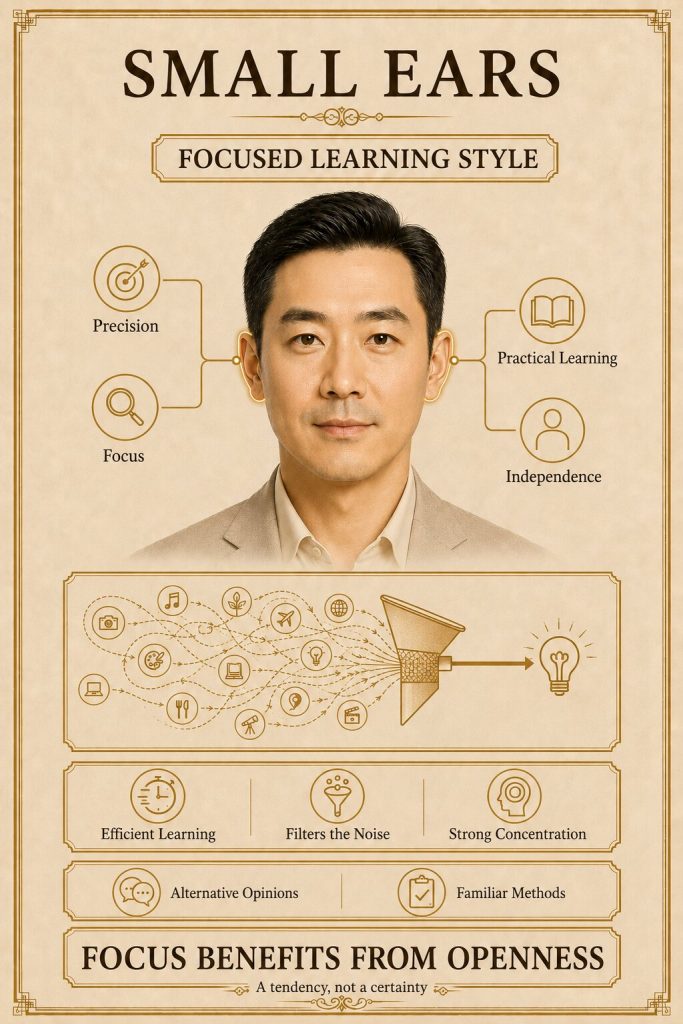
Smaller ears often suggest:
- Precision
- Focus
- Practical learning
- Independence
Strengths:
- Learns efficiently
- Filters unnecessary information
- Strong concentration
Challenges:
- Less receptive to alternative opinions
- May prefer familiar methods
High-Set Ears
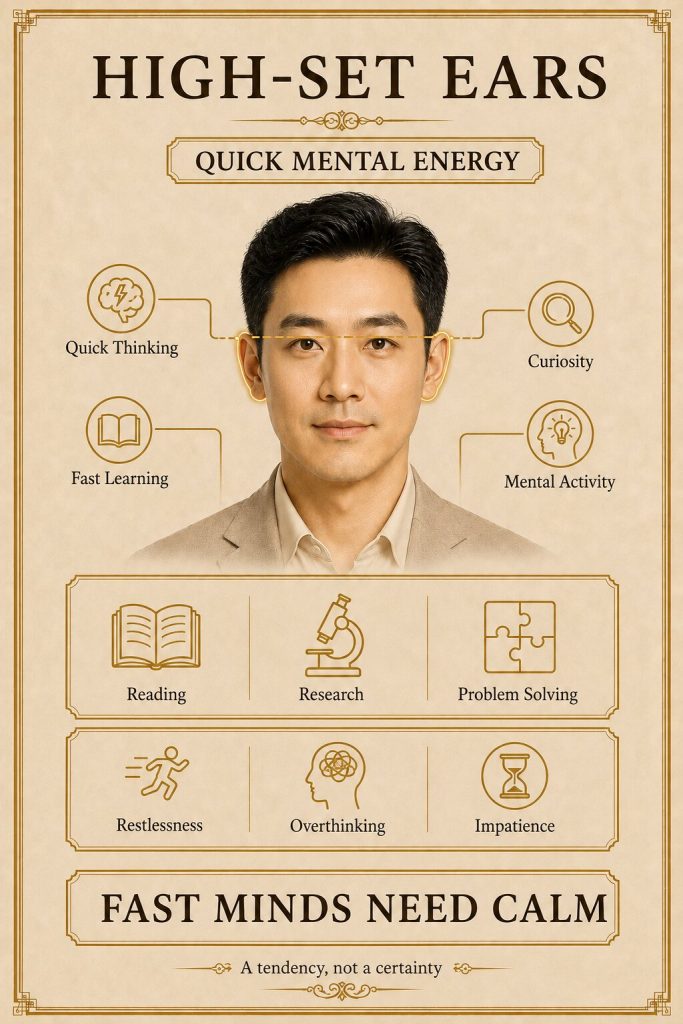
Ears positioned slightly higher often indicate:
- Quick thinking
- Fast learning
- Curiosity
- Strong mental activity
These individuals frequently enjoy:
- Reading
- Research
- Solving problems
Possible challenges:
- Mental restlessness
- Overthinking
- Becoming impatient
Low-Set Ears
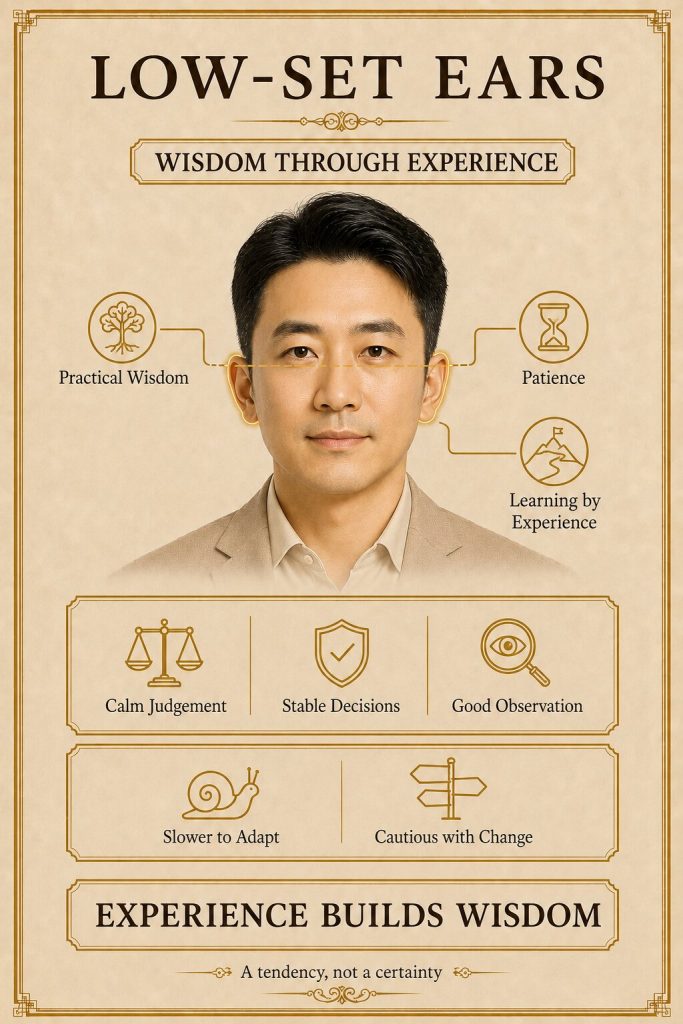
Lower-positioned ears often suggest:
- Practical wisdom
- Patience
- Learning through experience
Strengths:
- Calm judgement
- Stable decision making
- Good observation
Challenges:
- May take longer to adapt
- Sometimes cautious when facing change
Thick Ears
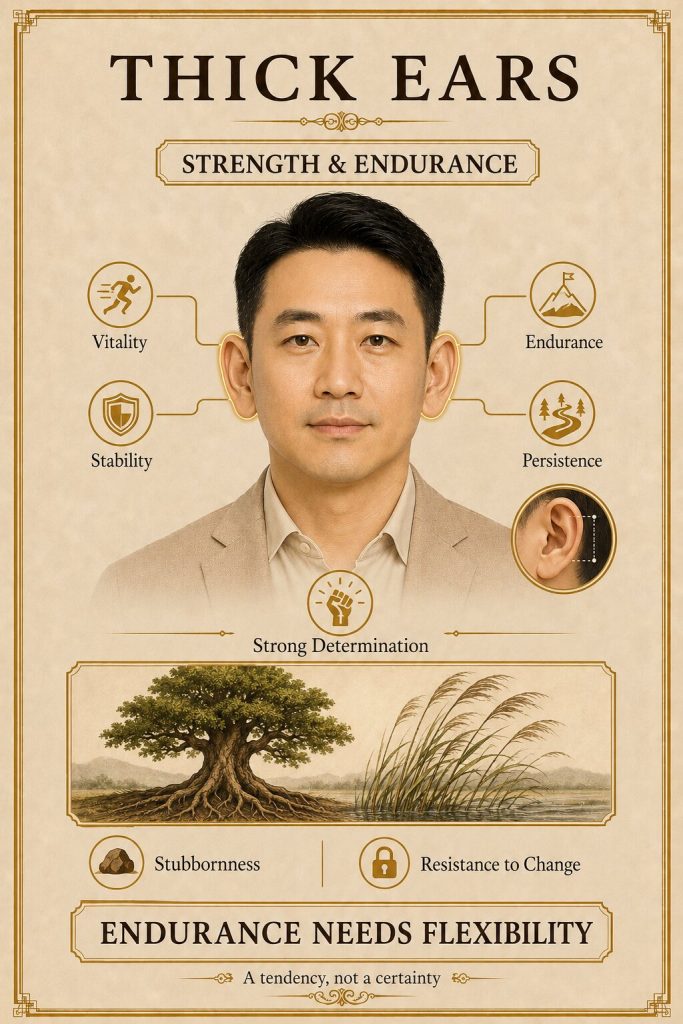
Thicker ears traditionally represent:
- Physical vitality
- Endurance
- Stability
- Persistence
These individuals often possess strong determination.
Challenges:
- Can become stubborn
- Resistant to change
Thin Ears
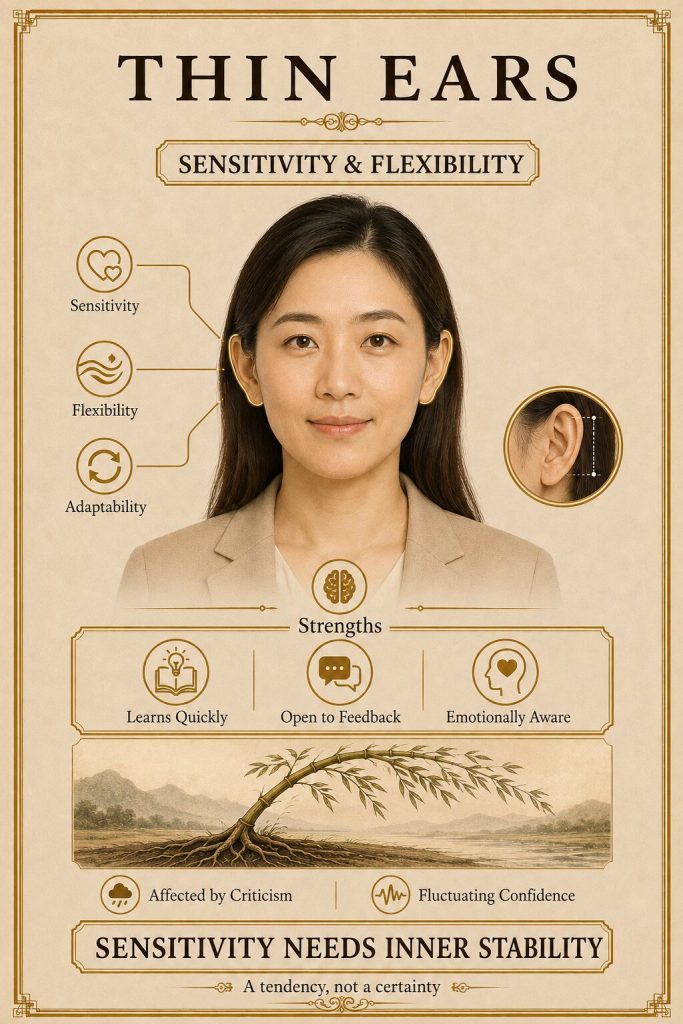
Thinner ears often indicate:
- Sensitivity
- Flexibility
- Adaptability
Strengths:
- Learns quickly
- Open to feedback
- Emotionally aware
Challenges:
- Easily affected by criticism
- Confidence fluctuates more readily
Large Ear Lobes
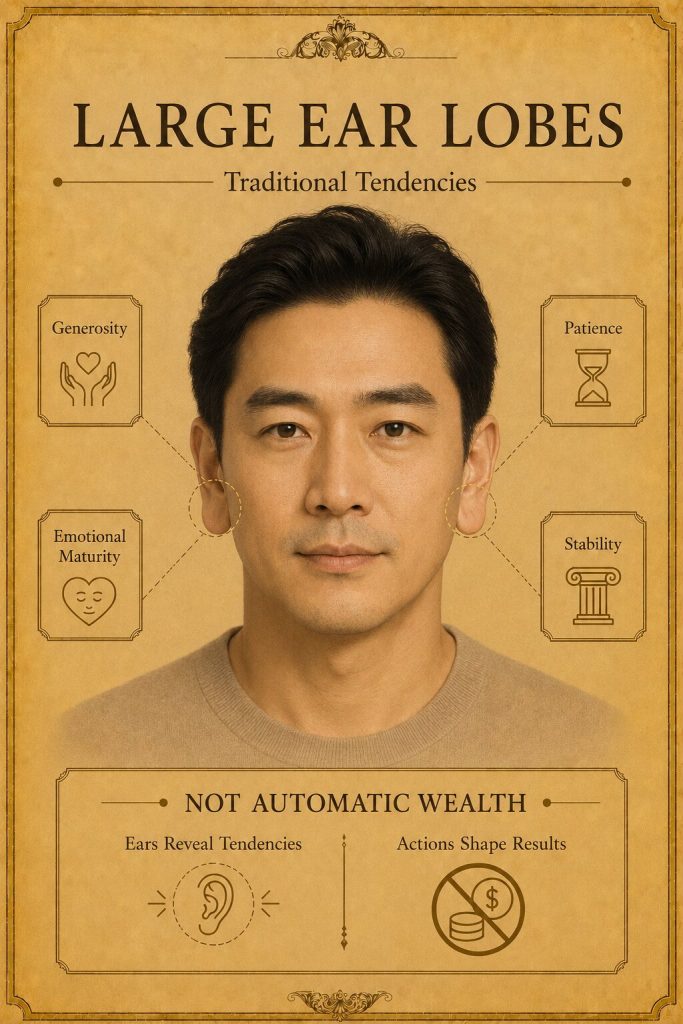
Large ear lobes are among the most recognised features in Face Reading.
Traditionally they are associated with:
- Generosity
- Patience
- Emotional maturity
- Stability
However…
Large ear lobes do not automatically indicate wealth.
Many people confuse symbols with guarantees.
The ears reveal tendencies.
Life results still depend on actions.
Small Ear Lobes
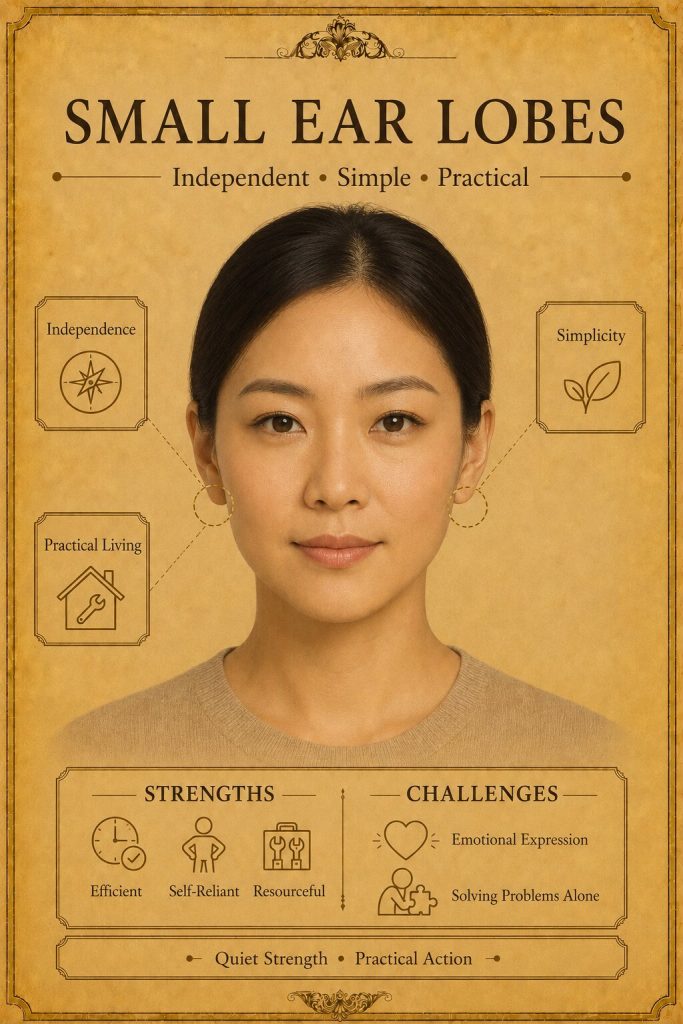
Smaller ear lobes may indicate:
- Independence
- Simplicity
- Practical living
Strengths:
- Efficient
- Self-reliant
- Resourceful
Challenges:
- Less expressive emotionally
- May prefer solving problems alone
Attached Ear Lobes
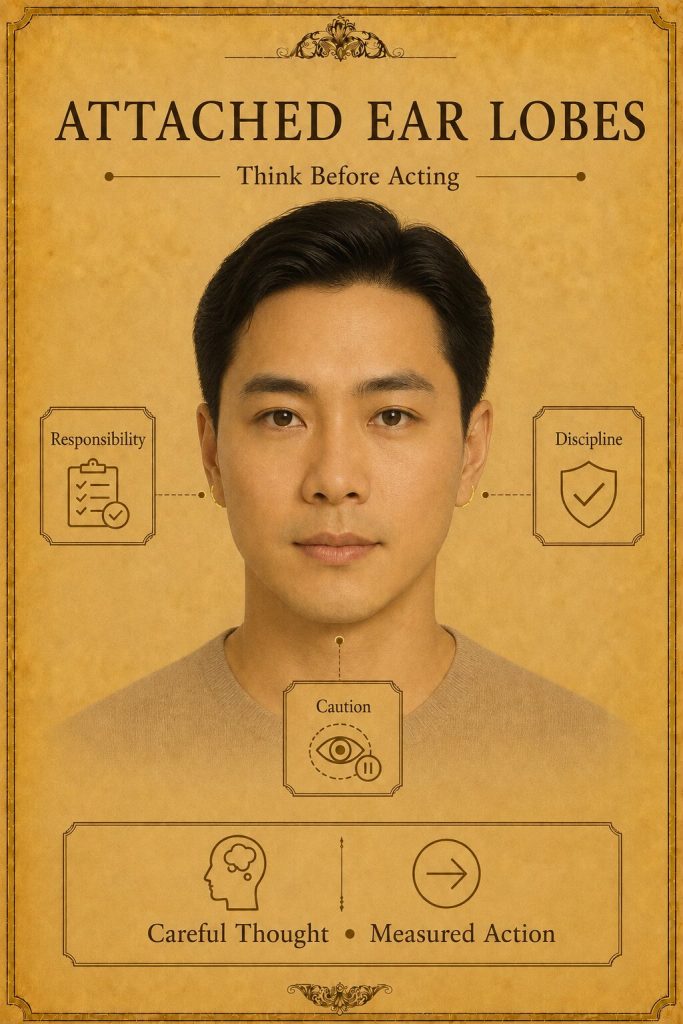
Attached ear lobes often suggest:
- Responsibility
- Discipline
- Caution
These individuals usually think carefully before acting.
Detached Ear Lobes
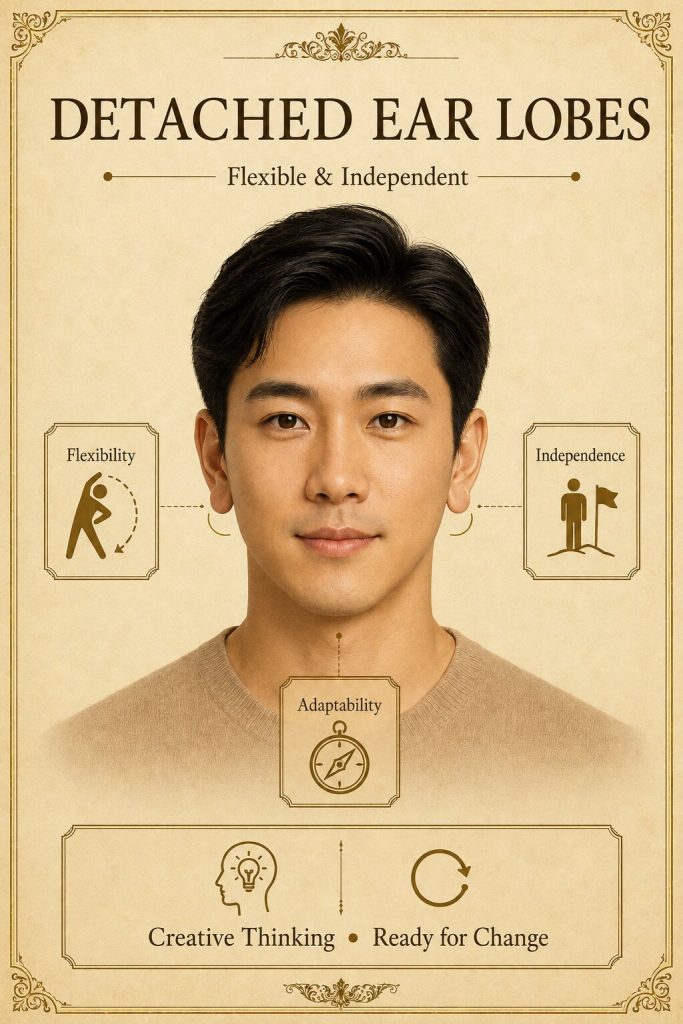
Detached ear lobes often indicate:
- Flexibility
- Independence
- Adaptability
Strengths:
- Creative thinking
- Comfortable with change
- Entrepreneurial spirit
Challenges:
- Sometimes inconsistent
- Easily attracted to new opportunities
Ears That Stand Out
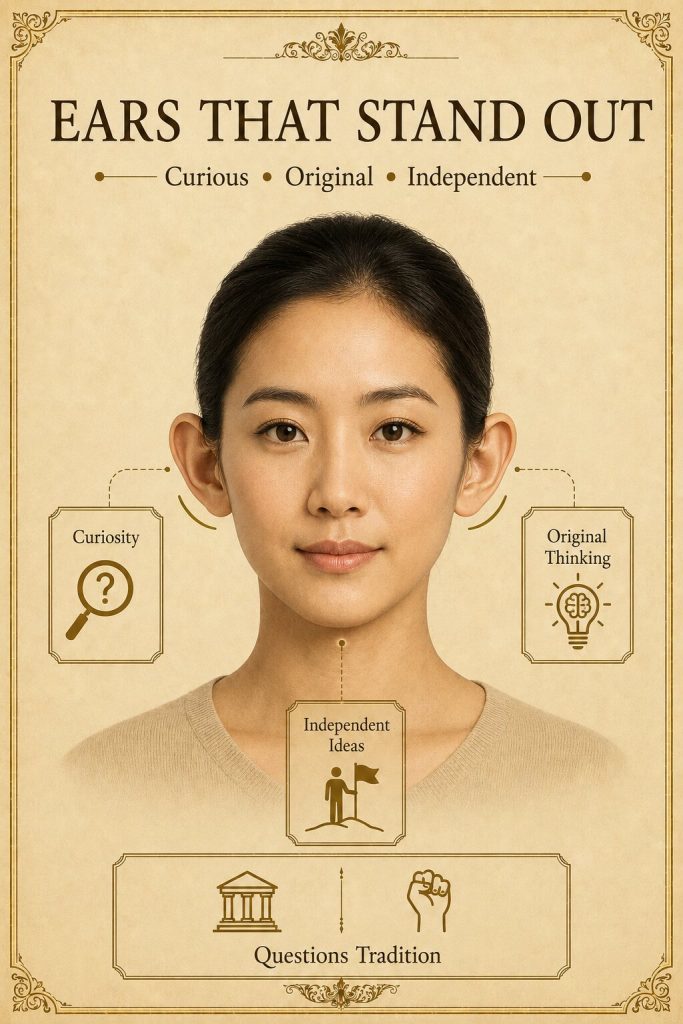
Ears that naturally project outward often indicate:
- Curiosity
- Original thinking
- Independent ideas
Such individuals may question traditional methods.
Challenges:
- Appearing rebellious
- Difficulty accepting authority without explanation
Ears Close to the Head
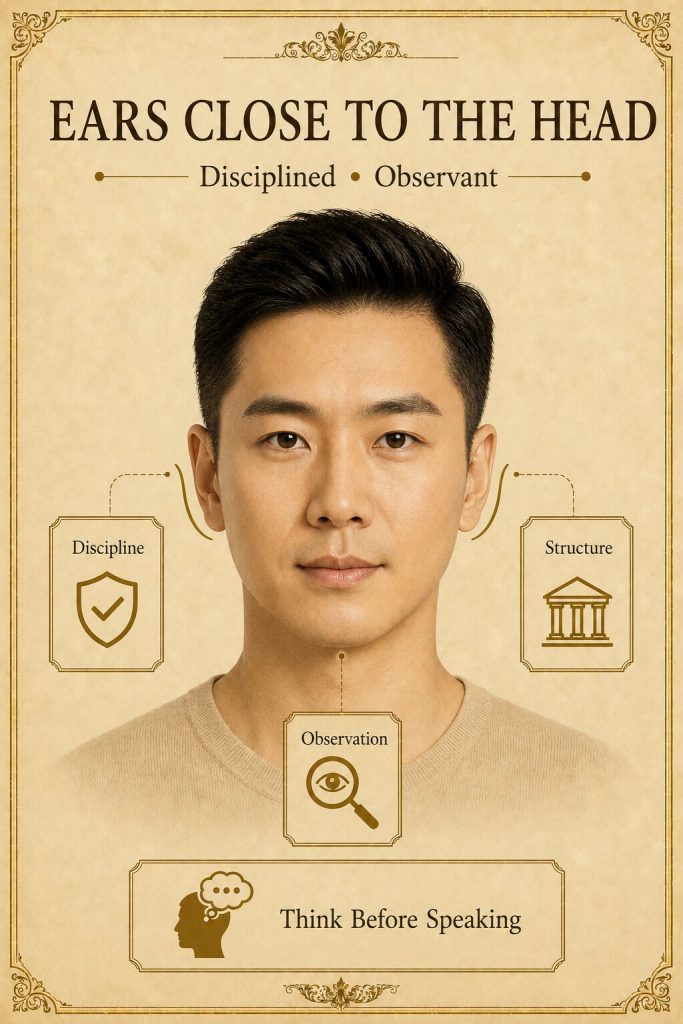
Ears lying closer to the head often reflect:
- Discipline
- Respect for structure
- Careful observation
These individuals usually think before speaking.
Ear Colour
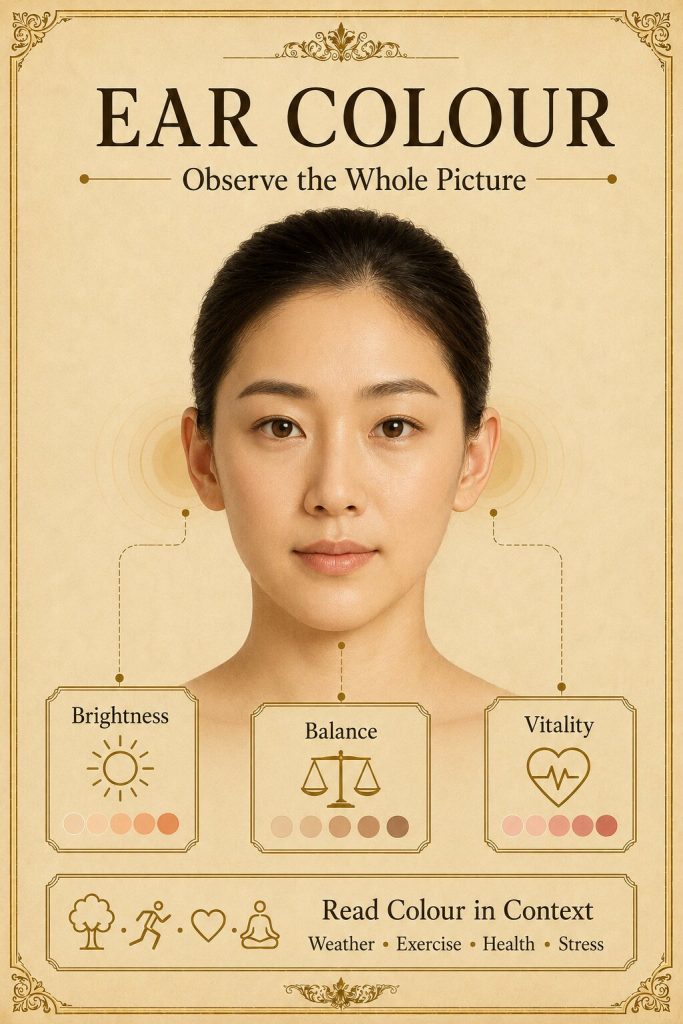
Professionals observe:
- Brightness
- Balance
- Overall vitality
Temporary colour changes may result from:
- Weather
- Exercise
- Illness
- Emotional stress
Therefore colour should never be interpreted independently.
Ear Symmetry
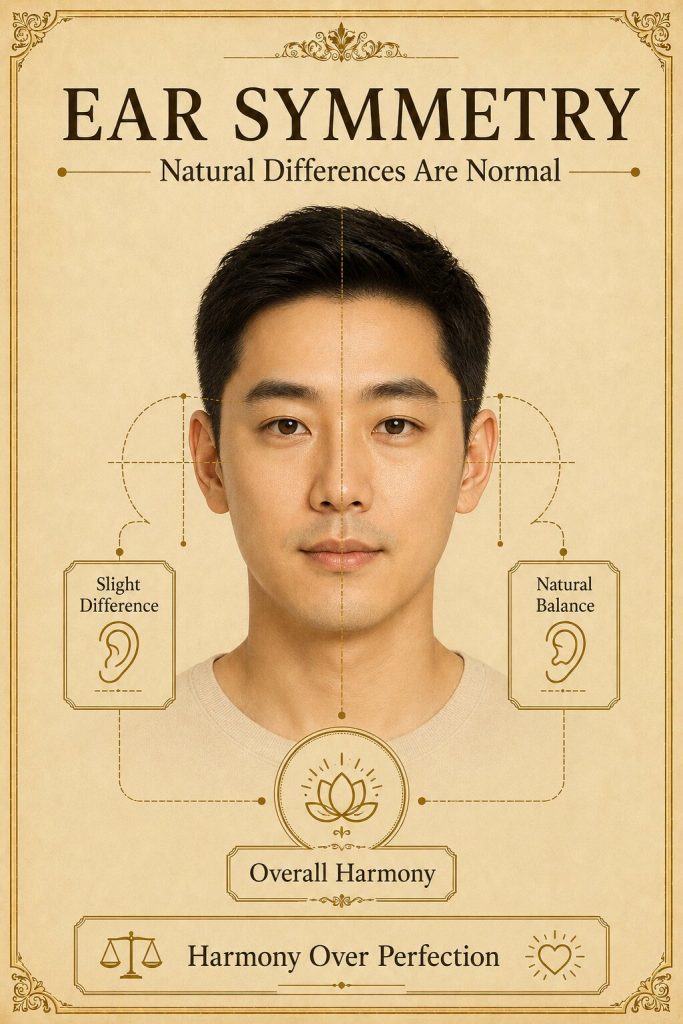
Most faces display slight natural differences.
Minor asymmetry is completely normal.
Professional readers focus on overall harmony rather than perfect symmetry.
Ear Shape
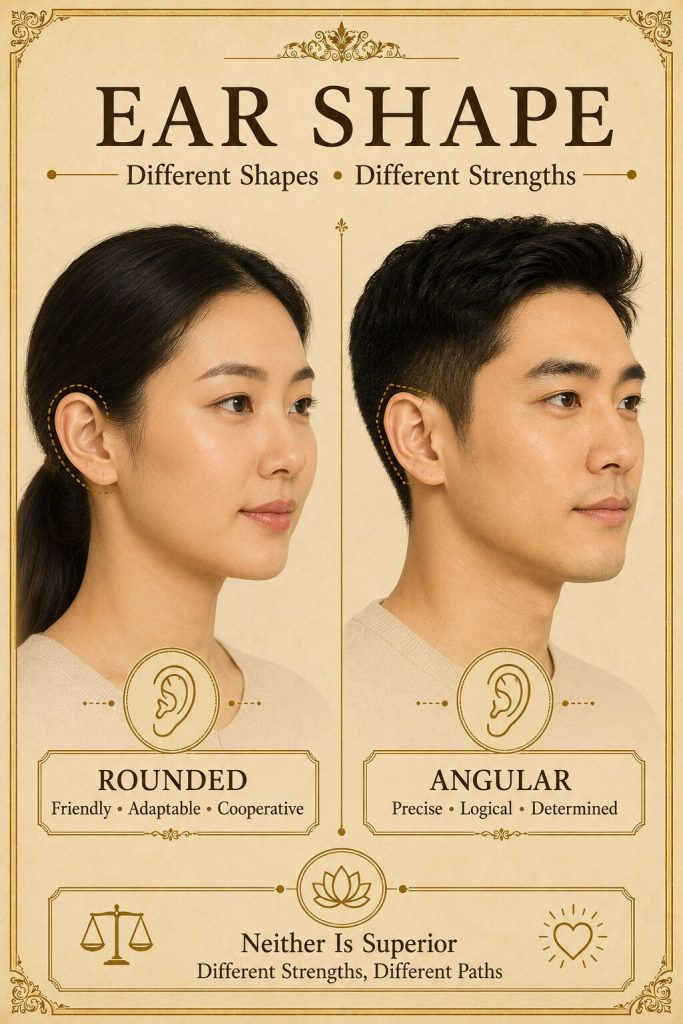
Rounded ears often indicate:
- Friendliness
- Adaptability
- Cooperation
More angular ears may indicate:
- Precision
- Logic
- Determination
Neither shape is inherently superior.
Different personalities suit different careers.
Ears and Intelligence
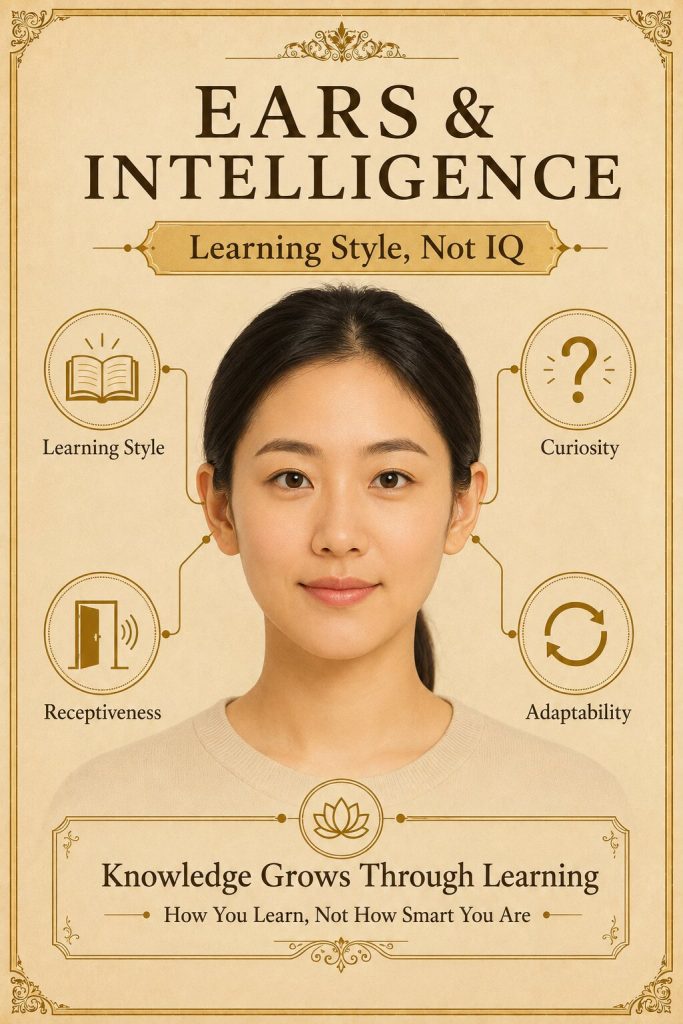
One of the biggest myths is:
“Ears predict intelligence.”
Professional Face Reading disagrees.
The ears more accurately reflect:
- Learning style
- Curiosity
- Receptiveness
- Adaptability
Knowledge is acquired through continuous learning.
The ears indicate how a person approaches that learning.
Ears and Career
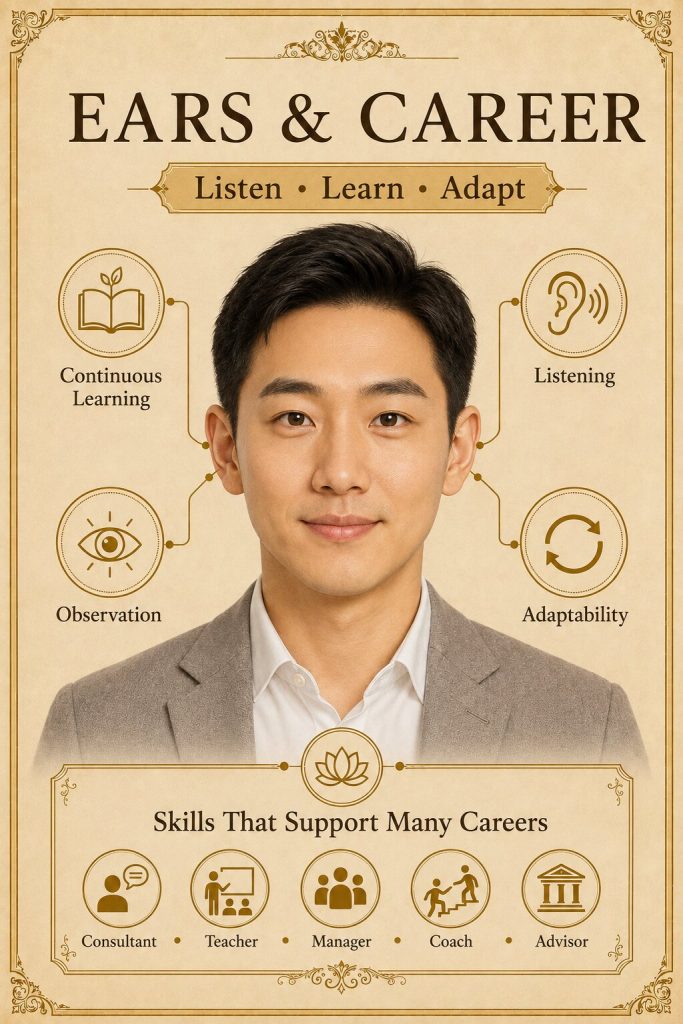
Individuals with balanced ears often perform well in careers requiring:
- Continuous learning
- Listening
- Observation
- Adaptability
Examples include:
- Consultants
- Teachers
- Managers
- Coaches
- Advisors
Ears and Leadership
Many successful leaders possess one quality that is often overlooked.
They listen.
Leadership is not only speaking.
Leadership also requires understanding.
Balanced ears frequently support this ability.
Ears and Relationships
People who genuinely listen often build stronger relationships.
The ears therefore contribute indirectly to:
- Trust
- Communication
- Respect
- Emotional connection
Listening remains one of the most valuable interpersonal skills.
Common Beginner Mistakes
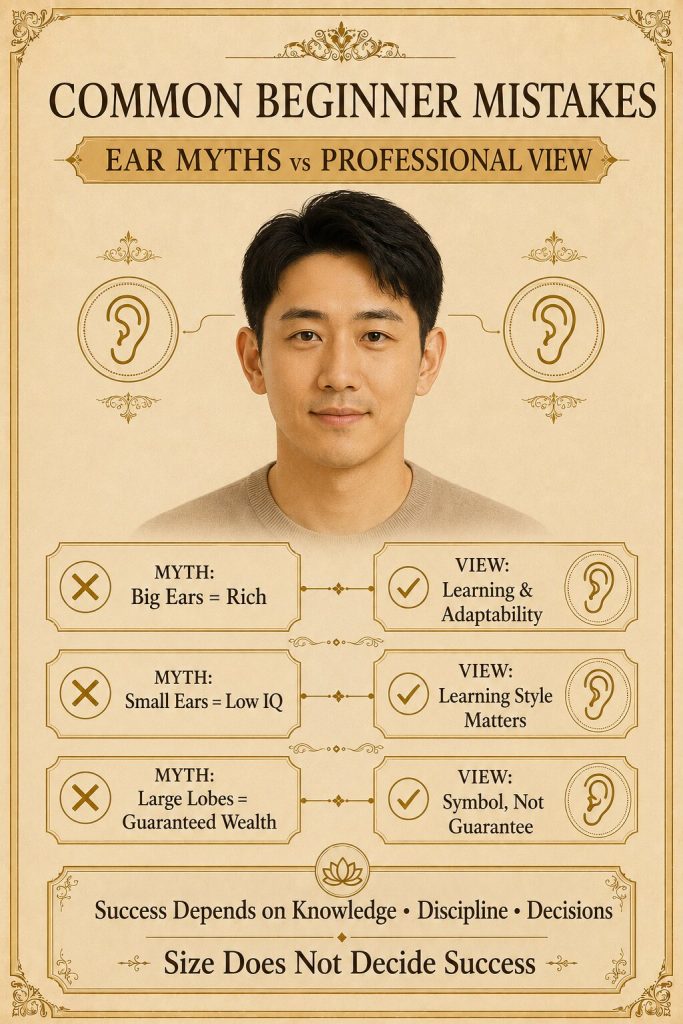
Incorrect:
Big ears mean rich.
Correct:
Larger ears often indicate openness to learning and adaptability.
Financial success depends on knowledge, discipline and decisions.
Incorrect:
Small ears mean low intelligence.
Correct:
Many highly intelligent individuals have naturally smaller ears.
Learning style is far more important than ear size.
Incorrect:
Large ear lobes guarantee prosperity.
Correct:
Large ear lobes traditionally symbolise generosity and emotional stability.
They are not guarantees of financial success.
Dougles Chan’s Professional Observation
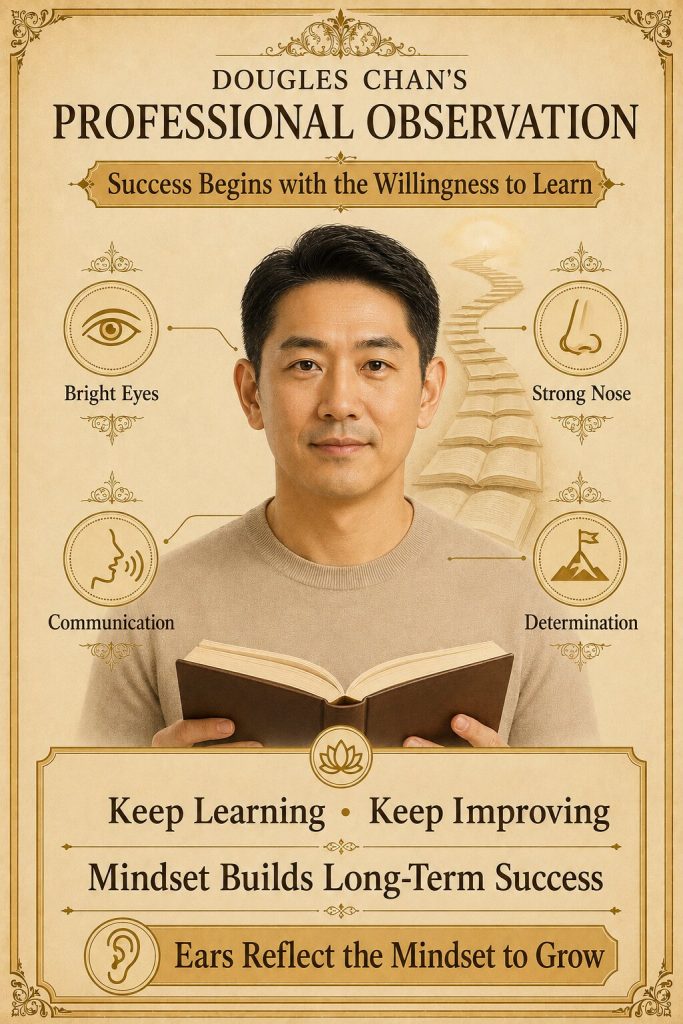
The ears teach an important lesson.
Success begins with the willingness to learn.
A person may possess:
- A strong nose
- Bright eyes
- Excellent communication
- Great determination
But if they refuse to learn…
their growth eventually stops.
The ears remind us that knowledge is never complete.
The most successful people continue learning long after others believe they already know enough.
In professional Face Reading, the ears do not predict success.
They reveal whether a person has the mindset to keep improving.
That mindset often becomes the true foundation of long-term achievement.
The Professional Face Reading Formula So Far
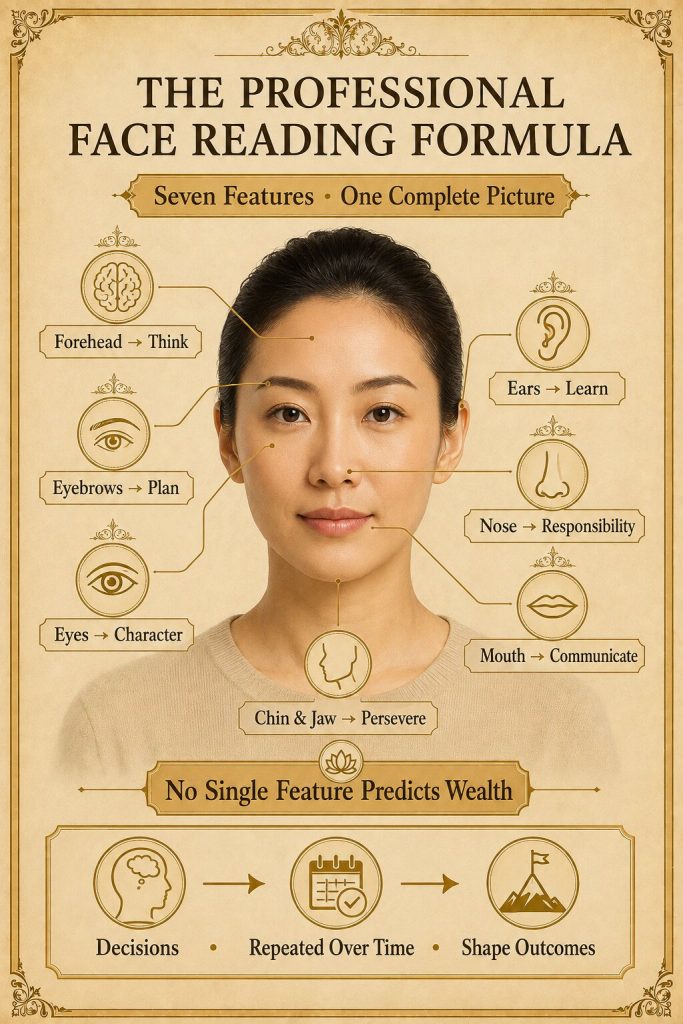
By now we have analysed the major facial features in sequence:
- Forehead → How a person thinks.
- Eyebrows → How they plan.
- Eyes → Their character and awareness.
- Nose → Their responsibility and judgement.
- Mouth → Their communication.
- Chin and Jaw → Their perseverance.
- Ears → Their willingness to learn.
Notice something important.
No feature directly predicts wealth.
Instead, each feature reveals qualities that influence decisions.
It is the quality of those decisions, repeated over many years, that often determines a person’s outcomes.
Face Shape – The First Observation
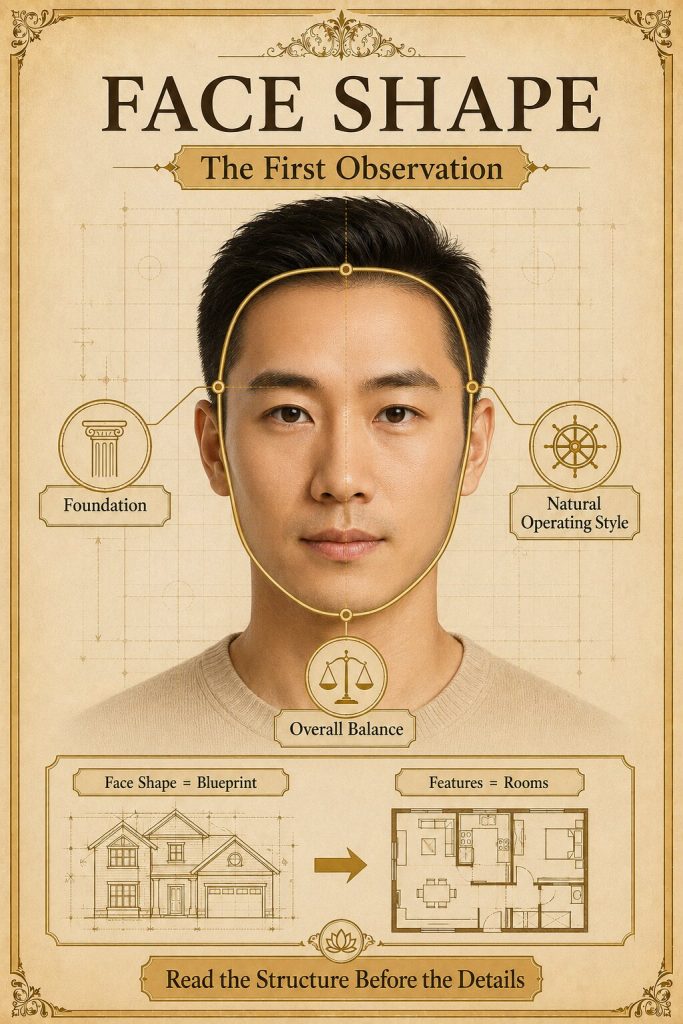
One of the first things a professional Face Reader observes is not the eyes, nose or mouth.
It is the overall face shape.
Why?
Because face shape provides the foundation.
Individual features tell us specific qualities.
Face shape tells us the person’s natural operating style.
Think of it this way.
The face shape is like the blueprint of a house.
The individual facial features are the rooms inside the house.
Both are important.
A beautiful room cannot compensate for a weak foundation.
Likewise, an excellent nose cannot completely override an unbalanced facial structure.
The Golden Rule of Face Shapes
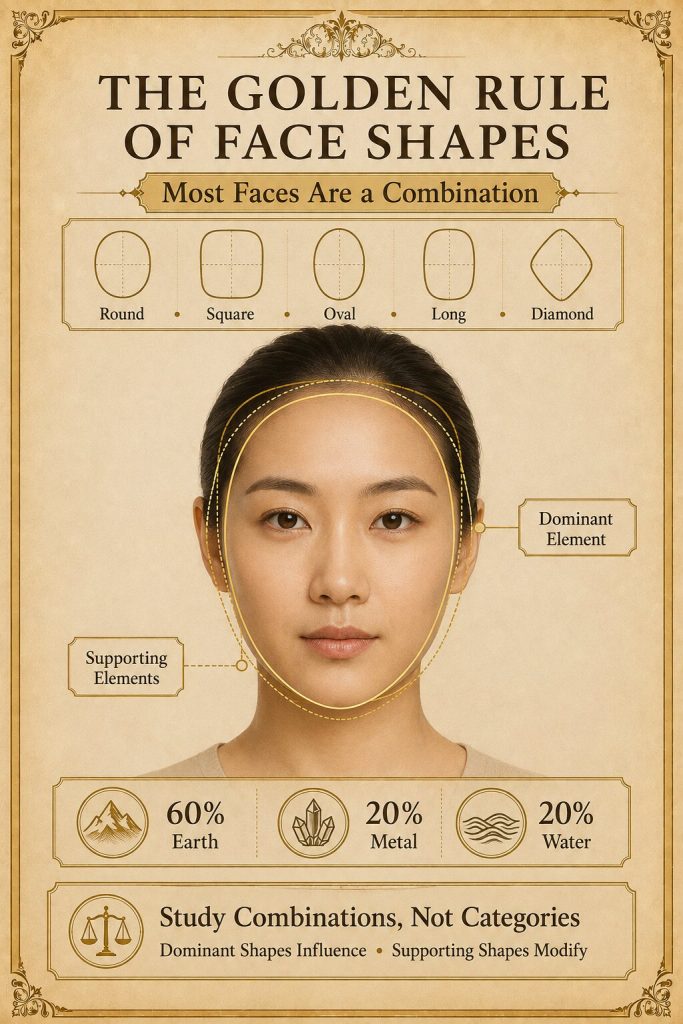
Many beginners try to force every face into one category.
Professional Face Reading does not.
Very few people possess a perfect:
- Round Face
- Square Face
- Oval Face
- Long Face
- Diamond Face
Most people display a combination.
For example:
- 60% Earth
- 20% Metal
- 20% Water
The dominant element influences personality, while the supporting elements modify behaviour.
Professional Face Reading always studies combinations.
The Five Elements
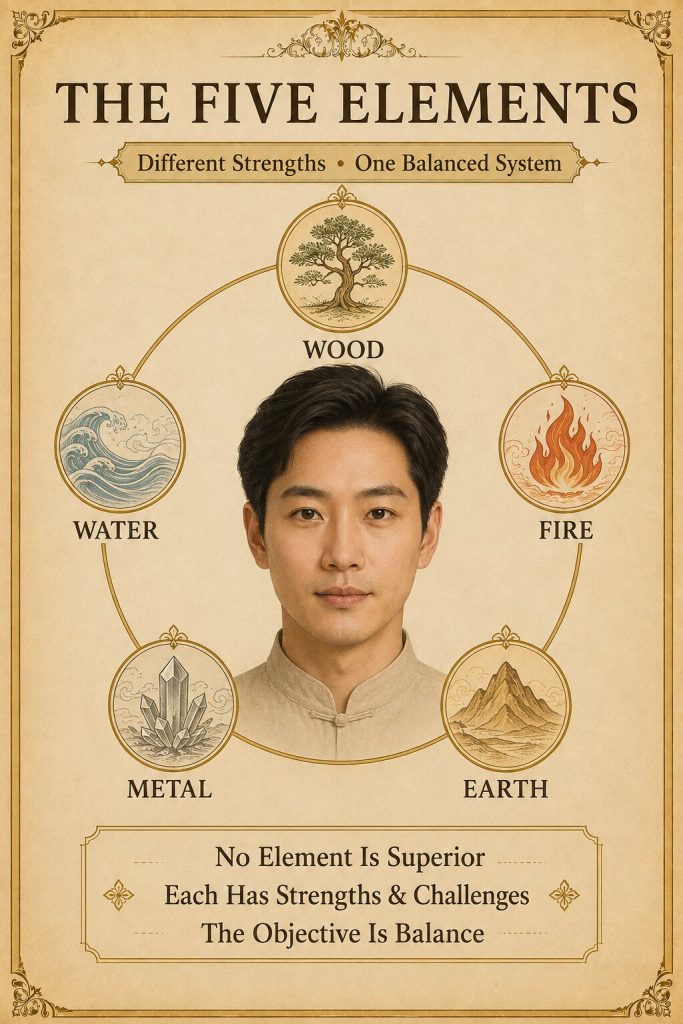
Chinese Face Reading is closely connected with the Five Elements.
Each element reflects different strengths.
No element is superior.
Each has advantages and challenges.
The objective is balance.
The Five Elements are:
- Wood
- Fire
- Earth
- Metal
- Water
Earth Face
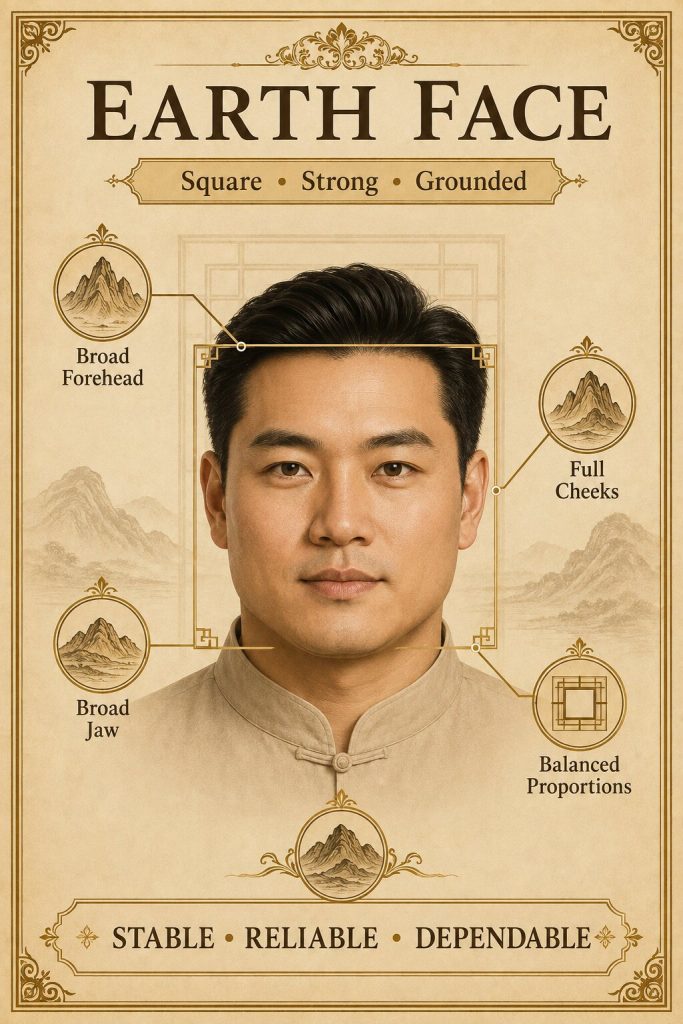
The Earth Face is one of the easiest to recognise.
Characteristics:
- Square appearance
- Broad forehead
- Broad jaw
- Full cheeks
- Thick facial muscles
- Balanced proportions
Overall impression:
Stable.
Reliable.
Dependable.
Positive Traits
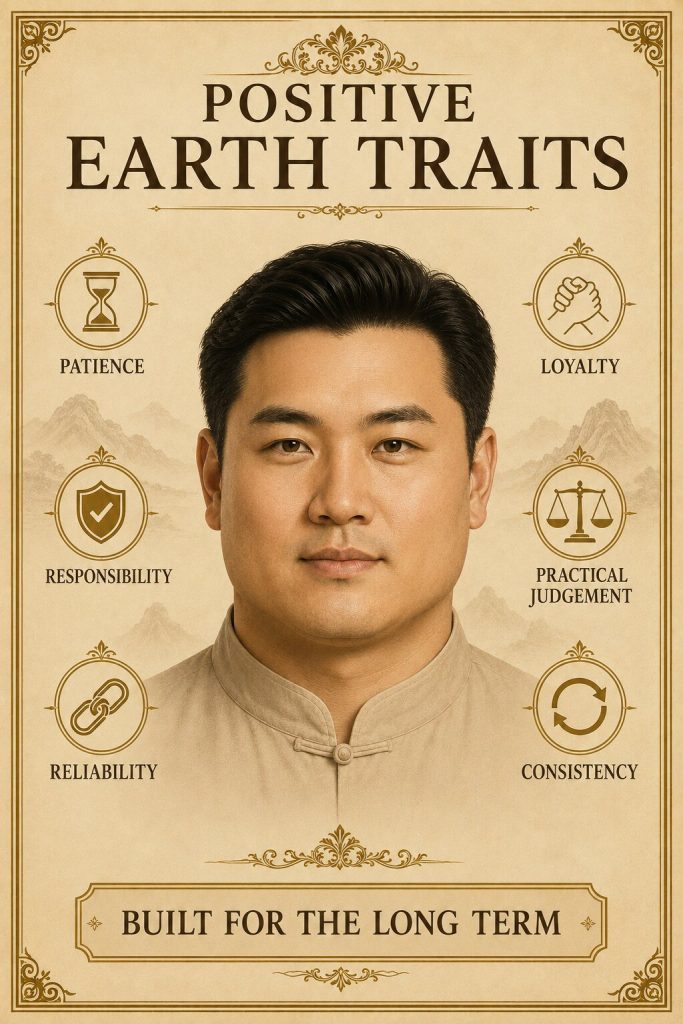
People with strong Earth characteristics often display:
- Patience
- Responsibility
- Reliability
- Loyalty
- Practical judgement
- Consistency
They usually prefer building long-term success rather than chasing quick results.
These individuals often become the people others depend upon.
Challenges
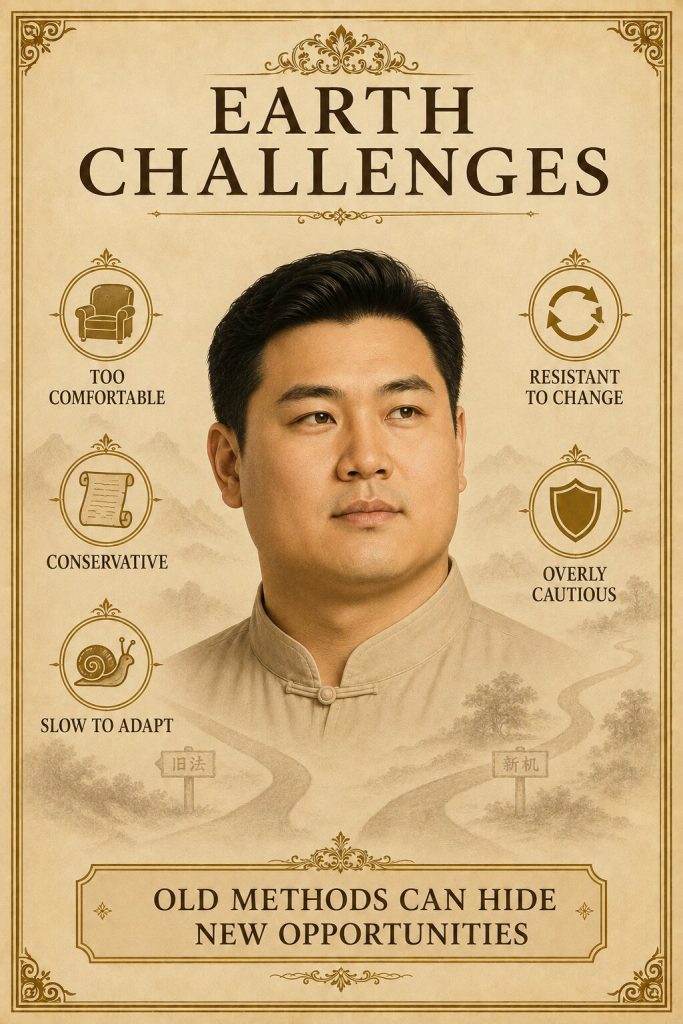
Every strength has a weakness.
Earth personalities may become:
- Too comfortable
- Resistant to change
- Conservative
- Slow to adapt
- Overly cautious
Sometimes they continue using old methods even when better opportunities appear.
Suitable Careers
Earth personalities often excel in:
- Property
- Education
- Finance
- Administration
- Operations
- Project Management
- Government
- Consulting
These careers reward consistency and responsibility.
Metal Face
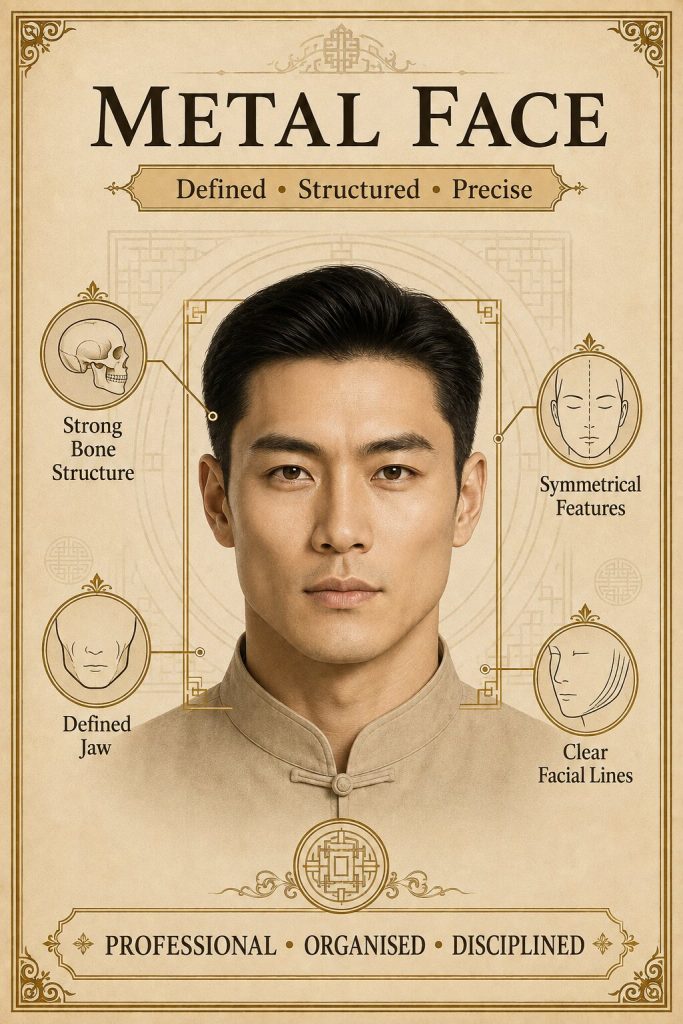
Metal Faces generally display:
- Strong bone structure
- Defined jaw
- Symmetrical features
- Clear facial lines
Overall impression:
Professional.
Organised.
Disciplined.
Positive Traits
Metal personalities frequently possess:
- Integrity
- Precision
- Discipline
- Responsibility
- Strong ethics
- High standards
These individuals often enjoy creating systems and improving efficiency.
Challenges
Strong Metal personalities may become:
- Perfectionists
- Critical
- Rigid
- Emotionally reserved
Perfection can delay progress.
Sometimes “good enough” is better than waiting forever.
Suitable Careers
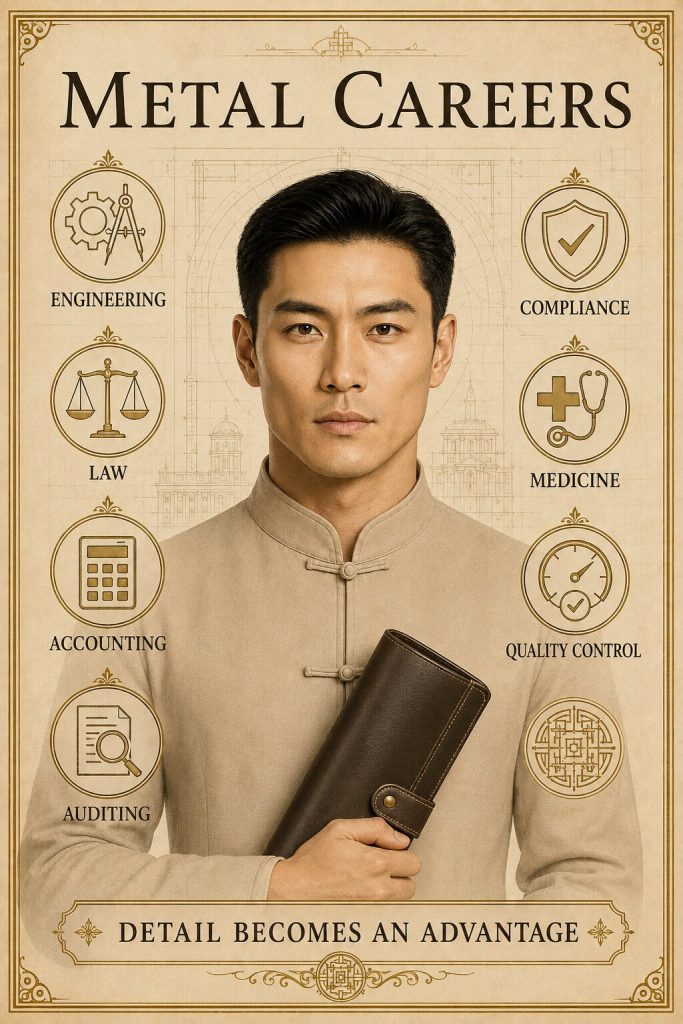
Metal personalities frequently succeed in:
- Engineering
- Law
- Accounting
- Auditing
- Compliance
- Medicine
- Quality Control
Their attention to detail becomes an advantage.
Water Face
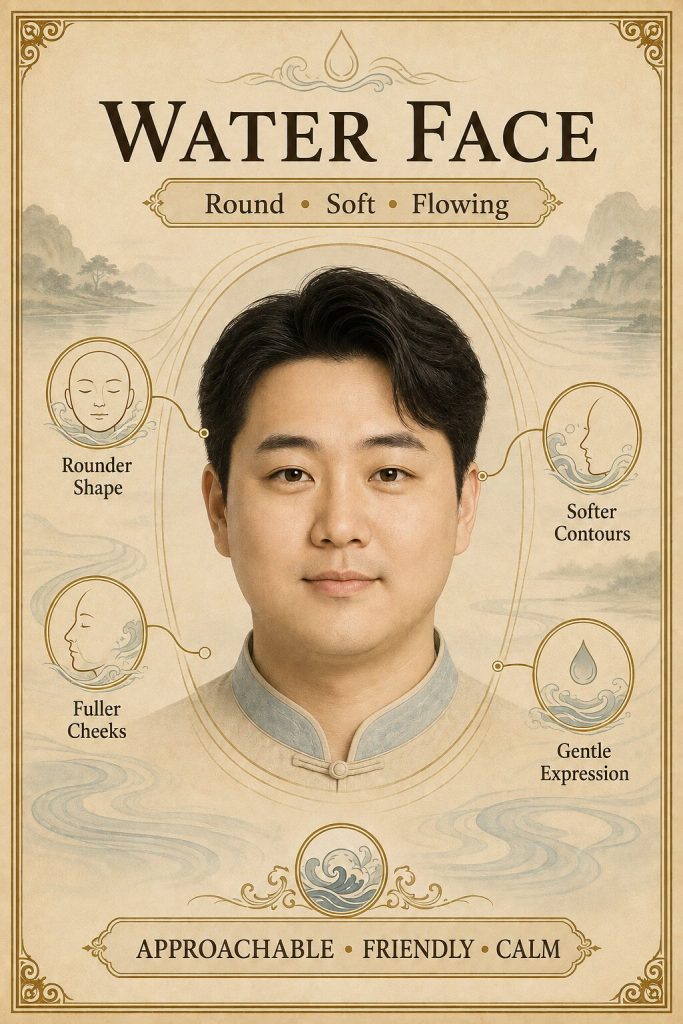
Water Faces usually appear:
- Rounder
- Softer
- Fuller
- Gentle
Overall impression:
Approachable.
Friendly.
Calm.
Positive Traits
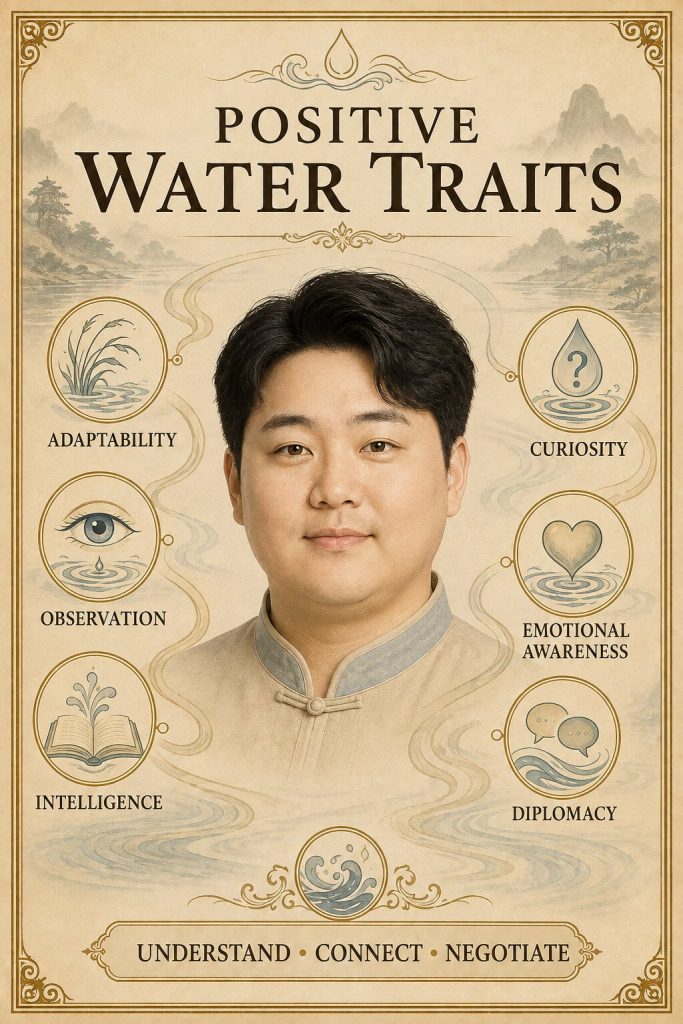
Water personalities often possess:
- Adaptability
- Observation
- Intelligence
- Curiosity
- Emotional awareness
- Diplomacy
These individuals usually understand people well.
They often become excellent negotiators.
Challenges
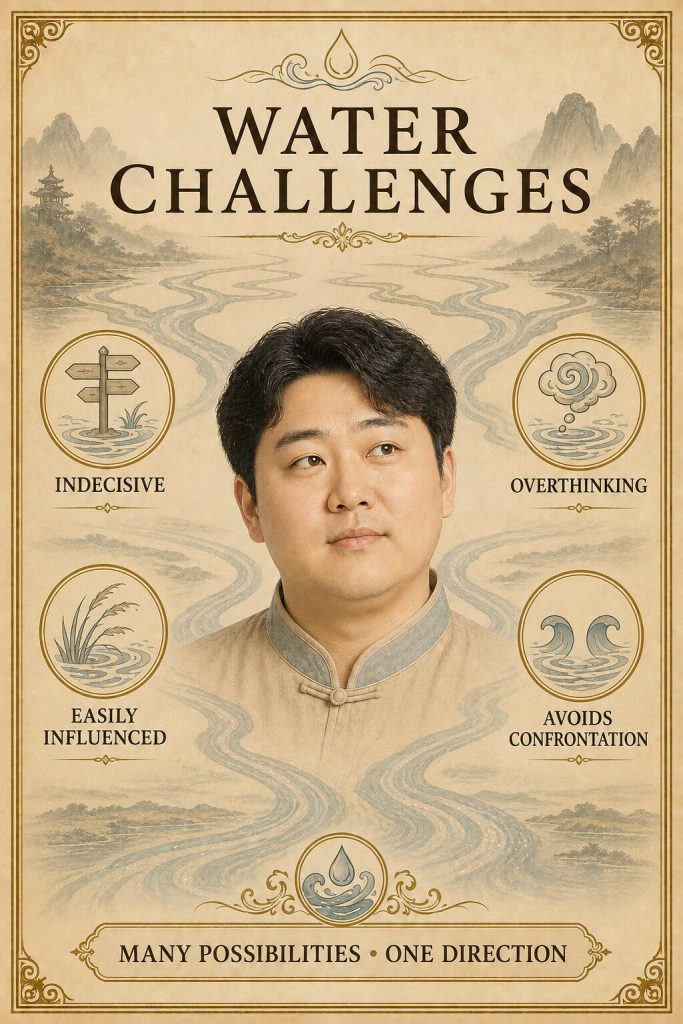
Water personalities sometimes become:
- Indecisive
- Overthinking
- Easily influenced
- Avoiding confrontation
Because they see many possibilities,
they sometimes struggle to choose one direction.
Suitable Careers
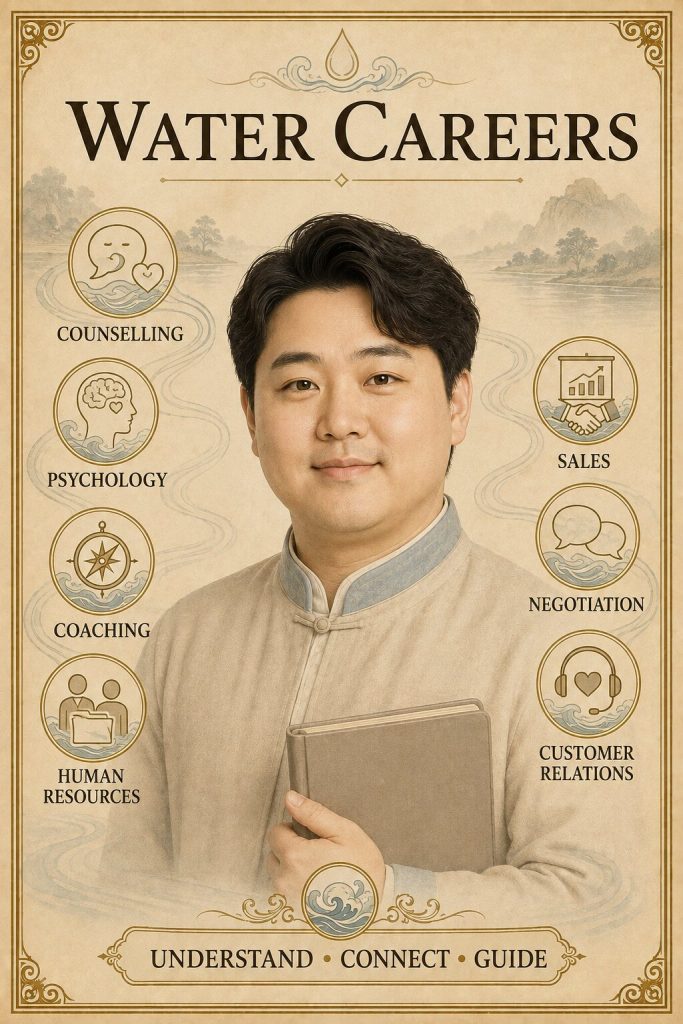
Water personalities often perform well in:
- Counselling
- Psychology
- Coaching
- Human Resources
- Sales
- Negotiation
- Customer Relations
Wood Face
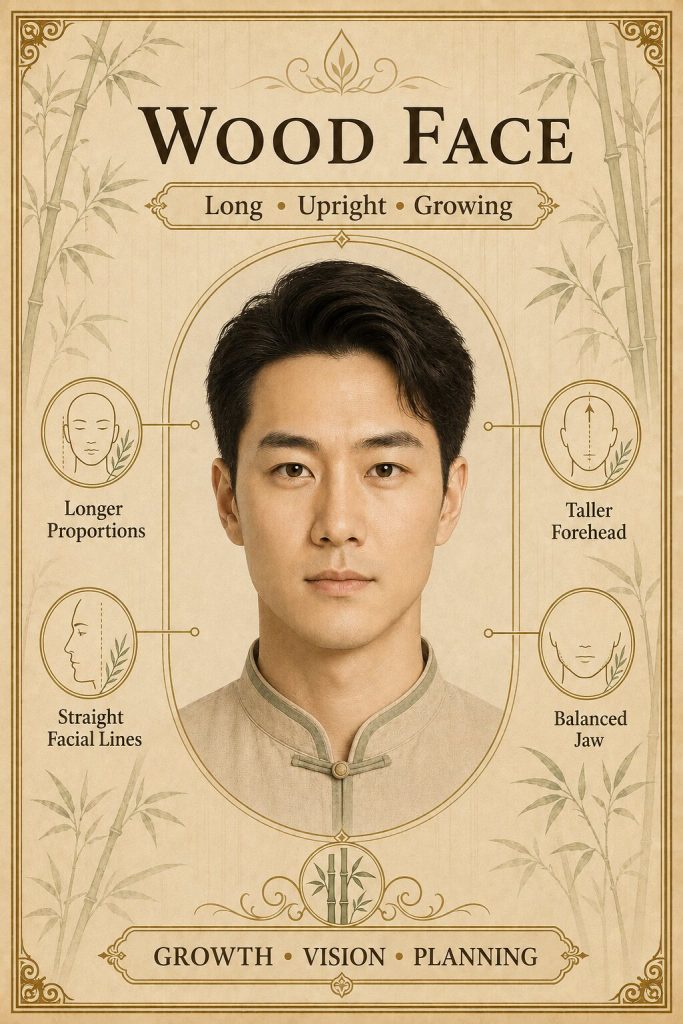
Wood Faces generally display:
- Longer facial proportions
- Taller forehead
- Straight facial lines
- Balanced jaw
Overall impression:
Growth.
Vision.
Planning.
Positive Traits
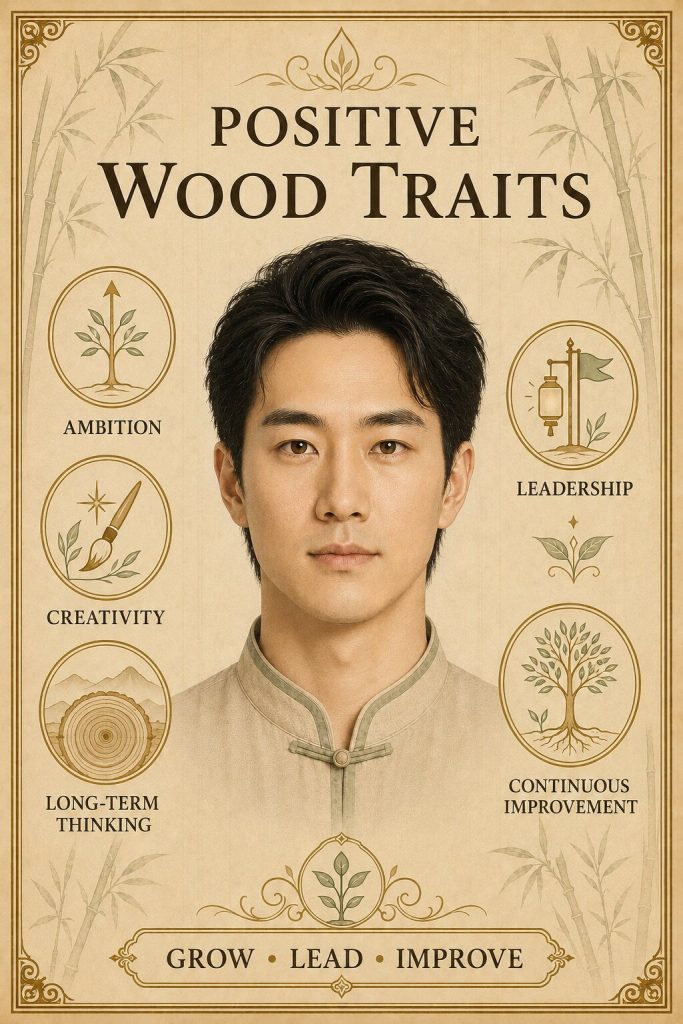
Wood personalities often demonstrate:
- Ambition
- Creativity
- Long-term thinking
- Leadership
- Continuous improvement
These individuals naturally seek progress.
Challenges
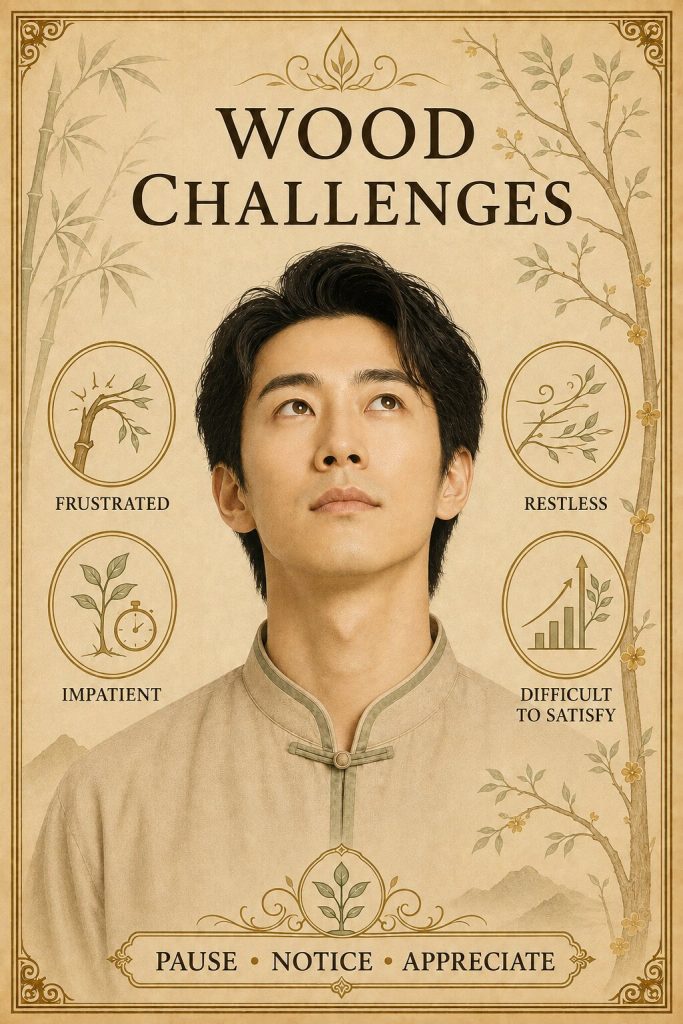
Wood personalities may become:
- Frustrated
- Impatient
- Restless
- Difficult to satisfy
Because they constantly pursue improvement,
they sometimes forget to appreciate current achievements.
Suitable Careers

Wood personalities often excel in:
- Entrepreneurship
- Business Development
- Marketing
- Strategic Planning
- Research
- Education
Fire Face
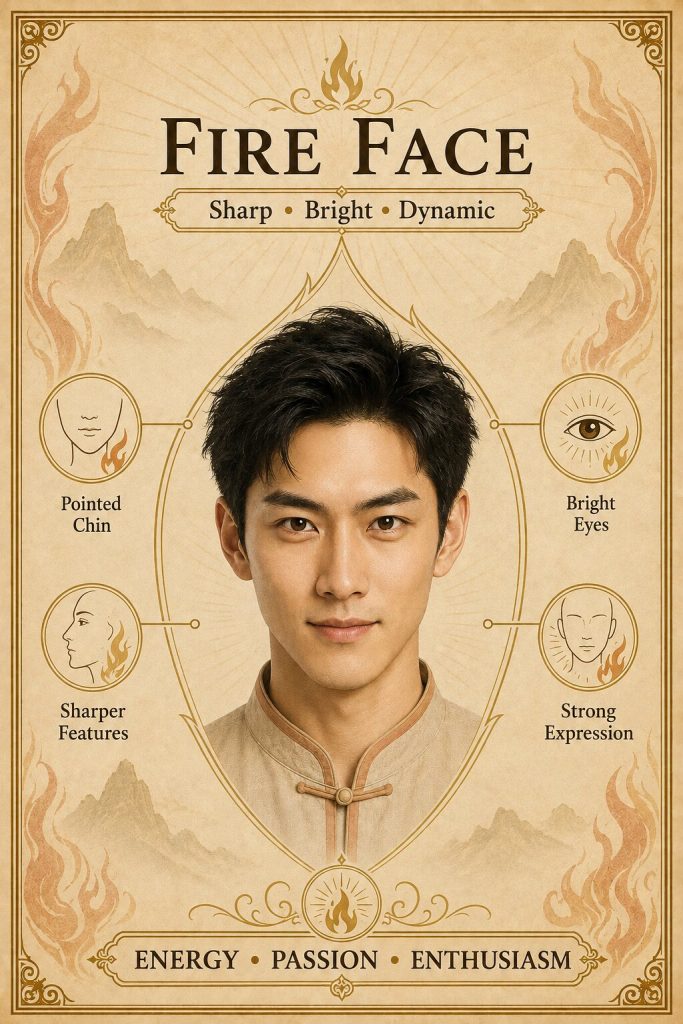
Fire Faces often display:
- Pointed chin
- Sharper features
- Bright eyes
- Strong facial expressions
Overall impression:
Energy.
Passion.
Enthusiasm.
Positive Traits
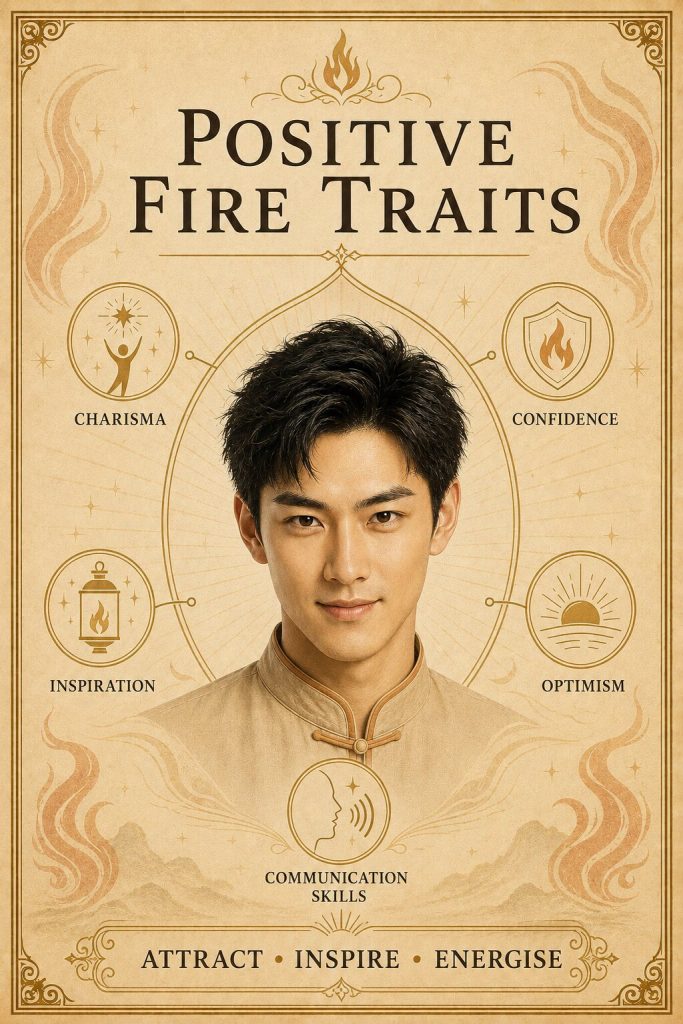
Fire personalities frequently possess:
- Charisma
- Confidence
- Inspiration
- Optimism
- Communication skills
These people naturally attract attention.
Challenges
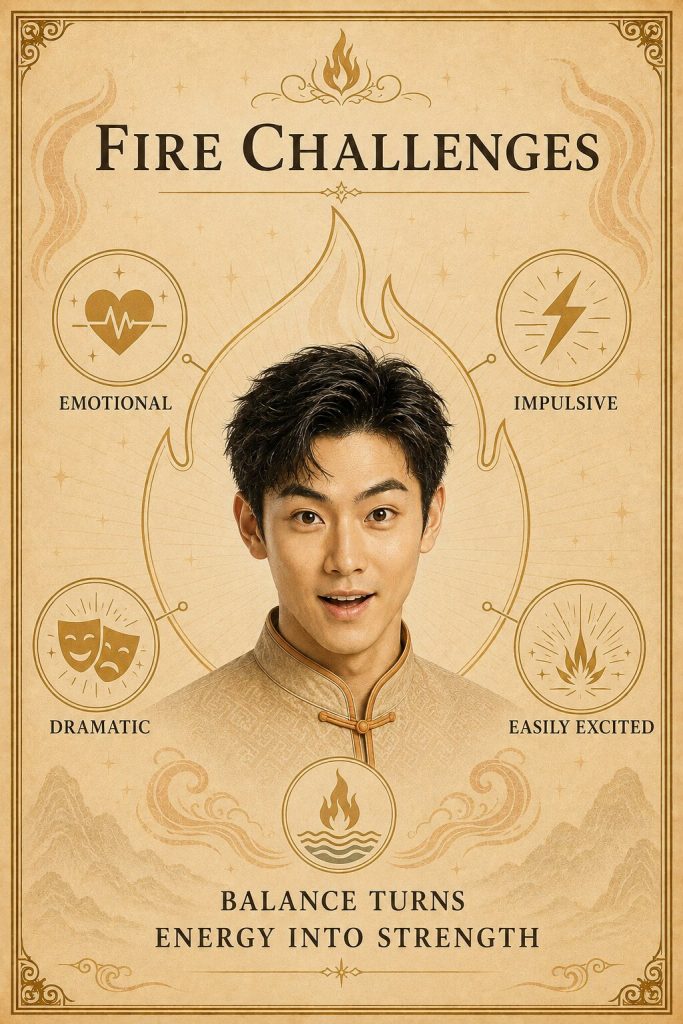
Strong Fire personalities may become:
- Emotional
- Impulsive
- Dramatic
- Easily excited
Learning emotional balance becomes one of their greatest strengths.
Suitable Careers
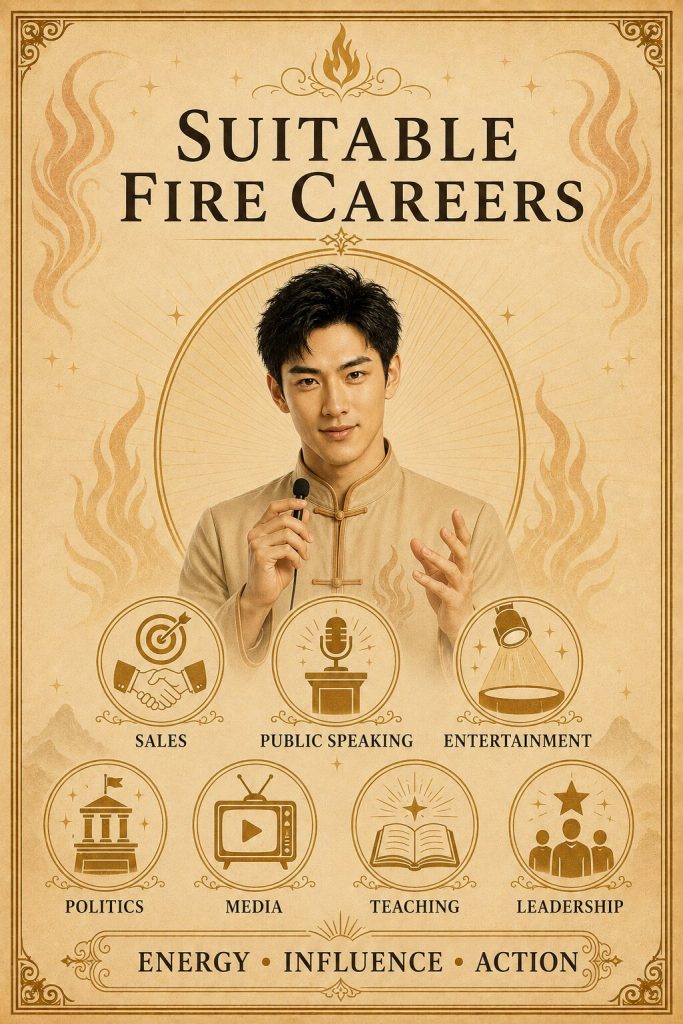
Fire personalities often perform well in:
- Sales
- Public Speaking
- Entertainment
- Politics
- Media
- Teaching
- Leadership
Mixed Face Shapes
Very few people belong entirely to one element.
Examples include:
Earth + Metal
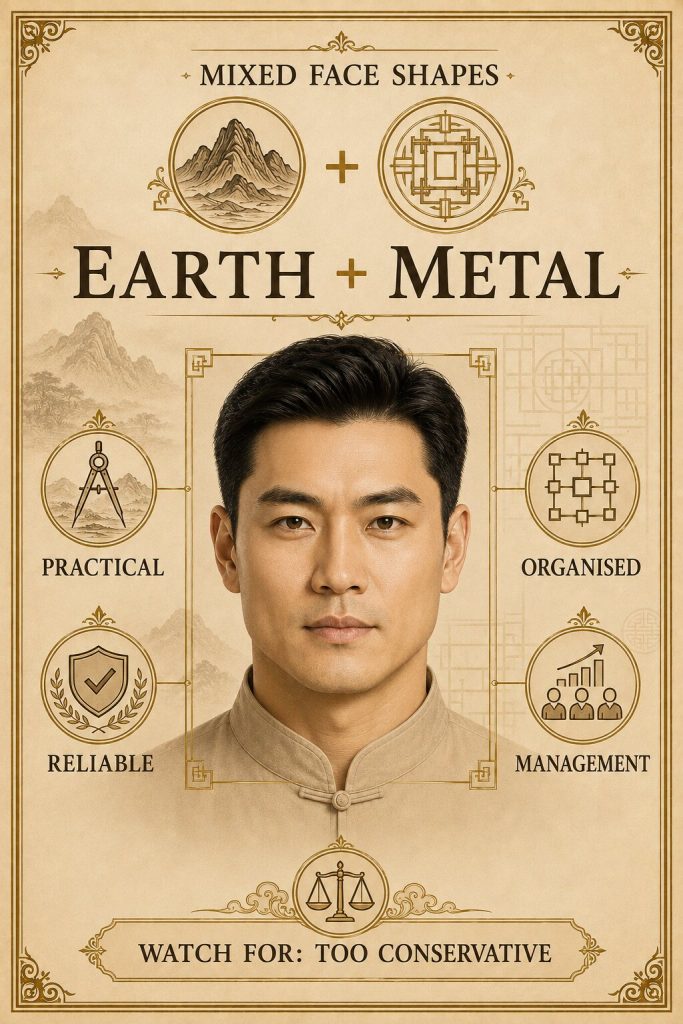
Often indicates:
- Practical
- Organised
- Reliable
- Excellent management ability
Possible challenge:
Too conservative.
Wood + Fire

Often indicates:
- Vision
- Leadership
- Innovation
- Motivation
Possible challenge:
Moving too quickly.
Water + Wood
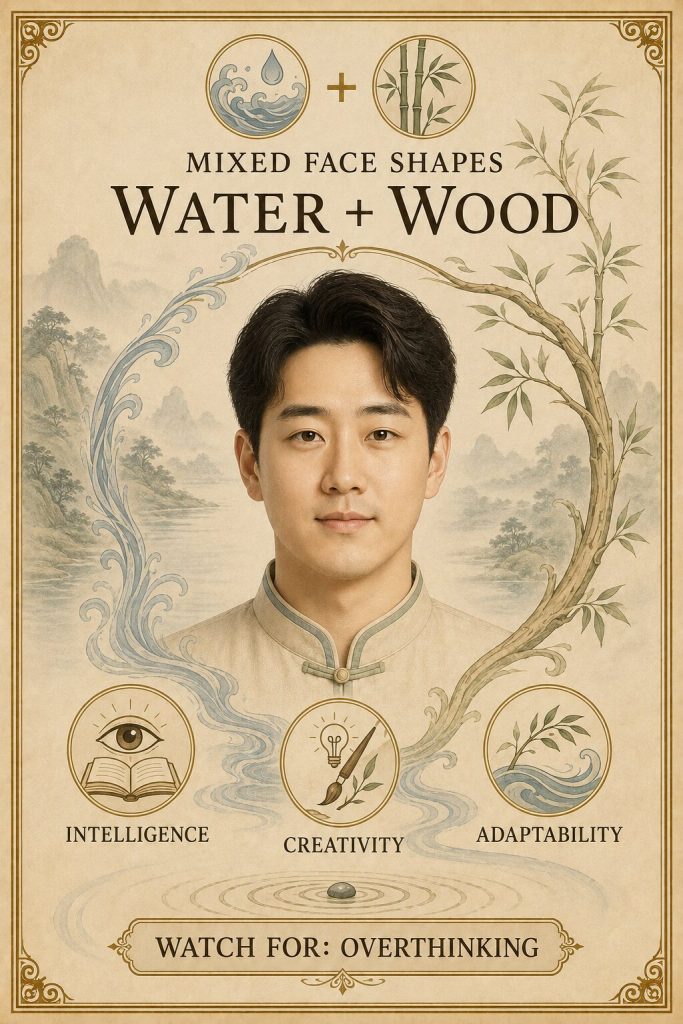
Often indicates:
- Intelligence
- Creativity
- Adaptability
Possible challenge:
Overthinking.
Fire + Earth
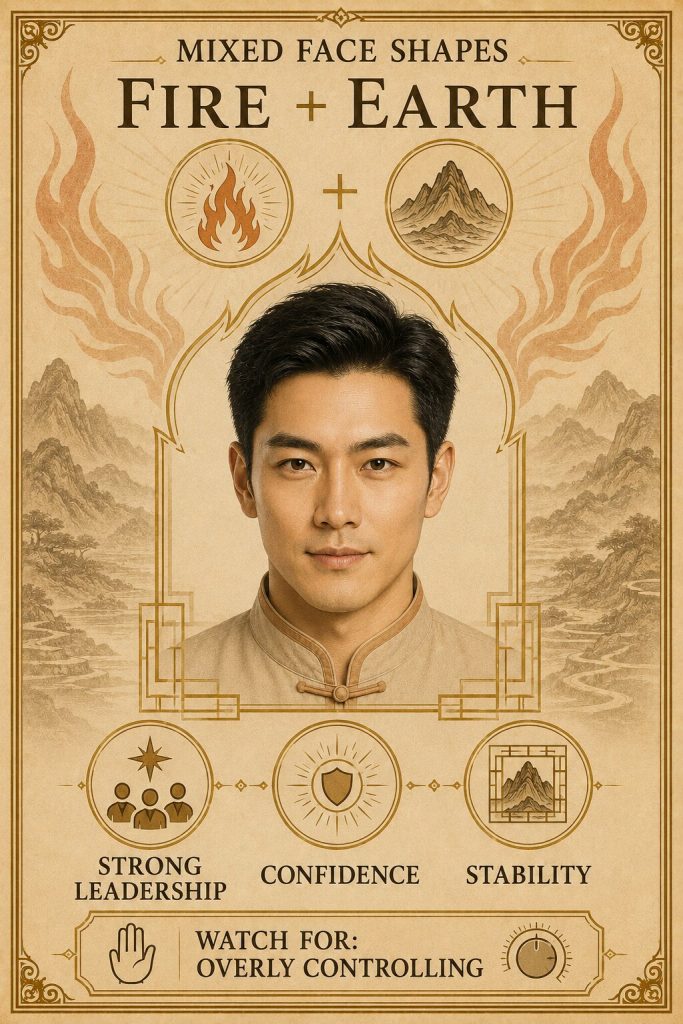
Often indicates:
- Strong leadership
- Confidence
- Stability
Possible challenge:
Being overly controlling.
Metal + Water
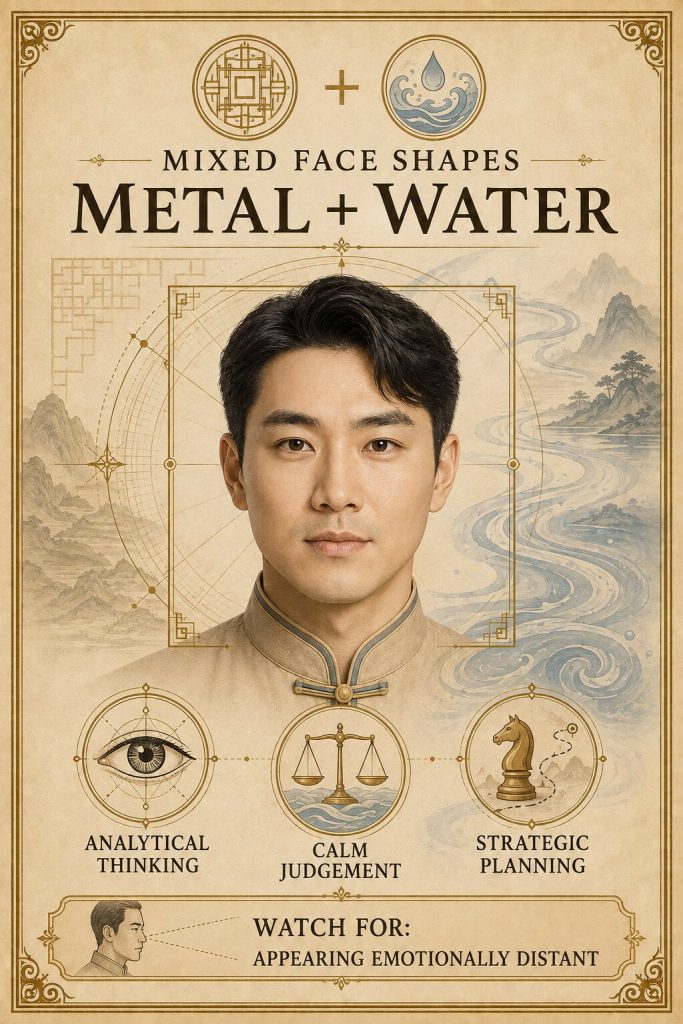
Often indicates:
- Analytical thinking
- Calm judgement
- Strategic planning
Possible challenge:
Appearing emotionally distant.
Face Shape and Leadership
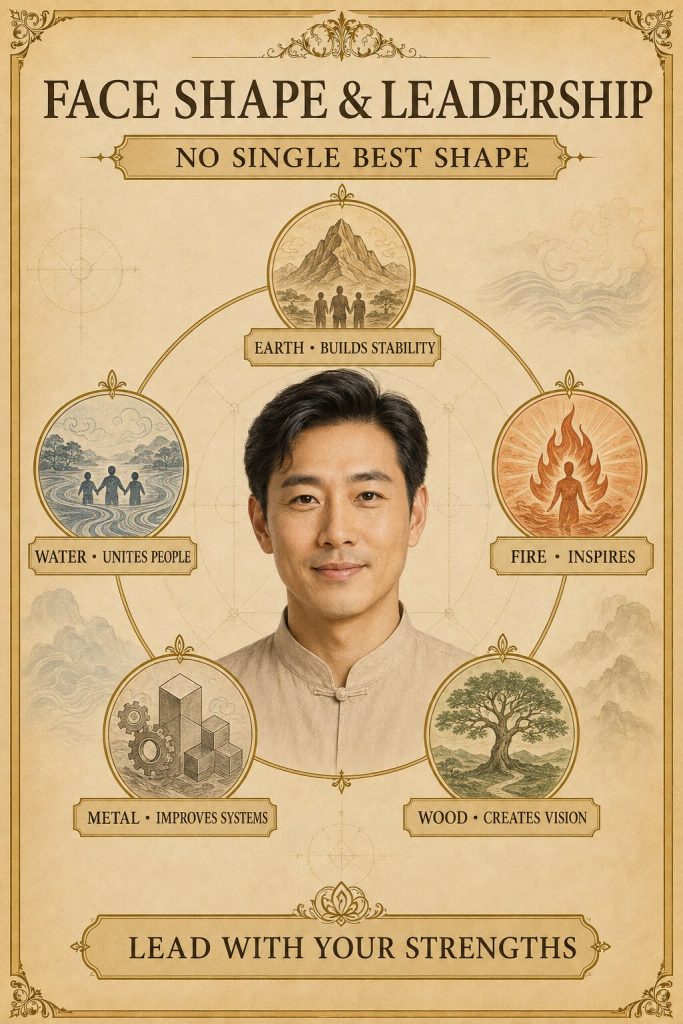
One common question is:
“Which face shape makes the best leader?”
The answer is:
There is no best face shape.
Different leaders succeed differently.
For example:
Earth leaders build stable organisations.
Fire leaders inspire people.
Metal leaders improve systems.
Wood leaders create vision.
Water leaders unite people.
Leadership depends on using your strengths effectively.
Face Shape and Wealth
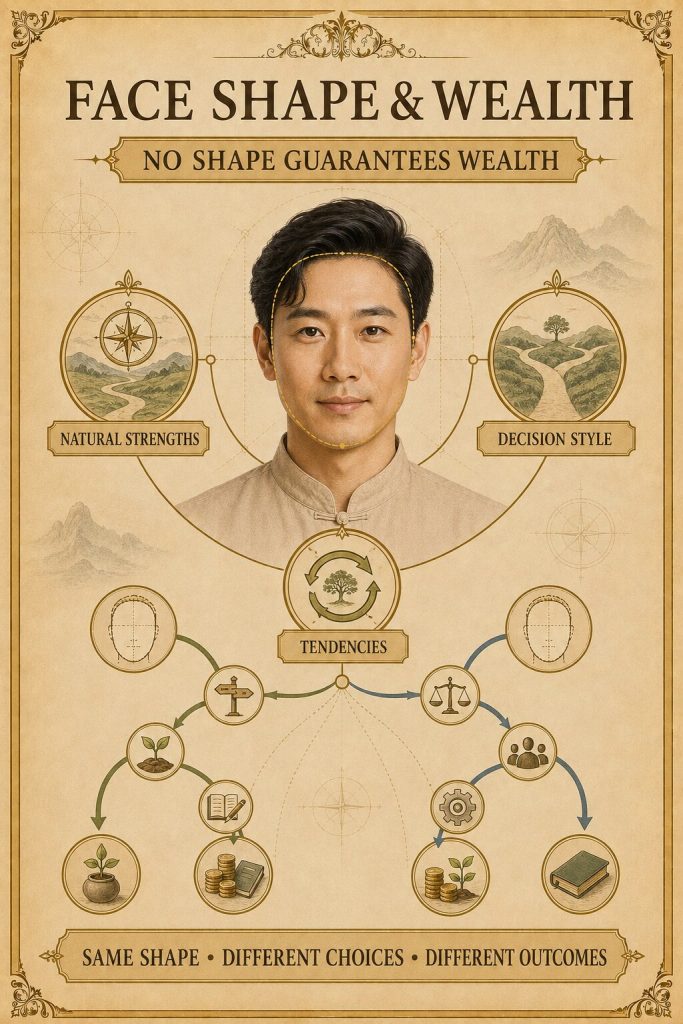
Another common myth is:
“Certain face shapes are born rich.”
Professional Face Reading disagrees.
Face shape reveals:
- Natural strengths
- Decision-making style
- Behavioural tendencies
These qualities may contribute to wealth,
but they do not guarantee it.
Two people with identical face shapes can achieve completely different outcomes because they make different decisions.
Face Shape and Relationships
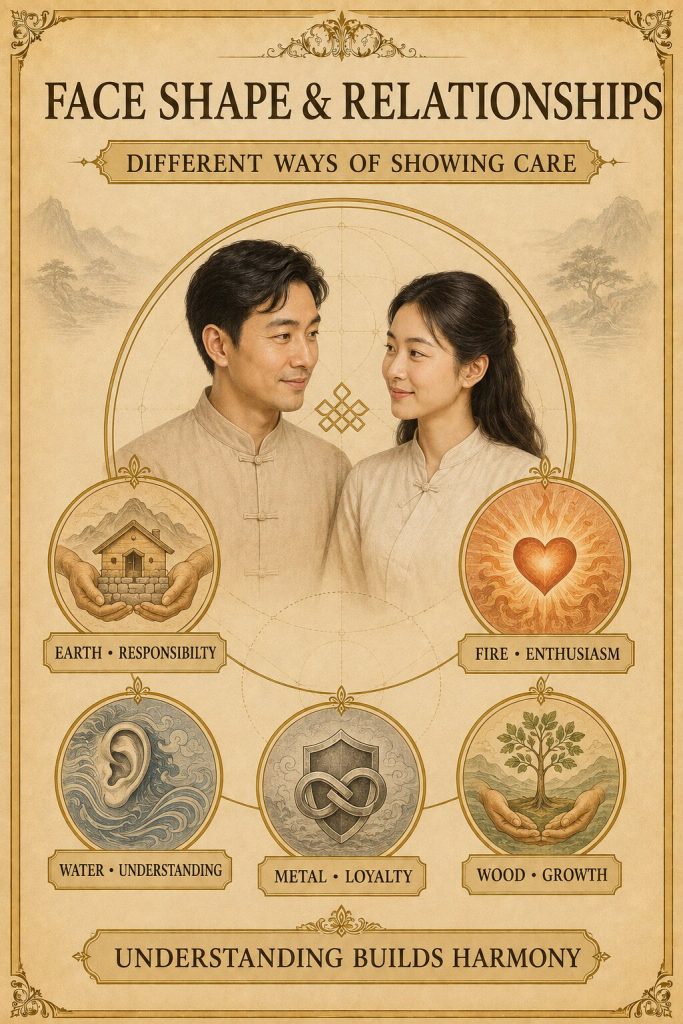
Face shape influences communication style.
For example:
Earth personalities often express love through responsibility.
Fire personalities often express love through enthusiasm.
Water personalities often express love through understanding.
Metal personalities often express love through loyalty.
Wood personalities often express love through helping others grow.
Understanding these differences often improves relationships more than trying to change someone’s personality.
Common Beginner Mistakes
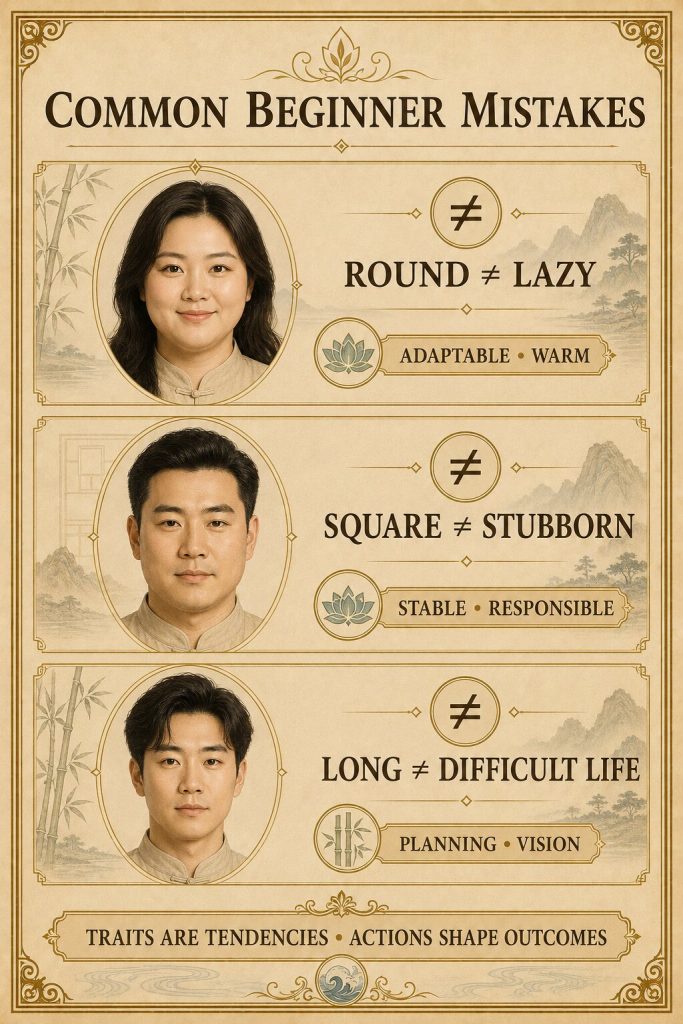
Incorrect:
Round face means lazy.
Correct:
A round face often reflects adaptability and emotional warmth.
Lifestyle and habits determine whether a person becomes disciplined or complacent.
Incorrect:
Square face means stubborn.
Correct:
A square face often indicates stability and responsibility.
Whether this becomes persistence or stubbornness depends on emotional maturity.
Incorrect:
Long face means difficult life.
Correct:
A longer face often reflects planning and vision.
Success depends on how those qualities are applied.
Dougles Chan’s Professional Observation
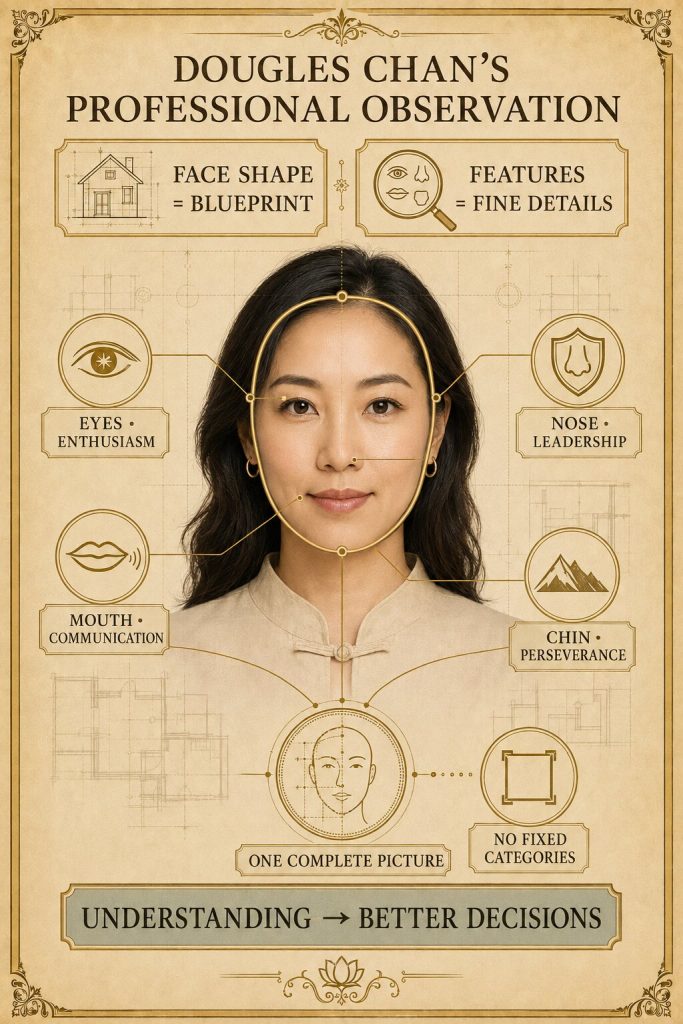
The face shape provides the overall blueprint of a person’s natural tendencies.
The individual features provide the fine details.
Professional Face Reading never relies on only one or the other.
A person with an Earth Face may naturally be patient.
However, bright eyes may add enthusiasm.
A strong nose may increase leadership.
A balanced mouth may improve communication.
A determined chin may strengthen perseverance.
It is this combination that creates a complete picture.
The purpose of Face Reading is not to place people into fixed categories.
Its purpose is to understand:
- Their natural strengths.
- Their likely challenges.
- Their preferred way of thinking.
- Their behavioural tendencies.
With greater understanding comes better decisions.
And with better decisions, people can improve their lives regardless of the face they were born with.
A Principle to Remember
Your face reflects your tendencies.
Your choices determine your future.
Face Reading helps us understand the starting point.
It does not limit where we can ultimately go.
Face Reading Ultimate Guide
Part 11 – Facial Colour, Complexion, Qi and Shen
By Grand Master Dougles Chan
Looking Beyond Facial Features
By now, we have studied:
- Face Shape
- Forehead
- Eyebrows
- Eyes
- Nose
- Mouth
- Chin
- Jaw
- Cheeks
- Ears
However, professional Face Reading does not stop there.
Many beginners only observe the structure of the face.
Experienced practitioners observe something that changes every day.
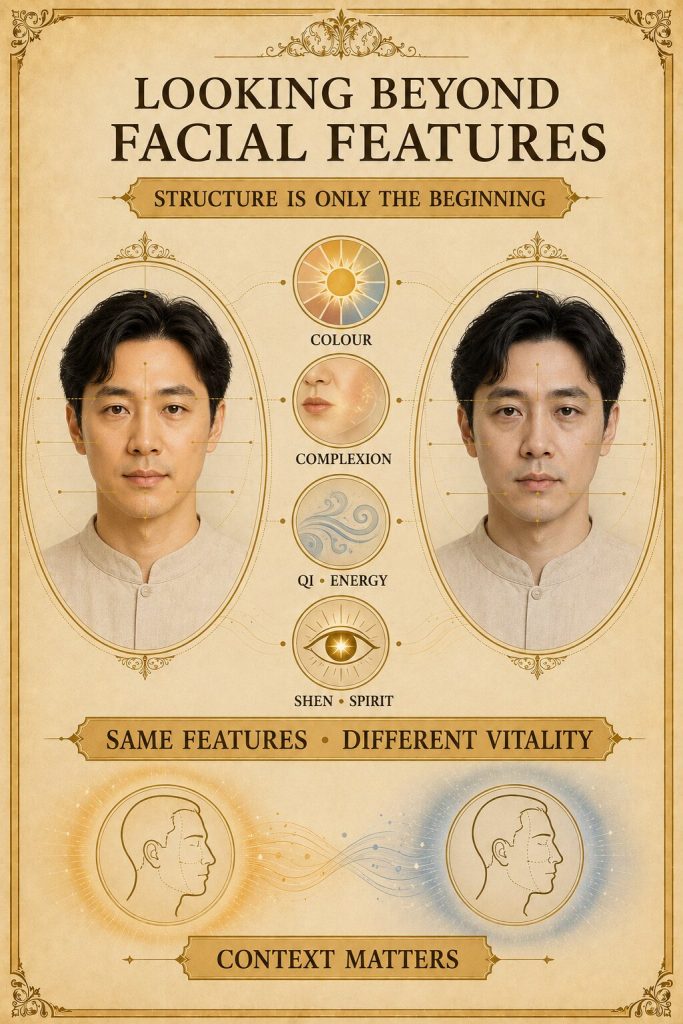
That is:
- Facial colour
- Complexion
- Qi (Energy)
- Shen (Spirit)
Two people may have almost identical facial structures.
Yet one appears energetic, confident and healthy.
The other appears exhausted, worried and lifeless.
The difference often lies in their Qi and Shen.
Structure vs Condition
Professional Face Reading separates observations into two categories.
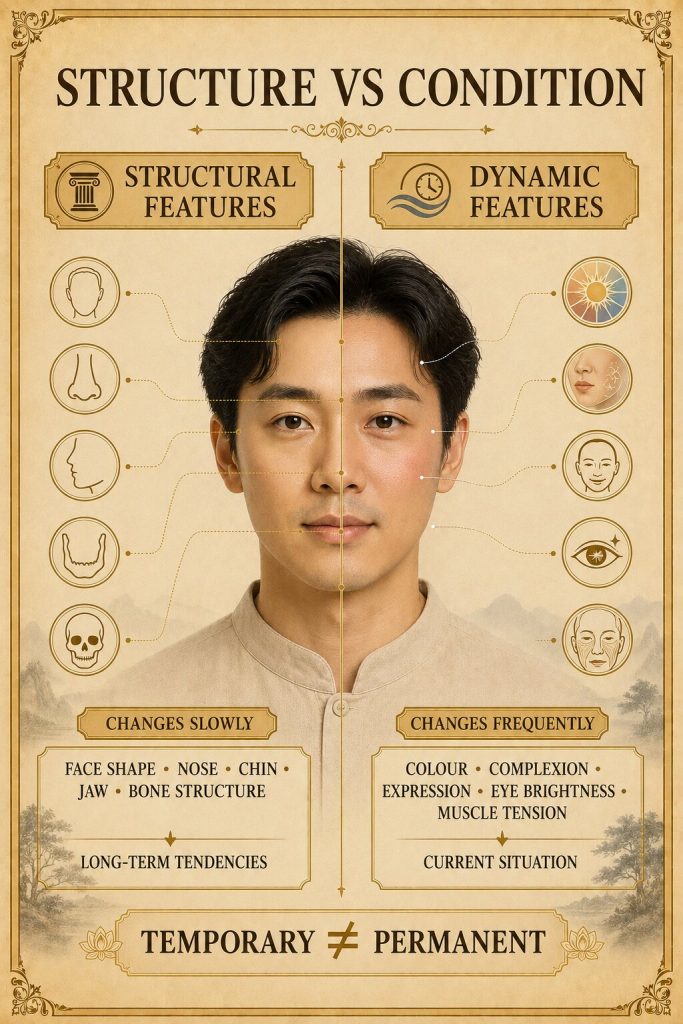
Structural Features
These change slowly.
Examples include:
- Face shape
- Nose
- Chin
- Jaw
- Bone structure
These reveal long-term tendencies.
Dynamic Features
These change frequently.
Examples include:
- Skin colour
- Complexion
- Facial expression
- Eye brightness
- Muscle tension
These often reflect a person’s current situation.
Many beginners confuse temporary conditions with permanent personality traits.
Professional Face Readers never make that mistake.
What is Qi?
Qi refers to a person’s life energy.
In Face Reading, Qi cannot be measured with an instrument.
Instead, it is observed through:
- Vitality
- Alertness
- Movement
- Facial brightness
- Overall presence
When someone enters a room, you may immediately feel their presence.
This is often described as their Qi.
Some people naturally attract attention without speaking.
Others seem invisible despite being physically attractive.
Qi contributes significantly to this impression.
What is Shen?
Shen is often translated as:
Spirit.
However, in Face Reading it represents something deeper.
Shen reflects:
- Mental clarity
- Emotional stability
- Inner confidence
- Awareness
- Wisdom
- Presence
The eyes are the primary place where Shen is observed.
A person with strong Shen usually appears:
- Calm
- Present
- Composed
- Confident
Not because they are trying to impress others,
but because their inner state is stable.
Why Shen Matters More Than Beauty
Many attractive people fail to leave a lasting impression.
Many ordinary-looking people immediately command respect.
Why?
Because beauty attracts attention.
Shen earns respect.
Professional Face Readers often pay more attention to Shen than physical attractiveness.
A face with strong Shen frequently appears more attractive over time.
Facial Colour
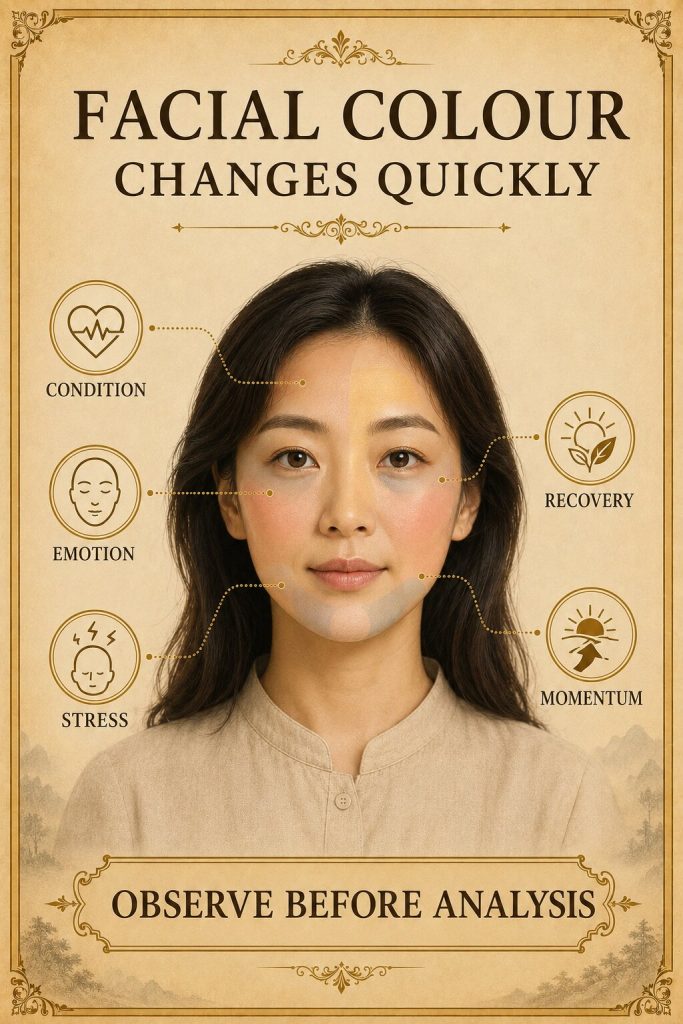
Facial colour changes much faster than facial structure.
It often reflects:
- Physical condition
- Emotional state
- Stress
- Recovery
- Momentum
Professional Face Readers observe colour before beginning detailed analysis.
Bright Complexion
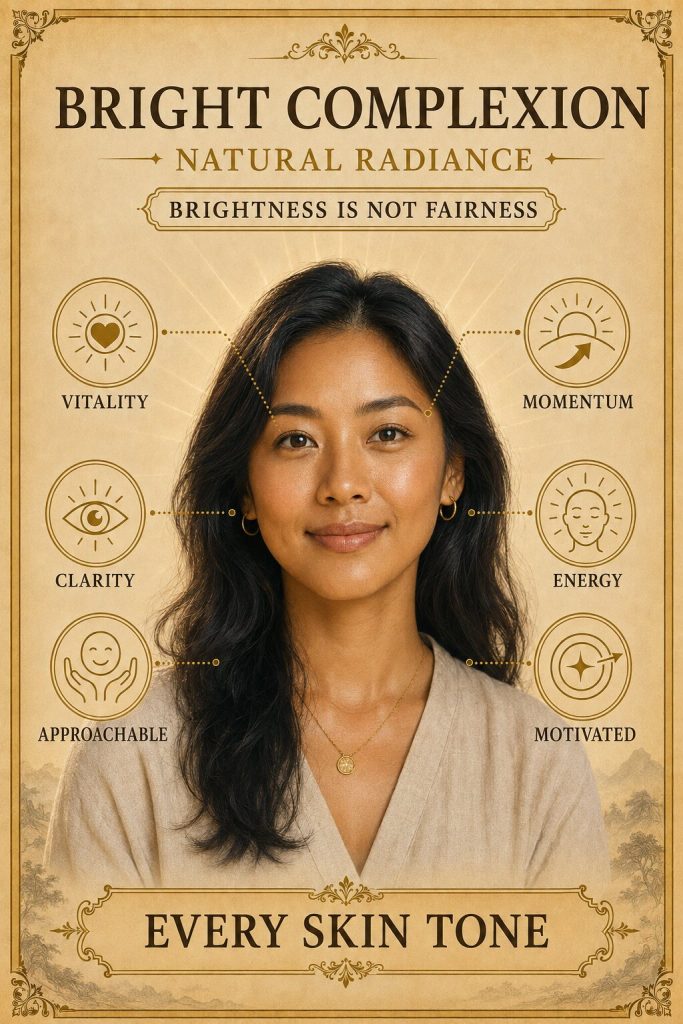
A naturally bright complexion often suggests:
- Good vitality
- Positive momentum
- Mental clarity
- Healthy circulation
The person often appears:
- Energetic
- Approachable
- Motivated
Brightness should not be confused with skin fairness.
People of every skin tone can display a bright complexion.
Dull Complexion
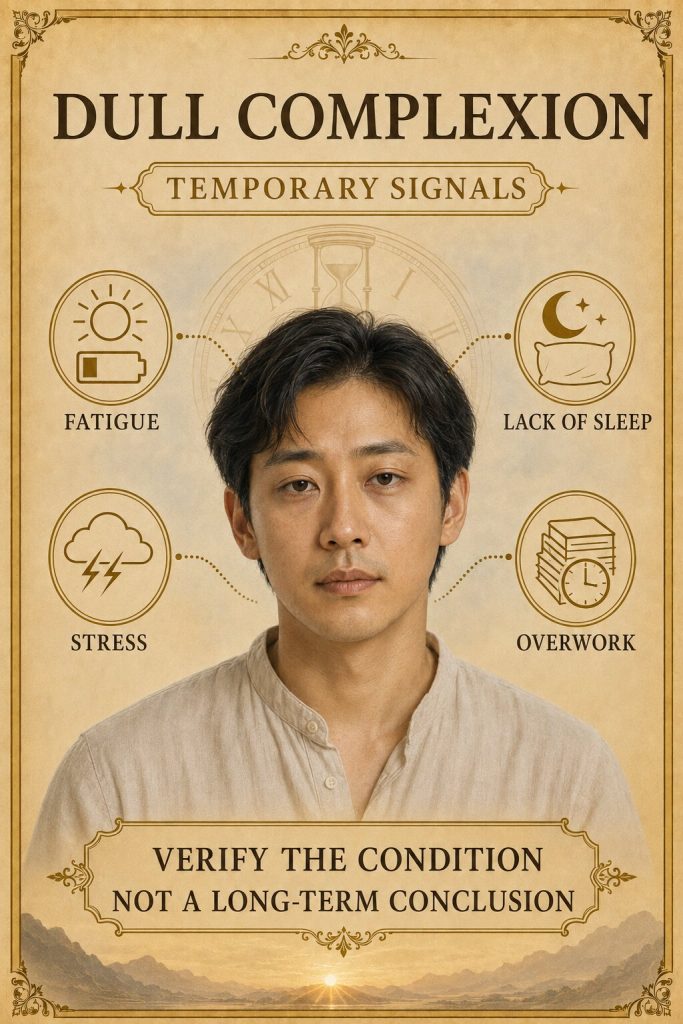
A dull complexion may indicate temporary conditions such as:
- Fatigue
- Lack of sleep
- Emotional stress
- Overwork
Professional readers avoid making long-term conclusions from temporary observations.
The person’s condition should always be verified.
Pale Complexion
Temporary paleness may result from:
- Illness
- Lack of rest
- Emotional shock
Some individuals naturally have lighter skin.
Therefore, colour should always be compared against the person’s normal appearance.
Red Complexion
Temporary redness may indicate:
- Exercise
- Heat
- Embarrassment
- Emotional excitement
Persistent redness requires careful observation.
Professional Face Reading does not replace medical assessment.
Yellow Complexion
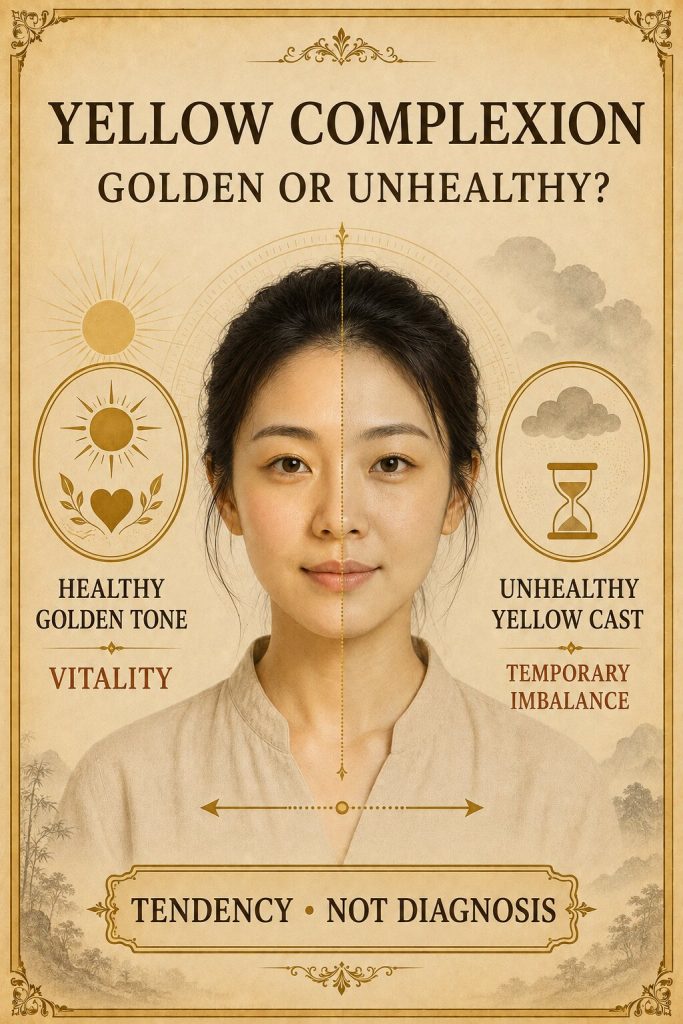
Traditional Face Reading often associates healthy golden tones with vitality.
However,
an unhealthy yellow appearance may indicate temporary physical imbalance.
Again…
Professional Face Reading identifies tendencies rather than medical diagnoses.
Dark Complexion
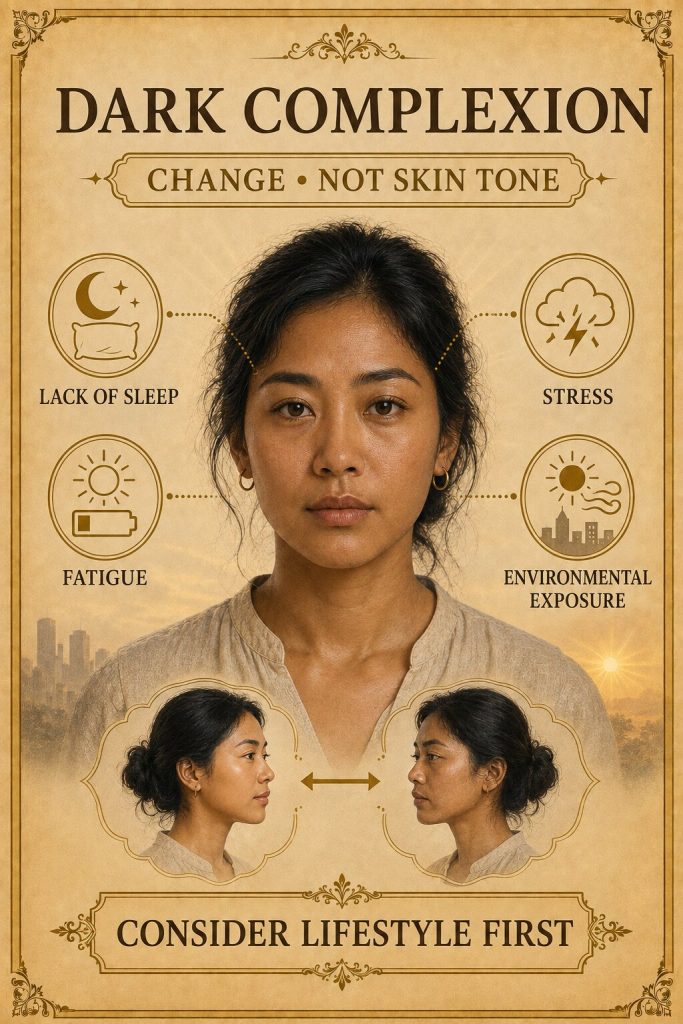
Changes towards a darker or duller appearance may occur because of:
- Lack of sleep
- Stress
- Fatigue
- Environmental exposure
Professionals always consider lifestyle before reaching conclusions.
Facial Shine
A healthy natural glow often reflects:
- Good energy
- Confidence
- Vitality
Excessive oiliness should not automatically be interpreted as positive Qi.
Likewise,
dry skin does not automatically indicate poor fortune.
Skin type differs from facial energy.
Skin Texture
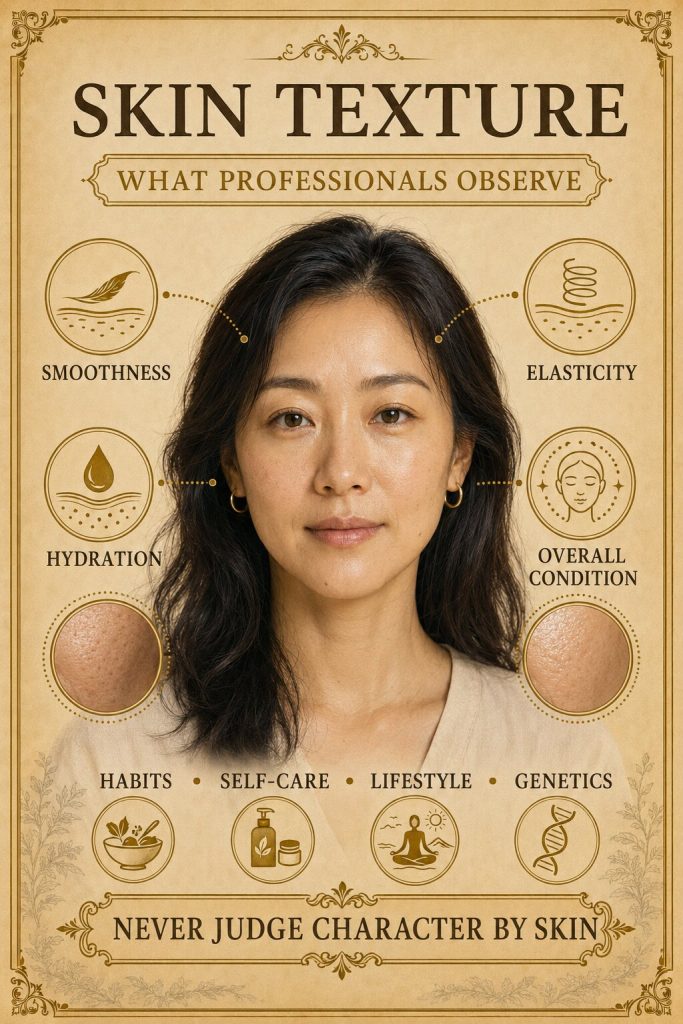
Professionals observe:
- Smoothness
- Elasticity
- Hydration
- Overall condition
Healthy skin often reflects:
- Good habits
- Consistent self-care
- Stable lifestyle
However,
genetics also influence skin quality.
Never judge character based on skin alone.
Muscle Tone
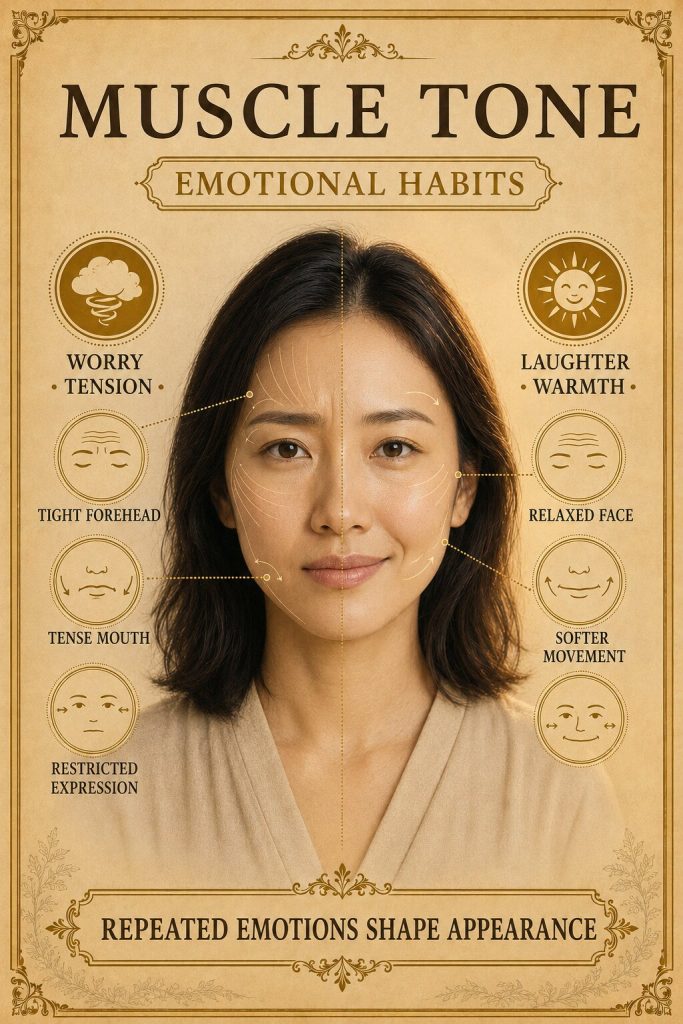
Facial muscles reveal emotional habits.
Someone who constantly worries may gradually develop:
- Tight forehead muscles
- Tension around the mouth
- Restricted expressions
Someone who laughs often usually develops:
- Relaxed expressions
- Natural warmth
- Softer facial movement
Repeated emotions slowly influence facial appearance.
The Power of Expression
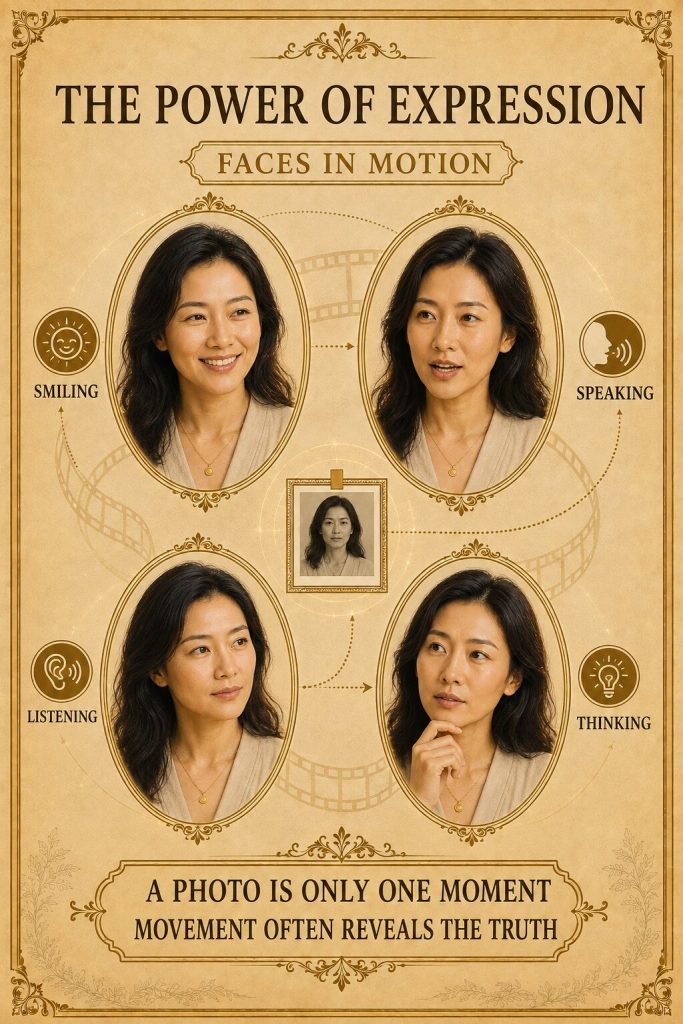
Professional Face Reading studies faces in motion.
Observe:
- Smiling
- Speaking
- Listening
- Thinking
Some people appear serious in photographs but become warm when speaking.
Others smile in photographs but appear tense during conversation.
Movement often reveals the truth.
Temporary vs Permanent Changes
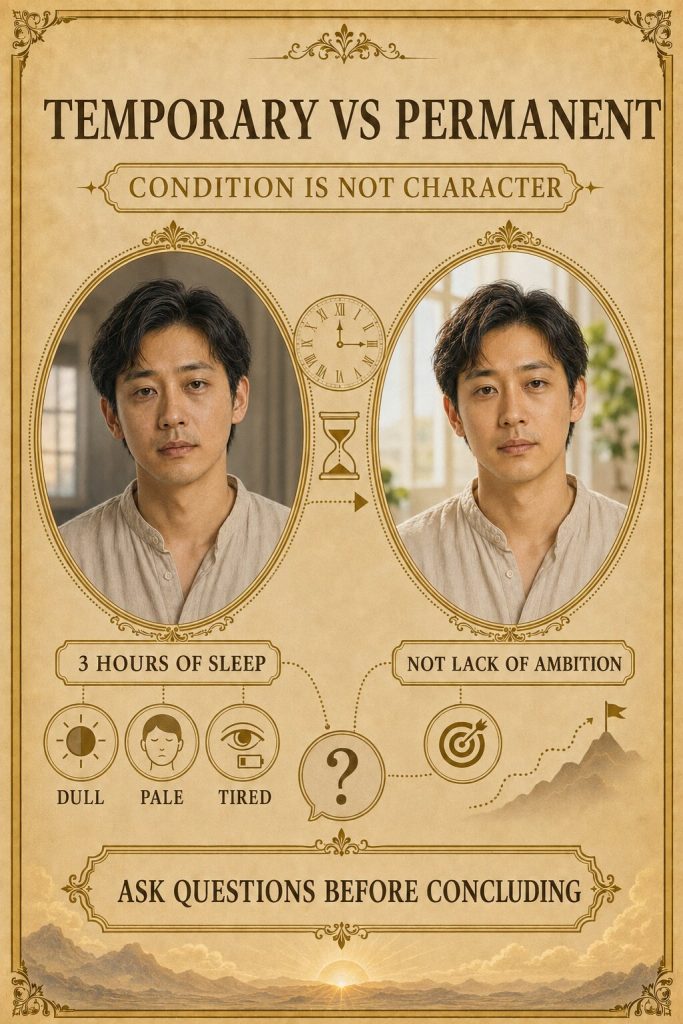
One of the biggest mistakes beginners make is interpreting temporary conditions as permanent personality traits.
For example:
Someone who slept only three hours may appear:
- Dull
- Pale
- Tired
This does not mean they lack ambition.
Professional readers always ask questions before making conclusions.
Emotional Energy
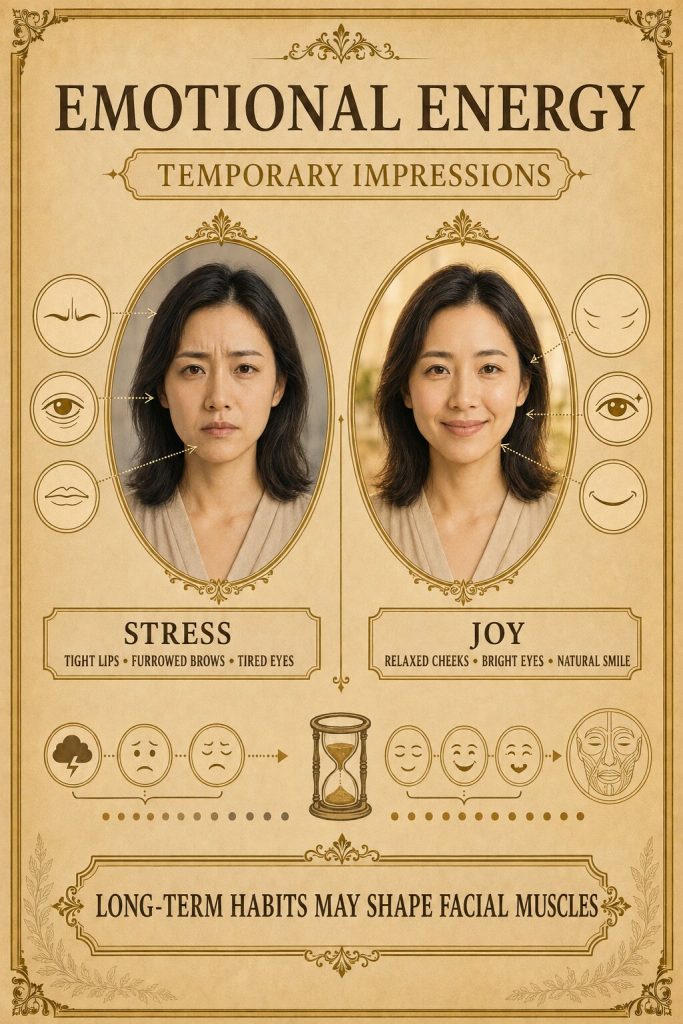
Emotions leave temporary impressions on the face.
Examples include:
Stress may create:
- Tight lips
- Furrowed brows
- Tired eyes
Joy often creates:
- Relaxed cheeks
- Bright eyes
- Natural smiles
Long-term emotional habits may eventually influence facial muscles.
Reading Momentum
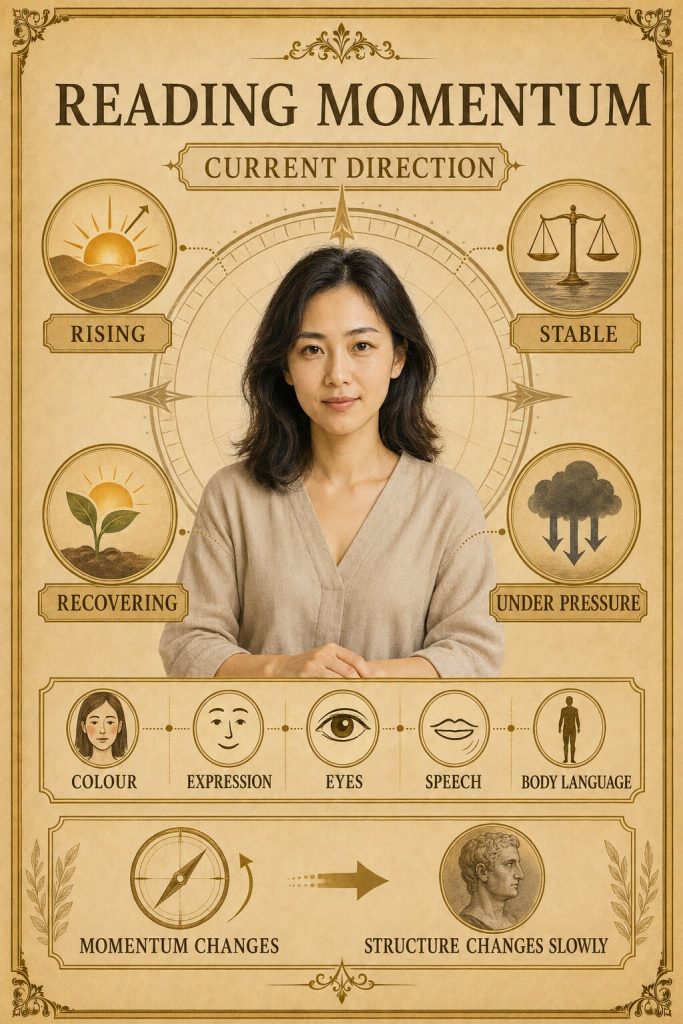
Experienced Face Readers often observe whether someone appears to be:
- Rising
- Stable
- Recovering
- Under pressure
These observations come from combining:
- Colour
- Expression
- Eyes
- Speech
- Body language
Momentum changes.
Structure changes slowly.
Understanding the difference is essential.
The Importance of Observation Over Assumption
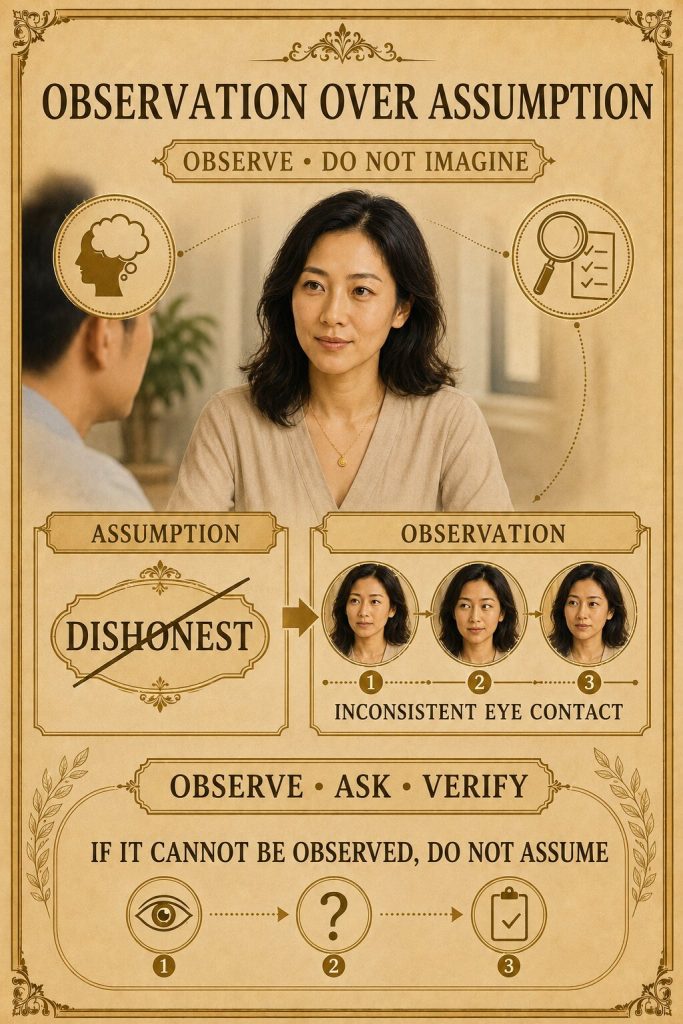
Professional Face Reading is about observation.
Not imagination.
If something cannot be observed,
it should not be assumed.
For example:
Instead of saying,
“This person is dishonest.”
A professional may observe:
“The person’s eye contact appears inconsistent during this discussion.”
Observation is objective.
Assumption creates error.
Shen and Leadership
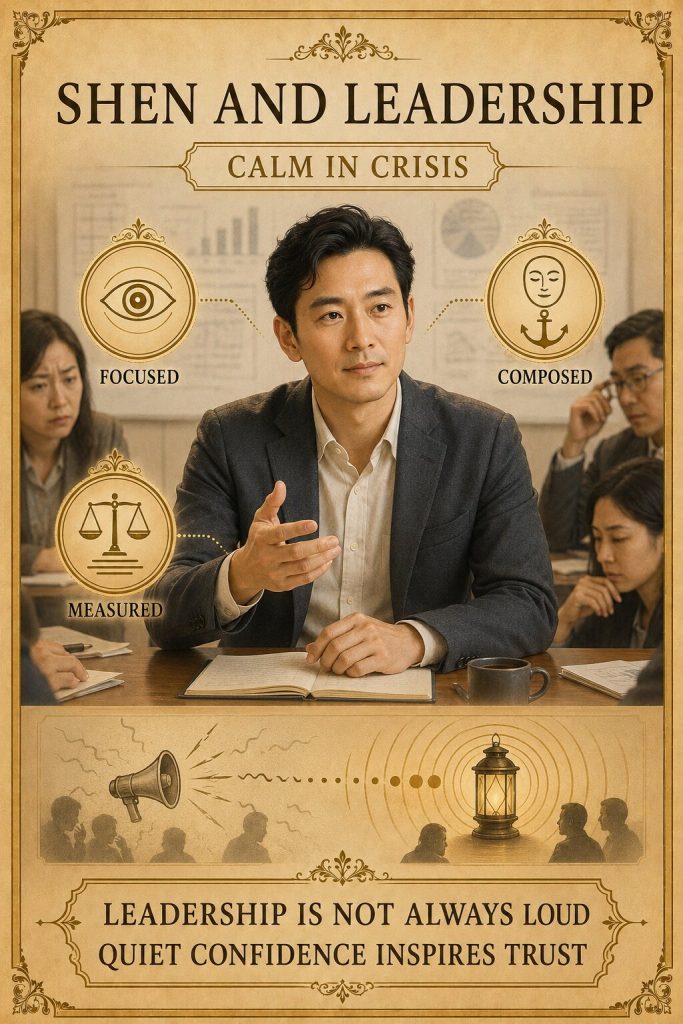
Many respected leaders possess calm Shen.
Notice how they respond during crises.
They remain:
- Focused
- Composed
- Measured
This calmness inspires confidence.
Leadership is not always loud.
Sometimes,
quiet confidence has greater influence than dramatic behaviour.
Shen and Success
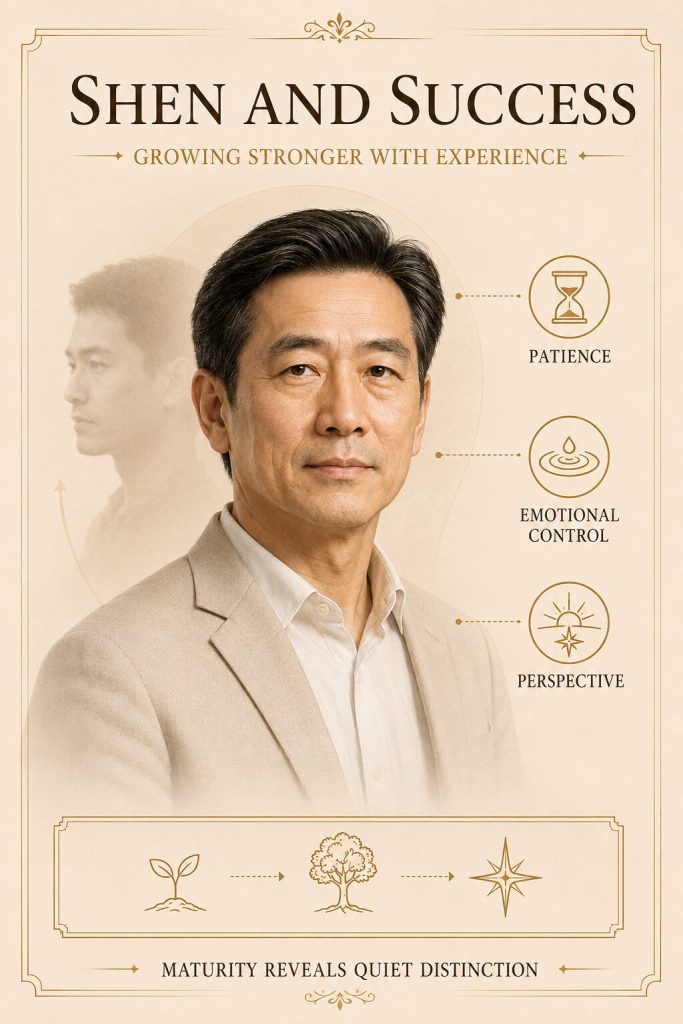
As people mature,
their Shen often becomes stronger.
Experience teaches:
- Patience
- Emotional control
- Perspective
These qualities naturally become visible in the face.
This is one reason why some individuals appear increasingly distinguished with age.
Can Qi and Shen Be Improved?
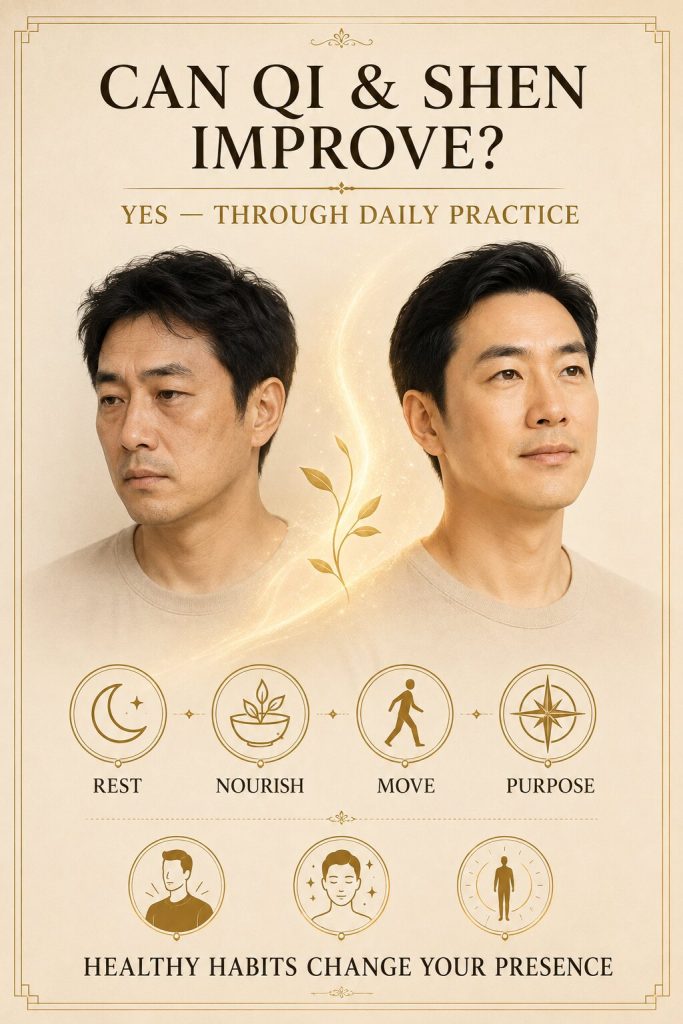
Yes.
Unlike bone structure,
Qi and Shen can improve significantly.
Professional Face Reading encourages improvement rather than prediction.
Strong Qi and Shen are often supported by:
- Quality sleep
- Balanced nutrition
- Regular exercise
- Emotional stability
- Lifelong learning
- Integrity
- Purposeful living
- Managing stress effectively
When these habits improve,
people often notice changes in:
- Their confidence.
- Their facial expressions.
- Their complexion.
- The way others respond to them.
Common Beginner Mistakes
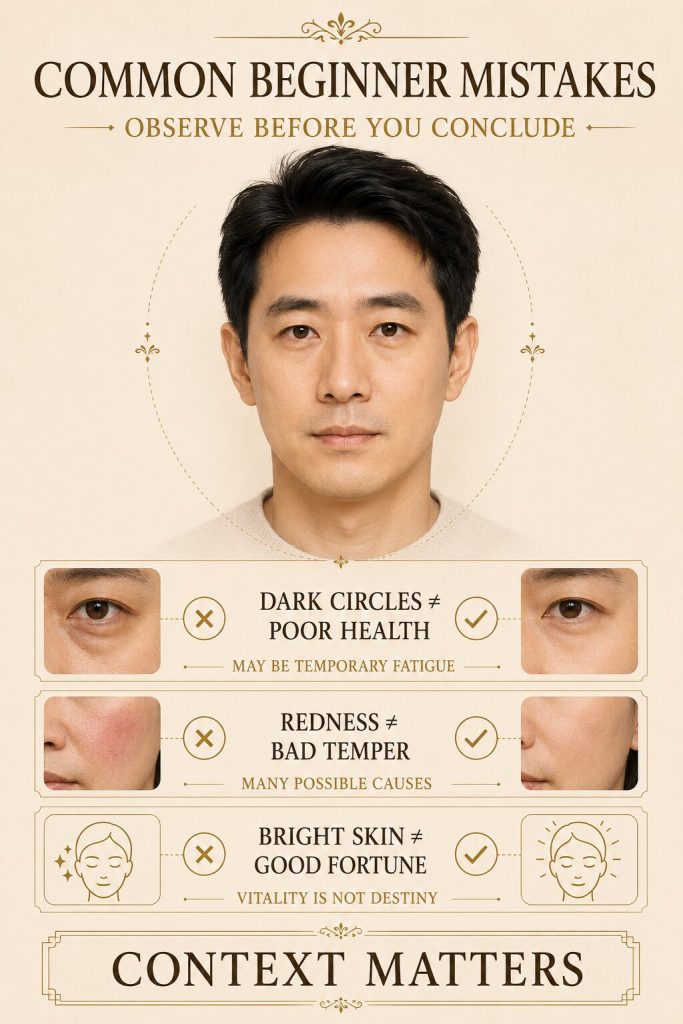
Incorrect:
Dark circles always indicate poor health.
Correct:
They may simply reflect temporary fatigue or lifestyle factors.
Incorrect:
Red face means bad temper.
Correct:
Redness has many possible causes.
Professional readers never reach conclusions without broader observation.
Incorrect:
Bright skin means good fortune.
Correct:
A bright complexion often reflects good vitality at that moment.
Long-term success still depends on character and decisions.
Dougles Chan’s Professional Observation
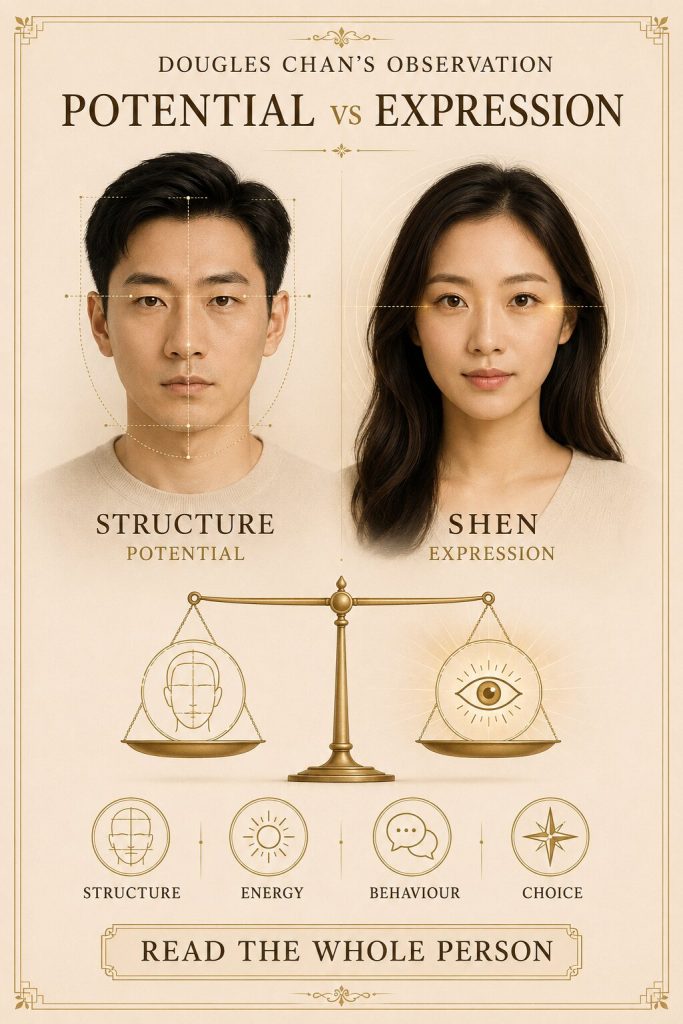
Facial structure tells us who a person has become over many years.
Qi tells us how they are functioning today.
Shen tells us how they carry themselves through life.
If I had to choose between reading a perfectly shaped face with weak Shen,
or an average face with bright Shen,
I would pay closer attention to the second.
Why?
Because structure reveals potential.
Shen reveals how much of that potential is currently being expressed.
A person with calm eyes, bright complexion, steady speech and balanced expressions often demonstrates emotional maturity and self-awareness.
These qualities frequently contribute to better judgement, stronger relationships and more consistent success.
Professional Face Reading is therefore not about finding a “perfect face.”
It is about understanding the relationship between structure, energy, behaviour and choice.
That relationship forms the true foundation of meaningful Face Reading.
Face Reading Ultimate Guide
Part 12 – Reading the Whole Face: The Professional Method
By Grand Master Dougles Chan
Why Beginners Get Face Reading Wrong
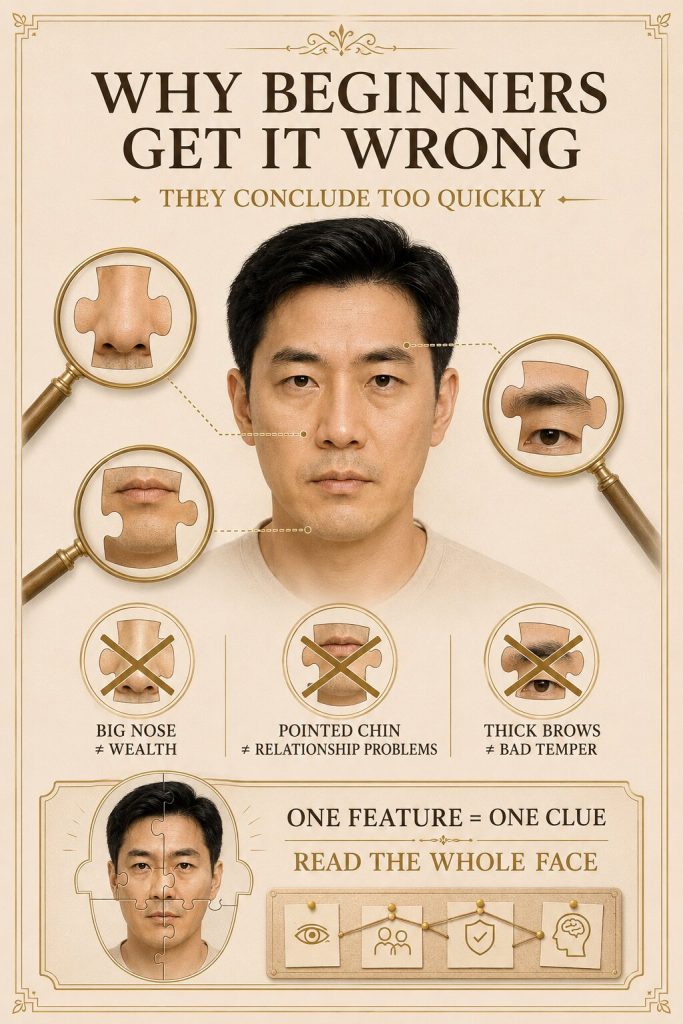
After teaching Face Reading for many years, I noticed one common pattern.
Most beginners are not wrong because they lack knowledge.
They are wrong because they try to reach a conclusion too quickly.
Someone has a large nose.
Immediately they say,
“This person is wealthy.”
Someone has a pointed chin.
Immediately they say,
“This person will have relationship problems.”
Someone has thick eyebrows.
Immediately they say,
“This person has a bad temper.”
Professional Face Reading does not work like this.
Every facial feature is only one piece of evidence.
One piece of evidence never tells the whole story.
Think Like A Doctor
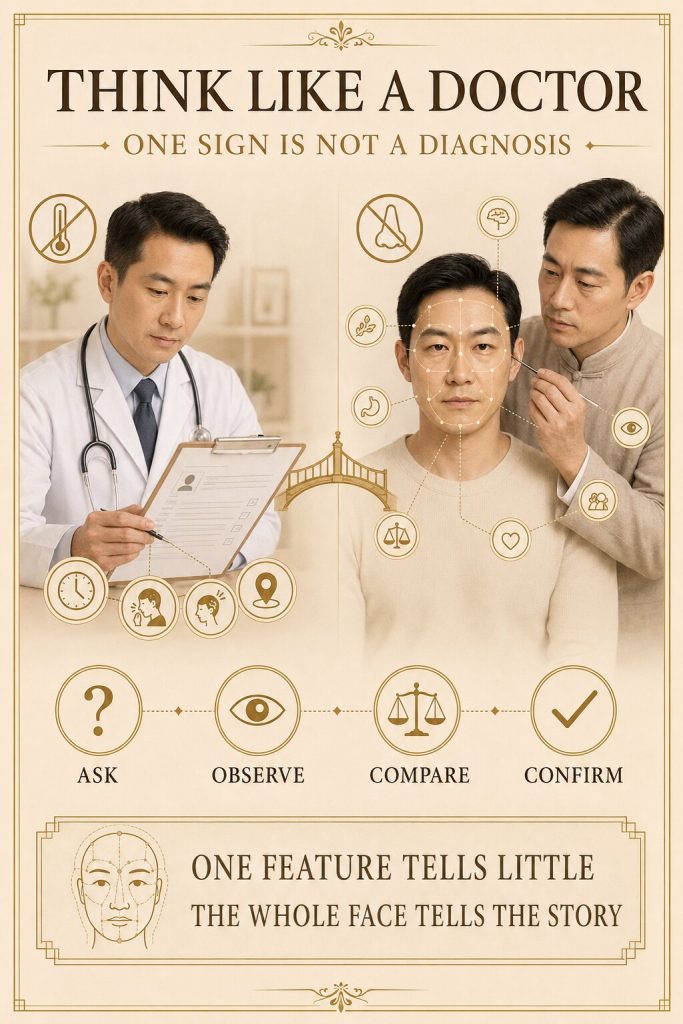
Imagine visiting a doctor.
The doctor does not diagnose you simply because you have a fever.
Instead, the doctor asks:
- How long have you had the fever?
- Are you coughing?
- Any headaches?
- Any recent travel?
- Any medical history?
Only after gathering enough evidence will the doctor arrive at a conclusion.
Professional Face Reading follows the same principle.
A nose alone tells very little.
The entire face tells the story.
The Five-Step Reading Process
When I conduct a consultation, I never begin with a single feature.
Instead, I follow a systematic sequence.
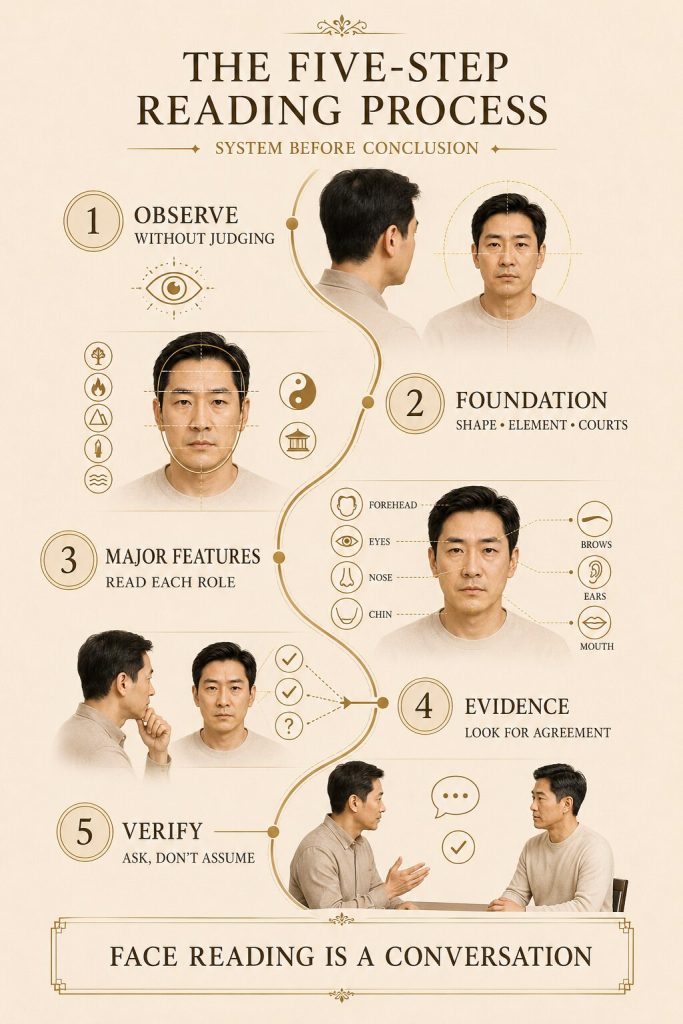
Step 1 – Observe Without Judging
Before analysing anything, simply observe.
Notice:
- Overall balance
- Facial proportions
- Facial symmetry
- Presence
- Energy
- Facial expressions
Do not interpret.
Simply observe.
Many students skip this step.
Step 2 – Determine The Foundation
Next, identify:
- Face shape
- Dominant Five Element
- Yin-Yang balance
- Three Courts
These establish the person’s natural tendencies.
Only then do individual facial features become meaningful.
Step 3 – Read The Major Features
Now analyse:
- Forehead
- Eyebrows
- Eyes
- Nose
- Mouth
- Chin
- Jaw
- Ears
Remember:
Each feature answers a different question.
The forehead tells us how they think.
The eyes reveal their awareness.
The nose reflects responsibility.
The mouth shows communication.
The chin shows perseverance.
None of these replace one another.
Step 4 – Look For Supporting Evidence
Now ask:
Do the observations agree?
For example,
Suppose the nose indicates leadership.
Do the eyes support confidence?
Does the chin support persistence?
Does the mouth support communication?
If three or four features point towards the same conclusion,
your confidence increases.
If they contradict one another,
continue investigating.
Professional Face Reading is about confirming evidence,
not collecting lucky signs.
Step 5 – Verify
Finally,
ask questions.
This is perhaps the most overlooked step.
Professional readers verify.
Beginners assume.
Suppose I observe that someone appears highly independent.
Instead of declaring,
“You don’t trust people.”
I might ask,
“Would you say you prefer solving problems yourself rather than asking others for help?”
Their answer provides valuable confirmation.
Professional Face Reading is a conversation,
not a performance.
Reading Patterns, Not Predictions
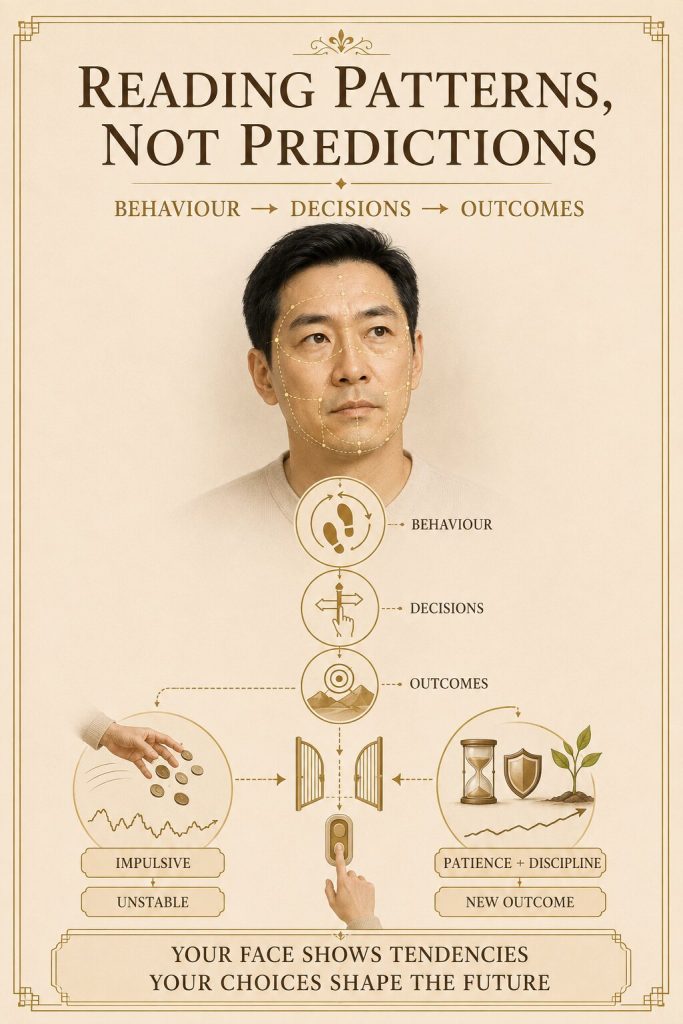
One of the greatest misunderstandings is that Face Reading predicts exact events.
It does not.
Instead,
it identifies recurring behavioural patterns.
Behaviour creates decisions.
Decisions create outcomes.
If someone repeatedly makes impulsive financial decisions,
their finances may become unstable.
If they later develop patience and discipline,
their financial future also changes.
The face reflects tendencies.
It does not imprison the future.
The Importance of Character
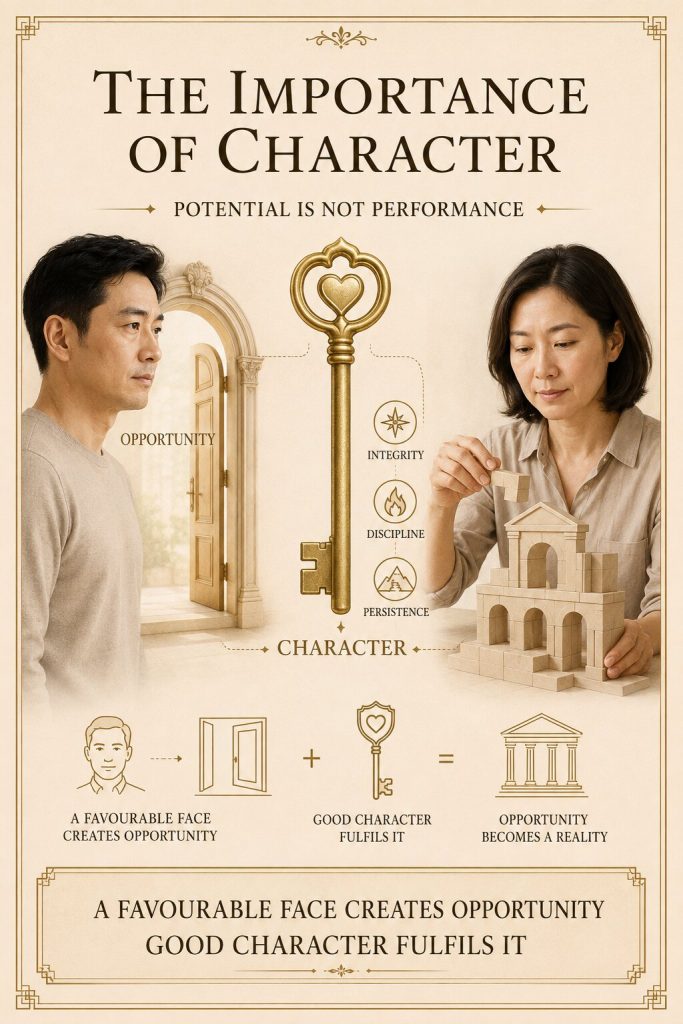
Over many years,
I have met people with excellent facial structures who achieved very little.
I have also met people with average facial structures who built extraordinary businesses.
What made the difference?
Character.
Character determines whether potential becomes reality.
This is why I often remind students:
A favourable face creates opportunity.
Good character determines whether that opportunity is fulfilled.
Face Reading Should Never Be Used To Judge Others
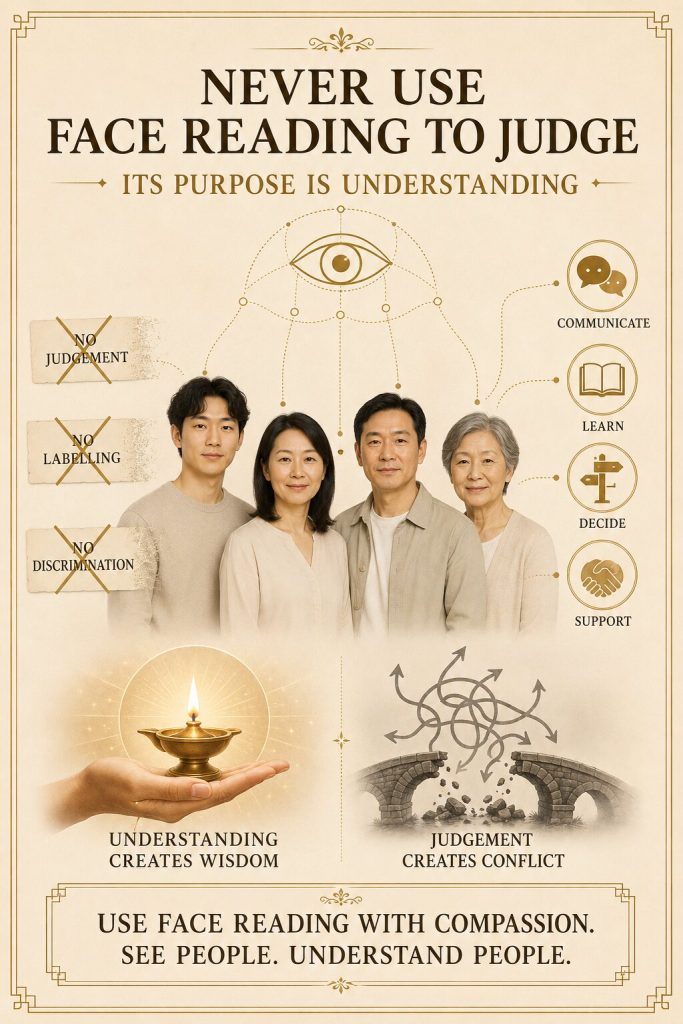
This is one of the most important ethical principles.
Face Reading should never become a tool for criticism.
Its purpose is understanding.
Not judgement.
Not labelling.
Not discrimination.
If you use Face Reading to decide whether someone deserves respect,
you have misunderstood its purpose completely.
Instead,
use it to understand:
- How people communicate.
- How they learn.
- How they make decisions.
- How they experience pressure.
- How you can work better with them.
Understanding creates wisdom.
Judgement creates conflict.
Why Two People With Similar Faces Live Different Lives
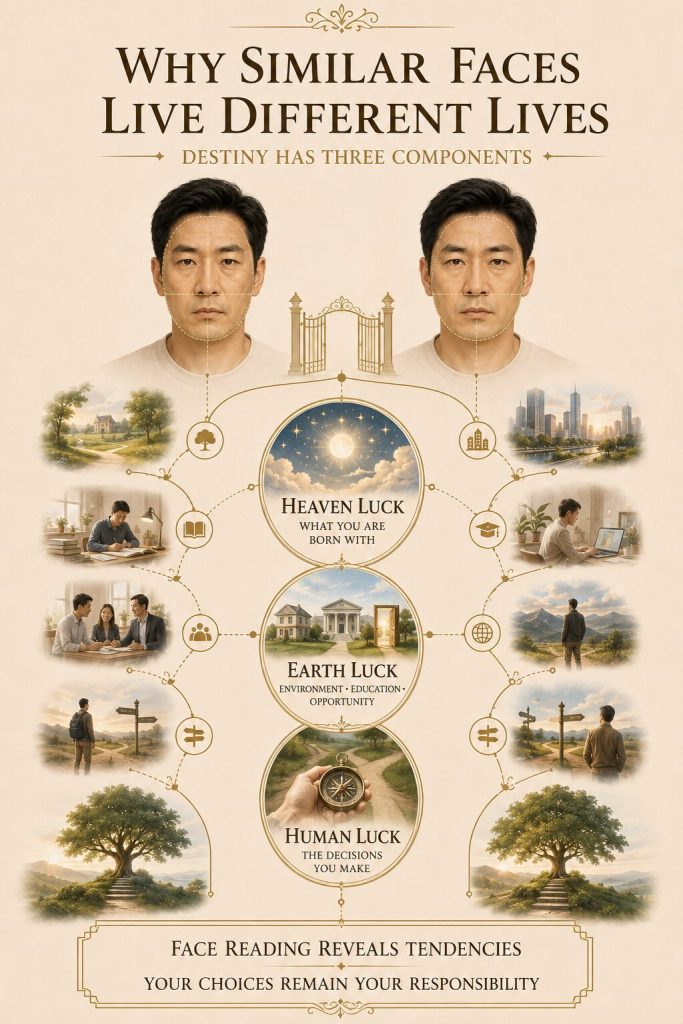
Students often ask,
“If two people have similar faces, shouldn’t they have similar destinies?”
No.
Because destiny has multiple components.
Traditional Chinese Metaphysics recognises:
Heaven Luck
What you are born with.
Earth Luck
Your environment.
Your education.
Your family.
Your opportunities.
Human Luck
The decisions you make every day.
Face Reading primarily reveals Heaven Luck.
Human Luck remains your responsibility.
This is why personal development matters.
The Greatest Lesson Of Face Reading
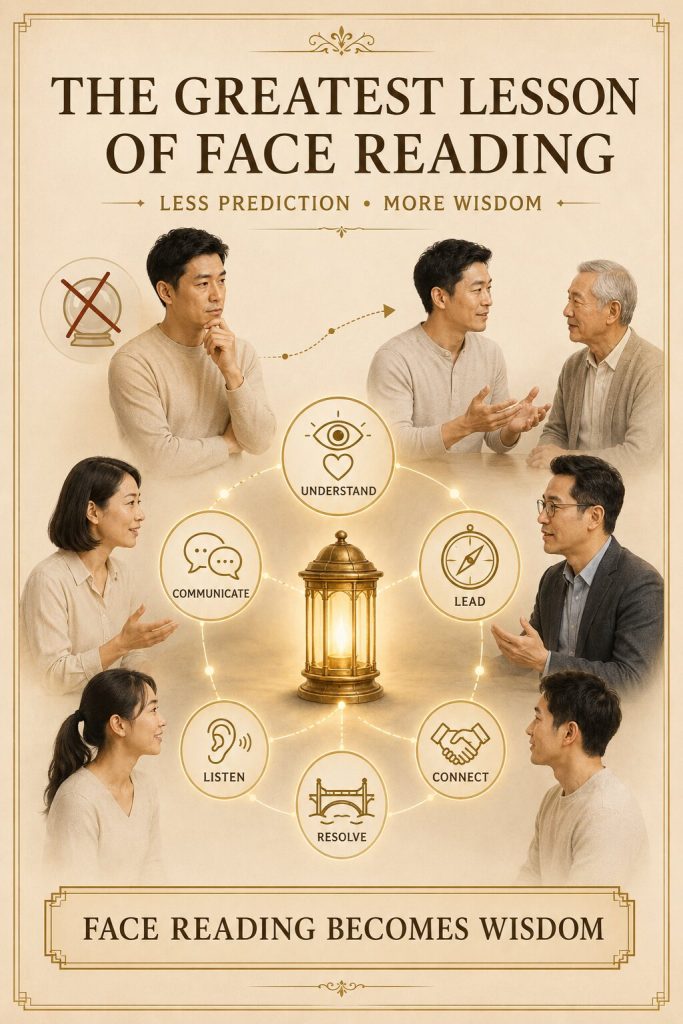
Many people begin studying Face Reading because they want to predict success.
After years of practice,
they realise something more valuable.
They begin understanding people.
They communicate better.
Lead better.
Listen better.
Manage conflict better.
Build stronger relationships.
Face Reading becomes less about prediction,
and more about wisdom.
Final Thoughts
There is no perfect face.
Every face carries strengths.
Every face carries challenges.
The purpose of Face Reading is not to search for perfection.
It is to discover potential.
When we understand ourselves,
we make better decisions.
When we make better decisions,
our lives improve.
Your face may reveal where your journey begins.
But your character,
your discipline,
your integrity,
and your choices
will always determine where that journey ends.
“Read the face with your eyes. Understand the person with your heart.”
— Grand Master Dougles Chan
End of The Face Reading Ultimate Guide
Leave a Reply
You must be logged in to post a comment.