Ming, the Art of Destiny in Chinese Metaphysics
When people come to my office in Singapore for a consultation, they often arrive carrying a heavy burden of unanswered questions. Over my 30-plus years in business, running recruitment firms and managing corporate enterprises, I saw thousands of resumes and hired hundreds of executives. I noticed something that always fascinated me. Two individuals could walk into an interview with identical academic credentials, similar industry experience, and equal enthusiasm. Yet ten years down the road, one would rise to become a chief executive officer while the other struggled through repeated business failures and career dead ends. Standard corporate theory attributes these divergent outcomes to grit, networking, or simple luck. But when I began studying classical Chinese metaphysics after decades in the commercial world, I discovered a far more systematic framework that explains these underlying patterns: the concept of Ming (命), or destiny analysis.
In Chinese metaphysics, destiny isn’t viewed as a rigid sentence handed down by an unyielding cosmic judge. Instead, Ming represents the foundational energy blueprint you inherit at the exact moment of your birth. It’s the unique configuration of environmental, seasonal, and planetary energies that were present when you took your very first breath. Just as a ship builder needs to know whether a vessel is built as a heavy cargo container ship or a nimble racing yacht before sending it out to sea, understanding your Ming helps you recognize your natural strengths, inherent vulnerabilities, and optimal operational speed in life.
In my teaching work as a Qi Men Dun Jia educator and lineage founder, I always remind my students that destiny reading isn’t about fortune-telling or passive resignation. It’s about strategic self-awareness. When you understand your chart, you stop trying to force open doors that were never meant for you, and you start focusing your energy where you have maximum leverage. In this comprehensive guide, I’m going to walk you through the classical art of Ming, explaining how natal charts are constructed, breaking down the major systems of Chinese destiny analysis, and showing you how to use these ancient tools to navigate your career, relationships, and personal growth with clarity.
This guide is one of five in my complete series on the Five Arts of Chinese Metaphysics.
1. What Ming Means in the Classical Taxonomy of the Five Arts
To understand Ming in its proper context, we need to look at the broader traditional taxonomy of Chinese metaphysics, known historically as the Five Arts (五术: Shan, Yi, Ming, Bu, Xiang). For thousands of years, ancient scholars categorized human knowledge and metaphysical practices into these five distinct pillars, each serving a specific purpose in maintaining balance between human beings and the cosmos.
The Five Arts form an interconnected ecosystem of wisdom:
- Shan (山) – The Art of Cultivation: This encompasses physical and spiritual refinement, including qigong, internal alchemy, meditation, and martial arts aimed at enhancing life force energy and longevity.
- Yi (医) – The Art of Healing: This covers Traditional Chinese Medicine (TCM), acupuncture, herbal therapy, and moxibustion designed to restore internal physical harmony.
- Ming (命) – The Art of Destiny: This focuses on analyzing a person’s life trajectory, character traits, wealth potential, and temporal cycles based on birth time coordinates.
- Bu (卜) – The Art of Divination: This deals with answering specific, time-sensitive questions using systems like the I Ching, Qi Men Dun Jia hourly divination, and Six Yao forecasting.
- Xiang (相) – The Art of Observation: This involves analyzing physical forms and structures, including Feng Shui (environmental forms), Mian Xiang (face reading), and palmistry.
In traditional Chinese society, these Five Arts were not practiced in isolation. An imperial advisor or accomplished scholar would often integrate all five disciplines to maintain personal vitality, heal physical ailments, select optimal locations, forecast timing, and understand individual human potential. When we isolate Ming for destiny analysis, we are focusing specifically on personal character, human capacity, and temporal timing. By understanding where Ming sits within the broader spectrum of the Five Arts, you realize that destiny reading is one pillar of a complete lifestyle philosophy aimed at living in alignment with Natural Law (Dao).
It’s important to draw a clear line between Ming (Destiny) and Bu (Divination). Many newcomers confuse these two branches. Divination is tactical; it answers specific, immediate queries such as “Should I invest in this specific property deal this month?” or “Will this contract negotiation succeed?” Destiny analysis, on the other hand, is strategic. Ming maps out your entire lifespan, showing your general capacity for wealth, your emotional wiring, your relationship tendencies, and the overall climate of your decade-long luck cycles.
2. The Core Concept of a Natal Chart Cast from Birth Data
Every system within the branch of Ming relies on one fundamental input: your exact time of birth. In Chinese metaphysics, your birth moment isn’t merely a timestamp on a hospital record. It represents the specific astronomical coordinates and energetic climatic conditions of the Earth and solar system at the moment your independent breathing began.
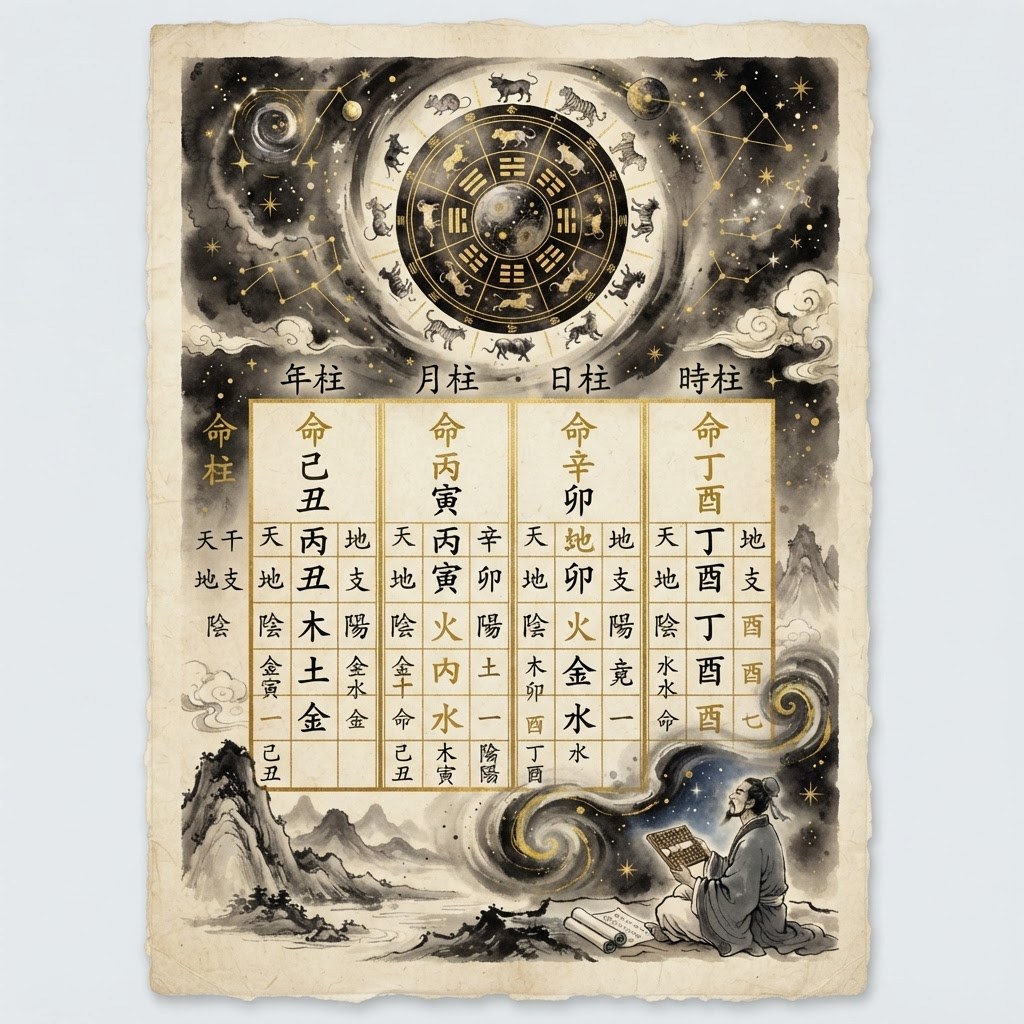
A complete natal birth chart requires four core parameters, known as the Four Pillars of Destiny (Sheng Chen Ba Zi):
- The Year Pillar: Represents your ancestors, grand-parents, early childhood background, outer social circle, and public persona.
- The Month Pillar: Represents your parents, upbringing, career environment, work capacity, and seasonal climatic influence.
- The Day Pillar: The Day Stem represents your core self (the Day Master), while the Day Branch represents your inner thoughts, spouse, and personal health.
- The Hour Pillar: Represents your children, subordinates, private goals, investments, late-life outlook, and secret aspirations.
Calculating these four pillars accurately requires converting your standard Gregorian calendar birth date into the traditional Chinese Solar Calendar (Hsiat Calendar). Unlike the lunar calendar which follows moon phases, the solar calendar is based on the Earth’s orbit around the Sun and is divided into 24 seasonal terms (Jie Qi). For instance, the Chinese astrological year doesn’t start on Western January 1st, nor on Lunar New Year’s Day, but on Li Chun (the Beginning of Spring), which usually falls around February 4th each year.
Furthermore, precise chart calculation requires adjusting your birth time to True Solar Time (Local Solar Time). In modern times, standard clock time is an administrative zone average. If you were born in Singapore, for example, official Singapore Standard Time is set to UTC+8 (matching Beijing time for commercial convenience), even though Singapore’s geographical longitude physically places it closer to UTC+7. A person born at 1:15 AM standard clock time in Singapore might actually have a local solar birth time of 12:45 AM, which moves their birth hour into a completely different double-hour branch (Zishi instead of Choushi). Getting the birth hour right is crucial because the hour pillar governs your ultimate outcome and late-life achievements.
Below is a breakdown of how the Four Pillars map onto different aspects of human life and temporal stages:
| Pillar | Life Stage (Ages) | Relational Sphere | External / Internal Domain | Primary Life Focus |
|---|---|---|---|---|
| Year Pillar | 0 to 16 years | Ancestors, Grandparents, Industry | Outer Social World, Public Persona | Childhood foundation, roots, general health predisposition |
| Month Pillar | 17 to 32 years | Parents, Siblings, Superiors | Workplace Environment, Company | Career building, education, professional skills, execution |
| Day Pillar | 33 to 48 years | Self (Day Stem), Spouse (Day Branch) | Home Life, Mindset, Marriage | Core identity, character, marriage stability, self-worth |
| Hour Pillar | 49 years and beyond | Children, Subordinates, Students | Private World, Investments, Legacy | Retirement wealth, business equity, mentorship, life harvest |
3. BaZi (Eight Characters) at an Accessible Level
When most people in Singapore or across East Asia speak of having their destiny read, they’re usually referring to BaZi (八字), which translates literally as “Eight Characters.” These eight characters consist of four Heavenly Stems and four Earthly Branches arranged in pairs across the four pillars of birth time. While the mathematical structure of a BaZi chart appears simple on the surface, the depth of psychological and practical insight it contains is remarkable.
At the center of every BaZi analysis is the concept of Yin and Yang combined with the Five Elements (Wu Xing: Wood, Fire, Earth, Metal, Water). Each element interacts with the others through two primary energetic cycles: the Producing Cycle (where Wood feeds Fire, Fire creates Earth, Earth bears Metal, Metal collects Water, and Water nourishes Wood) and the Controlling Cycle (where Wood breaks Earth, Earth dams Water, Water quenches Fire, Fire melts Metal, and Metal chops Wood). Balance, rather than extreme strength, is the ultimate goal in BaZi analysis.
The single most important character in your entire chart is the Day Stem, known in classical terminology as the Day Master (Ri Zhu). Your Day Master represents your core essence, your fundamental temperament, and your primary energetic orientation toward the world. There are ten possible Day Masters, corresponding to the Yin and Yang expressions of the Five Elements:
- Jia Wood (Yang Wood): Sturdy like a majestic tall oak tree. Independent, direct, principled, and slow to adapt but steadfast under pressure.
- Yi Wood (Yin Wood): Adaptable like climbing ivy or bamboo. Flexible, diplomatic, resilient, and skilled at navigating complex corporate environments.
- Bing Fire (Yang Fire): Radiant like the midday sun. Generous, warm, passionate, visible, and natural at inspiring others, though sometimes impatient.
- Ding Fire (Yin Fire): Focused like a candle flame or lantern. Detail-oriented, warm, meticulously thoughtful, and deeply intuitive.
- Wu Earth (Yang Earth): Solid like a massive boulder or mountain. Reliable, patient, protective, stable, and highly trustworthy in business dealings.
- Ji Earth (Yin Earth): Nurturing like rich farmland soil. Resourceful, practical, supportive, and excellent at cultivating talents in team members.
- Geng Metal (Yang Metal): Unyielding like raw iron or a forged sword. Decisive, tough, justice-minded, and thriving when challenged by adversity.
- Xin Metal (Yin Metal): Refined like fine jewelry or precision instruments. Articulate, elegant, sensitive, detail-conscious, and seeking perfection.
- Ren Water (Yang Water): Powerful like a surging river or ocean wave. Ambitious, adaptable, adventurous, communicative, and constantly in motion.
- Gui Water (Yin Water): Subtle like morning dew or gentle rain. Wise, observant, quiet, strategic, and possessive of deep intellectual curiosity.
Once your Day Master is identified, the other seven characters in your chart are evaluated based on their relationship to your Day Master. These relationships generate what metaphysicians call the Ten Gods (Shi Shen). The Ten Gods aren’t deity figures in a religious sense; they’re functional psychological and circumstantial archetypes. They categorize your relationship with resources (Direct/Indirect Resource), wealth and risk management (Direct/Indirect Wealth), career authority and structure (Direct Officer/Seven Killings), creative expression and output (Eating God/Hurting Officer), and social networks or competitive peers (Friend/Rob Wealth).
To evaluate the true strength of a Day Master, a practitioner must also examine seasonal strength (Wang, Xiang, Xiu, Qiu, Si). The month of birth establishes the seasonal commander of the chart. For example, a Jia Wood Day Master born in the peak of Spring (the Month of Mao or Yin) is exceptionally strong and prosperous (Wang), as Spring is the season when Wood energy flourishes naturally. Conversely, that same Jia Wood Day Master born in the dead of Autumn (the Month of You or Shen) is physically constrained (Si), because Autumn Metal energy cuts and controls Wood. Determining whether a Day Master is strong or weak dictates whether the chart requires supportive elements or draining elements to achieve balance.
“In my thirty years of business experience, I have noticed that executives rarely fail because they lack technical knowledge. They struggle because they operate against their natural Day Master element. When a gentle Yin Earth personality tries to lead using aggressive Yang Metal tactics, burnout is almost guaranteed.”
Understanding these energetic relationships allows a reader to see your natural psychological strengths and blind spots. If your chart contains a heavy concentration of Output elements but lacks Resource elements, you might be brilliant at generating creative ideas but constantly struggle with execution, stamina, and follow-through. Conversely, a chart heavy in Resource elements with no Output can lead to overthinking and analysis paralysis.
Anatomy of a Four-Pillar BaZi Chart
Below is a visual structural breakdown showing how Heavenly Stems, Earthly Branches, and Hidden Stems stack within a standard natal chart reading:
Heavenly Stem
(Output / Legacy)
Earthly Branch
(Late Life / Subordinates)
Hidden Stems (Roots)
DAY MASTER
(Core Essence / Self)
Spouse Palace
(Marriage / Mindset)
Hidden Stems (Roots)
Heavenly Stem
(Career / Parents)
Seasonal Commander
(Workplace / Capacity)
Hidden Stems (Roots)
Heavenly Stem
(Public Image / Ancestors)
Earthly Branch
(Social Sphere / Roots)
Hidden Stems (Roots)
4. Zi Wei Dou Shu (Purple Star Astrology) Briefly
While BaZi relies heavily on elemental balance and five-element dynamics, another premier system of Chinese destiny analysis takes a distinctly spatial and stellar approach: Zi Wei Dou Shu (紫微斗数), commonly translated as Purple Star Astrology. Developed during the Song Dynasty, Zi Wei Dou Shu constructs a complex astrological grid divided into twelve distinct houses or “palaces” (Gong).
Rather than focusing primarily on the Five Elements, Zi Wei Dou Shu maps over one hundred symbolic stars across these twelve palaces based on your birth date and hour. The central star of this system is Zi Wei (the Emperor Star or Purple Star), which represents authority, nobility, leadership, and personal stature. Where Zi Wei lands in your chart indicates where your greatest personal dignity and natural command reside.
The twelve palaces in a Zi Wei Dou Shu chart systematically cover every major dimension of human existence:
- Life Palace (Ming Gong): The primary anchor of your personality, core destiny, physical stamina, and overall life potential.
- Brothers Palace: Relationships with siblings, close peers, colleagues, and financial liquidity.
- Spouse Palace: Marriage dynamics, partner attraction, romantic expectations, and marital harmony.
- Children Palace: Relationship with children, junior employees, students, and creative projects.
- Wealth Palace: Financial management style, cash flow, income sources, and wealth retention capacity.
- Health Palace: Physical constitution, vulnerability to specific organ imbalances, and physical stress points.
- Travel Palace: Outlook when traveling abroad, public interactions, external reputation, and relocation luck.
- Friends / Servants Palace: Network quality, friends, staff loyalty, and general community support.
- Career Palace: Professional path, business style, executive capability, and ideal industry sectors.
- Property Palace: Real estate holdings, ancestral home environment, living conditions, and long-term asset accumulation.
- Mental / Karma Palace: Subconscious state, emotional well-being, spiritual inclination, and inner happiness.
- Parents Palace: Relationship with parents, mentors, regulatory bodies, and official authorities.
A key operational dynamic in Zi Wei Dou Shu is the Four Transformations (Si Hua): Lu (Prosperity/Flow), Quan (Power/Authority), Ke (Fame/Academic Skill), and Ji (Obstacle/Dilemma/Focus). These four transformation catalysts shift across different stars over time, indicating where smooth wealth flows, where struggles occur, and where your intense focus is required during specific life phases.
Zi Wei Dou Shu offers extraordinary detail when analyzing specific life scenarios. For instance, if you want to know how a business partnership will affect your personal real estate portfolio, Zi Wei Dou Shu allows you to examine the structural lines connecting your Friends Palace to your Property and Wealth Palaces with high clarity.
To help you see how these systems fit together, the table below compares the primary destiny reading modalities used in Chinese metaphysics:
| System | Primary Foundation | Key Analytical Lens | Best Suited For | Core Strength |
|---|---|---|---|---|
| BaZi (Eight Characters) | Solar Calendar, 10 Stems, 12 Branches | Five Element balance, Day Master, Ten Gods | Career direction, element harmony, decade luck cycles | Identifying core psychological wiring and timing waves |
| Zi Wei Dou Shu (Purple Star) | Lunar Calendar, 12 Palaces, 100+ Stars | Stellar placements, Four Transformations (Si Hua) | Detailed relational maps, specific palace interactions | Pinpointing specific events across 12 life domains |
| Qi Men Dun Jia (Destiny) | 3 Pillars / 4 Plates, 9 Stars, 8 Doors, 8 Deities | Life Palace, Palace Layering, Spiritual Guardians | Strategic execution, spiritual hidden layers, competitive edge | Uncovering hidden environmental and spiritual drivers |
5. Qi Men Dun Jia Destiny Charts: Layering the Four Plates
My personal specialty and primary area of teaching is Qi Men Dun Jia (奇门遁甲). Historically, Qi Men Dun Jia was developed thousands of years ago as a supreme imperial military forecasting system used by legendary strategists like Zhuge Liang and Liu Bowen to win battlefield engagements. In ancient China, its usage was strictly guarded by the emperor’s royal court. In modern times, however, master practitioners adapted this profound system for individual destiny analysis, business strategy, and personal coaching.
While standard BaZi looks at eight characters across four columns, a Qi Men Dun Jia destiny chart takes your birth parameters and casts them into a Nine-Palace Grid (Jiu Gong Grid) based on the Luoshu square. Instead of looking at isolated elements, Qi Men Dun Jia layers four distinct operational plates over your birth time, providing a multi-dimensional view of your personal universe.
The four plates layered onto a natal chart are:
- The Earth Plate (Di Pan): Represents your physical foundation, geographical environment, baseline resources, and inherited genetic or social background.
- The Heaven Plate (Tian Pan): Represents cosmic timing, external market forces, opportunities, and ambient environmental energies shifting around you.
- The Door Plate (Ren Pan / Eight Doors): Represents human actions, operational decisions, emotional behaviors, and practical execution strategies. The Eight Doors include Kai Men (Open Door – career/business), Sheng Men (Life Door – wealth/profit), and Xiu Men (Rest Door – relationships/peace).
- The Star Plate (Tian Pan / Nine Stars): Represents innate thinking patterns, intellectual capacity, subconscious mindsets, and core personality traits. The Nine Stars include Tian Yi (Heavenly Grain – endurance/nurturing), Tian Rui (Heavenly Impulse – problem-finding/learning), and Tian Fu (Heavenly Assistant – education/culture).
- The Eight Deities (Ba Shen): Positioned above the plates, the Eight Deities represent spiritual guardian forces, subconscious archetypes, and hidden luck multipliers. These include Zhi Fu (the Chief/Grand Guardian), Jiu Tian (Nine Heavens – expansion/vision), and Jiu Di (Nine Earths – stability/stealth).
When I conduct a destiny reading using Qi Men Dun Jia, I locate your Day Master’s birth stem within the Nine Palaces to pinpoint your primary Life Palace. If you want to explore how this integration works in practice, you can read my detailed guide on BaZi reading under Qi Men Dun Jia. You can also generate your own personal chart parameters using a specialized Qi Men Dun Jia calculator.
Understanding the interplay between the Door Plate and Star Plate provides actionable insight during strategic executive coaching. The Star Plate reflects how a person naturally thinks, processes information, and analyzes risk, while the Door Plate reflects how they execute, communicate, and take action in the physical world. When a client possesses a highly analytical Star like Tian Sui alongside a passive or cautious Door like Xiu Men, they may over-analyze decisions for months without taking physical steps. Recognizing this structural pattern allows us to implement deliberate accountability structures that bridge the gap between mental strategy and practical execution.
The beauty of Qi Men Dun Jia destiny reading lies in its diagnostic precision. For example, if your Life Palace contains the Life Door (Sheng Men) accompanied by the Chief Deity (Zhi Fu), you possess an exceptional natural talent for business, asset creation, and financial leadership. However, if that same palace is affected by an unfavorable Stem Combination or a Death Door (Si Men), you might experience severe friction in conventional business models unless you adjust your operational strategy to leverage specialized niches.
Qi Men Dun Jia Destiny Palace Layering Model
Below is a visual representation of how the four operational plates and deities overlay a single Life Palace in a natal QMDJ chart:
Nine Stars (Mindset & Thinking Style)
Eight Doors (Human Action & Execution)
Cosmic Timing & External Factors
Physical Ground & Historical Base
6. Luck Pillars and Ten-Year Cycles (Da Yun)
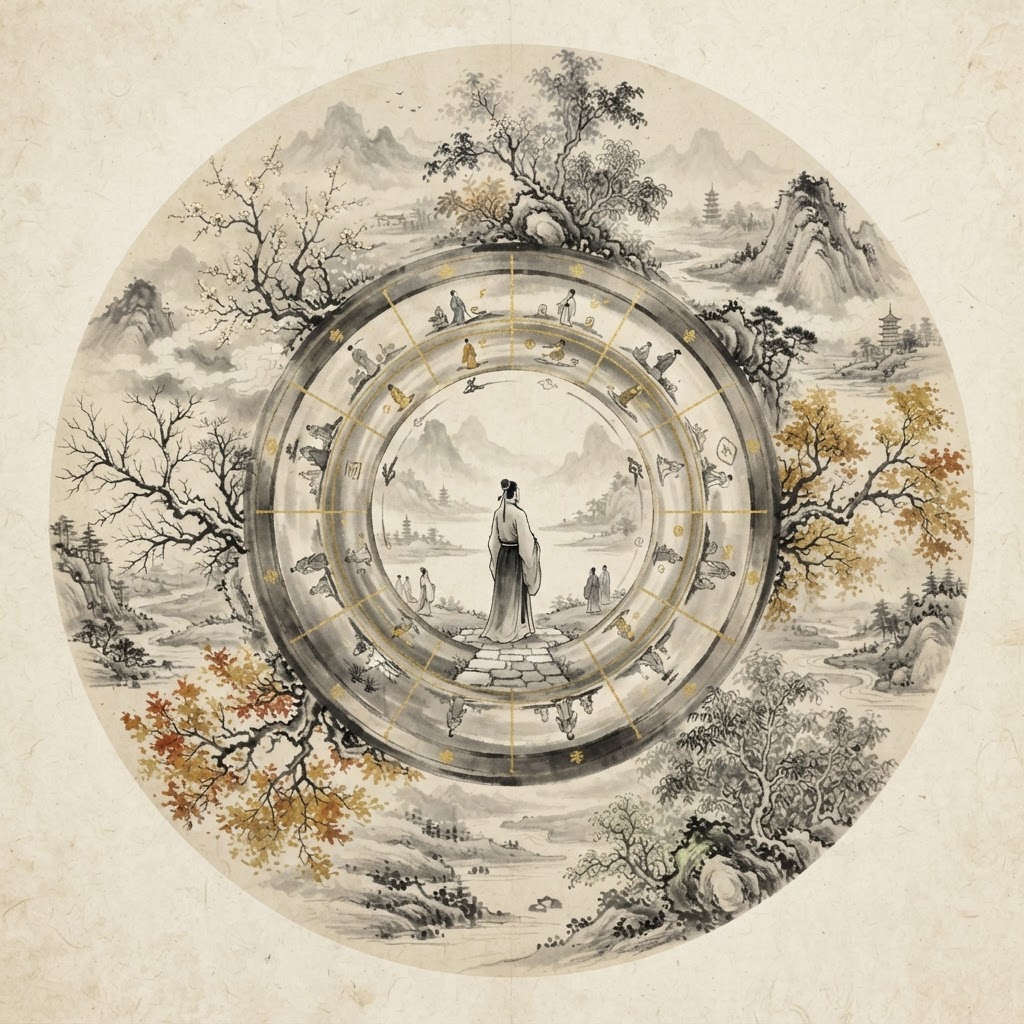
A static natal chart shows your baseline capacity, much like the blue-prints of a house. But life does not stand still. You do not live out your entire life in a single static moment. You travel through time. In Chinese destiny analysis, time dynamics are mapped through Luck Pillars, known in Chinese as Da Yun (大运) or Big Luck Cycles.
Every person enters their first Luck Pillar between the ages of one and ten, depending on the specific mathematical calculation derived from their month pillar and birth gender. Each Luck Pillar lasts for exactly ten years. When you move from one ten-year Luck Pillar to the next, the underlying energetic environment around you shifts dramatically.
A ten-year Luck Pillar introduces a new Heavenly Stem and Earthly Branch pair into your natal equation. This incoming pillar interacts directly with the four pillars in your natal chart through various relationships:
- Combinations (He): Smooth unions that bring new opportunities, strategic alliances, marriage, or collaborative business partnerships.
- Clashes (Chong): Sudden shifts, forced movements, career changes, geographic moves, or emotional turbulence that break open stagnant situations.
- Harms (Hai) and Punishments (Xing): Internal friction, hidden misunderstandings, betrayal, or subtle health vulnerabilities requiring disciplined attention.
To evaluate the true strength of a Day Master, a practitioner must also examine seasonal strength (Wang, Xiang, Xiu, Qiu, Si). The month of birth establishes the seasonal commander of the chart. For example, a Jia Wood Day Master born in the peak of Spring (the Month of Mao or Yin) is exceptionally strong and prosperous (Wang), as Spring is the season when Wood energy flourishes naturally. Conversely, that same Jia Wood Day Master born in the dead of Autumn (the Month of You or Shen) is physically constrained (Si), because Autumn Metal energy cuts and controls Wood. Determining whether a Day Master is strong or weak dictates whether the chart requires supportive elements or draining elements to achieve balance.
“During my years managing recruitment and corporate restructuring, I saw brilliant executives suddenly flounder for several years despite working twice as hard. When I analyzed their charts later, the pattern was obvious: they had stepped into a ten-year Luck Clash. Once they adjusted their expectations and shifted from aggressive expansion to strategic risk management, their peace of mind returned.”
Within each ten-year Luck Pillar, you also experience annual luck cycles (Liu Nian / Annual Pillars) and monthly shifts. This explains why even in a challenging ten-year cycle, you will still experience two or three highly profitable individual years. Conversely, during a magnificent golden ten-year Luck Pillar, you might encounter a minor bump during a specific unfavorable year. Understanding these nested cycles prevents knee-jerk panic and helps you plan capital expenditure, career moves, and personal sabbaticals with surgical timing.
7. What a Destiny Reading Session Actually Covers
When clients book a consultation with a professional practitioner, they’re often unsure what to expect. A proper destiny reading session is not a theatrical performance where a reader makes mysterious claims about your past. It’s a structured, practical, and highly focused strategic consultation designed to optimize your real-world decision-making.
If you’re new to this area, reviewing a comprehensive BaZi reading guide will give you a clear foundational perspective. Furthermore, practitioners often analyze short-term tactical timing alongside your long-term chart, utilizing tools like a Qi Men Dun Jia hour chart explained in real-time strategy sessions.
A standard professional destiny consultation systematically addresses six core life domains:
- Career Path and Professional Stature: Identifying whether you are suited for corporate management, solo entrepreneurship, equity partnership, or specialized technical mastery.
- Wealth Architecture and Financial Timing: Distinguishing between direct income (salary, earned fees) and indirect income (investments, trading, real estate gains), while identifying cash leakage points.
- Relationship Compatibility and Interpersonal Dynamics: Analyzing emotional needs, marital harmony timing, potential communication friction, and partner synergy.
- Business Partnership Alignment: Evaluating potential co-founders or investors to ensure your charts complement rather than clash with each other.
- Health Predispositions and Organ Balance: Examining elemental imbalances to identify potential physical stress points early so you can take preventative steps with qualified healthcare professionals.
- Strategic Timing for Major Life Moves: Determining the optimal months and years for launching a business, selling assets, relocating, or making major career transitions.
8. Free Will Versus the Chart: The Weather Analogy
One of the most persistent misunderstandings surrounding Chinese destiny reading is the idea of absolute fatalism. People often ask me: “If my birth chart is fixed at the moment I am born, does that mean everything in my life is predetermined? Why should I work hard if my destiny is already written?”
I address this question directly in my lectures because fatalistic thinking is destructive. Classical Chinese philosophy has never subscribed to absolute determinism. Instead, classical metaphysics operates on the fundamental framework of the Cosmic Trinity: Heaven, Earth, and Man (Tian, Di, Ren / 天地人).
In this classic framework, human success and quality of life are shaped equally by three distinct forces, each contributing approximately one-third to your total life experience:
- Heaven Luck (Tian Yun – 33%): Your Ming (natal chart) and Da Yun (ten-year luck cycles). This represents your energetic DNA, birth environment, innate talents, and temporal weather conditions. This part is fixed at birth.
- Earth Luck (Di Yun – 33%): Your Feng Shui. This represents your physical environment, residential energy, workplace layout, and geographical location. This part is adaptable and adjustable.
- Man Luck (Ren Yun – 33%): Your personal choices, actions, mindset, ethics, emotional discipline, education, and hard work. This part is entirely within your conscious control.
I like to explain this using a simple weather forecasting analogy. Your natal chart and luck pillars provide the weather forecast. If your chart indicates that a severe financial storm is approaching during your forty-fifth year, that is Heaven Luck at work. You cannot change the fact that rain will fall. However, how you respond to that forecast belongs entirely to Man Luck.
If you know a storm is coming, you don’t set sail in an open boat with full canvas spread. You stay in harbor, repair your hull, fortify your balance sheet, and preserve cash. When the storm hits, you experience minor discomfort rather than catastrophic shipwreck. Conversely, if your chart indicates a magnificent decade of financial sunshine, sitting at home watching television will yield very little. Sunshiny weather creates bumper harvests only if you actually go out into the field to plant and nurture your crops.
Destiny provides the terrain, but you hold the steering wheel. As a business mentor with three decades of experience watching companies succeed and fail, I can tell you that understanding your chart gives you leverage. It allows you to align your effort with time rather than wasting energy swimming against cosmic tides.
9. Ethics of Destiny Reading: Standards and Boundaries
Because destiny analysis touches upon personal, intimate dimensions of human life, ethical responsibility is paramount. Throughout history, unscrupulous fortune-tellers have used fear-mongering and superstitious claims to manipulate vulnerable individuals. In my teaching and practice, I strictly uphold professional ethical boundaries that every authentic practitioner should follow.
The primary ethical directive in classical metaphysics is simple: empower the client, never induce paralysis or fear. A professional destiny reading should leave you feeling clear, grounded, and equipped with practical strategies, not terrified of imaginary curses or inevitable tragedies.
There are two absolute red lines that no ethical metaphysician will ever cross:
- No Death Predictions: An ethical reader will never attempt to predict the date, time, or nature of a client’s death. Modern life span is influenced by medical technology, emergency care, nutrition, lifestyle, and individual choice. Claiming to predict death is manipulative, irresponsible, and fundamentally inaccurate.
- No Medical Diagnosis or Prescription: While a BaZi or Qi Men Dun Jia chart can indicate elemental vulnerabilities (such as strong Fire causing weak Water, which might correlate with kidney or circulatory stress), a reader is not a licensed medical doctor. A practitioner must never diagnose diseases or recommend stopping medical treatments. Health observations are strictly shared as energetic awareness prompts for professional medical evaluation.
Below is a comparative breakdown showing the clear difference between ethical destiny consultations and unethical practices:
| Dimension | Ethical Professional Practice | Unethical Exploitative Practice |
|---|---|---|
| Primary Focus | Strategic empowerment, self-awareness, timing optimization | Instilling fear, promoting dependency, claiming absolute doom |
| Health & Life Span | Identifies energetic tendencies; advises professional medical checks | Claims to predict exact illness timelines or death dates |
| Remedies Offered | Behavioral shifts, strategic timing, environmental alignment | Selling expensive talisman rituals or expensive lucky amulets |
| Client Autonomy | Respects personal agency; emphasizes human choice (Man Luck) | Demands total obedience to predictions; strips away self-determination |
To help you turn insights from a destiny reading into practical real-world growth, consider the following actionable steps:
| Action Step | Metaphysical Objective | Practical Execution |
|---|---|---|
| 1. Align Career with Day Master | Harmonize work environment with core elemental essence | Shift roles toward tasks matching your Day Master strength (e.g. Yin Wood diplomacy vs Yang Metal decision-making) |
| 2. Time Major Investments | Capitalize on favorable Da Yun and Annual Wealth pillars | Deploy major capital during supportive wealth years; maintain liquidity during clash periods |
| 3. Optimize Partnership Synergy | Balance chart imbalances through complementary team members | Recruit co-founders or key managers whose charts supply elements your chart lacks |
| 4. Manage Stress Points Proactively | Mitigate health vulnerabilities highlighted in chart balance | Schedule targeted wellness routines and routine health screenings aligned with weak organ elements |
The Other Four Arts
- Shan, the Art of Cultivation in Chinese Metaphysics
- Yi, the Art of Healing in Chinese Metaphysics
- Bu, the Art of Divination in Chinese Metaphysics
- Xiang, the Art of Observation in Chinese Metaphysics
Frequently Asked Questions
What is the difference between BaZi and Qi Men Dun Jia destiny readings?
BaZi focuses on your natal elemental balance and ten-year luck cycles based on four pillars of birth time. It excels at identifying core personality traits, long-term timing waves, and general life capacity. Qi Men Dun Jia destiny analysis layers four operational plates (Earth, Heaven, Doors, Stars) and Eight Deities over your natal chart, providing deeper diagnostic detail regarding hidden operational mechanisms, subconscious mindsets, spiritual guardians, and environmental factors.
Can two people born at the exact same minute have different lives?
Yes, absolutely. While two people born at the same minute share identical Heaven Luck (their natal birth chart blueprint), they differ in Earth Luck (their home environment, country of birth, parents) and Man Luck (their individual choices, education, work ethic, moral discipline). The birth chart establishes the energetic climate and vehicle type, but individual life choices and physical environments shape the actual journey.
Do I need my exact birth hour for an accurate destiny reading?
Having your exact birth hour is highly recommended because the Hour Pillar governs your late-life outlook, investments, subordinates, and ultimate life accomplishments. It represents one-fourth of your total birth parameters. However, if your birth hour is unknown, an experienced practitioner can analyze your Year, Month, and Day pillars to extract significant insights about your core temperament and major decade luck cycles, or perform hour verification through historical event cross-referencing.
Can a destiny chart reading predict when I will get married?
A reading does not mandate a forced marriage date, but it clearly identifies high-probability relationship windows. By examining when your Spouse Palace (in the Day Branch) experiences supportive combinations or clashes from incoming Luck Pillars or Annual Pillars, a practitioner can pinpoint periods when romance, marriage opportunities, or partnership decisions are highly likely to manifest.
Is destiny reading compatible with modern scientific thinking?
Modern practitioners view Chinese metaphysics not as magic or superstition, but as an ancient empirical system of pattern recognition and environmental psychology. Just as modern meteorology analyzes atmospheric pressure and temperature data to forecast seasonal weather, classical metaphysics analyzes solar-lunar cycles and planetary rhythms to forecast human energetic trends. It serves as an intuitive framework for executive decision-making.
How often should I get my destiny chart reviewed?
For most individuals, a comprehensive natal chart review is done once to understand baseline strengths and life strategy. After that, an annual review at the start of the solar year (around February) is helpful to evaluate incoming annual luck cycles, identify potential friction months, and adjust corporate or personal timing for the year ahead.
Can a destiny reading cure illness or remove bad luck?
No. A destiny reading is an analytical diagnostic tool, not a magical cure. It cannot erase past actions or cure medical diseases. What it provides is situational awareness. By identifying when difficult cycles occur, you can take preventative steps, adjust your behavior, fortify your finances, and consult appropriate healthcare professionals before minor issues become major crises.
Related Reading
To continue your exploration of classical Chinese metaphysics, destiny analysis, and strategic forecasting, explore these related guides from our platform:
- BaZi Reading Under Qi Men Dun Jia by Dougles Chan
- BaZi Reading: The Ancient Art of Fortune Telling
- Interactive Qi Men Dun Jia Calculator
- Qi Men Dun Jia Hour Chart Explained
Related Articles in Destiny (Ming)
- BaZi Four Pillars Anatomy: Day Masters and Five Elements Explained
- Zi Wei Dou Shu Twelve Palaces: The Emperor Star Guide
- Qi Men Dun Jia Destiny Analysis: Layering the Four Operational Plates
- Luck Pillars (Da Yun): How Ten-Year Cycles Shift Your Natal Energy
- The Cosmic Trinity: Balancing Heaven Luck, Earth Luck, and Free Will
- Ethics and Boundaries in Chinese Destiny Reading Consultations
- The BaZi Ten Gods: Career, Wealth, and Authority Archetypes
- True Solar Time and Chart Rectification Methods
Leave a Reply
You must be logged in to post a comment.