Bu, the Art of Divination in Chinese Metaphysics
When most people hear the word “divination,” they picture a fortune-teller in a dimly lit room, peering into a crystal ball or shuffling tarot cards while whispering vague predictions about distant lovers or unexpected windfalls. In the classical Chinese tradition, that imagery misses the mark entirely. Divination, known in Chinese metaphysics as Bu (卜), was never designed as a passive exercise in telling fortunes. It was created as a high-stakes tactical radar system for military commanders, imperial court strategists, and commercial merchants who needed clear, actionable clarity at pivotal decision points.
I am Dougles Chan. Over my 30 years in business, I have built recruitment firms, managed corporate operations, negotiated commercial contracts, and made thousands of operational decisions right here in Singapore. In my later years, I became a Qi Men Dun Jia educator and lineage founder, teaching students around the world in English. One lesson my business career taught me long before I ever taught metaphysics is simple: when you are facing a corporate crossroad or an urgent crisis, general predictions about ten years down the road are useless. What you need is a sharp diagnostic map of the exact situation sitting on your desk right now.
That is precisely what Bu provides. In the classic taxonomy of the Five Arts of Chinese Metaphysics (五术: Shan 山, Yi 医, Ming 命, Bu 卜, Xiang 相), Bu serves a unique function. It does not measure your lifelong destiny or your physical health. Instead, it captures a single slice of time to evaluate one clean question, revealing the hidden energies, hidden motives, and environmental forces governing that moment. In this comprehensive guide, we will explore what Bu actually means, how its primary methods operate, how to frame questions that produce reliable answers, and how to read those answers with cold, disciplined objectivity.
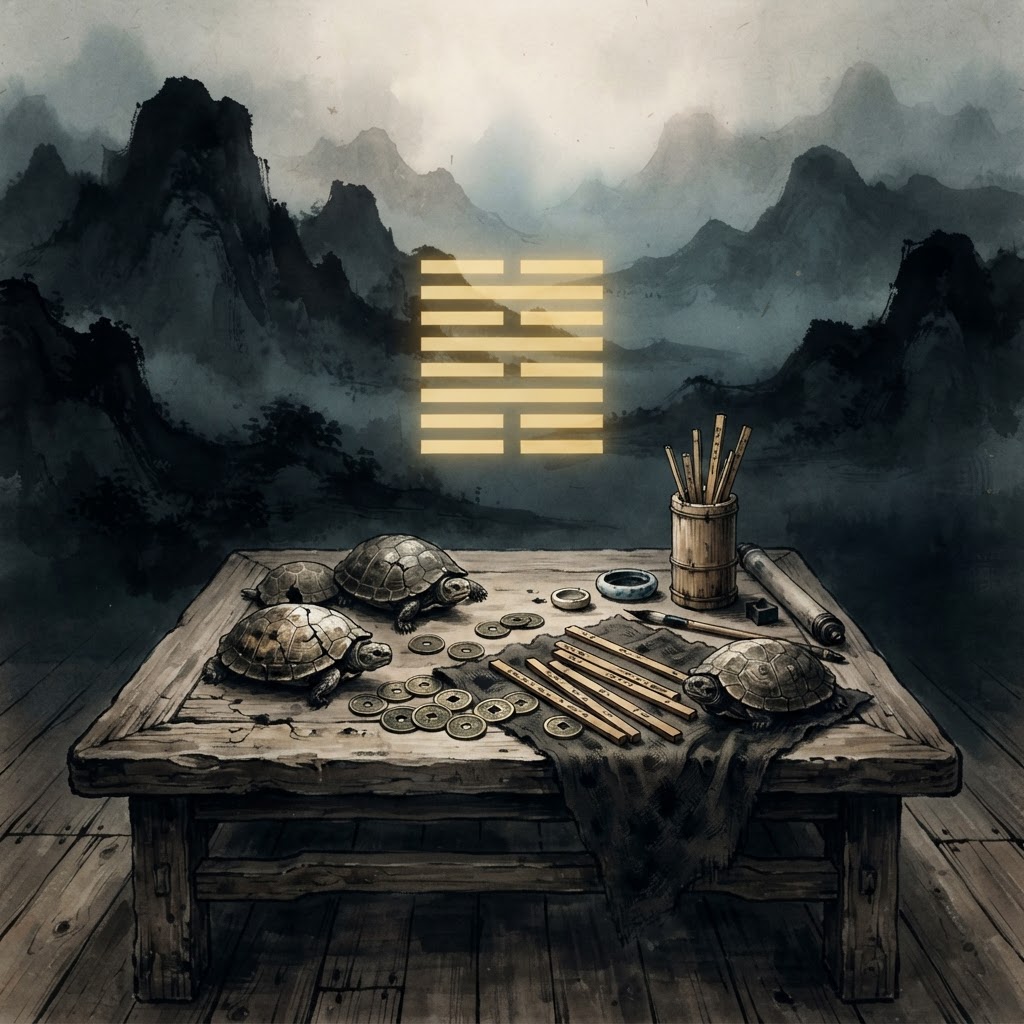
This guide is one of five in my complete series on the Five Arts of Chinese Metaphysics.
1. What Bu (卜) Means in the Classical Taxonomy of the Five Arts
To understand Bu, you first have to look at where it stands inside the classical taxonomy of the Five Arts (五术). Chinese metaphysics categorizes all human knowledge and spiritual practice into five distinct branches, each addressing a different aspect of life and cosmic interaction:
- Shan (山 – Cultivation): The art of self-mastery, inner discipline, Qigong, meditation, and martial arts designed to strengthen the spirit and body.
- Yi (医 – Healing): Traditional Chinese Medicine (TCM), acupuncture, herbal formulations, and body alignment aimed at maintaining physiological harmony.
- Ming (命 – Destiny Analysis): The study of lifelong life maps through BaZi (Eight Characters) and Zi Wei Dou Shu (Purple Star Astrology), mapping macro trends and luck pillars across decades.
- Bu (卜 – Divination): Horary analysis and tactical inquiry, capturing a specific moment in time to resolve an immediate choice, crisis, or strategy.
- Xiang (相 – Observation): The observation of physical forms, including face reading (Mian Xiang), palmistry, and Feng Shui (Kan Yu), interpreting how environment and physical shapes mirror Qi.
Etymologically, the Chinese character for Bu (卜) is one of the oldest logograms in written history. It originated during the Shang Dynasty (c. 1600–1046 BCE) as a pictorial representation of the vertical and horizontal stress cracks formed on tortoise plastrons and ox scapulae during oracle bone rituals (Jiaguwen 甲骨文). Ancient royal diviners carved questions into polished bone, applied intense heat with hot bronze rods, and interpreted the resulting fracture patterns. They were not attempting to read a person’s entire life from birth to death. They were asking specific operational questions: Will the northern border expedition succeed this month? Should the King harvest crops before the coming rain? Is this foreign alliance genuine?
As centuries progressed into the Zhou Dynasty and the imperial eras, bone cracking transformed into sophisticated mathematical, temporal, and symbolic systems. Preserved within Daoist canons and secret lineage manuscripts, Bu evolved from raw pyromancy into precise horary sciences. Yet, the core purpose of Bu remained identical: it provides a temporal snapshot. Where destiny reading (Ming) shows your general capacity for wealth or leadership over a 10-year luck pillar, divination (Bu) tells you whether signing contract A with supplier B at 2:00 PM today will produce profits or lead to costly litigation.
The following table illustrates how Bu compares directly with the other four branches within the classical Five Arts taxonomy:
| Art & Character | Primary Purpose | Temporal Focus | Primary Tools | Typical Query |
|---|---|---|---|---|
| Shan (山) Cultivation |
Inner spiritual discipline, longevity, and physical mastery. | Continuous / Lifelong practice | Qigong, Daoist meditation, breathwork, martial arts | “How can I cultivate emotional resilience and vitality?” |
| Yi (医) Healing |
Restoring physiological balance and treating disease. | Present health state | Herbal medicine, acupuncture, moxibustion, pulse diagnosis | “How can I rebalance my Spleen and Stomach Qi?” |
| Ming (命) Destiny |
Mapping lifelong potential, career peaks, and luck cycles. | Macro lifespan (10-year pillars) | BaZi (Eight Characters), Zi Wei Dou Shu | “What business sectors align with my core elements?” |
| Bu (卜) Divination |
Tactical decision-making and resolving specific queries. | Micro temporal moment (Horary) | Qi Men Dun Jia, I Ching, Da Liu Ren, Temple Lots | “Should I proceed with the partnership offer today?” |
| Xiang (相) Observation |
Reading physical environmental and bodily forms. | Current physical space & form | Feng Shui, face reading (Mian Xiang), palmistry | “Does this office layout support leadership authority?” |
2. The Core Principle: One Clean Question at One Specific Moment
The foundation of all classical Chinese divination rests on a fundamental law of time: cosmic timing (Shi 机). In Chinese metaphysics, time is not a passive backdrop or an arbitrary ticking clock. Time is a dynamic, living stream of Qi that carries specific elemental charges, energetic balances, and directional tendencies at every double-hour (Shi Chen 时辰).
When a question forms in your mind with genuine urgency, or when a client walks into my classroom and asks for guidance on a pressing business deal, that exact moment is not random. The cosmic chart calculated for that precise hour and minute mirrors the energetic structure of the problem itself. This concept, similar to what Carl Jung called synchronicity, is known in Chinese metaphysics as the resonance between mind and universe (Tian Ren He Yi 天人合一). The universe operates as an interconnected web, and the moment an inquiry crystallizes, the environment reflects its internal mechanics.
The Divination Inquiry Lifecycle
- Question Birth: A clear, specific question reaches critical urgency in the inquirer’s mind.
- Timestamp Capture: The practitioner records the exact hour, minute, day, month, and year of the inquiry.
- Chart Calculation: The horary map (Qi Men Dun Jia, I Ching hexagram, or Da Liu Ren lesson) is cast for that precise timestamp.
- Unbiased Decoding: The practitioner analyzes focus stems, doors, gods, and stars without wishful thinking.
- Strategic Execution: The inquirer implements real-world tactical actions based on the chart’s structural warnings and green lights.
Because divination relies on precise temporal resonance, the quality of the answer depends directly on the quality of the question. A vague, sprawling, or double-barreled question produces a tangled, incoherent chart. If someone asks me, “Should I quit my marketing job, move to London, open a bakery, or stay in Singapore and get married?”, they are trying to cram four distinct life trajectories into a single moment. The chart will reflect that mental chaos, rendering the stems and doors nearly unreadable.
“Divination does not predict a fixed destiny; it diagnoses the active energy of a single moment so you can make a smarter choice.”
To receive a clear diagnostic reading, you must present one clean question bounded by time, context, and personal agency. Divination is an inquiry into a specific fork in the road, giving you the clarity needed to make a deliberate choice rather than stumbling blindly forward.
3. Divination (Bu) Versus Destiny Reading (Ming): Snapshot vs. Lifelong Map
One of the most frequent points of confusion among newcomers to Chinese metaphysics is the distinction between destiny analysis (Ming) and divination (Bu). Many people assume that if you have already analyzed your BaZi birth chart, you have no need for divination. That assumption stems from a basic misunderstanding of how temporal scale works in metaphysics.
Your BaZi chart is calculated from your birth year, month, day, and hour. It represents your natal blueprint, your baseline personality traits, your inherent elemental balance, and the broad ten-year luck pillars (Da Yun 大运) that govern your life path. It tells you whether you are built like a heavy ocean vessel or a nimble river craft, and whether the coming decade brings favorable tailwinds or rough seas. Studying how a Qi Men Dun Jia hour chart explained works demonstrates why horary maps provide immediate tactical granularity that natal birth charts were never designed to supply.
In contrast, Bu does not care about your ten-year luck pillar or your natal birth elements. Bu focuses exclusively on the micro-moment. Consider a corporate analogy from my 30 years in business. BaZi is like a company’s ten-year strategic business plan, capital architecture, and macro market positioning. Bu, on the other hand, is like performing an immediate cash flow audit on a Tuesday morning or conducting a background check on a specific vendor before transferring a deposit. Even if your company is in a highly profitable ten-year expansion cycle, signing a poorly drafted contract with a fraudulent supplier on a bad day can still cost you hundreds of thousands of dollars.
To put this into practical perspective, consider two contrasting real-world scenarios:
- Scenario A (Strong BaZi, Poor Bu Chart): A business owner is currently navigating a highly favorable BaZi 10-year Wealth Luck Pillar. He decides to invest $500,000 in a new logistics partnership. However, a Qi Men Dun Jia horary chart cast at the hour of signing shows the Hour Stem (representing the deal) sitting with Death Door in Void/Emptiness, with the partner’s stem clashing violently with his own. If he relies solely on his BaZi luck, he will sign the contract and lose substantial capital to partner embezzlement. The Bu chart acts as an immediate hazard warning, advising him to halt the transaction despite his macro luck.
- Scenario B (Challenging BaZi, Favorable Bu Chart): An entrepreneur is going through a difficult BaZi luck pillar where wealth management requires extreme caution. However, she needs to submit a commercial tender bid this week. A horary divination chart shows her Day Stem residing in Palace 1 (Kan Water) produced by Palace 6 (Qian Metal) holding Open Door and Chief (Zhi Fu). This indicates that while her general 10-year environment is tough, this specific tender proposal carries exceptional alignment and institutional backing. By bidding at this precise window, she wins the contract.
The table below summarizes the key operational differences between destiny reading (Ming) and divination (Bu):
| Dimension | Destiny Reading (Ming – BaZi / Zi Wei) | Divination (Bu – QMDJ / I Ching / Da Liu Ren) |
|---|---|---|
| Core Focus | Lifelong blueprint, inherent potential, natal capacity. | Immediate crisis, tactical decision, single transaction. |
| Input Data | Exact birth date and birth hour of the individual. | Timestamp of the question or instant of event occurrence. |
| Time Horizon | Decades, 10-year luck pillars, annual luck cycles. | Immediate hours, days, weeks, or up to several months. |
| Nature of Insight | Strategic alignment, self-awareness, timing of major life eras. | Diagnostic radar, risk identification, immediate action steps. |
| Query Type | “What careers suit my elemental structure?” | “Will investing in Project X yield positive ROI this quarter?” |
| Flexibility | Fixed at birth; shows long-term weather patterns. | Highly dynamic; shifts as decisions and actions change. |
4. Major Divination Systems in Chinese Metaphysics
Over thousands of years, Chinese metaphysics developed several distinct methodologies under the umbrella of Bu. While all of them aim to decode the Qi of a specific moment, each system employs unique structural mechanics, mathematical calculations, and symbolic languages. Below are the four major traditional systems that have survived into the modern era.
A. Qi Men Dun Jia (奇门遁甲) Hour Charts
Qi Men Dun Jia, historically translated as the “Mysterious Doors Escaping Stem,” is widely considered the king of Chinese divination systems. Originating as an imperial military strategist’s tool used by famous figures like Zhuge Liang during the Three Kingdoms period and Liu Bowen during the Ming Dynasty, Qi Men Dun Jia constructs a complex 3×3 mathematical matrix known as the Nine Palaces (Jiu Gong 九宫) for any given double-hour.
The Nine Palaces correspond directly to the Eight Trigrams of the Luoshu square (Kan 1 North, Kun 2 Southwest, Zhen 3 East, Xun 4 Southeast, Central 5 Palace, Qian 6 Northwest, Dui 7 West, Gen 8 Northeast, Li 9 South). This creates a geographic and directional map alongside temporal timing. Within this matrix, a practitioner analyzes four distinct energetic layers:
- The Earth Plate (Di Pan 地盘) and Heaven Plate (Tian Pan 天盘): Representing the Ten Heavenly Stems, showing foundational environments and visible external interactions.
- The 8 Doors (Ba Men 八门): Representing human action, operational conditions, and business dynamics (for example, Open Door for business operations, Life Door for profit, Rest Door for recovery, Scenery Door for documentation and legal filings).
- The 9 Stars (Jiu Xing 九星): Representing atmospheric Qi, timing factors, and macro environmental conditions (such as Tian Chong Star for speed and aggressive expansion, Tian Fu Star for cultural and educational authority).
- The 8 Gods (Ba Shen 八神): Representing spiritual, psychological, and subtle subconscious influences (such as Chief / Zhi Fu for high authority and protection, Six Harmony / Liu He for contract signing and joint ventures, White Tiger / Bai Hu for intense stress or physical pressure).
When someone presents a question, the practitioner identifies the Focus Stem (Yong Shen 用神). The Day Stem typically represents the person asking the question, while the Hour Stem represents the matter or outcome. Furthermore, special diagnostic markers like Void/Emptiness (Xun Kong 空亡) indicate hidden missing factors, while the Horse Star (Yi Ma 驿马) indicates rapid movement or sudden shifts. By evaluating the structural interactions between these stems, doors, and palaces, the practitioner uncovers hidden motives, financial health, and operational obstacles. You can cast horary charts using a dedicated Qi Men Dun Jia calculator to observe how cosmic formations rotate across different hours. Mastering these interpretations requires exploring the overview of Qi Men Dun Jia combos in 8 doors 8 gods and 9 stars.
B. I Ching (易经) Casting & Mei Hua Yi Shu (Plum Blossom)
The I Ching, or Book of Changes, is the foundational text of Chinese philosophy and divination. It represents the universe through 64 Hexagrams (Gua 卦), each constructed from two three-line Trigrams (Ba Gua 八卦). Classical I Ching divination utilizes physical casting methods to generate a primary hexagram, identify changing lines (Dong Yao 动爻), and derive a transforming secondary hexagram.
Traditional methods include:
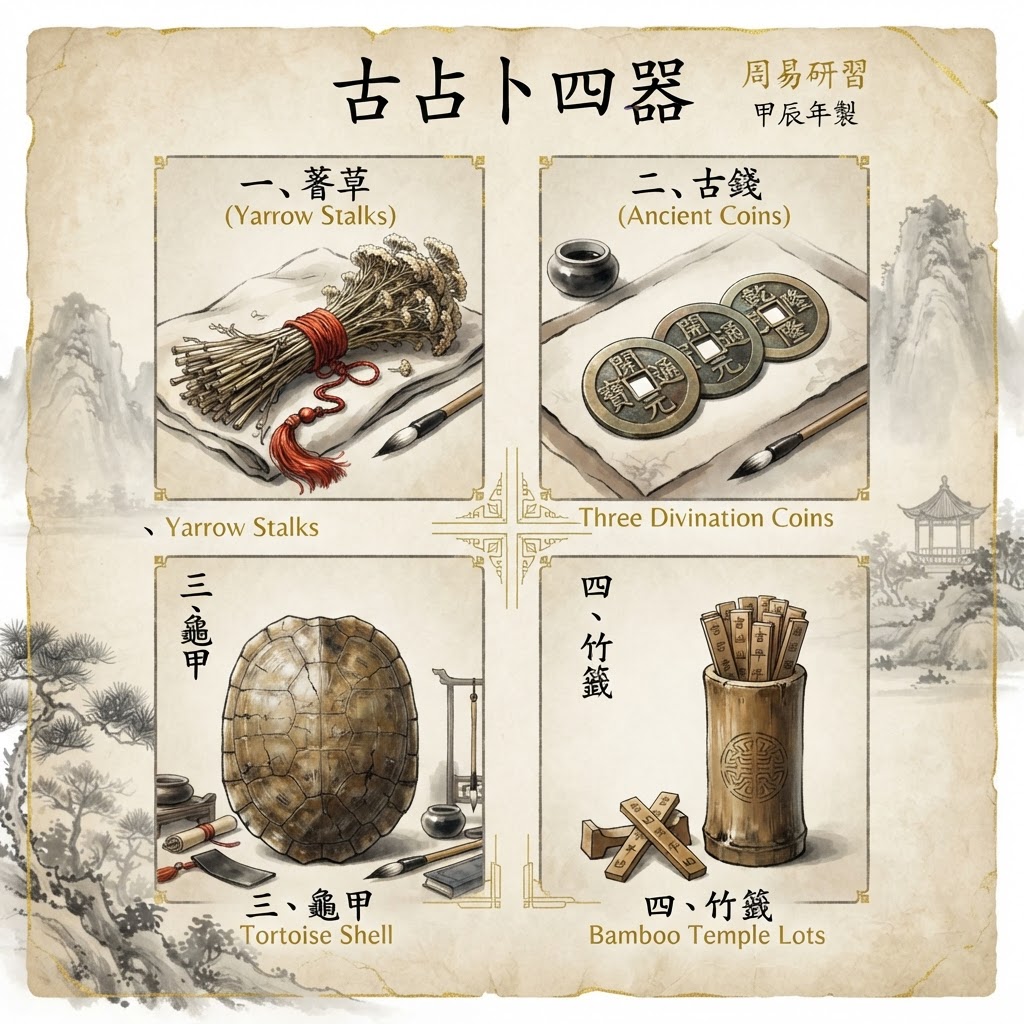
- Yarrow Stalk Counting: The most ancient, ritualistic method using 50 dried yarrow stalks, requiring deep focus, patience, and deliberate manipulation to count out remainders of four.
- Three Coin Casting (San Qian Fa): A simpler method using three bronze coins tossed six times to determine solid (Yang) or broken (Yin) lines based on heads and tails totals.
- Mei Hua Yi Shu (Plum Blossom Divination): Developed by Song Dynasty scholar Shao Yong, this system allows a practitioner to cast hexagrams instantly using numbers, timestamps, sounds, colors, or spatial observations without needing physical coins or stalks. Shao Yong famously derived hexagrams by observing real-world signs (Omens / Xiang 象), such as two sparrows fighting over a plum branch.
The philosophy of the I Ching emphasizes that change is the fundamental constant of existence. The primary hexagram describes your current situation, the changing lines pinpoint the exact point of energetic transformation, and the future hexagram outlines the inevitable outcome if current trends continue uninterrupted. By evaluating trigram relationships (such as Water over Fire or Heaven over Earth), the practitioner gains profound wisdom on how to adapt.
C. Da Liu Ren (大六壬) – The Big Six Ren
Alongside Qi Men Dun Jia and Tai Yi Shen Shu, Da Liu Ren belongs to the prestigious family of the Three Styles (San Shi 三式). While Qi Men Dun Jia excels at spatial positioning and military warfare, Da Liu Ren is historically revered as the supreme system for human affairs, legal disputes, interpersonal relationships, and daily operational matters.
Da Liu Ren operates by projecting the twelve Earthly Branches onto a circular celestial plate (Tian Pan) set above a square terrestrial plate (Di Pan). From this interaction, the system derives the Four Lessons (Si Ke 四课) and the Three Transmissions (San Chuan 三传). The Four Lessons detail the current relationship between the querent and the subject, while the Three Transmissions reveal the past origin, present development, and final resolution of the problem. It is an exceptionally analytical system favored by scholars who demand intricate details about motives, hidden feelings, and private agendas.
D. Temple Lot Drawing (Guan Yin Lots / Qiu Qian 求签 & Jiao Bei 皎杯)
While Qi Men Dun Jia, I Ching, and Da Liu Ren require rigorous study and mathematical calculation, temple lot drawing (Qiu Qian) represents the most accessible, widely practiced form of divination in Chinese folk culture. Devotees visit traditional temples, such as heritage centers across Asia, to seek spiritual counsel directly from deities like Guan Yin (the Goddess of Mercy) or Lord Guan (Guan Sheng Di Jun).
The ritual follows a sacred protocol:
- The inquirer presents incense, states their full name, birth details, and one specific question clearly before the deity.
- They take a bamboo cylinder containing 100 numbered bamboo sticks (Qian Stems) and gently shake it at an angle until a single stick rises and falls to the floor.
- To confirm that the deity designated that specific lot, the inquirer casts two wooden crescent-shaped blocks (Jiao Bei / Poe). One flat side facing up and one curved side facing up (Sheng Bei 胜杯) confirms divine authorization. If both flat sides land up (Laughing Block / Xiao Bei) or both curved sides land up (Sacred Block / Yin Bei), the inquirer must re-cast.
- The inquirer retrieves the corresponding poetry slip (Qian Shi 签诗), which contains a classical poem, historical references, and specific diagnostic advice.
Reading slips like Guan Yin Lot 1 demonstrates how classical temple poetry balances spiritual encouragement with practical worldly advice. Every day, thousands of seekers visit the historic Kwan Im Thong Hood Cho Temple Singapore to perform this traditional ritual when facing career changes, family decisions, or personal challenges.
The table below provides a comparative analysis of these four major divination systems:
| Divination System | Historical Origin | Primary Mechanism | Structural Components | Best Application | Learning Curve |
|---|---|---|---|---|---|
| Qi Men Dun Jia | Warring States / Han Dynasty | 3×3 Nine Palace matrix, mathematical rotation. | 9 Palaces, 8 Doors, 9 Stars, 8 Gods, Stems. | Corporate strategy, business deals, asset investments. | High / Complex |
| I Ching / Mei Hua | Zhou Dynasty / Song Dynasty | Binary Yin/Yang hexagram generation & changes. | 64 Hexagrams, 8 Trigrams, Changing Lines. | Personal wisdom, career shifts, timing of change. | Moderate to High |
| Da Liu Ren | Spring and Autumn Period | 12 Earthly Branch astronomical projection. | Heaven/Earth Plates, 4 Lessons, 3 Transmissions. | Interpersonal disputes, legal affairs, employee motives. | Very High |
| Temple Lots (Qiu Qian) | Tang / Song Dynasty Folk Culture | Sacred bamboo stick drawing & crescent verification. | 100 Bamboo lots, Jiao Bei blocks, poetry slips. | Personal clarity, spiritual counsel, immediate comfort. | Accessible / Intuitive |
5. The Discipline of Question Framing: Weak vs. Well-Framed Questions
In my years of teaching Qi Men Dun Jia and advising business leaders, I have noticed that at least eighty percent of poor divination readings have nothing to do with practitioner error or chart inaccuracies. They stem directly from bad question framing. If you ask a confused, half-baked question, the universe returns a confused, half-baked chart.
To master Bu, you must cultivate the discipline of question framing. High-quality divination queries obey four fundamental criteria:
- Single Focus: The question investigates one specific issue, transaction, or relationship at a time.
- Clear Time Horizon: The query is bounded by a realistic timeframe, such as “over the next six months” or “for this upcoming contract.”
- Personal Agency: The question centers on actions within your control, rather than asking for passive fantasy outcomes.
- Objective Clarity: The terms used in the question are concrete and defined, avoiding ambiguous emotional buzzwords.
Common pitfalls in question framing include asking double-barreled questions (“Should I sign this lease or move to another city?”), asking hypothetical questions without real intent (“What if I bought $1,000,000 in land next year?”), or asking voyeuristic queries about third parties where you have no operational standing. Each of these mistakes introduces energetic noise, making it impossible to identify the correct Focus Stem in a Qi Men Dun Jia chart or changing line in an I Ching reading.
The table below provides worked examples contrasting weak, poorly framed questions with well-framed alternative queries across common business and life scenarios:
| Scenario | Weak Question (Flawed) | Failure Reason | Well-Framed Alternative | Target Chart Indicator |
|---|---|---|---|---|
| Business Expansion | “Will my business be successful in the future?” | Lacks timeframe, definition of success, and specific business model. | “Will opening a retail branch in Jurong East generate positive cash flow in 2027?” | Life Door (Profit) & Earth Stems interaction in Palace 3 or 8. |
| Hiring Executive | “Should I hire John?” | Vague criteria; does not define John’s role, performance metrics, or risk factors. | “Will hiring John as Head of Sales increase total revenue this fiscal year?” | Day Stem (Employer) producing Hour Stem (John’s impact). |
| Commercial Investment | “Is crypto a good investment right now?” | Too broad; no specific asset class, entry capital, or holding period. | “Will allocating $50,000 into Commercial Asset X yield capital gain within 6 months?” | Wu Stem (Capital) & Sheng Men (Life Door / Return). |
| Partnership Offer | “Does Partner B like me?” | Focuses on emotional sentiment rather than legal integrity and business alignment. | “Will signing the joint venture agreement with Partner B result in legal dispute?” | Six Harmony (Contract) & Jing Men (Scenery Door / Lawsuit). |
6. Reading the Answer Without Wishful Thinking
Perhaps the hardest part of divination is not learning how to calculate the chart or memorize the symbols. The hardest part is reading the chart with absolute, unyielding objectivity. Human beings are hardwired for confirmation bias. When we care deeply about an outcome, we naturally look for evidence that validates our hopes and ignore warning signs that threaten our desires.
I have seen students cast a Qi Men Dun Jia chart for a risky business venture, see the Death Door (Si Men) sitting in Emptiness (Xun Kong) alongside a harsh Stem Punishment, and still try to rationalize the reading. They say things like, “Well, maybe Death Door just means the old company is dying so a new one can be born!” That is not metaphysics; that is self-deception.
Objective Interpretation Protocol
- Isolate Focus Stems: Identify the Day Stem (querent) and Hour Stem (matter/outcome) without preconception.
- Assess Elemental Relationship: Determine if the outcome palace produces, counters, or weakens the applicant’s palace.
- Audit Void & Punishments: Check for Emptiness (Kong Wang), Horse Star momentum, or hidden clashes.
- Face Negative Signals Head-On: Accept unfavorable indicators (Death Door, Harm Door, White Tiger) as direct warnings.
- Formulate Mitigation: Adjust timing, renegotiate terms, or walk away safely based on structural reality.
In classical Chinese metaphysics, a chart does not flatter your ego. If the Hour Stem clashes violently with the Day Stem, the deal will fail or cause severe stress. If the Life Door is buried in Emptiness, the financial return is nonexistent. Accepting a negative reading is not a defeat; it is a massive victory for risk management. Walking away from a bad deal saves capital, time, and emotional energy that you can invest into a viable opportunity later.
When you learn to detach your emotional desires from chart analysis, divination becomes an invaluable commercial asset. Instead of using metaphysics to validate your ego, you use it as an unvarnished audit tool that protects your assets and sharpens your timing.
“A practitioner who distorts a bad chart to give false comfort is committing ethical malpractice. True metaphysics gives you the courage to walk away from a trap.”
7. Divination Etiquette & Ethics: Respecting the Process
Divination is a sacred, disciplined practice that requires respect for the process, the practitioner, and the underlying cosmic order. Throughout Chinese history, scholars and lineage masters established strict ethical guidelines to prevent the misuse of divination.
The most famous ethical rule in classical divination is Bu Er Gu (卜不二卦), which translates as “Do not cast twice for the same matter.” If you cast a chart for a business inquiry and receive an unfavorable answer, you cannot simply toss the coins again or recalculate the hour chart hoping for a better result. Repeating a query out of dissatisfaction breaks temporal resonance and fills subsequent charts with meaningless energetic noise. If the situation changes fundamentally, such as new contract terms being offered or a new partner entering the deal, you may cast a new query. Otherwise, the first chart stands as the authoritative diagnostic result.
Key guidelines for ethical divination practice include:
- Sincerity of Intent (Cheng 诚): Approach the divination process with genuine need and mental clarity. Frivolous testing or insincere questions waste temporal alignment and produce distorted readings.
- Respect for Privacy: Never use divination to pry into the personal affairs, health secrets, or private finances of third parties without their explicit consent or direct operational cause.
- Empowerment Over Fear: Use chart insights to empower constructive decision-making, never to paralyze clients with fear or fatalism.
Furthermore, practitioners must respect state of mind. Casting a divination chart when you are severely intoxicated, emotionally enraged, or exhausted corrupts the mental focus required for accurate analysis. A calm, neutral mind is the mirror that allows temporal resonance to reflect clearly without distortion.
8. Honest Limits of Chinese Divination
While Bu is an exceptionally powerful diagnostic tool, every practitioner must remain clear about its inherent limits. Divination is not magic, and it does not make you omnipotent. Understanding what divination cannot do is just as important as knowing what it can do.
In Chinese philosophy, reality is governed by the Three Realms (San Cai 三才): Heaven (Tian 天), Earth (Di 地), and Man (Ren 人). Heaven represents timing and cosmic alignment; Earth represents environment and physical infrastructure; Man represents human choice, effort, and moral character. Divination maps the timing and environmental Qi of Heaven and Earth, but it can never eliminate the necessity of human action (Ren Wei 人为).
Divination cannot accomplish the following:
- Replace Hard Work and Competence: A green light in a Qi Men Dun Jia chart will not build a successful company if you lack execution skills, financial discipline, or market knowledge.
- Override Legal or Moral Law: Divination will not shield anyone from the natural legal and karmic consequences of unethical behavior or fraudulent schemes.
- Substitute for Due Diligence: A favorable horary reading should confirm your thorough research, never replace financial audits, legal advice, or background checks.
Divination provides high-grade diagnostic weather reports. It tells you whether it will rain during your journey, allowing you to pack an umbrella or delay departure. It does not walk the path for you. Human will, personal ethics, and hard work remain the ultimate drivers of destiny.
The Other Four Arts
- Shan, the Art of Cultivation in Chinese Metaphysics
- Yi, the Art of Healing in Chinese Metaphysics
- Ming, the Art of Destiny in Chinese Metaphysics
- Xiang, the Art of Observation in Chinese Metaphysics
Frequently Asked Questions
What is the difference between Bu (divination) and BaZi (destiny reading)?
BaZi (Ming) analyzes your natal birth chart to map your lifelong blueprint, core personality, and 10-year luck pillars across decades. Bu (divination) analyzes the exact timestamp of a specific inquiry to provide a short-term diagnostic snapshot for an immediate decision, transaction, or crisis. BaZi shows your overall capacity and macro weather, while Bu evaluates a specific micro-moment sitting on your desk right now.
Can I perform divination for myself, or do I need a master?
You can learn to cast and read divination charts for yourself using systems like Qi Men Dun Jia, the I Ching, or temple lots. However, reading your own charts requires extreme emotional detachment to avoid confirmation bias. When your own money or feelings are on the line, it is easy to misinterpret negative indicators like Death Door or Emptiness. Many experienced practitioners consult peers for major decisions to ensure an unvarnished, objective reading.
What happens if a divination chart gives a negative result?
A negative chart is not a curse or a fatalistic doom sentence; it is a tactical warning. It indicates that current environmental Qi, timing, or partner alignments are unfavorable for your proposed action. You can use this insight to renegotiate contract terms, delay execution, alter your strategy, or walk away safely before incurring financial losses. Recognizing a bad deal early is one of the greatest risk management benefits divination offers.
How often can I cast a Qi Men Dun Jia or I Ching chart?
You should cast a chart only when you face a genuine, high-stakes decision or crisis requiring clarity. Casting charts daily for trivial matters dilutes mental focus and violates the classical principle of Bu Er Gu (not casting repeatedly for the same issue). Reserve divination for meaningful business choices, major investments, contract reviews, or important life transitions.
Are temple lots like Guan Yin lots as accurate as complex Qi Men Dun Jia hour charts?
Yes, temple lot drawing (Qiu Qian) can be remarkably accurate when conducted with deep sincerity, proper mental focus, and divine authorization through Jiao Bei crescent blocks. Complex mathematical systems like Qi Men Dun Jia provide detailed structural sub-layers (stems, doors, stars, gods), whereas temple lots deliver synthesized diagnostic poetry. Both connect to the exact same universal law of temporal resonance, serving different user preferences and cultural contexts.
Why is question framing so important in classical divination?
Divination charts mirror the precise energetic structure of the question asked. A vague, sprawling, or double-barreled question generates an ambiguous, tangled chart with overlapping Focus Stems. Clear, specific questions bounded by time, context, and personal agency produce precise, actionable diagnostic readings that leave no room for confusion.
Can divination predict the exact outcome of financial markets or lotteries?
No. Classical divination was designed for tactical decision-making, strategic positioning, and risk diagnosis. It cannot be used to manipulate random gambling events or accurately predict hyper-complex macro stock fluctuations for personal greed. Attempting to use Bu for speculative gambling distorts temporal resonance and produces completely unreliable readings.
Related Reading
To deepen your understanding of Chinese divination, horary mechanics, and classical lot reading, explore the following detailed guides and tools:
- Qi Men Dun Jia Hour Chart Explained: A complete breakdown of reading horary matrices for immediate business decisions.
- Qi Men Dun Jia Calculator: Cast accurate Nine Palace horary charts for any double-hour timestamp.
- Overview of Qi Men Dun Jia Combos in 8 Doors, 8 Gods, and 9 Stars: Learn how energetic sub-layers interact in divination readings.
- Kwan Im Thong Hood Cho Temple Singapore Guide: Explore traditional lot drawing rituals and heritage history.
Detailed Guides: Divination Systems and Methods
Each of these topics dives deep into a specific aspect of Bu. They build on what is covered here and link out to related areas within the Five Arts framework.
- Qi Men Dun Jia Divination: How Hour Charts Reveal Present Realities: The foundational guide to QMDJ horary practice.
- I Ching Coin Casting: Hexagrams, Trigrams, and Changing Lines: Step-by-step coin casting with worked examples.
- Da Liu Ren Divination: The Classical Science of Cosmic Time and Relationships: The Four Lessons and Three Transmissions explained.
- Guan Yin Lots and Temple Qiu Qian: Traditional Rituals and Interpretation: Temple lot drawing rituals and practical interpretation.
- Question Framing Mastery: How to Formulate Precise Queries in Divination: Why the question shapes the entire reading.
- Overcoming Confirmation Bias: Reading Harsh Divination Results Objectively: How to keep your readings honest.
- Bu Er Gu and Divination Ethics: When to Cast and When to Pause: The ethical framework behind responsible divination practice.
- Divination vs. Destiny Reading: Combining Horary Charts with BaZi Life Maps: How to layer Ming and Bu for richer readings.
Leave a Reply
You must be logged in to post a comment.