
Daoist Stillness Meditation (Jing Zu): The Practice of Sitting and Forgetting
I first came across the phrase “sitting and forgetting” (坐忘, zuo wang) in a battered translation of the Zhuangzi, and it stopped me cold. I had spent fifteen years in business at that point, running recruitment firms across three countries, and I knew something about forgetting. I forgot appointments. I forgot names at networking events. I forgot to eat lunch. But this was different. Zhuangzi was talking about forgetting on purpose.
This article is a child of my Five Arts of Chinese Metaphysics pillar, and specifically of the guide to Shan, the Art of Cultivation. If you have not read the parent article, you can start there for the big picture, or you can stay here for a deeper look at one specific practice inside the Shan tradition.
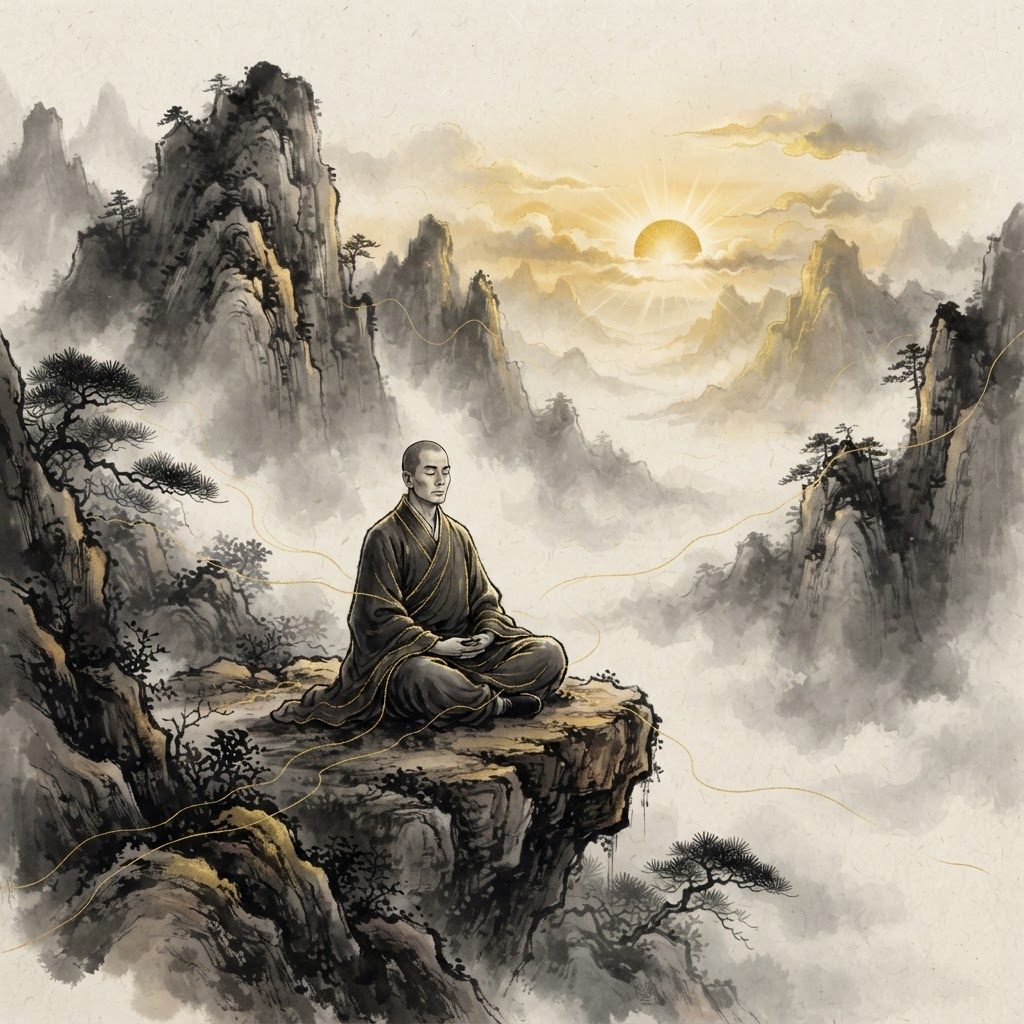
The Chinese phrase is 静坐 (jing zuo), sometimes written as jing zu. Jing means stillness or quiet. Zuo means sitting. Together they mean sitting in stillness, which sounds simple enough until you actually try it. Your knee hurts. Your phone buzzes. You remember you left the stove on. The mind does not want to be still, and that resistance is the whole point of the exercise.
What Jing Zu Actually Is
Jing zu is the Daoist counterpart to Buddhist sitting meditation, but with a different flavor. Where Buddhist vipassana focuses on observing sensations and thoughts as they arise, jing zu leans toward letting them dissolve. The practitioner sits, allows the internal noise to settle like sediment in a glass of muddy water, and rests in what remains when the thinking mind quiets down.
The classical source is the passage in the Zhuangzi where Yan Hui tells Confucius he has forgotten benevolence and righteousness, then forgotten rites and music, and finally he has forgotten everything. Confucius says, “You and I both become followers now.” (I am paraphrasing from memory, do not treat this as a precise quote.) The point is not amnesia. The point is dropping the constructs that separate you from direct experience.
Stillness is not the absence of thought. It is what remains when you stop chasing every thought that shows up at the door.
The Sitting Posture: Practical and Honest
You do not need a lotus position. I say this because I sat through too many workshops in my twenties where the instructor spent the first thirty minutesAdjusting people’s knees. If you can sit cross-legged on a cushion, good. If you need a chair, use a chair. The spine should be upright but not rigid, the shoulders relaxed, the chin slightly tucked. Hands rest in the lap, one palm on the other, thumbs lightly touching or not.
The traditional Daoist posture instructions go into tongue position (touching the roof of the mouth behind the teeth, to connect the conception and governing vessels), eye position (half-open, gazing at a point about three feet in front of you on the floor), and breathing (through the nose, slow, abdominal). These details matter, but they should not become a checklist that keeps you anxious about getting it right. Start with: sit up, relax, breathe.
| Posture Element | Traditional Instruction | Modern Practical Version |
|---|---|---|
| Base | Full lotus or half lotus on a flat cushion | Chair with both feet flat on the floor, or a cushion cross-legged |
| Spine | Upright, suspended by an invisible thread from the crown | Tall but relaxed, natural lower-back curve |
| Eyes | Half-open, gaze unfocused on the floor ahead | Closed if you are visual, half-open if you tend to fall asleep |
| Tongue | Tip touching the upper palate behind the front teeth | Optional; try it, keep it if it helps settle breathing |
| Hands | Mudra with left palm on right, thumbs forming a circle | One hand resting in the other in the lap |
| Breathing | Reverse breathing, drawing qi to the lower dantian | Natural nasal breathing, let it slow on its own |
The Method: What to Do Once You Are Sitting
Here is the part every beginner asks about. What do I actually do? The honest answer is: not much, and that is the hard part. But for a beginner, a structure helps. Here is one I use, adapted from traditional instructions but stripped of the jargon.
The Five-Step Jing Zu Cycle
- Settle (2 minutes): Sit. Close your eyes or lower your gaze. Let your body find its natural stillness. Do not force relaxation. Just notice where you are tense and let it be.
- Follow the Breath (5 minutes): Notice the breath moving in and out through the nose. When you notice you are thinking, come back to the breath. Do not fight the thoughts. Just return.
- Drop the Anchor (3 minutes): Stop following the breath. Let it breathe itself. Sit in the space that opens up. If thoughts arise, let them pass without engaging.
- Rest (remaining time): Abide in whatever stillness has appeared. It may be shallow or deep. It does not matter. You are sitting, and that is the practice.
- Return (2 minutes): Slowly open your eyes. Wiggle your fingers and toes. Notice the room. Stand up gently. Go about your day.
If you sit for twenty minutes, that cycle fits roughly. If you sit for ten minutes, compress it. The proportions matter more than the exact durations. The key transition is from step two to step three: you stop following the breath and let the attention rest in the stillness rather than on an object. That is the specifically Daoist move in jing zu, and it takes practice.
What Stillness Is and Is Not
People come to meditation expecting bliss, visions, or a blank mind. None of those are the goal, and chasing them is a reliable way to make sure they do not happen. Stillness in the jing zu sense is closer to silence after a loud noise. The noise is your ordinary mental habit. Stillness is what you hear underneath it once you stop adding more noise.
It is also not sleepiness. If you find yourself nodding off, open your eyes, straighten the spine, or shorten the session. If you find yourself in a dull, foggy state that feels pleasant but vacant, that is lethargy (the Daoists called it falling into the yin), and it is a common detour. The quality you are looking for is alert and quiet, not sleepy and comfortable.
| Experience | What It Probably Is | What to Do |
|---|---|---|
| Rushing thoughts | Normal, especially at the start | Return to the breath, do not fight |
| Sleepiness or fog | Dullness, too much yin | Open eyes, sit straighter, shorter sessions |
| Restlessness or itching | Body adjusting to stillness | Sit through it if you can, adjust if you must |
| Calm alertness | The target state | Enjoy it, but do not grab it |
| Visions or lights | Mind generating content (ignore it) | Do not chase or fear them, return to sitting |
Why Cultivation Comes Before the Other Four Arts
In the classical Five Arts, Shan is placed first. Not because it is the most impressive, but because it is the foundation. If you want to read a BaZi chart accurately, you need a mind that can hold focus. If you want to cast a Qi Men Dun Jia hour chart for a client, you need a mind that can sit still long enough to frame one clean question. If you read faces for a living, you need a mind that observes without projecting.
I noticed this in my own practice. When I sit for twenty minutes before a https://dougleschan.com/qimen-destiny/bazi-reading-under-qi-men-dun-jia-dougles-chan/ reading, my analysis is measurably better. I see options I would have missed when I was distracted. I am less likely to jump to the conclusion the client is hoping for. The stillness is not mystical. It is practical. It clears the desk before you start working.
A practitioner who cannot sit still will project their own noise onto every chart they read. The art begins with the artist.
Sitting and Forgetting in Everyday Life
You do not need a cushion, a temple, or a free morning to practice. The essence of zuo wang is dropping the mental scaffolding that separates you from the present moment. You can do that for thirty seconds at a traffic light, or for two minutes in the bathroom at work before a difficult meeting.
I used to joke with my team that the most important fifteen minutes of my workday were the fifteen minutes I spent doing nothing before a client call. It was not really a joke. I would sit, close my eyes, let go of the previous meeting, let go of what I wanted from the next one, and just be there. My conversion rates went up. Not because of any mysterious energy, but because I was actually listening instead of rehearsing.
How Long Until You Notice Something?
Most people who sit daily for two weeks notice a small but real shift. They are slightly less reactive. They sleep slightly better. They find a pause between a trigger and their response that was not there before. That pause, small as it is, is the entire reason the classical practitioners insisted on cultivation before divination or healing. A person with a pause can choose. A person without one just reacts.
| Timeframe | What Many People Report |
|---|---|
| First few sessions | Restlessness, boredom, surprise at how busy the mind is |
| Two weeks of daily practice | Slightly less reactive, small improvements in sleep and focus |
| Two months | A noticeable gap between trigger and response, better concentration |
| Six months or more | A baseline of calm that persists under pressure, clearer intuition |
Frequently Asked Questions
Do I need to be Daoist or religious to practice jing zu?
No. Jing zu is a sitting practice that comes from the Daoist tradition, but it does not require any beliefs or rituals. You can be atheist, Buddhist, Christian, or anything else and still benefit from sitting still.
How is this different from Buddhist meditation?
In practice, the sitting posture and basic method overlap a lot. The main difference is the flavor of the instructions: Buddhist meditation tends to emphasize observing what arises, while jing zu leans toward letting go of the observational framework itself and resting in what remains. For a beginner, the distinction does not matter much.
Should I sit before or after meals?
Neither on a full stomach nor when starving. Twenty to thirty minutes after a light meal, or before eating, works for most people. Listen to your body.
Can I practice jing zu if I have physical limitations?
Yes. A chair is perfectly fine. The practice is about the mind, not the flexibility of your knees. If sitting is impossible, you can practice lying down, though you are more likely to fall asleep.
What if my mind never gets quiet?
The goal is not a silent mind. The goal is a mind that does not chase every thought. If your mind stays busy but you stop getting dragged around by it, that is progress. The quiet comes and goes. The practice is showing up.
Is there a best time of day to practice?
Early morning is traditional and works well because the mind is fresh. But the best time is whatever time you will actually do it consistently. For some people that is before bed. For working parents it might be the ten minutes between the school run and the first meeting.
Should I combine jing zu with other Chinese metaphysics practices?
It pairs naturally with all of them. Sitting before a Five Arts reading or a https://dougleschan.com/qimen-destiny/bazi-reading-under-qi-men-dun-jia-dougles-chan/ destiny analysis sharpens the mind that does the reading. But you can also just practice it on its own. It does not need to be part of anything else.
Leave a Reply
You must be logged in to post a comment.