
The yarrow stalk method is the slow way to cast an I Ching reading. That is not a flaw. It is the point. In the thirty years I spent in business, I learned that most bad decisions were made in a hurry. The yarrow stalk method is the opposite of hurry. It takes time. It demands patience. And in that patience, something shifts in how you hold the question.
This guide walks through the full process. If you have only used coins before, this will feel different. Slower, more deliberate, and I think more revealing of your own inner state. Not because the resulting hexagram is different. The hexagram might be the same. But the path to it strips away what you thought you wanted to ask and leaves what you actually need to ask.
What You Need
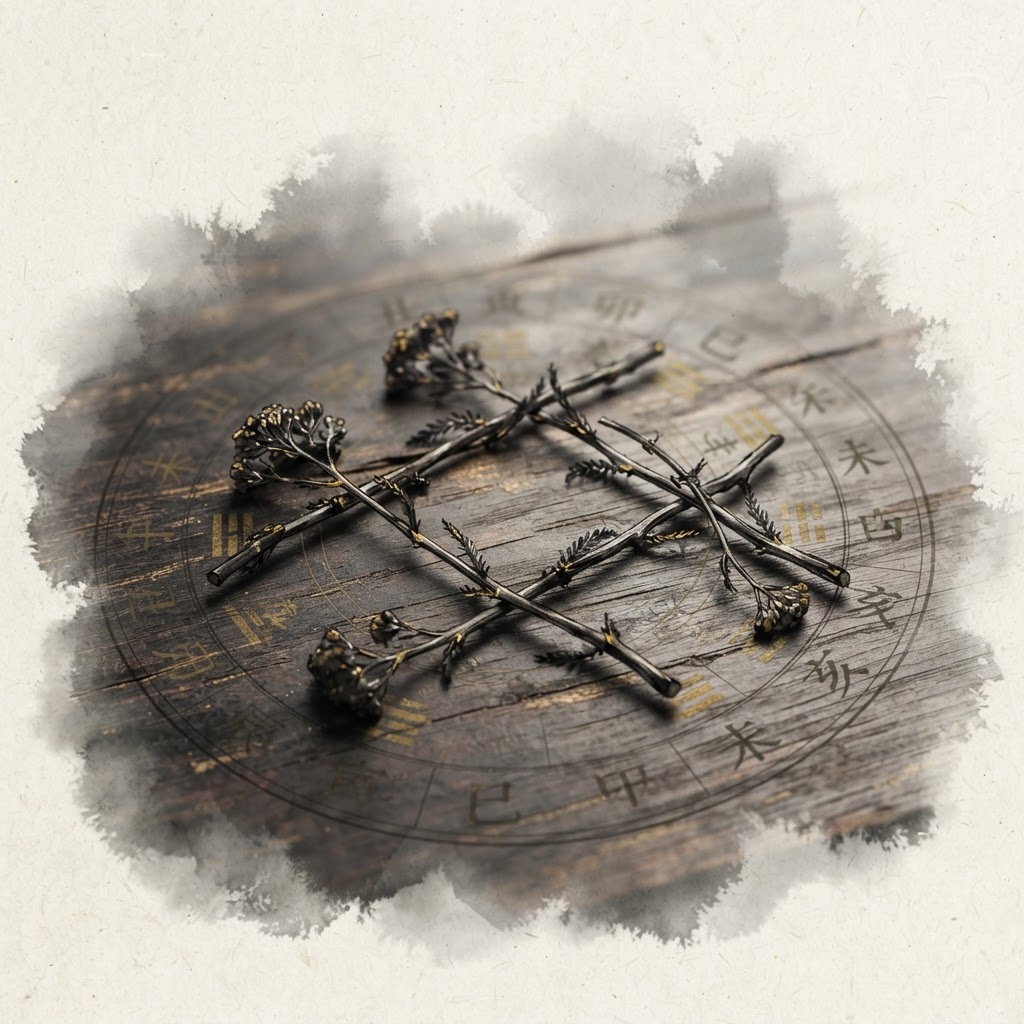
Traditionally, the method uses fifty stalks of yarrow (Achillea millefolium). If you cannot find yarrow, bamboo skewers or even wooden chopsticks work. The material matters less than the act. What matters is that you have fifty thin sticks and a flat surface to work on.
Some teachers say forty-nine stalks are used and one is set aside. That fiftieth stalk represents the totality, the Dao itself, which does not participate in the division. It is a beautiful detail, and I like it, but it is not essential for a functional reading.
| Item | Purpose | Alternatives |
|---|---|---|
| 50 yarrow stalks | Counting and dividing | Bamboo skewers, wooden sticks, even paper strips |
| Flat surface | Spreading the stalks | A table, a cloth on the floor, a tray |
| Pen and paper | Recording the hexagram as you build it | A dedicated I Ching journal is ideal |
| Your question | Written down, clear and specific | One question only, not a list of worries |
The Mental Preparation
Before you touch the stalks, sit quietly for a moment. Not a long meditation, just a pause. Let the day’s noise settle. Hold your question in your mind. Not as a desperate plea for an answer, but as a genuine inquiry. “What do I need to understand about this situation?”
The Casting Process: Building One Line
Each of the six lines of the hexagram is built through one full round of the yarrow stalk process. You repeat the round six times, building from the bottom line upward. Here is one round, step by step.
One Round of the Yarrow Stalk Method
Step 1: Take all 50 stalks. Set one aside. You now have 49.
Step 2: Divide the 49 stalks into two piles at random. Left pile and right pile.
Step 3: Take one stalk from the right pile and place it between your ring finger and little finger of your left hand.
Step 4: Count the left pile in groups of four. Set aside the remainder (1, 2, 3, or 4 stalks). Hold this remainder between your ring and middle fingers.
Step 5: Count the right pile in groups of four. Set aside the remainder. Hold it between your middle and index fingers.
Step 6: You now have three remainders held in your fingers. Their combined count is either 9 or 5. This is the first count. Set these stalks aside.
Step 7: Take the remaining stalks (either 40 or 44). Repeat the process: divide, take one from right, count left by fours, count right by fours. The second count gives a remainder of 8 or 4.
Step 8: Repeat a third time with what remains. The third count also gives 8 or 4.
Step 9: Combine the three counts. The result determines the line:
- 5 + 4 + 4 = 13 -> Old Yang (9, solid, changing)
- 9 + 8 + 8 = 25 -> Old Yin (6, broken, changing)
- 5 + 4 + 8 = 17 or 5 + 8 + 8 = 21 -> Young Yang (7, solid, stable)
- 9 + 4 + 4 = 17 or 9 + 8 + 4 = 21 -> Young Yin (8, broken, stable)
That gives you one line. Write it down. Then repeat the entire process five more times to build the hexagram from the bottom up. It sounds complicated on paper. After a few rounds, your hands learn the rhythm and it flows naturally.
The stalks slow you down enough to actually hear the question you are asking. That is their real function. The hexagram is a byproduct of that listening.
Why the Stalk Method Produces Different Probabilities
The yarrow stalk method does not give each line type equal chances. Because the counting involves groups of four and the remainders depend on how the stalks were split, the probabilities skew. Old Yang and Old Yin each come up about 1 in 16 lines, not 1 in 8 as with coins. This means fewer changing lines overall.
| Line Type | Coin Method | Yarrow Stalk Method |
|---|---|---|
| Old Yang (9, changing) | 12.5% | ~6.25% |
| Young Yang (7, stable) | 37.5% | ~50% |
| Young Yin (8, stable) | 37.5% | ~37.5% |
| Old Yin (6, changing) | 12.5% | ~6.25% |
| Total changing lines | 25% | ~12.5% |
The practical effect: yarrow stalk readings tend to be more static. You get fewer changing lines, which means the primary hexagram is usually the whole reading. With coins, you often get one or two changing lines, which means you also read the transformed hexagram. Both approaches work. The stalk method gives a steadier, more meditative reading. The coin method gives a more dynamic, situation-specific one.
How Slower Casting Changes Your Relationship to the Question
This is the part I care about most. When you cast with coins, the entire process takes two minutes. The question you hold at the start is the question you get. But when you use the stalks, you spend thirty minutes with the question. Your mind turns it over. By the third line, you may realize your question was wrong. By the fifth, you may see the answer forming before the hexagram is even complete.
I have had readings where the hexagram confirmed what I already understood by line four. And I have had readings where the hexagram surprised me, and the surprise was valuable precisely because the slow casting had cleared away my assumptions.
In business, we call this kind of slow processing “strategic thinking.” We pretend it happens in meetings, but it usually happens alone, with a piece of paper and a cup of tea. The yarrow stalk method is a structured version of that same aloneness. It gives the question the dignity of your full attention.
Related Reading
- How to Cast an I Ching Reading: Coins, Stalks and Interpretation (parent guide)
- I Ching / Book of Changes: The Complete Guide (pillar page)
- Using the I Ching in Modern Life: Decisions, Timing and Reflection
- Qi Men Dun Jia Hour Chart Explained
The Stalk Method as a Daily Practice
Some practitioners cast daily, first thing in the morning, as a way of taking the day’s temperature. I do not do this every day, but I did it for about six months when I was learning, and the effect was profound. Not because the hexagrams told me what would happen. Because the act of sitting for thirty minutes before the day began trained my mind to be slower, more deliberate, more observant.
In a world that rewards speed, the yarrow stalk method is a deliberate counterweight. It says: this question is worth thirty minutes of your undivided attention. If the question is not worth thirty minutes, perhaps it is not the right question to be casting about in the first place.
I eventually moved to casting weekly, on Sunday mornings. That rhythm suits my life. You will find your own. But I recommend trying daily casting for at least a month when you first learn the method. It builds the muscle memory, both in your hands and in your mind.
| Practice Level | Frequency | What It Develops |
|---|---|---|
| Beginner (first 3 months) | Daily or every other day | Muscle memory, question formulation, familiarity with all 64 hexagrams |
| Intermediate (3-12 months) | Weekly or when a real question arises | Pattern recognition, comfort with changing lines, journaling discipline |
| Experienced (1+ years) | Monthly or for significant decisions | Integration with other analytical tools, reading subtlety, trust in the process |
Translating the Stalk Method Into Decision-Making Language
When I advise business owners, I sometimes share how I use the I Ching. Not as a fortune-telling tool, but as a framing tool. The stalk method, in particular, does something that spreadsheets cannot: it forces you to sit with ambiguity until it resolves into clarity.
In a business negotiation, for example, the question is rarely “Should I take this deal?” It is usually something more nuanced: “What am I not seeing in this offer?” or “Where is the other party’s pressure point?” The stalk method’s slow, rhythmic counting gives your subconscious time to surface what it already knows. When I finish a reading, I often find that the hexagram matters less than the clarity I reached while counting.
That is the honest value of this practice. The stalks are a tool for thinking, not a machine for predicting. If you approach them that way, you will get far more out of them than if you treat the hexagram as a fixed answer.
One more thought. The yarrow stalk method is not about romanticizing the past. I am not suggesting that ancient methods are inherently better than modern ones. I am suggesting that slowness has a value that speed cannot replicate. In a culture that treats speed as a virtue, the deliberate pace of the stalks is a corrective. It reminds us that some questions deserve our full attention, and that full attention takes time. If you have never tried it, give it one month. You may be surprised by what you learn in the silence between the counting.
This article is part of my series on how to cast an I Ching reading, under the I Ching / Book of Changes guide. Related articles in this series:
- The Three Coin Method Deep Dive
- How to Formulate I Ching Questions
- How to Interpret Changing Lines
- The Eight Trigrams (Bagua)
Frequently Asked Questions
How long does a yarrow stalk reading take?
About 25 to 35 minutes for a full six-line hexagram. The time depends on how quickly you count. The slowness is intentional, not a flaw.
Do I need actual yarrow stalks?
No. Bamboo skewers, wooden sticks, or even paper strips will work. The material is less important than using fifty objects of the same type.
Is the yarrow stalk method more accurate than coins?
It produces different probability distributions, which means fewer changing lines. Whether that makes it “more accurate” depends on what you want. The stalk method tends to give steadier readings. The coin method tends to give more dynamic ones. Both are legitimate ways to cast.
Can I learn this from a book or video?
Yes. The mechanical steps are learnable in an afternoon. The real learning is in the months and years of practice afterward. Your hands learn the rhythm, and the ritual deepens naturally.
What if I lose count during the process?
Start that line over. Losing focus is information. It usually means your mind wandered from the question. Pause, return to the question, and begin the round again.
Leave a Reply
You must be logged in to post a comment.