The Eight Trigrams (Bagua): Elemental Energies and Hexagram Structure
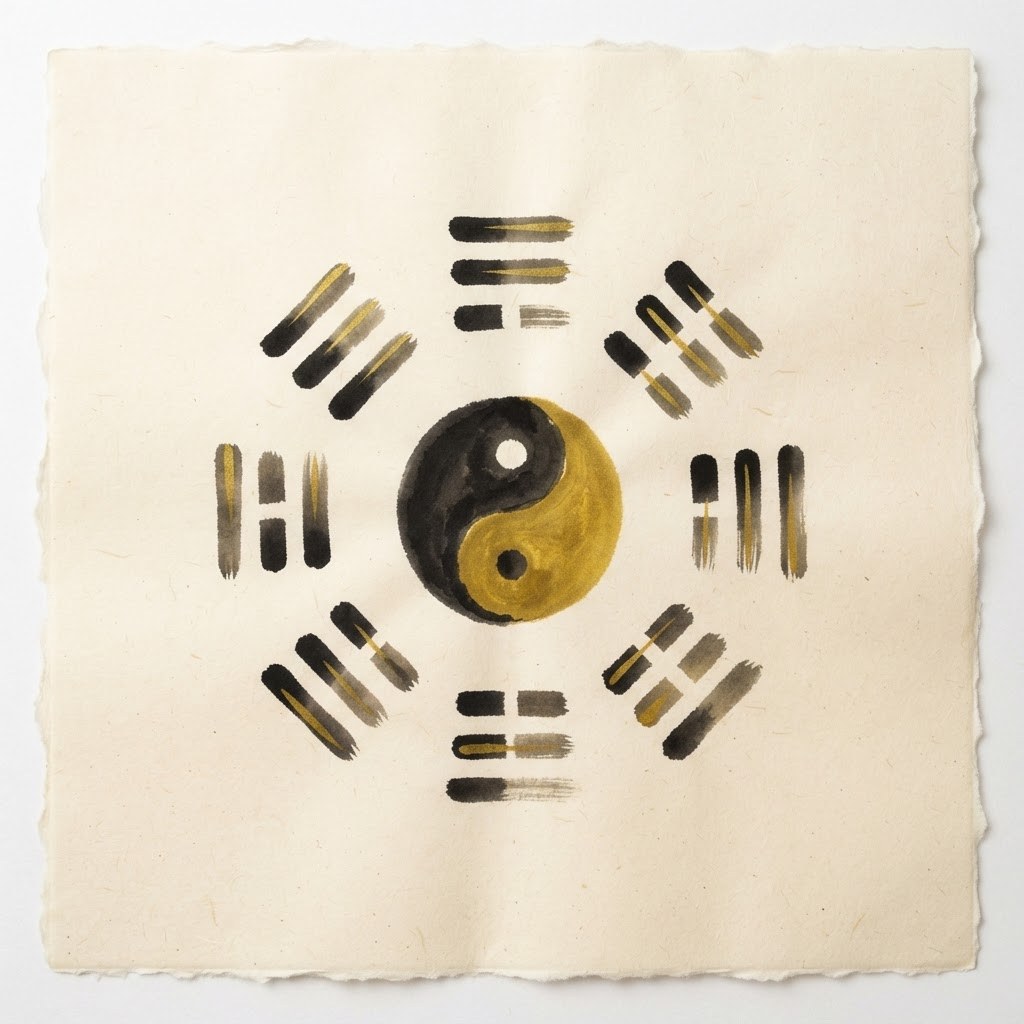
Everything in the I Ching starts with eight simple pictures. Three lines each, either broken or solid, stacked from bottom to top. That is it. Eight trigrams, and from those eight, all sixty-four hexagrams of the I Ching are built.
I came to the trigrams through Qi Men Dun Jia, where the eight directions, eight doors, and eight trigrams structure the entire chart. When I started teaching QMDJ, I realized my students needed to understand the trigrams first, because the trigrams describe elemental energies that show up everywhere in Chinese metaphysics. The trigrams are the alphabet. Learn the alphabet and the rest starts making sense.
This article is a practical guide to the eight trigrams: their names, their elements, their qualities, and how they combine into hexagrams. Whether your interest is I Ching divination or comparing I Ching with QMDJ, this is foundational material.
The Eight Trigrams at a Glance
Each trigram has three lines. A solid line is yang (active, bright, firm). A broken line is yin (receptive, dark, yielding). The arrangement of these three lines gives each trigram its character. In the traditional King Wen arrangement, they are paired as opposites: Heaven with Earth, Water with Fire, Mountain with Lake, Thunder with Wind.
| Trigram | Chinese | Pinyin | Element | Lines | Quality |
|---|---|---|---|---|---|
| Heaven | 乾 | Qian | Metal | = = = | Creative, strong, initiating |
| Earth | 坤 | Kun | Earth | – – – | Receptive, yielding, nourishing |
| Thunder | 震 | Zhen | Wood | = bottom, – top | Arousing, movement, shock |
| Water | 坎 | Kan | Water | – = – | Dangerous, flowing, deep |
| Mountain | 艮 | Gen | Earth | – – = | Still, resting, boundary |
| Wind | 巽 | Xun | Wood | = – – | Penetrating, gentle, pervasive |
| Fire | 离 | Li | Fire | = – = | Brilliant, clinging, illuminating |
| Lake | 兑 | Dui | Metal | – – = with changed bottom | Joyful, open, communicative |
Where = means a yang (solid) line and – means a yin (broken) line, reading bottom to top. The exact visual pattern of each trigram is easier to see with the traditional bagua diagram, but the key point is that each trigram combines an element with a quality of movement.
The trigrams are not arbitrary symbols. They describe real energies: the shock of thunder, the persistence of water, the stillness of a mountain. The I Ching asks you to feel which of these energies is present in your situation, then read accordingly.
How Trigrams Combine Into Hexagrams
A hexagram is two trigrams stacked: a lower trigram and an upper trigram. The lower trigram describes the inner or foundational aspect of the situation. The upper trigram describes the outer or environmental aspect. Together, they create a picture of a situation from inside out.
For example, hexagram 11 (Tai, Peace) is Earth above Heaven. Earth (receptive) on top, Heaven (creative) on the bottom. The creative energy is below, pushing upward, while the receptive energy is above, descending to meet it. Harmony. Communication. Things flowing well.
Its opposite, hexagram 12 (Pi, Standstill), is Heaven above Earth. The creative energy rises upward and away, while the receptive energy descends and away. They move apart. Stagnation. Things not communicating.
The Combination Grid
The 64 hexagrams come from pairing each of the 8 trigrams with each of the 8 trigrams (including itself). That gives 8 x 8 = 64 combinations. The lower trigram sets the foundation; the upper trigram sets the context. This grid is the structural heart of the I Ching.
Trigrams in Chinese Metaphysics Beyond the I Ching
The eight trigrams show up everywhere in Chinese metaphysics, and this is why understanding them pays off beyond I Ching readings:
- In Feng Shui: The bagua map places each trigram in a direction, associated with a life area (wealth, relationships, career). See the Five Arts of Chinese Metaphysics for the broader context.
- In QMDJ: The eight trigrams correspond to the eight directions in the hour chart, each carrying a door, a star, a stem and a spirit. The trigram tells you the elemental character of that direction.
- In BaZi: The hidden stems and seasonal elements relate to trigram energies. Understanding trigrams helps you see the elemental story beneath a BaZi chart.
The Pre-Heaven and Post-Heaven Arrangements
There are two arrangements of the eight trigrams that you will encounter. The pre-heaven (Xian Tian) arrangement, attributed to Fu Xi, places the trigrams in a circle of opposites. Heaven is at the top, Earth at the bottom, Fire and Water on the sides. This arrangement represents ideal balance, the cosmic pattern before manifestation.
The post-heaven (Hou Tian) arrangement, attributed to King Wen, places the trigrams in a sequence that reflects seasonal and directional cycles. Thunder (spring) is in the east, Fire (summer) in the south, Lake (autumn) in the west, Water (winter) in the north. This arrangement represents the world as it unfolds in time and space.
| Arrangement | Attributed to | Represents | Used in | Key feature |
|---|---|---|---|---|
| Pre-Heaven (Xian Tian) | Fu Xi | Ideal balance | Cosmology, theory | Opposites paired as mirror images |
| Post-Heaven (Hou Tian) | King Wen | Seasonal cycle | Feng Shui, practical application | Seasons and directions ordered |
You do not need to master both to work with the I Ching, but the distinction matters if you go deeper into feng shui or QMDJ, where the directional placements follow the post-heaven arrangement.
Reading the Trigrams in Your Hexagram
When you cast a hexagram, look at the two trigrams and ask yourself:
- What is the lower trigram saying about the inner situation? (The foundation, your inner state, the seed of the matter)
- What is the upper trigram saying about the outer situation? (The environment, what surrounds you, the visible expression)
- How do they interact? (Do they flow toward each other or away? Does the inner support the outer, or the outer press down on the inner?)
This three-part reading gives you a feel for the hexagram before you even look at the text. The Judgment gives you the traditional interpretation, but your trigram-level analysis gives you the intuitive ground to see how the Judgment applies to your specific situation.
I tell my students: read the trigrams like you read a room. The lower trigram is what is happening under the surface. The upper trigram is what everyone can see. The gap between them is the tension, and that tension is usually where your work is.
Each Trigram in More Detail
Let me go through each trigram with a bit more texture, because the associations are what make them useful in practice. I will keep this brief and practical rather than exhaustive. Scholars have written whole books on each one.
Qian (乾, Heaven): Three solid lines. Pure yang. The image is the sky at noon, vast and unobstructed. Qian is the initiating force, the impulse to create, the father figure in the trigram family. In a reading, Qian below means the situation is driven by strong, assertive energy. Qian above means the environment expects leadership and decisive action. When Qian appears, the question is usually about whether to act boldly or to wait. The temptation with pure Qian is to overextend, to confuse initiative with recklessness. The I Ching frequently advises those in a Qian position to use their strength with awareness of its limits.
Kun (坤, Earth): Three broken lines. Pure yin. The image is the open field, receptive to everything. Kun is the nourishing force, the mother figure, the capacity to absorb and sustain. In a reading, Kun below means the foundation is supportive and patient. Kun above means the environment is yielding, perhaps too yielding. The challenge with Kun is passivity: receiving is powerful, but there is a difference between opening to receive and collapsing into inertia.
Zhen (震, Thunder): Yang line at the bottom, two yin lines above. The image is the first thunder of spring, breaking through frozen ground. Zhen is the arousal, the shock that wakes things up. In a reading, Zhen means something sudden is beginning. It can be alarming, but the alarm is the energy that gets things moving. If your hexagram’s lower trigram is Zhen, look at what is stirring in the foundations. If upper, expect something unexpected from the outside.
Kan (坎, Water): Yang line in the middle, yin lines top and bottom. The image is water flowing through a ravine, deep and potentially dangerous. Kan is associated with danger, but also with depth and persistence. Water always finds a way through. In a reading, Kan points to risk, but also to the wisdom of flow: do not fight the obstacle, go around it, under it, through it. The key with Kan is not to panic. The danger is real, but panic makes it worse.
Gen (艮, Mountain): Yang line on top, two yin lines below. The image is a mountain: still, solid, unmoving. Gen is the energy of stopping, resting, meditating. In a reading, Gen often means: this is not the time to act. Pause. Reflect. Set a boundary. In my experience, Gen appears most often for people who have been pushing too hard. The trigram itself is the medicine: stop.
Xun (巽, Wind): Yin line at the bottom, two yang lines above. The image is wind penetrating through trees. Xun is gentle, pervasive, gradual. It does not force; it seeps in. In a reading, Xun means influence through consistency rather than force. If you need to change someone’s mind or shift a culture, Xun says: be like the wind, gentle and persistent. It takes longer, but it works.
Li (离, Fire): Yin line in the middle, yang lines top and bottom. The image is fire clinging to its fuel, illuminating what it touches. Li is associated with clarity, awareness, and attachment (fire needs fuel, it clings). In a reading, Li means the situation calls for clarity and illumination. See things as they are. The danger with Li is becoming too attached to what you see, mistaking the light for the thing itself.
Dui (兑, Lake): Yin line on top, two yang lines below. The image is a still lake surface reflecting the sky. Dui is associated with joy, communication, openness. In a reading, Dui means the situation benefits from honest expression and good faith. It is the most social trigram. Its caution is superficiality: a pleasant surface can hide shallow depths.
The trigrams give you a vocabulary for energy. When I read a QMDJ chart, I am looking at where Thunder sits (movement), where Mountain sits (stillness), where Water sits (risk). The names change across systems, but the energies are the same. Learn them once and they serve you everywhere.
Frequently Asked Questions
Do I need to memorize all eight trigrams?
Not memorize, but get familiar with them. Start with the four cardinal pairs: Heaven and Earth (the creative and the receptive), Water and Fire (the two most referenced), Mountain and Lake (stillness and joy), Thunder and Wind (arousal and penetration). Most hexagram interpretations make more sense once you can see these energies in play.
What is the difference between a trigram and a hexagram?
A trigram has three lines. A hexagram has six lines, made of two trigrams stacked. The trigrams are the building blocks, the hexagrams are the combinations.
Why are the trigrams associated with elements?
The elemental associations come from the natural imagery each trigram represents. Thunder is associated with wood (growth, spring). Water is self-evident. Fire is self-evident. Mountain is earth. These associations were established very early in Chinese thought and carry through to feng shui, BaZi and QMDJ.
Which arrangement should I use for I Ching readings?
For I Ching divination, the King Wen sequence of hexagrams (which is what most translations use) already incorporates the post-heaven directional logic. You do not need to choose an arrangement. The arrangements become relevant when you apply the trigrams to space (feng shui) or time (QMDJ).
How do the trigrams connect to the five elements?
Each trigram is associated with one of the five elements: Qian and Dui are metal, Kun and Gen are earth, Zhen and Xun are wood, Kan is water, Li is fire. This creates a bridge between the trigram system and the five-element cycle that underlies most of Chinese metaphysics.
Related Reading
This article is part of my series on the I Ching / Book of Changes. For the complete hexagram reference, see the 64 hexagrams explained. For the casting process, see how to cast an I Ching reading. For the broader context of Chinese metaphysics, see the Five Arts.
Leave a Reply
You must be logged in to post a comment.