
Casting an I Ching hexagram and reading a Qi Men Dun Jia hour chart are two of the most powerful divination methods in Chinese metaphysics, yet they answer fundamentally different questions. If you have ever wondered which one to reach for when a decision is on the line, this comparison will give you a clear framework.
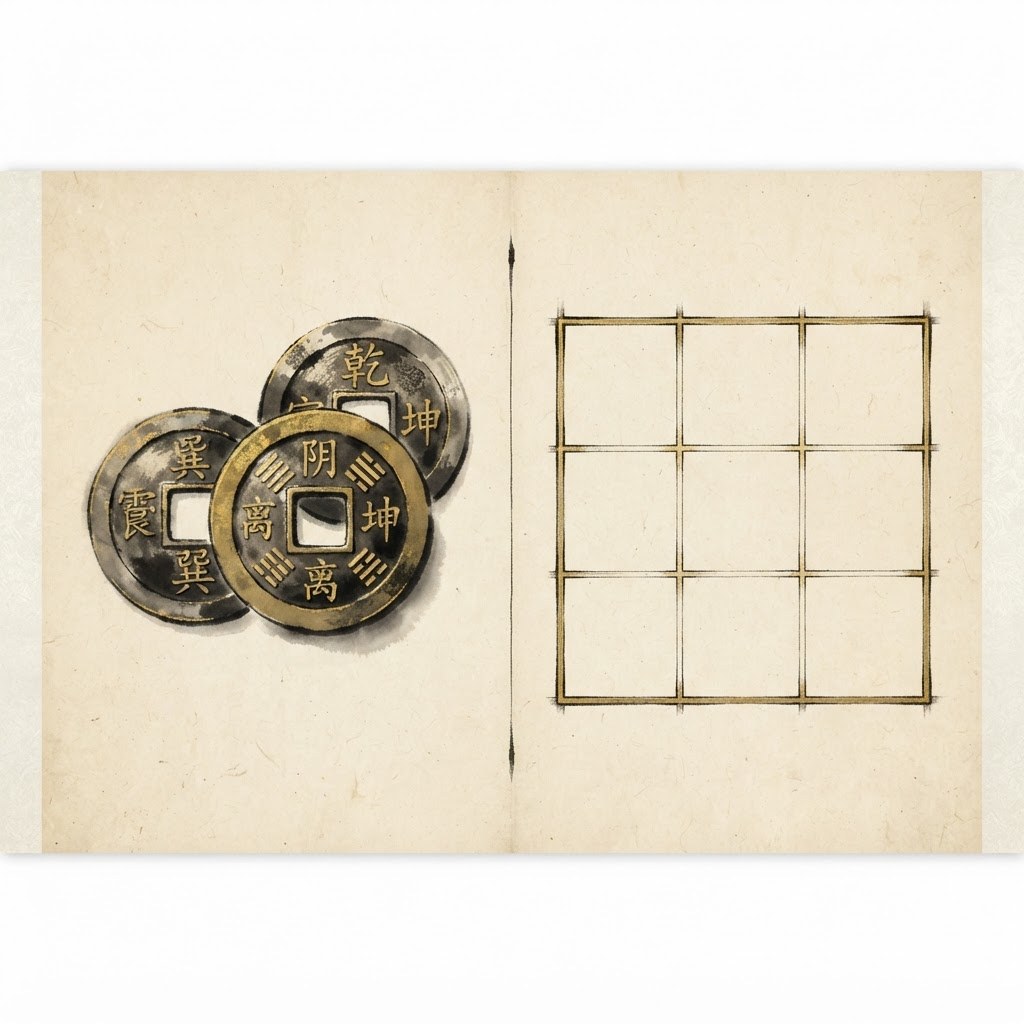
Both systems are built on the same cosmological foundations: yin and yang, the five elements (五行), the eight trigrams (八卦), and the 60-cycle of heavenly stems and earthly branches. But they diverge in how they generate answers, what they can tell you, and when each one is the better choice.
The Core Difference: Synchronicity vs. Spatial-Temporal Mapping
The I Ching works through synchronicity. You ask a question, cast coins or sort yarrow stalks, and the hexagram you receive reflects the energy pattern of that moment of inquiry. The answer is symbolic. You interpret the judgment text, the image text, and any changing lines to extract guidance.
Qi Men Dun Jia, by contrast, is a spatial-temporal system. Instead of casting, you compute a chart based on the exact date, time, and sometimes location. The chart maps nine palaces, each containing a door, a star, a god, and a stem. You read which palace is most favorable for your purpose, which directions to face, and which timing windows offer the best conditions.
| Aspect | I Ching (易经) | Qi Men Dun Jia (奇门遁甲) |
|---|---|---|
| What it answers | What is the energy of this situation? What should I consider? | When and where should I act for the best outcome? |
| Method | Casting (coins, yarrow stalks, beads) | Chart computation from date, time, location |
| Type of guidance | Symbolic, reflective, philosophical | Directional, tactical, time-specific |
| Best for | Understanding a relationship dynamic, weighing moral questions, reflecting on a crossroads | Choosing an hour to sign a contract, deciding which direction to travel for negotiations, timing a launch |
| Skill threshold | Lower. A beginner can cast and read a translation. | Higher. Chart construction requires training and practice. |
When the I Ching Is the Better Tool
The I Ching shines when the question is about understanding rather than timing. If you are weighing whether to accept a job offer, the I Ching will not tell you “go at 2pm on Thursday.” It will give you a hexagram that reflects the underlying dynamic of the situation, the risks, and the attitude you should adopt.
For questions about relationships, personal growth, or ethical dilemmas, the I Ching’s symbolic language is unmatched. Hexagram 4, Meng (蒙, Youthful Folly), might appear when you are rushing into something without enough knowledge. Hexagram 15, Qian (谦, Modesty), might show up when the situation calls for humility rather than assertiveness.
The I Ching is a mirror. It shows you the pattern you are standing inside. What you do with that reflection is still your choice.
If you want to go deeper into casting methods, my guide to casting an I Ching reading walks through the coins, stalks, and interpretation process. The three coin method deep dive covers probability and advanced technique, while the yarrow stalk guide gives the traditional ritual walkthrough.
When QMDJ Is the Better Tool
Qi Men Dun Jia excels when the question is about timing, direction, and tactical execution. “When should I send this proposal?” “Which direction should I face during the negotiation?” “Is this hour favorable for signing the lease?” These are questions that the I Ching’s symbolic framework answers only indirectly, while QMDJ addresses them with precision.
A QMDJ hour chart plots nine palaces, each containing a combination of door, star, god, and heavenly stem. The Opening Door (开门) in the same palace as the Heart Star (天心星) and a favorable stem suggests that palace’s direction is excellent for commercial activity. The Rest Door (休门) with the Divine Star (天辅星) may indicate a good window for negotiations or relationship-building.
If you want to explore QMDJ further, the hour chart guide explains how to read a chart, and the QMDJ calculator lets you generate charts for any date and time.
Can You Use Both Together?
Yes, and many practitioners do. A common approach is to cast an I Ching hexagram first to understand the nature of the situation and the attitude you should bring. Then, if the answer points toward action, use a QMDJ chart to choose the most favorable timing and direction for that action.
For example, if the I Ching gives you Hexagram 14, Dayou (大有, Great Possession), suggesting abundance and favorable conditions, you might then check a QMDJ chart to find the best hour and direction for launching the product or making the investment.
| Step | System | What You Get |
|---|---|---|
| 1. Understand the situation | I Ching | Hexagram reflecting the energy pattern and advice |
| 2. Check timing and direction | QMDJ | Best palace, door, star, and directional guidance |
| 3. Review afterward | Both | Journal the outcome and compare with the original reading |
The key is to avoid superimposing one system’s logic onto the other. The I Ching does not tell you which direction to face. QMDJ does not give you a hexagram to meditate on. Each has its own language and its own strength.
A Word on Accuracy
People often ask which system is more accurate. The honest answer is that accuracy depends on the practitioner, not the system. A skilled I Ching reader who has spent years studying the texts will get more value from a hexagram than a beginner will from a perfectly computed QMDJ chart. The reverse is equally true.
Both systems are tools. A good carpenter does not ask whether the hammer or the saw is more accurate. They pick the right tool for the job.
The Philosophical Gap: Wisdom vs. Strategy
There is a deeper philosophical difference that matters in practice. The I Ching is rooted in the idea that wisdom comes from understanding the pattern of change itself. When you receive a hexagram, you are being shown the archetype of your situation, the way forces are moving, and the attitude that will serve you best. The guidance is often about who you need to be, not just what you need to do.
QMDJ, on the other hand, descends from military strategy. Its original purpose was to help generals choose the right time, direction, and formation for battle. The information is concrete: which palace holds the strongest energy, which door opens the most favorable path, which direction to avoid. It is less about self-reflection and more about positioning.
This is why the two systems complement each other so well. The I Ching helps you align your mindset with the situation. QMDJ helps you align your actions with the timing. One without the other gives you only half the picture.
Quick Comparison: Decision Framework
Use I Ching when: you need to understand a situation, weigh your options, check your assumptions, or decide whether to act at all.
Use QMDJ when: you already know what you want to do and need to optimize the when, where, and how.
Use both when: the stakes are high and you want both philosophical clarity and tactical precision.
Practical Scenarios Side by Side
Let me walk through a few real-world scenarios so you can see how each system applies differently.
Scenario 1: A Job Offer
You have received a job offer and are unsure whether to accept. The I Ching is ideal here. Cast a hexagram with a clear question like, “What is the energy of accepting this position?” The hexagram you receive will illuminate the dynamics: whether the move is timely, whether the environment is favorable, whether caution is warranted. You might receive Hexagram 53, Jian (渐, Gradual Progress), suggesting that slow, steady advancement is the right path, or Hexagram 47, Kun (困, Oppression), warning that the role may feel constraining.
QMDJ is less useful for the yes-or-no decision itself, but once you decide to accept, it can tell you the most favorable hour to sign the contract and the direction to face when you do.
Scenario 2: Launching a Product
You are preparing to launch a new service and want to choose the best time. This is QMDJ territory. An hour chart will show you which two-hour window carries the most favorable energy for commercial activity, which direction to face when you send the announcement, and which hours to avoid entirely.
The I Ching can add a layer of insight about the overall energy of the launch. Cast before you check the QMDJ chart, and the hexagram may reveal whether the market conditions are ripe or whether patience would serve you better.
Scenario 3: A Difficult Conversation
You need to have a confrontation with a business partner. The I Ching will help you understand the relational dynamics and the right emotional approach. Hexagram 6, Song (讼, Conflict), might appear, advising you to seek mediation rather than forcing a resolution. Hexagram 58, Dui (兑, Joy), might suggest that approaching the conversation with warmth rather than aggression will yield better results.
QMDJ can then tell you the most favorable hour to schedule the meeting and which seat direction to take at the table.
Think of it this way: the I Ching tells you whether to go and how to carry yourself. QMDJ tells you the precise moment and the direction to step.
Learning Curve and Accessibility
The I Ching has a gentler learning curve. With a good translation (the Wilhelm-Baynes version remains the standard in English), three coins, and a journal, you can begin receiving meaningful guidance within days. The texts are dense but accessible, and each reading deepens your understanding over time.
QMDJ requires more study before it becomes useful. You need to learn the structure of the hour chart, the meaning of the eight doors, nine stars, eight gods, and ten heavenly stems, and the rules for identifying the strongest palace. Without this foundation, the chart is just a grid of unfamiliar symbols. But once you have that foundation, QMDJ gives you something the I Ching cannot: precise, actionable timing and directional guidance.
If you are coming from the I Ching and want to bridge into QMDJ, the guide on comparing the two systems on the pillar page provides a more philosophical comparison, while the QMDJ course covers the practical foundations.
Frequently Asked Questions
Can I use the I Ching for timing decisions?
You can, but the I Ching addresses timing symbolically rather than precisely. A hexagram might suggest that patience is needed now and action is better later, but it will not name a specific hour. For precise timing, QMDJ is the better choice.
Is QMDJ harder to learn than the I Ching?
Generally yes. The I Ching can be approached with a good translation and regular practice. QMDJ requires understanding the nine palaces, the interactions between doors, stars, gods, and stems, and the rules for reading favorable and unfavorable combinations. If you are interested in learning, the QMDJ course covers the system from foundations to advanced application.
Which system should I start with?
If you are new to Chinese metaphysics, start with the I Ching. It teaches you the foundational concepts of yin and yang, the trigrams, and the five elements in a hands-on way. Once those are second nature, QMDJ becomes much easier to understand. The broader overview at the Five Arts of Chinese Metaphysics shows how both fit into the larger framework.
Do I need special tools for either system?
The I Ching needs only three coins or a bundle of yarrow stalks. QMDJ can be computed with the online calculator or by hand once you know the construction rules. Neither requires expensive equipment.
Can I combine I Ching and QMDJ with BaZi?
Yes. BaZi (八字) gives you your natal destiny pattern, the I Ching answers situational questions, and QMDJ optimizes timing and direction. Together they form a complete toolkit. The guide to I Ching vs QMDJ goes deeper into the philosophical differences between the two.
This article is part of the I Ching casting guide series in the complete I Ching pillar. Related: formulating clear questions, interpreting changing lines, the eight trigrams explained, and keeping a divination journal.
Leave a Reply
You must be logged in to post a comment.