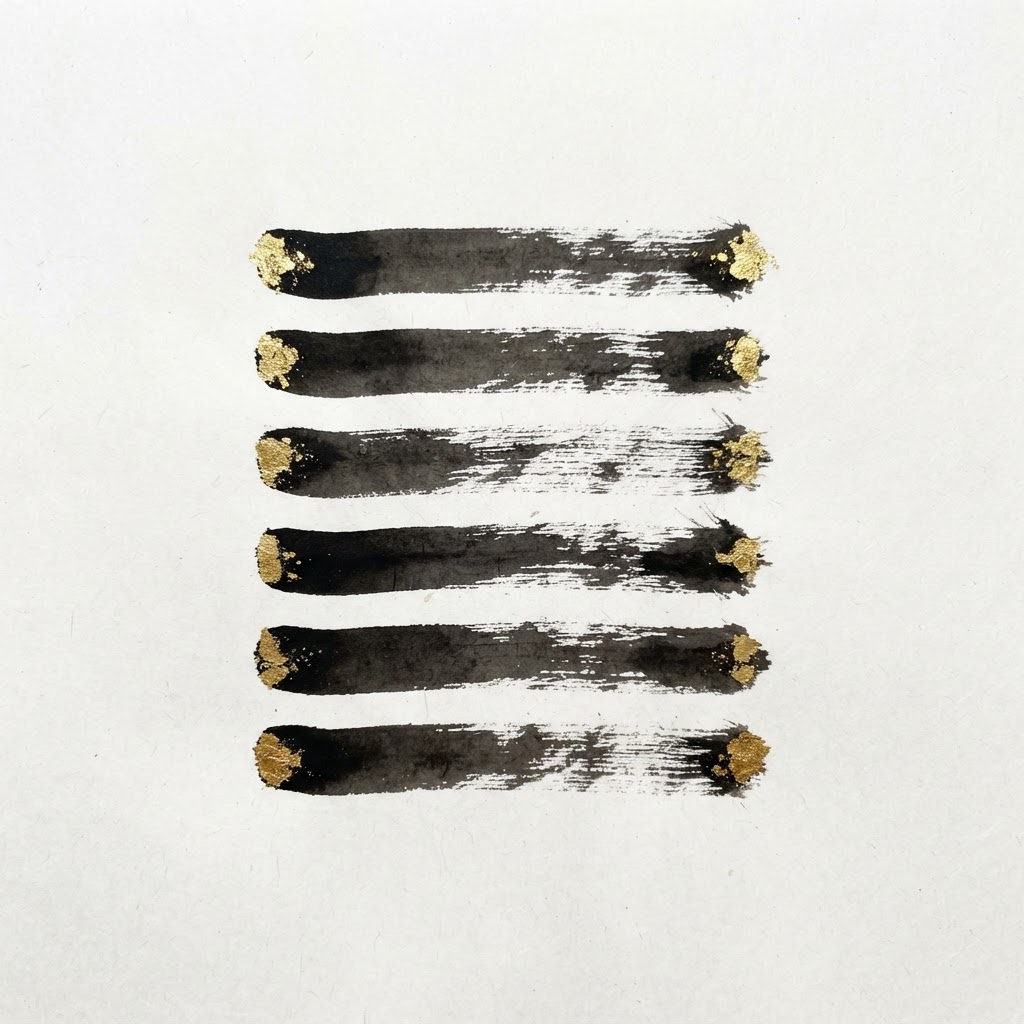
Qian is the first hexagram in the I Ching, and if you only learn one hexagram deeply, this is the one to spend time with. It is pure yang: six solid lines, all active, all pushing upward. The Chinese character is 乾, which carries the meaning of heaven, creativity, and vigorous energy. There is not a single broken line in it.
What makes Qian fascinating is not its simplicity, though. It is the fact that the Book of Changes, a text entirely built on the idea that nothing stays the same, opens with the one hexagram that appears to be all force and no flexibility. That tension, between unstoppable drive and the need to adapt, is the real teaching.
The Structure of Qian
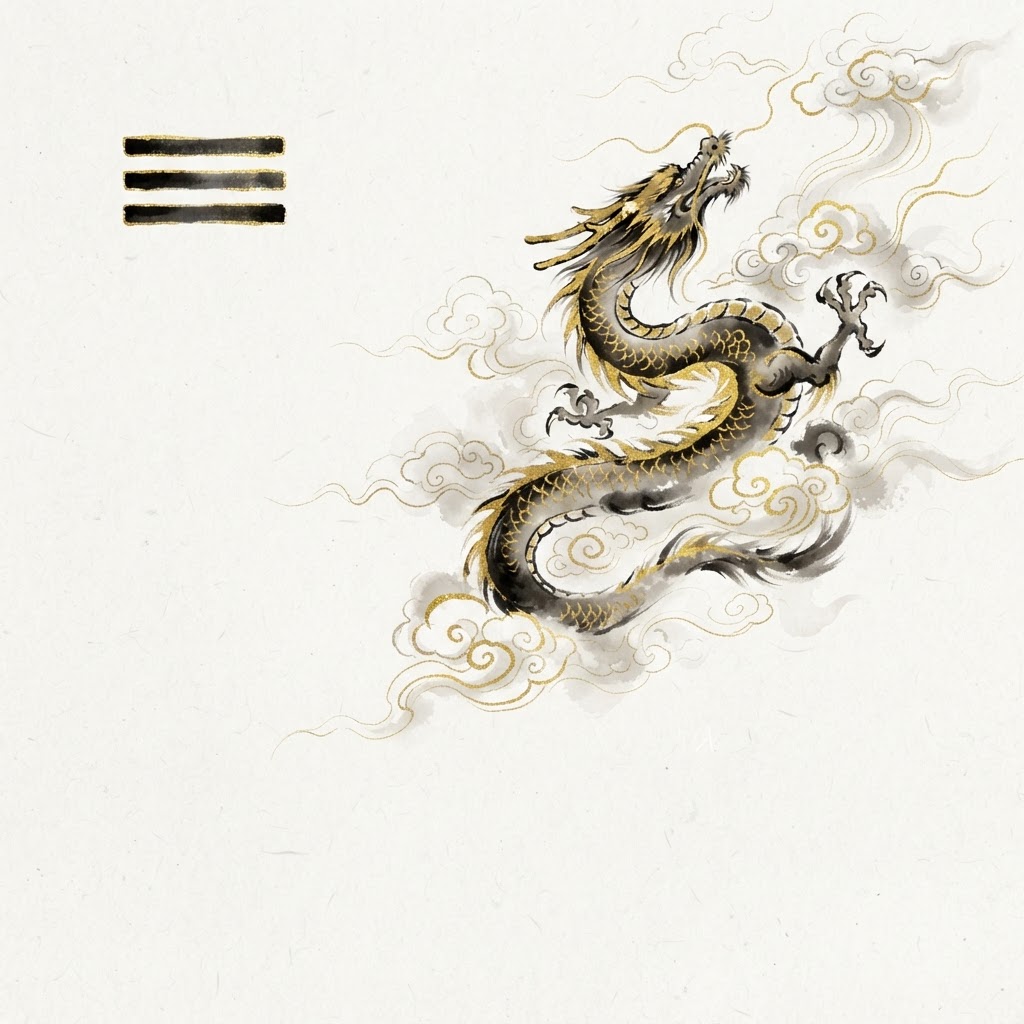
Six solid lines, bottom to top. Each line represents a stage of development, from the first tentative stirring of energy at the bottom to the moment when that same energy overreaches at the top. The hexagram is associated with heaven, the sky, dragon energy, and the season of early summer when growth is at its most intense.
Qian is the complement to Kun, hexagram 2. Where Qian is pure yang, Kun is pure yin. Where Qian creates, Kun receives. The I Ching always pairs them, and many readers see them as two halves of a single idea: creation needs a vessel to hold it, and a vessel needs something to fill it.
Qian at a Glance
| Attribute | Detail |
|---|---|
| Chinese | 乾 (Qian) |
| Meaning | The Creative, Heaven |
| Trigrams | Heaven over Heaven |
| Lines | Six yang (solid) lines |
| Season | Early summer |
| Animal | Dragon |
| Key theme | Initiative, timing, knowing when to stop |
The trigram for heaven appears in other hexagrams too, sometimes as the upper trigram, sometimes as the lower. When heaven sits above earth, for instance, you get hexagram 11, Tai (Peace), a very different energy from pure Qian. The trigram alone tells you something, but the hexagram as a whole tells you much more. If you want to see how the eight trigrams combine, the trigrams explained article goes through each one.
The Six Lines: A Dragon Going Through Stages
The line texts of Qian use the image of a dragon moving through different stages. This is not random mythology. The dragon is the traditional symbol of yang energy, and the lines trace that energy from its hidden beginnings to its peak and beyond.
| Line | Image | Meaning |
|---|---|---|
| 1 (bottom) | Hidden dragon. Do not act. | The energy is there but the time is wrong. Wait. Build capacity quietly. |
| 2 | Dragon appearing in the field. | The first visible step. You can begin to act, but small. Others notice you. |
| 3 | All day active, at night still cautious. | Intense effort balanced with reflection. Danger and opportunity together. Stay alert. |
| 4 | Wavering flight over the abyss. | A testing moment. Leap or retreat. The text says either can work if you are sincere. |
| 5 | Flying dragon in the heavens. | The peak. Full power, full visibility. This is the ruling line, the ideal moment to act with confidence. |
| 6 (top) | Arrogant dragon will have cause to repent. | Overreach. The energy has gone too far. You pushed past the natural limit and now you pay for it. |
The progression is the whole lesson. Qian is not telling you to charge ahead constantly. It is telling you that yang energy has a lifecycle, and wisdom means knowing which stage you are in. The hidden dragon is not a failure. It is preparation. The arrogant dragon is not strength. It is stubbornness dressed up as power.
Line 5 is the one everyone wants. But line 1 is where the real work happens. Nobody likes waiting, but the I Ching is clear: the hidden dragon who rushes too soon becomes the arrogant dragon who repents later.
The line texts also include something called the “Nine in the Fifth Place” ruling, which is the core judgment for Qian when the fifth line is the one that moves. This is the line of the ruler, and it says: “Flying dragon in the heavens. It is favorable to see the great person.” That last part is important. Even at the peak, the I Ching tells you to seek counsel. Power without wisdom is the top line, not the fifth.
The Judgment and the Image
The Judgment text (the Tuan) says: “Qian represents sublime success, beneficial if you persevere.” The classical commentators read this as a statement about the power of sustained, aligned effort. Not bursts of energy, but consistent creative force applied at the right time.
The Image text (the Xiang) says: “The movement of heaven is full of strength. The superior person strengthens themselves and does not stop.” Again, the emphasis is on continuous self-development, not on dominating others. Heaven does not try to be powerful. It simply is, and its movement is constant.
What Qian Looks Like in a Reading
When Qian shows up in a reading without changing lines, it usually points to a situation where you have the energy, the drive, or the mandate to act. The question is not whether you can. It is whether you should right now, and at what stage you are.
I have seen Qian appear for people who were about to launch something big but had not done the groundwork. The reading was not saying “go for it.” It was saying “yes, the energy is real, but check which line you are standing on.” Line 1 energy with line 5 confidence is a recipe for the arrogant dragon.
It also shows up the other way: someone with real competence who has been hiding for too long. Qian in that context is a gentle nudge. The dragon has been in the field long enough. Time to figure out whether line 4 or line 5 is where you belong, and act accordingly.
Changing Lines and How They Shift the Meaning
Because Qian is all yang, any changing line flips to yin, which means the reading transforms into a different hexagram. Here are the most common ones:
| Changing Line | Transforms To | What It Adds |
|---|---|---|
| Line 1 changing | Hexagram 44, Gou (Coming to Meet) | A seed of something new. Be careful what you invite in. |
| Line 2 changing | Hexagram 7, Shi (The Army) | Your emerging energy needs structure and discipline to succeed. |
| Line 5 changing | Hexagram 14, Dayou (Great Possession) | Abundance and recognition. Share it, do not hoard it. |
| Line 6 changing | Hexagram 43, Guai (Breakthrough) | The overreach is upon you. A decisive move is needed, but announce it clearly. |
The most important thing to understand about changing lines in Qian is that they always soften the hexagram. Pure yang is rare in real life. When a line changes, it means the situation is not as one-directional as it appears. There is a crack of yin entering, and that crack is usually where the real advice lives.
If you want to go deeper on changing lines generally, the changing lines article walks through how they work across all 64 hexagrams, with worked examples that show why a single changing line can completely flip the guidance of a reading.
Qian and Kun: The Dynamic Pair
You cannot fully understand Qian without its partner Kun (hexagram 2). The I Ching pairs every hexagram with its inverse or reverse, and the Qian-Kun pair is the most fundamental. Qian is the creative impulse. Kun is the receptive field that gives it form. One without the other is incomplete.
In practical readings, if you get Qian, it is often worth asking: where is the Kun in this situation? What is the receptive, supportive element that your creative energy needs in order to land? Qian without any yin is the arrogant dragon. Qian balanced with yin is flying dragon in the heavens.
The King Wen sequence, the traditional ordering of the 64 hexagrams, places Qian first and Kun second for exactly this reason. They are the two foundational forces, and everything else is a mix of the two. The article on the King Wen sequence goes into why this ordering matters and how it shapes the way the Book of Changes is meant to be read.
Practical Takeaways
If Qian appears in your reading, consider these questions:
Am I at the hidden dragon stage, where I need to keep building quietly? Or am I at line 5, where action is the right call? The difference matters more than having the energy to act at all.
Am I pushing past a natural stopping point? The top line warns that too much of a good thing is not more of a good thing. It is a mistake.
What is the Kun in my situation? Who or what is holding space for my energy to land in something real?
And perhaps the deepest question the hexagram poses: if you removed all the ambition, what would still be worth doing? Qian at its best is not about chasing. It is about creating something that matters because the time is right and the preparation is done. The dragon flies because it is ready, not because it is restless.
Frequently Asked Questions
Is Qian always a positive hexagram to receive?
It is powerful, but powerful is not always positive. Qian with the top line changing is a warning about overreach. The hexagram itself carries the seeds of its own excess. The I Ching never gives you a hexagram that is purely good or purely bad. It gives you one that is true to the moment.
What does it mean when Qian has no changing lines?
The situation is stable in its yang quality. You have the energy and the mandate, but the specific stage you are at matters. Look at which line corresponds to your position. If you are unsure, line 3, the line of effort balanced with caution, is often the safest default.
How does Qian relate to the other 63 hexagrams?
Qian and Kun together are sometimes called the parents of the other 62. Every mixed hexagram contains some lines of each. In that sense, Qian is the yang component of the entire system. Understanding it deeply gives you a foundation for reading every other hexagram.
Can Qian appear in a relationship reading?
Yes, and it usually points to one partner being in the driving seat. The question becomes whether that energy is being received and valued, or whether it is overwhelming the other person. Qian in a relationship often asks: are you flying together, or are you flying alone at full speed?
What is the connection between Qian and the five elements?
Qian is associated with metal in the five-element system, and with heaven as a trigram it connects to the creative, expansive phase of the cycle. The relationship between trigrams and elements is not always one-to-one, but it adds a useful layer when you are looking at how a reading interacts with other Chinese metaphysics systems.
The I Ching starts with Qian for a reason. It is the raw material of everything else. But the text immediately warns you that raw material, unshaped by timing and receptivity, burns itself out. That is not a mystical teaching. It is just good sense, written in the language of dragons.
For a deeper look at the full set of 64 hexagrams, visit the parent article on all 64 hexagrams, or explore the complete I Ching guide on the site.
Leave a Reply
You must be logged in to post a comment.