In this Qi Men Dun Jia lesson, Mr. Dougles Chan analyzes a practical money recovery case involving a car deposit.
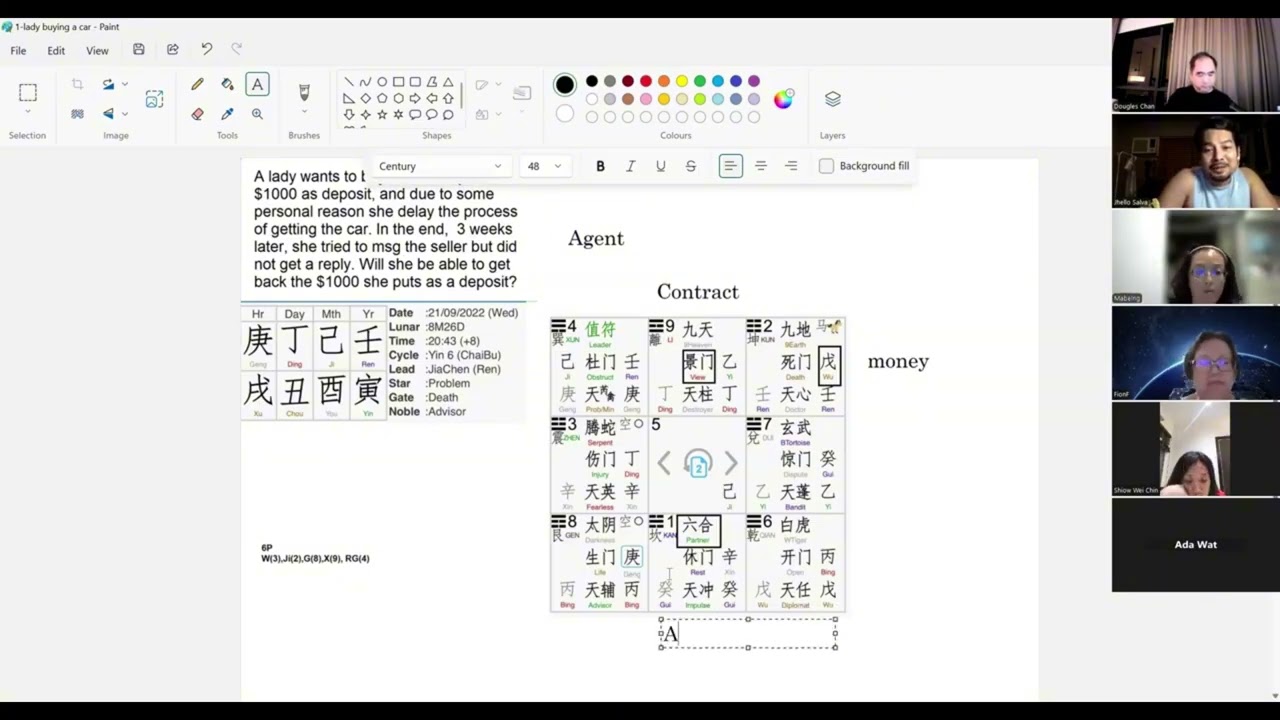
The situation is simple but stressful. A student wanted to buy a car and paid a $1,000 deposit. Due to personal reasons, she delayed the process of completing the purchase. About three weeks later, she tried to message the seller, but there was no reply. The question is: will she be able to get the $1,000 deposit back?
This case happened in Singapore, where car transactions and deposits are usually handled in a structured way. However, even when the amount is not extremely large compared with the total price of a car, the person asking may still feel worried, especially if cash flow is tight or if they feel ignored by the seller.
Mr. Dougles Chan begins by reminding students that not every symbol in the chart must be used. A real Qi Men Dun Jia practitioner must know which reference points are relevant and which ones should be ignored. In this case, the main concern is not the car itself. The key issue is the money. Therefore, the most important reference points are the money, the agent or seller, the contract, the asker, and the final answer.
The money is represented by Wu and is found in Palace 2. The money palace contains the Death Door and the Horse symbol. This is already a strong warning. Death Door shows weak, gone, or low-energy money. Horse shows movement, instability, or something running away. When these are combined in a question about whether money can be recovered, the chart suggests that the deposit may be difficult to get back.
Mr. Dougles Chan also explains the stem combination involving Wu and Ren. Wu represents Earth, while Ren represents Water. When Earth sits on top of Water, the situation becomes muddy, unstable, and messy. This gives another layer of meaning: the money situation is not clean and straightforward. With Death Door and Horse also present, the chart strongly suggests that the $1,000 is unlikely to return easily.
The agent or seller is represented through the Partner reference because this is a middleman situation. The person involved is not simply a direct private seller, but someone acting as an agent in a car sale. In such cases, Partner can represent the middleman facilitating the transaction.
The contract is examined through the View Door. Since deposits are often governed by terms, conditions, and business rules, the contract becomes relevant. If the buyer placed a deposit but did not complete the transaction within the expected process, the agent may have a reason to keep the deposit.
The asker is located in Palace 3. This palace contains Emptiness, Injury Door, Serpent, Fearless, Ding, and Xin. As a person, the asker may be in a weak or stressed condition. Injury Door can show someone who speaks sharply, reacts strongly, or is easily agitated when under pressure. Serpent suggests worry and overthinking. Fearless can show agitation. Ding and Xin may indicate information issues, mistakes, or a situation where something was not handled perfectly.
In practical terms, the asker may be upset and anxious about losing the deposit. The chart also suggests that her current condition may not be very strong. She may be financially tight, emotionally frustrated, or already dealing with other stress. This is why Mr. Dougles Chan reminds students that if a client is already stressed, the consultant should use softer wording.
The answer is located in Palace 8. On the surface, this palace has Life Door and Advisor, which can look positive. However, Palace 8 also contains Geng. Geng in Palace 8 creates a very difficult setup because it is connected with Six Punishment and Enter Grave. Mr. Dougles Chan emphasizes that whenever Geng appears in Palace 8, it is a serious warning sign. The palace may look acceptable outside, but internally the answer is very difficult.
This is a key teaching point. Students should not judge a chart only by one positive symbol. The Life Door and Advisor may look good, but the deeper structure of Palace 8 says otherwise. The stem combination and Six Punishment show that the answer is blocked, painful, and not favorable.
The final conclusion is that the asker is unlikely to recover the $1,000 deposit. The money palace shows Death Door, Horse, and instability. The answer palace is affected by Geng in Palace 8, Six Punishment, and Enter Grave. The seller or agent appears to control the situation, while the asker is not strong enough to force a refund.
This case also teaches an important mindset. Before interpreting any chart, we must understand the real-world context. A $1,000 deposit for a car may not be a huge amount relative to the car price, but it can feel significant to the person asking. Qi Men Dun Jia helps us see both the practical outcome and the emotional condition of the asker.
To learn Qi Men Dun Jia directly from Mr. Dougles Chan, click the link below:
Leave a Reply
You must be logged in to post a comment.