In this Qi Men Dun Jia lesson, Mr. Dougles Chan analyzes a career case involving a shipping company going through a major management revamp. The company is a multi-million-dollar organization, and two important second-level leaders, the CCO and COO, are being changed. The CEO remains the top person, and the CCO and COO are powerful decision makers under him. Because of this change, many employees feel uncertain.
The subject has worked in the company for more than 15 years. Many people have already left during the restructuring. His question is: what will happen to my job under the new organization and new management?
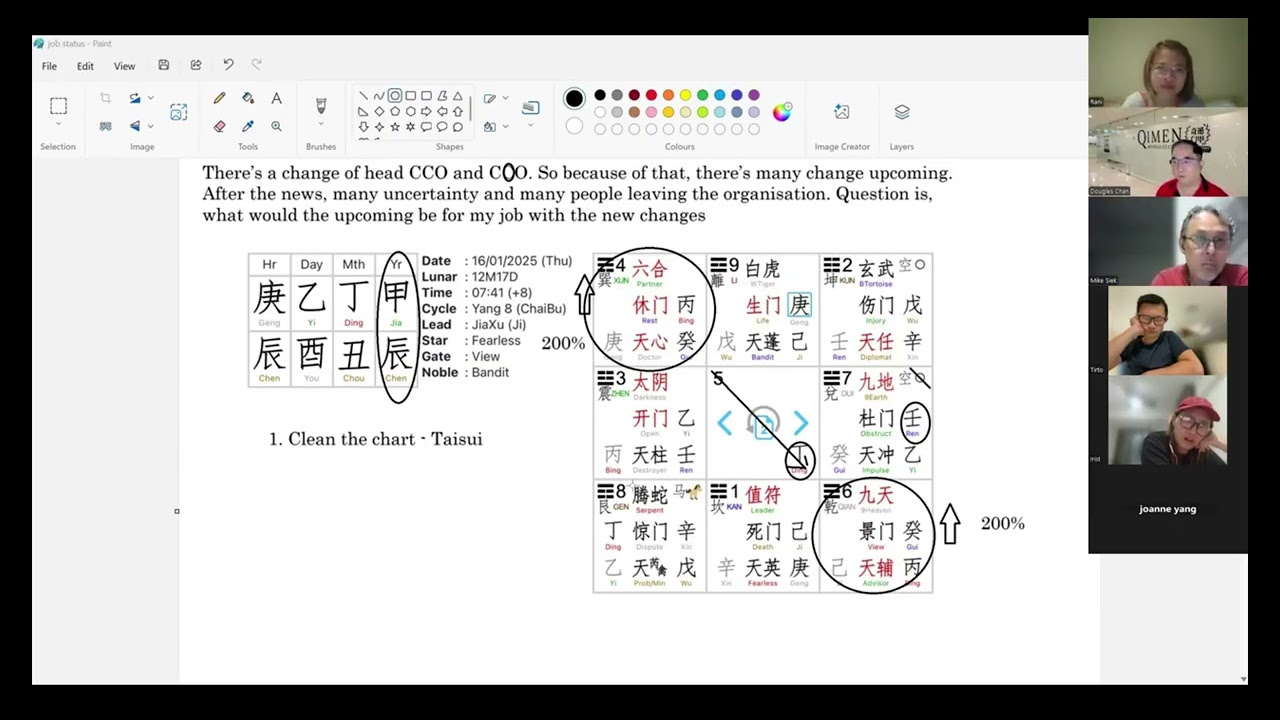
The first step is to clean the chart. Mr. Dougles Chan emphasizes that chart cleaning must be done before analysis in divination. Do not leave Tai Sui until later. If the chart is not cleaned first, the entire reading can go wrong. In this case, Ren is activated in Palace 7 and fills the Emptiness. Chen is located in Palace 4, so Palace 4 increases in energy, and the overflow goes to Palace 6.
After chart cleaning, the job is represented by Open Door. Open Door is located in Palace 3. Palace 3 also contains Darkness and Destroyer. Darkness shows something hidden, unclear, or happening behind the scenes. Destroyer shows damage, disruption, restructuring, or something being broken. This fits the real situation: many people are leaving, the company is chaotic, and the job environment is unstable.
The person is also located in the same palace as Open Door. This is an important positive sign. When the person and the job are together in the same palace, the job is still attached to the person. Mr. Dougles Chan compares it to super glue. Even though there is Darkness and Destroyer around the job, the person and the job are still stuck together.
This suggests that he is unlikely to be retrenched immediately. The job is still with him, and he still has a strong connection to the company. The chart does not show a peaceful environment, but it does show that his position is not easily removed for now.
The person also has Destroyer, which can be read in different ways. In this case, Destroyer can also mean a pillar. Since he has worked in the company for more than 15 years and holds an important role, he may be a mover and shaker, or someone the organization still relies on.
The next step is to check the bosses. Because he reports directly to the CCO and COO, Leader is used to represent his direct management. Leader is producing him. In five-element logic, when someone produces you, they need you, want you, or are moving toward you. This means the new management may still need his knowledge, experience, and support.
This is another positive sign. The job is attached to him, and the direct bosses are producing him. At this stage, the reading suggests that his job is quite safe.
However, the chart is also a Fanyin chart. Fanyin means reversal, instability, fast changes, and flip-flopping. Today the situation may look safe; later it may change again. Then it may flip back again. This means the conclusion is not permanently fixed. For now, the job looks safe, but the organization is still moving, changing, and unstable.
Mr. Dougles Chan explains that this is the key judgment: status quo for now, but not fully stable. The person is likely safe at the moment, but the company may continue to change.
Timing is also discussed. If the person asks when the situation may settle down, Palace 4 looks more promising. Palace 4 has Partner and Rest Door, and after chart cleaning its energy is stronger. This suggests that the situation may become calmer around April or May.
There may also be instability in January and February, and March may bring a possible job opportunity. Whether the person takes it is a matter of human decision. If he stays, he may settle down when the company stabilizes. If he leaves, he may also stabilize in a new place.
The CEO is another important factor. The CEO is represented by Ren in Palace 7, and Palace 7 clashes Palace 3, where the person and the job are located. This means the top CEO may not support him as much as the CCO and COO do. The final outcome depends on who has the real decision-making power. If the CCO and COO decide, he is likely safe. If the CEO steps in directly, there may be greater risk.
The conclusion is that the employee’s job is safe for now because Open Door is together with him and the direct bosses still need him. However, because the chart is Fanyin, the situation remains changeable. He should stay alert, observe who is making decisions, and prepare for possible changes.
This lesson teaches Qi Men Dun Jia students how to clean a career chart, identify Open Door as the job, read management changes, understand direct boss support, recognize Fanyin instability, and combine chart logic with corporate reality.
To learn Qi Men Dun Jia directly from Mr. Dougles Chan, click the link below:
Leave a Reply
You must be logged in to post a comment.