In this Qi Men Dun Jia lesson, Mr. Dougles Chan analyzes a sensitive relationship and divorce question. A woman born in 1993 asks about her marriage status and whether she should divorce. This case shows that relationship readings are not only about finding the spouse symbol. They require correct process, interpretation, and responsible wording.
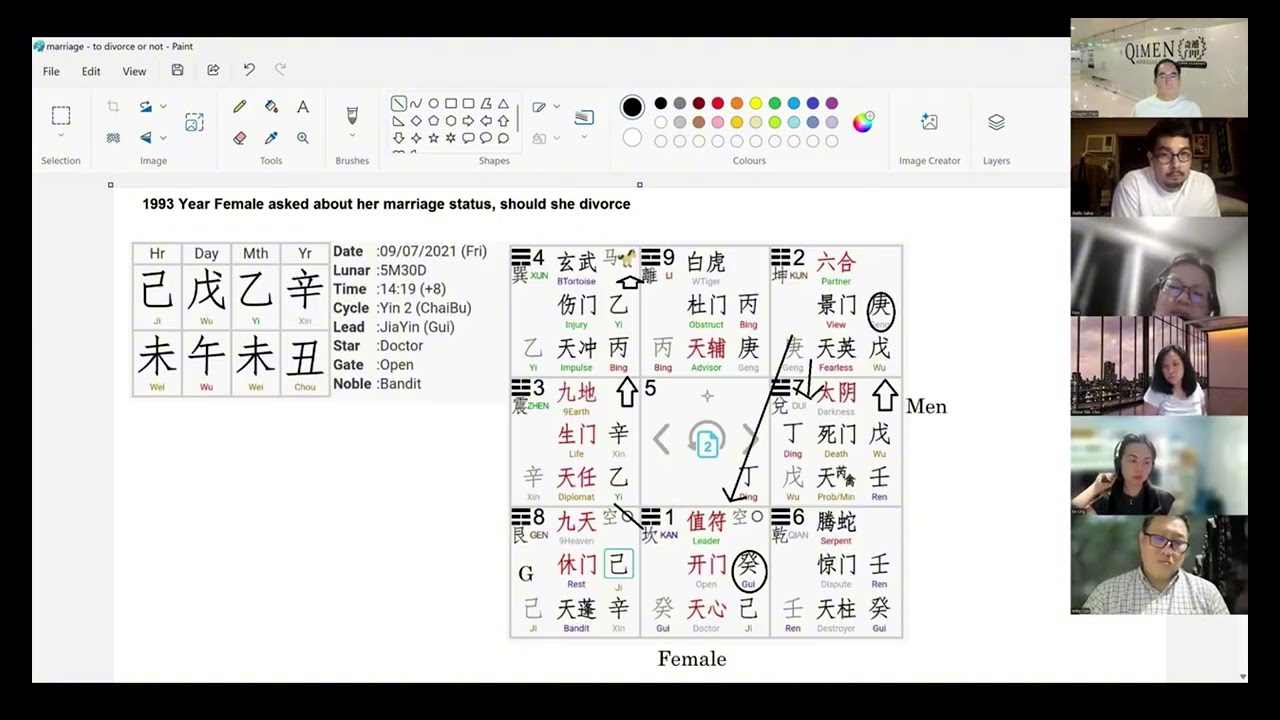
The first step is to clean the chart with Tai Sui, Six Punishment, and Enter Grave. After the chart is cleaned, students try to identify the woman, man, and marriage palace. Because the woman’s birth year is given, some students first try to use the year stem and then derive the opposite spouse symbol from it. Mr. Dougles Chan corrects this mistake.
The proper method is to use the modern method first. In relationship reading, the female and male are represented by the standard male-female stem pairing method, not by taking the woman’s birth-year stem and then creating a new corresponding spouse symbol from that. If the reader mixes methods incorrectly, the chart can reverse and the answer becomes confusing.
This is one of the biggest lessons in the case: process matters. If the first reference point is wrong, everything after that becomes wrong. The reader may give advice based on a mistaken setup.
In the modern method, the woman and man are located properly, and the marriage palace is checked. The marriage does not look completely destroyed on the surface. There are signs of connection and normal relationship structure. However, when students look deeper, it is not peaceful.
The marriage palace shows Fearless and View Door. In this context, Fearless can represent small issues, irritation, and quarrels over details. View Door also relates to details, observation, and focusing on specific points. Together, this can show a marriage where the couple argues about small matters repeatedly. From the outside, the marriage may look normal or even beautiful, but daily life can be tiring because both sides keep reacting to small details.
The woman’s condition also needs to be checked. Depending on which layer is used, she may appear stressed, financially concerned, or affected by the relationship. Money becomes a relevant factor because divorce is not only emotional. It also affects living expenses, legal costs, children, family arrangements, and future stability.
Mr. Dougles Chan reminds students that a divorce reading must be handled carefully. If a practitioner says “yes, divorce” too easily, that sentence can change a person’s life and affect an entire family. If there are children, the impact becomes even bigger. A careless statement can damage the woman, the husband, and the household.
Therefore, the reader should not decide the divorce for the client. The right approach is to give a situation analysis. Explain what the chart shows if she stays, and what may happen if she divorces. Then allow her to make the decision herself. The practitioner can advise, but should not take ownership of such a life-changing choice.
Mr. Dougles Chan also introduces the use of the older method as a second layer. If the modern method gives an unclear answer, the older method can be applied to gain more insight. The modern method is phase one. If the answer is still blurry, use the old-school method as phase two. Do not mix both methods randomly from the start.
When the older method is considered, another layer of the relationship appears. The chart can show more unhappiness, instability, and possible difficulty between the couple. However, the purpose of the old method is not to force a divorce conclusion. It is to provide additional confirmation and deeper context.
The key message is that marriage readings are complex because human relationships are complex. A chart may show disharmony, but disharmony alone is not enough to tell someone to end a marriage. The reader must check the marriage palace, the man, the woman, the relationship structure, financial factors, and the overall situation.
This lesson also teaches emotional responsibility. A Qi Men Dun Jia practitioner is not only reading symbols. The practitioner is speaking into someone’s life. The delivery of the message matters as much as the analysis. If the message is too direct, careless, or dramatic, it may create harm.
The conclusion of this case is not a simple “yes” or “no” to divorce. The marriage has problems, especially repeated arguments and tension over small details. It may be tiring and difficult, but the decision must be made by the woman herself after understanding the consequences.
This lesson teaches Qi Men Dun Jia students how to read divorce questions, avoid mixing modern and old methods incorrectly, identify the marriage palace, interpret Fearless and View Door in relationship context, use the old method only as a second layer, and deliver sensitive advice responsibly.
To learn Qi Men Dun Jia directly from Mr. Dougles Chan, click the link below:
Leave a Reply
You must be logged in to post a comment.