How to Cast an I Ching Reading: Coins, Stalks and Interpretation
When business owners come to me in Singapore for strategic guidance, they are usually looking for clarity in the middle of noise. Over my thirty years in corporate business, recruitment agency operations, and executive advisory, I have noticed that the hardest challenges rarely stem from a lack of raw data. They come from a lack of timing and perspective. Later in my career, when I founded a Qi Men Dun Jia (QMDJ) lineage and began teaching classical Chinese divination in English, I found that senior executives quickly resonate with the underlying philosophy of the Chinese classics. The Yijing, or I Ching (Book of Changes), is not a fortune-telling gimmick that predicts an unalterable fate. It is a precise mirror of the present moment, helping you understand the hidden dynamics of your current situation so you can make wiser decisions.
Casting an I Ching reading is the physical act of translating a specific moment in time into a mathematical and symbolic structure known as a hexagram. In classical Chinese metaphysics, divination falls under the category of Bu (卜), the art of assessing time, energetic alignment, and strategic decision points through synchronicity. Whether you use three simple coins or traditional yarrow stalks, the casting process creates a quiet pause in your routine. It forces you to stop reacting to surface chaos and start paying attention to the underlying currents moving through your life and enterprise.
If you have ever felt overwhelmed by a complex corporate merger, a partnership dispute, or a major career pivot, learning how to cast a hexagram gives you a structured framework to consult ancient wisdom. In this comprehensive guide, I will walk you through the practical mechanics of casting, step by step, using both coins and yarrow stalks. We will cover how to build a hexagram from the ground up, how to interpret changing lines, how to read the Judgment and Image, and how to cultivate the disciplined mindset necessary for reliable readings.
This article is part of my complete guide to the I Ching / Book of Changes.
What Casting Actually Is: The Discipline of Asking One Clean Question
Before touching a single coin or stalk, you must understand what casting actually represents. In modern business culture, executives love rapid-fire polling, instant market surveys, and endless scenario planning. Divination requires a different posture. In my Qi Men Dun Jia classes, I constantly emphasize to my students that the quality of your answer depends entirely on the clarity and sincerity of your question. The same fundamental rule applies to the I Ching.
Casting is not about seeking a simple yes or no to satisfy idle curiosity or calm immediate anxiety. It is about freezing a moment in time to examine its underlying energetic blueprint. The ancients recognized that the cosmos operates on natural cycles of growth, climax, decline, and stillness. When you cast a hexagram, you take a snapshot of the energetic field right now. You ask: what is the fundamental nature of this situation, what stage of the natural cycle am I occupying, and what is the proper posture for me to adopt?
Consider how this works in executive consulting. If a client asks me, “Will my business succeed next year?”, that is a sloppy question. It reflects passive worry rather than strategic focus. If that same client rephrases the question to, “What are the hidden risks and proper posture for expanding my recruitment operations into regional Asian markets over the next two quarters?”, now we have a clean question. The question defines the actor, the action, the context, and the timeframe. The I Ching responds best to clean, well-framed inquiries that acknowledge your agency as a decision-maker.
To help you formulate sharp inquiries, consider these three examples of converting vague anxieties into clean divination questions:
- Vague Question: “Should I quit my corporate job?”
Clean Question: “What are the core challenges and energetic posture if I transition from my executive role into independent consulting over the next six months?” - Vague Question: “Will my business partner betray me?”
Clean Question: “What is the true condition of our partnership, and how should I manage communication regarding equity distribution this quarter?” - Vague Question: “Is this market investment a good idea?”
Clean Question: “What are the hidden operational risks and market conditions surrounding our planned expansion into European software sales?”
Notice how each clean question focuses on actions under your control and asks for energetic perspective rather than fortune-telling guarantees. In my own advisory practice, I often spend twenty minutes with a client simply refining their question before we even touch a casting tool. Once the question is clear, the hexagram interpretation becomes straightforward.
“Divination is not about surrendering your intelligence or abdicating personal responsibility. It is an intentional act of stepping back from surface noise to consult a timeless mirror of strategy, timing, and human nature.”
To cast effectively, you must approach the consultation with a settled mind. If you are angry, panicked, or desperately trying to validate a decision you have already made, your state of mind obscures the reading. The ancient texts speak of Cheng (诚), which translates to sincerity, integrity, and single-minded focus. Sincerity means you are genuinely open to whatever counsel the hexagram provides, even if it tells you to hold back, re-evaluate your team, or abandon a pet project.
When Carl Jung explored the I Ching in Western psychology, he introduced the concept of synchronicity, describing meaningful coincidences that carry no direct causal connection. In classical Chinese philosophy, this principle is called Ganyi (感應), or resonance. When you focus your mind intently on a clean question while physically manipulating coins or stalks, the random mathematical pattern generated mirrors the subtle state of your environment at that exact micro-second.
The Diviner’s Mindset: Reverence, Sincerity, and Discipline
Over the years, I have seen many enthusiastic beginners ruin their practice by treating the I Ching like a parlor game. They toss coins casually on a cluttered desk while answering emails, or they repeat a cast three times in ten minutes because they did not like the initial response. That approach guarantees confusion. If you treat the system with indifference, you will receive chaotic output.
The proper diviner’s mindset rests on four foundational pillars:
- Quiet Atmosphere: Set aside ten to fifteen minutes in a clean, quiet space where you will not be interrupted. Turn off notifications on your phone. Take a few deep breaths to settle your nervous system before formulating your query.
- One Clear Question: Focus on one well-defined situation at a time. Write your question down on paper before casting. Writing forces your brain to organize its thoughts and eliminates emotional ambiguity.
- No Repeat Casting: Accept the first reading you receive for a specific question. If the answer seems cryptic or challenging, do not toss the coins again immediately hoping for a more comforting response. Respect the initial feedback, reflect on it, and revisit your notes later.
- Meticulous Journaling: Keep a dedicated divination journal. Record the date, time, exact question, the primary hexagram, any changing lines, the transformed hexagram, and your initial impressions. Review your journal entries three to six months later to evaluate how events actually unfolded.
When you establish this disciplined routine, casting becomes a powerful meditative practice. In my own daily workflow, writing down questions and tracking outcomes over years has given me invaluable insights into market cycles, leadership dynamics, and personal timing. You will quickly discover that the Book of Changes rewards patience and structured observation far more than emotional impulse.
Before moving to the physical mechanics of coin tossing, ensure that your workspace is organized. Clear away clutter, sit with an upright posture, and hold the physical tools in your hands for a few moments of quiet reflection. This simple physical transition signals to your mind that you are moving from chaotic daily execution into strategic contemplation.
What a Hexagram Is: Trigrams, Stacked Lines, and Structural Logic
To interpret an I Ching reading, you must understand the anatomical structure of a hexagram. The word hexagram comes from the Greek root for six lines. In Chinese, a hexagram is called a Gua (卦), specifically a six-line figure composed of solid lines and broken lines. A solid line represents Yang energy (active, creative, firm, light), while a broken line represents Yin energy (receptive, flexible, yielding, dark).
Every hexagram is built by stacking two three-line symbols known as trigrams (Ba Gua 八卦). The lower three lines form the inner trigram (Nei Gua 内卦), representing your internal state, your company’s core condition, or the underlying thoughts driving the situation. The upper three lines form the outer trigram (Wai Gua 外卦), representing the external environment, market forces, competitors, or external stakeholders.
There are eight basic trigrams in classical Chinese cosmology. Each trigram possesses a distinct elemental energy, directional association, and symbolic meaning. When these eight trigrams pair together in various combinations, they generate the 64 hexagrams of the Yijing canon.
Below is the complete table of the eight trigrams, including their traditional Chinese characters, pinyin, natural elements, core attributes, and business perspectives:
| Trigram | Name & Pinyin | Nature / Element | Core Attribute | Business & Leadership Perspective |
|---|---|---|---|---|
| ☰ | 乾 Qian | Heaven / Metal | Creative strength, leadership | Executive vision, decisive governance, strong initiative |
| ☷ | 坤 Kun | Earth / Earth | Receptivity, devotion, support | Operational execution, nurturing talent, patient absorption |
| ☳ | 震 Zhen | Thunder / Wood | Movement, shock, initiative | Disruptive entry, new product launching, rapid momentum |
| ☴ | 巽 Xun | Wind / Wood | Penetration, flexibility | Market communication, subtle negotiations, persistent influence |
| ☵ | 坎 Kan | Water / Water | Abyss, danger, adaptability | Risk management, cashflow stress, navigating treacherous terrain |
| ☲ | 離 Li | Fire / Fire | Clarity, intelligence, dependence | Brand visibility, corporate reputation, intellectual property |
| ☶ | 艮 Gen | Mountain / Earth | Stillness, boundary, restraint | Consolidation, strategic pause, risk containment, setting limits |
| ☱ | 兌 Dui | Lake / Metal | Joy, expression, partnership | Client satisfaction, team morale, persuasive sales pitch |
Notice the essential rule of hexagram construction: you always build and read a hexagram from the bottom up. Line 1 is the bottom line, representing the beginning or initial root of the matter. Line 6 is the top line, representing the ultimate culmination, exit, or overextension. When you toss coins or divide yarrow stalks, your first result becomes Line 1, your second result becomes Line 2, and so on until Line 6 completes the structure.
Understanding individual line positions gives you remarkable depth during interpretation:
- Line 1 (Initial Stage): The root or foundation. Represents entry-level personnel, early product development, or initial momentum.
- Line 2 (Operational Center): Core internal execution. Represents middle management, internal systems, and daily operational health.
- Line 3 (Crisis Point): The transition boundary between inner operations and outer exposure. Often indicates friction, stress, or crucial testing.
- Line 4 (Advisory Level): Senior executive transition. Represents executive advisors, board interaction, and strategic positioning.
- Line 5 (Ruling Position): The CEO or primary decision-maker. Represents central leadership, key authority, and major governance choices.
- Line 6 (Culmination Point): The top limit. Represents retirement, board oversight, exit strategies, or potential overreach.
Diagram 1: Hexagram Structural Anatomy
An I Ching hexagram consists of six stacked positions read strictly from bottom to top:
[Line 6] Top Position   : Outer Trigram (Upper/External Environment)
[Line 5] Ruler Position : Outer Trigram (Executive Leadership & Choice)
[Line 4] Senior Position: Outer Trigram (Transition & Advisory Stage)
========================================================================
[Line 3] Threshold Pos. : Inner Trigram (Crisis Point & Inner Strain)
[Line 2] Official Pos.  : Inner Trigram (Core Operations & Internal Management)
[Line 1] Initial Pos.   : Inner Trigram (Foundation, Root, Early Seed)
Key insight: The lower trigram (Lines 1 to 3) reflects your internal organization or personal mindset. The upper trigram (Lines 4 to 6) reflects external market conditions and broader timing.
The Coin Method Step-by-Step: Three Coins, Six Tosses
The three-coin method (San Qian Fa 三錢法) is the most widespread casting system in the world today. It was developed during the Song and Tang dynasties to provide a fast, reliable method without requiring fifty physical yarrow stalks. While ancient purists sometimes debated its mathematical probabilities, three centuries of practical experience confirm its efficiency for business executives and daily practitioners alike.
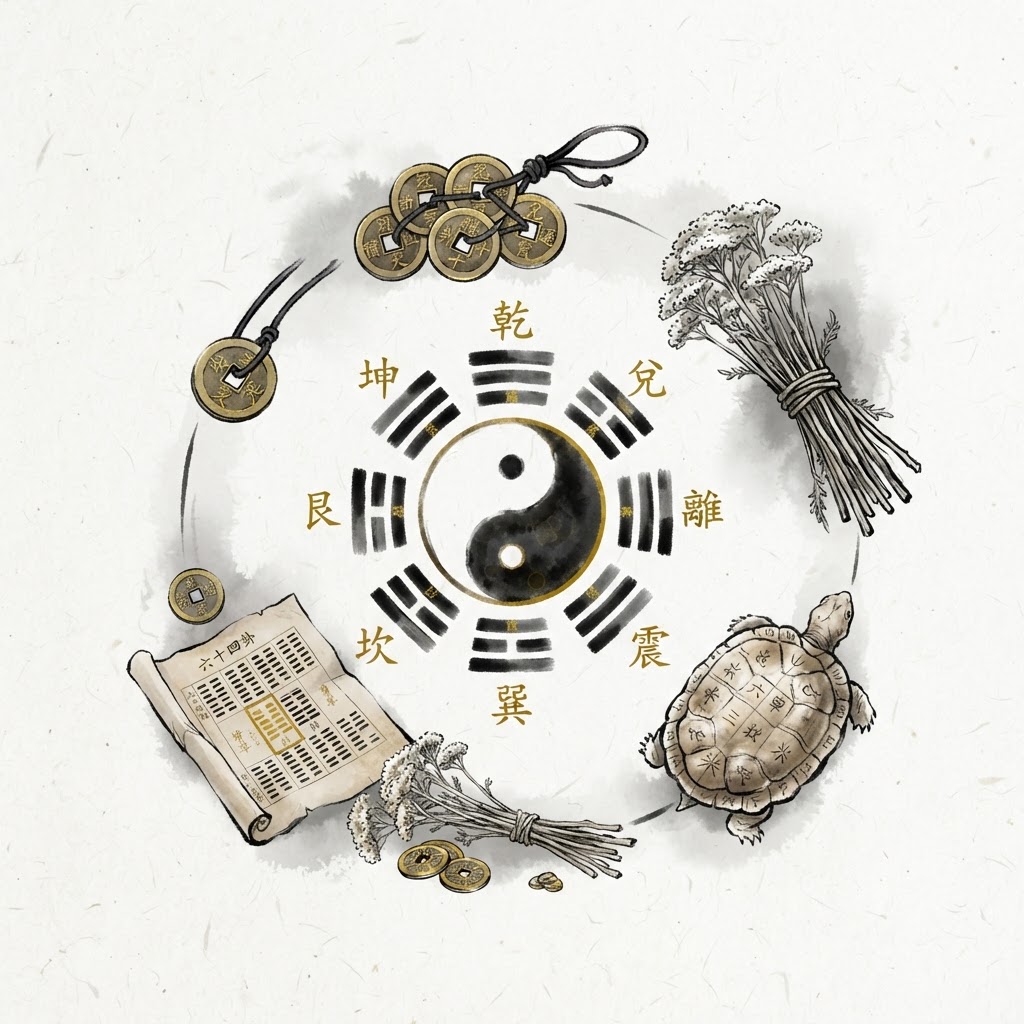
To use this method, obtain three identical coins. You can use traditional Chinese bronze coins with square holes in the center, or standard modern currency coins like quarters or Singapore dollar coins. Clean the coins physically and clear your desk space.
Step 1: Assigning Numerical Values to Heads and Tails
Before tossing, establish a fixed rule for coin values. In standard traditional convention:
- Heads (Inscription side / Yang side): Value of 3
- Tails (Blank or denomination side / Yin side): Value of 2
When you toss three coins simultaneously, you add their values together. Because each coin is either 2 or 3, the sum of three coins will always equal 6, 7, 8, or 9. These four numbers correspond directly to the four states of Yin and Yang in classical Chinese metaphysics.
| Coin Combination | Total Sum | Line Classification | Symbol | Dynamic Behavior |
|---|---|---|---|---|
| 3 Tails (2 + 2 + 2) | 6 | Old Yin (Changing Yin) | ━━ ━━ (x) | Active transition; turns into a solid Yang line (━━━━━) |
| 2 Tails + 1 Head (2 + 2 + 3) | 7 | Young Yang (Static Yang) | ━━━━━ | Stable state; remains a solid Yang line (━━━━━) |
| 1 Tail + 2 Heads (2 + 3 + 3) | 8 | Young Yin (Static Yin) | ━━ ━━ | Stable state; remains a broken Yin line (━━ ━━) |
| 3 Heads (3 + 3 + 3) | 9 | Old Yang (Changing Yang) | ━━━━━ (o) | Active transition; turns into a broken Yin line (━━ ━━) |
Step 2: Performing the Six Tosses
Hold the three coins gently between your cupped palms. Pause for a moment to center your attention on your written question. Shake the coins thoroughly and release them onto a flat, cushioned surface like a cloth mat or wooden tray.
Record your results immediately on paper. Remember: your first toss creates Line 1 at the bottom of the page. Repeat this sequence six times until you reach Line 6 at the top.
Let us walk through a detailed practical example from my executive consulting work. Suppose a business owner asks: “Should we launch our new executive coaching software platform in Q3 or delay until Q4?”
Here is how the six tosses unfold on paper, recorded strictly from bottom to top:
- Toss 1 (Bottom Line): 2 Tails + 1 Head = 7 (Young Yang). Draw a solid line: ━━━━━
- Toss 2 (Line 2): 3 Heads = 9 (Old Yang). Draw a solid line with a circle: ━━━━━ (o)
- Toss 3 (Line 3): 1 Tail + 2 Heads = 8 (Young Yin). Draw a broken line: ━━ ━━
- Toss 4 (Line 4): 2 Tails + 1 Head = 7 (Young Yang). Draw a solid line: ━━━━━
- Toss 5 (Line 5): 3 Tails = 6 (Old Yin). Draw a broken line with an x: ━━ ━━ (x)
- Toss 6 (Top Line): 1 Tail + 2 Heads = 8 (Young Yin). Draw a broken line: ━━ ━━
Looking at the original six lines, we identify the Primary Hexagram (Ben Gua 本卦). In this example, the lower trigram consists of Yang, Yang, Yin (Wind 巽 Xun), and the upper trigram consists of Yang, Yin, Yin (Wind or Mountain depending on exact arrangement). By referencing a standard 64-hexagram lookup table, you determine the exact name and number of your starting hexagram.
In our advisory scenario, Hexagram 53 (Gradual Progress / Jian) or Hexagram 37 (The Family / Jia Ren) might emerge as the Primary Hexagram. The core message of Gradual Progress is that rushing a software release without thorough beta testing damages brand trust. Progress must occur step by step, just as a tree grows slowly on a mountain peak.
Because Toss 2 produced a 9 (Changing Yang) and Toss 5 produced a 6 (Changing Yin), this reading contains two changing lines. Changing lines indicate dynamic points of pressure, evolution, or instability within your current situation. To understand where the situation is heading, you construct a secondary hexagram called the Transformed Hexagram (Zhi Gua 之卦).
To create the Transformed Hexagram, keep all static lines (7s and 8s) exactly as they are. Then transform Line 2 from Yang (━━━━━) into Yin (━━ ━━), and transform Line 5 from Yin (━━ ━━) into Yang (━━━━━). The resulting new hexagram reveals the future trajectory if current dynamics play out naturally.
In our executive software launch example, Line 2 changing indicates internal operational adjustments needed among core developers and customer success staff. Line 5 changing indicates a shift in leadership governance, executive messaging, and market communication. The Primary Hexagram shows current operational friction, while the Transformed Hexagram reveals the stabilized environment once those leadership adjustments are executed.
Diagram 2: The Complete Casting & Interpretation Flowchart
[Step 1: Quiet Sincerity] ==> Formulate 1 Clean Question & Write It Down
            |
[Step 2: Physical Casting] ==> Execute 6 Tosses (Coins or Stalks) Bottom-to-Top
            |
[Step 3: Build Primary Hexagram] ==> Identify Ben Gua (Current Snapshot)
            |
[Step 4: Check Changing Lines]
       /                   \
(No Changing Lines)      (Changing Lines Present: 6s or 9s)
       |                            |
  Read Primary Hexagram     Read Primary Hexagram + Changing Lines Text
  Judgment & Image Only     + Build Transformed Hexagram (Zhi Gua)
       |                            |
       +----------------------------+
            |
[Step 5: Synthesize & Journal] ==> Derive Strategic Action & Log Outcome
Core Principle: The Primary Hexagram describes your immediate reality. Changing lines show the exact operational levers of change. The Transformed Hexagram shows the ultimate destination.
The Yarrow Stalk Method: Ancient Rhythm, Patience, and Probability
Long before metal coins became commonplace, classical diviners used the stalks of the yarrow plant (Achillea millefolium or Shi Cao 蓍草). In traditional Chinese culture, yarrow was considered a sacred plant because its long roots draw nutrients deep from the earth, symbolizing deep spiritual resonance and connection with natural cycles.
While the coin method takes roughly two minutes, a traditional yarrow stalk reading requires twenty to thirty minutes of disciplined, rhythmic physical manipulation. For modern executives accustomed to frantic multi-tasking, learning the yarrow stalk method is an extraordinary lesson in patience and mental grounding.
How the Yarrow Stalk Method Works at a Lay Level
The traditional procedure uses fifty dried yarrow stalks. Before beginning the counting process, one stalk is removed and placed on a wooden stand. This single stalk represents Taiyi (太一), the Great Ultimate, the unchanging origin of all things. It remains untouched throughout the reading, leaving forty-nine active stalks for divination.
The diviner divides the forty-nine stalks into two random piles, representing Heaven (right) and Earth (left). One stalk is taken from the right pile and inserted between the fingers of the left hand, representing Human Agency (Ren 人). The diviner then counts through both piles in groups of four, symbolizing the four seasons of the year. The remaining leftover stalks from each pile are gathered together.
This elaborate manipulation process is repeated three times for every single line of the hexagram. Because a hexagram has six lines, you complete eighteen counting operations in total. Through this mathematical reduction, you arrive at the same four final values: 6, 7, 8, or 9.
To visualize the physical discipline involved, consider the three passes required to produce just one line:
- Pass 1: Divide 49 stalks into two piles, subtract 1 for Human Agency, count by 4s, gather remainder (either 5 or 9 stalks). Remaining stalks in hand: 44 or 40.
- Pass 2: Take the remaining 44 or 40 stalks, divide into two piles, subtract 1 for Human Agency, count by 4s, gather remainder (either 4 or 8 stalks). Remaining stalks in hand: 40, 36, or 32.
- Pass 3: Take the remaining stalks, divide into two piles, subtract 1 for Human Agency, count by 4s, gather remainder (either 4 or 8 stalks). Divide final remaining count by 4 to yield 6, 7, 8, or 9.
Repeat this three-pass operation six consecutive times to construct the full hexagram from Line 1 to Line 6.
Why Time, Rhythm, and Mathematics Matter
Why would anyone spend thirty minutes counting yarrow stalks when three coins can produce a hexagram in sixty seconds? There are two profound reasons: psychological state and mathematical probability.
First, the repetitive, quiet counting of stalks acts as a natural meditative filter. By the time you complete eighteen cycles of counting, your racing thoughts subside. Your executive ego releases its panic, allowing you to examine the textual advice with deep objectivity.
Second, the mathematical probabilities of the yarrow stalk method differ significantly from the coin method. In the coin method, flipping three coins creates a symmetric distribution: Old Yin (6) has a 1-in-8 chance (12.5%), Old Yang (9) has a 1-in-8 chance (12.5%), Young Yang (7) has a 3-in-8 chance (37.5%), and Young Yin (8) has a 3-in-8 chance (37.5%).
In the yarrow stalk method, the probabilities are asymmetrical:
- Old Yin (6): 1 in 16 probability (6.25%)
- Young Yang (7): 5 in 16 probability (31.25%)
- Young Yin (8): 7 in 16 probability (43.75%)
- Old Yang (9): 3 in 16 probability (18.75%)
Notice that in yarrow stalk casting, Old Yin is remarkably rare (only 6.25%), while Old Yang occurs three times as often (18.75%). The ancient masters understood that complete, extreme Yin energy takes much longer to accumulate and break than Yang energy. This subtle mathematical nuance reflects the real-world principle that building solid structures takes time, whereas active expansion occurs more rapidly.
| Divination Method | Time Required | Mathematical Distribution | Ritual & Meditative Quality | Ideal Application |
|---|---|---|---|---|
| Three Coin Method | 2 to 3 mins | Symmetric odds (12.5% changing lines) | Fast, direct, functional | Daily operational questions, quick tactical guidance, traveling |
| Yarrow Stalk Method | 20 to 30 mins | Asymmetric odds (Old Yin 6.25%, Old Yang 18.75%) | Deeply contemplative, serene, immersive | Major strategic pivots, life career decisions, annual planning |
| Six Die / Bead Method | 1 to 2 mins | Customizable probability presets | Moderate, modern mechanical feel | Alternative table-top study, rapid structural exploration |
Interpreting Your Reading: The Judgment, The Image, and Line Texts
Once your hexagram is cast, you turn to the textual commentaries. A standard translation of the Yijing provides three core layers of text for every hexagram: the Judgment, the Image, and the individual Line Texts.
1. Reading the Judgment (Tuan Ci 彖辭)
The Judgment gives you the overarching strategic summary of the entire hexagram. It outlines whether the timing favors aggressive advance, quiet retreat, internal consolidation, or cautious negotiation. When reading the Judgment, look for key classical directives such as “favorable to cross the great stream” (take decisive enterprise risk) or “perseverance brings good fortune” (stay the course despite temporary obstacles).
Always paraphrase classical translations into practical modern terms rather than getting lost in archaic phrasing. For example, if the Judgment speaks of “holding livestock in a mountain enclosure,” the practical advice is to store your capital reserves, protect your talent, and build internal capabilities before expanding external operations.
2. Reading the Image (Xiang Ci 象辭)
The Image examines the relationship between the two stacked trigrams and describes the ideal moral posture of the leader (the Junzi 君子 or exemplary person). If the upper trigram is Water and the lower trigram is Mountain, the Image describes water accumulating at the foot of a peak. The leadership takeaway is patience: when facing insurmountable external barriers, cultivate inner clarity and wait for natural channels to open.
“The Image in the Book of Changes does not tell you what market forces will do to you. It tells you who you must become in order to lead through those market forces with dignity and wisdom.”
3. Interpreting Changing Lines (Yao Ci 爻辭)
If your cast contains no changing lines, your answer rests entirely on the Judgment and Image of the Primary Hexagram. Your situation is stable, and the overarching theme gives you all the advice required.
If you have changing lines, pay closest attention to the specific text associated with those line positions:
- One Changing Line: Read the specific line text in the Primary Hexagram. That single line represents your primary focus. Then look at the Transformed Hexagram Judgment for the eventual outlook.
- Two Changing Lines: Read both changing line texts. The upper changing line usually represents the developing future trend, while the lower changing line reflects the current friction.
- Three Changing Lines: The situation is in major transition. Weigh the Judgments of both the Primary and Transformed Hexagrams equally, using the changing lines as transitional clues.
- Four or Five Changing Lines: Read the non-changing line in the Primary Hexagram as your primary pivot point, and lean heavily on the Transformed Hexagram Judgment.
- All Six Lines Changing: The entire situation is undergoing a complete paradigm shift. In Hexagram 1 (Qian) or Hexagram 2 (Kun), special master line texts apply. For all other hexagrams, read the Judgment of the Transformed Hexagram exclusively.
To illustrate how line position influences interpretation, consider Line 2 versus Line 5. Line 2 sits in the middle of the lower trigram, representing the chief operating officer or project manager on the ground. Line 5 sits in the middle of the upper trigram, representing the CEO or board chair. If Line 2 is changing, the issue lies in operational execution. If Line 5 is changing, the issue lies in strategic vision and executive governance.
Common Mistakes in I Ching Casting
In my thirty years of business leadership and teaching Chinese metaphysics, I have observed that most divination errors happen before the coins even touch the table. Practitioners fall into subtle emotional traps that distort their interpretation.
Here is a summary table of the four most common casting mistakes, why they happen, and how to correct them in your daily practice:
| Common Mistake | Root Cause & Psychological Trap | Practical Correction |
|---|---|---|
| Asking Vague or Double-Barreled Questions | Anxiety and indecision leads to asking “Should I sell my company or hire a new CEO?” in a single cast. | Split complex dilemmas into separate questions. Cast one reading for selling the company, and a separate reading for hiring a CEO. |
| Immediate Re-Casting After Disliking an Answer | Ego resistance. When the text advises patience or retreat, the diviner re-tosses hoping for permission to move forward. | Institute a strict one-question, one-cast rule. Close your journal and wait at least 24 hours before casting on related topics. |
| Over-Relying on Literal Ancient Symbols | Taking bronze age metaphors literally (e.g. “beheading an enemy”) instead of extracting the strategic management principle. | Paraphrase archaic imagery into modern organizational contexts (e.g. terminating a toxic executive contract). |
| Ignoring Internal vs External Trigram Dynamics | Treating all six lines as isolated fortune-telling predictions rather than a connected structural ecosystem. | Always analyze lines 1 to 3 as your internal corporate health and lines 4 to 6 as external market forces. |
Honest Limits: What the I Ching Can and Cannot Do
I believe in total transparency when teaching classical Chinese metaphysics. The Yijing is an extraordinary tool for strategic reflection, but it is not a substitute for sound judgment, financial due diligence, or ethical responsibility. Understanding the limits of the system is what separates a mature business practitioner from an irrational fatalist.
First, the I Ching cannot make executive decisions for you. It reveals the energetic climate of a moment, but you must execute the work. If a reading tells you that conditions favor expansion, but your company has zero cashflow and broken operational systems, launching a product will still fail. Divination informs strategy; it does not replace operational competence.
Second, the I Ching does not reveal absolute, unchangeable destiny. In Chinese metaphysics, outcomes depend on the harmony of three realms: Heaven Timing (Tian Shi 天時), Earth Terrain (Di Li 地利), and Human Effort (Ren He 人和). Divination provides insight into Heaven Timing. Your execution, leadership ethics, and operational choices represent Human Effort, which can alter outcomes dramatically.
Finally, it is valuable to understand how I Ching casting compares with other major disciplines in Chinese metaphysics:
- I Ching Divination (Bu 卜): Best for immediate decision points, specific questions, and analyzing a snapshot of synchronicity in real time.
- Qi Men Dun Jia Hour Charts (QMDJ): Best for complex multi-layered tactical forecasting, real-time spatial strategy, negotiation timing, and competitive positioning.
- BaZi Destiny Analysis (Ming 理): Best for understanding a person’s long-term lifetime blueprint, innate talents, career inclinations, and ten-year luck cycles.
When you integrate these tools properly alongside modern management principles, you develop an exceptionally well-rounded decision framework for corporate governance and personal growth.
A Simple Weekly Practice with the I Ching
One of the questions I get most often from students is how to make the I Ching a regular part of decision-making without it becoming an obsession. My answer is always the same: treat it like journaling, not like a prescription. You sit down once a week, you ask one honest question about something you are genuinely uncertain about, you cast, you record the hexagram, and you write down what you think it means. Then you go about your week.
The value is not in the hexagram itself. The value is in the act of framing a clean question. Most of us carry vague anxieties that never get articulated. The discipline of forming a single question forces you to decide what you are actually worried about. That act alone, before any coins are flipped, often clarifies more than the reading does.
Keep a notebook. Date each entry. Write the question, the hexagram, and your initial interpretation. Come back a week later and note what actually happened. Over a few months, you will start to see patterns in how you frame questions and how you interpret answers. Those patterns tell you about yourself, not about the I Ching. That is the real work, and it is the kind of work that makes you a better decision-maker regardless of whether you ever cast another hexagram.
| Week | Question Type | Hexagram | Outcome One Week Later |
|---|---|---|---|
| 1 | Should I take this meeting? | ||
| 2 | Is this partnership worth pursuing? | ||
| 3 | What am I missing in this situation? |
That table is a starting point. Fill it in by hand. The act of writing matters. A spreadsheet on your phone works too, but there is something about pen and paper that slows you down enough to think. The I Ching rewards slowness. It rewards the person who is willing to sit with ambiguity rather than rushing to a conclusion. If you bring that patience to the practice, the book will meet you there. If you bring speed and impatience, you will get answers that feel like noise, and you will stop. The book has not failed. The approach has.
Related I Ching Guides
- The 64 Hexagrams of the I Ching, Explained
- The History and Origins of the I Ching
- Using the I Ching in Modern Life
- I Ching vs Qi Men Dun Jia: Two Divination Traditions Compared
Deep Dive Guides
- The Three Coin Method: Probability, History, and Advanced Casting Technique
- The Traditional Yarrow Stalk Method: A Step-by-Step Practical Manual
- How to Formulate Clear Questions for the I Ching: Business and Personal Guidance
- How to Interpret Changing Lines in an I Ching Reading
- The Eight Trigrams (Bagua): Elemental Energies and Hexagram Structure
- How to Keep an I Ching Divination Journal to Track Strategy and Outcomes
- I Ching Divination vs. Qi Men Dun Jia Hour Charts: Choosing the Right Tool
- Deciphering the Judgment and Image Texts: Ancient Wisdom for Modern Decision Making
Frequently Asked Questions
How often should I cast an I Ching reading?
There is no strict calendar rule, but quality always trumps quantity. I recommend casting when you face a genuine strategic choice, an unexpected challenge, or a major planning phase. Daily casting is fine if you focus on personal reflection, but avoid asking multiple heavy business questions in a single day.
Can I cast an I Ching reading for someone else?
Yes, provided you have their consent and a clear understanding of their situation. In consulting practice, I frequently cast readings on behalf of business partners or corporate clients who seek strategic perspective on an upcoming joint venture or key hiring choice.
What should I do if my coins land on their edges or fall off the table?
If a coin rolls off the table or stands on its edge, treat that specific toss as invalid. Collect all three coins, pause for a deep breath to reset your focus, and re-toss that specific line position. Do not restart the entire hexagram from line 1.
Are modern coins as effective as ancient Chinese bronze coins?
Yes. The energy of divination does not reside in museum artifacts or antique metals. It resides in your focused intention and the mathematical randomness of the toss. Standard quarters, five-cent coins, or Singapore dollar coins work perfectly as long as you assign heads and tails consistently.
What is the difference between the Primary Hexagram and the Transformed Hexagram?
The Primary Hexagram (Ben Gua) represents your current situation as it exists right now. The Transformed Hexagram (Zhi Gua) represents the future state toward which the situation is evolving as changing lines complete their transition.
Why do hexagram lines build from the bottom up instead of top down?
In classical Chinese cosmology, all living growth emerges from roots in the earth before expanding upward into the sky. Plant stems grow upward, buildings rise from foundations, and strategic initiatives begin at the foundational level before reaching executive leadership.
Can I use digital coin rolling apps or online I Ching generators?
While digital generators are convenient for quick reference, physical casting with coins or yarrow stalks engages your tactile senses and creates a genuine pause in your physical environment. I strongly advise using physical objects whenever possible for serious consultations.
How should I handle contradictory line text during interpretation?
Contradictory line text usually reflects conflicting forces operating at different levels of your organization. Line 2 might advise quiet patience internally, while Line 5 encourages bold external communication. Treat these contradictory statements as balanced instructions for different levels of leadership rather than a logical error.
Related Reading
To deepen your understanding of classical Chinese metaphysics, executive timing, and ancient divination practices, explore these comprehensive guides on dougleschan.com:
- The Complete I Ching (Book of Changes) Guide: Our master pillar page covering the history, philosophy, and 64 hexagrams of the Yijing.
- Bu: The Art of Divination in Chinese Metaphysics: Discover how I Ching casting fits into the broader framework of classical Chinese forecasting.
- Qi Men Dun Jia Hour Chart Explained: Learn how time-space astrological forecasting provides real-time strategic insights for business negotiations.
- The Five Arts of Chinese Metaphysics: An overview of Shan, Yi, Ming, Bu, and Xiang for modern leadership and self-cultivation.
- Qi Men Dun Jia Calculator: Access our online tool to plot authentic QMDJ charts for timing and decision support.
- BaZi Reading: The Ancient Art of Destiny Analysis: Understand your innate character blueprint, career strengths, and ten-year luck cycles.
- What is Chinese Metaphysics?: A foundational introduction to how classical principles apply to modern personal and professional growth.
Leave a Reply
You must be logged in to post a comment.