The 64 Hexagrams of the I Ching, Explained
When I first encountered the Book of Changes, or the I Ching (易经), over thirty years ago during my early days in corporate management in Singapore, I treated it with healthy skepticism. Like many young executives running sales teams and managing commercial operations, I thought ancient texts belonged in dusty historical archives rather than modern corporate boardrooms. I assumed it was merely a form of fortune-telling or mystical folklore. However, as my career progressed and I later founded my lineage in Qi Men Dun Jia (奇门遁甲) education, my perspective shifted completely. I began reading the Chinese classics not as magical crystal balls, but as profound psychological and systemic mirrors for leadership, human behavior, and organizational change.
The I Ching does not promise to reveal a fixed destiny. Instead, it maps out the underlying patterns of transformation that govern every situation in your business, your relationships, and your personal life. At the heart of this ancient system sit the 64 hexagrams (卦 guà). Each hexagram represents a specific state of energy, a moment in time, or an evolving dynamic between internal preparation and external reality. If you can read a hexagram accurately, you gain a clear view of where you stand right now, where momentum is pushing you, and how you ought to respond with wisdom rather than impulse.
In this guide, I want to demystify the 64 hexagrams completely. We will explore what a hexagram is made of, how the six stacked lines work together, how the eight elemental trigrams combine to form the full system, and how famous hexagrams reflect the exact strategic challenges you face every day in modern life and enterprise.
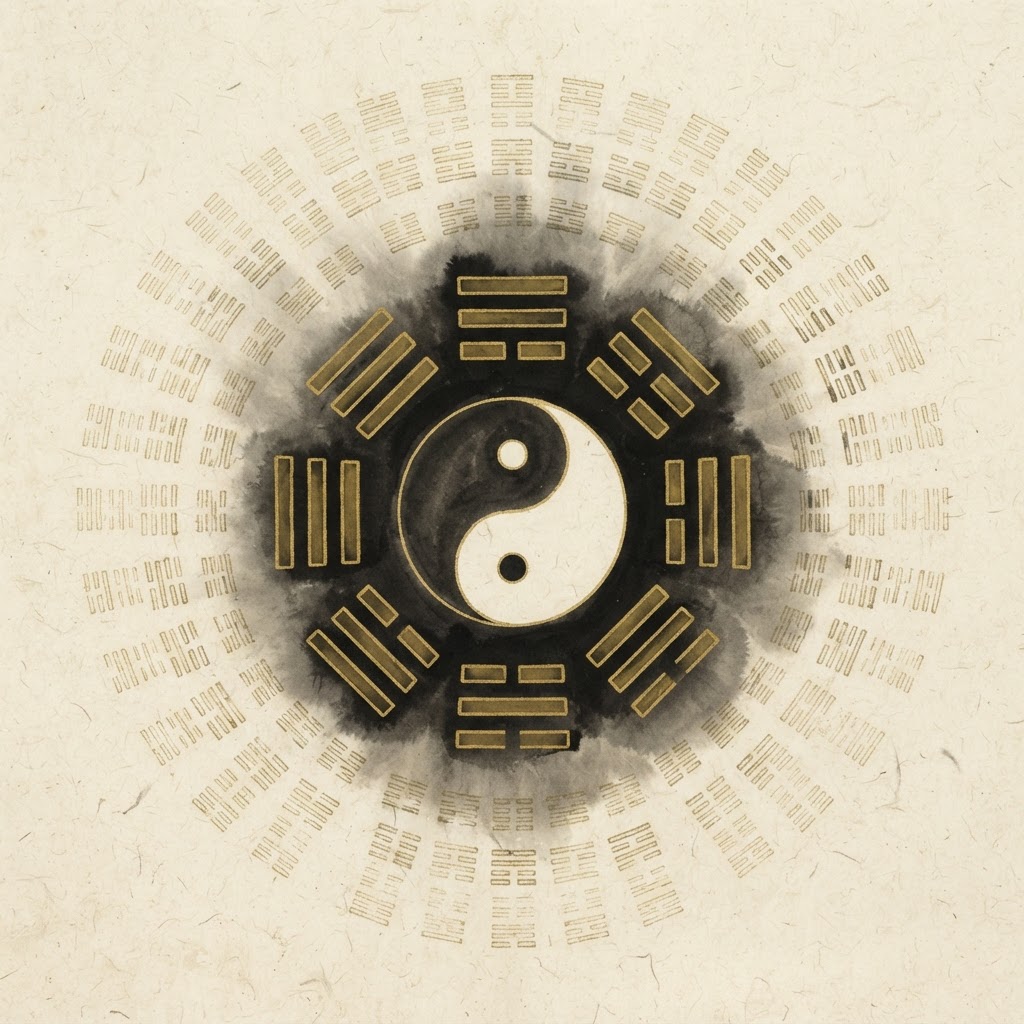
This article is part of my complete guide to the I Ching / Book of Changes.
1. What Is a Hexagram? Anatomy, Yin-Yang, and Line Structure
At its core, a hexagram is a vertical stack of six horizontal lines. In Chinese metaphysics, these six lines are called yáo (爻). Each line is either a solid line representing Yang (阳) or a broken line representing Yin (阴). A solid line embodies active, expansive, assertive, and creative energy. A broken line embodies receptive, yielding, integrative, and observational energy.
Because every position in the stack can hold either a Yin line or a Yang line, mathematically there are two raised to the sixth power ($2^6$), which equals exactly 64 possible combinations. These 64 structures cover the entire spectrum of human experience and situational dynamics known to ancient Chinese philosophy.
One fundamental rule that every student must grasp immediately is the direction of reading. You always read a hexagram from the bottom to the top. Line 1 is at the base, and Line 6 is at the peak. This bottom-up progression mirrors natural growth in the real world: a seed sprouts underground at the root before it grows a trunk, branches out into leaves, and eventually reaches its final harvest or eventual decay.
Understanding the Six Line Positions
The six positions inside a hexagram are not merely random slots. They represent a clear hierarchy of development, influence, and social or strategic position. In my classes, I often explain these six positions using the structure of a modern business enterprise:
- Line 1 (The Base / The Seed): This is the initial stage of a situation. The energy is newly born, fragile, and unproven. In business, this corresponds to the early research phase, an entry-level employee, or the first line of code in a startup project. Action here must be cautious because the foundation is still setting.
- Line 2 (The Manager / Internal Execution): Located in the center of the lower trigram, Line 2 represents internal balance, practical execution, and middle management. It is a place of steady duty and quiet competence. It connects directly with Line 5 above it.
- Line 3 (The Threshold / The Risky Transition): Positioned at the top of the inner world, Line 3 represents a dangerous transition point. You are stepping out of your comfortable internal environment and preparing to meet the public world. This position is notoriously prone to anxiety, overconfidence, or premature exposure.
- Line 4 (The Minister / Senior Executive): Positioned at the bottom of the outer world, Line 4 is close to the ultimate seat of power. It represents senior leadership, vice presidents, or key advisors who must execute strategy while navigating corporate diplomacy and proximity to the CEO.
- Line 5 (The Ruler / Prime Authority): Located in the center of the upper trigram, Line 5 is the most favorable and influential seat in the hexagram. It represents the chief executive, the sovereign, or the core decision-maker who holds balance, vision, and authority.
- Line 6 (The Sage / The Retired Chairman): The topmost line represents the absolute climax of the situation. Energy here has reached its ultimate limit. If handled with wisdom, it represents quiet mentorship or graceful retreat; if handled with arrogance, it leads straight to reversal, exhaustion, and fall.
Resonance, Centrality, and Correctness
To analyze a hexagram deeply, classical scholars examine three key structural relationships among the six lines:
1. Centrality (中 Zhōng): Lines 2 and 5 hold special importance because they occupy the middle of the lower and upper trigrams respectively. A line that is central avoids extremes. It represents emotional balance and sound judgment. In my experience, when Line 2 or Line 5 is active, the situation has a solid anchor.
2. Correctness (正 Zhèng): In classical theory, odd line positions (1, 3, 5) are naturally Yang positions, while even line positions (2, 4, 6) are naturally Yin positions. When a Yang solid line occupies an odd position, or a Yin broken line occupies an even position, the line is said to be correct (正 zhèng). Correctness indicates that your role aligns perfectly with your environment.
3. Correspondence and Resonance (应 Yìng): Lines in the lower trigram resonate with corresponding lines in the upper trigram: Line 1 pairs with Line 4, Line 2 pairs with Line 5, and Line 3 pairs with Line 6. When one line in the pair is Yin and the other is Yang, they attract and support each other (proper resonance). If both are Yang or both are Yin, they repel or lack mutual assistance.
Moving Lines and Hexagram Transformation
A hexagram is rarely static when used in personal contemplation or consultation. When you cast a hexagram using traditional yarrow stalks or three bronze coins, individual lines can be either stable (young) or changing (old). A stable Yang line (represented by the number 7) remains Yang. A stable Yin line (represented by the number 8) remains Yin.
However, when Yang reaches its absolute maximum (represented by the number 9), it becomes an Old Yang line. Old Yang is so ripe that it must transform into its opposite, Yin. Similarly, when Yin reaches its deepest point (represented by the number 6), it becomes an Old Yin line that turns into Yang. These changing lines are called biàn yáo (变爻).
When one or more lines in your initial hexagram change, they give birth to a second hexagram called the resulting hexagram or biàn guà (变卦). The primary hexagram reveals your present situation and immediate environment. The moving lines point out the exact friction points or actions you are taking right now. The resulting hexagram shows the future trend and outcome toward which your situation is naturally moving if those line changes unfold fully.
2. The 8 Trigrams (Ba Gua): The Fundamental Alphabet
To understand how 64 hexagrams function, you must first master their building blocks: the 8 Trigrams, known in Chinese as the Ba Gua (八卦). A trigram is a three-line figure composed of Yin and Yang lines. If the 64 hexagrams are complex sentences describing every life situation, the 8 trigrams are the fundamental alphabet and raw elements of nature.
Ancient Chinese observers identified eight primary phenomena in the natural cosmos: Heaven, Earth, Thunder, Wind, Water, Fire, Mountain, and Lake. Each phenomenon carries a distinct physical behavior, psychological archetype, and strategic posture. When you stack two trigrams on top of each other, you create a hexagram containing six lines.
The table below presents the 8 Trigrams, complete with their Chinese characters, pinyin, English names, natural elements, family roles, compass directions, and core attributes:
| Trigram | Chinese & Pinyin | English Title | Natural Element | Family Role | Direction | Core Characteristic |
|---|---|---|---|---|---|---|
| ☰ ☰ ☰ | 乾 Qián | The Creative | Heaven / Sky | Father | Northwest | Strong, initiating, persistent, sovereign leadership. |
| ☷ ☷ ☷ | 坤 Kūn | The Receptive | Earth | Mother | Southwest | Yielding, nurturing, devoted execution, vast support. |
| ☳ ☳ ☳ | 震 Zhèn | The Arousing | Thunder | Eldest Son | East | Sudden movement, shock, initiation, breakthrough. |
| ☴ ☴ ☴ | 巽 Xùn | The Gentle | Wind / Wood | Eldest Daughter | Southeast | Penetrating, gradual influence, flexibility, adaptability. |
| ☵ ☵ ☵ | 坎 Kǎn | The Abyssal | Water | Middle Son | North | Danger, depth, flow, emotional adaptability, trial. |
| ☲ ☲ ☲ | 离 Lí | The Clinging | Fire / Sun | Middle Daughter | South | Clarity, intelligence, dependence, illumination, vision. |
| ☶ ☶ ☶ | 艮 Gèn | Keeping Still | Mountain | Youngest Son | Northeast | Stillness, boundary, meditation, stopping, stability. |
| ☱ ☱ ☱ | 兑 Duì | The Joyous | Lake / Marsh | Youngest Daughter | West | Joy, expression, communication, openness, pleasure. |
When you study these eight trigrams, notice how they balance each other in natural pairs. Heaven stands opposite Earth. Water stands opposite Fire. Thunder stands opposite Wind. Mountain stands opposite Lake. This cosmic symmetry forms the foundation of all classic Chinese metaphysical thought.
3. How the 64 Hexagrams Arise: The Architecture of Two Trigrams
Every hexagram is created by placing one trigram over another trigram. The lower three lines (Lines 1, 2, and 3) form the Inner Trigram (内卦 nèi guà), while the upper three lines (Lines 4, 5, and 6) form the Outer Trigram (外卦 wài guà).
Understanding the distinction between the inner trigram and the outer trigram is one of the most effective analytical habits you can develop in I Ching interpretation:
- The Inner Trigram (Bottom): Represents your internal psychological state, your team’s internal health, your personal attitude, your office culture, or what is happening behind closed doors. It is the subjective environment.
- The Outer Trigram (Top): Represents the external market conditions, public opinion, macro-economic factors, client reactions, or physical environment. It is the objective world.
When you combine an inner trigram with an outer trigram, you are analyzing how your internal condition interacts with external reality. For example, if you have Water (Danger) on the inside and Mountain (Stillness) on the outside, your internal mindset is anxious and turbulent, but your external strategy requires remaining perfectly motionless. That dynamic produces Hexagram 39 (Jian / Obstruction).
Conversely, if you have Mountain (Stillness) on the inside and Water (Danger) on the outside, you are calm and anchored inside, but you are facing external hazards ahead. That produces Hexagram 4 (Meng / Youthful Folly).
The Concept of Nuclear Hexagrams (Hu Gua)
Beyond the primary inner and outer trigrams, every hexagram contains a hidden internal engine known as the Nuclear Hexagram (互卦 hù guà). You construct the nuclear hexagram by taking lines 2, 3, and 4 to form the lower nuclear trigram, and lines 3, 4, and 5 to form the upper nuclear trigram.
While the primary hexagram shows the surface situation and immediate environment, the nuclear hexagram reveals the underlying psychological tension and core cause that drives the situation forward. In my executive consultations, examining the nuclear hexagram often explains why two corporate projects that look identical on paper end up producing completely different outcomes.
The grid below shows how the 8 lower trigrams combine with the 8 upper trigrams to construct the complete matrix of 64 hexagrams:
The 8×8 Trigram Combination Matrix (64 Hexagrams)
Locate the Inner (Lower) Trigram on the left row and the Outer (Upper) Trigram on the top column to find the intersecting Hexagram number and Chinese name.
| Lower \ Upper | 乾 Qian (Heaven) | 坤 Kun (Earth) | 震 Zhen (Thunder) | 巽 Xun (Wind) | 坎 Kan (Water) | 离 Li (Fire) | 艮 Gen (Mountain) | 兑 Dui (Lake) |
|---|---|---|---|---|---|---|---|---|
| 乾 Qian (Heaven) | 1. 乾 Qian | 12. 否 Pi | 25. 无妄 Wu Wang | 44. 姤 Gou | 6. 讼 Song | 13. 同人 Tong Ren | 33. 遁 Dun | 10. 履 Lu |
| 坤 Kun (Earth) | 11. 泰 Tai | 2. 坤 Kun | 24. 复 Fu | 46. 升 Sheng | 7. 师 Shi | 36. 明夷 Ming Yi | 15. 谦 Qian | 19. 临 Lin |
| 震 Zhen (Thunder) | 34. 大壮 Da Zhuang | 16. 豫 Yu | 51. 震 Zhen | 32. 恒 Heng | 40. 解 Xie | 55. 丰 Feng | 62. 小过 Xiao Guo | 54. 归妹 Gui Mei |
| 巽 Xun (Wind) | 9. 小蓄 Xiao Xu | 20. 观 Guan | 42. 益 Yi | 57. 巽 Xun | 59. 涣 Huan | 37. 家人 Jia Ren | 53. 渐 Jian | 61. 中孚 Zhong Fu |
| 坎 Kan (Water) | 5. 需 Xu | 8. 比 Bi | 3. 屯 Zhun | 48. 井 Jing | 29. 坎 Kan | 63. 既济 Ji Ji | 39. 蹇 Jian | 60. 节 Jie |
| 离 Li (Fire) | 14. 大有 Da You | 35. 晋 Jin | 21. 噬嗑 Shi Ke | 50. 鼎 Ding | 64. 未济 Wei Ji | 30. 离 Li | 56. 旅 Lu | 38. 睽 Kui |
| 艮 Gen (Mountain) | 26. 大蓄 Da Xu | 23. 剥 Bo | 27. 颐 Yi | 18. 蛊 Gu | 4. 蒙 Meng | 22. 贲 Bi | 52. 艮 Gen | 41. 损 Sun |
| 兑 Dui (Lake) | 43. 夬 Guai | 45. 萃 Cui | 17. 随 Sui | 28. 大过 Da Guo | 47. 困 Kun | 49. 革 Ge | 31. 咸 Xian | 58. 兑 Dui |
“A hexagram never stands still. It reveals the natural tension between where you are internally and what the environment demands from you externally.”
4. A Walkthrough of Representative Famous Hexagrams
To see how the I Ching translates into lived human experience, let us examine twelve of the most famous and strategically significant hexagrams in the text. Rather than memorizing dictionary definitions, I encourage you to view each hexagram as a situational snapshot that demands a specific response in your career, leadership, and personal conduct.
Hexagram 1: 乾 (Qián): The Creative (Pure Yang)
Hexagram 1 consists of six solid Yang lines stacked vertically (Heaven over Heaven). It represents pure creative power, raw initiative, unyielding persistence, and sovereign strength. In Chinese philosophy, Qián is the dragon, flying through the sky and generating momentum out of empty space.
When you encounter Qián in business, it signals a period of intense initiation, product launching, and decisive leadership. However, the commentary on the six lines of Qián provides a masterclass in self-restraint:
- Line 1 (Hidden Dragon): Do not act yet. Gather strength and study the environment quietly.
- Line 2 (Dragon in the Field): Show your capabilities, build strategic alliances, and seek guidance from an experienced mentor.
- Line 3 (All Day Active): Work tirelessly through the day, but remain watchful at night. Avoid vanity and arrogance.
- Line 4 (Leaping over the Chasm): Prepare for the major leap into significant corporate responsibility.
- Line 5 (Flying Dragon in the Sky): Peak performance and authority. You are leading at your absolute best.
- Line 6 (Arrogant Dragon Has Cause for Repentance): Overextension and pride. You have flown too high and disconnected from ground reality.
Hexagram 2: 坤 (Kūn): The Receptive (Pure Yin)
Hexagram 2 consists of six broken Yin lines (Earth over Earth). Where Qián initiates, Kūn absorbs, supports, executes, and nurtures. It represents the quiet strength of the earth, which carries all living beings without complaint or boastfulness.
In modern corporate strategy, Kūn represents operational execution, client support, supply chain reliability, and collaborative partnership. The wisdom of Kūn lies in leading by following. If a leader tries to force personal ego when Kūn is present, they lose their way. By focusing on service, thoroughness, and patience, great success follows naturally.
Hexagram 3: 屯 (Zhūn): Difficulty at the Beginning
Hexagram 3 features Thunder (Zhèn) below Water (Kǎn). It portrays a blade of grass pushing through hard frozen soil in early spring. The environment is chaotic and turbulent, yet life is striving to establish itself.
In business life, Zhūn represents the early startup phase or new project rollout. Systems are unformed, resources are tight, and confusion is high. The I Ching advises against rushing into premature expansion. Instead, you must focus on establishing order, assigning clear roles, and building basic infrastructure before attempting to scale up operations.
Hexagram 11: 泰 (Tài): Peace and Prosperity
Hexagram 11 features Earth (Kūn) on top and Heaven (Qián) on the bottom. At first glance, this placement might seem inverted, but in Chinese metaphysics, heavy Earth sinks downward while light Heaven rises upward. Because Earth moves down and Heaven moves up, they meet in the middle, creating harmonious communication and abundant growth.
In business life, Tài marks an era of effortless expansion, high team morale, and booming sales. Management and staff are completely aligned. However, the classical wisdom attached to Tài warns us that peace never lasts forever. Wise leaders use periods of prosperity to build capital reserves and reinforce foundations before market conditions turn cold.
Hexagram 12: 否 (Pǐ): Standstill and Obstruction
Hexagram 12 is the exact spatial inverse of Tài: Heaven (Qián) sits on top, and Earth (Kūn) sits on the bottom. Here, Heaven rises higher into the sky while Earth sinks deeper into the ground. They move away from each other, resulting in total stagnation, miscommunication, and paralysis.
When Pǐ manifests in an organization, bureaucracy chokes innovation, senior management is detached from frontline reality, and trust evaporates. The I Ching advises that during a standstill, capable people should pull back, guard their personal integrity, and refuse to compromise their core values for short-term financial gain.
Hexagram 15: 谦 (Qiān): Modesty and Humility
Hexagram 15 shows Earth (Kūn) above Mountain (Gèn). A massive, grand mountain sits humbly beneath the level surface of the earth. This striking image symbolizes true authority: vast inner substance combined with an unpretentious outer demeanor.
In my thirty years of business experience across Asia, I have observed that long-term commercial success belongs to those who embody Qiān. Modesty reduces jealousy from competitors, earns the genuine loyalty of staff, and allows you to make calm, objective assessments without letting personal ego cloud your judgment.
Hexagram 18: 蛊 (Gǔ): Correcting Decay and Corruption
Hexagram 18 places Mountain (Gèn) above Wind (Xùn). Wind trapped under a mountain becomes stagnant, creating decay and rot. In ancient times, Gǔ referred to toxins or neglect that crept into family lineages or administrative structures over generations.
In enterprise management, Gǔ represents legacy debt, outdated software, toxic corporate politics, or neglected operational protocols. The I Ching stresses that fixing decay requires courage and thoroughness. You must investigate the root cause, establish a clear three-day plan before acting, and conduct three days of follow-up auditing after implementation to ensure old habits do not return.
Hexagram 24: 复 (Fù): Return and Turning Point
Hexagram 24 consists of five Yin lines on top with a single Yang line reappearing at the very bottom (Thunder beneath Earth). It represents the winter solstice, the rebirth of light, and the quiet return of positive momentum after a long season of decline or loss.
Fù teaches that turnarounds in career or health do not happen through violent force; they begin with a single small step. When a business is recovering from a major setback, trying to rush immediate massive growth will shatter fragile operations. You must nurture the solitary Yang line at the base until it gains sufficient strength to grow.
Hexagram 28: 大过 (Dà Guò): Great Preponderance and Critical Stress
Hexagram 28 places Lake (Duì) over Wind (Xùn). Four strong Yang lines are sandwiched in the middle, while weak Yin lines remain at the top and bottom. The structural image is a heavy roof beam bending under excessive weight, threatening immediate collapse.
Dà Guò represents crisis management, extreme overload, or high-stakes market turbulence. When a company faces this hexagram, standard operational procedures will fail. Leaders must make immediate, decisive structural interventions to relieve stress before the entire organization breaks under pressure.
Hexagram 49: 革 (Gé): Revolution and Radical Pivot
Hexagram 49 features Fire (Lí) inside Lake (Duì). Fire boils the water of the lake, while water extinguishes the fire. They engage in intense struggle, resulting in radical transformation and complete rebirth.
In business life, Gé represents a major corporate pivot, brand overhaul, or technology shift. The I Ching notes that revolution must meet three strict criteria to succeed: timing must be ripe, internal motive must be unselfish, and execution must bring genuine benefit to the broader community. Rushing revolution prematurely brings disaster, but delaying necessary change leads to extinction.
Hexagram 63: 既济 (Jì Jì): After Completion
Hexagram 63 places Water (Kǎn) over Fire (Lí). Water boils over fire, creating perfect thermodynamic order. Every single line in this hexagram is in its correct place: Yang lines occupy odd positions (1, 3, 5) and Yin lines occupy even positions (2, 4, 6).
On the surface, Jì Jì looks like total perfection. Yet the commentary attached to Jì Jì carries an urgent warning: once perfection is achieved, the only direction left to move is downhill. When an enterprise reaches its absolute peak, complacency sets in, minor oversights accumulate, and decay quietly begins behind the scenes. Eternal vigilance is required to preserve success.
Hexagram 64: 未济 (Wèi Jì): Before Completion
Hexagram 64 is the final hexagram in the I Ching, placing Fire (Lí) over Water (Kǎn). Fire rises above while water flows below, meaning they do not mix and the task remains unfinished. Furthermore, every line is out of its proper position.
It is deeply significant that the Book of Changes ends not with perfection (63), but with unfinished work (64). Life and business are perpetual cycles of change. There is no final destination where you can stop adapting. Hexagram 64 reminds us to stay alert, agile, and prepared as we step across the threshold into the next cycle.
“In business, Hexagram 63 warns us that the moment your operations look completely flawless is precisely when complacency begins to rot the foundation.”
The table below summarizes these iconic hexagrams, highlighting their trigram components and strategic modern applications:
| Hexagram # & Name | English Title | Trigram Structure | Core Symbolism | Strategic Business Insight |
|---|---|---|---|---|
| 1. 乾 Qián | The Creative | Heaven over Heaven | Pure Yang, dragon power | Initiate bold projects; avoid ego overextension. |
| 2. 坤 Kūn | The Receptive | Earth over Earth | Pure Yin, vast earth | Focus on service, team culture, and reliable execution. |
| 3. 屯 Zhūn | Initial Difficulty | Water over Thunder | Sprout in frozen ground | Build basic infrastructure before scaling up. |
| 11. 泰 Tài | Peace & Growth | Earth over Heaven | Heaven-Earth interplay | Capitalize on market alignment; build capital reserves. |
| 12. 否 Pǐ | Standstill | Heaven over Earth | Divergence, obstruction | Protect assets, maintain ethics, wait out stagnation. |
| 15. 谦 Qiān | Modesty | Earth over Mountain | Mountain under earth | Lead quietly, reduce market friction, earn trust. |
| 18. 蛊 Gǔ | Fixing Decay | Mountain over Wind | Stagnant wind, rot | Clean legacy debt and audit operational inefficiencies. |
| 24. 复 Fù | Return | Earth over Thunder | Rebirth of light at base | Start turnaround small; avoid rushing fragile recovery. |
| 28. 大过 Dà Guò | Critical Stress | Lake over Wind | Bending roof beam | Intervene immediately during high-stress operational crisis. |
| 49. 革 Gé | Revolution | Lake over Fire | Molten bronze in water | Pivot business model when timing and benefits align. |
| 63. 既济 Jì Jì | After Completion | Water over Fire | Perfect thermodynamic order | Audit operations; prevent silent decay at peak. |
| 64. 未济 Wèi Jì | Before Completion | Fire over Water | Unfinished transition | Stay agile; continuous adaptation is essential. |
5. The King Wen Sequence Versus Other Orderings
When you open a standard edition of the I Ching, you encounter the 64 hexagrams arranged in a traditional sequence numbered from 1 to 64. This arrangement is known as the King Wen Sequence (文王卦序 Wén Wáng guà xù), named after King Wen of Zhou, who compiled line judgments during his imprisonment in the 11th century BCE.
The King Wen sequence is organized into 32 complementary pairs. Each pair follows a profound structural symmetry:
- Inversion (覆卦 Fù Guà): In 28 of the 32 pairs, the second hexagram is created by physically turning the first hexagram upside down (Line 1 becomes Line 6, Line 2 becomes Line 5, and so forth). For example, Hexagram 11 (Tài) turned upside down becomes Hexagram 12 (Pǐ).
- Opposition (错卦 Cuò Guà): In 4 pairs where the hexagram is entirely symmetrical (such as Hexagram 1 Qián, Hexagram 2 Kūn, Hexagram 27 Yí, and Hexagram 28 Dà Guò), turning it upside down produces no change. In these cases, the second hexagram is formed by changing every single Yin line to Yang and every Yang line to Yin.
Understanding Structural Pairing in the King Wen Sequence
The King Wen sequence pairs hexagrams based on relational dynamics rather than strict mathematical progression. It reflects the philosophical journey of human experience from creation to completion.
Contrast this with the Fu Xi Sequence (伏羲卦序), popularized during the Song Dynasty by philosopher Shao Yong. The Fu Xi sequence arranges the hexagrams in a flawless binary progression based on line density, moving logically from pure Yin (000000) to pure Yang (111111). Modern computer scientists have noted that Fu Xi’s arrangement mirrors binary arithmetic, whereas King Wen’s order reflects moral, political, and cyclical changes in human life.
6. How to Look Up a Hexagram When You Cast One
When you consult the I Ching using coins or yarrow stalks, looking up your cast hexagram can feel overwhelming if you do not know the step-by-step workflow. Here is the exact methodology I teach my students for quick and accurate lookup:
- Record the Six Lines Bottom to Top: Write down your six lines on paper, starting from Line 1 at the bottom and ending with Line 6 at the top. Note any moving lines (Old Yin or Old Yang).
- Separate Into Two Trigrams: Draw a horizontal line between Line 3 and Line 4. Lines 1, 2, and 3 form your Inner (Lower) Trigram. Lines 4, 5, and 6 form your Outer (Upper) Trigram.
- Identify Both Trigram Names: Use the Trigram reference table to identify the natural element of each trigram (for example, Lower = Water, Upper = Mountain).
- Locate the Hexagram on the 8×8 Matrix: Find your Lower Trigram on the row axis and your Upper Trigram on the column axis of the lookup grid. The intersecting cell gives you the exact Hexagram number and title.
- Analyze Moving Lines: Read the primary hexagram judgment first. Next, examine the specific line texts for your moving lines. Finally, invert the moving lines to form your resulting hexagram, which shows the future trajectory.
| Step Number | Action Required | Trigram / Matrix Mapping | Verification Check | Common Practitioner Pitfalls |
|---|---|---|---|---|
| Step 1 | Cast lines and record 1 to 6 | Identify line types (6, 7, 8, 9) | Confirm Line 1 is drawn at bottom | Writing lines top-to-bottom by mistake. |
| Step 2 | Split into Inner & Outer trigrams | Lower = Lines 1-3, Upper = Lines 4-6 | Verify 3 lines per trigram | Confusing inner state with outer environment. |
| Step 3 | Cross-reference 8×8 lookup table | Row = Lower, Column = Upper | Match number and Chinese name | Swapping row and column coordinates. |
| Step 4 | Read line changes and resulting hexagram | Transform 6 to 7 and 9 to 8 | Check resulting hexagram structure | Ignoring moving lines or overinterpreting static lines. |
7. Practical Mapping: Hexagrams in Life, Career, and Business
In my consultations with business leaders and students of Chinese metaphysics, I emphasize that hexagrams are practical blueprints for decision-making. You do not need to sit under a tree in meditation to benefit from the I Ching. You can apply its strategic frameworks directly to modern management:
- Organizational Restructuring: When a firm is undergoing major restructuring, observing whether the primary hexagram is Hexagram 49 (Gé / Revolution) or Hexagram 50 (Dǐng / The Cauldron) determines whether you need to tear down old processes or rebuild internal culture.
- Market Timing: Entering a market during Hexagram 33 (Dùn / Retreat) leads to financial waste. The wise strategy is to consolidate resources, protect cash flow, and wait for Hexagram 24 (Fù / Return) before launching aggressive campaigns.
- Leadership Selection: Choosing a manager who embodies Hexagram 15 (Qiān / Modesty) ensures steady execution and low conflict, whereas choosing someone stuck in the upper line of Hexagram 1 (Arrogant Dragon) risks costly public PR crises.
Furthermore, in Chinese metaphysics, the I Ching serves as the foundational root for advanced systems such as The Five Arts of Chinese Metaphysics, Bu (Divination), and Qi Men Dun Jia. Understanding trigram interactions inside hexagrams elevates your ability to read destiny charts and strategic charts with far greater depth.
8. Frequently Asked Questions
What is the difference between a trigram and a hexagram in the I Ching?
A trigram is a three-line figure representing one of eight natural elements such as Heaven, Earth, Water, or Fire. A hexagram is a six-line figure formed by stacking two trigrams together. While trigrams represent pure elemental energies, hexagrams represent specific, multi-layered situations created when those elemental energies interact.
Why are hexagram lines always read from the bottom to the top?
Hexagrams are read from bottom to top because they mirror natural growth and progression. Line 1 represents the root or origin of a situation, while Line 6 represents the final outcome or decay phase. Reading from bottom to top allows you to trace how a situation evolves over time.
How do changing lines alter the meaning of a hexagram reading?
Changing lines, also called moving lines, occur when Yin or Yang energy reaches its maximum threshold (Old Yin turning to Yang, or Old Yang turning to Yin). Changing lines highlight the exact areas of action or friction in your current state and create a resulting hexagram that indicates where the situation is heading next.
Is the King Wen sequence the only way to arrange the 64 hexagrams?
No. While the King Wen sequence is the most traditional arrangement used in literary and divinatory study, there are other historical arrangements. The Fu Xi sequence arranges hexagrams in a binary mathematical progression, while other lineage traditions order hexagrams according to element combinations or seasonal cycles.
Can a hexagram predict exact calendar dates for business decisions?
The I Ching provides qualitative and developmental timing rather than exact calendar dates. It reveals what stage of a cycle you are in, such as early preparation, active growth, peak prosperity, or necessary retreat. For precise date selection, practitioners usually combine I Ching principles with Qi Men Dun Jia or BaZi analysis.
What should I do if I cast Hexagram 12 (Standstill) during a career transition?
Hexagram 12 signals that external conditions are unsupportive and communication is blocked. It advises against forcing major public launches or aggressive negotiations. Instead, focus on internal preparation, skills improvement, and protecting your core resources until the cycle shifts toward Hexagram 24 or Hexagram 11.
How does the I Ching connect with other Chinese metaphysics disciplines?
The I Ching is considered the grandfather of all Chinese metaphysics. Systems like Qi Men Dun Jia, BaZi destiny analysis, and Feng Shui use the eight trigrams, Yin-Yang theory, and five-element dynamics directly derived from the I Ching to map energy patterns in time and space.
How can a business owner use hexagram principles without casting coins?
You can use hexagram principles as a strategic mental model. By analyzing any corporate scenario through the lens of inner mindset (lower trigram) versus outer market conditions (upper trigram), and assessing your line position from base execution (Line 2) to executive leadership (Line 5), you gain objective clarity without formal divination.
9. Related Reading
If you want to deepen your understanding of Chinese classics and strategic metaphysics, explore these related guides:
- I Ching Core Pillar: The Complete Guide to the Book of Changes
- The Five Arts of Chinese Metaphysics Overview
- Bu: The Art of Divination in Chinese Metaphysics
- Qi Men Dun Jia Calculator & Strategic Charting
- BaZi Fortune Reading & Destiny Analysis
- Understanding Chinese Metaphysics for Modern Life
- Zi Wei Dou Shu Destiny System Explained
Leave a Reply
You must be logged in to post a comment.