
I Ching vs Qi Men Dun Jia: Two Divination Traditions Compared
People often ask me which divination system they should learn first, the I Ching or Qi Men Dun Jia. The question assumes one is better. They are different tools for different jobs, and understanding the difference is part of learning to use either one well.
I teach Qi Men Dun Jia as my primary subject. But I have deep respect for the I Ching, and I consider it the grandfather of all Chinese divination systems. QMDJ would not exist without the conceptual foundations the I Ching laid down three thousand years ago.
Both systems ask you to frame a question and use a structured method to generate guidance. Both are rooted in yin-yang and five-elements theory. Both demand honesty from the practitioner. But they differ in complexity, in what they are best at, and in how long they take to learn.
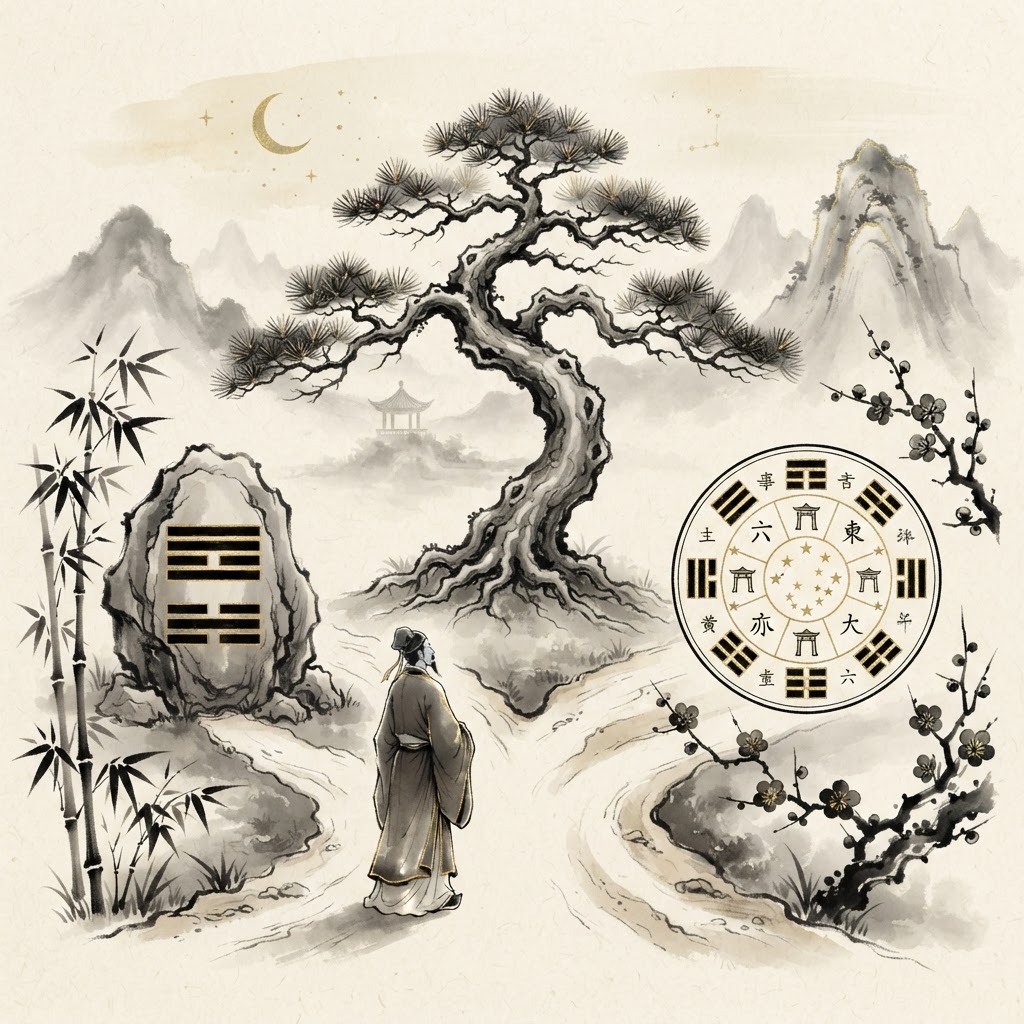
This article is part of my complete guide to the I Ching / Book of Changes.
The I Ching at a Glance
The I Ching is the oldest of the Chinese classics, and its origins stretch back to the oracle bone divination practices of the Shang and early Zhou dynasties. The system works through hexagrams: six-line figures built from two trigrams, each line either yin (broken) or yang (solid). You cast a hexagram by tossing coins or sorting yarrow stalks, and the resulting hexagram describes the pattern of your situation.
The I Ching has sixty-four hexagrams, each with a name, a Judgment and an Image. The Ten Wings, traditionally associated with Confucius, add philosophical interpretation. You can learn the coin method in an afternoon, and with practice you will know the sixty-four hexagrams within a year.
The I Ching is portable. You need a book and three coins. The entire process takes about twenty minutes. The interpretations are discursive: they give you a pattern to reflect on rather than a specific instruction. The I Ching speaks in images and metaphors, and your job is to sit with those images until you see how they apply.
| Feature | I Ching | Qi Men Dun Jia |
|---|---|---|
| Origin era | c. 1000 BCE (oracle bone roots) | Warring States to Tang dynasty |
| Casting method | Three coins, six tosses | Calendar-based chart from time |
| What it produces | One hexagram with changing lines | A full chart of palaces, stems, doors, stars, gods |
| Learning curve | Low (one afternoon) | Moderate to high (several months) |
| Best at | Reframing a situation, reflection | Timing, strategy, tactical decisions |
| Time per reading | 15-30 minutes | 30-60 minutes for a full chart |
| Equipment | Book and three coins | Reference tables or a calculator |
Qi Men Dun Jia at a Glance
Qi Men Dun Jia is a system I have spent years studying and now teaching. It originated as a military and statecraft tool, traditionally used by strategists to time campaigns and advise rulers on when to act. The name translates roughly as Mysterious Gate Escaping Heavenly Stem, which hints at its complexity.
A QMDJ chart is a grid of nine palaces, each containing heavenly stems, eight doors, nine stars, eight gods and the five elements. The chart is cast from a specific moment in time using the Chinese calendar. Unlike the I Ching, which uses randomness, QMDJ derives its chart deterministically from the time of the question.
What QMDJ gives you that the I Ching does not is precise directional and timing information. A QMDJ hour chart tells you which direction is favorable, which door is open, and which combination supports your action. Where the I Ching says this is a time for patience, QMDJ can say act between 3 and 5 pm, facing southeast, through the Open Door.
The I Ching names the pattern. QMDJ times the action. The first tells you what kind of moment you are in. The second tells you when and how to move within that moment.
Shared Roots
Both systems grow from the same soil. Oracle bone divination, practiced during the Shang dynasty, is the ancestor of both. Both use yin and yang as their fundamental binary, and both incorporate the five elements as part of their interpretive framework.
The trigrams (bagua) that form the I Ching’s building blocks also appear in QMDJ as the eight doors and eight gods. The directional associations are shared. If you understand one system, you will find many of its concepts in the other. But the application is different: the I Ching uses trigrams to build situations, while QMDJ uses them to construct a tactical chart.
Shared Concepts Between I Ching and QMDJ
| Concept | In the I Ching | In Qi Men Dun Jia |
|---|---|---|
| Yin and Yang | Lines are yin (broken) or yang (solid) | Stems and palaces have yin or yang nature |
| Eight Trigrams | Stacked to form 64 hexagrams | Used as 8 doors and 8 gods in the chart |
| Five Elements | Underlies trigram associations | Assigned to stems, doors, stars and palaces |
| Heavenly Stems | Not used in hexagram casting | Core component: 10 stems across 9 palaces |
| Asking a question | Frame a question before casting | Cast a chart from the time of the question |
What Each System Is Best At
The I Ching is best at helping you see the pattern of your situation. When you are confused about what is happening, when you need perspective on a decision that feels tangled, the I Ching gives you a frame. It excels at situations where the problem is a lack of clarity, not a lack of information.
QMDJ is best at tactical timing. When you know what you want to do and need to know when and how, QMDJ gives you specific guidance. Its combinations of doors, stars and gods provide a detailed read on the energy of a specific moment, and its military heritage means it was built for tactical decisions.
When I Would Use Each
In my practice, I use the I Ching for questions about meaning and pattern. If I am uncertain about the nature of a situation, the I Ching is my first stop. I grab my coins, frame a question, and sit with the hexagram for a day. The answer comes as a reframe, not a directive.
I use QMDJ when I know what I want to do and need to know how to do it well. If I am scheduling a meeting, choosing a day for an important conversation, or advising a client on timing, QMDJ gives me the specific moment. The hour chart tells me which two-hour block is favorable and which direction supports the action.
The distinction is simple: I Ching for what is happening. QMDJ for when to act. Both are asking how to align your decision with the pattern of the moment, but from different angles.
| Question Type | Better System | Why |
|---|---|---|
| What is the nature of this situation? | I Ching | Names the archetypal pattern |
| When should I schedule this meeting? | QMDJ | Provides specific timing |
| Should I take this opportunity? | I Ching | Reframes the question at a pattern level |
| Which direction should my desk face? | QMDJ | Directional guidance built into the chart |
| Am I in a growth or waiting phase? | I Ching | The hexagram names the phase |
| Is this week good for launching? | QMDJ | Specific week and hour analysis |
| What am I not seeing? | I Ching | Surfaces blind spots through metaphor |
| Which of two offers should I accept? | Both | I Ching for pattern, QMDJ for timing |
Learning Curve and Time Investment
The I Ching has a gentle learning curve. You can do your first competent reading in an afternoon if you have a good translation and follow the casting method. Becoming fluent takes regular practice, but the entry barrier is low.
QMDJ has a steeper curve. You need to understand the calendar system, stems and branches, nine palaces, eight doors, nine stars, eight gods, and how they interact. Building a competent read of a chart takes several months. My course is designed to shorten this, but there is no shortcut to understanding.
If you are starting from zero and want a divination practice you can use this week, start with the I Ching. If you are willing to invest months for precise tactical guidance, learn QMDJ. Many of my best students started with the I Ching, fell in love with Chinese metaphysics, and then came to QMDJ for its depth.
The Discipline Both Systems Demand
Both systems demand the same thing: honesty. The I Ching requires you to frame a clean question and sit with an answer you may not want. QMDJ requires you to read the chart objectively without twisting the interpretation to suit your preference. The temptation in both is to hear what you want to hear, and the discipline in both is to resist that temptation.
One clean question. One honest interpretation. One decision made with the new perspective. That is the practice, whether you are tossing coins or reading a QMDJ chart.
The I Ching and QMDJ share one essential requirement: you must be willing to hear the answer you did not want. Without that willingness, both become expensive ways of telling yourself what you already think.
What a Beginner Should Learn First
Learn the I Ching first. Spend three to six months using it weekly. Learn the coin method. Keep a journal. Become familiar with the hexagrams. Let the experience of framing a question and sitting with an answer become habitual.
Once that habit is established, if you want to go deeper into timing and tactical decision-making, learn QMDJ. The conceptual foundation from the I Ching will make QMDJ easier, because you will already understand yin and yang, the five elements, and the trigrams. You will have developed the discipline of honest interpretation, which is the hardest thing to teach and the most important thing to learn.
Suggested Learning Path
| Stage | What to Learn | Time |
|---|---|---|
| 1. Start | I Ching coin casting and journaling | 1-2 weeks to begin, 3-6 months to feel fluent |
| 2. Deepen | All 64 hexagrams, changing lines, commentary | Ongoing, perhaps 1 year |
| 3. Add QMDJ | Stems, branches, palaces, doors, stars, gods | 3-6 months with a teacher |
| 4. Combine | Use I Ching for pattern, QMDJ for timing | Ongoing practice |
Combining Both Without Superstition
The risk of having two divination tools is the temptation to cast both until one says what you want. That is not combining them. That is shopping for the answer you prefer.
The correct way to combine them is sequential. First, use the I Ching to understand the pattern. Sit with that reading. Accept it, even if it is uncomfortable. Then use QMDJ to find the right timing within that pattern. The I Ching answer constrains the QMDJ question. If the I Ching says this is a time for patience, you do not ask QMDJ for the best time to act aggressively. You ask QMDJ for the best time to practice patience well.
If you find yourself casting repeatedly until you get the answer you want, stop. That is the signal that the tools are using you. Put the coins down. Close the calculator. Sit with your decision in silence for a day. Come back when you are ready to hear whatever the systems have to say.
Related I Ching Guides
- How to Cast an I Ching Reading
- The 64 Hexagrams of the I Ching, Explained
- The History and Origins of the I Ching
- Using the I Ching in Modern Life
Frequently Asked Questions
Which is more accurate, the I Ching or QMDJ?
Neither is more accurate. They answer different questions. Usefulness is the right frame, not accuracy.
Can I use both at the same time?
You can, but learn one first. Start with the I Ching because it is simpler. Once you have a foundation, QMDJ becomes easier because the concepts overlap.
Does QMDJ replace the I Ching?
No. I still use the I Ching regularly for questions about pattern and meaning. QMDJ is my primary teaching subject, but the I Ching remains the foundational text of Chinese divination.
Is QMDJ harder to learn than the I Ching?
Yes, significantly. The I Ching has a gentle learning curve. QMDJ requires understanding the Chinese calendar, stems and branches, nine palaces, doors, stars and gods, and how they interact.
Do I need to know Chinese to use either system?
No. Both systems have good English translations. I teach QMDJ in English, and my students come from English-speaking countries. Knowing Chinese helps with classical texts but is not required.
Can I use the I Ching for business timing?
You can, but QMDJ is better for this. The I Ching tells you whether the moment is favorable generally. QMDJ tells you which specific hour and direction to use.
Related Reading
- I Ching / Book of Changes: The Complete Guide: my pillar page on the I Ching.
- How to Cast an I Ching Reading: the coin and stalk methods.
- The 64 Hexagrams Explained: the building blocks of readings.
- Using the I Ching in Modern Life: practical applications.
- Qi Men Dun Jia Hour Charts: the QMDJ timing system.
- My QMDJ Course: if you want to go deeper.
- BaZi Reading: the destiny system that complements both.
- Bu, the Art of Divination: how both fit into the Five Arts.
Leave a Reply
You must be logged in to post a comment.