Sima Qian (司馬遷) is the person who gave Chinese history its shape. Before him, historical records existed, but nobody had attempted a single, comprehensive account spanning from legendary origins to the historian’s own era. He did that, and in doing so, he created a template that every subsequent dynastic historian in China would follow for the next two thousand years. This is the story of his life, his suffering, and the work that survived him.
For the full pillar guide to the Shiji, see Records of the Grand Historian. This article is one of five in our Shiji series, alongside the structure of the Shiji, its greatest chapters, the Shiji as literature, and lessons for modern leaders.
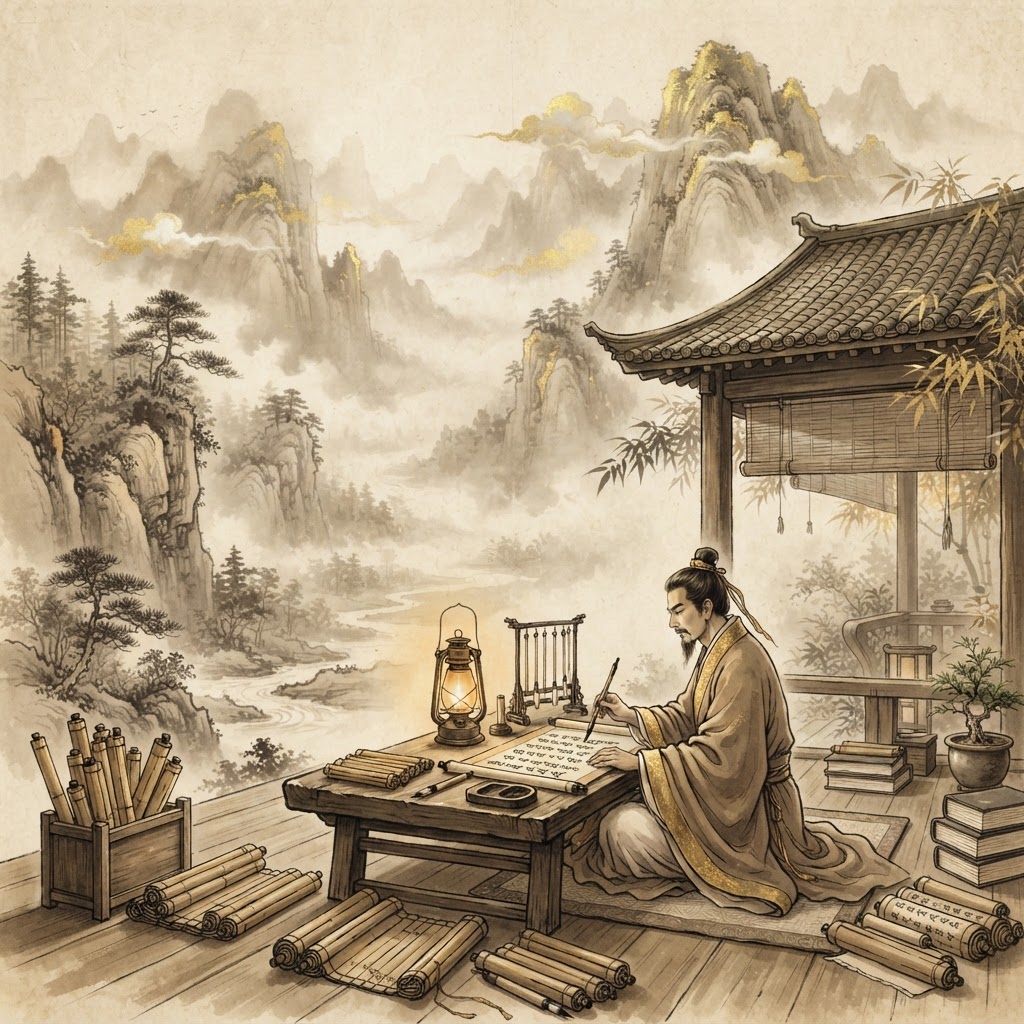
Sima Qian, China’s first great historian, writing at his desk
The World Sima Qian Was Born Into
Sima Qian was born around 145 BCE during the Western Han dynasty, under the reign of Emperor Jing. His father, Sima Tan (司馬談), held the position of Grand Astrologer (太史令, taishi ling), a role that combined astronomical observation, calendar maintenance, and record-keeping. In Han dynasty government, the Grand Astrologer was not a minor figure. He advised the emperor on matters of ritual timing, auspicious dates, and the cosmic significance of natural phenomena.
Sima Tan was also a scholar of broad learning. He studied astronomy, the calendar, and the philosophical traditions of his time. He is best known for his essay “On the Essential Beliefs of the Six Schools” (論六家要旨), which classified the major intellectual traditions of China into six categories: the Yin-Yang school, the Confucian school, the Mohist school, the Legalist school, the School of Names, and the Daoist school. This classification influenced Chinese intellectual history for centuries.
Growing up in this household, Sima Qian absorbed both the technical skills of the astrologer’s office and the philosophical breadth of his father’s scholarship. He learned to read the stars, maintain the calendar, and write in the formal documentary style required of government scribes. These were not optional skills for his future work. They were the building blocks.
Sima Tan’s six-school classification was the first systematic attempt to categorise Chinese philosophy. His son would later inherit his office, his unfinished history, and his conviction that the work mattered.
Early Travels and Education
At the age of twenty, Sima Qian embarked on an extensive tour of the empire. This was not unusual for the sons of officials; it was a form of practical education. But Sima Qian’s travels were more ambitious than most. He visited the ancient states of Lu and Qi (modern Shandong), where Confucius had lived and taught. He climbed Mount Kuaiji in the southeast, where tradition held that Yu the Great, the legendary flood-tamer, was buried. He travelled to the north, to the regions near the Great Wall, where the Qin dynasty had fought the Xiongnu nomads.
He was not merely sightseeing. At each location, he collected oral histories, verified local traditions against written records, and examined physical evidence. When he visited the tomb of Qu Yuan (屈原), the poet-statesman of Chu, he wept. When he passed through the battlefields of the Chu-Han contention, he recorded the stories told by local elders about Xiang Yu and Liu Bang.
This fieldwork method, gathering evidence from multiple sources and cross-checking accounts, was not standard practice in an age when most historians simply copied previous records. Sima Qian’s willingness to travel, interview, and verify became one of the Shiji’s defining strengths.
A quick note: Sima Qian’s travels covered much of the Han empire, from the Shandong coast in the east to the Sichuan basin in the west, and from the northern frontier to the Yangtze delta. He wrote about what he saw, not just what he read. This made his history feel lived in, not merely compiled.
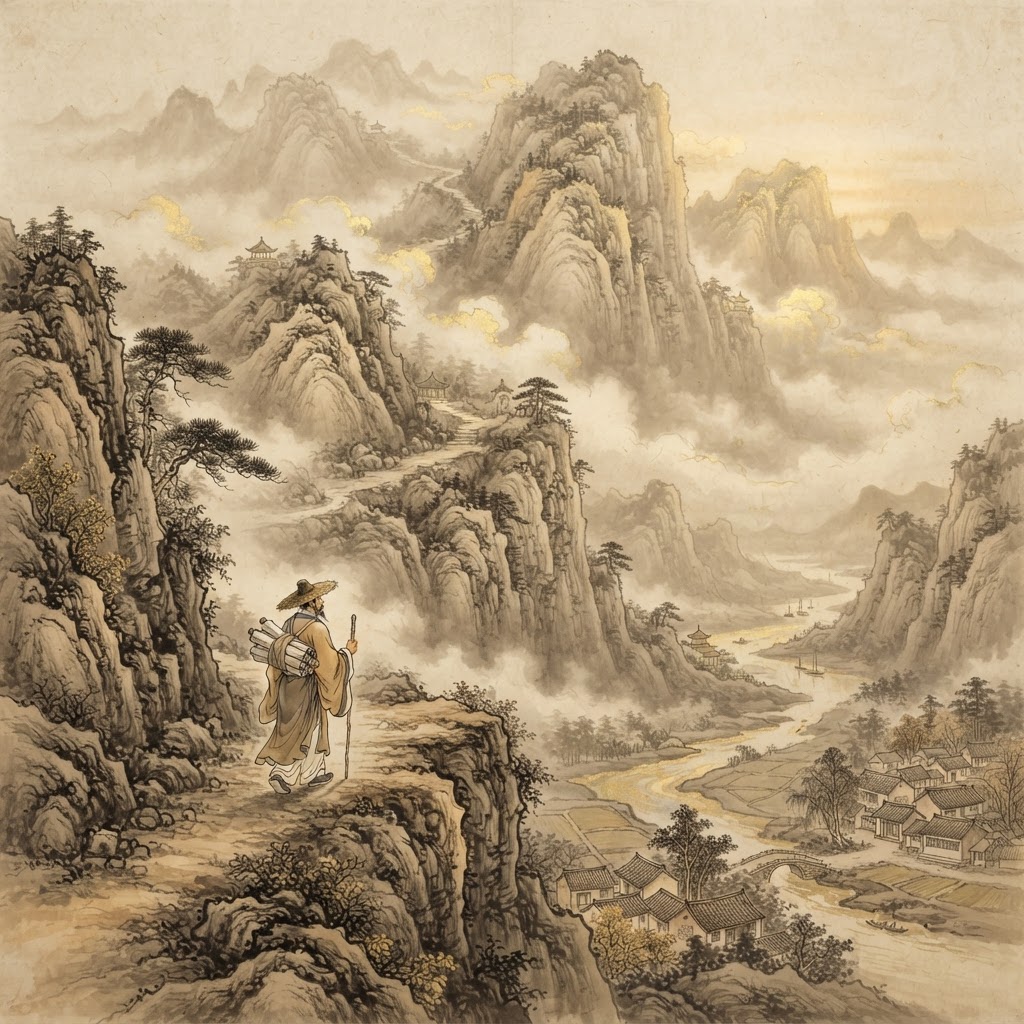
Sima Qian traveled the empire, visiting battlefields and interviewing elders
Office and the Father’s Deathbed Request
After his travels, Sima Qian entered government service. He was appointed to a position in the imperial court and served on several diplomatic and administrative missions. In 111 BCE, Emperor Wu sent him on a military expedition to the southwest, to the regions of Ba and Shu (modern Sichuan), to survey routes for the empire’s expansion.
In 110 BCE, Sima Qian’s father, Sima Tan, fell seriously ill. According to Sima Qian’s own account in the Shiji’s postface, his father summoned him to his deathbed and delivered a dying instruction. Sima Tan told his son that he had dreamed of a great history, a comprehensive record from the legendary Yellow Emperor to the present day, but had not lived to complete it. He asked Sima Qian to finish the work.
The deathbed scene, as Sima Qian recounts it, is one of the most emotionally charged passages in all of Chinese historical writing. Sima Tan compared his son’s mission to that of Confucius, who compiled the Spring and Autumn Annals after a period of political disorder. The implication was clear: writing history was not merely scholarship, it was a moral duty to restore order and meaning after chaos.
Sima Qian wept and accepted the charge. “I dare not refuse,” he wrote, in words that resonate across two millennia.
| Year (BCE) | Event | Significance |
|---|---|---|
| ~145 | Birth of Sima Qian | Born into a family of astrologers and scholars |
| ~125 | Begins extensive travels | Collects oral histories and verifies sites |
| 111 | Southwest expedition | Gains administrative and geographic knowledge |
| 110 | Death of Sima Tan | Deathbed request to finish the history |
| 108 | Appointed Grand Astrologer | Begins formal work on the Shiji |
| 104 | Begins the Taichu calendar reform | Co-develops a new imperial calendar system |
| 99 | The Li Ling affair | Speaks out, is punished with castration |
| ~91 | Completes the Shiji | ~130 chapters, over 500,000 words |
The Li Ling Affair
In 99 BCE, a military disaster changed Sima Qian’s life. A general named Li Ling (李陵) led a small force of infantry against the Xiongnu, the powerful nomadic confederation on China’s northern border. Li Ling was outnumbered, his supplies ran out, and after a desperate defence, he surrendered to the Xiongnu rather than dying in battle.
Emperor Wu was furious. The court officials, sensing the emperor’s mood, unanimously condemned Li Ling as a traitor. Sima Qian, who knew Li Ling personally and respected his character, spoke up. He argued that Li Ling had fought bravely against impossible odds, that his surrender was a desperate act by a man who had no other choice, and that he might yet find a way to escape and return to Han.
The emperor did not see it that way. Sima Qian was charged with defaming another official (implicitly accusing the emperor of poor judgment in his appointment of Li Ling’s commander) and sentenced to death. In Han law, a death sentence could be commuted in three ways: payment of a large fine (which Sima Qian could not afford), acceptance of castration (the most shameful option), or execution. Sima Qian chose castration.
“A person’s death may be heavier than Mount Tai or lighter than a feather. The difference lies in whether it has meaning.” This sentence from Sima Qian’s famous letter to Ren An is one of the most quoted lines in Chinese literature.
The Decision to Live
In Han society, castration was considered worse than death for a man of Sima Qian’s standing. It meant the end of his family line. It meant social disgrace. It meant he could never again hold a normal government position. Most men in his situation would have chosen suicide.
Sima Qian chose to live. In his letter to Ren An, written after the punishment, he explained why. He said that he could not die yet because the Shiji was not finished. His father’s dying request kept him alive. He wrote:
If I had followed the law and submitted to execution, it would have been no more significant than the loss of one hair from nine oxen. Why? Because my life would have ended without making any mark. If even the most lowly slave could achieve death by ten cuts, would that not be what I deserved? No. I should not accept such a death. The reason I have endured the disgrace of imprisonment, the leather whip, the knife and the saw, and have not refused to live, is because I have not yet finished the work that is in my heart.
This is the passage where Sima Qian explains his choice to endure shame rather than die. He goes on to list great thinkers who suffered and produced their masterworks under adversity: Confucius wrote the Spring and Autumn Annals while in exile in Qi, Qu Yuan wrote his poetry after being banished, Zuo Qiuming lost his sight and wrote the Guoyu, and Han Fei was imprisoned in Qin and produced his political writings. Sima Qian’s message is clear: suffering produces great work, and his suffering must produce the Shiji.
Historical Inspiration for Sima Qian
| Figure | Suffering | Work Produced |
|---|---|---|
| Confucius (孔子) | Exiled and marginalised | Spring and Autumn Annals (春秋) |
| Qu Yuan (屈原) | Banished from court | Encountering Sorrow (離騷) and other poems |
| Zuo Qiuming (左丘明) | Lost his sight | Guoyu (國語, Discourses of the States) |
| Han Fei (韓非) | Imprisoned in Qin | Political writings (韓非子) |
| Sima Qian (司馬遷) | Castrated | Records of the Grand Historian (史記) |
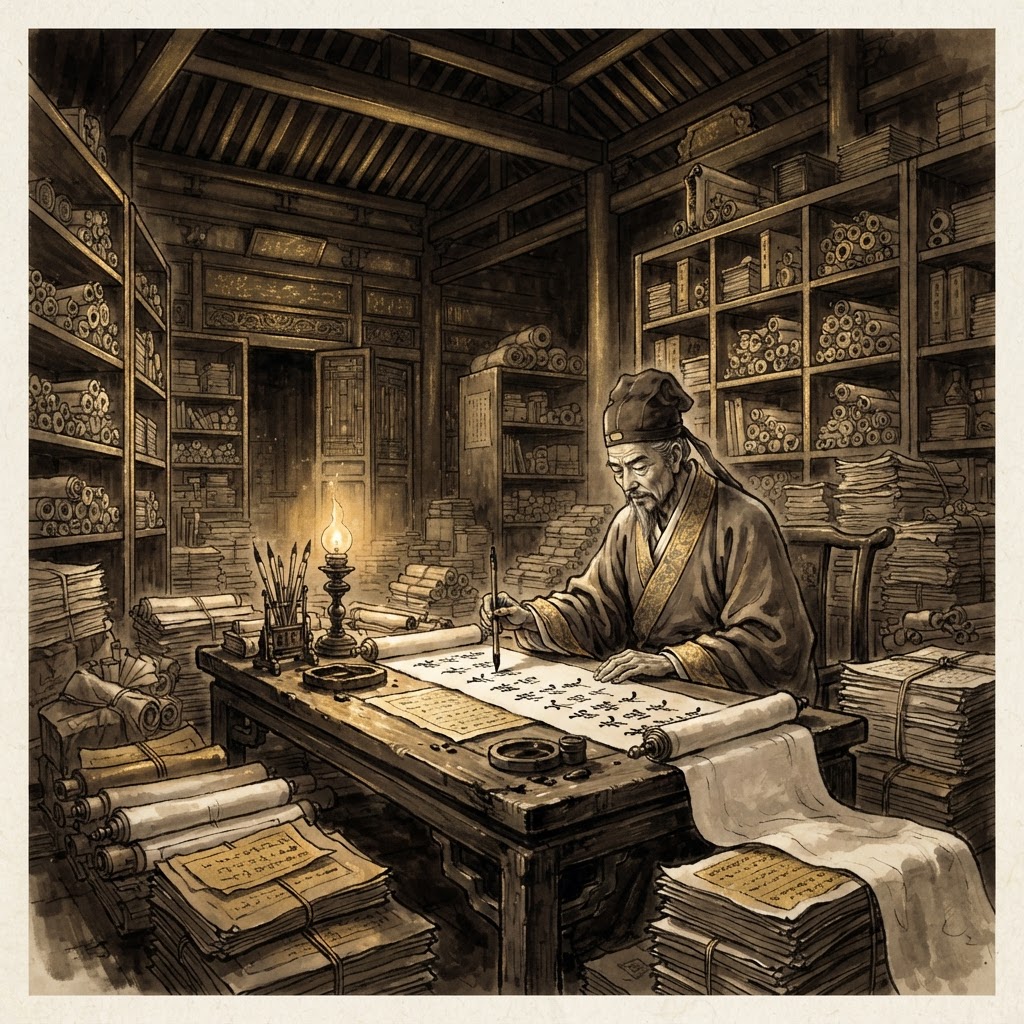
Despite castration, Sima Qian continued his history in the palace library
The Grand Astrologer at Work
After his punishment, Sima Qian was appointed to a position as Palace Secretary (中書令), a role that involved managing documents for the emperor. This position, while humble for a man of his abilities, gave him access to the imperial archives. He could read the records of previous dynasties, the diplomatic correspondence, the philosophical texts, the astronomical observations. Everything he needed was in those archives.
He worked on the Shiji for the rest of his life. The exact date of his death is unknown; there is no historical record of it. Some scholars believe he died shortly after completing the Shiji, around 86 BCE. Others suggest he lived longer but was removed from court. What is certain is that the Shiji was completed, and it contained approximately 130 chapters and over 500,000 words.
The work covered the entirety of Chinese history from the Yellow Emperor (around 2600 BCE) to the reign of Emperor Wu (around 90 BCE), a span of nearly 2,500 years. It was not a simple chronicle. It was a layered, complex, multi-perspective account that wove together political narrative, biography, treatise, and genealogy. For a detailed walkthrough of its structure, see our companion article on the five sections of the Shiji.
The Shiji’s Treatment of Power and Morality
One of the most remarkable aspects of the Shiji is how Sima Qian treated the powerful. He did not flatter emperors. He did not spare villains. He wrote about Xiang Yu, the failed contender for the throne after the fall of Qin, with sympathy and respect, placing him in the “Basic Annals” section normally reserved for rulers. He wrote about the First Emperor of Qin with a clear eye, praising his achievements while documenting his tyranny.
Sima Qian’s moral framework was subtle. He did not preach. Instead, he let the facts speak. When he described a ruler’s cruelty, he did so in plain language. When he admired someone’s integrity, he said so directly. When he thought a decision was foolish, he let the ensuing disaster demonstrate it. This approach, showing rather than telling, gave the Shiji a power that more didactic histories lacked.
His chapter on the “Assassin-Retainers” (刺客列傳) is a good example. He tells the story of Jing Ke, who attempted to assassinate the King of Qin, neither condemning nor praising the act. He shows the retainer’s loyalty, the king’s terror, and the geopolitical consequences, and lets the reader judge. This restraint is one reason the Shiji has been read continuously for two thousand years.
A quick note: Sima Qian’s moral courage is easy to miss because he rarely states judgments overtly. But his choices about what to include, what to emphasise, and where in the work to place a biography all carry moral weight. The Shiji is a quiet argument, not a loud one.
The Letter to Ren An
The “Letter to Ren An” (報任安書) is the most personal document Sima Qian left us. Written to a friend who was himself facing execution, it explains why Sima Qian chose to live after castration rather than accept death with dignity. It is one of the most powerful self-explanations in Chinese literature.
In the letter, Sima Qian writes about shame. He says that there are ten levels of shame, and that castration is the most shameful of all. He writes about his ancestors, who were astrologers and musicians, positions close to those of jesters and entertainers, looked down upon by the powerful. He writes about how, after his punishment, he could not face the tombs of his ancestors. He writes about how he felt in the presence of other officials, who looked at him with contempt.
But the letter is not only about suffering. It is about purpose. Sima Qian explains that he endures the shame because he has a work to finish. He says:
I wish to collect and arrange the forgotten records of the past, investigating the rise and fall of events from ancient times to the present, understanding the reasons for success and failure, and preserving the record of them. I will write a work of 130 chapters, and I call it the Records of the Grand Historian. I submit my body to the shame of the castration, concealing myself among the women of the palace, living only until I have written this work, so that it can be stored in a famous mountain and transmitted to those who can appreciate it in later ages.
In this passage, Sima Qian makes clear his vision: the Shiji is not for Emperor Wu. It is for future generations. He writes for “those who can appreciate it in later ages.” And indeed, we are those people, two thousand years later, still reading.
Sima Qian’s Legacy to Chinese Historical Writing
The Shiji became the template for every subsequent dynastic history in China. Ban Gu, writing the Book of Han (漢書) in the first century CE, adopted Sima Qian’s structure intact. The twenty-four official dynastic histories that followed, from the Shiji to the Ming History, all used variations of Sima Qian’s five-section format: Basic Annals, Chronological Tables, Treatises, Hereditary Houses, and Biographies.
But the legacy goes beyond format. Sima Qian established a standard of historical integrity that later historians strove to meet. His willingness to criticise the powerful, his commitment to multiple sources, his integration of non-Chinese peoples into the historical record, and his literary skill all set a bar that subsequent historians acknowledged even when they could not equal it.
| Aspect of Legacy | What Sima Qian Did | How It Shaped Later History |
|---|---|---|
| Structure | Created the five-section format | All 24 official dynastic histories adopted it |
| Sources | Cross-checked oral, written, and physical evidence | Later historians cited sources and noted discrepancies |
| Non-Chinese peoples | Gave Xiongnu, Yue, and others their own chapters | Later histories included foreign peoples as a standard section |
| Biography as literature | Wrote biographies as narrative, not bare record | Biographic narrative became a genre in its own right |
| Moral independence | Judged rulers and officials on their merits | Later historians of integrity saw it as a model of honest recording |
The Question of Sima Qian’s Death
One of the mysteries of Sima Qian’s life is how it ended. There is no record of his death in the Shiji itself (he did not consider his own life important enough to include) or in Han dynasty sources. The Book of Han mentions him briefly but does not give a death date. Some later sources suggest he died around 86 BCE, shortly after completing the Shiji. Others propose he may have been executed or died in obscurity, his punishment having marked him out permanently.
The silence itself is telling. A man of his stature, who had served the emperor and produced one of the greatest works of history ever written, vanishes from the record. It is possible that the shame of castration meant that no one thought his death worth recording. It is also possible that the political circumstances of his last years made it dangerous to mention him. Whatever the case, his silence about himself is in keeping with his approach: he wrote about others, not about himself, and let the work speak.
Why Sima Qian Still Matters
Sima Qian matters because he faced the worst thing that could happen to a man in his society, and he chose to use that suffering to create something that would outlast everything and everyone that hurt him. He wrote a history that covered 2,500 years, that treated the powerful and the powerless with equal honesty, and that read like literature while maintaining the discipline of history.
He matters for another reason too. He shows us that integrity has a cost, and that the cost can be worth paying. When he spoke up for Li Ling, he knew the risk. When he chose to live after castration, he chose the harder path. When he wrote about emperors with honesty rather than flattery, he was putting his safety on the line again. The Shiji exists because one man decided that telling the truth was more important than living comfortably.
Every Chinese historian who followed Sima Qian looked back to him and asked: am I writing with his honesty? Most had to admit they were not.
The Shiji is not perfect. Sima Qian sometimes relied on unreliable sources, occasionally wrote contradictory accounts, and was influenced by the cultural assumptions of his time. But his commitment to honest recording, his willingness to include uncomfortable truths, and his literary skill make the Shiji a work that still rewards reading today. For a deeper look at the literary qualities that make the Shiji endure, see our companion article on the Shiji as literature. For the lessons his work offers modern decision-makers, see Shiji lessons for modern leaders.
The Shiji and the Non-Chinese World
Sima Qian did something that many of his contemporaries would have found strange: he gave the Xiongnu, the nomadic peoples of the northern steppe, their own chapter in the Shiji. The “Account of the Xiongnu” (匈奴列傳) is not a dismissive footnote. It is a detailed, respectful description of Xiongnu society, their governance, their seasonal migrations, their military organisation, and their relationship with China.
Sima Qian described the Xiongnu as a people organised differently from China, not as an inferior people. He explained their pastoral economy, their strategy of feigned retreats, and their political structure of subordinate kings and tribal leaders. He treated the Xiongnu as a political entity worth understanding on its own terms, not merely as a threat to be suppressed.
This mattered because most Han dynasty writers described the Xiongnu in terms of deep contempt. They were “dogs and goats,” “greedy and cruel,” unworthy of engagement. Sima Qian rejected this framing. He wrote that in some respects, the Xiongnu had better customs than China. For instance, he noted that their succession was based on merit and strength, not birth, and that their punishments were simpler and more consistently applied.
His treatment of other non-Chinese peoples followed a similar pattern. The “Account of the Southwestern Barbarians” (西南夷列傳) described the diverse peoples of what is now Yunnan and Sichuan, their trade networks, and their relationships with the Han empire. The “Account of the Dayuan” (大宛列傳) described the Central Asian kingdoms, their horses, and their agriculture. These accounts were based partly on the reports of Zhang Qian, the Han envoy who travelled to the West, and partly on Sima Qian’s own interviews with people who had visited these regions.
Non-Chinese Peoples in the Shiji
| Account | People Covered | Region |
|---|---|---|
| Xiongznu | Xiongnu | Mongolian steppe |
| Nanyue | Yue people | Southern China (Guangdong, Guangxi, Vietnam) |
| Southwestern Yi | Various tribes | Yunnan, Guizhou, Sichuan |
| Dayuan | Central Asians | Ferghana Valley (modern Uzbekistan) |
| Donghu | Eastern nomads | Manchuria |
The Calendar Reform of 104 BCE
One of Sima Qian’s most significant contributions outside the Shiji was the Taichu calendar reform of 104 BCE. As Grand Astrologer, he was responsible for the imperial calendar. The calendar in use during the early Han was based on the Qin system, which had known inaccuracies. Sima Qian, along with the astronomers Deng Ping and Luo Xiahong, developed a new calendar system that was more accurate in tracking the lunar months and solar terms.
The Taichu calendar adopted a system where one month was defined as 29/43 days, and one year as 365 385/1539 days. While these figures were not perfect, they represented an improvement over the previous system. More importantly, the reform established the principle that the calendar should be periodically revised based on astronomical observation rather than being frozen in an archaic formula.
This work was not separate from the Shiji. Sima Qian’s deep knowledge of astronomy and the calendar informed his “Treatise on the Heavenly Offices” (天官書), which catalogued the stars, their movements, and their astrological significance. His treatise was the most detailed astronomical record of its time, and it demonstrates the range of his intellectual interests. He was not just a historian. He was a scientist by the standards of his era.
A quick note: The Taichu calendar reform shows that Sima Qian practiced what he wrote about. The Shiji’s “Treatise on the Calendar” (曆書) describes the theoretical basis of the new system. Sima Qian did the actual work of observation and calculation, then wrote the history of how such systems had been developed over the centuries.
Sima Qian’s Use of Irony and Indirect Criticism
One of the hardest things to see in translation is Sima Qian’s use of irony. He rarely says outright that a ruler was wrong or a policy was foolish. Instead, he arranges the facts so the reader draws the conclusion. This is a technique that requires careful reading, and it is one of the most rewarding aspects of studying the Shiji.
For example, in his account of Emperor Wu’s campaigns against the Xiongnu, Sima Qian describes the military victories in glowing terms, listing the captured horses and surrendered tribes. Then, without comment, he notes the cost: the imperial treasury emptied, the peasants conscripted, the farmland left untended. He does not say “the campaigns were too expensive.” He shows you the bill and lets you reach that conclusion.
Similarly, in his biography of the First Emperor of Qin, Sima Qian describes the construction of the Epang Palace and the Great Wall with awe at the scale. Then he notes the number of workers who died, the taxes raised, and the rebellions that followed. The admiration and the criticism exist in the same paragraphs, without editorialising. The reader has to hold both.
This technique had a practical reason. Direct criticism of a sitting emperor could result in punishment, as Sima Qian knew from bitter experience. Indirect criticism, woven into the arrangement of facts, was safer. But it was also, in many ways, more effective. A reader who reaches a conclusion through their own reasoning is more convinced than one who is told what to think.
Sima Qian’s irony is not sarcasm. It is the art of showing two truths at once: that a ruler achieved great things, and that those things came at a terrible cost. The Shiji does the accounting so the reader can do the judging.
The Shiji’s Influence Beyond China
The Shiji’s influence was not confined to China. As Chinese culture spread to Korea, Japan, and Vietnam, the Shiji became part of the scholarly canon in all of these countries. Japanese historians studied it in the Heian period (794 to 1185 CE), and the Japanese tradition of official historical writing, beginning with the Nihon Shoki (720 CE), was modelled partly on the Shiji’s structure.
In Korea, the Shiji was studied by Confucian scholars throughout the Goryeo and Joseon dynasties. The Korean tradition of official history writing drew from Sima Qian’s approach, including the use of biographies and treatises alongside political chronicles.
In the West, the Shiji was not translated into a European language until the twentieth century. French sinologist Edouard Chavannes published a French translation of portions of the Shiji between 1895 and 1905. The first major English translation was by Burton Watson in 1961, covering the most important chapters. A complete English translation, led by William H. Nienhauser, began publication in 1994 and is still ongoing.
The Unfinished Quality of the Shiji
One thing that surprises careful readers of the Shiji is that it does not feel finished. There are gaps, incomplete references, and places where Sima Qian seems to have intended to add more material. Some chapters are marked as “missing” or “lost” in the earliest bibliographic records. This is because the Shiji, despite its enormous scope, was probably never fully polished. Sima Qian may have run out of time, or he may have been forced to stop working while some sections were still in draft.
This unfinished quality is not a weakness. If anything, it makes the Shiji feel more human and more honest. You can see the joins. You can tell where the writer was moving fast and where he slowed down. You can see where his interest was deepest (the biographies of his contemporaries, the treatises on economics and astronomy) and where he was working from secondary sources (some of the very early chronicles).
For contrast, the Book of Han (漢書), written by Ban Gu a century later, is more polished but also more constrained. Ban Gu had the benefit of the Shiji as a model, but he was also more cautious in his judgments, more deferential to the court. The Shiji’s rawness gives it an energy that the Book of Han, for all its elegance, does not match. For a detailed comparison, see our article on the Book of Han vs the Shiji.
Sima Qian and the I Ching
While the Shiji is a work of history, Sima Qian’s intellectual framework was shaped by many traditions, including the I Ching. The Shiji makes several references to the Book of Changes. Sima Qian cited the I Ching’s ideas about change, cycles, and the balance of opposites as influences on his understanding of history. The rise and fall of dynasties, the alternation of war and peace, and the way that strength contains the seeds of its own decline, these are themes that resonate with I Ching philosophy.
For those interested in how Chinese classical traditions connect, the relationship between the Shiji’s philosophy of history and the I Ching’s philosophy of change is a rich topic. For a broader context, see our I Ching pillar guide and our comparison of I Ching vs QMDJ.
Frequently Asked Questions
Was Sima Qian the first historian in China?
No. Historical records existed before him, including the Spring and Autumn Annals, the Zuo Zhuan, and various court chronicles. Sima Qian was the first to write a comprehensive history spanning the entirety of known Chinese history in a single, structured work.
Why did Sima Qian choose castration instead of death?
He explained in his letter to Ren An that he chose to live because he had not yet finished the Shiji. He viewed the work as more important than his personal dignity, and believed that completing it would give his life meaning beyond the shame he endured.
How accurate is the Shiji?
For the period of the Qin and early Han, where Sima Qian had access to archives and contemporaries, the Shiji is considered highly accurate. For the earlier, legendary periods, he sometimes relied on traditions that cannot be verified, but he frequently noted when sources disagreed or when a story was unreliable.
What happened to Sima Qian after he finished the Shiji?
His death is not recorded. Most scholars believe he died shortly after completing the work, around 86 BCE. The silence in the historical record about his death may reflect the social stigma attached to his castration.
Did Sima Qian’s history influence later Chinese political thought?
Yes, deeply. The Shiji became required reading for Chinese officials and scholars for centuries. Its biographies of rulers, ministers, and advisors served as case studies in governance, and its honest treatment of both success and failure set a moral standard that later political writers invoked.
Is the Shiji accessible to modern readers in translation?
Yes. Several English translations exist, including partial translations by Burton Watson (which are considered the most readable) and more complete translations by William H. Nienhauser and others. For the structure, see our guide to the five sections of the Shiji.
Leave a Reply
You must be logged in to post a comment.