The Structure of the Shiji: Its Five Sections Explained
The Shiji is not one story. It is five different kinds of history woven into a single work. Understanding its structure is the key to reading it well, because each section has its own rules, its own purpose, and its own way of telling the truth.
This article is part of our Shiji series. For the full guide, see Records of the Grand Historian. Related articles: Sima Qian’s life and legacy, greatest chapters, the Shiji as literature, and lessons for leaders.
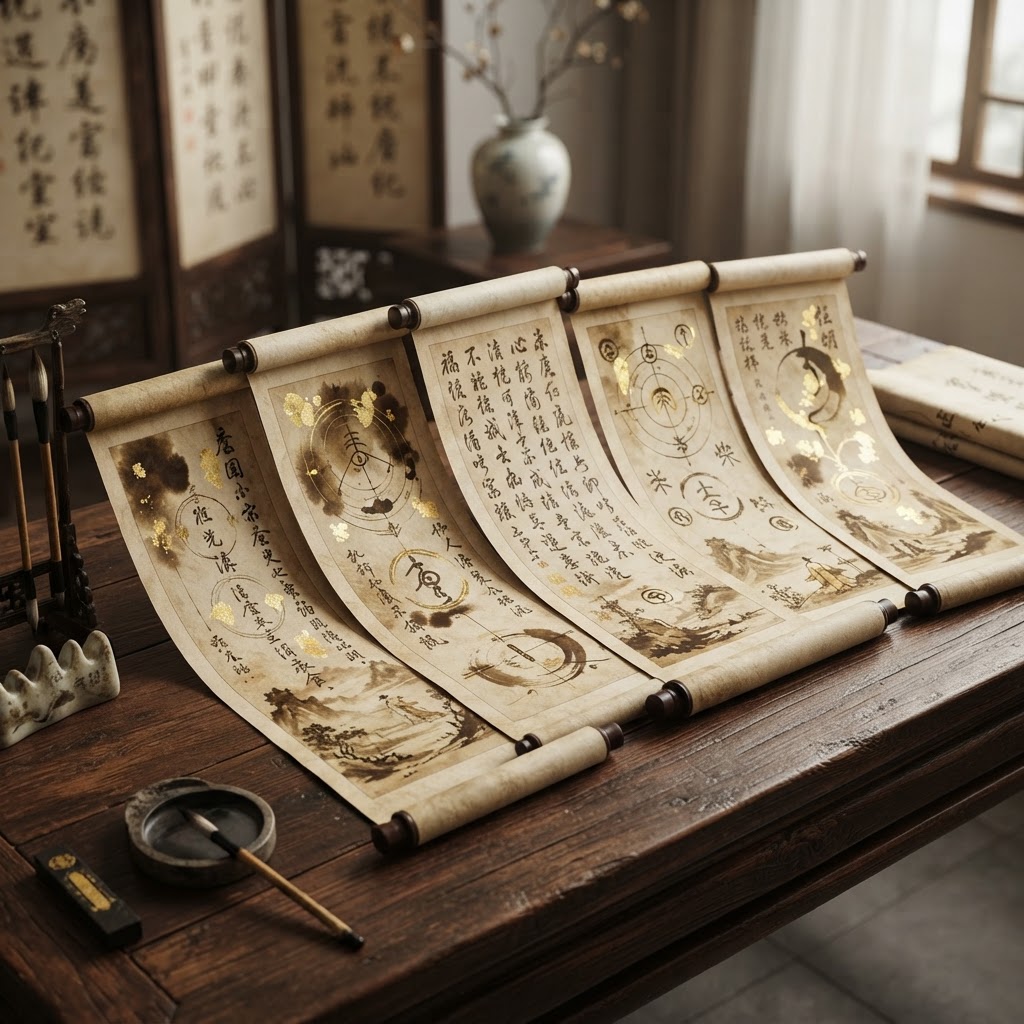
The Shiji organized history into five distinct sections
The Five Sections: An Overview
Sima Qian organised the Shiji into five distinct parts. Each part answers a different question about history: who ruled, when things happened, how institutions worked, who the important families were, and what individuals did with their lives. The five sections are:
| Section |
Chapters |
What It Contains |
Question It Answers |
| Basic Annals (Benji, 本紀) |
12 |
Chronological records of rulers and emperors |
Who held power? |
| Chronological Tables (Biao, 表) |
10 |
Tabular timelines of events, states, and appointments |
When did things happen? |
| Treatises (Shu, 書) |
8 |
Essays on institutions, rituals, economics, astronomy |
How did the systems work? |
| Hereditary Houses (Shijia, 世家) |
30 |
Accounts of feudal lords and founding families |
Who ruled regions over generations? |
| Biographies (Liezhuan, 列傳) |
70 |
Individual life stories of officials, scholars, warriors |
What did individuals accomplish? |
TOTAL: 130 chapters. Some are now lost or fragmentary, but the structure Sima Qian designed remains intact in all surviving copies.
The Shiji’s structure is more than an organisation of content. It reflects Sima Qian’s view that history has multiple dimensions: the political, the temporal, the institutional, the regional, and the personal. No single format can capture all five.
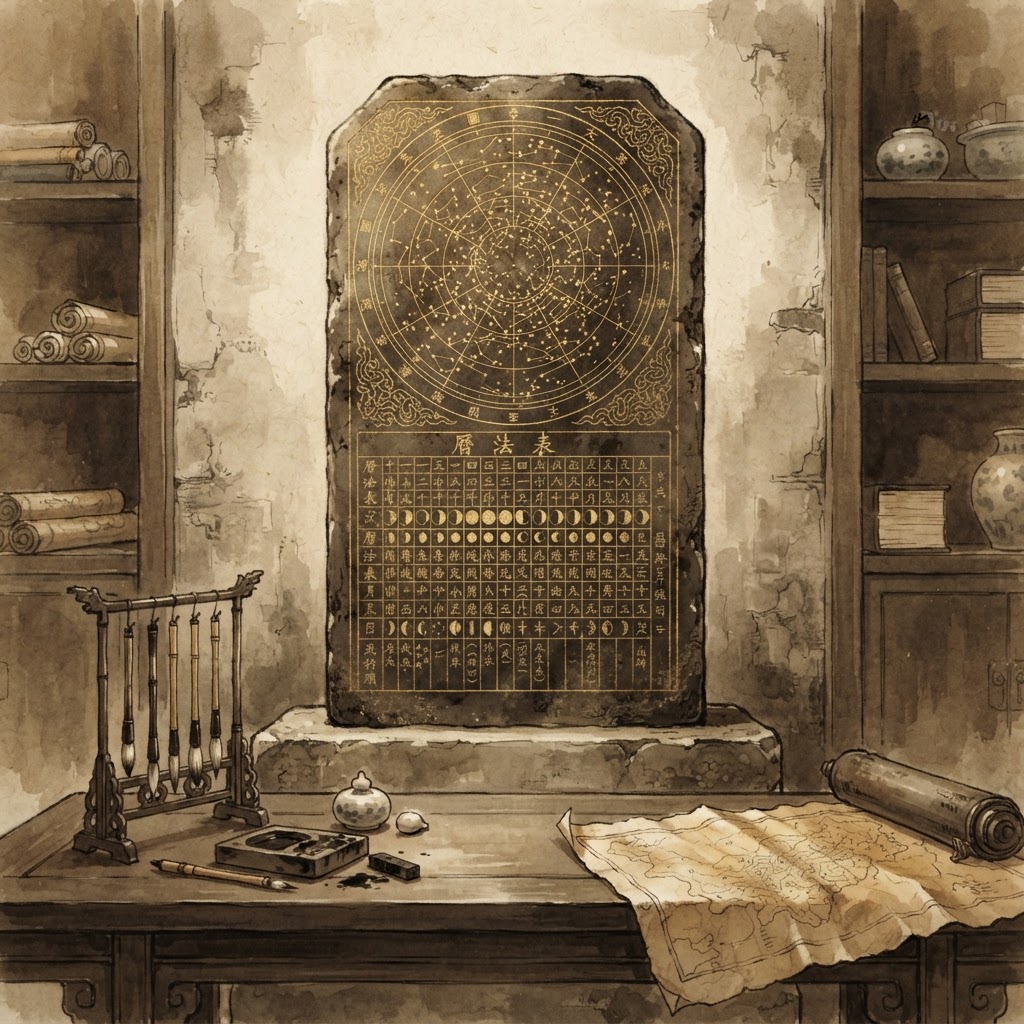
Sima Qian’s treatises covered astronomy, economics, and institutions
The Basic Annals: Who Ruled
The Basic Annals (本紀, benji) are the backbone of the Shiji. They provide the chronological framework that holds the entire work together. There are twelve annals, covering rulers from the Yellow Emperor (around 2600 BCE) to Emperor Wu of Han (around 90 BCE).
The word benji literally means “basic records” or “foundational annals.” These chapters tell the story of political power: who ascended, who ruled, who fell. They record the key events of each reign: wars, reforms, natural disasters, diplomatic missions, and the deaths of rulers. In a sense, they are the skeleton of the Shiji, and everything else hangs from them.
What makes the annals unusual is Sima Qian’s choice of who deserves to be in them. He included legitimate emperors and also some who were not: Xiang Yu, the warlord who briefly controlled China after the fall of Qin, gets his own annal even though he never officially held the throne. Sima Qian’s reasoning was that Xiang Yu exercised real power for a period, and power, not title, determines who belongs in the annals. He also included the Empress Lu (Lu Zhi), who ruled as regent after the death of Liu Bang, even though she was not a male emperor.
This is an example of Sima Qian’s principle of treating reality over form: if someone held actual power, they belong in the annals regardless of whether tradition recognised them as a legitimate sovereign.
A quick note: The decision to include Xiang Yu in the annals was politically sensitive. Sima Qian was effectively saying that the founder of the Han dynasty’s great rival deserved the same dignity as a ruling emperor. This is the kind of editorial courage that made the Shiji extraordinary and, probably, made Sima Qian’s own life harder.
The Chronological Tables: When Things Happened
The Chronological Tables (表, biao) are the most technically innovative part of the Shiji. There are ten tables, covering different periods and different types of information. Some tables track the lineages of feudal states, showing which ruler followed which and for how long. Others track the appointments and dismissals of officials. One table covers the complex diplomacy of the Warring States period.
In an age before spreadsheets, these tables were a masterwork of information design. They allowed a reader to see, at a glance, who was ruling where in any given year. For overlapping or competing claims to power, the tables showed which states existed simultaneously and how they related to each other chronologically.
The tables also serve a subtler purpose. By showing when things happened in parallel (for example, a reform in one state at the same time as a military campaign in another), they suggest connections that the narrative chapters might not make explicit. A reader who studies the tables alongside the annals and biographies can see patterns that no single chapter reveals alone.
| Table Number |
Period Covered |
What It Tracks |
| 1-3 |
Three Dynasties (Xia, Shang, Zhou) |
Lineages and dates of ancient rulers |
| 4-6 |
Spring and Autumn period |
Feudal states and their rulers, with inter-state events |
| 7 |
Warring States period |
The seven major states and their relations |
| 8-9 |
Qin and Chu-Han contention |
Rise of Qin, its fall, and the war between Liu Bang and Xiang Yu |
| 10 |
Han dynasty appointments |
Marquises and officials under Emperor Wu |
The Treatises: How Systems Worked
The Treatises (書, shu) are Sima Qian’s institutional history. There are eight treatises, each covering a different aspect of government and society: rituals and ceremonies, music, astronomy and astrology, the calendar, sacrifices, the Yellow River and water management, economics and money, and warfare and military organisation.
These chapters are where Sima Qian shows his deepest technical knowledge. His treatise on astronomy (天官書) catalogues the stars and their movements. His treatise on the calendar (曆書) explains how the Chinese calendar works and how it was reformed. His treatise on economics (平準書) documents the Han dynasty’s financial policies, the minting of coins, state monopolies on salt and iron, and the impact of these policies on ordinary people.
The economic treatise is particularly noteworthy. Sima Qian documented how the state’s monopoly policies enriched the treasury but impoverished merchants and farmers. He described how speculators profited from government needs and how the gap between rich and poor widened under Emperor Wu. This is not the kind of writing that pleased the emperor, which is one reason later dynastic histories became more cautious in their economic commentary.
The Eight Treatises of the Shiji
| Treatise |
Topic |
| Ritual (禮書) |
Court ceremonies, social hierarchy, propriety |
| Music (樂書) |
Musical theory, ritual music, cosmic harmony |
| Heavenly Offices (天官書) |
Astronomy, astrological portents, star catalogues |
| Calendar (曆書) |
Calendar systems, the Taichu reform |
| Sacrifices (封禪書) |
Imperial sacrifices, the feng and shan ceremonies |
| Rivers and Canals (河渠書) |
Water management, Yellow River floods, irrigation |
| Balanced Standard (平準書) |
Economics, money, state monopolies, inflation |
| The text of treatise 8 is partially lost. |
Military organisation (content reconstructed from fragments) |
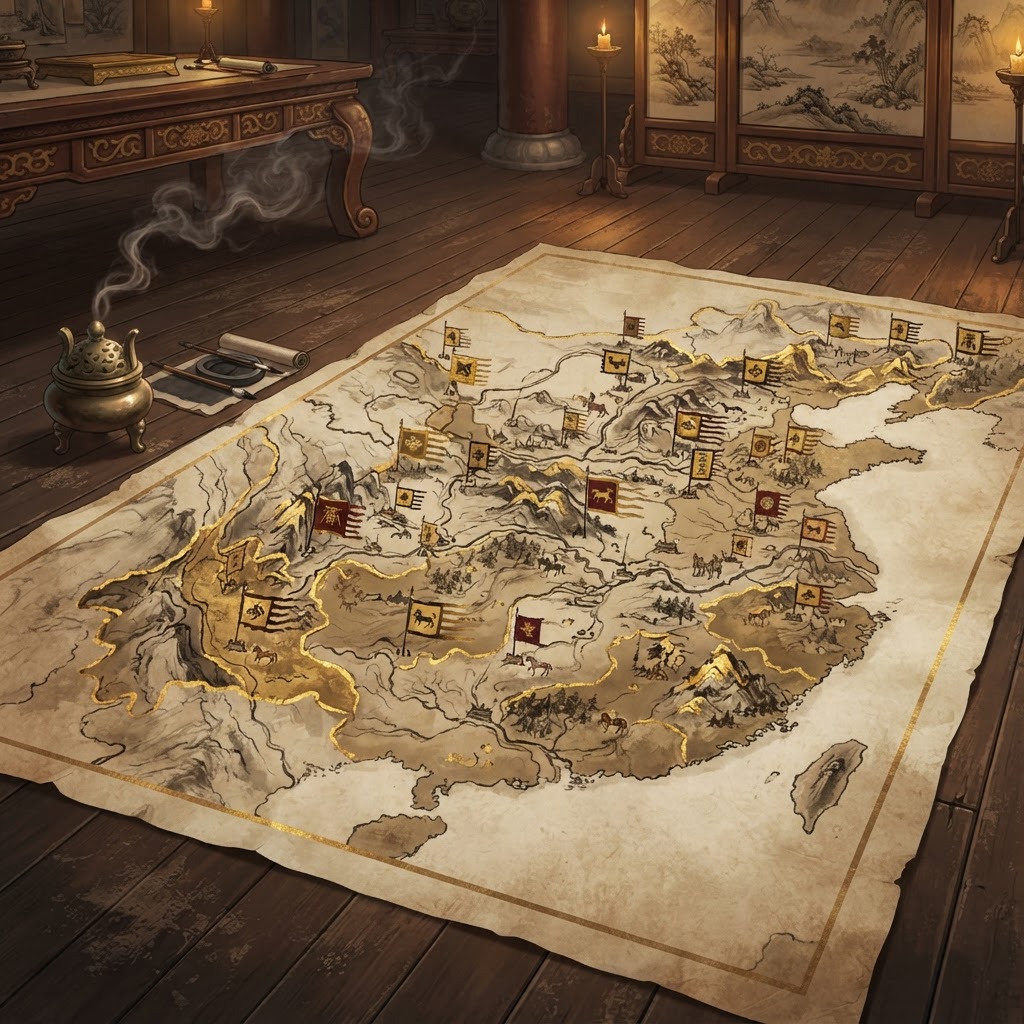
The Hereditary Houses documented regional rulers and their domains
The Hereditary Houses: Who Ruled Regions
The Hereditary Houses (世家, shijia) occupy a middle ground in the Shiji. There are thirty of them, covering the hereditary lords of the Zhou dynasty’s feudal system and the kings of the early Han. These are not independent nations in the modern sense, but they are also not mere provinces. They are semi-autonomous political entities ruled by families that passed their territory from father to son.
The word shijia means something like “lineage house” or “hereditary establishment.” Sima Qian created this category to acknowledge that in the Zhou and early Han systems, power was not concentrated in a single centre. The feudal lords wielded real military, legal, and economic authority over their territories. They had their own courts, their own ministers, and their own foreign policies.
Some of the most important chapters in Chinese history fall in this section. The “Hereditary House of Qi” (齊太公世家) tells the story of the state of Qi, from its founding by Jiang Ziya (the Grand Duke of Qi) through the rivalries of the Spring and Autumn period. The “Hereditary House of Chu” (楚世家) covers the powerful southern state that produced Qu Yuan, the poet. The “Hereditary House of Han” (漢興以來諸侯王) covers the kings of the early Han dynasty and the simmering tensions that would eventually erupt in the Rebellion of the Seven States.
Sima Qian’s approach to the hereditary houses follows a pattern: he starts with the founding ancestor, traces the lineage through generations, and concludes with the state’s absorption into a larger power (usually Qin) or its transformation under the Han. The pattern shows how dynasties rise through vigour and fall through complacency, a theme that runs throughout the Shiji.
The hereditary houses are the Shiji’s way of saying that history is not only made by emperors in capital cities. The states on the periphery, the lords in their regional courts, the families that endure for centuries, they are also history.
The Biographies: What Individuals Accomplished
The Biographies (列傳, liezhuan) are the crown jewel of the Shiji. There are seventy chapters, more than all other sections combined, and they are the reason the Shiji has been read for pleasure as well as for information.
The word liezhuan means “arrayed traditions” or “arranged lives.” These are not obituaries or Staatsbiografien. They are narrative essays, written with literary skill, that tell the story of a person’s life in context. Some biographies cover a single person, like the “Biography of Qu Yuan” (屈原列傳) or the “Biography of Li Guang” (李將軍列傳). Others cover groups, like the “Biographies of the Assassin-Retainers” (刺客列傳) or the “Biographies of the Harsh Officials” (酷吏列傳).
The biographies are where Sima Qian’s literary power is most visible. He gives characters dialogue, action, psychological depth, and moral complexity. He lets them speak in their own voices (or at least the voices he creates for them). He shows them making decisions under pressure. He lets the reader understand why someone acted as they did, even if the action was wrong.
The biographies also contain some of the Shiji’s most integrated commentary. Sima Qian often appended a personal evaluation (太史公曰, “The Grand Historian says”) at the end of a chapter, giving his own judgment on the people described. These evaluations are brief, clear, and often surprising. The Grand Historian who spoke up for Li Ling against the emperor does not shy from praising people the court condemned or criticizing people the court rewarded.
A quick note: The biographies are the part of the Shiji most accessible to general readers. Burton Watson’s English translation of the Shiji focuses primarily on the biographies for exactly this reason: they are where the work’s literary and human power is strongest. For more on the literary dimension, see our article on the Shiji as literature.
How the Five Sections Work Together
The structure of the Shiji is not merely five independent collections. The sections cross-reference each other constantly. A biography will refer to events in the annals. A treatise will discuss a policy that appears in a biography. A table will help you locate a hereditary house’s events chronologically. The reader who works across the sections gets a layered, three-dimensional view of any event.
For example, to understand the fall of Qin, you would read the Basic Annals of Qin (for the political timeline), the Hereditary House of Zhao (for the military campaigns that weakened Qin’s enemies), the Chronological Table of the Warring States (for who was involved when), the Biographies of Li Si and Zhao Gao (for the internal court politics), and the Biographies of Chen She and Xiang Yu (for the rebellions). No single chapter tells the whole story. Together, they do.
| If You Want to Know About… |
Where to Start |
Then Check |
| A particular emperor |
Basic Annals |
Biographies of their officials |
| An economic policy |
Treatise on the Balanced Standard |
Biographies of economic officials |
| A war or campaign |
Basic Annals (for chronology) |
Biographies of generals involved |
| A philosophical school |
Biographies of Confucius, Laozi, etc. |
Treatise on Rituals |
| A non-Chinese people |
Biographies (foreign accounts) |
Chronological Tables of the relevant period |
The Influence of the Five-Section Format
Every subsequent dynastic history in China adopted Sima Qian’s five-section format, sometimes with minor variations. The Book of Han (漢書), written by Ban Gu, follows the Shiji structure almost exactly, though it replaces the “Hereditary Houses” with “Biographies of Imperial Relatives” (since the Han had no true feudal system by Ban Gu’s time). The Later Han History (後漢書), the Records of the Three Kingdoms (三國志), and all the way down to the Qing History (清史稿) follow the same pattern.
This is where Sima Qian’s influence is most structural. He did more than write history; he invented a template for writing history. For over two thousand years, Chinese historians followed his basic plan: chronicle, table, treatise, genealogy, biography. It was only in the twentieth century, with the introduction of Western historical methods, that this template was finally challenged.
Even today, the five-section format has strengths that modern narrative history sometimes lacks. By separating the political timeline (annals), the temporal grid (tables), institutional analysis (treatises), regional history (hereditary houses), and individual lives (biographies), Sima Qian created a format that can hold complexity without flattening it. Modern history works, which usually mix all five modes into a single narrative, sometimes lose the structural clarity that the Shiji format preserves.
Dynastic Histories That Followed Sima Qian’s Format
| History |
Author |
Year |
| Book of Han (漢書) |
Ban Gu |
~100 CE |
| Records of the Three Kingdoms (三國志) |
Chen Shou |
~280 CE |
| History of the Later Han (後漢書) |
Fan Ye |
~450 CE |
| Book of Jin (晉書) |
Fang Xuanling et al. |
~650 CE |
| Comprehensive Mirror (資治通鑑) |
Sima Guang |
1084 CE |
The Annals of Specific Rulers: A Closer Look
To understand how the Basic Annals work in practice, let us examine three of the most important. The “Annal of the First Emperor of Qin” covers the rise and fall of the short-lived Qin dynasty. It begins with Ying Zheng’s inheritance of the throne as a young boy, his methodical conquest of the six remaining warring states, the unification in 221 BCE, and then the downward slide: the harsh laws, the burning of books, the burying of scholars, the massive public works, the emperor’s obsession with immortality, and finally the collapse shortly after his death.
What makes this annal remarkable is Sima Qian’s balance. He does not portray the First Emperor as a cartoon villain. He describes the efficiency of Qin’s administration, the standardisation of weights, measures and script, the network of roads, and the surveying of territory. Then he shows the human cost. He describes the conscription for the Great Wall and the Epang Palace, the death toll among labourers, the suppression of dissent, and the paranoia of the aging emperor. The reader sees the whole picture.
The “Annal of Xiang Yu” is another standout. Xiang Yu was never emperor. He was a warlord who briefly dominated China after the fall of Qin, before being defeated by Liu Bang (who became the founder of the Han dynasty). By placing Xiang Yu in the annals, Sima Qian made a statement: the annals record power, not title. Xiang Yu is given more narrative space and dramatic energy than many legitimate emperors. His last stand at the Wu River, where he refused to cross to safety and instead died fighting, is one of the most famous scenes in Chinese literature.
The “Annal of Emperor Wu” (literally “the Annal of the Current Ruler”) is unique because Sima Qian was writing about the emperor he served. The original text of this annal is one of the lost or suppressed portions of the Shiji. What survives is often thought to be a reconstruction or a heavily edited version. This makes sense: writing an honest annal of a living emperor who has already punished you once is an act of bravery that borders on recklessness. The loss of the original text might well have been the result of imperial censorship.
The Tables as Precursors to Modern Information Science
The chronological tables of the Shiji deserve more attention than they usually receive, because they represent a genuine innovation in how information was organised. Before Sima Qian, Chinese historical writing was almost entirely narrative. If you wanted to know which states existed in 500 BCE and how they related to each other, you had to piece it together from scattered accounts. Sima Qian created tables that show this information at a glance.
Consider what a table requires. You need a dimension for time (years), a dimension for each entity being tracked (states, rulers, officials), and a cell content for each intersection. This is what modern spreadsheet software does automatically. Sima Qian was doing it by hand, in text, on bamboo strips, over two thousand years ago.
His table of the Warring States period is particularly sophisticated. It tracks seven major states (Qin, Qi, Chu, Yan, Han, Zhao, Wei) across the years of their final struggle, showing which state was ascendant, which was in decline, and which key events occurred in parallel. A reader can see, for instance, that when Qin was attacking Zhao in the north, Chu was expanding in the south. These parallel movements would be hard to notice in a narrative; in a table, they are obvious.
A quick note: The tables accomplish multi-perspective temporal analysis, which modern historians consider an advanced method. Sima Qian was doing this in the first century BCE.
The Treatise on Economics: A Bold Institutional Critique
Among the eight treatises, the “Balanced Standard” deserves special examination because it is Sima Qian’s most direct institutional critique. The treatise documents Emperor Wu’s economic policies: the state monopolies on salt and iron, the debasement of coinage, the taxation of merchants, and the government’s purchase and resale of goods to stabilise prices (the “balanced standard” system).
Sima Qian does not openly condemn these policies. But his selection of facts tells the story. He records how merchants found loopholes and evaded the new tax laws. He records how the state’s own officials profited from the monopolies. He records the inflation that followed the debasement of coinage. He records the growing wealth gap and the anger of the population. The reader gets a clear picture: the policies enriched the treasury but created economic distortions that hurt ordinary people.
This is the kind of institutional analysis that later dynastic histories often lacked. Ban Gu, writing the Book of Han, covered the same period but was more cautious and more deferential to imperial policy. Later historians tended to follow Ban Gu’s model rather than Sima Qian’s. The result is that the Shiji remains the most economically candid of all the official Chinese histories.
The “Balanced Standard” treatise is Sima Qian’s quiet indictment of Emperor Wu’s economic policies. He does not say they failed. He shows the cost, and lets the reader decide.
The Biographies: Categories and Themes
Sima Qian did not arrange his biographies randomly. He grouped them by type, and the groupings themselves carry meaning. Knowing the categories helps you understand what Sima Qian valued and what he wanted you to notice.
| Category |
Coverage |
What Sima Qian Honours |
| Assassin-Retainers |
5 individuals |
Loyalty unto death, the courage of a single moment |
| Harsh Officials |
~10 individuals |
Efficiency at the cost of justice, the price of state power |
| Persuaders |
~10 individuals |
The power of words in an age of war, diplomacy as survival |
| Money-Makers |
~10 individuals |
Entrepreneurs, merchants and the legitimacy of wealth |
| Scholars |
Confucius, Laozi, etc. |
Intellectual life, the power of ideas across generations |
| Generals |
Li Guang, Wei Qing, etc. |
Military skill, but also the fragility of military reputation |
| Non-Chinese peoples |
Xiongnu, Yue, Dayuan |
Recognition that history is made by many peoples |
The category of “Money-Makers” is particularly important. In Confucian tradition, merchants were near the bottom of the social hierarchy, below scholars, farmers, and artisans. Sima Qian gave them their own chapter, arguing that the desire for wealth is natural and that entrepreneurs who create value deserve respect. He profiles merchants like Fan Li and the family of Zhuo Wenjun, showing how they understood markets and built fortunes through enterprise. This was a radical departure from Confucian orthodoxy and one of the Shiji’s most distinctive contributions.
The “Biographies of the Assassin-Retainers” is another distinctive category. Sima Qian profiles five men who attempted to assassinate rulers out of loyalty to their lords. He does not condemn them. He presents their courage, their planning, and their sacrifice with sympathy and respect. Two of the five succeeded in their mission (though they died in the process). Three failed. Sima Qian treats success and failure with equal dignity. Whether the assassination is morally justified is left for the reader to decide.
How the Format Shapes the Meaning
One of the most subtle but important points about the Shiji’s structure is that the format itself carries meaning. Where Sima Qian places a story, and in which section it appears, is an editorial decision with moral weight.
If you appear in the Basic Annals, you are being treated as a ruler, actual or de facto. If you appear in a Hereditary House, you come from a powerful lineage. If you appear in a Biography, you are an individual whose personal story matters, regardless of birth or title. And if you appear in a Treatise, your work is a systemic contribution to governance or knowledge.
These choices mattered because in Chinese tradition, placement signals judgment. Being in the annals grants legitimacy. Being in the “Harsh Officials” biographies signals criticism even before the reader has read the chapter. Being given a joint biography with another person implies a connection between them, as when Sima Qian paired Lian Po and Lin Xiangru, showing how military strength and diplomatic skill work together.
Consider the case of Chen She (陳涉), the farmer who led the first rebellion against the Qin dynasty. He was not a noble. He was not a general. He was a poor labourer conscripted for military service who, when his unit was delayed by rain and faced execution for late arrival, decided to revolt. He failed, dying within months. But Sima Qian gave him a chapter in the “Hereditary Houses,” a section normally reserved for noble lineages. This was a deliberate choice to honour Chen She as a founder, however brief, of the movement that brought down Qin.
How Placement Creates Meaning: Three Examples
| Person |
Expected Placement |
Sima Qian’s Placement |
What It Means |
| Xiang Yu |
Biography (failed contender) |
Basic Annals |
He held real power, deserves ruler’s treatment |
| Chen She |
Biography (peasant rebel) |
Hereditary House |
Briefly founded a movement, deserves founding-father treatment |
| Confucius |
Hereditary House (noble) or Biography |
Hereditary House (shijia) |
His intellectual legacy is hereditary in a deeper sense: passed through disciples |
The case of Confucius in the Hereditary Houses is especially subtle. Confucius held no hereditary territory. He was not a feudal lord. But Sima Qian placed him in the hereditary section because his teachings, passed from teacher to student, constituted a “house” in the intellectual sense. Confucius’s “territory” was the mind. His “descendants” were his disciples and their disciples across generations. This is a radical interpretation of what “hereditary” means, and it reveals Sima Qian’s view that intellectual influence is a form of political power.
The Cross-Referencing System
The five sections of the Shiji do not stand alone. They cross-reference each other constantly. When you read about a general’s military campaign in his biography, the annals tell you when it happened, the tables place it in the broader context of other events, and the treatises explain the institutional background (how the army was supplied, how the soldiers were conscripted). No single section gives you the complete picture. All five are needed.
Sima Qian sometimes explicitly directs the reader to other sections. He writes “see the annals of [X]” or “as detailed in the treatise on [Y].” These cross-references are the connective tissue of the Shiji. They invite the reader to navigate the work as a network, not as a linear narrative.
This is why the Shiji rewards re-reading. On a first pass, you read the biographies for the stories. On a second pass, you follow the cross-references and discover connections between events you had read about separately. On a third pass, you notice the structural choices: who Sima Qian placed where, and why.
Missing and Reconstructed Chapters
The Shiji as we have it today is not exactly what Sima Qian wrote. A few chapters are missing. The most significant gap is the eighth treatise, which was supposed to cover military organisation and the management of armies. The text we have for this chapter is a reconstruction from later sources, assembled by scholars who tried to guess what Sima Qian might have written based on fragments and references in other chapters.
Other chapters may have been deliberately excised. The original annal of Emperor Wu, as mentioned, is probably lost or heavily edited. Some scholars believe that politically sensitive material was removed after Sima Qian’s death, either by the court or by Sima Qian’s own descendants who feared further repercussions.
Despite these losses, the Shiji remains remarkably complete. Out of 130 chapters, the vast majority survive in what appears to be their original form. This is a testament to the work’s importance: people copied it, preserved it, and passed it on because they valued it, even when its honesty made it uncomfortable.
The Format in Practice: How to Navigate
For a modern reader approaching the Shiji, the structure can seem daunting. Here is a practical approach. Start with the biographies, which are the most readable and self-contained. Pick a biography of someone who interests you. As you read, note any cross-references to other chapters, then follow those cross-references into the annals, treatises, or tables. Gradually, you will build a network of connections and develop a sense of how the work fits together.
If you want to understand the political narrative, read the annals in order. They provide the chronological backbone. If you want institutional analysis, read the treatises independently. If you want the regional story, read the hereditary houses of the states that interest you. Do not try to read the entire 130 chapters in order beginning to end. That approach works for the chronological narrative of Sima Guang’s Zizhi Tongjian, but it is not how the Shiji is designed to be read.
Frequently Asked Questions
How is the Shiji different from the Zizhi Tongjian?
The Shiji has a five-section format (annals, tables, treatises, houses, biographies) that covers political, institutional, and personal history. The Zizhi Tongjian, written by Sima Guang a thousand years later, is a chronological narrative that focuses primarily on political events. Sima Guang’s work covers a longer period (~1,300 years) but in a single format. For the comparison, see Zizhi Tongjian vs Shiji.
Why did Sima Qian include Xiang Yu in the Basic Annals?
Because Xiang Yu held real power after the fall of Qin, even though he never held the title of emperor. Sima Qian’s principle was that the annals record who wielded authority, not who held nominal titles.
Are any parts of the Shiji lost?
Yes. One of the eight treatises is largely missing (the one on military affairs), and some scholars believe a few biographies may be incomplete. The earliest bibliographic records note these gaps. However, the vast majority of the Shiji survives intact.
Can I read the Shiji in English?
Yes. Burton Watson’s translation (1961) covers the most important chapters and is highly readable. William H. Nienhauser’s ongoing translation project (1994-present) aims for completeness. Either is a good starting point for English readers.
Why does Sima Qian include the Grand Historian’s evaluation at the end of chapters?
The “太史公曰” commentary is Sima Qian’s personal judgment on the people and events in each chapter. It serves as a bridge between the factual narrative and his own perspective. It is where he is most direct about his values and his views, in contrast to the indirect, fact-driven approach of the rest of the chapter.
Why does the Shiji have more biographies than annals?
Because Sima Qian believed individual lives are where history actually happens. Emperors set policy, but the people who implement it, resist it, or suffer from it give history its texture. The 70 biography chapters reflect his view that personal stories are the core of historical understanding, more than political chronology alone.
What is the relationship between the Shiji and the Spring and Autumn Annals?
Sima Qian saw himself as continuing the tradition of the Spring and Autumn Annals (春秋), which Confucius was traditionally said to have compiled. Both works use historical events to convey moral judgment. But the Shiji’s five-section structure, with its treatises and tables, goes far beyond the spare chronicle format of the Annals. For more on the Annals themselves, see our overview of the Chinese classics program.
Leave a Reply
You must be logged in to post a comment.