Why the Day You Cut Your Hair Matters in the Chinese Almanac
Of all the questions I get asked about daily timing, haircut days come up more often than you would expect. People plan weddings around the almanac, they pick business launch dates with care, and then somewhere in between a client will lower their voice and ask, half embarrassed: is there actually a good day to cut your hair?
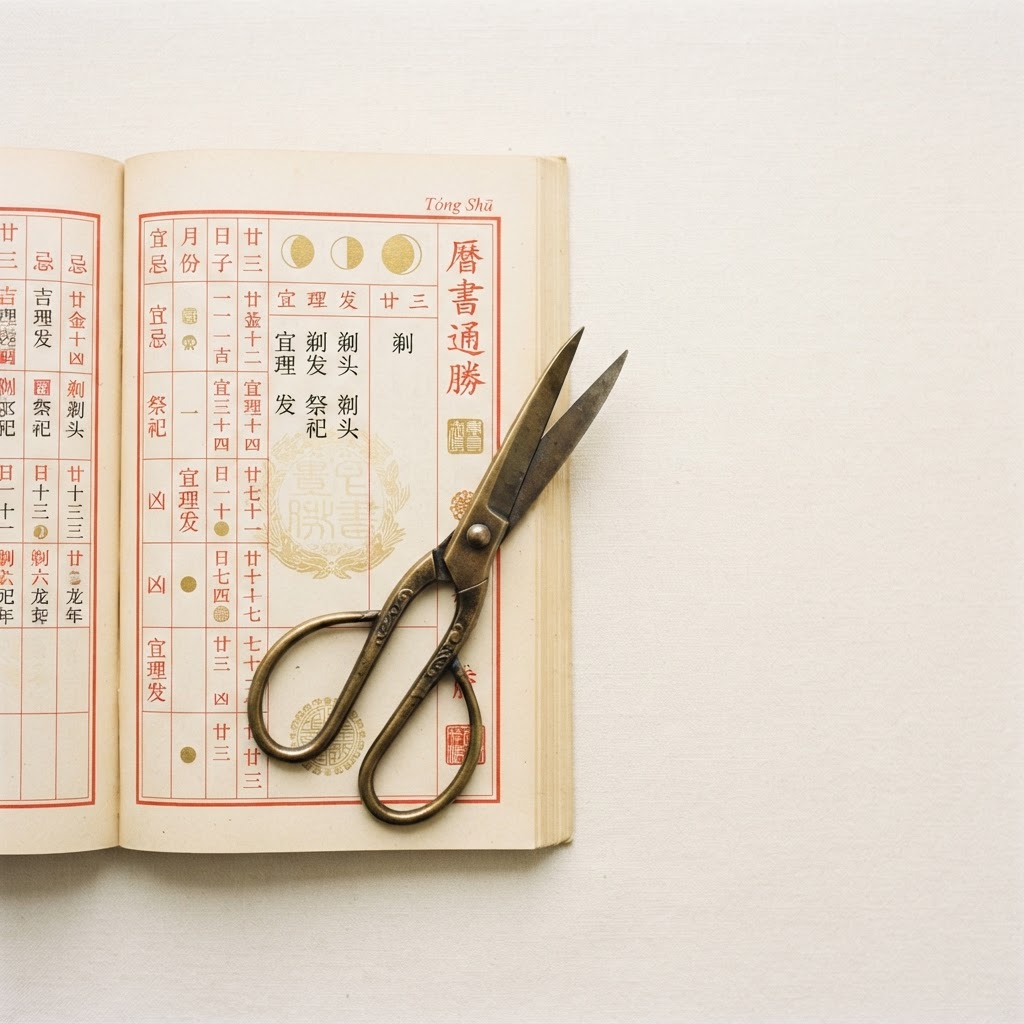
There is. The Chinese almanac, the Tong Shu, has treated cutting hair as a real date-selection matter for centuries, alongside activities like signing contracts, moving house and starting a job. Not because hair itself is magical, but because in the traditional view the day carries a quality, and everything you begin on that day picks up some of that quality. A haircut is small enough to be convenient and regular enough to matter. It is the one date-selection decision most people can actually practice every few weeks.
This guide is the complete reference I wished existed when I started teaching date selection. It covers where the haircut rules come from, which days the almanac favours, which days it warns against, the famous traditions like Dragon Head Raising Day and the first lunar month taboo, how to personalise the rules with your own BaZi chart, and how all of this applies in 2026, 2027 and 2028.
Timing is not superstition dressed up as planning. It is planning dressed up in a language your grandmother already spoke.
What You Will Find in This Guide
The page is organised so you can use it two ways. If you want a practical answer, the sections on the 12 Day Officers, weekday beliefs and the lunar date rules will tell you how to find a good day this week. If you want to understand the system, the sections on hair in Chinese metaphysics, traditional Chinese medicine and face reading explain why the rules exist at all, because in my experience a rule you understand is a rule you can bend intelligently, while a rule you merely follow is a rule you will eventually abandon.
Use it as a living reference. Each section links out to deeper guides: year calendars for 2026, 2027 and 2028, weekday luck guides, and the deeper traditions behind every rule.
Personalising Your Haircut Day with BaZi: Personal Clash Days, Noble Days, and Why Generic Rules Are Only the First Filter
In my thirty years of running commercial enterprises and advising executive teams, I have frequently observed a basic strategic mistake: people often rely entirely on macro level guidelines without adjusting for their individual situation. When a company reviews broad industry reports, that information provides a general backdrop, yet no sensible chief executive makes capital allocations without scrutinizing their own balance sheet. The exact same rule applies when selecting an auspicious haircut date through classical Chinese metaphysics. Many people open a standard daily almanac, see an auspicious indicator for personal grooming, and assume that every person will experience identical benefits on that date. In reality, the traditional Chinese almanac serves as a macro baseline, while your personal birth chart provides the precise individual filter.
To understand why generic date selection is merely a starting point, we must examine the architecture of a BaZi birth chart. Your birth chart consists of four primary pillars representing the year, month, day, and hour of your birth. Among these four pillars, the Day Pillar holds extraordinary significance because its upper element represents your Day Master, which is your core energetic identity. The lower element of the Day Pillar is your Day Branch, also known as your personal palace of health and bodily harmony. When you look up date recommendations in a Chinese almanac guide, the text evaluates the macro energy of the daily branch against general planetary cycles. However, if the daily branch of a chosen date directly collides with your personal Day Branch, the resulting friction disrupts your personal qi regardless of how positive the general almanac entry appears.
In classical date selection, this friction is identified as a personal clash day, often referred to as Fan Chong. For example, if your personal Day Branch is the Zi Branch, which represents the Rat, any day governed by the Wu Branch, representing the Horse, will trigger a direct elemental clash. The energy of Water in Zi collides violently with the Fire energy of Wu. If you decide to trim your hair on a personal clash day, you subject your upper body and scalp to turbulent energetic movements. In my consulting practice, clients who ignore personal clash days and cut their hair solely based on general almanac dates often report feeling restless, irritable, or unusually fatigued immediately after their appointment. The haircut may look aesthetically pleasing, but the subtle energetic field around the head has been unsettled.
- Macro Filter: Check the daily almanac to eliminate universally unfavorable dates such as Year Clash or Month Clash days.
- Micro Filter: Cross reference the daily Earthly Branch against your personal Day Branch to avoid personal clash days.
- Nobleman Boost: Schedule major hair transformations on your personal Nobleman days to maximize clarity, support, and executive presence.
Beyond avoiding personal clash days, sophisticated metaphysics practice involves identifying your personal Nobleman days, known in classical texts as Tian Yi Gui Ren. In business leadership, having a Nobleman means having a mentor, investor, or trusted partner who steps in to resolve complex bottlenecks. In date selection, a Nobleman day brings harmonious, supportive energy that smoothes out obstacles and elevates your personal authority. When you schedule a haircut on a day that carries your personal Nobleman star, you are not simply trimming physical hair strands. You are aligning your personal qi with supportive external influences. Executives who utilize Nobleman days for grooming often discover that important meetings conducted shortly after their haircut proceed with surprising ease and mutual respect.
To calculate your personal Nobleman day, you look at your Day Master Stem. For instance, individuals born on a Jia Wood or Wu Earth day find their Nobleman in the Chou Branch and the Wei Branch. Someone born on a Bing Fire or Ding Fire day finds their Nobleman in the You Branch and the Hai Branch. When you combine a generally favorable calendar entry with a personal Nobleman day, the subtle benefits compound significantly. This level of customization explains why standardized calendars can never replace personalized chart analysis. When consulting auspicious dates for 2027 or any other year, serious practitioners always overlay their birth details onto the general calendar framework.
Generic almanac rules provide the weather forecast for the general public, but your personal BaZi chart dictates whether you ought to carry an umbrella or sail your boat forward.
Consider the structural relationship between your hair and your overall bio-energetic system. In Chinese metaphysics, the scalp represents the convergence point of all yang meridians, known as the summit of the head where clear qi ascends. When a stylist cuts your hair, sharp metal blades interact directly with the energetic perimeter surrounding your crown. If this physical act takes place during a day when your personal Day Branch suffers a clash, the sudden disturbance at the crown can induce subtle head discomfort, scattered focus, or temporary emotional instability. Conversely, performing the cut on a personal Nobleman day reinforces the energetic crown, creating a protective buffer against external chaos.
During my decades of teaching Qi Men Dun Jia and BaZi, I have frequently reviewed cases where business owners experienced unexplainable setbacks right after major personal changes. In one memorable case, a senior corporate officer decided to undergo a dramatic hairstyle change right before pitching a pivotal joint venture. The officer selected a date listed as generally favorable in a basic calendar. Unfortunately, that specific date happened to be a direct personal clash day against his personal Day Branch. The meeting turned contentious, key negotiators clashed unexpectedly, and the deal stalled for months. While a haircut alone does not dictate commercial fortune, in metaphysics we recognize that every action taken during a personal clash day amplifies existing friction. When we later rescheduled his key meetings and personal grooming around his Nobleman days, his focus sharpened and negotiations resumed smoothly.
Therefore, when you approach haircut date selection, treat generic almanac lists as your preliminary screening filter. First, eliminate days marked with major universal clashes. Second, cross check your own Day Branch to ensure the daily branch does not clash with your personal pillar. Third, locate days that feature your personal Nobleman star or supportive resource elements. By applying this three-step strategic framework, you elevate a routine personal hygiene task into a deliberate alignment with natural cosmic forces.
The Five Elements and Your Hair: Element Typing, Hair Texture and Condition, and What Cutting Rituals Suit Each Type
In classical Chinese cosmology, every physical manifestation in the tangible world reflects the dynamic interaction of the Five Elements: Wood, Fire, Earth, Metal, and Water. Throughout my thirty years in corporate management and metaphysics education, I have constantly reminded my students that human physiology is not an exception to this universal framework. Your hair is an energetic antenna rooted in your body. Its texture, thickness, natural wave, growth speed, and scalp oil production directly mirror the dominant elemental forces within your constitutional profile. When you understand your elemental hair typing, you can tailor your haircut timing and maintenance rituals to restore internal equilibrium rather than working against your natural baseline.
In our study of Five Elements principles, Wood represents growth, expansion, upward movement, and sprouting vegetation. Individuals with strong Wood element characteristics in their physical structure generally possess straight, coarse, fast growing hair with thick individual strands. Their hair grows like resilient timber in a fertile forest. However, when Wood energy becomes excessive or unpruned, it leads to stubbornness, scalp tension, and headaches caused by rising liver qi. For Wood hair types, regular trimming during Wood dominant days, specifically days carrying the Yin Branch or Mao Branch, provides an energetic outlet that channels rapid growth into structured, controlled vitality.
Fire hair types present a strikingly different set of physical traits. Fire represents heat, animation, upward flickering energy, and dryness. People with dominant Fire hair often have naturally curly, frizzy, or wiry hair, sometimes with natural reddish highlights or an unusually dry scalp prone to inflammation. Because Fire burns quickly, hair strands can become brittle and split easily if subjected to aggressive chemical treatments or improper timing. When a Fire hair type cuts their hair on an intense Fire day carrying the Si Branch or Wu Branch, the excess heat can aggravate dry skin and cause further brittle breakage. Instead, Fire hair types benefit immensely from scheduling their trims on Water days, such as those governed by the Zi Branch or Hai Branch, which introduce cooling moisture and calm scalp inflammation.
| Elemental Hair Type | Physical Characteristics | Scalp Condition | Optimal Cutting Days |
|---|---|---|---|
| Wood | Coarse, straight, fast growing, dense | Tense, tight scalp | Yin (Tiger) & Mao (Rabbit) days |
| Fire | Curly, frizzy, reddish tone, brittle | Dry, prone to redness | Zi (Rat) & Hai (Pig) days |
| Earth | Heavy, thick, slow growing, dense volume | Oily, heavy moisture | Yin (Tiger) & Shen (Monkey) days |
| Metal | Fine, pin-straight, sleek, early grey | Balanced but delicate | Chou (Ox) & Chen (Dragon) days |
| Water | Wavy, soft, fine, flexible, limp volume | Cool, sensitive scalp | Shen (Monkey) & You (Rooster) days |
Earth hair types are characterized by heavy volume, thick density, and slow growth. Earth represents stability, containment, and heavy nourishment. Scalp conditions for Earth types frequently lean toward excessive sebum production and dampness. If an Earth type allows their hair to grow unchecked without structured trimming, stagnant energy accumulates around the head, leading to mental sluggishness and heavy morning fatigue. To disperse heavy Earth stagnation, these individuals should select Wood days to introduce penetrating growth energy or Metal days to drain excess dampness. Checking a reliable Chinese almanac guide allows you to locate these specific branch days effortlessly throughout the month.
Metal hair types feature fine, pin-straight, sleek strands that fall with natural precision. Metal represents structure, refinement, sharpness, and clarity. While Metal hair often looks polished and neat with minimal styling, it tends to lack elasticity and can turn grey prematurely when life stress depletes the body. For Metal hair types, cutting rituals ought to focus on nourishment and support rather than aggressive thinning. Selecting Earth branch days, such as the Chou, Chen, Wei, or Xu branches, provides generating support because Earth produces Metal in the classical generative cycle of five elements.
Your scalp is the soil and your hair is the crop; if you do not understand which element dominates your soil, no amount of external styling can produce long term health.
Water hair types exhibit wavy, soft, fine strands that adapt easily to moisture changes in the air. Water represents fluidity, communication, movement, and adaptability. When Water energy is balanced, the hair flows with natural grace and soft luster. However, when Water energy becomes depleted, the hair appears limp, lifeless, and prone to thinning. Water types require supportive Metal energy to generate consistent vitality. Scheduling trims on Shen Branch or You Branch days introduces Metal energy, reinforcing the structural root of the hair and promoting steady, resilient density.
In corporate advisory, when I evaluate an executive whose leadership style is overly rigid or fiery, I often examine their daily habits to see where balance can be restored. I remember working with a managing director who possessed an intense Fire constitution. He was constantly burnt out, suffered from chronic scalp irritation, and complained of relentless mental agitation. During our BaZi assessment, we identified his severe element imbalance. I advised him to alter his personal schedule, including shifting his grooming appointments away from hot Fire days toward cooling Water branch days. Within two months, he reported a dramatic reduction in scalp redness alongside a noticeable improvement in his emotional composure during high pressure board negotiations. Aligning your grooming rituals with your elemental type is a practical tool for internal self regulation.
By mapping your natural hair condition to the Five Elements, you transform a mundane salon visit into a functional metaphysical adjustment. Identify whether your hair requires cooling, structural support, growth stimulation, or dampness dispersal. Once your elemental requirement is clear, cross reference the daily branch entries in your calendar and schedule your haircuts accordingly.
Hair Growth and Trimming Days: The Traditional Logic of Cutting for Growth Versus Cutting to Release
Throughout human history, traditional societies recognized that physical hair growth is intimately connected to environmental cycles and personal intentions. In Chinese metaphysics, haircutting is never viewed as a singular, one size fits all activity. Instead, classical date selection distinguishes clearly between two entirely different strategic objectives: cutting hair to stimulate lush growth versus cutting hair to release stagnant energy, emotional burdens, or illness qi. During my thirty years of commercial business management and executive consulting, I have seen how strategic timing dictates outcomes. If a corporation intends to expand into new markets, it executes an expansion campaign. If it needs to cut unprofitable divisions, it executes a restructuring plan. Applying the wrong strategy at the wrong moment leads to failure, and the exact same principle applies to managing your personal energy through haircut timing.
When your primary objective is to accelerate hair growth, enhance hair thickness, and promote long term vitality, you align your haircut with ascending growth energy. In the Chinese almanac framework, ascending energy reaches its peak during the waxing phase of the lunar cycle, particularly from the third lunar day through the tenth lunar day. During this period, the natural pull of the moon draws qi upward into plant foliage, ocean tides, and human hair follicles. To maximize this growth acceleration, you select days governed by Wood branches such as the Yin Branch or Mao Branch. Wood represents sprouting shoots, robust branches, and expanding life force. Trimming your ends on a Wood day during a waxing lunar phase acts like pruning a young fruit tree, sending a strong signal to the root system to generate dense, vigorous growth.
- Growth Expansion Strategy: Target the Waxing Lunar Phase (Days 3 to 10) paired with Yin (Tiger) or Mao (Rabbit) Wood days. Purpose: stimulate thickness, speed up growth, and revitalize weak ends.
- Energetic Release Strategy: Target the Waning Lunar Phase paired with Chu (Remove) Days or Shen/You Metal days. Purpose: sever ties with past misfortune, release emotional fatigue, and clear illness energy.
- Maintenance & Stability Strategy: Target Earth days (Chou, Chen, Wei, Xu) during stable lunar phases. Purpose: maintain clean shape, reinforce structural strength, and prevent split ends.
Conversely, there are moments in life when your primary goal is not rapid growth, but energetic release and cleansing. If you have recently recovered from a severe illness, ended a long legal dispute, exited a painful relationship, or suffered a major corporate setback, your physical hair holds subtle residual traces of that low frequency experience. In classical metaphysics, hair acts as a recorder of personal qi. Retaining long, uncut hair after a traumatic life chapter allows stagnant energy to linger around your upper meridians. When your goal is to shed past misfortune, you adopt a release strategy. You cut your hair during the waning lunar phase on a day classified as a Remove Day, known in classical texts as a Chu Day within the Twelve Officer system.
A Remove Day possesses a natural clearing authority designed by ancient masters to sweep away old debris, banish lingering illness qi, and cut ties with unsupportive past patterns. When you combine a Remove Day with Metal branch energy such as the Shen Branch or You Branch, the sharp cutting energy of Metal severs lingering emotional attachments with surgical precision. Many people who undergo a haircut on a designated Remove Day report feeling an immediate lightness across their shoulders and scalp, as though a heavy energetic coat has been lifted from their aura. When consulting auspicious dates for 2027, smart practitioners deliberately scan for Remove Days whenever they prepare for a personal transition.
Cutting hair to grow requires ascending spring energy, whereas cutting hair to release requires sharp autumn steel; matching your intention to the season of the day is the secret to metaphysical grooming.
Understanding the interplay between Wood growth energy and Metal release energy is fundamental to applying Five Elements wisdom in daily life. Wood represents birth and expansion, while Metal represents harvesting, pruning, and boundaries. If you attempt to trim your hair for fast growth on a heavy Metal clash day, the sharp energy suppresses the sprouting power of Wood, resulting in slow, sluggish regrowth. On the hand, if you attempt an energetic cleanse during a hyperactive Wood day, the dominant growth energy preserves the very patterns you are seeking to eliminate. Clearly defining your personal objective before opening the calendar is essential.
In my executive mentoring work, I frequently consult with founders who have just completed stressful corporate restructurings or lengthy litigations. A founder once visited my office following a grueling eighteen month shareholder dispute that left him mentally exhausted and unable to sleep. Despite winning the legal battle, he felt weighed down by residual bitterness. During our discussion, I noticed his heavy, unkempt hair, which he had not cut since the lawsuit began. I advised him to schedule a decisive haircut on an upcoming Remove Day falling under a Metal branch, while intentionally holding the mindset of releasing the legal dispute forever. He followed the advice, shaved his overgrown hair down into a crisp executive cut on the exact hour recommended. The following day, he informed me that his mental clarity had returned and his sleep quality improved dramatically. The physical act of cutting hair on an energetic clearing day served as the catalyst for his internal reset.
If you seek to cultivate long, thick hair or clear out stagnant life energy, respect the dual nature of haircutting. Never treat a trim as a random errand squeezed into a busy afternoon. Clarify if your goal is building or shedding, select the appropriate lunar phase and branch energy, and let the natural daily rhythm work in your favor.
Hair Washing Days: The Lesser-Known Rules About When to Wash and What They Share with Haircut Timing
When modern readers open a traditional daily Chinese calendar, they are often surprised to find specific entries dedicated to hair washing, recorded under the classical heading of Xi Tou. In contemporary society, hair washing is viewed as a trivial daily hygiene routine performed without a second thought. However, in traditional Chinese metaphysics and classical medicine, washing the head was treated with profound caution and energetic awareness. Throughout my thirty years of commercial leadership and teaching Chinese metaphysics, I have consistently emphasized to my students that small daily rituals form the foundation of micro energetic stability. Just as a well managed corporation enforces operational security protocols for minor transactions, traditional Chinese wisdom established precise energetic protocols for caring for the physical scalp.
To understand the traditional logic behind hair washing rules, one must look at the physical and energetic physiology of the human head. The scalp contains numerous critical acupuncture points, including the Baihui point located at the absolute apex of the crown. Baihui translates to the Meeting Point of a Hundred Convergences, representing the location where all yang channels intersect to receive heavenly qi. When you wash your hair, warm water expands the scalp pores, opening the upper protective barrier of the body. If you wash your hair during an energetically unfavorable hour or expose a wet head to cold drafts, external environmental pathogens known in Chinese medicine as Feng Han, or Wind-Cold, penetrate directly into the crown meridians.
In classical almanac selection, recorded in texts such as the Tong Shu guide, specific days are designated as unfavorable for hair washing due to dominant damp, cold, or clashing energetic conditions. For example, washing hair on days dominated by heavy Water clashes or severe Earth dampness was traditionally warned against because damp cold energy tends to settle into the head, causing chronic sinus congestion, stiff neck muscles, and clouding of the mental faculties. Classical masters observed that individuals who washed their head on heavy clash days frequently suffered from sudden headaches, brain fog, and weakened immune responses. The physical act of opening scalp pores during an energetic clash invites turbulence directly into the central nervous and meridian systems.
| Hair Care Activity | Primary Energetic Focus | Optimal Timing Factors | Key Energetic Risks to Avoid |
|---|---|---|---|
| Hair Cutting (Li Fa) | Altering the protective perimeter & growth trajectory | Nobleman days, growth/remove officer days | Personal Day Branch clash (Fan Chong) |
| Hair Washing (Xi Tou) | Regulating scalp pore openness & crown yang qi | Sunny Yang hours (Si, Wu, Wei hours), stable days | Late night washing, cold wind exposure, clash hours |
| Scalp Massage & Tonic | Stimulating blood flow & nourishing kidney Jing | Wood & Water hours, quiet morning rituals | Aggressive scratching, extreme hot water |
Furthermore, hair washing rules share a deep underlying philosophy with haircut timing: both practices focus on safeguarding your vital crown energy. When cutting hair, sharp metal scissors trim external physical strands, altering your bio-energetic aura. When washing hair, water and temperature changes alter your internal thermal regulation and pore tightness. In both cases, the crown of the head is exposed to external elements. Modern lifestyle habits often involve washing hair late at night right before going to sleep with damp strands, a practice that classical practitioners strongly discouraged. Sleeping with damp hair allows cold damp qi to seep into the skull overnight, depleting kidney yang and causing premature fatigue.
To align your modern hygiene routines with ancient wisdom, pay close attention to the time of day and elemental balance when washing hair. The ideal hours for head washing occur during peak yang periods, specifically between nine in the morning and three in the afternoon, corresponding to the Si, Wu, and Wei hours. During these daylight hours, natural solar energy is strong, enabling the body to dry quickly and maintain warm scalp circulation. When applying principles of Five Elements alignment, washing hair during warm, sunny hours balances excess moisture with gentle heat energy, preventing dampness from stagnating in the body.
Opening the crown of the head through washing is an act of opening your energy gates; doing so during cold clash hours invites external turbulence into your central system.
In my executive consultations, I often encounter senior professionals who complain of chronic afternoon brain fog and unexplained fatigue despite sleeping seven hours a night. When I inquire about their morning routines, many reveal that they take freezing cold showers or wash their hair late at night and leave the scalp damp while sleeping in heavily air-conditioned bedrooms. I remember advising a technology executive who was struggling with severe morning sluggishness. We reviewed his daily schedule and identified that his habit of late night hair washing coincided with a weak Fire element in his BaZi birth chart. I advised him to shift his hair washing exclusively to warm morning hours and to dry his scalp thoroughly before stepping outside. Within three weeks, his morning mental clarity improved significantly, and his recurring tension headaches vanished.
Hair washing rules remind us that body maintenance is an interconnected holistic system. When you respect the timing of hair washing alongside your haircut calendar, you maintain an unbroken energetic shield around your head. Avoid washing your hair late at night, thoroughly dry your scalp immediately after washing, and refrain from head washing during days marked by extreme weather or heavy personal clashes. Treating your scalp with conscious respect preserves your vital qi for high stakes decision making.
Hair in Traditional Chinese Medicine: Qi, Blood, the Kidneys, and the Idea That Hair Is the Surplus of Blood
In Traditional Chinese Medicine, physical appearance is never viewed in isolation from internal organ vitality. One of the most famous aphorisms in classical medical literature states: Fa Wei Xue Zhi Yu, which translates directly as “Hair is the surplus of blood.” Furthermore, classical texts establish that the root and shine of hair are directly governed by Kidney Essence, known as Jing. Throughout my thirty years of commercial executive experience and metaphysics teaching, I have observed that high performing leaders often burn out their internal reserves without realizing it until their hair displays obvious signs of distress. Understanding how Chinese medicine views hair provides crucial insight into why external grooming and internal energetic timing must work together seamlessly.
To grasp the principle that hair is the surplus of blood, we must understand how the human body allocates its vital resources. In Chinese medical theory, blood carries oxygen, nutrients, and energetic essence to every organ and tissue. The heart governs blood, the spleen generates blood from digested food, and the liver stores blood during rest. However, the body operates on a strict hierarchy of energetic priorities. Critical internal organs such as the heart, lungs, liver, and kidneys receive first priority for blood distribution. Only when blood and qi are abundant does the surplus flow outward to nourish peripheral structures such as hair, skin, and nails. Therefore, vibrant, thick, lustrous hair is an undeniable indicator of abundant internal blood and energetic reserves.
- Hair Loss & Thinning: Indicates Kidney Essence (Jing) deficiency or chronic Spleen qi weakness unable to generate sufficient blood.
- Premature Greying: Indicates declining Kidney Qi and exhausted Blood vitality, frequently caused by chronic stress and overwork.
- Dry, Brittle Hair: Indicates Liver Blood deficiency or internal Fire drying up systemic moisture.
- Excess Oily Scalp: Indicates Damp-Heat accumulation in the Spleen and Stomach systems.
Conversely, when an individual experiences persistent stress, inadequate rest, erratic diet, or excessive cognitive strain, the body consumes blood and kidney essence at an accelerated pace. When internal blood reserves run low, the body cuts off the supply to peripheral areas to protect core organ function. The immediate result is dry, brittle hair strands, excessive shedding, and loss of natural shine. If kidney essence becomes severely depleted, hair follicles lose their pigmentation, leading to premature greying. When corporate executives consult me about sudden hair thinning or early greying, I explain that their physical scalp is serving as a clear early warning system for internal exhaustion.
The kidneys play a foundational role in this energetic system because they store Jing, the foundational essence inherited at birth and replenished through food and rest. In our study of Five Elements principles, the Kidneys correspond to the Water element, which governs the head, bone marrow, and hair roots. When Kidney Water is flourishing, the root of the hair is firmly anchored and well hydrated. When Kidney Water is drained by overwork and sleep deprivation, the hair root weakens, causing hair to fall out easily during daily combing or cutting. This is why cutting hair on supportive Water or Metal branch days helps align your grooming routines with Kidney replenishment.
Lustrous hair is not produced by external shampoos; it is the natural overflow of abundant blood and flourishing kidney essence overflowing from within.
Furthermore, seasonal variations dictate how blood and kidney essence circulate toward the hair follicles throughout the year. During the spring and summer months, internal qi expands outward, causing hair to grow faster as blood circulation reaches peak peripheral velocity. During autumn and winter, energy retreats inward to protect core internal organs, making the hair root more vulnerable to dryness and shedding. In classical TCM doctrine, performing hair maintenance during late autumn requires extra caution to prevent depleting reserved kidney Jing. Aligning seasonal nourishment with monthly calendar selection ensures that your blood reserves remain protected year round.
This deep connection between hair and internal organs is also central to face reading practices. In classical physiognomy, a practitioner examines hair thickness, texture, and hairline shape to judge an individual’s constitutional vitality and emotional stability. A person with lustrous, soft, dense hair possesses robust liver blood and stable kidney qi, which translates into steady emotional resilience and sustained energy during business negotiations. Conversely, thin, coarse, patchy hair indicates fluctuating blood quality and volatile emotional temperaments. When assessing potential business partners, classical masters evaluated hair quality as a direct reflection of internal stamina and moral fortitude.
In my thirty years of business coaching, I have seen many ambitious professionals ignore the physical signs of blood depletion in pursuit of career goals. A managing partner of a financial consulting firm once came to me for a BaZi reading after noticing rapid hair loss and chronic insomnia during a tense corporate acquisition. He was relying on expensive external hair loss serums, yet his condition worsened. When I analyzed his chart, I pointed out that his Fire element was dangerously hyperactive, burning up his internal Water element and exhausting his liver blood. I advised him to pause his late night work sessions, restore his sleep schedule, consume blood nourishing herbs, and schedule his hair trims strictly on supportive Water branch days. Within four months, his hair shedding decreased significantly and his hair regained its natural sheen. Restoring internal balance cured the root cause of his peripheral symptoms.
Recognizing hair as the surplus of blood changes how you approach daily grooming and calendar selection. When you select an auspicious date for a haircut, remember that you are supporting an outward extension of your internal organ system. Nourish your blood with proper rest, protect your kidney essence from excessive stress, and select favorable almanac dates to maintain a harmonious flow of qi from your core to your crown.
Hair and Face Reading: What Hairlines and Hair Quality Reveal in Physiognomy
In the classical art of Mian Xiang, or Chinese Face Reading, every feature of the head offers a direct window into an individual’s character, early life fortune, emotional temperament, and executive leadership capacity. Throughout my thirty years of business experience, corporate negotiations, and metaphysics instruction, I have utilized face reading as a powerful tool to evaluate key personnel, business partners, and counter-parties. While many people focus primarily on the eyes, nose, and jawline during facial analysis, experienced practitioners recognize that the hairline and hair quality provide essential foundational context. Your hairline defines the boundary of your forehead, which represents your early fortune palace, intellectual processing style, and connection to authority.
The forehead is traditionally known as the Guan Lu Gong, or the Palace of Career and Official Rank. It governs an individual’s life path between the ages of fifteen and thirty. The hairline acts as the frame for this critical zone. A high, broad, smooth hairline unobstructed by stray hairs indicates strong intellectual capacity, clear analytical thinking, and early career opportunities. Conversely, a low, narrow, jagged hairline that encroaches upon the upper forehead indicates early life struggles, friction with authority figures, and a delayed career trajectory. When you trim your hairline during grooming, maintaining a clean, open forehead frame supports the uninhibited flow of executive qi into your career palace.
| Hairline Contour | Physiognomy Trait & Personality | Executive & Business Style | Grooming & Styling Advice |
|---|---|---|---|
| M-Shaped Hairline | High intellect, artistic flair, strategic design | Visionary leadership, original problem solving | Keep temples clean; avoid concealing forehead |
| Square Hairline | Practicality, discipline, strong logic, endurance | Operational execution, systems management | Maintain neat, straight edges; clear stray growth |
| Rounded Hairline | Diplomacy, high empathy, social adaptability | Human resources, public relations, deal-making | Soft contours; avoid harsh geometric lines |
| Widow’s Peak | Early independence, strong stubbornness, rebellion | Disruptive entrepreneurship, risk taking | Do not shave the central peak forcefully |
Different hairline shapes reveal distinct cognitive orientations. An M-shaped hairline, characterized by receded temples forming a prominent central peak, is commonly found in strategic thinkers, innovators, and creative directors. Individuals with an M-shaped hairline excel at macro strategic planning, yet they can become emotionally restless if confined to routine administrative work. A square hairline, featuring straight vertical sides and a flat top line, belongs to practical, logical executioners who thrive in structured corporate operations. These individuals value order, punctuality, and concrete metrics. Understanding these hairline patterns through a detailed face reading guide allows business leaders to deploy personnel to tasks that match their innate cognitive strengths.
Another classic contour is the widow’s peak, where a single pointed section of hair extends downward into the center of the upper forehead. In traditional physiognomy, a widow’s peak signifies early self reliance, emotional intensity, and a tendency to question conventional authority during youth. While traditional folklore viewed a widow’s peak with caution, modern business metaphysics recognizes it as a hallmark of disruptive entrepreneurs who challenge established industry norms. However, if hair strands around a widow’s peak become messy or obscure the central line, it causes mental confusion and erratic decision making. Keeping the hairline neatly groomed balances that intense entrepreneurial drive.
In addition to shape, hair quality and texture provide critical insights into an individual’s emotional baseline. In our study of Five Elements principles, coarse, thick, wiry hair indicates dominant Wood and Fire energy, reflecting a strong physical constitution, high competitive drive, but a potentially quick temper. People with coarse hair act decisively, yet they may clash with colleagues if their opinions are challenged. Conversely, soft, fine, silky hair indicates dominant Metal and Water energy, reflecting high intellectual sensitivity, strategic nuance, and diplomatic finesse. Fine hair individuals excel in subtle negotiations, though they can suffer from decision paralysis if subjected to toxic environments.
The forehead is the palace of your career authority; keeping your hairline clean and unobstructed invites clear strategic vision and respect from peers.
Furthermore, the specific location where hair loss occurs offers important diagnostic signals in executive physiognomy. Thinning around the temples, known as the Sun Palace or Yi Ma Gong, reflects frequent travel, changing career environments, and high intellectual activity. When temple hair thins cleanly, it often accompanies an expansion of strategic global influence. However, thinning at the crown apex, near the Baihui point, indicates an exhaustion of mental stamina and over-extension of personal resources. Monitoring these hair density shifts enables executives to modify their workload and schedule restoration before burn out impacts commercial operations.
Hairline placement also interacts with your overall BaZi birth chart. For instance, an executive whose chart shows an abundance of aggressive Officer stars requires a clear, unobstructed forehead to project calm authority rather than tyrannical intimidation. In my executive coaching career, I once advised an operations director who was consistently passed over for C-suite promotions despite excellent technical performance. When I met him, I noticed he wore a heavy fringe hairstyle that completely covered his upper forehead and obscured his career palace. In face reading, hiding the forehead signals self doubt, secretiveness, and a lack of executive openness. I recommended that he adjust his hair style, sweeping his hair back to reveal a clean, broad forehead while trimming unruly side hairs on a favorable almanac date. The visual transformation opened his facial palace, and within seven months he earned the executive promotion he had sought for years.
Your hair and hairline are not static aesthetic features; they are dynamic expressions of your internal energetic blueprint. As you age, subtle shifts in your hairline reflect changes in your life focus and wisdom. By maintaining clean hairline contours and aligning your haircuts with proper dates, you sharpen your executive presence and harmonize your face reading indicator with your professional aspirations.
The Newborn’s First Haircut: Full-Month Traditions, Timing, and What Families Are Really Marking
Among all traditional Chinese grooming rituals, few carry as much cultural weight, emotional significance, and energetic importance as the infant’s first haircut. Traditionally performed when a baby reaches thirty days of life, this milestone is celebrated under the cultural framework of Man Yue, which translates to Full Month. Throughout my thirty years of corporate leadership, family lineage studies, and metaphysics teaching, I have observed that modern parents often view the full month haircut as a mere photographic photo opportunity or social obligation. In classical metaphysics, however, the infant haircut represents a pivotal energetic transition where a child is formally severed from fetal protective energy and anchored into the ancestral lineage of the household.
The hair with which a baby is born is called Tai Mao, or fetal hair. Developed within the womb, fetal hair carries the pure, uncorrupted energy of the prenatal state, known as Xian Tian Qi. However, because fetal hair developed in fluid environment within the mother’s womb, classical masters considered it energetically soft and retained from prenatal life. Shaving the fetal hair at the full month mark serves a dual physical and metaphysical purpose. Physically, it stimulates the scalp to produce thicker, more uniform hair growth suited for the external world. Metaphysically, it symbolizes casting off prenatal residues and stepping into the child’s own worldly path, known as Hou Tian Qi.
- Timing Selection: Calculate the full month mark (Day 24, 30, or 100 based on family tradition) and cross reference the daily almanac to eliminate personal clash days.
- Protecting Fontanelle Qi: Leave a small patch of hair over the crown fontanelle (Shin Men) to shield the delicate soft spot from cold wind and environmental shock.
- Tai Mao Bi Preservation: Collect the harvested fetal hair to craft a traditional calligraphy brush, embedding scholarly blessings and ancestral protection.
- Family Harmony: Ensure both parents’ birth branches do not suffer direct personal clashes on the selected ceremony date.
Selecting an auspicious date for the infant’s first haircut requires meticulous calculation using a reliable Chinese almanac guide. The primary requirement is avoiding any direct branch clash with the newborn’s birth year branch and birth day branch. Because an infant’s energetic field is exceptionally sensitive during the first month of life, subjecting the baby to a haircut during a clash day can induce restless crying, digestive discomfort, or sleep disturbances. Furthermore, traditional family practitioners check that the haircut date does not clash with the Day Branches of the father and mother, ensuring that the entire household remains in energetic alignment during the celebration.
A fascinating tradition associated with this ritual is the creation of a Tai Mao Bi, or Fetal Hair Brush. After the newborn’s head is gently shaved, the harvested hair is carefully cleaned, bound by traditional craftsmen, and mounted onto an engraved wooden or jade brush handle. Historically, this brush was gifted to the child when they began their formal education, serving as a talisman for academic success, wisdom, and examination excellence. In modern business families, creating a fetal hair brush represents a lasting commitment to preserving family heritage and cultivating intellectual discipline across generations.
Shaving the newborn hair is not merely trimming physical locks; it is the formal ritual that anchors a soft prenatal spirit into robust worldly reality.
During the cutting ceremony, classical etiquette requires keeping a small patch of hair intact directly over the top fontanelle, known as the Shin Men or Spirit Gate. In infants, the cranial bones have not fully fused, leaving a soft spot over the apex of the head. In traditional Chinese medicine, this area represents a direct opening where external wind can easily penetrate the infant’s nervous system. By leaving a neat lock of hair over the fontanelle, the family provides an energetic cap that protects the infant’s ascending qi while the rest of the scalp is refreshed. This practical wisdom blends physical protection with metaphysical safeguard.
When analyzing an infant’s natal chart through a BaZi assessment, metaphysics practitioners examine whether the baby possesses delicate resource elements or strong competitive stars. For an infant born with a sensitive health profile, selecting a Nobleman day for the full month haircut acts as a stabilizing anchor, inviting harmonious growth and strong immune development. Parents planning future family events often consult auspicious dates for 2027 to ensure major life milestones align with supportive planetary branches.
In my metaphysics teaching, I recall advising a young corporate executive couple who were planning their first child’s full month ceremony. They originally intended to hold the gathering on a weekend date that happened to trigger a violent personal clash against the infant’s birth year branch. The baby had been unusually fussy and colicky. I advised them to shift the haircut ceremony to a quiet, supportive Nobleman day falling two days later. Following the shifted ceremony on the proper branch day, the infant slept peacefully through the night for the first time in weeks. The parents realized that respecting traditional timing creates tangible peace within the home.
The newborn haircut serves as a profound reminder that human life is governed by natural rhythms and intentional transitions. By honoring traditional timing, protecting delicate crown qi, and preserving the fetal hair with care, families establish a solid foundation of health, wisdom, and ancestral continuity for the next generation.
Ordination and Devotion: Head Shaving as a Rite in Monastic Life and What It Teaches About Hair as Attachment
Throughout Asia’s spiritual history, few rituals carry as much radical symbolism as the complete shaving of the head during monastic ordination, known in classical literature as Ti Fa. In both Buddhist and Taoist monastic traditions, hair is poetically described as San Qian Fan Nao Si, which translates to “the three thousand strands of worry and affliction.” During my thirty years in corporate management, executive advisory, and metaphysics education, I have studied how spiritual rites reflect deep energetic laws. While corporate leaders operate in the secular commercial realm rather than monastic cloisters, understanding the metaphysical mechanics of head shaving provides profound lessons on managing mental clutter, vanity, and executive ego.
In classical spiritual philosophy, hair is the primary physical vehicle through which individuals project personal identity, social standing, sexual attraction, and vanity. Hair styles signal wealth, rank, youth, and corporate authority. When a novice candidate enters a monastery and undergoes complete head shaving, the physical act severs all external indicators of social status. Whether the individual was previously a wealthy merchant, a high ranking minister, or a humble worker, the razor levels all distinctions instantly. In metaphysics, removing hair eliminates the subtle energetic antenna that collects worldly desires, allowing the practitioner to focus inward on cultivating pure mental stillness.
| Dimension of Hair | Secular & Corporate Expression | Monastic Metaphysical Shift | Practical Executive Application |
|---|---|---|---|
| Social Identity | Styling reflects corporate rank & wealth | Complete removal levels ego & worldly class | Simplify grooming to reduce cognitive fatigue |
| Energetic Antenna | Absorbs workplace stress & social noise | Clears crown meridian for meditative clarity | Schedule clearing haircuts after intense projects |
| Emotional Attachment | Vanity, anxiety over aging & greying | Transcends physical form & impermanence | Release personal rigidities during strategic resets |
From an energetic perspective, shaving the head completely alters the conductivity of the crown meridians. When hair is removed down to the scalp skin, the Baihui acupuncture point and surrounding skull meridians are exposed directly to ambient air and environmental energy. In monastic discipline, this exposure accelerates the clearing of stagnant head heat and calms hyperactive thinking. In our analysis of Five Elements principles, hair belongs to Wood energy due to its growth characteristics, but excess unpruned Wood can stir up internal Liver Wind, resulting in restlessness, obsessive thought patterns, and irritability. Complete shaving extinguishes excess Wood fire, inducing a quiet, stable mental field conducive to deep meditation.
Furthermore, monastic traditions observe strict timing rules for head shaving, performing the ritual on specific lunar days, such as the new moon or full moon, and selected branch days to maximize purification. Monks do not shave on random impulse; the act is embedded within a calculated energetic timetable designed to minimize bodily shock and open spiritual perception. By conducting head shaving under supportive branch days, the monastic order ensures that candidates transition smoothly without experiencing physical chill or energetic vulnerability. This rigorous attention to timing demonstrates that even the most radical act of renunciation respects natural cosmic cycles.
While secular business leaders are not required to shave their heads completely, the monastic lesson on attachment offers practical value for modern corporate governance. Executives frequently cling to outdated operational strategies or personal vanity long past their utility, mirroring how people cling to damaged or thinning hair out of fear of losing youth. In face reading practice, we learn that true authority comes not from concealing physical changes, but from displaying an unobstructed forehead and clear, luminous eyes. When a leader willingly sheds unnecessary vanity, their decision making becomes noticeably sharper and less burdened by defensive posturing.
Calling hair three thousand strands of worry is not a poetic exaggeration; every strand holds a micro thread of personal identity that can tangle your mental clarity if left unmanaged.
Secular professionals can apply monastic haircutting principles during major life transitions or strategic pivots. When completing a high stress multi-year corporate initiative or exiting an exhausting venture, scheduling a short, clean haircut on a designated Remove day in the Chinese almanac calendar provides a mini secular ordination. It marks the deliberate end of an old energetic phase and the conscious entry into a fresh operational cycle. The physical sensation of air moving across a freshly trimmed scalp acts as an immediate physical anchor for mental renewal.
In my executive coaching experience, I recall working with a CEO who was struggling to make a decisive pivot after his firm’s flagship product suffered market obsolescence. He was paralyzed by nostalgia for past achievements and spent weeks agonizing over public perception. During a strategy retreat, I observed his constant habit of running his fingers nervously through his long hair. I discussed with him the monastic concept of severing strands of worry to regain mental objectivity. Inspired by the concept, he visited a master barber that very evening, cutting his long hair into a tight, military style crop. He returned to the boardroom the next morning looking transformed. He remarked that losing his long hair broke his emotional attachment to past glory, enabling him to execute the company’s painful restructuring with firm, calm resolve.
Monastic head shaving teaches us that hair is an energetic coat we wear. When that coat becomes heavy with accumulated worries and social expectations, stepping back to trim or shorten your hair with clear intention is a powerful act of energetic self mastery. Value your hair for its physical protection, but never allow your strands of worry to dictate your peace of mind.
Mourning and Hair: What Tradition Asks When a Family Member Passes
In classical Chinese culture, the observance of filial piety, known as Xiao, forms the ethical and energetic pillar of society. When a direct family member or parent passes away, traditional customs prescribe a period of profound mourning, historically referred to as Xiao Fu. Among the various observance rules governing grief, none is more visually distinct than the strict prohibition against cutting, trimming, styling, or shaving one’s hair and beard during the initial mourning period. Throughout my thirty years in corporate leadership, lineage studies, and Chinese metaphysics education, I have counseled many executives on how to navigate traditional grief protocols while maintaining professional duties. Understanding the deep metaphysical reasoning behind mourning hair customs helps transform an apparently archaic ritual into a meaningful act of ancestral respect and personal energetic protection.
The philosophical foundation of mourning hair customs traces back to classical texts such as the Book of Filial Piety, which states that our bodies, hair, and skin are received from our parents, and that avoiding unnecessary harm to them is the beginning of filial devotion. When a parent dies, refraining from cutting your hair serves as a visible, physical declaration that your mind is focused entirely on grieving and honoring the deceased rather than on personal vanity, social impression, or career advancement. In traditional communities, grooming oneself during early mourning was considered disrespectful, signaling a callous disregard for family lineage loss.
- Initial 49-Day Window: Refrain from all unnecessary hair cutting, dyeing, and vanity styling to honor the immediate transition of the deceased’s spirit.
- Energetic Stillness: Treat unkempt hair during mourning as an energetic shield that keeps external social distractions away during grief.
- Post-Mourning Cleansing Haircut: Select a supportive Remove (Chu) Day or Nobleman day after the 49-day or 100-day window to perform a formal haircut, marking your clean re-entry into secular commercial life.
- Modern Professional Adaptation: If corporate duties require neatness, perform minimal hygienic trimming on non-clash days while maintaining quiet, dignified styling.
Beyond moral ethics, mourning hair customs possess a vital metaphysical function centered on energetic stillness. When a close family member passes away, the energetic field of the entire household suffers a major disruption. The presence of Yin energy increases dramatically within the home. During this vulnerable period, the surviving family members’ qi is naturally suppressed by grief. Cutting hair, as established in our study of the Chinese almanac framework, opens the crown meridians and alters the body’s protective aura. Performing a haircut during deep grief exposes a person’s weakened qi to external cold and environmental turbulence, making the mourner susceptible to depression, illness, and financial missteps.
While classical mourning periods historically lasted up to three years for parents, modern family practice generally compresses this timeline into seven days, forty-nine days, or one hundred days depending on specific regional lineage traditions and professional responsibilities. Regardless of whether a family observes a brief seven-day window or a full forty-nine-day period, the core metaphysical objective remains identical: preserving internal qi while funeral arrangements and spiritual transition ceremonies take place. Recognizing these flexible time windows enables modern professionals to respect ancestral customs without compromising their career commitments.
By allowing the hair to grow unhindered during the mourning window, the body creates a temporary energetic buffer. The uncut hair acts as a protective shield, containing the individual’s remaining vitality and keeping worldly social demands at a distance. It forces a period of stillness, allowing the heart and liver systems to process grief without the disturbance of social activities or business celebrations. In our analysis of BaZi principles, grief directly affects the Metal element and Lung system, which governs protective qi. Preserving hair during mourning protects this fragile external boundary until internal balance is restored.
Refraining from cutting hair during mourning is not a backward taboo; it is a shield of energetic stillness that safeguards your qi while your heart processes profound family loss.
Once the formal mourning period concludes, tradition requires a structured re-entry ritual centered around a formal cleansing haircut. This post-mourning haircut is never performed on impulse. Families consult the daily almanac to select an auspicious Remove Day or personal Nobleman day to shave away the unkempt hair accumulated during grief. This ceremonial cut symbolizes shedding sorrow, washing away lingering funeral Yin qi, and stepping back into active secular life. When consulting auspicious dates for 2027, families planning memorial anniversaries schedule these post-mourning haircuts on branch days that harmonize with the family’s survival chart pillars.
In my executive consulting career, I have guided corporate leaders who faced immense pressure to maintain immaculate grooming while observing family bereavement. A corporate managing director once sought my advice after his father passed away. He wished to honor traditional mourning customs, yet his position required him to chair international board meetings. I advised him to observe energetic stillness during the critical first forty-nine days by keeping his hair simply groomed without undergoing major restyling or dyeing, and by avoiding festive social events. After the forty-nine day period concluded, we calculated a supportive Nobleman day for his formal post-mourning haircut. He executed the haircut on the designated hour, feeling a profound sense of closure and renewed strength as he resumed full commercial leadership.
Mourning hair customs remind us that life moves in sacred cycles of activity and pause, expansion and quiet honor. When loss strikes, respecting the pause by honoring hair customs preserves your internal reserves, honors your ancestors, and prepares you to re-enter the commercial world with renewed dignity and strength.
How to Read the Almanac Yourself: A Step-by-Step Method for Finding Your Own Good Haircut Day
In my thirty years of running commercial enterprises before taking up the mantle of lineage founder in Qi Men Dun Jia, I learned that timing is the invisible variable behind every successful outcome. People often assume that Chinese metaphysics is reserved for massive decisions like purchasing real estate or signing corporate merger agreements. However, true mastery of classical timing begins with the daily habits that regulate your personal energy field. Trimming your hair is one of the oldest physical rituals for shedding stale Qi and inviting fresh momentum into your personal life and career. When clients ask me how to select an auspicious haircut day without relying constantly on a master, I teach them a clear, repeatable system based on the classical Chinese almanac.
The traditional Chinese almanac serves as a cosmic calendar, mapping the cyclical movements of natural forces through heavenly stems, earthly branches, and daily energy officers. Reading this calendar does not require magical belief; it requires disciplined observation and a structured analytical approach. When you learn to evaluate daily calendar selections yourself, you take direct control over how you present your vital energy to the world. Below is the exact step-by-step protocol I give to my executive students to help them select their own optimal dates for personal grooming.
Core Rule of Date Selection: Never schedule a haircut on a day that clashes with your personal BaZi Day Branch or the current Year Branch. Personal harmony always overrides general daily auspiciousness.
Step 1: Determine Your BaZi Day Branch
Before opening any traditional calendar, you must know your personal energetic foundation. In BaZi structural chart analysis, your birth chart consists of four pillars representing the year, month, day, and hour of your birth. The most critical element for daily timing is your Day Branch, which governs your physical body, personal wellness, and inner constitution. The twelve earthly branches (Rat, Ox, Tiger, Rabbit, Dragon, Snake, Horse, Goat, Monkey, Rooster, Dog, and Pig) form a perpetual cycle. You must identify which of these twelve animal symbols sits in your Day Branch. If your Day Branch is the Horse, for instance, any day governed by the Rat creates a direct clash, known as Six Clashes (Liu Chong). Grooming on a personal clash day destabilizes your personal energy and can leave you feeling fatigued or unfocused during key business interactions.
Step 2: Identify the Year Breaker Branch
The second step involves scanning for macro-level environmental conflicts. Every lunar year is governed by a dominant Earthly Branch, known as the Grand Duke Jupiter (Tai Sui). The branch directly opposite the Grand Duke is designated as the Year Breaker (Sui Po). In traditional date selection, Year Breaker days carry volatile, chaotic Qi that disrupts long-term plans and physical vitality. When you look at annual timing guides, such as the 2026 haircut calendar guide or the 2027 haircut calendar guide, you will see that Year Breaker days are immediately eliminated from consideration regardless of how favorable the general daily text appears.
Step 3: Evaluate the Twelve Day Officers
Once you have eliminated personal clash days and annual Year Breakers, you examine the duty of the Twelve Day Officers (Jian Chu Shi Er Shen) listed in the traditional calendar. The almanac assigns one of twelve specific duties to each day, creating a continuous cycle of energetic characteristics:
| Day Officer | Energetic Quality | Haircut Suitability |
|---|---|---|
| Establish (Jian) | Initiation, laying foundations | Highly Favorable for fresh starts |
| Remove (Chu) | Cleansing, shedding bad habits | Favorable for removing old burdens |
| Success (Cheng) | Peak abundance, achievement | Optimal for major style changes |
| Open (Kai) | Unobstructed movement, welcoming opportunity | Excellent for networking preparation |
| Close (Bi) | Stagnation, energy containment | Avoid for active growth goals |
To deepen your understanding of these daily duty markers, consult our comprehensive Tong Shu Chinese almanac guide. For haircut selection aimed at personal expansion, favor Success, Open, Establish, and Remove days. Avoid Close and Danger days whenever possible.
Mastering date selection is not about fear of bad luck; it is about swimming with the current of natural time rather than thrashing against it.
Step 4: Check Lunar Day Traditions
In classical Chinese metaphysics, specific lunar days carry inherited cultural associations with wealth accumulation, intellectual sharpness, and long life. The 3rd, 8th, 9th, 11th, 13th, and 15th days of any lunar month are traditionally considered advantageous for trimming hair to boost personal aura. Conversely, the 1st day (New Moon) and 15th night (Full Moon) require careful consideration depending on your personal chart stamina. By pairing a favorable lunar day with an appropriate Day Officer, you create a powerful synergy that amplifies your confidence.
Step 5: Select the Optimal Hourly Window
The final layer of date selection involves selecting the exact hour for your salon appointment. In advanced strategic calculation, we use Qi Men Dun Jia timing principles to assess the hourly directional energy. If you are preparing for high-stakes business negotiations, booking your trim during an hour where favorable energetic gates (such as the Open Gate or Life Gate) reside in your personal sitting direction ensures that you leave the chair centered, refreshed, and aligned with your broader strategic objectives. Review our 2028 haircut calendar guide to see how annual branch cycles continuously interact with hourly calculations over long-term strategic horizons.
In addition to evaluating daily officers and lunar days, executive timing requires observing your immediate psychological readiness. When you approach a haircut as a conscious energetic clearing, you align your conscious mind with your physical actions. Throughout my career, I have seen business leaders achieve remarkable clarity simply by treating personal grooming as an intentional strategic ritual rather than an offhand chore. Taking thirty minutes to pause, disconnect from digital noise, and sit quietly while your hair is shaped creates a calm mental space where breakthrough commercial insights often surface naturally.
A Worked Example: Choosing a Haircut Day for a Business Owner Before an Important Quarter
During my thirty years managing commercial ventures, I frequently noticed how top-tier executives prepare before entering high-stakes negotiations. They refine their financial models, rehearse their presentations, and double-check every legal clause. Yet many overlook their immediate energetic presence. A few years ago, a seasoned corporate director approached me before launching a major quarterly initiative. The enterprise was preparing to negotiate a multi-million-dollar contract that would determine their market position for the next three years. The director wanted every strategic advantage available, including traditional timing principles. We agreed to audit his personal calendar and select an optimal day for his haircut to align his personal Qi with his corporate objectives.
To demonstrate how classical metaphysics operates in a real business environment, let us walk through the exact analytical process we used. This practical case study demonstrates how we move from general calendar principles to personal strategic application, turning ancient timing concepts into tangible executive performance.
Initial Chart Analysis and Environmental Factors
We began by examining the director’s foundational birth chart using BaZi structural chart analysis. His Day Branch was the Dragon. In Chinese calendar theory, the Dragon holds a powerful Earth element position associated with authority, leadership, and resilience. However, the Dragon forms a direct clash with the Dog branch. Therefore, any Dog day on the calendar represented a personal clash day (Ri Po), which would cause internal friction, miscommunication, or unexpected resistance during client presentations. Furthermore, we examined the dominant annual branch to identify the Year Breaker. As outlined in our 2027 haircut calendar guide, identifying annual conflict zones is the essential first filter of date selection. Any day carrying the Year Breaker energy was immediately crossed off our candidate list.
Strategic Selection Objective: Find a day governed by the Open Officer (Kai Ri) or Success Officer (Cheng Ri) that forms a harmonious combination (San He or Liu He) with the director’s Dragon Day Branch, completely avoiding Dog clash days and annual conflict branches.
Filtering the Two-Week Preparation Window
The director needed to get his haircut within a fourteen-day window prior to the opening pitch session. We evaluated the available calendar options across five distinct criteria to ensure absolute clarity:
| Option | Earthly Branch | Day Officer | Relationship to Dragon Branch | Final Decision |
|---|---|---|---|---|
| Day A | Dog | Establish (Jian) | Direct Personal Clash (Six Clashes) | Rejected immediately |
| Day B | Rat | Close (Bi) | Three Harmonies (San He) | Rejected due to Close Officer |
| Day C | Rooster | Open (Kai) | Six Harmonies (Liu He) | Selected as Primary Option |
| Day D | Monkey | Success (Cheng) | Three Harmonies (San He) | Selected as Secondary Option |
Day A was an Establish day, which normally carries good energy for starting new initiatives. However, because it fell on a Dog branch day, it created a severe clash with the director’s Dragon Day Branch. Cutting hair on Day A would have triggered personal agitation and potential head-on conflicts during executive discussions. Day B fell on a Rat day, which forms a beneficial Three Harmonies relationship with the Dragon. However, the ruling Day Officer was Close (Bi Ri), which creates energetic stagnation and closes off incoming communication channels. We rejected Day B because the business goal required maximum openness from prospective corporate partners.
Day C presented the ideal combination. The day was governed by the Rooster branch, which forms a Six Harmonies (Liu He) combination with the director’s Dragon branch. In Chinese metaphysics, Six Harmonies represents smooth cooperation, mutual attraction, and strong rapport between negotiating parties. Furthermore, the ruling Day Officer was Open (Kai Ri), which promotes transparent communication and unhindered momentum. As detailed in our Tong Shu Chinese almanac guide, an Open day paired with a Six Harmonies branch is one of the most potent daily selections for career advancement and commercial expansion.
When strategic intent matches natural timing, execution feels effortless. You are no longer forcing doors open; the doors simply unlock as you approach.
Refining with Hourly Timing and Execution
Once we established Day C as our target date, we applied Qi Men Dun Jia timing calculations to choose the precise hour for the haircut appointment. We selected the Snake hour (9:00 AM to 11:00 AM). In the hour chart, the Snake double-hour held the Open Gate (Kai Men) paired with the Chief Spirit (Zhi Fu). This configuration signifies decisive authority, intellectual clarity, and institutional support. I instructed the director to travel to his appointment with a clear, calm mindset, treating the session as a quiet executive reset rather than a rushed errand.
He arrived at the salon ten minutes early, sat comfortably, and allowed the stylist to clean and trim his hair without engaging in chaotic phone calls or stressful text messages. Immediately following the trim, he washed his face and hands thoroughly, shedding residual hair particles and resetting his posture. When he walked into the corporate pitch meeting forty-eight hours later, he reported feeling exceptionally composed, grounded, and clear-headed. The negotiation proceeded smoothly, culminating in a successful agreement that exceeded the original revenue targets. Similar strategic planning principles apply across annual cycles, as explained in our 2026 haircut calendar guide and our 2028 haircut calendar guide.
In strategic business planning, execution quality depends on internal harmony. When the director executed his haircut during the Snake hour on Day C, he was not merely changing his appearance; he was intentionally shedding physical stale energy and stepping into a higher state of executive readiness. This holistic integration of BaZi chart alignment, day officer selection, and Qi Men Dun Jia hourly positioning demonstrates how classical metaphysics serves as a practical decision-making framework for modern corporate leadership.
The Barber Shop and the Salon: Feng Shui of the Place You Get Cut, Choosing Where, and Why the Mirror Matters
When selecting an auspicious timing window for your haircut, the physical environment where the cut occurs plays an equally vital role. In classical environmental design, the spatial configuration of a room acts as a lens that either focuses beneficial energy or amplifies chaos. In my thirty years of business experience, I have evaluated hundreds of commercial properties, from corporate headquarters to retail outlets. The same environmental principles that govern corporate offices apply directly to barber shops and styling salons. Your head is the highest point of your body, known in traditional philosophy as the meeting place of all Yang energy (Bai Hui). When you sit in a barber chair with your scalp exposed to metal shears, you are vulnerable to the immediate Qi field of the room. Choosing the right establishment is an essential component of strategic personal grooming.
To evaluate a styling venue, you must look beyond luxury decor or brand reputation. You must assess the underlying environmental harmony of the space. Below, we examine the fundamental environmental criteria that determine whether a salon supports your personal energy field.
Spatial Qi Flow and Atmospheric Lighting
A high-quality styling salon must exhibit clear, active Yang energy balanced by clean environmental movement. When you enter a shop, observe the lighting and air circulation. Natural sunlight streaming through clean windows generates vibrant Yang Qi, which uplifts your mood and revitalizes your mental stamina. Dark, subterranean parlors or dimly lit shops trap stagnant Yin energy, which can leave you feeling drained after your appointment. Proper spatial planning in commercial rooms mirrors the principles described in our Feng Shui rooms guide. Air must circulate freely without strong drafts blowing directly onto the back of your neck while you are seated.
Environmental Checklist for Salon Selection: Look for abundant natural light, orderly workstations free of excessive clutter, calm background acoustics, and chairs positioned so clients do not face narrow corridors or direct door openings.
The Metaphysical Function of the Mirror
The mirror is the central feature of any styling station, yet few people understand its profound metaphysical function. In environmental design, mirrors serve as potent reflectors that multiply energy, redirect light, and double the visual impression of everything within their reflection field. When sitting in front of a styling mirror, consider what the mirror is actively capturing and projecting onto you:
| Mirror Aspect | Favorable Environmental Feature | Unfavorable Environmental Feature |
|---|---|---|
| Reflected Image | Clean wall, artwork, or open natural views | Cluttered waste bins, dirty towels, or dark corners |
| Mirror Alignment | Single clear reflective surface facing client | Opposing mirrors creating infinite visual tunnels |
| Surface Quality | Immaculate, crack-free, highly polished glass | Smudged, tarnished, or damaged mirror surfaces |
When a mirror reflects a dirty, cluttered workstation or overflowing hair bins, it continuously bounces chaotic Sha Qi back toward the crown of your head. Furthermore, station layouts where opposing mirrors create infinite reflections tend to destabilize visual focus and create subtle psychological disorientation. Seek out salons where mirrors reflect clean, orderly space and bright, welcoming light. This spatial clarity supports personal authority, which complements your natal chart configuration as studied in BaZi structural chart analysis.
Seating Position and Backing Security
In classical environmental layout, sitting position dictates personal security and subconscious composure. In executive boardroom design, we never position key decision-makers with their backs to open glass walls or busy foot-traffic doors. The same rule applies to the barber chair. If your styling chair sits directly in a high-traffic hallway where staff and clients walk constantly behind your back, your subconscious remains on high alert. This constant background movement creates subtle stress that impairs physical relaxation. Request a chair that offers a solid wall or quiet partition behind you, allowing you to settle into a relaxed state during the haircut.
Exterior Form and Neighborhood Energy
The external surroundings of the barber shop or salon also dictate its overall energetic quality. Avoid venues located directly across from heavy industrial machinery, construction waste sites, or sharp architectural corners (poison arrows) pointing straight at the main entrance. A salon located in a vibrant, prosperous commercial district with active foot traffic and clean surroundings absorbs positive commercial Qi. When you spend an hour inside such a space, you absorb that vibrant atmosphere.
The space surrounding you during a grooming ritual either restores your personal authority or quietly erodes it. Environmental clarity breeds mental resilience.
Stylist Temperament and Human Qi Transfer
Beyond the physical building, the human element is paramount. Metal shears act as physical conductors. As a stylist cuts your hair, their emotional state and personal demeanor directly affect the atmosphere of the haircut. A stylist who is agitated, complaining about personal grievances, or rushing through appointments transfers chaotic, tense energy into your immediate space. Conversely, a master stylist who approaches their craft with quiet composure, steady focus, and professional dignity creates an environment of calm focus.
When booking your appointment, choose professionals who maintain orderly workstations and demonstrate pride in their craft. If you notice high staff turnover, erratic scheduling, or chaotic workplace dynamics, look for another location. By aligning a harmonious physical space with auspicious date selections from our 2027 haircut calendar guide and our 2028 haircut calendar guide, you establish a solid foundation for strategic personal performance. You can also consult our Tong Shu Chinese almanac guide to pair your venue selection with environmental day officers that support steady commercial expansion.
What to Say to Your Barber: How Practitioners Actually Brief a Stylist When a Date Was Chosen
Once you have selected an auspicious haircut date using the traditional calendar and verified a harmonious salon environment, the practical execution phase begins. A common question my students ask is how to interact with their barber or stylist after choosing a date. Many worry that explaining Chinese metaphysics will sound unusual or create awkward conversations in the styling chair. In my thirty years of business experience, I have found that true mastery lies in seamless execution. You do not need to deliver a lecture on cosmic timing to your stylist. Instead, you translate your internal strategic preparation into clear, professional, and practical instructions that allow the stylist to perform their best work in a calm, orderly manner.
Communicating with your stylist is an exercise in leadership. When you enter an appointment with clear intention and steady composure, you set a positive tone for the entire session. Below is the exact communication framework I recommend to practitioners and business professionals to achieve optimal results.
Frame Your Instructions with Clarity and Precision
Stylists operate best when given concise, objective directions rather than vague generalities. Before sitting down, take a minute to state exactly what you want to achieve during the appointment. If you are preparing for an important corporate presentation, tell the stylist that you require a clean, structured appearance that reflects executive authority. If you are trimming split ends to remove stale energy, specify the exact length to be taken off. Clear parameters eliminate guesswork and build immediate trust between you and the practitioner.
Professional Briefing Protocol: State your exact preferred length and style structure clearly, request a methodical pace rather than a rushed service, and ask for a complete hair wash immediately after cutting to remove loose particles.
Key Phrases for a Calm and Focused Appointment
To ensure your salon visit aligns with your intended date selection, use simple, professional phrasing that guides the interaction without introducing friction. Consider the following practical dialogue guidelines:
| Objective | What to Say to Your Stylist | Metaphysical Purpose |
|---|---|---|
| Pacing & Focus | “I am not in a rush today, so please take your time to ensure the lines are clean.” | Prevents erratic, rushed cutting energy and steady Sha Qi buildup |
| Structural Refinement | “Let us keep the classic silhouette, focusing on trimming split ends and clean edges.” | Maintains structural stability without introducing drastic personal chart disruption |
| Post-Cut Cleansing | “Please rinse my hair thoroughly after the cut so no stray hairs remain on my neck.” | Ensures immediate physical removal of shed energy particles |
Notice that none of these statements mention lunar days, daily officers, or planetary alignment. Yet each instruction directly serves the metaphysical goal: maintaining a serene, orderly environment that protects your aura while removing physical clutter. This practical approach is central to how we teach metaphysics in our Tong Shu Chinese almanac guide.
Clear executive communication in the salon chair transforms a mundane hair trim into a quiet, deliberate alignment of intent and action.
Managing Mindset and Digital Distractions
One of the biggest mistakes people make when getting a haircut on an auspicious day is remaining glued to their smartphones. Answering urgent emails, arguing over messaging apps, or scrolling through disturbing news feeds while sitting in the barber chair completely undermines the beneficial Qi of the chosen timing window. In Qi Men Dun Jia timing calculations, personal mindfulness activates the receptive capacity of your chart. When you are distracted and agitated, your body absorbs stress chemicals, creating energetic noise that neutralizes the positive timing of the day.
When you sit in the barber chair, put your phone on silent and place it in your pocket. Close your eyes, practice calm breathing, and allow yourself to be fully present. Treat the twenty or thirty minutes in the chair as a focused mental reset. This quiet stillness allows your personal energy field to stabilize as stale hair is trimmed away. Staying silent and composed also grants the stylist the mental space needed to execute precision cuts without distraction.
Post-Haircut Rituals and Personal Hygiene
In traditional Chinese metaphysics, hair is regarded as an extension of your vital blood supply and personal Jing. When hair is severed, the loose clippings temporarily retain residual energetic resonance. Leaving small hair clippings clinging to your neck, shoulders, or clothing after leaving the salon can create subtle physical irritation and energetic clutter.
Always request a thorough shampoo and rinse immediately after the haircut is complete. If you are getting a quick dry cut, return home directly to wash your hair and change into fresh clothing. Wash your face and hands with clean running water, visualizing any residual fatigue or stale energy washing down the drain. This simple hygiene ritual completes the grooming session, leaving you refreshed and ready to execute your strategic goals. As detailed in our 2026 haircut calendar guide and our 2027 haircut calendar guide, combining external hygiene with internal date alignment ensures consistent, reproducible results. Reviewing your personal chart stamina through BaZi structural chart analysis will further help you tune your timing protocol to your unique elemental structure.
Maintaining clear personal boundaries during your salon appointment reinforces your internal composure. When you communicate calmly with your stylist, state your preferences with confidence, and decline unnecessary small talk or chaotic salon gossip, you protect your focus. This quiet posture allows you to leave the chair feeling composed, grounded, and fully prepared to lead high-stakes corporate discussions.
Cutting Hair at Home vs the Salon: Tradition’s Take and the Practical Middle Path
As interest in traditional date selection grows, many people ask whether cutting hair at home carries the same metaphysical effect as visiting a professional salon. Traditional Chinese texts express a clear caution regarding cutting hair inside personal living spaces. Historical classical masters viewed hair as an extension of vital blood supply (Xue) and ancestral essence (Jing). Bringing sharp metal blades into personal quarters to sever physical energetic threads was believed to scatter household Qi if done improperly. However, in my thirty years of business experience, I advocate for practical wisdom over dogmatic fear. Modern life demands flexibility, and understanding the practical middle path allows you to balance traditional energetic principles with daily convenience.
To navigate this choice effectively, we must compare traditional perspectives with modern practical realities, establishing clear guidelines for when to cut at home and when to visit a professional salon.
Traditional Perspective on Domestic Haircutting
In traditional Chinese metaphysics, every room in a residence serves a specific energetic purpose. Living quarters are intended to accumulate and store nurturing, peaceful Qi. When hair is cut inside a home, microscopic hair clippings scatter across floors, rugs, and furniture. Classical scholars argued that these fallen fragments act as physical containers of lingering personal energy. If left unswept in residential quarters, scattered hair creates stagnant Sha Qi that disrupts domestic harmony and causes subtle restlessness among household members. Furthermore, operating sharp steel blades near sleeping quarters or family dining spaces introduces harsh Metal element energy into zones meant for rest and nourishment. These principles of spatial harmony are explored in depth in our Feng Shui rooms guide.
Domestic Haircutting Protocol: If cutting hair at home, restrict the activity to well-ventilated tiled areas like bathrooms, immediately sweep and discard all fallen hair outside the main living quarters, and wash the space with clean water.
Evaluating Home Trims versus Salon Visits
Rather than adhering to rigid prohibitions, modern practitioners evaluate the intent, scope, and stakes of the haircut. The following comparative matrix outlines when domestic grooming is suitable and when professional salon services are required:
| Grooming Scenario | Recommended Location | Metaphysical & Practical Rationale |
|---|---|---|
| Beard Trimming & Maintenance | Home (Bathroom) | Minor routine upkeep; low energetic disruption if washed immediately |
| Children’s Routine Hygiene | Home (Tiled Space) | Familiar, comfortable setting reduces anxiety and physical fidgeting |
| Major Style Transformation | Professional Salon | Significant structural shift requiring precise spatial and timing alignment |
| Pre-Negotiation Executive Grooming | Professional Salon | Pivotal career milestones demand professional Yang atmosphere and focus |
For minor touch-ups, such as trimming facial hair or neatening a child’s fringe, cutting at home is entirely sensible. As long as you maintain strict spatial hygiene, minor home maintenance will not harm your personal energy field. However, when preparing for major commercial launches, career transitions, or high-stakes public appearances, booking a professional salon appointment on an auspicious date aligns with your broader strategic goals. The dedicated commercial environment provides a clean neutral ground free from domestic distractions, as emphasized in our Tong Shu Chinese almanac guide.
The Psychological Advantage of Leaving Domestic Space
From an executive coaching perspective, leaving your domestic living space to visit a professional salon creates a distinct psychological boundary. When you step out of your home office or family environment and sit in a professional styling chair, your mind automatically shifts into an outward-facing, professional posture. This environmental transition reinforces your internal intent. In corporate leadership, physical rituals reinforce mental discipline. Stepping away from home chores to dedicate an hour exclusively to personal refinement reinforces your commitment to executive presence and professional performance.
Care and Storage of Domestic Grooming Tools
If you maintain grooming scissors or electric trimmers at home, treat these sharp Metal implements with care. Leaving exposed scissors or trimmers sitting openly on bathroom counters introduces active conflict energy into the room. In classical environmental design, exposed sharp points act as miniature sources of Sha Qi. Store all domestic hair clippers and scissors inside closed drawers or protective sheaths when not in use. Ensure blades remain clean, oiled, and sharp. Dull, rusted scissors tug at hair, causing physical discomfort and creating erratic energetic cutting.
Tradition provides wisdom, but practical execution requires adaptability. Use domestic convenience for daily maintenance, but seek professional environments for major strategic resets.
Proper Disposal of Hair Clippings at Home
If you choose to perform hair maintenance at home on an auspicious day, strict cleanup protocols must be observed to prevent energetic stagnation. Immediately upon completing the trim, sweep up all loose hair using a damp cloth or broom. Never allow loose hair to sit in bathroom waste bins inside the home for days. Wrap the collected hair clippings in a small paper or plastic bag, seal it tightly, and take it directly to an external waste receptacle outside your living quarters.
Following hair disposal, rinse the bathroom floor with clean running water to wash away microscopic residual particles. Take a warm shower immediately, washing your head and shoulders thoroughly. This physical cleansing process restores personal balance and prevents residual energy from settling into your domestic environment. By combining clean residential habits with individual birth chart insights from BaZi structural chart analysis, you maintain optimal domestic harmony while respecting ancient timing traditions. For annual timing context, consult our 2027 haircut calendar guide and our 2028 haircut calendar guide.
Modern Life and the Old Rules: Travel, Deadlines, Interviews, and When to Quietly Skip a Rule
In my thirty years of navigating high-pressure business environments, I have observed that rigidity is the enemy of long-term success. Executive leadership requires strategic flexibility. A common dilemma facing students of Chinese metaphysics occurs when modern schedules collide with traditional almanac recommendations. You may receive an urgent invitation for a board interview tomorrow morning, discover an unexpected overseas business flight departing in two days, or face a sudden media appearance. If the calendar indicates that today is an unideal haircut date, what should you do? Should you present yourself with unkempt hair to avoid violating an almanac rule, or should you get groomed despite an imperfect date?
My advice is always unambiguous: real-world responsibilities and executive presentation come first. Metaphysics is designed to empower your life, not to paralyze your actions. Understanding the classical hierarchy of rules allows you to navigate schedule conflicts calmly, knowing when to adhere strictly to timing and when to quietly skip a minor guideline.
The Hierarchy of Date Selection Rules
To make informed decisions under time constraints, you must understand that not all calendar rules carry equal weight. Classical date selection employs a structured hierarchy of priorities:
| Priority Level | Calendar Constraint | Flexibility Status | Recommended Action Under Pressure |
|---|---|---|---|
| Level 1 (Highest) | Personal Day Clash (Ri Po) | Non-Negotiable Filter | Avoid if possible; if forced, use hourly timing remedies |
| Level 2 (High) | Year Breaker Day (Sui Po) | Strict General Filter | Avoid major style changes; stick to minimal trims |
| Level 3 (Moderate) | Unfavorable Day Officer (e.g. Close) | Flexible Secondary Rule | Proceed with trim if executive necessity requires it |
| Level 4 (Minor) | Minor Hourly or Folk Lunar Taboos | Fully Negotiable | Quietly ignore when professional commitments require action |
Personal Day Clash (Level 1) represents the most direct conflict because it directly impacts your personal BaZi Day Branch as studied in BaZi structural chart analysis. However, lower-level rules, such as minor hourly restrictions or folk lunar taboos, carry far less weight. If an urgent interview requires a clean, professional appearance today, and the only conflict is a minor hourly mismatch or an ordinary day officer, get your haircut without hesitation.
Executive Decision Rule: Never sacrifice a real-world career opportunity or present a sloppy professional appearance out of fear of a minor calendar restriction. Pragmatism always leads strategic metaphysics in professional life.
Corporate Travel and Time Zone Realities
International business travel introduces another layer of complexity. When an executive flies across multiple time zones for roadshows, press conferences, or investor meetings, local time shifts relative to the solar calendar. Trying to calculate precise lunar hours while suffering from jet lag during a multi-city tour adds unnecessary cognitive friction. In such scenarios, adopt the quiet override protocol. Secure your haircut before departure if possible, aligning with local home time. If a haircut becomes necessary while abroad, choose a high-end, reputable hotel salon, request a conservative trim, and focus on physical rest. The physical benefit of feeling immaculate and sharp during an international summit far outweighs minor time-zone discrepancies.
Practical Mitigations for Forced Haircut Dates
When real-world emergency schedules force you to get a haircut on an imperfect day, you can apply simple, effective energetic remedies to neutralize potential friction:
1. Leverage Hourly Timing: Even on an imperfect day, specific two-hour windows remain favorable. Use Qi Men Dun Jia timing calculations to pick a supportive hour (such as an hour containing the Open Gate or Life Gate) for your appointment. A favorable hour acts as a localized buffer against general daily instability.
2. Keep the Haircut Conservative: On an unideal calendar date, avoid drastic restyling, shaving your head completely, or dramatic color changes. Request a simple, conservative trim to tidy your appearance. Minimal structural disturbance minimizes energetic friction.
3. Maintain Internal Quietness: Your psychological state is your primary shield. Enter the salon with a composed, confident mindset. Do not harbor feelings of guilt or fear regarding the calendar date. Self-doubt creates far more internal friction than any minor almanac clash.
4. Immediate Post-Cut Reset: After completing a forced haircut on an unideal date, wash your head and face with warm water as soon as you return to your hotel room or home. Consciously visualize resetting your focus, shaking off any lingering fatigue, and stepping into your upcoming meeting with unshakeable personal authority and poise.
Systemic alignment is a strategic tool to enhance performance, not a chain to bind your daily choices. Courage and practical clarity override minor temporal flaws.
Long-Term Perspective and Strategic Balance
When you consult comprehensive timing resources like our Tong Shu Chinese almanac guide or our 2027 auspicious dates selection framework, remember that date selection operates over multi-year horizons. A single haircut performed on a sub-optimal day will not derail your long-term success if your overall strategy, personal conduct, and business execution remain sound. By consistently aligning major career moves with auspicious annual windows detailed in our 2026 haircut calendar guide, our 2027 haircut calendar guide, and our 2028 haircut calendar guide, you build a resilient, positive baseline that easily absorbs minor day-to-day scheduling adjustments.
Understanding when to flexibly adjust your calendar strategy is a hallmark of executive maturity. When high-priority corporate opportunities arise suddenly, delaying action due to minor calendar hesitation can cost valuable commercial momentum. By focusing on primary conflict filters such as personal day clashes while remaining adaptable regarding secondary rules, you maintain full control over your schedule while leveraging the natural flow of time to your strategic advantage.
2026 in Overview: The Branch-Level Haircut Weather of the Fire Horse Year
As we examine the macro-level energetic environment for 2026, we enter the Bing Wu (Fire Horse) year. In Chinese calendar theory, the Horse holds the zenith of Yang Fire energy, representing momentum, high visibility, rapid expansion, and decisive action. In my thirty years of business experience, high-Fire years always correlate with accelerated market movements, swift corporate restructurings, and intense competition for leadership positioning. To maintain personal stamina and clear strategic focus during such a dynamic year, personal grooming schedules must align with the underlying elemental rhythm of the Horse branch.
Understanding annual haircut weather requires analyzing how daily earthly branches interact with the governing Grand Duke Jupiter (Tai Sui) of 2026. Below is a comprehensive breakdown of the branch-level rules for personal date selection throughout the Fire Horse year.
The Dominant Energetic Theme of the Horse Branch
The Wu Horse branch is characterized by pure, radiant Fire element energy. When Fire is strong, mental activity, public communications, and brand leadership are heightened. However, excess Fire can also manifest as impatience, emotional volatility, or physical exhaustion if personal energy is not managed carefully. In BaZi structural chart analysis, individuals whose charts require Fire will find 2026 invigorating, while those with Fire-heavy charts must exercise measured restraint. Haircut timing in 2026 serves as a stabilizing anchor, anchoring your physical presence so you can harvest the expansive momentum of the year without burning out.
2026 Annual Rule Summary: Favor Tiger, Dog, and Goat branch days for grooming. Strictly avoid Rat days, which serve as the Year Breaker (Sui Po) clash throughout the Fire Horse year.
The Elemental Chemistry of Hair and Fire
In traditional Chinese medicine and metaphysics, hair is classified as the physical manifestation of the Wood element, while being nourished by the blood and kidneys. When a year like 2026 is governed by intense Yang Fire, the interaction between Wood and Fire becomes highly active. Fire consumes Wood. If you cut your hair on days that carry conflicting water energy (like Rat days) or excessive unmodulated Fire (like double-Horse days), you risk weakening the vital Wood element of your constitution. This elemental depletion manifests as mental fatigue, scalp dryness, or a sudden loss of professional drive before important corporate initiatives. Scheduling your trims on supportive wood-nurturing days protects your energetic root, allowing your mind to remain sharp and highly creative.
Branch-Level Harmony and Conflict Analysis for 2026
To schedule your haircuts effectively across 2026, consult the following branch interaction matrix, which categorizes daily earthly branches based on their relationship with the Horse year:
| Earthly Branch | Interaction Type with Horse Year | 2026 Haircut Recommendation | Strategic Purpose |
|---|---|---|---|
| Rat (Zi) | Direct Clash (Year Breaker / Sui Po) | Strictly Prohibited | Prevents severe conflict, volatile disruptions, and energy drain |
| Tiger (Yin) | Three Harmonies (San He – Fire Combination) | Highly Favorable | Boosts leadership authority, innovation, and long-term vision |
| Dog (Xu) | Three Harmonies (San He – Fire Combination) | Highly Favorable | Enhances organizational stability, team loyalty, and execution |
| Goat (Wei) | Six Harmonies (Liu He – Direct Combination) | Optimal Choice | Fosters smooth negotiations, partnership rapport, and harmony |
| Horse (Wu) | Self-Penalty (Zi Xing) | Exercise Caution | Avoid major style overhauls to prevent internal self-doubt |
As detailed in the matrix, Rat days represent the Year Breaker (Sui Po) in 2026. The Water energy of the Rat clashes directly with the Fire energy of the Horse. Selecting a Rat day for a haircut during 2026 creates emotional agitation and unexpected professional hurdles. Conversely, Tiger and Dog days form the Fire Three Harmonies (San He) structure with the Horse, channeling intense creative drive into productive business outcomes. Goat days provide a Six Harmonies (Liu He) combination, softening the intense Fire energy into steady, warm personal charisma. Detailed monthly date lists can be accessed directly in our dedicated 2026 haircut calendar guide.
The Fire Horse year demands decisive momentum. Aligning your personal grooming with supportive branch days ensures your vitality remains steady under intense competition.
Seasonal Shifts and Key Lunar Months in 2026
The haircut weather evolves across the four seasons of 2026. During the spring lunar months (governed by Wood branches Tiger and Rabbit), Wood feeds the Fire of the Horse year. Spring represents an ideal period for strategic expansions, rebranding, and major style resets on Tiger or Goat days. As summer arrives (governed by Snake, Horse, and Goat branches), Fire reaches its peak intensity. The 5th Lunar Month (governed by the Horse branch itself) presents a double-Horse configuration. This period is highly volatile and heated. Haircuts in this month must be highly conservative, avoiding radical changes that could trigger the self-penalty of the Horse branch. Use Qi Men Dun Jia timing calculations to select early morning appointments during cool hourly branches like the Ox or Dragon hours.
During the autumn lunar months (governed by Metal branches Monkey and Rooster) and winter lunar months (governed by Water branches Pig and Rat), the environmental temperature shifts. Autumn offers excellent opportunities for harvesting commercial gains, making Dog days particularly effective for client-facing grooming sessions. For a broader overview of how 2026 transitions into subsequent annual cycles, consult our 2027 haircut calendar guide and our 2028 haircut calendar guide. You can also review general selection criteria in our Tong Shu Chinese almanac guide.
For executive leaders navigating the fast-paced Fire Horse year, maintaining physical vitality and mental composure is paramount. By choosing Tiger, Dog, or Goat branch days for personal grooming, you tap into supportive energetic currents that enhance your leadership presence, stabilize your team dynamics, and shield your focus from the volatile fluctuations of competitive commercial markets.
2027 in Overview: The Goat Year, Its Clash Logic, and Favourable Branches
Following the intense, fast-moving energy of the Fire Horse year, 2027 transitions into the Ding Wei (Fire Goat) year. In classical Chinese metaphysics, the Goat branch belongs to the Yin Earth element, carrying lingering Wood and Fire within its hidden stems. In my thirty years of business leadership, I have observed that Goat years represent periods of consolidation, relationship building, diplomatic negotiations, and long-term strategic positioning. Where the Horse demands immediate outward expansion, the Goat encourages steady refinement, internal alignment, and sustainable growth. Structuring your grooming calendar in 2027 requires aligning with this nurturing yet disciplined Earth energy.
Understanding the annual haircut weather for 2027 hinges on mastery of the branch clash logic that governs the Goat year. Below is a detailed breakdown of how daily earthly branches interact with the Goat, highlighting favorable dates and conflict zones.
The Clash Logic of the Goat Year: Ox Days as Year Breaker
In traditional date selection, the most critical rule for 2027 is the direct clash between the Ox (Chou) and the Goat (Wei). The Ox branch represents cold, hard Yin Earth, while the Goat represents warm, dry Yin Earth. When these two Earth branches collide, they create the Six Clashes (Liu Chong) dynamics known as the Earth Clash. Because the Goat rules the entire year of 2027 as Grand Duke (Tai Sui), all Ox days function as the Year Breaker (Sui Po). The clash logic between Ox and Goat generates subterranean friction, stubborn misunderstandings, and hidden structural obstacles. Selecting an Ox day for a haircut in 2027 destabilizes your personal foundation and invites unnecessary friction into executive negotiations.
2027 Established Rule: The Goat year favors Rabbit, Pig, and Horse days for personal grooming. Ox days represent the Year Breaker (Sui Po) and must be strictly avoided for all major haircuts.
The Earth Element and Physical Vitality in 2027
In traditional Chinese health philosophy, Earth governs the stomach, spleen, and overall digestive absorption. When Earth energy is heavy or conflicted (as occurs during Ox clash days in a Goat year), physical stamina becomes sluggish and decision-making can grow overly stubborn. Haircut timing during 2027 plays a vital role in maintaining clear mental focus. Trimming hair on balanced Wood and Fire days (such as Rabbit, Pig, or Horse days) lifts stagnant Earth energy away from the scalp, invigorating mental clarity and promoting physical lightness. Executives who maintain this grooming rhythm report fewer periods of mental fatigue during lengthy corporate strategy sessions.
Favorable Earthly Branches for 2027
To maximize your personal aura during the Goat year, focus your haircut appointments on days governed by branches that form harmonious combinations with the Goat. The primary supportive branches for 2027 include:
| Earthly Branch | Interaction Type with Goat Year | 2027 Haircut Recommendation | Strategic Benefits |
|---|---|---|---|
| Ox (Chou) | Direct Clash (Year Breaker / Sui Po) | Strictly Prohibited | Prevents stubborn conflicts, delayed agreements, and energy drain |
| Rabbit (Mao) | Three Harmonies (San He – Wood Combination) | Highly Favorable | Promotes creative growth, strategic partnerships, and diplomacy |
| Pig (Hai) | Three Harmonies (San He – Wood Combination) | Highly Favorable | Enhances wealth accumulation, resource access, and emotional poise |
| Horse (Wu) | Six Harmonies (Liu He – Direct Combination) | Optimal Choice | Fosters executive authority, public charisma, and smooth leadership |
Rabbit and Pig days join with the Goat to form the Wood Three Harmonies (San He) frame. In Chinese metaphysics, Wood represents benevolence, strategic planning, and organic growth. Trimming hair on Rabbit or Pig days during 2027 activates this Wood energy, boosting your capacity for long-term vision and collaborative negotiations. Horse days form the Six Harmonies (Liu He) pair with the Goat, combining the fire of executive presence with the stability of Earth. These branch rules form the cornerstone of our detailed 2027 haircut calendar guide and our general 2027 auspicious dates framework.
The Goat year rewards patience, diplomatic skill, and steady consolidation. Avoiding Ox clash days preserves your internal balance, allowing strategic agreements to mature naturally.
Strategic Grooming Protocols for 2027
When scheduling your appointments throughout 2027, pair favorable branch days with auspicious Day Officers from the traditional calendar, as outlined in our Tong Shu Chinese almanac guide. On Rabbit days governed by the Open Officer (Kai Ri), schedule haircuts prior to launching team initiatives or attending industry networking events. On Pig days governed by the Success Officer (Cheng Ri), schedule trims before finalizing joint ventures or closing long-term commercial contracts. During the late summer transition period (the 6th Lunar Month), Earth energy reaches its seasonal peak, making strict adherence to Pig and Rabbit days especially helpful for maintaining mental clarity.
To ensure your grooming alignment matches your personal birth energy, cross-reference your personal BaZi Day Branch using BaZi structural chart analysis. If your personal Day Branch is the Ox, 2027 requires extra care, as you experience a double Earth clash throughout the year. For such individuals, selecting Horse or Pig days for haircuts provides a crucial energetic cushion. You can also refine your hourly appointment times using Qi Men Dun Jia timing calculations to ensure absolute precision. To examine how 2027 compares with adjacent annual cycles, review our 2026 haircut calendar guide and our 2028 haircut calendar guide.
As you map your grooming schedule across 2027, remember that the Yin Earth energy of the Goat year favors steady, methodical progress over impulsive leaps. Aligning your haircut appointments with Rabbit, Pig, and Horse days provides a steady foundation that supports long-term strategic relationships, financial stability, and sustained professional authority throughout the entire annual cycle.
2028 in Overview: The Monkey Year Outlook, Combined FAQ, and Practicing the System
As we project our strategic timing forward into 2028, the planetary cycle enters the Wu Shen (Earth Monkey) year. In traditional Chinese metaphysics, the Shen Monkey branch belongs to the Yang Metal element, carrying strong hidden stems of Metal, Water, and Earth. In my thirty years of commercial experience, Monkey years bring sharp innovation, rapid technological adaptability, mental agility, and competitive strategic shifts. Yang Metal represents decisive structure, precision tools, and unyielding authority. To navigate this dynamic year effectively, personal grooming date selection must align with the sharp, decisive energy of the Monkey branch.
Below is the annual outlook for 2028, followed by a comprehensive FAQ answering ten common questions from practitioners, and a closing reflection on integrating Chinese metaphysics into your professional life.
2028 Annual Outlook: Clash Logic and Favorable Branches
In 2028, the governing Grand Duke (Tai Sui) is the Monkey (Shen). The branch in direct clash with the Monkey is the Tiger (Yin), creating the Six Clashes (Liu Chong) relationship between Metal and Wood. Therefore, throughout 2028, Tiger days function as the Year Breaker (Sui Po) and are strictly prohibited for major haircuts or strategic styling. Conversely, Dragon (Chen) and Rat (Zi) days form the Water Three Harmonies (San He) structure with the Monkey, promoting fluid intellect and commercial acumen. Snake (Si) days provide a Six Harmonies (Liu He) pair, softening sharp Metal energy into strategic charisma. These rules are detailed further in our dedicated 2028 haircut calendar guide.
2028 Annual Rule Summary: Favor Dragon, Rat, and Snake branch days for personal grooming. Strictly avoid Tiger days, which serve as the Year Breaker (Sui Po) clash throughout the Earth Monkey year.
| Earthly Branch | Interaction Type with Monkey Year | 2028 Haircut Recommendation | Strategic Benefits |
|---|---|---|---|
| Tiger (Yin) | Direct Clash (Year Breaker / Sui Po) | Strictly Prohibited | Prevents sudden disruption, legal disputes, and physical tension |
| Dragon (Chen) | Three Harmonies (San He – Water Combination) | Highly Favorable | Enhances strategic authority, institutional backing, and stability |
| Rat (Zi) | Three Harmonies (San He – Water Combination) | Highly Favorable | Boosts intellectual sharpness, commercial agility, and resource flow |
| Snake (Si) | Six Harmonies (Liu He – Direct Combination) | Optimal Choice | Fosters diplomatic rapport, executive charisma, and smooth deals |
Frequently Asked Questions: Practical Metaphysics in Daily Life
Over decades of teaching and executive consulting, I have addressed numerous practical questions regarding haircut date selection. Here are ten direct answers to real questions from practitioners:
Q1: Does shaving a beard follow the same almanac date rules as cutting hair on your head?
Yes. Facial hair and head hair both represent the physical manifestation of personal blood and Qi. While minor daily shaving upkeep is fine, major beard restyling or clean shaving after growing a full beard should follow favorable branch dates.
Q2: Is hair coloring or chemical perming subject to Chinese almanac date rules?
Chemical treatments alter the physical structure and elemental tone of your hair. Applying harsh chemicals on personal clash days can cause scalp irritation or mental fatigue. Schedule chemical perms and major color changes on Success or Open days.
Q3: What should I do if I accidentally cut my hair on a clash day?
Do not panic. Wash your head and face with warm water immediately, practice calm breathing, and maintain quiet confidence. Fear creates far more disruption than a single imperfect date. You can consult our Tong Shu Chinese almanac guide for mitigation insights.
Q4: Should children follow the same haircut date rules as adults?
Children have sensitive, rapidly developing energy fields. Avoiding personal clash days and Year Breaker days for children prevents restlessness and sleep disruption. However, maintain a relaxed, playful attitude during their appointments.
Q5: How does cutting hair during illness or low vitality affect personal Qi?
When recovering from physical illness, your immune system and Jing are temporarily depleted. Avoid major haircuts during peak illness. Wait until recovery begins, then select a Remove day (Chu Ri) to symbolically trim away residual sickness energy.
Q6: Is there a specific rule for disposing of cut hair after a home trim?
Always sweep up loose hair immediately. Wrap clippings in a paper bag and discard them in an external waste bin outside your home. Never leave loose hair scattered in indoor living quarters.
Q7: Can a haircut on an auspicious day reverse a streak of bad financial luck?
A haircut date selection is an supportive tuning mechanism, not a miracle cure. It clarifies your personal aura and removes stagnant energy, giving you the mental composure needed to make better decisions. True financial reversal requires sound business strategy and disciplined execution.
Q8: How far in advance should I plan haircut dates for quarterly business goals?
I recommend mapping your grooming appointments two to four weeks in advance when planning quarterly campaigns, matching dates with key milestones as detailed in our 2027 auspicious dates selection framework.
Q9: Does a haircut during a lunar eclipse or solar eclipse carry negative energy?
Eclipse windows represent volatile atmospheric transitions. Traditional masters advise avoiding haircuts during the exact hours of an eclipse. Schedule your appointment at least twenty-four hours before or after an eclipse event.
Q10: How do I balance Qi Men Dun Jia hourly selections with Tong Shu day officers?
Treat the day officer as the foundation and the hour as the execution window. Select a favorable day officer first using BaZi structural chart analysis, then refine the appointment time using Qi Men Dun Jia timing calculations.
Chinese metaphysics is not a rigid dogma; it is an applied strategic discipline. Master the rules, apply them with practical wisdom, and let disciplined action drive your success.
Practicing the System with Maturity and Purpose
As you apply the date selection methods outlined across this pillar guide, maintain a mature, balanced perspective. Metaphysics is designed to serve your goals, providing an extra edge in competitive environments. By combining disciplined date selection across 2026, 2027, and 2028 with sound commercial decision-making, clear communication, and personal integrity, you align your inner purpose with the natural movement of time. For further study, explore our 2026 haircut calendar guide and our 2027 haircut calendar guide as you build a lifelong practice of strategic personal timing.
The Complete 12 Day Officers Reference for Haircuts
Most people who hear about the 12 Day Officers for the first time assume there must be a single list somewhere that says, do this, do not do that. There is. But the list only makes sense when you understand what each officer actually governs, because the officers are not arbitrary labels stuck onto calendar dates. Each one describes the quality of the day itself, the way the day tends to behave, and that quality is what makes a particular activity feel easy or strained.
I spent years in business before I came to this system, and the officers remind me of something I saw in boardrooms constantly. Some days, the room is with you. Decisions land, people agree, the meeting ends early and everyone walks out feeling good. Other days, the same agenda, the same people, and nothing moves. The officers are the traditional explanation for why days have those different textures. Cutting your hair is a small enough activity that you can test this yourself, and I encourage people to do exactly that. Do not take my word for it. Cut on an Establish day, watch what happens over the following week, then cut on a Broken day and compare.
The officers do not make the day lucky. They describe what the day already is. You are choosing to align with it, or choosing to push against it.
| Officer | Haircut? | Why |
|---|---|---|
| Establish (Jian) | Favourable | New beginnings, laying foundations. Good for a fresh style or a new look. |
| Remove (Chu) | Acceptable | Removal and cleansing. Cutting to shed old energy works here. |
| Full (Man) | Favourable | Fullness and completion. Good for a satisfying, complete haircut. |
| Stable (Ping) | Favourable | Stability and settling. Your style holds longer when cut on this day. |
| Broken (Po) | Avoid | Rupture and breaking apart. Not ideal for cutting anything you want to last. |
| Danger (Wei) | Caution | Risky day generally. Some practitioners say it is fine for minor trims only. |
| Success (Cheng) | Favourable | Accomplishment and completion. One of the best days for a haircut. |
| Receive (Shou) | Acceptable | Receiving and gathering. Fine for maintenance trims and touch ups. |
| Open (Kai) | Favourable | Opening and expansion. Good for a new haircut that should grow well. |
| Close (Bi) | Avoid | Closing and shutting. Not for starting anything new, including a new look. |
| Destroy (Wei) | Avoid | Destruction and loss. One of the worst days for cutting hair. |
| Hold (Zhi) | Acceptable | Holding and maintaining. Good for keeping your current style consistent. |
What the table cannot tell you is which officer is on which day. That changes every lunar month, and the only reliable way to know is to check the Tong Shu almanac for the specific date. What I can tell you is that the officers rotate in a fixed sequence, so once you know what day today is, you can calculate tomorrow and next week. The sequence is always Establish, Remove, Full, Stable, Broken, Danger, Success, Receive, Open, Close, Break, Hold, and then it repeats.
The Lunar Calendar and Hair: Which Days Multiply Your Luck
Beyond the 12 Day Officers, there is a second layer of rules that comes from the lunar calendar dates themselves. These are specific days within the lunar month that tradition marks as particularly favourable or unfavourable for cutting hair, and they derive from a combination of the lunar date, the day branch, and sometimes the position of the moon itself.
In my experience, the most consistent lunar date rule is this: days when the moon is waxing, particularly during the first and second lunar weeks, are associated with growth and increase. If you want your hair to grow back thick and full, tradition says cut during the waxing phase. If you want to thin out hair that grows too fast, or you want a cut that lasts longer before the next one, cut during the waning phase. This is not my theory. It is folk wisdom that circulated in families for generations, and it has a parallel in agricultural timing, where waxing moon days are favoured for planting things you want to grow and waning days are favoured for harvesting and pruning.
Cut during the waxing moon for growth and fullness. Cut during the waning moon for control and restraint. The rule is simple to remember because it mirrors what the moon itself is doing.
There are also specific lunar dates that carry strong traditions. The eighth day of the lunar month, for instance, is associated with prosperity and longevity in many folk traditions, and cutting hair on this day is said to bring good fortune. The fourteenth day, being close to the full moon, is seen as a day of fullness and completion. The twenty ninth day of a short lunar month, or the thirtieth of a long one, is the day before the new moon, a day of endings and quiet. Tradition generally advises against cutting on this final day because the day carries closing energy, and hair cutting is seen as an act that should be done when energy is building, not when it is draining.
I should be clear about something here. These lunar date rules are folk traditions, not hard metaphysical laws. The deeper I went into studying the Five Arts, the more I came to see that the day branch and the 12 Day Officers are the structural backbone, and the lunar date rules are a softer, cultural layer on top. Both are worth knowing, both have been observed for centuries, but you should not panic if you can only follow one system. Start with the officers, add the lunar dates when you feel comfortable, and let your own observation guide you over time.
| Lunar Date | Quality | Haircut? |
|---|---|---|
| Day 1 (New Moon) | New beginnings | Favourable for a fresh look |
| Day 8 | Prosperity, longevity | Highly favourable |
| Day 14 | Near full, completion | Favourable |
| Day 15 (Full Moon) | Fullness, peak | Favourable but intense |
| Day 29/30 (Day before new moon) | Endings, closing | Avoid |
One more note: the lunar dates I am listing here are not the same as Gregorian dates. The first of the lunar month is not the first of the Gregorian month. You need to convert, and the almanac does this for you. If you are serious about following the lunar calendar, the almanac is your essential tool, not a Western calendar with lunar dates pencilled in.
The Cultural Logic Behind the First Lunar Month Taboo
Of all the haircut rules in Chinese tradition, the first lunar month taboo is the one most people know, even if they do not know why. The rule is simple: do not cut hair during the first lunar month. In practice, this means that the days between the Lunar New Year and the next new moon (which begins the second lunar month) are off limits. Many families treat this as a hard rule, and the famous Dragon Head Raising Day on the second day of the second lunar month becomes the first safe day to cut.
The cultural logic goes deeper than most people realize. There are a few layers to it, and understanding them helps you see why this taboo persisted even in communities that follow no other almanac rule.
The first layer is respect for beginnings. The Lunar New Year is the start of the year. In the traditional view, the first month sets the tone for all twelve that follow. You do not cut, trim, or remove anything in the foundational month because you are building, not reducing. This is why the first month is associated with family gatherings, reunion meals, and settling in rather than starting new endeavours or making big changes.
The second layer is the connection between hair and vitality. In traditional Chinese medicine, hair is considered the surplus of blood, and blood is produced by the spleen and stored by the liver. The first lunar month coincides with late winter and early spring in the seasonal calendar, a time when the body is conserving its deepest resources. Cutting hair, in the folk interpretation, is seen as releasing stored energy at a time when the body should be holding it. Whether you accept the medical reasoning or not, the cultural habit reinforced a pattern of conservation during the coldest part of the year.
The taboo is a seasonal conservation rule wearing the costume of superstition. It says, do not shed what you need to keep.
The third layer is filial piety. The classical Confucian text Xiaojing states that the body and hair are received from one’s parents and should not be damaged. While cutting hair is not damage in any literal sense, the first month, being the month of family reunion, is the time when this principle is most culturally felt. You are gathered with the very people who gave you your body and hair. Cutting it during the reunion period feels like cutting the connection, or so the cultural saying goes. After the reunion month passes and the second lunar month begins, the principle relaxes, and Dragon Head Raising Day opens the door.
The taboo is not universal across all Chinese communities. Some regions, particularly in southern provinces and among overseas Chinese families, follow the rule strictly. Others, particularly in urban settings, treat it as a cultural landmark rather than a binding law. What I tell my students is this: if your family observes it, honour it. If they do not, you are free to follow the officer rules instead, which will still steer you toward good haircut days within any month.
Hair Cutting and the Five Arts: Where It Sits in the System
People sometimes ask me whether haircut timing is part of the Five Arts of Chinese metaphysics, and the honest answer is that it sits at the junction of two of them. The timing itself comes from the art of selection, Ze Ri, which is the branch that deals with choosing dates for specific activities. The personalisation comes from the art of destiny reading, which encompasses BaZi and other systems that map a person’s chart to their favourable and unfavourable energies.
This is why a proper haircut day is more than a good day on the calendar. It is a good day for you, and that requires two filters layered together. The first filter is the almanac, which tells you what the day is like in general. The second filter is your chart, which tells you how that day interacts with you personally. A day carrying the Establish officer is good for most people, but if that day also carries a branch that clashes with your birth day branch, the officers favour you but the branch energy does not, and you are left with a mixed day worth thinking about before deciding.
I talk about this layered approach in more detail in the auspicious dates guide, but the short version is this: the almanac is your starting point, your chart is your refinement, and your own observation over time is your proof. I have seen students who followed the almanac rules for a year and saw no difference. I have also seen students who followed them for three months and told me their hair grew back thicker and their days felt calmer after a haircut. I cannot promise either result, because the system is not a machine that produces identical outputs, but I can say that the people who follow it consistently tend to report positive patterns that they did not see before.
The Five Arts are not a menu. They are a system, and everything in them connects. The haircut rule connects to date selection, which connects to your destiny chart, which connects to the seasons and the branches. Pull any one thread and the whole web moves.
A Note on Modern Practice and Common Sense
I want to end this section with something that I think gets lost in most traditional guides. The rules exist to serve you, not the other way around. If you have a job interview on a day that carries the Broken officer, and you need a haircut before that interview, get the haircut. The interview matters more than the officer on the calendar. What the system gives you is a preference, not a prohibition, and preferences are things you weigh against the realities of your life.
In my own practice, I use the haircut rules about seventy percent of the time. When the calendar is favourable and my schedule allows, I cut on those days. When life does not cooperate, I cut when I need to and move on. What I have noticed is that the thirty percent of cuts I do on unfavourable days are not dramatically worse. The difference is subtle. My hair seems to grow back slightly faster on waxing moon days that carry favourable officers, and it seems to grow back slightly slower and slightly thinner on waning days that carry unfavourable officers. But the word “slightly” is doing a lot of work in that sentence.
What I hope this guide does is give you the complete picture so that you can make informed choices. Not every day needs to be a lucky day. But every day can be a day where you understood what energy you were working with, and that understanding is the real value of the system. It makes you conscious of timing in a culture that has largely forgotten it, and consciousness, in my experience, is always the first step toward better outcomes, whether you are cutting hair, signing a contract, or simply walking into your day.
FAQ: Quick Answers to Common Haircut Day Questions
Does the day I cut my hair really matter?
In the traditional Chinese system, yes. The day carries a quality described by the 12 Day Officers and the day branch, and activities begun on that day are believed to absorb some of that quality. Whether it makes a measurable difference in hair growth is debatable, but the system has been followed for centuries and many practitioners report subtle patterns.
What is the single best day to cut hair?
There is no single universal best day. The best day is one that carries a favourable officer (Establish, Stable, Success, Open) and whose day branch does not clash with your personal BaZi birth day branch. For the general public, any Establish or Open day is a solid choice.
Is it really bad luck to cut hair in the first lunar month?
Traditional families avoid it out of respect for beginnings and the conservation of energy during late winter. It is a cultural taboo, not a metaphysical law. If you must cut, trim only the ends and choose a favourable officer day.
When is Dragon Head Raising Day and why is it special?
Dragon Head Raising Day falls on the second day of the second lunar month. It marks the first traditional haircut day after the first lunar month taboo, and is associated with fresh starts and good fortune. Many families take children for their first haircut of the year on this day.
Should I check my BaZi chart before every haircut?
It is ideal but not necessary. The almanac officers are a good general filter. If you want to go deeper, your BaZi day branch tells you which branches clash with you personally, and you can avoid those days. But for most people, following the officers is enough to start.
What if I can only follow one rule?
Avoid cutting on days carrying the Broken, Close or Destroy officers. That one habit alone eliminates the most unfavourable days and leaves you with a calendar full of acceptable options.
Does the moon phase affect hair growth after cutting?
Folk tradition says yes. Waxing moon days are associated with growth and fullness, and waning moon days with control and restraint. Many gardeners follow the same logic for planting and pruning, and the parallel suggests the same underlying observation about natural cycles.
Are there days you should never cut hair regardless of other factors?
Days that carry the Destroy officer and also clash with your personal branch are the strongest avoid days in the system. Beyond that, the first lunar month taboo and the day before the new moon are culturally avoided. If you want a short list of hard avoids, this is it.
Hair and the Seasons: When Nature Cuts and Grows
The Chinese calendar is built on seasons, not months. Each of the 24 solar terms that structure the year describes a shift in the natural world, and these shifts affect everything, including hair. Understanding the seasonal layer of the haircut rules gives you a third filter beyond the officers and the lunar dates, and it is the one that connects most directly to traditional Chinese medicine.
Spring, in the five element system, belongs to Wood. Wood governs growth, expansion, upward movement, and the liver. The liver, in TCM, stores blood and is responsible for the smooth flow of qi throughout the body. Hair, being the surplus of blood, responds to liver qi. When spring arrives and the liver qi begins to move more vigorously, hair tends to grow faster. This is why many practitioners say spring is the best season to cut hair if you want it to grow back thick and healthy, because the body’s growth energy is already in motion and a cut simply redirects it.
Cut in spring for growth. Cut in autumn for letting go. Cut in winter for keeping. Summer is neutral, which means any of the three approaches work, but nothing works dramatically.
Summer belongs to Fire. Fire governs the heart and the outward expression of energy. In summer, the body is at its most active, and hair growth tends to slow slightly as the body directs its resources to temperature regulation and external activity. A summer haircut is fine, but it is not the growth accelerator that a spring cut can be. What summer cuts are good for is style maintenance, because the energy is stable and the hair responds predictably to a trim.
Autumn belongs to Metal. Metal governs contraction, refinement, and letting go. The lungs, which are the Metal organ, control the skin and body hair in TCM theory. Autumn is the season when trees shed their leaves, and the traditional view is that the body also sheds during this time. Cutting hair in autumn aligns with the body’s natural release impulse, and many practitioners recommend autumn cuts for people whose hair grows too fast or too thick. A cut at this time tends to last longer because the growth energy is moderating, not accelerating.
Winter belongs to Water. Water governs the kidneys, and the kidneys, in TCM, are the root of the body’s deepest vitality. The classical texts say the kidneys manifest in the hair, meaning the condition of your hair reflects the strength of your kidney qi. Winter is the season of storage and conservation. The body is holding its resources close, and cutting hair during this season is traditionally seen as a minor release of stored energy. Some practitioners advise against winter cuts altogether, but that seems extreme. A more moderate position is that winter cuts should be small maintenance trims, not dramatic style changes, because the body is in conservation mode and dramatic intervention goes against that grain.
This seasonal layer is also why the five elements system matters for hair care. If you know your personal element type from your BaZi chart, you can refine further. A person whose chart is dominated by Wood, for instance, already has strong growth energy, and spring cuts amplify that. But a person with weak Wood might benefit from spring cuts precisely because the external Wood energy of the season compensates for what they lack internally. This kind of personalisation is what makes the system richer than a simple good day / bad day list, and it is where the real practice lives.
The Practitioner’s Method: A Step by Step Guide to Finding Your Haircut Day
I want to walk you through the actual process I use when a client asks me to pick a haircut day. This is not theoretical. It is the method I have refined over years, and it works whether you are choosing for yourself or for someone else.
Step one is to identify the window. When do you need the haircut? Is it this week, this month, or are you planning ahead? Most people operate within a two week window, so start there.
Step two is to check the 12 Day Officers for each day in your window. You can do this with any Tong Shu almanac app or printed calendar. Look for days carrying Establish, Stable, Success, Open or Full. Eliminate days carrying Broken, Close, Destroy or Danger. Keep the remaining days as your candidate pool.
Step three is to check the day branches of those candidate days against your personal birth day branch. If you do not know your birth day branch, you can calculate it from your BaZi chart or have a practitioner do it for you. The rule is simple: if the day branch clashes with your birth day branch, remove it from your pool. The six clashes are Rat versus Horse, Ox versus Goat, Tiger versus Monkey, Rabbit versus Rooster, Dragon versus Dog, and Snake versus Pig.
| Your Birth Day Branch | Clash Day (Avoid) |
|---|---|
| Rat | Horse days |
| Ox | Goat days |
| Tiger | Monkey days |
| Rabbit | Rooster days |
| Dragon | Dog days |
| Snake | Pig days |
Step four is to check the lunar phase. Within your remaining candidate days, see whether the moon is waxing or waning. If you want growth, lean toward waxing days. If you want control, lean toward waning. If you are neutral either way, this filter can be skipped.
Step five is the practical check. Of the two or three days that remain, which one fits your schedule? Which one gets you to the barber or salon without rearranging your life? The system is supposed to serve you, and if the best day on the almanac is a Tuesday afternoon when you are in meetings, take the next best day instead.
Five steps, and you have a haircut day that layers the almanac, your chart, the lunar phase, and your own life. That is the full method. Everything else in this guide is context to help you understand why these steps work.
One question that comes up often is whether the time of day matters. The traditional texts do talk about auspicious hours, and if you want to go that deep, you can check the hour branch of your chosen day. But for most people, the day itself is enough precision, and the hour is a refinement that only serious practitioners bother with. My advice is to start with the day, practise for a few months, and add the hour only if you feel the system is not giving you enough resolution.
Regional Variations: How Different Traditions Approach Hair Cutting
One of the things that surprised me when I started teaching internationally was how many different traditions of haircut timing exist around the world. Students from different backgrounds would come to me with their own family rules, and comparing them taught me that the Chinese system is one branch on a much larger tree.
The Tibetan tradition, for instance, is the one most people encounter online because the WOFS website publishes monthly haircut calendars based on it. The Tibetan system comes from a sutra text that lists the consequences of cutting hair on each day of the lunar month. Some days bring wealth, some bring obstacles, some bring long life, and some are simply neutral. The system is fascinating, and it overlaps with the Chinese almanac in some places and diverges in others. The key difference is that the Tibetan system is purely lunar date based, while the Chinese system layers in the day officers and the branches.
The Indian tradition, rooted in Vastu Shastra and Hindu calendar systems, has its own haircut rules. Certain weekdays are favoured, particularly Thursday and Friday for auspicious activities, and the new moon and full moon days carry their own sets of rules that sometimes align with and sometimes contradict the Chinese system. The overlap is interesting because both traditions are working with the same moon and the same natural cycles, but the frameworks they use to interpret them are different.
Every tradition that studies time has noticed the same thing: days are not equal. What differs is the vocabulary they use to describe the differences. The Chinese use officers and branches. The Tibetans use lunar dates. The Indians use planetary hours and weekdays. The underlying observation is the same.
What I tell students who ask which system to follow is to pick one and go deep. Most of my students start with the Chinese almanac because that is what I teach, but I know practitioners who work primarily with the Tibetan system and get excellent results. The danger is not in picking the wrong system. The danger is in dabbling in three systems simultaneously and never learning any of them well enough to actually practise. Consistency matters more than which system you are consistent with.
Within the Chinese tradition itself, there are regional variations. Northern and southern provinces sometimes interpret the first month taboo differently, with some families treating the entire lunar month as off limits and others relaxing after the fifteenth day. Some regions have specific days beyond the general officers that they consider locally auspicious, often tied to local festivals or historical events. These regional customs are worth knowing if they come from your family, but they are not universal rules, and you should not impose a regional custom from one area onto practitioners from another.
What Changes in 2026, 2027 and 2028
As I write this, we are in the Fire Horse year of 2026. Each year brings its own energetic signature, and that signature affects how the haircut rules play out. I want to give you a brief preview here, with full details in the year guides.
In 2026, the Horse branch governs the year. The Horse clashes with the Rat, so Rat days carry a year breaker energy and are less favourable for haircuts during Horse years. Conversely, days carrying the Goat, Tiger and Dog branches form harmonious combinations with the Horse and tend to be more favourable. The 2026 year is a Fire year, which means the growth energy is vigorous, and spring cuts in a Fire year tend to be particularly dynamic.
In 2027, we move into the Goat year. The Goat clashes with the Ox, making Ox days the year breaker in 2027. Rabbit, Pig and Horse days are harmonious with the Goat and are the day branches to favour for haircuts. The Goat year is an Earth year, which means the growth energy is steadier and more grounded than in the Fire Horse year. Earth years favour maintenance cuts and consistent grooming over dramatic changes.
In 2028, the Monkey takes over. The Monkey clashes with the Tiger, so Tiger days become the year breaker and should be avoided for haircuts. Rat and Dragon days are harmonious with the Monkey and favour haircuts. The Monkey year is an Earth year as well (Earth Monkey), but the Monkey branch carries Metal energy, which means autumn cuts in a Monkey year tend to be particularly effective for thinning and release.
Closing: The Living Tradition of Choosing Your Day
I want to end where I started. The question of when to cut your hair is, on the surface, a small one. It is the kind of thing people ask with a slight embarrassment, as though they should have something more important to bring to a practitioner. But in my experience, the small questions are the ones that build a practice. You start by choosing your haircut days, and before long you are thinking about timing when you sign contracts, when you schedule meetings, when you plan travel. The haircut is the gateway, the training ground where you learn to feel the quality of a day.
That is what I want this guide to give you. Not a set of rules to obey, but a way of thinking about time that you can apply to anything, not just hair. The Tong Shu almanac is a complete system for understanding the quality of each day, and haircut timing is one of the simplest and most accessible entry points into that system. Once you can read the officers and the branches for a haircut, you can read them for anything.
The best practitioners are not the ones who follow the most rules. They are the ones who understand the fewest rules most deeply, and who can apply them with flexibility and common sense.
Cut on good days when you can. Cut on ordinary days when you must. Pay attention to what changes. Over time, you will build your own evidence base, and that is when the system stops being something you were told and becomes something you know from experience. That transition, from belief to practise to knowledge, is the path I am still walking, and it is the one I invite you to join.
Hair Care Beyond the Cut: Washing, Combing, and the Daily Ritual
Cutting hair is the event that gets all the attention, but the daily rituals around hair matter just as much in the traditional system. Washing, combing, oiling, and the way you treat your hair between cuts all contribute to what the almanac calls the “hair quality” of your life. I want to cover these daily practices because students who only follow the cutting rules and ignore everything else tend to see much less benefit than those who pay attention to the whole picture.
Hair washing has its own set of traditional rules, though they are softer than the cutting rules. The general principle is that washing removes qi, just as cutting does, but more gently. Folk wisdom says to avoid washing hair on the day of the new moon, because the new moon is a time of new energy entering the body, and stripping that energy with a wash defeats the purpose. Some families also avoid washing on the first day of the lunar month for the same reason. Beyond that, the rules get more personal: a person with a Water element imbalance in their chart might be more sensitive to washing on certain days, while a person with strong Fire can wash almost any day without issue.
Washing is the gentle version of cutting. If cutting reshapes the qi, washing refreshes it. Both remove something, and both should be timed with awareness.
Combing has a different quality entirely. Where cutting removes and washing cleanses, combing stimulates and directs. The act of running a comb through your hair, done mindfully, is said to promote the flow of qi across the head, which in Chinese medicine corresponds to the meeting point of all the yang channels. The classic recommendation, found in texts as old as the Huangdi Neijing, is to comb the hair one hundred times each morning before washing the face. The comb should be made of a natural material, ideally wood or horn, because metal and plastic are said to interfere with the body’s electromagnetic field.
I have a personal routine that I developed over the years and I will share it because students ask. I comb my hair every morning with a wooden comb, always from the forehead backward to the nape, and I do it slowly enough that it takes about two minutes. I cut my hair on favourable officer days, usually every three to four weeks depending on the lunar phase, and I wash every other day, taking care to avoid the day before and the day of the new moon. Is this the correct routine? It is correct for me. You will develop your own version through observation, and that is how it should be. The system gives you the framework. Your experience fills in the content.
Oiling the hair is another practice that has roots in both Chinese and Ayurvedic tradition. In the Chinese system, hair oil is usually sesame or camellia oil, applied to the scalp in small amounts and massaged in before washing. The massage stimulates the acupoints on the head, many of which connect to the liver, gallbladder, and kidney channels. The oil itself, being a nourishing substance, is seen as adding to the hair’s stored qi. Timing the oiling on a day with a favourable officer adds another layer, though honestly, the benefit of head massage far outweighs the timing concern in my experience. Massage the head, oil or not, and you will notice a difference in hair quality within a month.
The evening routine is simpler. The traditional advice is to comb the hair before sleep, which serves a dual purpose. It clears the head of the day’s accumulated qi, similar to how wiping your feet removes dirt, and it promotes calm liver qi for the night ahead, which in TCM is important because the liver performs its restorative functions during the hours of 1 to 3am, the liver time in the Chinese body clock. A person who goes to sleep with tangled, uncombed hair is metaphorically going to sleep with the day’s stress still lodged in their scalp. Whether you believe that literally or not, the routine feels good, and feeling good before sleep has measurable benefits that no one disputes.
The Deeper Question: What Hair Timing Is Really About
Everything I have written in this guide so far is practical. Here is the more philosophical layer, which I think is worth understanding if you are going to take the system seriously.
The Chinese metaphysical tradition operates on a principle I find endlessly elegant: the same pattern shows up at every scale. The year has a quality, the month has a quality, the day has a quality, the hour has a quality, and your birth moment has a quality. These qualities are described by the same vocabulary of branches and stems, and they layer on top of each other the way weather layers on top of climate. A good year can have bad months, a good month can have bad days, and within a bad day there can be a good hour.
The implication is that you are never working with a single yes or no answer. You are working with layers, and the art of date selection, whether it is for a haircut or a wedding, is about finding where the layers align. A day that carries the Establish officer, falls during the waxing moon, does not clash with your birth branch, and sits within a favourable season is a day where four layers point the same direction. That is rare, and when it happens, it is worth marking in your calendar and preparing for.
The system is not looking for perfect days, because perfect days do not exist. It is looking for alignments, moments where enough layers converge that your effort meets less resistance than usual. That is what a lucky day actually is: a day with less drag.
In my business years, I learned to watch for these alignments in a different vocabulary. I would notice when a meeting felt effortless, when every call seemed to go forward, when the whole day had a downhill quality to it. I came to metaphysics later in life, and when I did, I recognised the same observation expressed in a different language. The Qi Men Dun Jia system I teach describes these energetic conditions with a precision the almanac does not attempt, but the underlying insight is the same: time has quality, and when you act in alignment with the quality of the moment, you meet less resistance and achieve more with less effort.
Cutting hair on a good day is a small act. But small acts, repeated consciously over time, build something. They build attention. They build a relationship with time that most people do not have. And in my experience, attention is the one quality that improves every domain of your life simultaneously. The person who notices the quality of their haircut days is the same person who eventually notices the quality of their business deals, their conversations, their health patterns. The haircut is where it starts, but it does not end there.
If that sounds like more than you expected from a page about haircut timing, good. I want more for my students than a calendar of good and bad days. I want them to understand why the calendar works, and from there, to develop their own capacity to feel it without the calendar. The Tong Shu is the training wheel, not the bicycle. Use it until you no longer need it, and then use it anyway, because even experienced practitioners check the almanac. Not because they have to, but because they have learned that the system sees things their own perception misses, and that kind of intellectual honesty, the willingness to defer to a system wider than yourself, is the mark of a real practitioner.
A History of Hair in Chinese Culture: From Ancient Texts to Modern Practice
To understand why the Chinese almanac treats haircut timing with such seriousness, you need to trace the thread of hair through Chinese cultural history. It is a surprising thread, and it runs through philosophy, medicine, law, and family ritual in ways that no single modern practice preserves in full.
The story begins, as so much of Chinese thought does, with the classical texts. The Xiaojing, the Classic of Filial Piety attributed to Confucius and his disciples, contains the line that has shaped Chinese hair culture more than any other: “Our bodies, our hair and skin, are received from our parents, and we dare not damage them.” This single sentence created a cultural framework where hair was not merely a personal feature but a gift from the ancestors, a physical connection to the lineage that produced you. You did not cut it casually because you did not own it entirely in the first place.
In practice, this did not mean that Chinese people never cut their hair. They did, regularly and for practical reasons. But the philosophical principle created an underlying reverence for the body’s integrity that made every cut meaningful. When you cut your hair, you were engaging with a gift, not merely trimming a feature, and that engagement deserved the courtesy of good timing.
When Confucius said the body belongs to the parents, he was not banning haircuts. He was saying: treat the body with the respect you would treat something borrowed from someone you love. The timing rules flow from that posture of respect.
The Han dynasty established the first formal calendar bureaus, and these officials were responsible for computing the almanac that ordinary families would use for daily activities. The almanac originally served imperial purposes: the emperor needed to know which days were favourable for rituals, military campaigns, and diplomatic missions. But the 央almanac, once published, became a household reference, and the 12 Day Officers were adopted for everyday decisions. Haircutting entered the almanac as a household activity sometime during the Tang dynasty, when printed almanacs became widely available. By the Song dynasty, the haircut rules were a standard section in most printed Tong Shu copies.
The Qing dynasty introduced one of the most dramatic hair regulations in Chinese history: the queue, the long braid that all male subjects were required to wear. This was not a voluntary cultural choice. It was a political decree, enforced with the penalty of death for non-compliance. The queue was a Manchu hairstyle imposed on Han Chinese men as a sign of submission to the new dynasty. Cutting the queue, once imposed, was an act of rebellion. This historical detail is important because it shows that hair in Chinese culture has always been political as well as personal. The almanac rules treat hair as a matter of timing. The political history treats hair as a matter of identity and allegiance. Both perspectives coexist, and both inform the modern practice in ways that many people are not consciously aware of.
The Republican era saw a tension between modernisation and tradition. Western hairstyles became popular in cities, and young men in particular adopted shorter cuts. The traditional barbers who worked from the almanac lost ground to modern salons that ignored timing. But in rural areas and smaller towns, the almanac continued to guide haircut days well into the mid twentieth century, and the practice never fully disappeared even in cosmopolitan centres.
The modern revival of interest in Chinese metaphysics, which I am part of and which I teach through my Qi Men Dun Jia courses, has brought the haircut rules back into conversation. Not as a binding law, but as an optional practice that connects people to their cultural roots. My students who follow the rules do so out of curiosity, respect for tradition, or because they have experienced the benefits of date selection in other areas and want to extend that awareness to daily life.
The history matters because it tells you that the haircut rules are not a fixed dogma. They evolved over two thousand years, adapted to different dynasties and cultural contexts, and the version we practise today is a living tradition, not a museum piece. When you choose a haircut day using the 12 Day Officers, you are participating in a practice that has been continuously refined since the Tang dynasty, and that carries the accumulated wisdom of generations of practitioners who observed and recorded the patterns they noticed. That is the lineage you are joining, and it is one I am honoured to be part of.
A tradition that survived the queue, the Cultural Revolution, and the internet is not fragile. It is durable, and it is durable because it works well enough that each generation passes it forward voluntarily, not from obligation.
The Path Forward: Making This System Your Own
Every guide I write ends the same way, not because I lack imagination but because the conclusion is always the same: the value of traditional systems lives in practice, not in theory. You can read this entire page, understand every rule, memorise every table, and nothing will change in your life until you actually use it. The system needs practitioners, not scholars. It needs people who will mark their good haircut days, cut on those days, observe what happens, and adjust over time.
Start with the beginners’ method I described earlier: avoid Broken, Close and Destroy days, prefer Establish, Stable, Success and Open. Do that for three months. Then add the lunar phase. Then add the personal clash check. Build the system layer by layer, the way the tradition itself was built, one observation at a time. There is no exam at the end and no diploma to earn. There is only the quiet practice of paying attention to the quality of your days, and the gradual discovery that time is not the blank container we often imagine it to be. It has texture, it has direction, and once you learn to read it, even slightly, your decisions get better. That has been my experience, and it is the experience I wish for you.
Begin where you are. Use what you have. Observe what changes. Repeat. That is the whole method, and it has been the whole method for two thousand years. Everything else is commentary.
This guide will continue to evolve as I add the year guides for 2026, 2027 and 2028, and as the deeper topic guides go live. Bookmark it, refer back when you need the rules, and let the daily practice of choosing your haircut day be the thread that leads you into a richer relationship with time itself. The Tong Shu is one of the oldest continuous tools in human culture. You are holding it in your hands now, in whatever form works for you, and the fact that you are reading this paragraph means you have already taken the first step. The rest is just haircuts and time.
Leave a Reply
You must be logged in to post a comment.