How to Read a Bazi Chart for Complete Beginners
When I spent over thirty years in corporate business, recruitment, and managing companies across Singapore, I noticed something remarkable about human potential. Some individuals excelled when placed in fast-moving environments, while others thrived in structured, analytical roles. Later in my life, when I started studying traditional Chinese metaphysics, Qi Men Dun Jia, and BaZi reading, everything clicked into place. A BaZi chart is essentially a personal energy blueprint. It reveals your inherent traits, your natural decision-making style, and the underlying timing of opportunities throughout your life.
If you’re looking at a BaZi chart for the very first time, it’s completely normal to feel overwhelmed. You see Chinese characters, elements, polarities, and unfamiliar terminology scattered across columns and rows. Many beginners assume they need years of classical language study just to make sense of a single page. That isn’t true. When I teach my students in Singapore and internationally, I always break chart reading down into logical, structured steps. You don’t need complex mysticism. You simply need a clear framework to decode what the chart is telling you.
In this comprehensive beginner’s guide, I’ll walk you through the fundamentals of reading a BaZi chart from scratch. You’ll learn what the Four Pillars represent, how to identify your core self through the Day Master, how the Five Elements interact, and how to read the chart without falling into common beginner traps. Whether you’re curious about your own career trajectory or interested in personal growth, this guide will give you a solid, practical foundation.
What Is a BaZi Chart?
BaZi (八字) literally translates to “Eight Characters.” In English, it’s widely known as the Four Pillars of Destiny. The system is based on traditional Chinese solar calendar mathematics, which converts your exact birth year, birth month, birth day, and birth hour into four distinct columns or pillars. Each pillar consists of two Chinese characters: a Heavenly Stem on top and an Earthly Branch on the bottom. Four pillars multiplied by two characters gives you the eight characters that form your birth chart.
Think of your BaZi chart as a timestamp of the universe’s energetic state at the exact moment you took your first breath. In Chinese metaphysics, everything in nature is composed of Qi (cosmic energy), which manifests through Yin and Yang polarities and the Five Elements: Wood, Fire, Earth, Metal, and Water. Your chart records how these energies were aligned when you entered the world.
Unlike Western astrology, which relies heavily on planetary constellations, BaZi uses solar terms (Jie Qi) to measure the seasonal strength of elements. The Chinese solar calendar tracks the position of the Earth relative to the Sun, making the birth month in BaZi a precise measurement of environmental temperature and seasonal energy.
A common misconception among newcomers is that BaZi is pure fortune-telling designed to lock your future in stone. In my practice and teaching, I emphasize that BaZi shows your potential, your inclinations, and your atmospheric conditions, but it doesn’t replace personal choice or hard work. If your chart shows strong wealth capacity, you still must take real-world action to build a business or manage your finances. Knowing your chart helps you navigate life with clarity rather than swimming against the natural current.
Understanding the Four Pillars
To read a BaZi chart, you must understand what each of the four columns represents in your life. The pillars are arranged from right to left in traditional chart displays: Year Pillar on the far right, followed by Month Pillar, Day Pillar, and Hour Pillar on the far left. Each pillar governs a specific age range, a realm of relationships, and a layer of your inner and outer experience.
Let’s examine how the four pillars divide your life experience into distinct categories:
| Pillar | Time Unit | Life Aspect & Relationships | Approximate Age Span | Perspective |
|---|---|---|---|---|
| Year Pillar | Birth Year | Grandparents, ancestors, public social circle, industry environment, general reputation. | Ages 0 to 15-19 | Outer World / Public Face |
| Month Pillar | Birth Month | Parents, siblings, career trajectory, work environment, business capacity. | Ages 16 to 30-34 | Career & Social Order |
| Day Pillar | Birth Day | Yourself (Day Master), spouse, internal personality, personal home life. | Ages 31 to 45-49 | Core Self & Marriage |
| Hour Pillar | Birth Hour | Children, subordinates, investments, private ambitions, secret thoughts, late life. | Ages 50+ | Inner Thoughts & Legacy |
When you analyze a chart, the Year Pillar shows your external environment and how the broader world perceives you. It reflects your background, early childhood conditions, and general social footprint. The Month Pillar is often considered the heaviest weight in chart analysis because it represents the season of your birth. In my business recruiting days, I saw how a person’s work ethic and adaptability often aligned closely with their Month Pillar characteristics.
The Day Pillar contains the Day Master, which is the single most important character in your entire chart. It represents your essential self, your consciousness, and your physical body. The Earthly Branch of the Day Pillar is known as the House of Spouses, giving clues about relationship dynamics and partner characteristics. Finally, the Hour Pillar governs your private world, creative outputs, financial investments, staff or employees, and your later retirement years.
Your BaZi chart isn’t a script for a play you’re forced to perform. It’s a map of the terrain. Knowing where the hills, rivers, and clear roads lie allows you to drive your life with confidence and strategic awareness.
Anatomy of a BaZi Chart on Paper
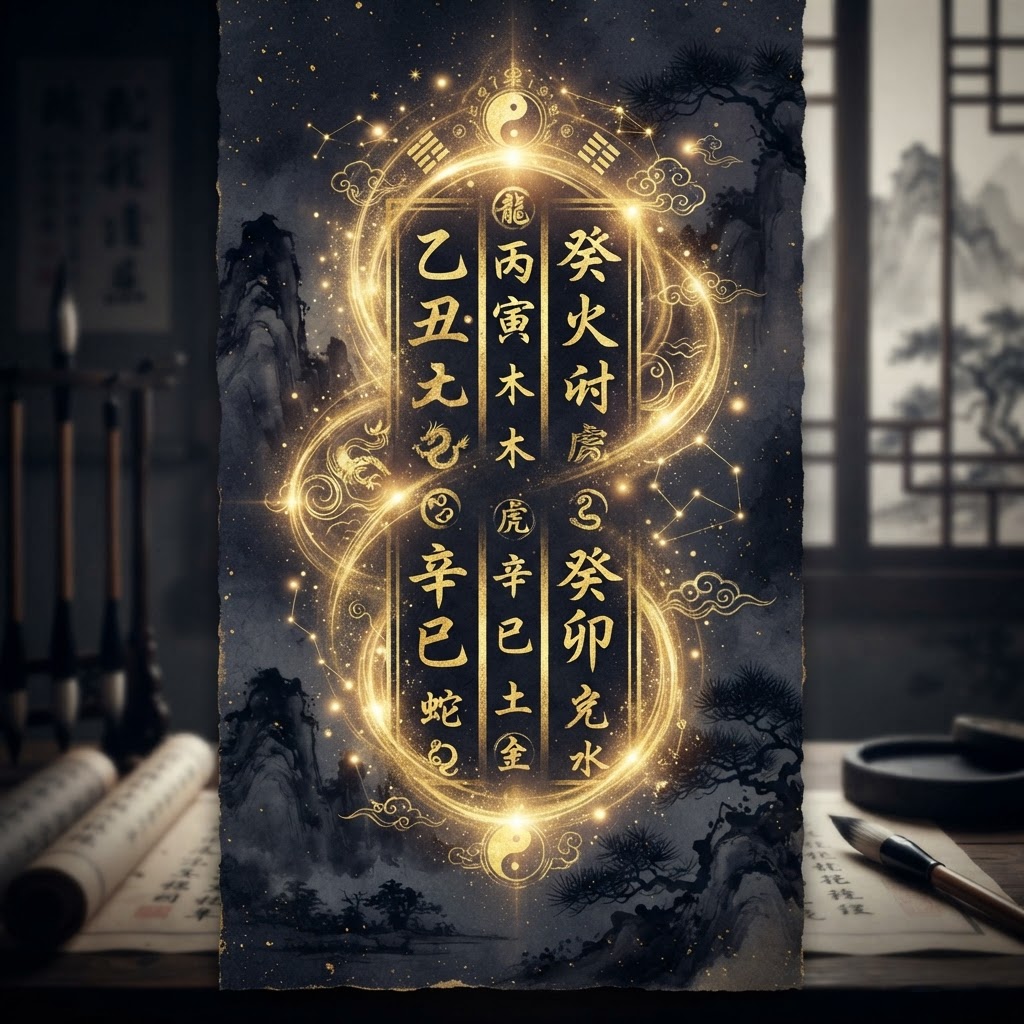
When you generate your birth chart using an online tool like my Qi Men Dun Jia and BaZi calculator, you’ll see a structured matrix. To a beginner, all those boxes can look like a maze. Let’s break down the physical visual layout so you know exactly where to look when reading a chart.
A standard chart layout displays the four pillars vertically side by side. Each pillar has a top box for the Heavenly Stem (Tian Gan) and a bottom box for the Earthly Branch (Di Zhi). Beneath the Earthly Branches, you’ll usually find smaller text listing the Hidden Stems (Cang Gan). Below the main chart grid, modern software also displays your Luck Pillars (Da Yun), which represent ten-year life cycles.
Here is a simplified structural diagram showing how a standard Four Pillars chart is formatted on paper:
Standard BaZi Four Pillars Chart Matrix
| Hour Pillar | Day Pillar | Month Pillar | Year Pillar |
|---|---|---|---|
| Heavenly Stem (Hour Stem) |
DAY MASTER (Day Stem – Core Self) |
Heavenly Stem (Month Stem) |
Heavenly Stem (Year Stem) |
| Earthly Branch (Hour Branch) |
Earthly Branch (Day Branch / Spouse) |
MONTH BRANCH (Seasonal Command) |
Earthly Branch (Year Branch / Zodiac) |
| Hidden Stems (Qi elements) |
Hidden Stems (Qi elements) |
Hidden Stems (Seasonal Qi) |
Hidden Stems (Qi elements) |
Note: The Day Master (top row of Day Pillar) is your anchor point. The Month Branch (bottom row of Month Pillar) sets the climate and seasonal balance of the chart.
When studying this matrix, notice how the Day Master sits right at the center top of the Day Pillar. Every other element in the chart is evaluated based on its relationship to this single Day Master. If the Day Master is Yang Wood, we look at the Month Stem, Year Stem, and all the Branches to see if they nourish, attack, drain, or support that Yang Wood.
The 10 Heavenly Stems Explained
The Heavenly Stems represent the pure, active energies of the cosmos. There are ten stems in total, derived from combining the Five Elements (Wood, Fire, Earth, Metal, Water) with the two polarities (Yin and Yang). Each stem carries distinct character traits, tendencies, and physical representations.
Let’s look at the complete breakdown of the 10 Heavenly Stems:
| Stem Name | Chinese Character | Element & Polarity | Nature Metaphor | Core Character Traits |
|---|---|---|---|---|
| Jia | 甲 | Yang Wood | Tall Pine Tree, Sturdy Timber | Direct, stubborn, reliable, growth-oriented, protective, independent leadership. |
| Yi | 乙 | Yin Wood | Climbing Ivy, Flexible Flower | Adaptable, diplomatic, resilient, networking ability, gentle yet persistent approach. |
| Bing | 丙 | Yang Fire | Blazing Sun, Radiant Heat | Generous, passionate, optimistic, visible, quick-tempered, warm-hearted motivation. |
| Ding | 丁 | Yin Fire | Candle Flame, Starlight | Meticulous, inspiring, intuitive, detail-focused, warm guidance, steady vision. |
| Wu | 戊 | Yang Earth | Majestic Mountain, Heavy Boulder | Solid, trustworthy, patient, slow to change, grounded, highly stable foundation. |
| Ji | 己 | Yin Earth | Fertile Soil, Garden Earth | Nurturing, adaptable, practical, resourceful, tolerant, talent developer. |
| Geng | 庚 | Yang Metal | Raw Iron, Unrefined Sword | Righteous, decisive, tough, direct, competitive, values justice and direct execution. |
| Xin | 辛 | Yin Metal | Refined Gold, Fine Jewelry | Elegant, sharp, sensitive, detail-oriented, self-respecting, articulate expression. |
| Ren | 壬 | Yang Water | Surging Ocean, Fast River | Dynamic, adventurous, smart, adaptable, persuasive, restless strategy drive. |
| Gui | 癸 | Yin Water | Morning Dew, Gentle Rain | Intuitive, quiet, contemplative, subtle, imaginative, deep analytical thinker. |
Understanding these ten stems is central to learning BaZi. When you read a person’s chart, their Day Stem gives you an immediate glimpse into their core personality. In my recruitment leadership work over three decades, observing how Jia Wood individuals differed from Yi Wood or Bing Fire personalities proved remarkably consistent. Jia Wood people tend to stand firm and lead directly, while Yi Wood people navigate around obstacles through diplomacy and strategic relationships.
The 12 Earthly Branches and Zodiac Animals
While Heavenly Stems represent active energy above, the Earthly Branches represent the physical earth below. There are twelve Earthly Branches, each associated with a popular Chinese zodiac animal, an element, a polarity, a solar month, and a two-hour time window during the day.
Most people know their Chinese Zodiac animal based on their birth year. For instance, if you were born in 1984, you’re a Rat. But in complete BaZi reading, you actually have four zodiac animals in your chart, one in each pillar! Your birth year animal is just one-fourth of your structural picture.
Let’s review the 12 Earthly Branches and their foundational attributes:
| Branch | Zodiac Animal | Primary Element | Polarity | Season / Solar Month | Double-Hour Window |
|---|---|---|---|---|---|
| Zi (子) | Rat | Water | Yang (functions as Yin) | Mid-Winter (Dec) | 11:00 PM – 1:00 AM |
| Chou (丑) | Ox | Earth (Wet Earth) | Yin | Late Winter (Jan) | 1:00 AM – 3:00 AM |
| Yin (寅) | Tiger | Wood | Yang | Early Spring (Feb) | 3:00 AM – 5:00 AM |
| Mao (卯) | Rabbit | Wood | Yin | Mid-Spring (Mar) | 5:00 AM – 7:00 AM |
| Chen (辰) | Dragon | Earth (Damp Earth) | Yang | Late Spring (Apr) | 7:00 AM – 9:00 AM |
| Si (巳) | Snake | Fire | Yin (functions as Yang) | Early Summer (May) | 9:00 AM – 11:00 AM |
| Wu (午) | Horse | Fire | Yang (functions as Yin) | Mid-Summer (Jun) | 11:00 AM – 1:00 PM |
| Wei (未) | Goat | Earth (Dry Earth) | Yin | Late Summer (Jul) | 1:00 PM – 3:00 PM |
| Shen (申) | Monkey | Metal | Yang | Early Autumn (Aug) | 3:00 PM – 5:00 PM |
| You (酉) | Rooster | Metal | Yin | Mid-Autumn (Sep) | 5:00 PM – 7:00 PM |
| Xu (戌) | Dog | Earth (Dry Earth) | Yang | Late Autumn (Oct) | 7:00 PM – 9:00 PM |
| Hai (亥) | Pig | Water | Yin | Early Winter (Nov) | 9:00 PM – 11:00 PM |
When analyzing these branches, pay attention to the seasonal progression. Spring is dominated by Wood (Tiger, Rabbit, Dragon), Summer by Fire (Snake, Horse, Goat), Autumn by Metal (Monkey, Rooster, Dog), and Winter by Water (Pig, Rat, Ox). Earth branches act as transitional buffers between seasons.
An Introduction to Hidden Stems (Cang Gan)
Underneath each Earthly Branch in a chart, you’ll see one to three Heavenly Stems listed in smaller font. These are called Hidden Stems (Cang Gan, 藏干). They represent subterranean energy reserves stored inside the branch.
Think of an Earthly Branch as a physical house, and the Hidden Stems as the residents living inside that house. Some houses have only one resident (for instance, the Rabbit branch Mao contains only Yin Wood Yi). Other houses contain multiple residents. For example, the Tiger branch Yin has Yang Wood Jia as its primary resident, but also carries Yang Fire Bing and Yang Earth Wu as secondary hidden energies.
Why do Hidden Stems matter to a beginner? Because they reveal hidden talents, secondary character traits, and underlying support systems. A person might not show Fire in their top Heavenly Stems, but if their branches contain strong Fire hidden stems, they possess internal passion and enthusiasm that surfaces under the right circumstances. If you’d like to explore how these elemental layers work across overall destiny analysis, check my foundational guide on BaZi reading for broader context.
The Heart of the Chart: Finding Your Day Master
If you take away only one lesson from this entire article, let it be this: your Day Master is the focal point of your entire BaZi reading. Located at the Heavenly Stem of your Day Pillar, your Day Master represents your core self, your fundamental temperament, and your primary perspective on life.
Every other element in your chart is evaluated based on how it interacts with your Day Master. Does another element support your Day Master, challenge it, drain its energy, or provide valuable resources? You cannot answer these questions until you know your Day Master.
The 10 Day Master Profiles
Let’s take a closer look at how each of the ten Day Masters manifests in real-life behavior, personal values, and communication styles:
- Jia Wood (Yang Wood): Like a majestic pine tree. Strong-willed, principled, straightforward, and growth-oriented. They dislike being micro-managed and possess strong leadership qualities, but can sometimes be rigid under pressure when fast adaptation is required.
- Yi Wood (Yin Wood): Like climbing ivy or a flexible flower. Adaptable, networking-minded, diplomatic, and highly resilient. They know how to pivot around obstacles and thrive in changing corporate environments through relationship building.
- Bing Fire (Yang Fire): Like the blazing sun. Generous, warm, enthusiastic, and highly visible. They shine light on others, motivate teams naturally, but can occasionally act impetuously when excited about a new venture.
- Ding Fire (Yin Fire): Like a steady candle flame or lantern. Meticulous, inspiring, intuitive, and dedicated. They pay close attention to details and provide warm, thoughtful guidance to people around them over long periods.
- Wu Earth (Yang Earth): Like a solid mountain. Dependable, calm, grounded, and patient. They protect others and offer stability, though they may take time to adapt to abrupt workplace disruptions or market shifts.
- Ji Earth (Yin Earth): Like rich garden soil. Nurturing, practical, resourceful, and tolerant. They excel at developing talent, keeping projects organized, and managing practical operational details behind the scenes.
- Geng Metal (Yang Metal): Like unrefined iron or a broadsword. Decisive, direct, tough, and fiercely loyal. They value justice and hard work, facing challenges head-on without flinching from conflict.
- Xin Metal (Yin Metal): Like fine jewelry or a surgical scalpel. Refined, articulate, sensitive, and detail-driven. They appreciate elegance and high standards, expressing thoughts with sharp precision and personal pride.
- Ren Water (Yang Water): Like a rushing river or ocean wave. Dynamic, smart, adventurous, and highly persuasive. They love movement, big-picture strategy, and continuous learning across diverse industries.
- Gui Water (Yin Water): Like morning mist or gentle rain. Intuitive, creative, quiet, and deeply analytical. They absorb information silently and offer clever, insightful solutions when complex problems arise.
Evaluating Day Master Strength: Seasonal Command
Once you identify your Day Master stem, your next step is determining whether your Day Master is “Strong” (Wang) or “Weak” (Shuai). In BaZi analysis, strength has nothing to do with physical health or personal character worth. It’s strictly an energy measurement: does your Day Master have an abundance of elemental energy, or is its energy lean and in need of support?
The single most powerful factor in evaluating strength is the Month Branch, also known as the Seasonal Command (Yue Ling). The month branch determines the atmospheric season when you were born:
- If a Wood Day Master is born in Spring (Tiger, Rabbit, Dragon months), the Wood element is naturally prosperous and in seasonal command. The Day Master gains heavy baseline strength from the ambient spring climate.
- If a Wood Day Master is born in Autumn (Monkey, Rooster, Dog months), Metal dominates the season and chops Wood. The Wood Day Master is out of season and leans weak.
- If a Fire Day Master is born in Summer (Snake, Horse, Goat months), Fire is abundant and hot. The Day Master is strong by seasonal command.
- If a Water Day Master is born in Mid-Winter (Rat, Pig months), Water is icy and deep. The Day Master receives strong seasonal support.
Besides seasonal command, we also check whether other stems and branches in the chart contain matching elements (Friends/Rob Wealth) or producing elements (Resource). If many elements in the chart support your Day Master, your Day Master becomes strong. If many elements drain, control, or consume your Day Master (Output, Wealth, Officer), your Day Master becomes weak.
The Five Elements and Energy Balance
To read how elements move through your chart, you must understand the two fundamental interaction cycles of Wu Xing (the Five Elements): the Generating Cycle and the Controlling Cycle. To study elemental dynamics in greater detail, see my comprehensive guide on the Five Elements in BaZi reading.
1. The Generating Cycle (Sheng Cycle)
The Generating Cycle represents nourishment, production, and support. One element produces and feeds the next element in a continuous clockwise circle:
- Wood generates Fire: Burning wood creates fire, heat, and light energy.
- Fire generates Earth: Fire reduces matter to rich ash, enriching the surrounding earth.
- Earth generates Metal: Ores and precious minerals form deep within the mountain earth.
- Metal generates Water: Metal condenses ambient moisture into liquid droplets, and mineral springs flow from rock.
- Water generates Wood: Water waters plants and trees, fostering new growth and vibrant vegetation.
2. The Controlling Cycle (Ke Cycle)
The Controlling Cycle represents regulation, structure, discipline, and boundaries. Without control, an element can grow wildly out of proportion:
- Wood controls Earth: Tree roots penetrate and stabilize the soil, preventing erosion.
- Earth controls Water: Earth dams and riverbanks direct and contain liquid flow.
- Water controls Fire: Water cools and extinguishes burning flames.
- Fire controls Metal: Intense fire melts raw metal into shaped, useful tools.
- Metal controls Wood: An axe or saw cuts and shapes timber into lumber.
Let’s map out how these five elements connect to physical, emotional, and business dimensions:
| Element | Generates | Controlled By | Associated Qualities | Business & Career Fields |
|---|---|---|---|---|
| Wood | Fire | Metal | Growth, kindness, vision, expansion, creative planning. | Education, publishing, timber, agriculture, fashion, human resources. |
| Fire | Earth | Water | Passion, elegance, visibility, illumination, expressiveness. | Technology, media, branding, public speaking, energy, entertainment. |
| Earth | Metal | Wood | Trust, stability, patience, consolidation, practical grounding. | Real estate, construction, warehousing, insurance, agriculture land. |
| Metal | Water | Fire | Structure, discipline, righteousness, precision, execution. | Finance, banking, machinery, legal professions, surgery, engineering. |
| Water | Wood | Earth | Wisdom, flexibility, communication, strategy, networking. | Logistics, travel, ocean trade, coaching, psychology, beverage industry. |
What Does “Balance” Really Mean in BaZi?
A frequent mistake made by beginners is believing that a balanced chart must contain exactly 20% of Wood, Fire, Earth, Metal, and Water. Nature doesn’t work that way! Think of a lush tropical rain forest compared to a majestic desert mountain range. Neither landscape has equal parts of every element, yet both are beautiful and functional ecosystems.
In BaZi, balance means finding your Favorable Elements (Yong Shen, 用神), often called your Useful Elements. Your Useful Element is the specific element that brings harmony, smooth energy flow, and structural support to your Day Master.
For example, if you have a very Strong Bing Fire Day Master born in the peak of Summer, adding more Fire or Wood will make your chart uncomfortably hot and dry. Your chart desperately needs Water to cool the temperature and Metal to produce Water. In that scenario, Water and Metal become your Favorable Elements. Conversely, if you have a Weak Gui Water Day Master born in freezing Mid-Winter, your chart needs Metal to produce Water and warm Earth or Fire to unfreeze the environment.
A great chart isn’t one that has equal amounts of every element. A great chart is one where the elements flow productively and the Favorable Element is accessible when life presents opportunities.
The Ten Gods (Shi Shen) at a Glance
As you advance beyond basic elements, you’ll encounter the concept of the Ten Gods (Shi Shen, 十神). Don’t let the name confuse you. In Chinese metaphysics, “Gods” doesn’t refer to religious deities. Instead, it’s a technical term for ten specific relational archetypes created between your Day Master and the other elements in your chart.
The Ten Gods are categorized into five elemental pairs based on how another element relates to your Day Master stem:
| Category | Ten God Name | Relationship to Day Master | Core Life Manifestation | Practical Career / Personality Trait |
|---|---|---|---|---|
| Companion (Self) | Friend (Bi Jian) | Same element, same polarity | Peers, colleagues, equal partners, self-confidence. | Independent, strong teamwork capacity, firm personal boundaries. |
| Rob Wealth (Jie Cai) | Same element, opposite polarity | Competitors, intense social connections, sharing wealth. | Charismatic, persuasive, competitive drive, generous with money. | |
| Output (Expression) | Eating God (Shi Shen) | Element produced by DM, same polarity | Creative ideas, strategy, enjoyment of life, calm talent. | Refined intellect, strategic planning, artistic taste, teaching skills. |
| Hurting Officer (Shang Guan) | Element produced by DM, opposite polarity | Bold expression, innovation, challenging authority, performance. | Outspoken, highly innovative, breakthrough problem solver, energetic. | |
| Wealth (Possession) | Direct Wealth (Zheng Cai) | Element controlled by DM, opposite polarity | Earned income, steady salary, assets, systematic management. | Disciplined, practical, risk-averse, excellent financial control. |
| Indirect Wealth (Pian Cai) | Element controlled by DM, same polarity | Investments, side ventures, windfall gains, big deals. | Entrepreneurial, opportunist, comfortable with calculated risk. | |
| Officer (Influence) | Direct Officer (Zheng Guan) | Element controlling DM, opposite polarity | Structure, corporate rank, discipline, lawful authority. | Organized, law-abiding, natural manager, values corporate hierarchy. |
| Seven Killings (Qi Sha) | Element controlling DM, same polarity | Command, authority under pressure, crisis management, raw power. | Decisive under fire, pioneering leader, courageous, highly driving. | |
| Resource (Support) | Direct Resource (Zheng Yin) | Element producing DM, opposite polarity | Education, mentors, motherly care, formal credentials. | Studious, honorable, reflective, seeks stability and reputation. |
| Indirect Resource (Pian Yin) | Element producing DM, same polarity | Unconventional knowledge, intuition, metaphysics, specialized skills. | Sharp intuition, original thinker, curious about hidden mechanics. |
When you look at a chart, seeing which Ten Gods are prominent gives you an instant snapshot of a person’s life orientation. An individual with strong Indirect Wealth and Seven Killings often thrives in entrepreneurial ventures and turnaround management. Someone with strong Direct Officer and Direct Resource tends to build impressive, stable careers within structured corporate organizations or civil service.
How a BaZi Reading Flows in Practice
When I conduct a reading or guide my students through chart analysis, we follow a disciplined, five-step protocol. Rather than jumping randomly between details, a structured workflow ensures you catch the big picture before diving into minor nuances.
Here is the exact step-by-step reading process used by practical chart readers:
The 5-Step Practical BaZi Reading Workflow
- Identify the Day Master: Locate the Heavenly Stem on the Day Pillar. Note its element, polarity, and baseline character profile.
- Check Seasonal Command (Month Branch): Look at the Month Branch to determine if the Day Master was born in season, out of season, or during a transitional month.
- Assess Overall Elemental Strength: Count the supporting elements (Resource and Companion) versus consuming elements (Output, Wealth, Officer) across all stems and branches.
- Determine Useful & Unfavorable Elements: Identify your Favorable Elements (Yong Shen) needed to bring the chart into functional harmony and energy balance.
- Examine Luck Pillars & Annual Timing: Overlay the current 10-Year Luck Pillar (Da Yun) and Annual Year Stem/Branch to see which elements are entering the chart right now.
Following this five-step sequence keeps your analysis grounded. You begin by understanding who the person is (Day Master), what climate they operate in (Season), whether they have high or lean energy reserves (Strength), what tools or elements help them succeed (Useful Elements), and when those supportive energies arrive in real time (Timing).
Common Beginner Mistakes to Avoid
Over the years, I’ve seen hundreds of beginners make the same predictable errors when learning chart reading. Avoiding these traps will save you unnecessary anxiety and significantly improve your analytical accuracy.
| Common Beginner Mistake | Why the Mistake Happens | The Correct Practical Perspective |
|---|---|---|
| Panicking over missing elements | Assuming every chart must have all five elements present in equal amounts. | Missing elements simply indicate areas where you don’t focus naturally. You can bring those energies into your life through partnerships, career choices, or specific habits. |
| Reading only the Zodiac animal | Relying on popular media forecasts that focus exclusively on the Year Branch. | Your Year animal represents only 25% of your static birth chart and primarily reflects public social perception. The Day Master and Month Branch carry far greater weight. |
| Equating ‘Weak Day Master’ with bad luck | Confusing elemental energy weight with personal health, morality, or career success. | A weak Day Master is merely an energy classification. Weak Day Masters often build massive business empires when they leverage supportive partners and timing. |
| Treating BaZi as absolute fatalism | Viewing chart indicators as unchangeable predictions set in stone. | BaZi maps baseline energy conditions and timing windows. Your decisions, execution, location, and environment dictate your real-world outcomes. |
| Ignoring the 10-Year Luck Pillars | Focusing entirely on the static birth chart without looking at dynamic timing cycles. | A static birth chart is like a car, while the Luck Pillars represent the road you drive on. A modest car on a smooth highway travels much faster than a luxury car stuck in mud. |
An Honest Note on What BaZi Can and Cannot Tell You
In my business career and in my teaching of Chinese metaphysics, I always insist on complete honesty. There is a lot of exaggeration in the marketplace regarding what metaphysics can accomplish. Let’s be clear about the realistic boundaries of BaZi reading.
What BaZi CAN tell you:
- Your natural personality strengths, emotional defaults, and cognitive preferences.
- The types of work environments where you naturally perform at your best.
- Key relationship dynamics, communication tendencies, and potential conflict triggers.
- Favorable timing windows for expansion, career shifts, investments, or holding steady.
- Potential health vulnerabilities based on elemental imbalances.
What BaZi CANNOT tell you:
- Winning lottery numbers or guaranteed stock picks.
- An unalterable future that removes your need to work hard or make wise choices.
- Exact dates of events down to the second without considering human action and location.
- Your moral character or personal integrity, which are shaped by choice and values.
When you combine BaZi with advanced tactical systems like Qi Men Dun Jia, you gain both macro-level strategy and micro-level execution power. BaZi gives you the long-term weather forecast for your life, while Qi Men Dun Jia helps you execute specific strategic moves in business, negotiations, and career decisions. You can read more about this combined approach in my article on BaZi reading under Qi Men Dun Jia.
Frequently Asked Questions
Do I need to know my exact birth time to read my BaZi chart?
While having your exact birth time provides the complete four pillars, you can still read a great deal without it. Your birth year, month, and day reveal your Day Master, your seasonal command, and your core elemental structure. The birth hour adds detail about late life, private ambitions, investments, and subordinates, but you can begin learning chart analysis using just three pillars.
Can two people born at the exact same minute have different lives?
Yes, absolutely. A BaZi chart represents energy propensity and timing conditions, but it does not account for differences in upbringing, geographic location, parental choices, education, and personal willpower. Two people with identical charts share similar underlying energy themes, but their real-world choices and environments produce unique outcomes.
Is a Strong Day Master better than a Weak Day Master?
No. Neither is inherently better or worse. A strong Day Master simply has an abundance of self-energy and prefers elements that drain, control, or consume energy (Output, Wealth, Officer). A weak Day Master has leaner self-energy and prefers elements that nourish or support it (Resource, Companion). Success depends on whether your current Luck Pillar supplies your favorable elements.
What should I do if my chart is missing an element entirely?
A missing element is not a tragedy. It simply means that specific element’s energy isn’t prominently active in your baseline chart. You can introduce missing elemental qualities through your career choices, daily routines, social networks, and business partnerships. Furthermore, missing elements often arrive during specific 10-Year Luck Pillars or annual years.
How often does a BaZi chart change during your life?
Your birth chart (the four pillars derived from your birth date and time) remains static throughout your entire life. However, your dynamic environment changes constantly as you move through 10-Year Luck Pillars (Da Yun) and Annual Pillars. Every decade and every year brings new elemental combinations that interact with your static chart.
How long does it take a complete beginner to learn basic chart reading?
You can learn to identify Day Masters, seasonal strength, and basic elemental relationships within a few days of study. Becoming fluent in nuanced interactions, hidden stems, and Ten Gods analysis typically takes a few months of practical exercise. The key is analyzing real charts rather than memorizing dry theory.
Can reading my BaZi chart help me make better business decisions?
Yes. Understanding your chart helps you identify your natural management style, optimal timing for business expansion, potential partnership risks, and key strengths. In my thirty years of business experience, using chart reading as a strategic self-awareness tool has helped many leaders align their strategic moves with natural timing.
Related Reading
To deepen your knowledge of Chinese metaphysics, explore the BaZi guides on this site and check these detailed articles:
- BaZi Reading: The Ancient Art of Fortune Telling – Explore my comprehensive parent guide on the foundational principles of Four Pillars analysis.
- The Five Elements in BaZi Reading – Learn how Wood, Fire, Earth, Metal, and Water interact to create energy balance in your chart.
- BaZi Reading Under Qi Men Dun Jia – Discover how combining BaZi destiny analysis with Qi Men Dun Jia execution provides strategic clarity in business and life.
- Qi Men Dun Jia & BaZi Calculator Tool – Plot your birth chart instantly to find your Day Master, Four Pillars, and Luck Cycles.
Complete Guide: BaZi Basics
This article is part of a five-part series. The other articles in this guide:
Leave a Reply
You must be logged in to post a comment.