
The Four Pillars: Year, Month, Day, and Hour in Qimen Destiny
When I first started studying Qimen Dun Jia, the four pillars confused me. Not the concepts themselves, those are straightforward enough. What confused me was how the same four pieces of birth data could produce completely different charts depending on the system you used. In BaZi, the year, month, day, and hour give you eight characters arranged in a line. In Qimen destiny, those same four data points get distributed across a nine-palace grid using a completely different calculation method. The raw materials are identical. The architecture built from them is entirely different.
I want to take you through exactly what each pillar represents, how it feeds into the Qimen destiny chart, and why understanding the pillars individually helps you read the chart more effectively. Whether you are preparing for a reading or studying the system yourself, knowing what each pillar contributes will deepen your understanding of how the chart works as a whole.
The Year Pillar: Your Ancestral Foundation
The year pillar is the broadest and most foundational. In Chinese metaphysics, the year represents your ancestry, your family background, and the social environment you were born into. It sets the stage. The year stem and branch tell us about the generation you belong to and the collective energy that shaped your early life.
In Qimen destiny, the year pillar has a specific role: it helps determine which palace the chart’s energy originates from. The year stem is placed in a particular palace based on the Donggong calculation method, and from there, the other stems are distributed across the remaining palaces. The year pillar is like the seed from which the rest of the chart grows. Get the year wrong and the entire chart shifts, which is why accuracy matters from the very first piece of data.
The year branch (one of the twelve earthly branches) tells us about the animal energy of your birth year. In Qimen destiny, this branch interacts with the palace it lands in, creating element relationships that affect how your ancestral energy expresses in your life. A year branch that generates the palace element suggests ancestral support flows naturally. A year branch that controls or clashes the palace element suggests you had to work to reconcile your family background with your own path. Neither is good or bad. It just tells us about the kind of terrain you started from.
| Pillar | Time Frame | Life Area | In Qimen Destiny |
|---|---|---|---|
| Year | 1-16 years | Ancestry, family, social context | Determines chart origin palace |
| Month | 17-32 years | Parents, upbringing, early career | Sets the month stem’s palace position |
| Day | 33-48 years | Self, spouse, core identity | Day stem = primary personality indicator |
| Hour | 49+ years | Children, late career, legacy | Fine-tunes the chart’s final palace layout |
The Month Pillar: Your Upbringing and Early Environment
The month pillar is arguably the most important for chart strength calculation. In both BaZi and Qimen destiny, the month branch determines the season of your birth, which in turn determines whether your day stem is strong or weak. Born in summer with a Fire day stem? Your stem is strong because the season supports it. Born in winter with a Fire day stem? Your stem is weak because the season drains it. The seasonal influence is foundational to everything else.
In Qimen destiny, the month stem is placed in its own palace, and its relationship with the day stem’s palace tells us about how your upbringing shaped your core nature. A month stem that generates the day stem’s palace element suggests your early environment nurtured your authentic self. A month stem that controls or clashes suggests friction between what your family wanted for you and who you actually are. This is not about blame. It is about understanding the dynamics that shaped you so you can work with them consciously rather than repeating patterns unconsciously.
The month also determines the solar term at your birth. Chinese metaphysics uses 24 solar terms (jieqi), and the month changes at the beginning of a solar term, not at the calendar month boundary. This is a common source of confusion. Someone born on February 3 might be in a different month than someone born on February 5, depending on when the solar term Li Chun (Start of Spring) falls that year. I always check the solar term boundary when building charts because getting the month wrong cascades into errors throughout the rest of the chart.
Solar Term Boundaries: A Common Pitfall
The Chinese month does not change on the 1st of the Gregorian month. It changes at a specific solar term. For example, the month of Yin (Tiger) begins at Li Chun (Start of Spring), usually February 3-5. The month of Mao (Rabbit) begins at Jing Zhe (Awakening of Insects), usually March 5-6. If your birthday falls near a solar term boundary, the month pillar could go either way. Always verify against the exact solar term time for your birth year.
The Day Pillar: Your Core Self
The day pillar is the heart of the chart. The day stem (the heavenly stem of the day pillar) represents you in the most fundamental sense. Everything else in the chart is interpreted in relation to this stem. In BaZi, the day stem is called the Day Master. In Qimen destiny, the day stem serves a similar role but is interpreted within the palace it occupies rather than as a standalone character.
The day stem tells us about your innate temperament. Are you a Jia (Yang Wood): pioneering, direct, growth-oriented? A Ding (Yin Fire): warm, illuminating, refined? A Xin (Yin Metal): precise, elegant, discerning? Each of the ten stems has a distinct personality that shows up in how you think, feel, and act. In a Qimen destiny reading, the day stem’s palace position and its interactions with the other elements in that palace tell us how your core nature expresses itself in the world.
The day branch is also significant. In BaZi, the day branch is called the Spouse Palace because it represents the kind of partner you attract and the dynamics of your closest relationships. In Qimen destiny, the day branch contributes to the palace energies and affects the Relationship Palace’s interpretation. The day branch’s element interacting with the day stem’s element gives us a micro-reading of your internal dynamics: are your head (stem) and your heart (branch) in harmony, or is there tension between your conscious and subconscious?
The day pillar is where you live in the chart. It is the address of your authentic self. Every other pillar is a visitor in relation to it.
I discuss the ten stems in more detail in my ten stems in destiny charts guide, where each stem gets its own breakdown. For now, the key point is that the day stem is your chart’s protagonist, and understanding its nature is the first step in reading any Qimen destiny chart.
The Hour Pillar: Your Legacy and Later Life
The hour pillar is the most specific and the most detail-oriented. It represents your later life, your children, your students, and the legacy you leave behind. It also represents the outcomes of new projects and how you interact with subordinates. In Qimen destiny, the hour pillar fine-tunes the chart by adding the final layer of palace information.
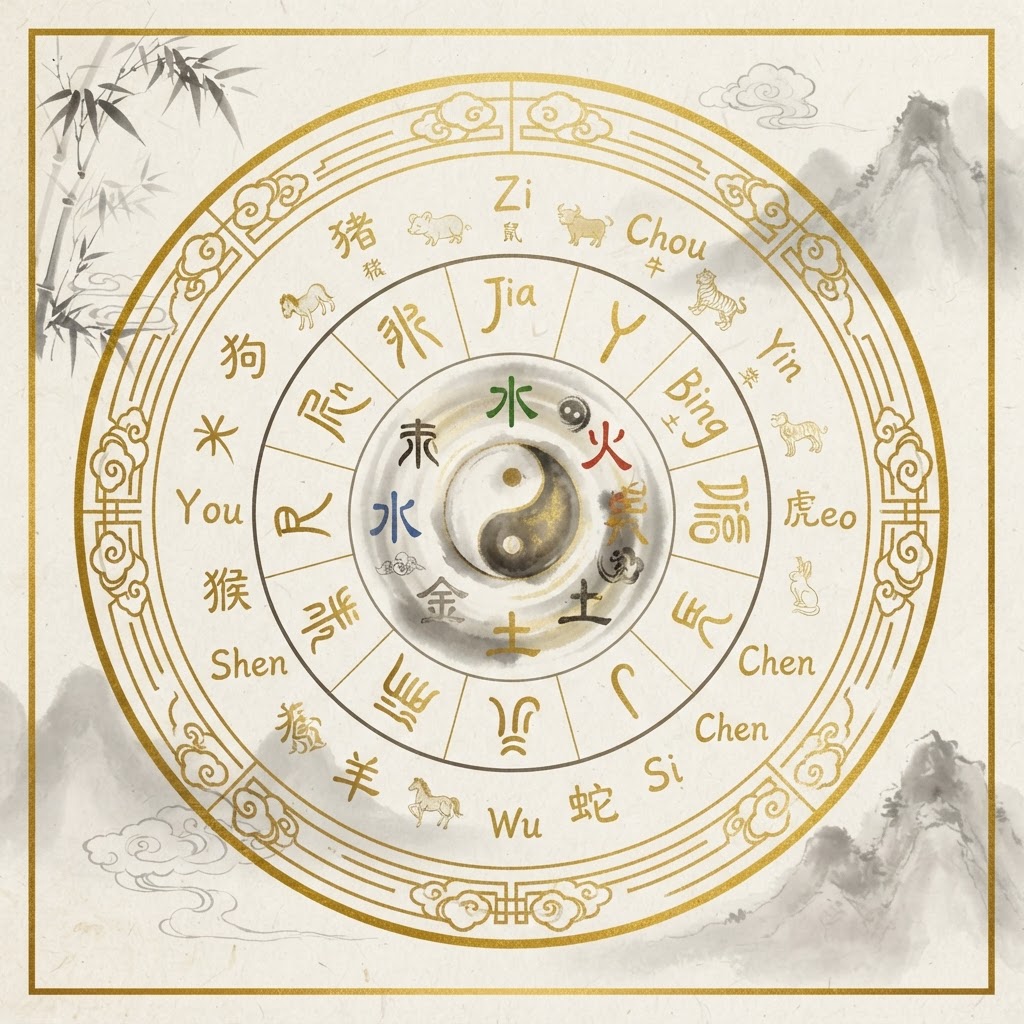
The hour in Chinese timekeeping is not the same as the Western hour. The Chinese day is divided into twelve two-hour periods, each corresponding to one of the twelve earthly branches. The Zi hour runs from 11 PM to 1 AM. The Chou hour from 1 AM to 3 AM. And so on. This means that if you were born at 11:30 PM, you are in the Zi hour of the next day, not the day you started on. This is another common source of chart errors, and I always double-check the hour branch boundary when building charts.
| Branch | Time (24h) | Animal | Element |
|---|---|---|---|
| Zi | 23:00-01:00 | Rat | Water |
| Chou | 01:00-03:00 | Ox | Earth |
| Yin | 03:00-05:00 | Tiger | Wood |
| Mao | 05:00-07:00 | Rabbit | Wood |
| Chen | 07:00-09:00 | Dragon | Earth |
| Si | 09:00-11:00 | Snake | Fire |
| Wu | 11:00-13:00 | Horse | Fire |
| Wei | 13:00-15:00 | Goat | Earth |
| Shen | 15:00-17:00 | Monkey | Metal |
| You | 17:00-19:00 | Rooster | Metal |
| Xu | 19:00-21:00 | Dog | Earth |
| Hai | 21:00-23:00 | Pig | Water |
Notice the Zi hour problem. If you were born at 23:15, the day pillar has already shifted to the next day in Chinese timekeeping. This is because the Zi hour straddles midnight. Some practitioners treat 23:00-23:59 as late day and 00:00-01:00 as early next day. Others treat the entire Zi hour as belonging to the next day. I use the convention that 23:00 onwards belongs to the next day’s hour pillar, which is the more widely accepted approach. But this is something I always verify carefully because it affects the entire chart.
How the Four Pillars Map to the Nine Palaces
This is where Qimen destiny diverges most clearly from BaZi. In BaZi, the four pillars give you eight characters arranged in a simple grid: two columns per pillar, four pillars left to right. The reading is linear and sequential. In Qimen destiny, the four pillars feed into a nine-palace grid through a specific calculation method.
Here is the process in simplified form. The year stem is placed in a palace determined by the Luoshu number for that year. The month stem is placed based on the month’s position in the solar cycle. The day stem goes to the palace dictated by the day’s numerical value in the Qimen calculation sequence. The hour stem fills in the final palace. The result is that your four pillars are distributed across four of the nine palaces, and the remaining five palaces are filled through the system’s internal logic, each receiving its own stems, doors, stars, and deities.
This spatial distribution is what makes Qimen destiny a map rather than a profile. Instead of reading eight characters in sequence, you read nine palaces in relationship. Each palace tells you about a different life domain, and the way the palaces interact with each other through element relationships gives you a dynamic, multi-dimensional view of your life. I explain this structure in more detail in my four plates guide, which breaks down each layer of the chart.
BaZi vs Qimen: Where the Pillars Go
BaZi: Year, Month, Day, Hour pillars arranged left to right. Each pillar has one stem (top) and one branch (bottom). Eight characters total. Read sequentially.
Qimen Destiny: Same four pillars, but the stems are distributed across nine palaces based on the Luoshu sequence and Donggong method. Each palace contains five layers. Read spatially, looking at relationships between palaces.
The True Solar Time Question
One topic that comes up frequently is true solar time. The Chinese calendar is based on the sun’s actual position, not on clock time. If you were born in Singapore at 10 AM, the clock says 10 AM, but the true solar time is different because Singapore’s time zone (UTC+8) does not perfectly match its longitude. Singapore is at approximately 104 degrees east, which corresponds to about UTC+6.9 in solar time. This means true solar time in Singapore is about 70 minutes behind clock time.
Some practitioners insist on converting to true solar time. Others use clock time. I have tested both approaches over many readings and found that for Singapore-born clients, using clock time with the standard time zone calculations produces charts that match their life experience more consistently. I discuss this more in my Qimen vs BaZi comparison, but the key insight is that the system was developed in China where solar time and clock time were the same. When applied to other longitudes, there is a question of which adjustment produces more accurate results, and I have found that the standard approach works well for most cases.
Common Errors in Birth Data Collection
I have seen every kind of birth data error over the years. Here are the most common ones and how to avoid them.
The Wrong Calendar
Some people’s parents recorded their birth date in the lunar calendar rather than the solar calendar. Chinese metaphysics uses the solar calendar (based on solar terms), not the lunar calendar. If your family celebrated your birthday according to the lunar calendar, the date needs to be converted. Always verify which calendar system your birth date was recorded in.
The Hour Boundary
If you were born at exactly 11 AM, you are on the boundary between the Si hour (9-11 AM) and the Wu hour (11 AM-1 PM). Which side of the boundary you fall on changes the hour pillar and potentially the entire chart. Always ask for the exact minute if you are near a boundary.
The Zi Hour Midnight Problem
As mentioned above, the Zi hour runs from 11 PM to 1 AM. If you were born between 11 PM and midnight, there is a question of whether you belong to the day you started or the day you are entering. This is the most common source of day pillar errors.
Wrong Year Due to Li Chun
The Chinese year changes at Li Chun (Start of Spring), not on January 1 or Chinese New Year. If you were born in late January or early February, your year pillar might belong to the previous year. For example, someone born on February 2, 1985, might have a 1984 year pillar, depending on when Li Chun falls that year. I always check the exact Li Chun time for the birth year.
| Error Type | When It Happens | Impact | Solution |
|---|---|---|---|
| Wrong calendar | Lunar date recorded instead of solar | Entire chart is wrong | Convert lunar to solar using a reliable calendar converter |
| Hour boundary | Birth time near a two-hour boundary | Hour pillar changes | Get exact minute, determine correct branch |
| Zi hour midnight | Birth between 11 PM and midnight | Day pillar may shift | Apply the convention that 23:00+ = next day |
| Year boundary (Li Chun) | Birth in late Jan or early Feb | Year pillar may belong to previous year | Check exact Li Chun time for birth year |
What Each Pillar Tells Us in a Reading
Let me bring this together by describing what I actually say to clients about each pillar during a reading. This is where the theory meets the practical.
For the year pillar, I describe the ancestral and social context. “Your year pillar shows a strong Metal stem in a Wood palace. This suggests you came from a structured, disciplined family environment, but it also suggests some tension between your family’s expectations and your natural growth direction. You probably felt pressure to follow a conventional path even though your instincts pulled you elsewhere.” This kind of reading gives people a framework for understanding their early life dynamics.
For the month pillar, I talk about upbringing and early development. “Your month stem generates your day stem’s palace element. Your early environment was supportive, and your parents or caregivers nurtured your authentic nature. You were encouraged to be yourself rather than being molded to fit someone else’s expectations.” Or alternatively: “Your month stem controls your day stem’s palace. Your early environment was structured but potentially restrictive. You may have felt that your family’s vision for you did not fully align with who you are.”
For the day pillar, I describe core identity. “Your day stem is Bing (Yang Fire). You have a warm, illuminating nature. You are the kind of person who lights up a room and naturally draws people in. But Bing Fire can also be scattered when it lacks structure. Your challenge is channeling your warmth and enthusiasm into sustained focus rather than spreading yourself too thin.” I elaborate on each stem in my ten stems guide.
For the hour pillar, I describe later life and legacy. “Your hour pillar has a strong Water element in a generating relationship with your day stem. Your later life looks like a time of wisdom and reflection. Your relationship with children or students is flowing and supportive. You will likely find that teaching or mentoring becomes an important part of your later years.” Or: “Your hour pillar has a clashing relationship with your day stem. Your later life may involve some friction with children or subordinates. This is not a prediction of conflict, but a sign that you need to be more conscious in those relationships rather than expecting them to flow naturally.”
Each pillar is a chapter of your life. Read together, they tell a story. Read separately, they each offer a different kind of guidance.
The Interaction Between Pillars
Pillars do not exist in isolation. The richness of a Qimen destiny reading comes from looking at how the pillars interact. The year stem interacts with the month stem. The month interacts with the day. The day interacts with the hour. Each interaction creates a generating, controlling, or neutral relationship that adds nuance to the reading.
For instance, if your year stem generates your day stem, your ancestral energy supports your core nature. You might find that your family background, even if it was not explicitly nurturing, gave you the raw material you needed to become who you are. If your year stem controls your day stem, you may have had to overcome family expectations to find your authentic path. These dynamics are not about assigning blame or credit. They are about understanding the forces that shaped you so you can work with them more consciously.
I explore these interactions in the context of a full reading in my destiny reading session walkthrough, where I describe how the pillars come together in practice. The key takeaway is that the four pillars are not four separate readings. They are one reading seen from four different angles.
Stems and Branches: The Heavenly and Earthly in Each Pillar
Each of the four pillars contains two components: a heavenly stem and an earthly branch. The stems come from a ten-part cycle (Jia, Yi, Bing, Ding, Wu, Ji, Geng, Xin, Ren, Gui) and the branches from a twelve-part cycle (Zi, Chou, Yin, Mao, Chen, Si, Wu, Wei, Shen, You, Xu, Hai). The stems represent the more subtle, energetic, Heaven-level quality of each pillar. The branches represent the more tangible, material, Earth-level quality. Think of the stem as the flavor and the branch as the substance.
In a Qimen destiny reading, I look at both. The stem tells me about the quality of energy in a palace. The branch tells me about the ground that energy is landing on. A Ji (Yin Earth) stem in a Si (Snake/Fire) branch tells me something very different from a Ji stem in a Hai (Pig/Water) branch. In the first case, Earth energy is warmed and supported by Fire. In the second, Earth energy is dealing with Water, which could either generate growth (if the relationship is balanced) or cause erosion (if Water is too strong).
The stems cycle every ten days. The branches cycle every twelve days. They come back into alignment every sixty days (the least common multiple of 10 and 12). This is why the Chinese calendar has a sixty-day cycle and a sixty-year cycle. Each combination of stem and branch has a unique quality, and the same stem-branch combination does not reappear for sixty cycles. This means that there are sixty possible day pillars, sixty possible year pillars, and each gives a slightly different reading.
The stem-branch combination in your day pillar is particularly important. This combination, one of sixty, is considered the most personal identifier in Chinese metaphysics, more specific than your zodiac animal (which comes from the year branch alone). Two people born in the same year can have very different day stems and thus very different core natures, even though they share the same zodiac animal. I go into each stem in detail in my ten stems guide, but the important point here is that the stem-branch combination in each pillar creates a unique energy signature that no other pillar system replicates.
| Component | Origin | Cycle Length | What It Represents |
|---|---|---|---|
| Heavenly Stem | Ten-part cycle from the five elements (each in Yang and Yin form) | 10 days | Energetic quality, Heaven-level influence, conscious aspect |
| Earthly Branch | Twelve-part cycle of zodiac animals | 12 days | Material grounding, Earth-level influence, subconscious aspect |
| Stem-Branch Pair | Combination of the two cycles | 60 days/years | Unique energy signature for that pillar |
The Five Elements Within the Pillars
Both stems and branches carry one of the five elements: Wood, Fire, Earth, Metal, or Water. The element of the stem and the element of the branch within the same pillar may be the same or different. When they are the same, the pillar has a focused, concentrated energy. When they are different, the pillar has an internal dynamic, a conversation between two elements that can be harmonious or tense.
For example, the Bing Wu day pillar has Yang Fire in both the stem and the branch. This is a pillar of concentrated Fire energy. The person with this day pillar is likely warm, expressive, and energetic, but may also struggle with excess, burnout, or intensity management. The Xin Hai day pillar, by contrast, has Yin Metal in the stem and Water in the branch. Metal generates Water, so this pillar has a flowing, productive internal dynamic. The person is likely precise and discerning (Metal) with a deep, intuitive undercurrent (Water).
In Qimen destiny, these elemental dynamics within each pillar feed into the palace energies. The stem’s element interacts with the palace’s element. The branch’s element adds another layer. A pillar with a harmonious internal element relationship landing in a palace that generates its energy creates a very favorable combination. A pillar with internal tension landing in a controlling palace creates challenges that require conscious management. The chart is built from these layers of elemental interaction, and reading it well means seeing all the layers at once. For a broader overview of the Qimen destiny system, see the main Qimen destiny article, which covers how the four pillars feed into the nine-palace architecture.
I discuss the five elements in BaZi context in my five elements balance guide, which covers the same elemental principles that apply in Qimen destiny, just arranged differently. The underlying physics of the five elements is the same across all Chinese metaphysics. What changes is the architecture built from those elements.
The five element interactions also tell us about timing. When the current year’s element generates your day stem’s element, that year tends to be supportive and productive. When the current year’s element controls your day stem’s element, the year may feel more challenging or restrictive. This is not fatalistic. It is about knowing when to push forward and when to consolidate. A controlling year is not a bad year. It is a year that asks for discipline and patience rather than expansion.
The Five Element Relationships
Generating (Sheng): Wood feeds Fire, Fire creates Earth, Earth bears Metal, Metal collects Water, Water nourishes Wood. One element supports and produces the next.
Controlling (Ke): Wood parts Earth, Earth controls Water, Water extinguishes Fire, Fire melts Metal, Metal chops Wood. One element restrains the next.
Weakening: The reverse of controlling, where the controlled element drains the controller. A common issue in imbalanced charts.
Understanding these pillar interactions is what separates a surface-level reading from one that actually helps you make decisions. When I read a chart, I am not just looking at isolated pieces. I am looking at the web of relationships between the pillars and how that web interacts with the current timing. A generating relationship between year and day pillars that is being activated by the current year’s energy is a window of opportunity. A controlling relationship that is being triggered by a clashing year is a signal to be cautious. The static chart tells you the shape of your life. The dynamic chart tells you what is happening now and what is coming. That distinction is at the heart of why the Qimen destiny system is a navigation tool, not a crystal ball.
The four pillars also interact with the broader nine-palace structure in ways that create both opportunities and tensions. A chart where the pillar stems land in harmonious palaces tends to produce a life where things flow more naturally. A chart where the stems land in challenging palace relationships tends to produce a life of more deliberate effort. Neither is superior. Some of the most interesting charts I have read belong to people with challenging palace configurations who used that tension as fuel for growth. The chart shows you the material. What you build with it is your own.
FAQ: Year, Month, Day, and Hour in Qimen Destiny
Why does the hour matter so much if it only affects later life?
The hour pillar affects more than just later life. It also represents how you interact with subordinates, new projects, and the outcomes of your efforts. In Qimen destiny, the hour stem’s palace position also fine-tunes the entire chart layout. Getting the hour wrong does not change the day pillar, but it does shift which palace certain energies land in, which can change the reading of specific life areas.
What if I was born in a different time zone? Do I convert to Beijing time?
No, you use the local time of your birth location, adjusted for the time zone in effect at the time of your birth. The Chinese calendar system is based on solar time, which is a local phenomenon. The solar terms were originally calibrated for China, but the system works with local solar time at your birth location. Do not convert to Beijing time unless you were born in China.
Does the true solar time conversion matter for Singapore births?
There is ongoing debate about this. Some practitioners convert to true solar time. I have found that using standard time zone time (UTC+8 for Singapore) produces charts that match lived experience more consistently, but I always note when a client’s birth time is near a boundary and might shift with true solar time conversion.
How accurate does my birth time need to be?
Within the correct two-hour branch period is the minimum. Ideally, within 15 minutes. If you are near a branch boundary (like 10:55 AM or 11:05 AM), the exact minute matters because it determines which branch you fall in. If you are in the middle of a branch period (like 2 PM), small variations do not change anything.
Can the four pillars be the same for two different people?
Yes, people born in the same two-hour window on the same day in the same year and month will have identical pillars. In the broader population this is rare, but twins are the obvious case. The pillars are not the entirety of destiny. Environment, choices, and upbringing all matter. Two people with identical charts can live very different lives.
What is the difference between the stems and the branches in the pillars?
Stems (heavenly stems) represent the conscious, Heavenly aspect of each pillar. Branches (earthly branches) represent the material, Earthly aspect. The stem is the energy, the branch is the form it takes. In Qimen destiny, the stems are placed in the palaces and are the primary reading focus. The branches contribute to the palace elements and interact with the stems to add nuance.
If I do not know my birth time, can I still get a useful reading?
Yes. The year, month, and day pillars give you six out of eight characters. That is 75 percent of the chart’s information. The hour pillar adds the remainder, and without it, certain areas (later life, children, subordinate relationships) will be less specific. But the core chart from the first three pillars is still highly informative.
How do the four pillars relate to the luck pillars in Qimen?
The four pillars form your natal chart, which does not change. Luck pillars are the time dimension overlaid on the natal chart. In Qimen destiny, the luck cycles work through palace rotations and year-stem movements rather than the ten-year luck pillar system used in BaZi. The interaction between natal palace energies and the current time period energies tells us when specific life areas are activated or under pressure.
Are the pillars weighted equally in importance?
No. The day pillar is the most important because it represents your core self. The month pillar is next because it determines chart strength. The year and hour pillars are important but more contextual. The day pillar is the main character, the month is the stage, the year is the background, and the hour is the epilogue.
Why are there exactly ten stems and twelve branches?
The ten stems come from the five elements, each expressed in both Yang (active) and Yin (receptive) form. Five elements times two polarities equals ten. The twelve branches come from twelve lunar months in a year, each associated with a zodiac animal and a two-hour period. The system is elegantly simple in its structure but endlessly rich in its applications.
Leave a Reply
You must be logged in to post a comment.