What Are 100 Chinese Fortune Sticks? The Core Definition and Purpose
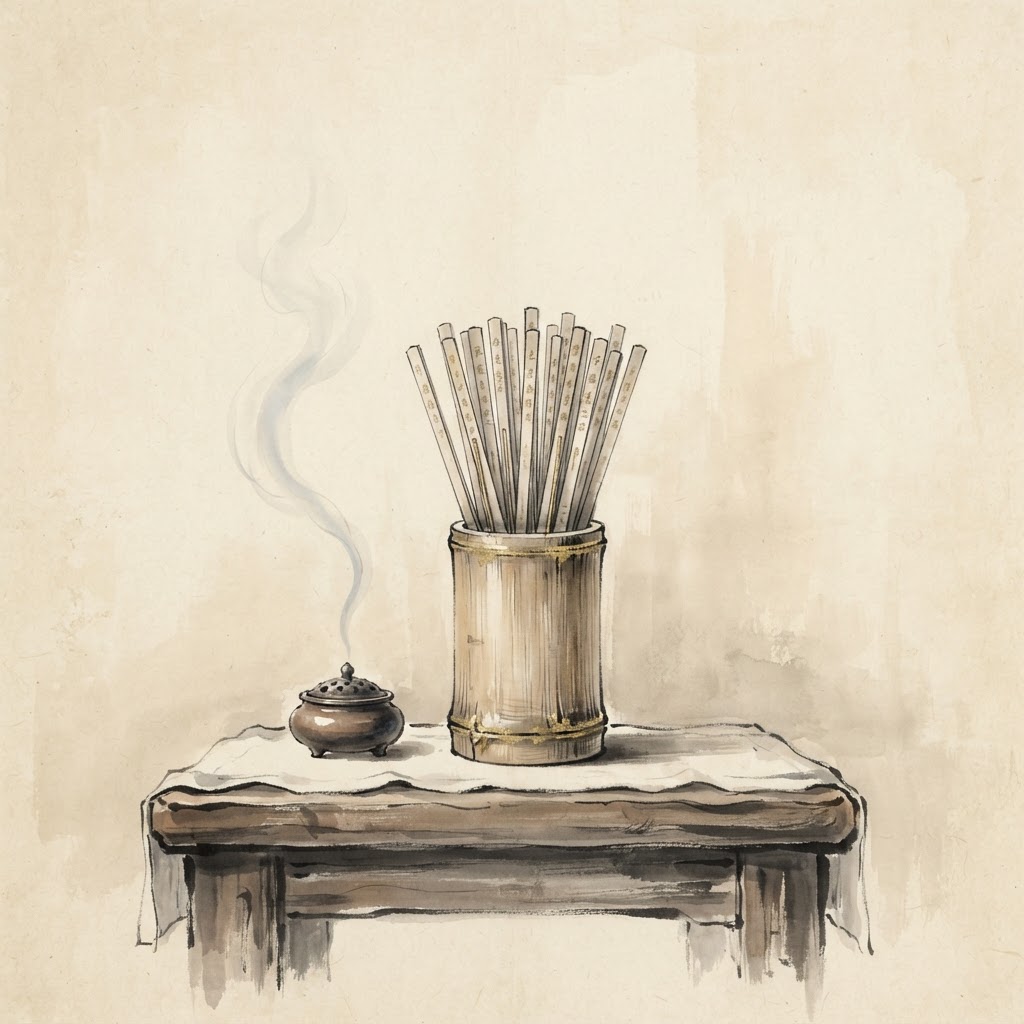
A reading of 100 Chinese fortune sticks is a traditional Taoist and Buddhist divination practice where a querent shakes a cylindrical wooden container filled with 100 numbered bamboo sticks until a single stick falls out. That stick’s number corresponds to a printed lot paper featuring a classical four-line poetic verse, a historical story, and practical guidance across major life domains like career, health, family, and finances. Confirmed using crescent-shaped wooden moon blocks, this 100-stick system provides structured clarity and risk assessment for personal and professional decisions.
In my 30 years of running corporate recruitment agencies, consulting for regional enterprises, and advising business owners across Singapore and Asia, I have evaluated thousands of high-stakes decisions. Whether an executive team is deciding whether to expand into a new overseas territory, hire a key C-suite executive, or restructure debt during a market downturn, decision-makers always struggle with uncertainty. Traditional management training teaches us to rely on spreadsheets, market research reports, and risk probability models. Yet every experienced business leader knows that logic alone has clear boundaries. You can analyze financial ratios until you are red in the face, but you still have to deal with timing, human motives, and hidden environmental forces that no spreadsheet can ever predict.
That realization led me deeper into Chinese metaphysics. After decades in corporate boardrooms, I dedicated myself to studying and teaching systems like Qi Men Dun Jia, BaZi, and traditional fortune stick readings as an educator and lineage founder in Singapore. What surprised many of my corporate peers was how practical these ancient tools are when approached with an analytical, disciplined mindset. Divination is not about superstitious guesswork, blind luck, or fatalistic paralysis. It is an objective situational audit, a psychological mirror, and a strategic decision-support framework designed to help you see past your own emotional biases and cognitive blind spots.
A fortune stick reading is not a weather forecast of your fate. It is a mirror, held up at the exact moment you asked.
In modern corporate governance, senior executives routinely face decision fatigue and information overload. When you are buried under hundreds of pages of market data, competing opinions from board members, and conflicting economic forecasts, adding more raw data rarely solves the problem. In fact, it often increases anxiety and leads to analysis paralysis. A fortune stick reading functions as a powerful mental reset. It strips away the surrounding noise, forces you to distill your situation down to a single core inquiry, and provides a structured lens through which to evaluate your choices.
When you stand before a 100-stick fortune set, you are engaging with a decision-making protocol refined over more than a thousand years. The 100 bamboo sticks represent a complete taxonomy of human experiences, ranging from seasonal hardship and intense market competition to sudden breakthroughs and peaceful consolidation. Each stick acts as a diagnostic key. When you shake the cylinder with a specific, well-framed question in mind, you are not asking a piece of bamboo to rule your life. You are using a time-tested symbolic framework to evaluate the underlying momentum of your situation so you can make smarter, more deliberate choices.
For a business owner or a working professional, the value of this practice lies in its ability to break mental gridlock. When you are torn between two competing strategies or feeling anxious about an unverified partnership, your brain tends to loop endlessly through the same arguments. A fortune stick reading interrupts that cognitive loop. By forcing you to articulate your question clearly, execute a physical selection protocol, and study a classical verse rooted in historical precedent, the system shifts your perspective from emotional panic to objective analysis.
This document forms Part 1 of my comprehensive master guide to reading 100 Chinese fortune sticks on dougleschan.com. In the sections below, I will break down the precise terminology across dialects, the physical components of the set, the mathematical logic behind the 100-stick numbering system, the vital historical connection to Guan Yin lots, and what a reading can and cannot do for you. My goal is to strip away the mystical fluff and provide you with actionable, real-world clarity that you can apply immediately, whether you are seeking guidance at a local temple or conducting a reading in your own home office.
The Names and Dialect Variations of Chinese Fortune Sticks
If you travel across East Asia or explore Chinatown communities in Western cities, you will quickly notice that people refer to fortune sticks by different names depending on their regional dialect and cultural background. Understanding these names reveals how the practice migrated across regions and adapted to different spiritual environments over the centuries.
Kau Cim in Cantonese
In Hong Kong, Guangdong province, and many overseas Cantonese communities, the practice is universally known as Kau Cim (求签, pronounced “kow tsim”). If you visit the famous Wong Tai Sin Temple in Hong Kong on a busy weekday morning, you will see hundreds of devotees kneeling on cushions, shaking bamboo cylinders filled with tall sticks. In Cantonese culture, Kau Cim is deeply woven into daily commercial and personal life. Business executives routinely consult the sticks before signing major real estate contracts, launching new commercial ventures, or resolving shareholder disputes, seeking a clear signal on whether the timing favors aggressive expansion or cautious defense.
In the vibrant Cantonese temple culture of Hong Kong, drawing the stick is only the first half of the process. After drawing a stick and obtaining the lot paper, querents typically take their paper to a row of small wooden stalls lining the temple courtyard, where professional temple interpreters analyze the verse in detail. These interpreters examine the subtle connections between the classical poem, the historical allegory, and the querent’s specific business or personal situation. This two-step process highlights an essential principle: the bamboo stick provides the raw diagnostic key, but thorough analysis is required to transform that key into actionable strategy.
Qiu Qian and Chien Tung in Mandarin
In Mandarin-speaking regions, including Mainland China, Taiwan, and international Chinese communities, the act of drawing a stick is called qiu qian (求签, Pinyin: qiú qiān). The word qiu means to seek, request, or ask, while qian refers to the bamboo lot or slip itself. When referring to the cylindrical shaker cup, Mandarin speakers call it chien tung or qian tong (签筒). The container holds the entire set of 100 sticks and serves as the mechanical instrument used to isolate a single answer through rhythmic physical shaking.
In Mandarin literature and historical records, the phrase qiu qian carries a sense of respectful petitioning. It implies that the individual is not demanding an outcome from the universe, but rather requesting guidance from higher cosmic principles or ancestral wisdom. The container itself, the chien tung, is viewed as a sacred balance chamber where human intent, kinetic energy, and cosmic probability intersect to produce a meaningful result.
Cim in Hokkien and Teochew Traditions
Across Singapore, Malaysia, Fujian province, and Taiwan, where Hokkien and Teochew dialects dominate, the practice is simply called drawing or shaking a cim (pronounced “tsim”). In Singapore, where my teaching academy is based, older merchants and family patriarchs often speak of going to the temple to “shake the cim.” At historic locations like Kwan Im Thong Hood Cho Temple on Waterloo Street, merchants have relied on cim readings for generations to navigate trade disruptions, resolve partnership disputes, and evaluate personal health challenges.
During the nineteenth and early twentieth centuries, Chinese immigrants traveling to Nanyang (Southeast Asia) carried their home temple traditions with them across the South China Sea. These early pioneers faced enormous physical hardships, unfamiliar tropical diseases, and volatile economic conditions. Shaking the cim at local community temples provided them with emotional grounding, moral boundaries, and practical guidance in a dangerous new world. To learn how these regional traditions took root across different dynasties and geographical migrations, you can read our detailed overview of the history of Chinese fortune sticks.
The Etymology of 求签 (Qiu Qian)
The classical Chinese characters 求签 explain the exact core function of the practice:
- 求 (Qiú): To request, seek after, petition, or inquire. It signifies an intentional act of asking a structured question rather than passively waiting for outcome events to unfold.
- 签 (Qiān): A bamboo slip, tally, or written lot. Historically, bamboo tallies were used in Chinese military administration and imperial bureaucracy to count troops, verify identity passes, record official decrees, and tally grain reserves.
When combined, qiu qian literally translates to “seeking a bamboo slip.” It represents a formal petition submitted by the querent to the unseen cosmic forces or temple deity, requesting a clear diagnostic slip that reflects the current reality of their inquiry. Just as an ancient military commander drew a bamboo tally from a canister to assign a specific battle station, a modern querent draws a qian to receive their strategic assignment for their current life challenge.
The Anatomy of a Physical 100-Stick Fortune Set
An authentic 100-stick Chinese fortune set is an engineered system of four distinct physical components. Each component plays a specific operational role in generating, isolating, recording, and verifying your reading. If any one of these four elements is missing or misused, the integrity of the reading drops significantly.
1. The 100 Numbered Bamboo Sticks (The Qian)
The heart of the set consists of exactly 100 long, slender bamboo sticks. Bamboo is selected because it is lightweight, remarkably durable, flexible under stress, and holds a neutral organic energy. In traditional craft workshops, artisans select mature Moso bamboo harvested in late autumn when moisture content is low, ensuring the wood will not warp over time. The bamboo stems are split into uniform strips, seasoned over dry heat, and polished smooth to prevent splintering during shaking.
Each stick is cut to a precise uniform length, typically between 20 and 25 centimeters. The top flat tip of each stick is beveled at a subtle angle and stamped or hand-painted with a unique Chinese numeral from 1 to 100 (一 to 百), often accompanied by standard Arabic numerals for modern clarity. In premium temple sets, the numbers are carved directly into the bamboo grain and filled with red or gold lacquer to ensure legibility after years of constant handling.
The mechanical design of the sticks is critical. The sticks must be perfectly uniform in weight and thickness so that no individual stick is heavier or wider than the others. When placed inside the cylinder, their smooth surface allows them to slide against each other cleanly. As you tilt the cylinder forward at a 45-degree angle and shake it in a steady rhythm, friction and momentum cause the sticks to rise unevenly until a single stick separates from the bundle, edges over the rim, and falls to the surface.
2. The Shaking Cylinder (Chien Tung)
The container that holds the 100 sticks is the chien tung (签筒). Traditionally, this cylinder is crafted from a single section of dense bamboo, aged hardwood like rosewood or mahogany, or cast brass. The dimensions of the cylinder are mathematically proportioned to the length of the sticks. The cylinder must be tall enough to conceal roughly two-thirds of the sticks’ length, preventing them from falling out prematurely, yet wide enough at the mouth to permit the sticks to expand outward when shaken.
In traditional Chinese workshops, master carpenters pay close attention to the interior contour of the cylinder. The bottom interior surface must be completely flat so that all 100 sticks stand at the exact same vertical baseline. If the interior bottom is rounded or uneven, certain sticks will settle deeper than others, creating a mechanical bias toward the elevated sticks.
In business terms, the chien tung acts as a mechanical randomizer and kinetic filter. By holding all 100 options in tight alignment, it prevents human hands from consciously selecting a preferred stick. The shaking motion transforms your intent and physical energy into kinetic friction, allowing probability and cosmic resonance to bring the correct stick to the top. A well-made cylinder produces a rhythmic, resonant clacking sound during shaking, which helps the querent enter a focused, meditative mental state.
3. The Printed Lot Papers and Verses (Qian Shi)
Once a stick falls from the cylinder, its number directs you to the corresponding lot slip, known in Chinese as the qian shi (签诗, literally “lot poem”). In traditional Chinese temples, these slips are stored in a tall wooden cabinet containing 100 small, numbered drawers. After verifying your stick number, you retrieve the paper slip from the corresponding drawer.
Each printed lot paper is divided into four structured analytical sections:
- The Lot Number and Grade: Displays the stick number (1 to 100) and its general category rating, such as Upper-Superior (上上), Superior (大吉), Middle (中平), or Lower (下下).
- The Four-Line Poem: A classical Chinese verse written in heptasyllabic (seven-character) or pentasyllabic (five-character) poetic meter. The poem uses metaphor, seasonal imagery, and natural symbolism to describe the core energetic momentum of your situation.
- The Historical Narrative (Gushi): A reference to an iconic historical event, classical myth, or literary tale from Chinese history, such as an episode from the Romance of the Three Kingdoms or the Water Margin. The strategic actions and mistakes of the historical characters in the story provide direct clues on how you should handle your current dilemma.
- Categorized Life Domains (Jie Yue): Specific bulleted interpretations detailing practical expectations across key areas, including business transactions, career advancement, personal health, legal disputes, lost property, marriage, and travel safety.
4. The Crescent Moon Blocks (Jiao Bei)
No 100-stick fortune reading is complete without the confirmation step using moon blocks, known as jiao bei (筊杯) or sheng bui in Hokkien. Moon blocks are two crescent-shaped pieces carved from wood, bamboo root, or dense stone. Each block is shaped with one flat side representing the Yang (active/masculine) principle, and one curved, rounded side representing the Yin (receptive/feminine) principle.
Artisans prefer carving moon blocks from aged bamboo roots because the natural fibrous density of the root provides excellent weight and rebound characteristics when dropped on temple floors. The blocks are shaped to mirror the dual crescent phases of the moon, symbolizing the continuous dynamic flux between light and shadow, expansion and contraction.
After a stick falls from the shaking cylinder, you do not immediately run to pick up the lot paper. First, you hold the two moon blocks together in your palms, restate your question and the stick number, and drop the blocks onto the floor from waist height. The physical resting position of the two blocks gives you an immediate three-way signal from the universe or deity regarding whether that stick is truly meant for you. To master the exact throwing technique and understand how to interpret conflicting drops, explore our guide on using moon blocks in fortune stick readings.
The moon blocks produce three primary combinations when dropped:
- Sheng Jiao (Divine Answer / Confirmed): One flat side faces up (Yang) and one curved side faces up (Yin). This represents perfect harmony between Yin and Yang, confirming that the stick drawn is accurate and valid.
- Xiao Jiao (Laughing Answer / Unclear): Both flat sides face up (Yang / Yang). This indicates that the deity or cosmic energy is amused, the question is ill-framed, or the querent already knows the answer and is asking out of doubt. You must re-frame your question or re-shake the cylinder.
- Yin Jiao or Nu Jiao (Angry Answer / Rejected): Both curved sides face up (Yin / Yin). This indicates a clear “no” or disagreement. The stick drawn is incorrect, or the timing is not right to ask this question. You must return the stick to the cylinder and start over.
The table below summarizes the four physical components of a complete 100-stick set, detailing their material properties, structural purpose, and the operational errors I most frequently observe among beginners.
| Component | Traditional Terms | Physical Material & Construction | Functional Role in the Reading | Common Operational Pitfalls |
|---|---|---|---|---|
| 100 Bamboo Sticks | Qian (签) / Cim Stick | Aged Moso bamboo, 20-25cm length, uniform weight, smooth polish, numbered 1 to 100 at the tip. | Isolates a single numerical key representing one of 100 specific life scenarios through kinetic movement. | Using warped or sticky sticks that bind together; grabbing a stick manually instead of letting it drop naturally. |
| Shaking Cylinder | Chien Tung (签筒) / Qian Tong | Hollowed bamboo section, hardwood, or cast brass, proportioned to two-thirds stick height. | Serves as a mechanical randomizer and kinetic filter, holding the sticks in vertical alignment while shaking. | Tilting at an incorrect angle (too steep causes a spill; too flat prevents sticks from rising). |
| Printed Lot Papers | Qian Shi (签诗) / Lot Slips | Paper slips stored in 100 small drawers containing classical poems, stories, and domain advice. | Provides the written diagnostic output, historical narrative, and practical category guidance for your question. | Reading only the summary grade while ignoring the historical context and poetic nuance. |
| Crescent Moon Blocks | Jiao Bei (筊杯) / Sheng Bui | Paired crescent blocks carved from wood or bamboo root, featuring one flat (Yang) and one rounded (Yin) side. | Validates whether the drawn stick is confirmed by divine or cosmic energy before retrieving the lot slip. | Skipping the block confirmation entirely or re-throwing endlessly until forced into a positive drop. |
How the 100-Stick Numbering System Works
When newcomers look at a set of 100 Chinese fortune sticks, they often assume the numbers from 1 to 100 function like a simple ranking system where Stick 1 is the best possible outcome and Stick 100 is total disaster. That is a fundamental misunderstanding. In Chinese metaphysics, numbers represent energetic signatures and historical cycles, not crude ordinal ranks.
Why 100 Sticks? Numerical Philosophy and Completeness
The number 100 holds immense symbolic and practical weight in traditional Chinese cosmology. The term Bai Shi (百事) translates to “one hundred affairs,” representing the full spectrum of human experiences, obstacles, and achievements. While certain specialized temples use smaller sets of 24, 28, or 60 sticks based on lunar cycles or the sexagenary calendar, the 100-stick set became the dominant standard across East Asia because it offers the necessary granularity for complex real-world questions.
In business, if your diagnostic framework only has three categories (good, neutral, bad), your advice will be far too broad to be useful. A 100-option framework allows the system to distinguish between a situation where you should forge ahead aggressively, a situation where you should wait for a better partner, a situation where an internal betrayal is looming, and a situation where immediate retreat is necessary to preserve capital.
The 100-stick system creates a complete matrix of human scenarios. Within these 100 possibilities, you find situations representing early preparation, rapid growth, peak achievement, arrogance before a fall, defensive consolidation, deceptive calm, and victorious recovery. No matter how complex your current career, financial, or personal dilemma might feel, it fits somewhere within this 100-part continuum.
The Six Traditional Lot Grades
While each of the 100 sticks features a unique poem and historical narrative, every stick is categorized under one of six traditional grades. These grades indicate the overall energetic momentum and tactical direction of your inquiry:
- Upper-Superior (上上 – Shang Shang): The highest possible alignment. Represents perfect timing, strong internal harmony, and powerful external support. Indicates a green light for major initiatives, strategic expansion, and bold commitments.
- Superior (大吉 / 上吉 – Shang Ji): Highly favorable momentum. Opportunities are clear and tangible, though success still requires disciplined action and clear communication.
- Superior-Middle (中吉 – Zhong Ji): Solid, healthy progress. Outcomes are favorable, provided you maintain steady effort and avoid reckless speculation or arrogance.
- Middle (中平 – Zhong Ping): Neutral status quo. Energy is balanced or dormant. Indicates a period of waiting, consolidation, and routine maintenance rather than aggressive expansion.
- Middle-Lower (中下 – Zhong Xia): Minor obstacles and friction. Suggests internal misalignment, delayed results, or small financial drains. Requires risk management and careful contract review.
- Lower (下下 – Xia Xia): Severe warning energy. Represents active conflict, hidden traps, severe market headwinds, or high risk of loss. Calls for immediate defensive action, risk mitigation, and self-reflection.
To learn how to evaluate these six categories when managing personal career moves or corporate deals, read our detailed analysis of the six fortune stick lot categories.
Debunking Common Numbering Myths
One of the biggest mistakes I see people make is panicking when they draw a Middle or Lower lot, or becoming overly reckless when they draw an Upper-Superior lot. In my corporate career, some of the most dangerous business failures occurred right after a company had a record-breaking quarter, simply because leadership became complacent and ignored operational risks. Conversely, some of our greatest strategic turnarounds came right after a painful setback forced us to audit our operations, cut unproductive overhead, and refocus on core strengths.
The exact same principle applies to fortune stick numbers:
- An Upper-Superior Lot is not a magic pass: Drawing Lot 1 or Lot 28 indicates great potential, but if you sit on your hands and execute poorly, that potential evaporates. The poem provides the exact conditions required to capitalize on the favorable trend.
- A Lower Lot is a protective audit, not a curse: Drawing a Lower lot like Lot 100 does not mean you are doomed. It means your current plan has critical flaws, your timing is wrong, or the people involved are untrustworthy. It gives you the advance warning needed to fix the problem before real damage occurs.
- Middle Lots are often the most valuable: A Middle lot forces you to slow down, refine your strategy, and build internal strength. In business, periods of consolidation are what allow a company to survive long-term market volatility.
Furthermore, stick numbers are not arranged in chronological order. Stick 1 is not followed by a slightly worse Stick 2. Each number is an independent entry point into a historical archive. For example, Stick 100 in many classic Guan Yin sets features a story of long-term endurance leading to ultimate recognition, rather than total ruin. When reading your lot paper, you must analyze the specific poetic imagery and historical narrative rather than relying solely on the headline grade. For practical techniques on deciphering poetic metaphors, consult our guide on interpreting fortune stick poems and verses.
The Guan Yin 100 Lots Tradition and Its Role in Fortune Sticks
When people refer to reading a 100-stick Chinese fortune set, nine times out of ten they are utilizing the historical system known as the Guan Yin 100 Lots (观音一百签). Understanding why Guan Yin lots became the universal standard across Chinese temples worldwide gives deep insight into how the readings should be interpreted.
Who Is Guan Yin and Why Her 100 Lots Dominate
Guan Yin (观音菩萨, Pinyin: Guānyīn Púsa), short for Guanshiyin, is the Bodhisattva of Compassion in Mahayana Buddhism, widely venerated across East and Southeast Asia. The name Guanshiyin translates to “Observing the Cries of the World.” In Chinese folk religion and Taoist temple traditions, Guan Yin is revered not as a distant, punitive deity, but as a merciful protector who responds to human suffering with practical wisdom and spiritual comfort.
Over the centuries, temple scholars, monk poets, and spiritual masters compiled a standardized set of 100 lot poems attributed to Guan Yin’s compassionate guidance. This 100-lot system gained immense popularity during the Song and Ming dynasties because its verses struck a perfect balance between deep spiritual ethics and practical, real-world advice. To explore the full historical archive and line-by-line structure of the complete set, visit our master guide on Guan Yin lots.
What makes the Guan Yin 100 Lots system so enduring is its psychological accessibility. Whether an illiterate farmer in the sixteenth century or a modern tech executive in Singapore visited a Guan Yin temple, the lot poems spoke directly to their lived experience. The verses avoid dense philosophical jargon, using clear metaphors of farming, navigation, court politics, family relationships, and seasonal changes to deliver profound strategic guidance.
How Guan Yin Lots Blend Compassion with Practical Strategy
Unlike colder divination systems that simply deliver a binary “yes” or “no,” Guan Yin lots are designed to educate and refine the querent’s character. The tone of a Guan Yin lot poem is consistently compassionate, ethical, and deeply realistic. Even when a reading delivers a stern warning through a Lower lot, the underlying message is always protective, urging you to practice patience, cultivate integrity, and avoid self-destructive behavior.
In Mahayana Buddhist philosophy, this pedagogical approach is known as Upaya (skillful means). Instead of lecturing devotees on abstract metaphysical doctrines, Guan Yin lots use relatable human stories, historical precedents, and vivid poetic imagery to guide the mind toward righteous conduct, strategic patience, and self-awareness.
Every Guan Yin lot poem incorporates three distinct layers of wisdom:
- Buddhist Moral Rectitude: Emphasizes karma, cause and effect, restraint, and selfless intention. It warns against greed, deception, and rash aggression, reminding you that corrupt methods will destroy long-term wealth.
- Confucian Practical Ethics: Focuses on filial piety, loyalty, duty, proper conduct, and maintaining social harmony in business partnerships and family relationships.
- Taoist Natural Timing: Uses vivid natural metaphors (snow melting in spring, dragons rising from the deep, ships navigating stormy seas) to explain the natural rhythms of timing, momentum, and non-action (Wu Wei).
Examining Specific Guan Yin Lot Examples
To see how this works in practice, consider Guan Yin Lot 1, one of the most famous Upper-Superior lots in the entire 100-stick set. Associated with the historical legend of Emperor Yu taming the Great Floods, Lot 1 opens with imagery of the sun rising over the heavens, symbolizing magnificent new beginnings, supreme leadership, and breakthrough progress. Yet, the accompanying commentary explicitly notes that great position requires absolute humility and untiring effort. If a corporate executive draws Lot 1 while considering a major corporate merger, it confirms that the strategic opportunity is massive, but success will demand relentless leadership and flawless operational execution.
Consider another classic example from the Guan Yin set: Lot 50. This lot often centers on the historical story of Su Wu tending sheep in the desolate northern wilderness for nineteen years while remaining loyal to his homeland. The poem speaks of bitter winter cold, isolation, and unyielding patience before the spring thaw arrives. If an entrepreneur who is struggling through cash-flow problems draws Lot 50, the lesson is clear: this is not the time to surrender or panic, nor is it the time to launch aggressive new campaigns. It is a time for disciplined endurance, protecting your core assets, and waiting out the winter until the economic environment turns in your favor.
A third example is Lot 80, which references the battle of Chibi (Red Cliffs) from the Three Kingdoms era. The verse depicts a sudden wind shifting direction, turning a desperate defense into a decisive victory. For a business leader facing intense market competition, Lot 80 advises staying vigilant and keeping reserves ready, because a sudden shift in regulatory policy, consumer sentiment, or competitor missteps will create an unexpected opening that changes the entire competitive landscape overnight.
What a Fortune Stick Reading Is (and What It Is Not)
In my 30-plus years of corporate leadership and metaphysics education, the single biggest problem I encounter is misplaced expectations. People frequently approach fortune sticks with wild misconceptions, treating the bamboo cylinder either as a magical crystal ball that predicts fixed fate, or as an entertaining parlor game. Both approaches are completely wrong.
A Strategic Situational Audit, Not Fatalistic Prophecy
A 100 fortune stick reading is best understood as an energetic situational audit. In business, when a board of directors hires an independent auditing firm to review company accounts, the auditor does not dictate the future of the company. The auditor evaluates current balance sheets, identifies operational vulnerabilities, highlights hidden liabilities, and presents an objective report so the board can make informed strategic adjustments.
A fortune stick reading operates in the exact same manner:
- It reflects present momentum: The stick you draw captures the current energetic alignment of your question, showing where your current trajectory is leading if no changes are made.
- It exposes hidden blind spots: The historical narrative and poetic verse reveal underlying factors you may have overlooked, such as an untrustworthy business partner, misaligned market timing, or emotional overconfidence.
- It provides risk mitigation boundaries: If you draw a Lower lot, the reading acts as a strategic red flag, urging you to pause, renegotiate terms, delay launch dates, or restructure your approach before committing fresh capital.
- It encourages internal clarity: The process of framing a precise question and waiting for confirmation forces you to slow down, eliminate emotional noise, and connect with your true strategic intent.
The Limits of Fortune Sticks in Business and Life
To maintain a healthy, effective practice, you must be clear on what fortune sticks cannot do for you. Fortune sticks will not provide winning lottery numbers, predict precise stock price movements to the exact penny, or force another person to fall in love with you. They cannot replace personal effort, sound financial management, legal due diligence, or professional medical care.
If you ask a vague, lazy question like “Will I be successful next year?”, you will receive a vague, unhelpful reading. But if you ask a structured, actionable question like “What risks should I prepare for if I launch this new product line in the third quarter?”, the 100-stick system will provide extraordinary clarity. To master the exact step-by-step protocol for preparing your mind, asking effective questions, and executing post-reading decisions, review our guide on how to read Chinese fortune sticks step by step.
How Fortune Sticks Compare to Other Chinese Divination Systems
In my decades of analyzing corporate strategies and Chinese metaphysics, I view fortune sticks as a swift, situational diagnostic tool rather than a comprehensive strategic blueprint. Compared to high-level energetic mapping systems like Qi Men Dun Jia (QMDJ), which maps multidimensional battlefield dynamics, directional strategy, and precise timing windows, or BaZi, which analyzes your lifetime astrological birth chart and decades-long luck cycles, a 100 fortune stick reading provides an immediate thematic snapshot for a specific question at a specific moment. Where I Ching uses hexagram lines to track cosmic shifts and Tarot relies heavily on subjective visual symbolism, fortune sticks combine physical randomized selection, divine block confirmation, and structured classical poetry to deliver accessible, grounded guidance. If you need a comprehensive comparison of costs, complexity, and best use cases across systems, see our guide on fortune sticks versus other Chinese divination methods.
History and Living Tradition of Chinese Fortune Sticks
The history of Chinese fortune sticks, traditionally known as Kau Cim (求签) in Cantonese or Qiu Qian in Mandarin, spans over a thousand years, evolving from Tang dynasty monastic lot-drawing into a standardized 100-lot oracle system during the Song and Ming dynasties. Today, it stands as a vibrant living tradition across Singapore, Hong Kong, Taiwan, and Malaysia, bridging ancient folk cosmology with practical modern decision-making. Over my 30-plus years in business running recruitment firms, managing corporate operations, and advising business owners, I’ve observed that modern executives face the exact same fundamental anxieties that ancient merchants faced along trade routes: timing, counterparty risk, market volatility, and hidden operational obstacles.
When you study how temple priests, scholars, and ordinary devotees shaped this tradition across different Chinese dynasties, you stop viewing fortune sticks as mere folk superstition. Instead, you see a battle-tested, highly structured decision-support system designed to help people navigate unpredictable environments. In my metaphysics teaching here in Singapore, I always remind my students that ancient oracle systems survived precisely because they delivered practical clarity to real people making high-stakes choices under conditions of uncertainty.
In my corporate consulting work, business leaders frequently ask me how fortune sticks compare to advanced systems like Qi Men Dun Jia or BaZi chart reading. While BaZi reveals your overall life blueprint and Qi Men Dun Jia maps out strategic energy grids for timing major moves, fortune sticks provide an immediate, accessible situational snapshot. It acts like a quick diagnostic health check when you need fast, actionable perspective on a specific crossroads.
This section explores the complete historical trajectory of Chinese fortune sticks, from early bamboo strips in Tang dynasty shrines to the emergence of the 100-lot standard, the primary role of the Guan Yin tradition, its migration across Southeast Asia, and how it continues to function as an active decision tool in modern Asian commercial hubs.
Early Origins: From Tang Bamboo Strips to Song Temple Oracles
To understand the true roots of Chinese fortune sticks, we must carefully separate documented historical evidence from popular temple folklore. Pious legends frequently attribute the creation of divine lots to famous historical icons like the Three Kingdoms strategist Zhuge Liang or the deified general Guan Yu. While these colorful stories enrich temple culture, actual textual research reveals a more gradual, practical historical development. The practice of drawing numbered lots at shrines emerged during the late Tang dynasty (618–907 CE) and achieved full organizational structure during the Song dynasty (960–1279 CE).
From Elite Shell Pyromancy to Accessible Bamboo Strips
Before bamboo fortune sticks gained widespread adoption, Chinese divination relied on methods that demanded elite literacy, high financial cost, and lengthy ritual preparation. Shang dynasty rulers burned tortoise shells and cattle scapulae to read heat cracks. Zhou dynasty court scholars manipulated fifty yarrow stalks through complex mathematical steps to construct I Ching hexagrams. These ancient techniques were time-consuming, expensive, and largely restricted to royal courts or scholar-bureaucrats.
By the 9th and 10th centuries, rapid urban expansion and growing commercial market towns created a new social reality. Common merchants, coastal traders, artisans, and traveling families needed a fast, affordable, and accessible method to consult divine guidance before undertaking long journeys, signing trade contracts, or treating family illnesses. Bamboo provided the ideal physical medium. Bamboo grew abundantly across southern Chinese provinces, offered remarkable physical durability under repeated handling, and was simple to carve with numbers or distinct notch symbols.
Early Monastic Regulations and Textual Evidence
Historical records from late Tang and early Song Taoist canons (Daozang) and Buddhist monastic guidelines (Qinggui) document early forms of lot drawing referred to as Ling Qian (灵签) or Qian Bu (签卜). Early monastic compounds utilized wooden or bamboo tallies to distribute daily chores or assign meditation rotations. Over time, temple guardians realized that these numbered tallies could also be used to deliver spiritual advice to lay pilgrims seeking guidance on personal affairs.
Unlike pyromancy or complex astrological calculations, bamboo lot drawing required no special mathematical training from the pilgrim. The seeker simply focused on a personal question, drew a numbered stick from a vessel, and presented it to a literate monk or temple attendant who referenced a master index. This radical democratization of divination allowed ordinary citizens to receive direct advice without paying exorbitant fees to elite court diviners.
The Development of Divination Poetry (Qian Shi)
During the early Tang dynasty, temple lot drawing involved simple bamboo or wooden strips marked with basic fortune labels like “Great Fortune” or “Severe Caution.” However, as literacy expanded during the Song dynasty, temple keepers, Taoist priests, and Buddhist monks began pairing each numbered stick with a written poem, known as Qian Shi (签诗).
These four-line or eight-line classical verses drew heavily from traditional poetry formats (such as five-character or seven-character quatrains), historical episodes, classical theater stories, and local folklore. Instead of returning a simplistic binary answer, the poem provided a rich narrative context. A merchant inquiring about a new trade partnership might draw a stick tied to a famous historical retreat, signaling that immediate aggressive expansion would lead to heavy financial loss. This transition from basic fortune tags to narrative poetry transformed fortune sticks into a sophisticated analytical tool that forced the seeker to reflect on strategy, timing, and personal conduct.
The Formation of the Standard 100-Lot System
As fortune stick divination spread through Buddhist and Taoist temples across China, different shrines experimented with various stick counts. Some temples utilized 24 sticks, others used 36 or 60 sticks based on the sexagenary calendar cycle (the Ganzhi system), and some expanded to 120 or 240 sticks. Over time, however, the 100-lot format emerged as the undisputed standard for major deity shrines across East Asia.
Why the Number 100 Prevailed in Temple Culture
In Chinese numerology and cultural philosophy, the number 100 represents full completion, a complete cycle, and cosmic perfection, encapsulated in the classical phrase Bai Shi Da Ji (百事大吉). A set of 100 lots provided sufficient statistical breadth to cover the full spectrum of human experience without overwhelming temple devotees or interpreters with excessive complexity.
The number 100 also mirrors the cosmological framework of Wan Wu (万物), the “ten thousand things” in Taoist philosophy, representing all manifest phenomena in the universe. By dividing human experience into 100 distinct narrative scenarios, the system creates a balanced matrix where favorable, neutral, and challenging outcomes are distributed in realistic proportions.
Woodblock Printing and Regional Standardization
During the Ming dynasty (1368–1644 CE) and Qing dynasty (1644–1912 CE), woodblock printing technology revolutionized temple operations. Instead of relying on hand-copied scrolls that varied from village to village, commercial printing houses in major urban centers like Suzhou, Nanjing, Fuzhou, and Guangzhou produced standardized printed lot papers.
These mass-printed sheets made it possible for small rural shrines to adopt the exact same 100-lot poem text used by major urban pilgrimage temples. As a result, a merchant traveling from Fujian to Jiangxi could consult fortune sticks at any regional temple along his route and encounter familiar poem structures, historical allegories, and interpretation guidelines.
Anatomy of a Traditional Printed Lot Slip
To appreciate how comprehensive a traditional fortune stick reading was, consider the structured layout of a Ming or Qing era woodblock-printed lot sheet (Qian Zhi). A standard printed slip was divided into distinct functional zones:
- Header and Number: Displayed the stick number prominently in classical Chinese numerals alongside the deity’s title.
- Fortune Category Stamp: Stamped with the grade tier, such as Upper Superior, Middle, or Lower Lot.
- Historical Title (Gushi): Featured a short four-word to eight-word title summarizing a well-known historical or mythological story.
- Classical Verse (Qian Shi): The core four-line poem containing metaphorical imagery, seasonal references, and moral guidance.
- General Meaning Summary (Jie Yue): A concise prose explanation summarizing the primary theme of the poem.
- Thematic Domain Guidance (Sheng Yi / Xiang Zhu): Specific bulleted predictions for nine distinct life domains: Seeking Wealth, Business/Trade, Career/Exams, Marriage/Romance, Health/Sickness, Legal Disputes, Travel/Migration, Missing Property, and Family/Ancestral Blessings.
Historical Evolution of Chinese Fortune Stick Practices
To help you see how the tradition transformed across major historical periods, I’ve compiled this comparison table showing how divination formats, text mediums, and cultural contexts evolved over time.
| Historical Era | Divination Format | Text & Medium | Primary Deities & Context |
|---|---|---|---|
| Tang Dynasty (618–907 CE) | Numbered bamboo or wooden strips drawn individually from bamboo vessels. | Simple numerical markers and basic luck tags (e.g., Lucky, Unlucky). | Local Taoist shrines, mountain hermits, early Buddhist monastic compounds. |
| Song Dynasty (960–1279 CE) | Cylindrical bamboo containers shaken rhythmically until one stick falls out. | Four-line classical poetic quatrains (Qian Shi) carved on wooden printing blocks. | Urban Taoist and Buddhist temples serving market merchants and scholars. |
| Ming Dynasty (1368–1644 CE) | Standardized 100-lot and 60-lot sets confirmed using crescent moon blocks. | Mass-printed lot papers containing historical allegories and thematic advice. | Guan Yu (Guan Di), Guan Yin, and Mazu shrines across coastal trading ports. |
| Qing Dynasty (1644–1912 CE) | Widespread regional standardization; scholar commentary added to verses. | Bound lot books (Qian Pu) offering detailed breakdowns for specific life queries. | City God temples, guild halls, ancestral shrines, and regional pilgrimage sites. |
| Modern Era (1912–Present) | Physical temple shaking alongside printed lot papers, digital tools, and mobile apps. | Multilingual lot slips (Chinese, English, and local Southeast Asian languages). | Global diaspora temples, urban shrines in Singapore, Hong Kong, and Taiwan. |
The Guan Yin Fortune Stick Tradition
Among all deity-specific divination sets in Chinese history, none commands greater spiritual reverence or wider geographical distribution than the Guan Yin 100-lot system. Guan Yin (观音菩萨), known in Mahayana Buddhism as the Bodhisattva of Compassion, holds a unique position in Chinese folk religion. Revered as the listener of the world’s cries, she is approached not with formal court fear, but with deep personal sincerity and emotional trust.

If you want to study the core mechanics of this lineage in depth, you can explore the complete Guan Yin 100-lot system guide on my website, where I walk through the full structural breakdown. What makes the Guan Yin lots so durable is their balanced integration of Buddhist compassionate ethics, Taoist natural harmony, and Confucian practical duty.
Structure and Tone of Guan Yin Poems
Unlike some martial deity lots that deliver stern reprimands or harsh warnings, Guan Yin lot poems speak with the voice of an experienced, compassionate mentor. Even when a lot indicates temporary failure, heavy opposition, or bad timing, the underlying narrative emphasizes patience, inner reflection, ethical restraint, and strategic preparation.
Every Guan Yin lot poem links directly to a specific historical event or legendary scene. For instance, a verse might reference Duke Wen of Jin enduring long years of exile before regaining his kingdom, or Zhao Yun courageously protecting his young lord at the Battle of Changban. When you draw that stick, the divine response isn’t offering magical quick fixes. It’s asking you to align your strategy with the core lessons of that historical narrative: maintaining loyalty under pressure, exercising tactical patience, or knowing when to pull back from a failing venture.
In Guan Yin practice, the oracle never forces fatalistic despair. It operates on the core metaphysical principle that while external timing (Heaven Timing / Tian Shi) presents specific environmental forces, human action (Human Effort / Ren Shi) remains the decisive variable in determining ultimate success or failure.
Three Famous Guan Yin Lot Allegories Examined
To understand how Guan Yin lot poems translate ancient narrative into practical strategy, let’s examine three famous historical allegories commonly encountered in the 100-lot set:
1. Su Wu Tending Sheep in the North (苏武牧羊): This story recounts the Han dynasty envoy Su Wu, who was captured by the Xiongnu and exiled to the freezing desolate northern lakes to herd rams. He refused to renounce his loyalty, enduring nineteen years of extreme hardship before returning home with honor. When a business client draws a stick tied to Su Wu during an economic downturn, the message is clear: You are facing a severe winter season. This is not the time for reckless expansion or risky pivot maneuvers. Focus on cash flow preservation, maintain core integrity, and endure until environmental conditions shift.
2. Jiang Ziya Fishing at Mount Wei (姜太公钓鱼): Jiang Ziya spent decades studying military strategy and cosmology while living in poverty, fishing with a straight hook by the river bank. He waited patiently until King Wen of Zhou recognized his genius when Jiang Ziya was eighty years old, leading to the establishment of the Zhou dynasty. If you draw this allegory when asking about career promotion or venture funding, the lot advises that your current preparation is necessary, but your true window of opportunity lies ahead. Do not force an premature launch before key stakeholders are aligned.
3. Han Xin’s Strategic Victory at River Wei (韩信破楚): Han Xin, the brilliant general of the early Han dynasty, used clever water management and psychological warfare to defeat a far larger enemy force at the River Wei. Drawing this lot during a commercial contract dispute or competitive market campaign indicates that brute force will fail, but innovative strategy, tactical agility, and unexpected market positioning will yield a decisive victory.
The Six Category Tiers in the Guan Yin Tradition
The 100 Guan Yin lots are organized into six distinct fortune categories. These tiers indicate the current energetic momentum surrounding your question and help you gauge the level of risk involved:
- Upper Superior Lot (上上签): The top tier, representing optimal timing, powerful environmental support, and smooth execution. You can read my detailed Upper Superior Lot guide to learn how to capitalize on peak momentum without succumbing to complacency.
- Superior Lot (大吉 / 上吉签): Highly favorable energy, signaling steady progress, solid returns on effort, and strong alignment.
- Superior Middle Lot (中上签): Positive growth potential, though ultimate success depends directly on your proactive work and clear focus.
- Middle Lot (中平签): Neutral equilibrium. Explore my Middle Lot analysis to understand why this tier is perfect for operational consolidation and internal auditing.
- Middle Lower Lot (中下签): Minor friction, administrative delays, hidden overheads, or counterparty resistance requiring caution.
- Lower Lot (下下签): High downside risk, heavy conflict, structural flaws, or severe obstruction. Review my Lower Lot breakdown to see how severe warnings can protect your business assets and personal well-being.
Migration and Adaptation: Spread to Hong Kong, Taiwan, and Southeast Asia
During the 19th and early 20th centuries, millions of Chinese emigrants departed Fujian and Guangdong provinces to settle across the South China Sea. They carried their spiritual devotions, temple customs, and fortune stick sets with them. Wherever Chinese merchant networks established roots, fortune sticks travelled alongside trade goods, adapting to new economic and social environments.
Hong Kong: Urban Integration and Professionalization
In Hong Kong, fortune stick divination became deeply woven into the fabric of daily commercial life. Major temples like Wong Tai Sin (黃大仙祠), Man Mo Temple in Sheung Wan, and Kwun Yam Temple in Hunghom became world-famous hubs for Kau Cim. In Wong Tai Sin Temple’s spacious courtyards, hundreds of devotees kneel daily, shaking bamboo containers amidst dense clouds of fragrant incense smoke.
Under British colonial administration, Hong Kong developed a formal licensing system for temple fortune-telling stalls. Below the main shrine terraces at Wong Tai Sin, multi-story arcades house dozens of licensed consulting booths. Business founders, real estate investors, corporate managers, and parents seeking advice on international university admissions sit down with professional interpreters who translate archaic classical verses into actionable modern advice.
Taiwan: Scholar Annotations and Folk Devotion
In Taiwan, fortune stick traditions integrated seamlessly with folk agriculture, maritime culture, and regional temple networks. Famous shrines such as Dalongdong Baoan Temple and Mengjia Longshan Temple in Taipei, along with historic Mazu temples in Dajia, Beigang, and Tainan, maintain pristine sets of woodblock-printed lot slips.
Taiwanese scholars made outstanding contributions to documenting and annotating lot poetry. During the mid-20th century, Taiwanese compilers published exhaustive reference books (*Qian Pu*) that provided multi-layered commentaries. These guides mapped traditional agricultural metaphors (such as spring planting, autumn harvests, and river crossings) directly onto modern corporate challenges, including stock market investments, manufacturing supply chains, and technology patent filings.
Southeast Asia: The Nanyang Tradition
Across Southeast Asia, historically known as Nanyang (南洋), Chinese migrants built temples that served as community centers, trade guild halls (*Kongsi*), and spiritual anchors. In Malaysia, Penang’s Kek Lok Si Temple, Kuala Lumpur’s Thean Hou Temple, and historic Hokkien shrines in Malacca draw huge crowds seeking fortune stick guidance during Lunar New Year and major deity feast days.
In historic clan halls and regional temples, trade guild leaders frequently consulted fortune sticks before resolving commercial disputes between member merchants or approving long-distance shipping ventures. To make these texts accessible to multicultural younger generations, Southeast Asian temples began printing multilingual lot papers featuring parallel translations in English, Malay, and Thai. To explore the broader historical timeline across these regions, you can read my complete history of Chinese fortune sticks.
Living Tradition in Singapore and Malaysia Temples Today
Living and working in Singapore, I see the fortune stick tradition operating as a live, daily practice. This isn’t a historical artifact confined to textbook displays or rural villages. Right in Singapore’s financial district and cultural precincts, historic temples stay filled with active working professionals, business founders, and families.
The Daily Rhythm at Waterloo Street
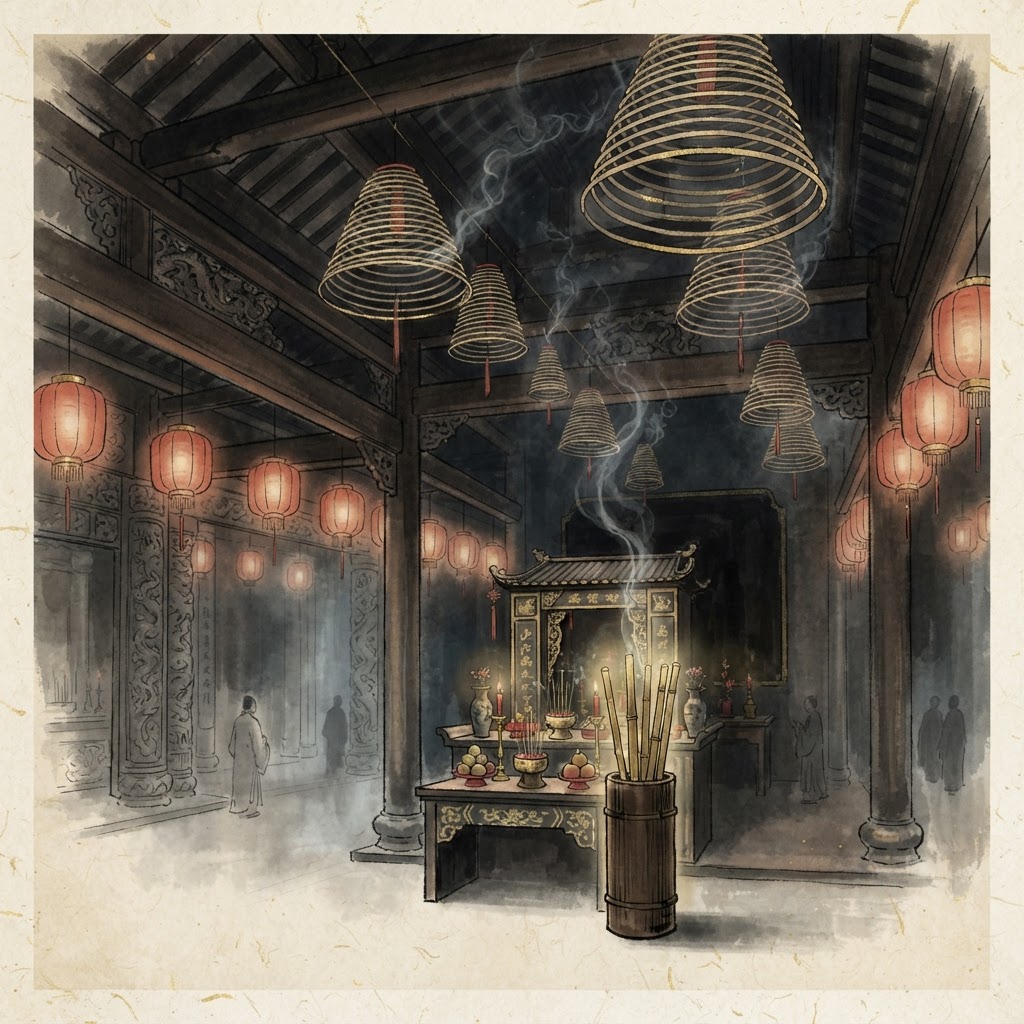
Consider Kwan Im Thong Hood Cho Temple on Waterloo Street as a prime example. On any weekday during lunch hour, you’ll see corporate executives in business attire kneeling alongside shopkeepers, tech founders, blue-collar workers, and university students. They pick up a polished bamboo cylinder holding 100 numbered sticks, raise it with both hands to chest level, and initiate the steady shaking motion.
Major deity celebrations, such as Guan Yin’s Birthday (observed on the 19th day of the 2nd, 6th, and 9th lunar months), see tens of thousands of devotees queuing around the temple block. People consult fortune sticks for major life milestones: career pivots, corporate rebranding, home purchases, marriage decisions, and health recoveries.
Physics and Intentionality of Shaking the Bamboo Cylinder
The physical act of shaking a *Chien Tung* (bamboo container) involves a specific balance of mechanics and focus. A standard cylinder holds 100 flat bamboo sticks, each approximately thirty centimeters long. The sticks are tightly packed, requiring a steady, rhythmic vertical motion tilted slightly forward at a fifteen-degree angle.
If you shake too violently or carelessly out of impatience, multiple sticks will spill out simultaneously onto the floor, invalidating the attempt and requiring you to re-bundle the sticks and restart. If you shake too weakly, no stick will rise. Proper shaking demands physical composure, steady breathing, and total mental focus on your question. That physical rhythm acts as a natural meditative filter, calming erratic emotions before the lot is drawn.
The Essential Verification: Moon Blocks (Jiao Bei)
Dropping a stick does not complete the consultation in Singapore and Malaysia temple protocol. You cannot simply grab the fallen stick and retrieve your printed slip. You must confirm whether the deity validates that specific stick for your question using Jiao Bei (筊杯), known in English as moon blocks.
You pick up two crescent-shaped wooden blocks, hold them between your cupped palms, state the stick number silently, and gently drop them onto the floor. Moon blocks can land in three distinct physical combinations:
- Sheng Jiao (圣筊 – Sacred Combination): One flat side up, one curved side up. This indicates divine approval and confirms that the stick number is accurate for your question.
- Xiao Jiao (笑筊 – Laughing Combination): Both flat sides facing up. This indicates divine amusement, an unclear question, or that you already know the answer in your heart. You must put the stick back and re-shake.
- Yin Jiao (阴筊 – Angry Combination): Both curved sides facing up. This signals divine disagreement, bad timing, or an inappropriate question. You must return the stick and re-shake.
In traditional Singapore temple practice, especially for high-stakes business or personal matters, some devotees request three consecutive *Sheng Jiao* throws to confirm absolute clarity before proceeding to collect their printed lot paper.
Overview of the Six Lot Categories: A Business & Life Taster
When seekers retrieve their printed lot paper, their eyes immediately jump to the fortune category stamped across the top. For a complete analysis of all tiers and their practical applications, check out my detailed guide to the six fortune stick lot categories. Here is how I explain these six tiers from an analytical and strategic business perspective:
It is worth noting how category frequencies are distributed across the standard 100 Guan Yin lots. The extreme tiers (Upper Superior and Lower Lots) represent a minority of the set, while the middle tiers (Superior, Superior Middle, and Middle Lots) make up the vast majority. This mathematical distribution reflects real life: extreme boom times and total catastrophes are rare, while periods of steady work, manageable growth, and neutral consolidation represent the normal state of affairs.
1. Upper Superior Lot (上上签)
This represents the highest possible tier. It signifies that market conditions, internal capability, counterparty alignment, and timing are operating in total harmony. In business, this is your signal for aggressive project expansion, major product launches, or bold capital commitments. However, I always warn my executive clients: an Upper Superior lot promises favorable conditions, not immunity from poor execution. If you drop your operational standards, you can still lose a winning position.
2. Superior Lot (大吉 / 上吉签)
A highly favorable lot that indicates steady, reliable progress and strong returns on investment. Unlike the sudden, powerful surge of an Upper Superior lot, a Superior lot represents manageable, sustainable growth. It’s the ideal result when evaluating long-term business partnerships, talent recruitment, or steady corporate expansion.
3. Superior Middle Lot (中上签)
This tier indicates solid upside potential, but ultimate success depends heavily on your personal effort and operational discipline. The environmental tailwinds are positive, but you must steer the ship actively. When clients draw a Superior Middle lot, I advise them to refine their execution plans, maintain tight quality control, and press forward with confidence.
4. Middle Lot (中平签)
Many people feel disappointed when they draw a Middle lot because it sounds average. That stems from a fundamental misunderstanding. In Chinese metaphysics, “Middle” signifies balance, neutrality, and equilibrium. It tells you that external forces are neither pushing you forward nor blocking your path. Success depends entirely on your internal competence, operational efficiency, and cost control. It is the best lot for internal restructuring, process auditing, and consolidating existing gains.
5. Middle Lower Lot (中下签)
This category flags friction, hidden administrative costs, miscommunication, or unfavorable timing. It is not a signal to abandon your goals entirely, but it is an urgent instruction to slow down. When I see a Middle Lower lot in a commercial query, I advise the business owner to re-examine contract fine print, conduct deeper background checks on partners, and defer unnecessary capital expenditure.
6. Lower Lot (下下签)
The lowest tier serves as a clear warning flare. It highlights high collision risk, structural flaws, legal vulnerabilities, or adverse market conditions. The most effective response to a Lower Lot is a disciplined defensive strategy. You pause ongoing negotiations, reduce cash burn, protect core assets, and wait for energetic conditions to stabilize. In my years of advisory work, a Lower Lot has saved far more capital than it ever lost by forcing decision-makers to halt risky ventures before damage occurred.
From Temple Scrolls to Printed Lot Books to Online Simulators
The physical medium of fortune sticks has evolved through three distinct technological eras over the past five centuries. Examining this progression helps us understand how modern digital tools change the delivery format while testing the traditional spirit of the practice.
Phase 1: Carved Wooden Blocks and Hand-Copied Rolls
During the Ming and Qing dynasties, temples guarded their master lot texts with care. Scholar-monks transcribed verses onto paper rolls, or skilled artisans carved master printing blocks out of durable pear wood. When a devotee drew a stick number, the temple clerk referenced the master block and hand-stamped or transcribed the corresponding verse onto a strip of paper using red or black ink.
Phase 2: Mass-Printed Slips and Commercial Lot Books
With the arrival of commercial offset printing in 20th-century Shanghai, Hong Kong, and Guangzhou, temples began stocking pre-printed lot slips in organized wooden cabinets. Simultaneously, publishers produced commercial Qian Pu (签谱), comprehensive reference manuals that compiled all 100 poems alongside historical commentary, astrological markers, and specific guidance for everyday life challenges.
Phase 3: Digital Simulators and Mobile Apps
In the digital age, dozens of websites and mobile applications offer virtual fortune stick generators. You tap a screen, an animated bamboo cup shakes on your display, a virtual stick appears, and an automated algorithm outputs the poem along with computerized translations.
An Honest Evaluation of Digital Fortune Stick Simulators
As a metaphysics educator who incorporates digital tools into teaching, I hold a very realistic view of online fortune stick simulators. Digital platforms offer undeniable convenience and rapid reference value. If you’re traveling, conducting research at your desk, or looking up historical verses for study, an online simulator provides instant access to the traditional text.
However, digital simulators lack three essential components that define traditional temple consultations:
First, they eliminate physical kinetic friction. In a temple setting, your physical posture, breathing, and hands interact directly with the weight and motion of the bamboo cylinder. That physical engagement creates a deliberate pause that stills your mind and focuses your intention.
Second, digital simulators rarely enforce the strict moon block verification protocol. Without physical moon block verification, users frequently click “redraw” several times until they receive a favorable lot, completely undermining the integrity of the consultation.
Third, digital software relies on pseudo-random number generators. While mathematically random, software code cannot replicate the intentional focus that occurs when a person standing before a shrine frames a single, deeply meaningful query.
Furthermore, automated digital translation tools often mangle the delicate metaphors embedded in classical Chinese poetry. An automated translation software might translate a reference to “burning bridges at River Wei” as a literal hazard warning, missing the deeper historical context of bold military strategy. For serious inquiries, consulting traditional printed texts or working with an experienced interpreter remains vastly superior to automated digital outputs.
Why the Tradition Survives: Psychology, Strategy, and Metaphysical Logic
Why does an ancient oracle system based on bamboo sticks, wooden blocks, and Song-era poetry continue to thrive in a modern landscape dominated by artificial intelligence, real-time data analytics, and corporate forecasting models? Why do pragmatic business owners in Singapore, Hong Kong, and London still consult fortune sticks before committing to major life moves?
The sticks outlived every dynasty and every technology wave for one simple reason: the question never changes. What should I do next?
The answer lies in three key psychological and strategic benefits that modern analytical tools often fail to provide:
1. Forcing Mental Clarity Through Structured Query Framing
Before you can shake a bamboo container effectively, you must distill your concern into a single, focused question. You cannot approach the cylinder with a chaotic, unfocused mind. The physical ritual forces you to identify your primary uncertainty: Is it partner trustworthiness? Is it market timing? Is it operational capacity? That process of mental distillation provides immediate clarity before you even draw a stick.
2. Historical Narrative Alignment and Perspective
Human beings make sense of complex reality through stories, not isolated statistics. By connecting your personal dilemma to a classical historical episode, a lot poem lifts you out of immediate emotional panic and places your problem within a timeless human framework. If your lot references a historical siege, it reminds you that tactical endurance and asset preservation matter far more right now than impulsive action.
3. A Built-In Circuit-Breaker Against Confirmation Bias
In business and personal governance, confirmation bias is a major danger. When we want an investment or relationship to succeed, we naturally overlook glaring red flags. When a fortune stick consult yields a Lower Lot or Middle Lower Lot, verified by moon blocks, it operates as an objective circuit-breaker. It demands that you pause, re-read the contract, re-evaluate assumptions, and protect yourself against unexamined risks.
Frequently Asked Questions About Fortune Stick History and Tradition
Did Chinese fortune sticks originate in Taoism or Buddhism?
The tradition represents a historical fusion of Taoist natural philosophy, Buddhist ethics, and local folk worship. Early lot-drawing techniques developed parallel in Taoist mountain shrines and Buddhist monasteries during the Tang and Song dynasties. Today, major divination sets like the Guan Yin 100-lot system seamlessly incorporate Buddhist compassion, Taoist cyclical cosmology, and Confucian moral ethics side by side.
Why are Guan Yin fortune sticks more widely used than other deity sets?
Guan Yin is worshipped across nearly all Chinese cultural communities as the Bodhisattva of Compassion. Her lot poems are known for their empathetic tone, practical wisdom, and focus on self-cultivation rather than severe condemnation, making her 100-lot set the most popular and widely translated divination text across East and Southeast Asia.
Is drawing fortune sticks considered religious worship or fortune-telling?
It functions as both, depending on the seeker’s mindset. For devout temple visitors, it is a sacred dialogue with a divine presence. For practical business owners, educators, and metaphysics students, it serves as an intuitive decision-support tool that uses symbolic narrative poetry to evaluate timing, strategic alignment, and operational risk.
How were lot poems preserved before modern commercial printing?
Prior to mass offset printing, temples preserved master texts using hand-copied scrolls or carved pear-wood printing blocks. When a devotee drew a stick number, temple clerks referenced the master blocks and hand-stamped or transcribed the verse onto paper strips using red or black ink.
Can you perform a valid fortune stick reading at home without visiting a temple?
Yes, provided you maintain proper ritual discipline and respect. If you have a physical bamboo set and a pair of wooden moon blocks, set up a clean space, frame your question with total clarity, and adhere strictly to the moon block verification rules, a home consultation carries the exact same structural validity as a temple reading.
Why do some temples use 60 sticks while others use 100 sticks?
The 60-stick sets are structured around the traditional 60-year Ganzhi sexagenary calendar cycle, commonly found in Mazu and Guan Di shrines. The 100-stick sets reflect numerological completeness and provide a broader spectrum of historical allegories, making them the standard format for Guan Yin temples worldwide.
What should you do if moon blocks reject your stick number repeatedly?
If moon blocks return laughing or angry combinations three consecutive times, stop shaking. This signals that your question is either too vague, framed with hidden dishonesty, or that you are asking about something you already have the power to decide yourself. Re-frame your question clearly, calm your mind, and try again later.
How do traditional fortune stick poems compare to modern business scenario planning?
Both methods aim to reduce strategic blind spots. While modern scenario planning uses financial models and risk matrices, fortune stick poetry uses historical patterns and archetype allegories to highlight human dynamics, timing cycles, and ethical risks that quantitative models often miss.
The Complete Reading Method: Step-by-Step Protocol for Chinese Fortune Sticks
Reading Chinese fortune sticks, known traditionally as Kau Cim, requires a disciplined protocol to receive clear guidance. The complete reading method involves twelve distinct steps: calming your mind, formulating a precise question, offering incense, holding and shaking the bamboo cylinder correctly, confirming the fallen stick with wooden moon blocks, collecting the verse paper, and analyzing the classical poem before reading domain details. Whether performed in a temple or at a home altar, adhering to this ritual sequence prevents noisy readings, respects ancient traditions, and yields practical insights for business and personal decisions.
| Phase | What You Do | What It Decides |
|---|---|---|
| Before | Calibrate your state, frame one specific question | whether the reading can be usable at all |
| Ritual | Greet, shake the cup, confirm with moon blocks | which stick, and whether it is yours to take |
| Reading | Study the poem, match it to your question | what the verse actually says for your case |
| After | Thank, write it down, act on it | whether the reading changes anything real |
settle the mind
one clear question
incense and respect
the cup chooses
moon blocks agree
poem then meaning
the follow-through
In my thirty years of running companies, recruiting executives, and advising business owners across Asia, I have consistently seen that high-stakes decision-making relies on process discipline. When executives make impulsive choices based on chaotic emotions or incomplete data, the results are almost always disastrous. The exact same principle applies to Chinese metaphysics. Divination is not a game of chance. It is a structured consultation with a spiritual authority. If you approach the bamboo cylinder with a scattered mind or an ambiguous request, you will receive an ambiguous answer that leaves you more confused.
To master this practice, you must learn the complete standard operating procedure. Below is the master sequence of the ritual, followed by an in-depth breakdown of every single stage.
Master Summary of the Twelve-Step Reading Protocol
- Internal Preparation and Mindset Calibration: Settle your mind, wash your hands, establish respectful posture, and ensure you are emotionally grounded.
- Question Formulation: Frame a clear, single-topic, time-bound question focused on your own actions or decisions.
- Temple Greeting and Incense Offering: Light three sticks of incense, bow thrice, and state your name, birth details, residence, and intention to the deity.
- Holding and Shaking the Bamboo Cylinder: Hold the cup with both hands at a forty-five-degree angle and shake rhythmically until a single stick jumps out.
- The Moon Block Confirmation (Jiao Bei): Cast the wooden crescent blocks to verify if the fallen stick carries the deity’s confirmed message.
- Applying Redraw and Rejection Rules: If the blocks give a laughing or angry response, return the stick, reset your mind, and re-shake up to three total attempts.
- Retrieving the Stick Number and Verse Slip: Note the stick number, return the bamboo stick to the container immediately, and collect the matching paper slip from the temple cabinet.
- Sequential Verse Analysis: Read the historical story title first, then the classical four-line poem, then the lot category, and finally the specific domain details.
- Post-Reading Gratitude and Action Planning: Thank the deity at the altar, make a respectful donation, and translate the classical poem into a concrete real-world plan.
- Observing Temple Etiquette: Move quietly through sacred spaces, respect fellow devotees, and follow traditional customs regarding paper slip preservation or burning.
- Adapting Protocol for At-Home Practice: Set up a clean, consecrated space at home with proper incense and maintain the exact same ritual discipline as a temple visit.
- Reviewing Edge Cases and Common Questions: Address dropped sticks, multiple jumping sticks, third-party inquiries, and handling lower lots constructively.
Step 1: Internal Preparation and Mindset Calibration
Before touching the bamboo cylinder, your internal state must be calm, focused, and respectful. In Chinese metaphysics, this is referred to as cultivating Cheng, or absolute sincerity. Sincerity is the state of being fully present and honest about your intentions.
Start with physical cleanliness. Wash your hands before approaching the altar. Carrying dirt to an altar shows a lack of respect. Your attire should be modest and tidy. Entering a temple in gym clothes or flip-flops signals that you treat the space casually.
Mental preparation is critical. If your pulse is racing from an argument, sit down on a temple bench for ten minutes first. Take deep breaths into your abdomen and clear mental chatter. Drawing a fortune stick while filled with anxiety or anger projects erratic energy into the cylinder, causing sticks to jam or spill.
When You Must NOT Draw Fortune Sticks
Over decades of advising clients, I have established strict rules on when to refrain from drawing sticks:
- Under the Influence of Alcohol or Drugs: Intoxication destroys the subtle alignment required for divination. Never draw sticks after drinking alcohol.
- During Extreme Emotional Turmoil: If you are grieving intensely, raging with anger, or experiencing severe panic, your mind cannot form an objective question or accept an honest answer.
- To Test or Challenge the Deity: Approaching the altar with a cynical mindset to test if the deity is real is a waste of time. The moon blocks will consistently give angry or laughing responses to mock queries.
- For Trivial, Frivolous, or Gambling Topics: Asking which horse will win a race or whether a coworker likes your haircut dishonors the practice. Fortune sticks guide significant life decisions, career moves, and health strategies. Treating them like a game reflects poorly on your judgment.
Step 2: Crafting and Formulating the Specific Question
The main reason people receive confusing answers from fortune sticks is asking vague or poorly constructed questions. If you ask a bad question, even a superior lot poem will sound like nonsense.
A well-formed question must follow three fundamental principles:
Bring a vague question and the best stick in the cup can only give you a vague answer.
First, focus on a single issue. Do not combine multiple decisions into one query. Asking whether to resign, move to a new city, and get married bundles three separate trajectories together. A bamboo stick cannot split its message across unrelated topics.
Second, include a realistic timeframe. Asking if you will ever be wealthy is far too broad. A better structure is: What is the financial outlook for my logistics company over the next twelve months if I expand into the regional market?
Third, center the question on your own actions, not on prying into other people. You can ask how to navigate a difficult business partnership, but do not ask for private personal details about your partner.
For a detailed breakdown of question formulas and business examples, consult my guide on how to ask fortune sticks questions.
Comparing Weak vs. Strong Question Formats
| Weak Question (Avoid) | Why It Fails | Strong Question (Recommended) |
|---|---|---|
| Will I get rich this year? | Vague, passive, lacks specific operational context. | What is the commercial potential of launching my new product line in Q3? |
| Should I break up with my partner or stay? | Compound binary choice that demands the deity make your personal decision. | What energy and outcome can I expect if I commit to resolving our current relationship conflicts over the next six months? |
| Is my manager a dishonest person? | Prying into another individual’s character rather than focusing on your career path. | How should I manage my professional boundary with my supervisor to protect my career growth this year? |
Step 3: Temple Greeting, Incense Protocol, and Offering Respects
Entering a traditional temple dedicated to Guan Yin or Lord Guan means stepping into a formal court setting. Traditional Chinese temples are structured like imperial administrative halls where the deity holds spiritual jurisdiction. Courtly manners apply.
Enter through side doors rather than the middle entrance, which is reserved for deities. Step over the raised wooden threshold on the floor; never step directly on top of it, as doing so is considered disrespectful.
Prepare three sticks of incense representing Heaven, Earth, and Humanity. Light the tips using temple candles. If the incense catches fire, do not blow out flames with your breath, as human breath is considered impure in ritual spaces. Wave your hand gently to extinguish flames so only glowing embers remain.
Hold the incense with both hands, elevating burning tips to eyebrow level. Stand before the central altar, bow three times, and introduce yourself silently. State your full name, date of birth, home address, and the specific reason for your visit. Establishing your identity grounds your inquiry in physical reality.
Place the three incense sticks upright into the main incense burner. Ensure they stand straight rather than tilting. Then proceed to the altar table where fortune stick cylinders and wooden moon blocks are kept.
Step 4: Holding, Angling, and Shaking the Bamboo Cup
Shaking the bamboo cylinder, known as Qiu Qian or Kau Cim, requires proper ergonomics. The hollowed bamboo tube contains exactly one hundred numbered sticks marked from 1 to 100 on their upper tips.
Pick up the cylinder with both hands. Right hand grips the middle section while left hand supports the base for control. Kneel on the prayer cushion before the altar, or sit on a low stool if health prevents kneeling.
Incline the cylinder forward at thirty-five to forty-five degrees. Holding it vertical causes sticks to bounce at the bottom without emerging, while tilting too low causes multiple sticks to spill out at once.
Begin a rhythmic upward and downward shaking motion originating from forearms and wrists. As sticks slide against each other, maintain mental focus on your question, repeating it silently with each movement.
Understanding the “Jumping Stick” Dynamics
Smooth rhythmic motion causes one stick to rise higher than the rest, extending above the cylinder lip. Continue gentle micro-movements without pulling the stick with your fingers. Allow momentum and gravity to tip the stick over onto the cushion.
If multiple sticks jump out simultaneously, the draw is invalid. Return all fallen sticks to the cylinder, mix them thoroughly, refocus your mind, and resume shaking.
If a stick flies far off the mat or the cylinder slips, stop immediately. It signals agitated focus or overly violent movement. Compose yourself before trying again.
Step 5: The Moon Block Confirmation Protocol (Jiao Bei)
Dropping a bamboo stick from the cylinder is only half of the selection process. A common mistake among beginners is picking up the fallen stick, reading the number, and immediately running to get the verse paper. That is completely incorrect. The physical fall of a stick can sometimes be caused by mechanical friction or accidental tipping rather than genuine spiritual alignment.
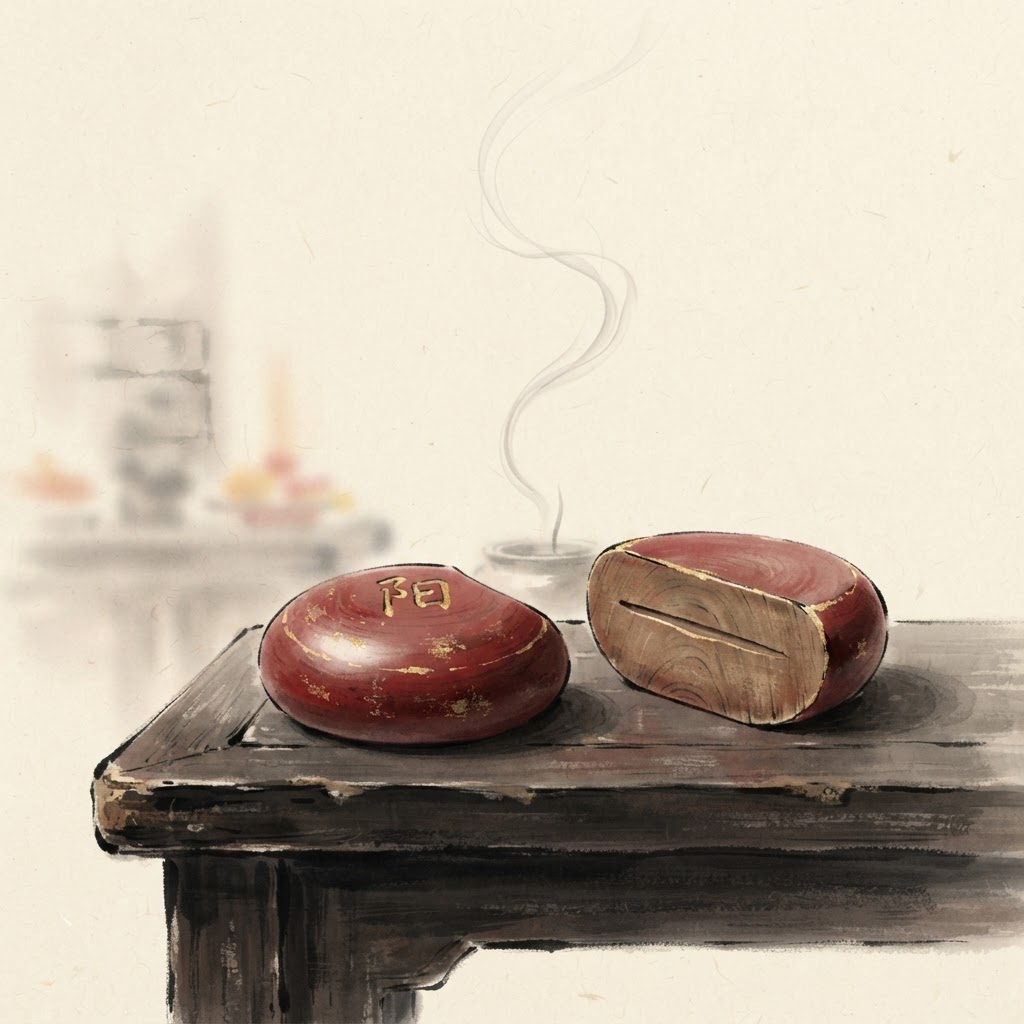
To confirm whether the fallen stick represents the true, deliberate message from the deity, you must perform the moon block confirmation protocol, known as casting Jiao Bei or Sheng Bei.
Moon blocks are a pair of red-painted wooden or bamboo blocks carved in the shape of crescents or mango halves. Each block has one flat surface, representing Yang, and one rounded, curved surface, representing Yin. To master the subtle nuances of these confirmation tools, read the dedicated analysis on moon blocks in fortune sticks.
Pick up the pair of moon blocks from the altar table. Hold them together between your palms at chest height. State the number of the fallen stick silently to the deity: “Respected deity, I have drawn stick number thirty-six for my question regarding my career transition. Is stick number thirty-six your true and confirmed answer for me?”
Drop the moon blocks gently from waist height onto the floor or carpet before the altar. Allow them to bounce and settle naturally. Do not throw them aggressively like dice. Observe how the two blocks land on the floor.
The Three Moon Block Outcomes Explained Plainly
When the blocks settle on the floor, they will display one of three distinct physical configurations:
1. Sacred Lot (Sheng Bei / Divine Confirmation): One block lands flat-side up (Yang), and the other block lands rounded-side up (Yin). This balance of Yin and Yang indicates absolute confirmation. The deity has validated that the drawn stick number is indeed your correct message. You may now pick up your stick and proceed to collect the verse paper.
2. Laughing Lot (Xiao Bei / Amusement or Uncertainty): Both blocks land flat-side up (Yang-Yang). This outcome means the deity is amused, the question is ill-formed, the answer is already self-evident in your own mind, or you are asking something trivial. The stick is rejected. You cannot use this stick number.
3. Angry Lot (Yin Bei / Nu Bei / Divine Rejection): Both blocks land rounded-side up (Yin-Yin). This configuration represents strict denial or disagreement. The deity indicates that the stick is wrong, the timing of your inquiry is inappropriate, or the path you are asking about is firmly closed. The stick is rejected.
Summary Table of Moon Block Outcomes
| Outcome Name | Physical Position | Spiritual Meaning | Required Action |
|---|---|---|---|
| Sheng Bei (Sacred Lot) | One Flat (Yang) + One Curved (Yin) | Divine confirmation and approval. The stick is correct. | Note the stick number and collect your verse paper. |
| Xiao Bei (Laughing Lot) | Two Flats Up (Yang-Yang) | Amusement, ambiguity, or obvious answer already known. | Return stick to cup, re-frame question, and re-shake. |
| Yin Bei (Angry Lot) | Two Curves Up (Yin-Yin) | Strict rejection, wrong timing, or improper request. | Return stick to cup, clear mind, and make second attempt. |
Yes. Take the stick, read the verse.
Not yet. Restate, re-shake, try again.
No. Stop drawing for the day.
Step 6: Redraw Rules, Rejection Limits, and Knowing When to Stop
If your moon block toss yields Xiao Bei (Laughing) or Yin Bei (Angry), the bamboo stick lying on the floor is null and void. You must not look up the verse for that number. Doing so will only provide misleading information that does not apply to your situation.
Here is the exact redraw procedure when a stick is rejected by the blocks:
Pick up the rejected bamboo stick and return it to the bamboo cylinder. Do not leave rejected sticks sitting on the floor or on the altar table. Mix the sticks gently inside the cylinder so the rejected stick returns to the general pool.
Pause for fifteen to thirty seconds. Re-evaluate your question in your mind. If you received a Laughing Lot, your question was likely too broad or contained a false premise. Re-phrase it to be more direct. If you received an Angry Lot, take a deep breath and ask yourself if you are demanding an answer to something you are not ready to face.
Kneel down again, incline the cylinder, and shake until a new stick emerges. Perform the moon block toss for this second stick. If it yields Sheng Bei, you have your confirmed reading.
The Strict Three-Tries Rule
In traditional Chinese divination, there is a hard rule regarding repeated attempts: You are allowed a maximum of three stick draws for a single question in one session.
If you draw a stick and the moon blocks reject it, that is attempt number one. If you draw a second stick and the blocks reject it again, that is attempt number two. If you draw a third stick and the moon blocks reject it a third time, yielding either Laughing or Angry outcomes, your session for that question is officially terminated.
Do not continue shaking the cup for a fourth or fifth time hoping for a lucky break. In business terms, when a board of directors rejects a proposal three times in a row, you do not keep re-submitting the same document every five minutes; you withdraw, re-analyze your strategy, and return another day. When the moon blocks reject your draw three times, the spiritual message is crystal clear: either the timing is completely wrong to ask this question, the cosmic conditions are still shifting, or you already possess all the information necessary to make your own decision without divine intervention.
Pack up the cylinder, thank the deity, bow respectfully, and leave the altar. Wait at least three to seven days before attempting to ask about that specific topic again.
Step 7: Retrieving the Stick Number and Collecting the Verse Slip
When the moon blocks grant you a confirmed Sheng Bei, your selection process is successfully complete. Look closely at the top of the fallen bamboo stick. You will see a number carved or painted on the wood, written in both Chinese numerals, such as 第一签 for Lot 1, and standard Arabic numerals.
Commit that number to memory or write it down immediately in your mobile phone or notebook. Once you have noted the number, return the bamboo stick to the cylinder. Never carry the bamboo stick away from the altar or take it home with you. The bamboo sticks are the permanent property of the temple, and removing one breaks the complete set of one hundred for future devotees.
Walk over to the temple’s lot paper distribution cabinet. This is usually a large wooden or metal cabinet containing one hundred small drawers or cubbies numbered sequentially from 1 to 100. Locate the drawer that matches your confirmed stick number.
Open the drawer and retrieve a single printed paper slip. In traditional temples, these slips are printed on thin red, yellow, or white paper containing classical Chinese poetry, historical commentary, and category classifications. Make sure you pull only one sheet. If two sheets are stuck together, leave the second sheet neatly inside the drawer.
Step 8: The Proper Reading Order and Structural Analysis of the Verse
Most people pick up a fortune stick paper slip, glance at the top corner to see if it says Upper-Superior or Lower, and immediately panic or celebrate. That is an amateur approach. The top classification label is merely a broad energy summary; it is not the actual advice.
In my metaphysics practice, I teach students to analyze the lot slip in a disciplined, four-stage reading order. To master verse structure and hidden metaphors, study my guide on interpreting fortune stick poems.
Stage 1: The Historical Allusion (Gushi)
At the top of almost every traditional 100-lot paper slip, you will find the title of a classic Chinese historical story or legendary reference. Examples include “Jiang Ziya Awaits the King,” “Liu Bei Visits Zhuge Liang Three Times,” or “Chao Tian Palace Celebrates Success.”
This historical allusion provides the overall macro context of your reading. It describes the archetypal scenario you are currently operating in. For instance, if your business question yields a poem tied to Jiang Ziya waiting by the river until age eighty before being hired as prime minister, the core message is strategic patience and timing. You have high potential, but the market or the decision-maker is not ready yet. Pushing hard right now will fail, but preparing your skills in secret will lead to massive success later.
Stage 2: The Classical Four-Line Poem (Qian Shi)
Directly below the historical title is the main poem, typically composed of four lines with five or seven Chinese characters per line. This poem is the heart of the divination. It uses rich natural and seasonal imagery, such as dragons rising from water, withered trees blooming in spring, ships navigating stormy seas, or travellers finding shelter in mountain huts.
Read the poem carefully. Translate the ancient metaphors into your modern operational reality:
- Water and Rivers: Represent cash flow, communication channels, liquidity, or physical travel.
- Mountains and Rocks: Represent solid foundation, heavy obstacles, stubborn opposition, or fixed assets.
- Spring and Summer: Indicate periods of growth, expansion, public launches, and high visibility.
- Autumn and Winter: Indicate periods of consolidation, cutting costs, internal auditing, and defensive holding positions.
- Noble Persons (Gui Ren): Represent helpful mentors, key investors, supportive bosses, or reliable strategic partners entering your life.
Stage 3: The Overall Lot Category
Only after reading the story and the poem should you evaluate the lot category rating. Traditional 100-stick systems, such as the famous Guan Yin lot tradition, divide the slips into six main categories:
- Upper-Superior (Shang Shang / 上上): Exceptional luck, maximum alignment, full green light for expansion.
- Superior (Shang Ji / 上吉): Very favorable, smooth progress, strong positive momentum with minor effort required.
- Superior-Middle (Zhong Shang / 中上): Moderate success, solid steady gains, good for long-term incremental building.
- Middle (Zhong Ping / 中平): Neutral or balanced energy. Stability without dramatic growth. Excellent for maintaining current operations.
- Middle-Lower (Zhong Xia / 中下): Chilly or challenging energy. Delays, friction, administrative headaches, and unexpected expenses. Proceed with caution.
- Lower (Xia Xia / 下下): Warning of danger, loss, conflict, or severe setbacks. Green light is off. Time to defend, audit, and pause risky ventures. For deep analysis on how lots are grouped across traditions, refer to the master fortune sticks guide.
Stage 4: The Domain Breakdown Table
At the bottom or side of the lot slip, you will see a series of small sub-headings breaking down specific life domains. These typically cover:
- Career and Business: Outlook for ventures, employment, and investments.
- Wealth and Money: Income potential, debt recovery, and financial transactions.
- Health and Illness: Physical vitality, medical prognosis, and recovery timelines.
- Marriage and Relationships: Partnership stability, romantic prospects, and domestic harmony.
- Travel and Moving: Safety during relocations, overseas expansion, or travel.
- Legal Matters and Disputes: Court cases, contractual disagreements, and regulatory audits.
Always cross-reference the main poem with your specific domain. If you asked about a business merger, read the Career line carefully. If the poem is generally positive but the Career line explicitly says “Exercise extreme caution in legal contracts,” the deity is telling you that while the business concept is sound, the legal documentation contains hidden traps.
Step 9: Post-Reading Protocol: Gratitude, Action Planning, and Follow-Through
Once you have collected your verse paper and completed your preliminary reading, your work at the altar is not quite finished. Divination is a reciprocal relationship built on respect and follow-through.
Return to the main altar where you offered incense earlier. Stand or kneel, place your hands together in a respectful gesture, and offer silent thanks and express deep gratitude to the deity for granting you wisdom and clear guidance today. If you received a challenging Lower Lot, do not express anger or frustration. A Lower Lot is a merciful early warning system; it alerts you to hidden risks so you can avoid costly mistakes. Thanking the deity for a warning is just as important as thanking them for a fortune prediction.
| Date | Question Asked | Lot No. & Category | First Reaction | Action Taken | Outcome Later |
|---|---|---|---|---|---|
| (fill in) | as close to your exact words as possible | e.g. 14, Middle | honest, not flattering | the concrete next step | noted months later, unedited |
Place a modest cash donation into the temple’s donation box. Traditional temples rely on donations from devotees to maintain the physical premises, purchase incense, print verse papers, and support community charitable works. Generosity seals your karmic transaction with clean energy.
Handling Your Printed Verse Paper
What should you physically do with the paper slip after leaving the temple? Traditional customs offer two main approaches depending on the lot category you drew:
If you drew an Upper-Superior, Superior, or Superior-Middle lot, keep the paper slip. Fold it neatly and place it inside your wallet, business card holder, or personal journal. Keep it as a positive anchor and a reminder of the strategic direction you must execute over the coming months.
If you drew a Lower or Middle-Lower lot, traditional etiquette suggests leaving the negative energy behind at the temple. Many traditional temples provide a dedicated furnace or incense burner specifically for burning low-tier lot papers. You respectfully burn the paper slip in the temple burner, allowing the smoke to dissipate the stagnant energy, while retaining the mental warning in your mind so you can adjust your real-world strategy.
Translating Metaphysics into Business Execution
The biggest flaw in how modern people approach fortune sticks is treating the reading as a passive destiny that will magically happen without effort. If you draw an Upper-Superior lot predicting business expansion, but you sit on your sofa for six months playing video games and sending zero proposals, your business will still collapse.
A fortune stick verse provides the weather report, not the automatic outcome. If the weather report says brilliant sunshine, you still have to go outside and plant the crops. If the weather report says typhoon warning, you must fortify your warehouse doors and clear your drainage ditches. Take the guidance from Step 8, map it directly into your quarterly action plan, and execute with disciplined daily effort.
Step 10: Temple Etiquette and Respecting Public Sacred Spaces
Visiting a traditional temple to draw fortune sticks requires awareness of public sacred space etiquette. Temples are active spiritual centers where people are praying, meditating, and seeking solace during difficult life moments. If you are deciding between visiting a traditional temple or setting up your own space, explore my comparison of fortune sticks at home vs at the temple.
Keep these essential temple rules in mind during your visit:
- Maintain Low Volume: Speak in quiet, muted tones. Turn your mobile phone to silent mode before entering the temple gates. Never answer phone calls or conduct business meetings while standing in front of the main altar.
- Respect Photography Restrictions: Many traditional temples prohibit photography or filming of the main deity statues and private prayer rituals. Always look for posted signs or ask temple staff before taking photos. Never take selfie photos while holding the bamboo cylinder at the altar.
- Do Not Monopolize the Altar Cushion: During busy days, long queues form at the fortune stick stations. Perform your shaking and moon block tosses efficiently. Do not sit on the main prayer cushion for thirty minutes reading your phone or arguing with the moon blocks. If your first draw requires a redraw, step aside briefly to let others use the cushion while you re-frame your question.
- Respect Temple Interpreters: Many traditional temples have resident elders or professional fortune stick interpreters sitting at desks near the exit. These elders have spent decades studying classical poetry and historical texts. If you consult an interpreter, present your paper slip politely, state your specific question clearly, and offer a respectful voluntary tip or donation for their time and expertise.
Step 11: Adapting the Complete Method for At-Home Practice
While visiting an established traditional temple offers powerful environmental energy and historical ambiance, many modern practitioners, executives, and international students prefer to maintain a personal fortune stick practice at home. You can achieve excellent accuracy at home if you maintain the exact same ritual discipline as a major temple visit.
Setting Up Your Home Divination Space
To practice at home, you need to acquire a complete, authentic 100-stick bamboo cylinder set and a proper pair of wooden moon blocks. Avoid cheap plastic novelty sets or digital smartphone app simulators. Digital random number generators lack the physical kinetic connection and manual intention required for true divination.
Designate a clean, elevated area in your home. This can be a dedicated traditional altar table featuring a deity statue or a clean, uncluttered desk reserved for quiet study and contemplation. Never place your fortune stick set on the floor, under a bed, or in a chaotic storage closet. Treat the physical tools with high respect.
Consecrating Your Home Set Before First Use
When you purchase a new bamboo stick cylinder set, it arrives as an inert commercial product. Before using it for divination, you should perform a basic cleansing and consecration ritual:
- Clean the altar table thoroughly with fresh water and a dedicated cloth.
- Light three sticks of natural sandalwood or agarwood incense.
- Pass the bamboo cylinder and the pair of moon blocks through the rising incense smoke clockwise seven times.
- Offer a sincere opening prayer, dedicating the set to honest guidance, clarity, and ethical decision-making.
- Store the set wrapped in clean red or yellow cloth when not in use.
The Adapted Home Protocol
When conducting a reading at home, execute the steps in this sequence:
First, wash your hands and sit quietly at your dedicated desk for three minutes. Turn off all electronic notifications.
Second, light one or three sticks of quality incense. If household members have smoke sensitivities or building rules prohibit open burning, lighting a clean natural beeswax candle or using a small drop of natural essential oil in a diffuser is a practical modern adaptation. The goal is creating a sensory boundary that signals to your mind that ritual work has begun.
Third, hold the moon blocks in your hands, bow toward your altar or toward the open window, and state your full name, birth details, and clear question aloud or in your mind.
Fourth, pick up the bamboo cylinder with both hands, incline it at forty-five degrees, and shake steadily until a single stick emerges and drops onto your desk mat.
Fifth, perform the moon block confirmation toss on your desk or on a clean floor rug. Follow the exact same Sheng Bei, Xiao Bei, and Yin Bei rules detailed in Step 5 and Step 6, including the strict three-attempt limit.
Sixth, look up your confirmed stick number in a reputable classical 100-lot reference book or verified digital archive. Record the date, the exact question asked, the stick number, the lot category, the full poem, and your personal interpretation notes in a dedicated physical reading journal.
Maintaining a dedicated journal is one of the most powerful habits you can build. When you review your journal six to twelve months later, you will see exactly how the predictions unfolded in your real-world business and personal life, sharpening your ability to interpret classical metaphors with extreme accuracy over time.
Step 12: Frequently Asked Questions About the Reading Method
1. What should I do if a stick drops while I am carrying the cylinder to the altar?
If a stick slips out of the container while you are walking toward the prayer cushion or adjusting your posture before you have even begun shaking, that drop is purely accidental. It carries zero spiritual meaning. Simply pick up the dropped stick, place it back into the cylinder, mix the sticks thoroughly with your hand, take your position on the prayer cushion, and start the formal protocol from Step 3.
2. Can I draw a fortune stick on behalf of my business partner or family member?
As a general rule, divination works best when the person making the decision performs the ritual themselves. However, if you are a managing director or family head who holds direct legal, financial, or operational responsibility for the outcome, you may draw a stick on their behalf. When offering incense, clearly state your relationship: “I am drawing this stick today as managing director on behalf of my company regarding our joint venture proposal.” Never draw sticks to pry into the private personal affairs of people where you hold zero operational authority.
3. What does it mean if I draw the exact same stick number two times in a row?
Drawing the exact same stick number on different days or for related questions is a strong cosmic confirmation. In statistics, drawing the same stick out of one hundred twice consecutively has a one-in-ten-thousand probability. When this occurs and is confirmed by Sheng Bei, the deity is emphasizing that the core message of that specific lot poem applies urgently to your life situation. Pay extra attention to the historical allusion and structural metaphors in that verse.
4. Is it acceptable to use a digital fortune stick app on a smartphone?
While digital apps can be useful for quick text lookup when studying classical poetry, I strongly advise against using random number generator apps for active decision-making. Digital algorithms operate on artificial code and lack the physical kinetic feedback loop created when your physical energy interacts with real bamboo sticks and wooden moon blocks. Physical ritual creates mental presence; clicking a screen button encourages lazy, passive thinking.
5. What if I accidentally break one of my wooden moon blocks during a toss?
If a wooden moon block splits or cracks upon hitting a hard marble floor, stop your session immediately. Collect the broken pieces respectfully. A broken block signals that the tools have absorbed heavy physical impact or conflicting spiritual energy. Do not attempt to glue the block back together for divination use. Wrap the broken blocks in clean red paper, dispose of them respectfully, and acquire a new consecrated set before conducting further readings.
6. How often can I draw fortune sticks without overusing the practice?
Divination should be reserved for major strategic crossroads, annual reviews, complex negotiations, or significant personal dilemmas. Drawing fortune sticks every single morning for minor daily decisions creates spiritual fatigue and mental dependency. In my business advisory work, I recommend clients consult fortune sticks no more than once or twice a month, or whenever a genuine strategic shift arises that requires deep perspective.
How to Interpret Chinese Fortune Stick Verses and Answers
Interpreting a Chinese fortune stick poem means translating a four-line classical verse, an ancient historical allusion, and a lot category grade into a practical decision framework for your situation. You are not reading a fixed fate. You are evaluating a strategic snapshot reflecting your current momentum, hidden risks, and required operational actions. In my thirty years of running companies and advising business owners before teaching metaphysics, I have seen people treat fortune stick slips like lottery numbers or magical mandates. That is a mistake. A lot poem functions like an executive briefing from an ancient advisor. If you only read whether the slip says Upper-Superior or Lower, you miss ninety percent of the actionable intelligence inside the paper.
When you pull a stick at a temple or at home, the stick number leads you to a printed lot sheet known in traditional Chinese as the 签诗 (Qian Shi). That slip contains three distinct layers of information: the four-line classical poetic verse, the historical story reference (Gushi), and the commentary breakdown for specific life domains like career, wealth, health, legal disputes, and family. Interpreting the answer requires reading all three layers together against the exact question you submitted to the deity during the divination ritual. If your initial question was vague or unfocused, your interpretation will inevitably be confused. When your question is sharp and well-structured, the classical metaphors align with remarkable clarity.
In classical Chinese metaphysics, fortune sticks do not force outcomes upon you. They reveal the current energetic trajectory of the situation you inquired about. If you are sailing a ship and a storm is approaching, drawing a warning stick does not mean you are destined to drown at sea. It means you must drop anchor, secure your cargo, or change your course before the storm hits. When you approach lot interpretation with this practical mindset, divination stops being guesswork and becomes a tool for strategic clarity and risk management.
The Anatomy of a Classical Fortune Stick Poem
Every traditional Kau Cim verse, particularly in the widely respected 100-lot Guan Yin system, follows a strict classical poetic structure established during the Song and Ming dynasties. The poets, scholars, and temple monks who drafted these texts were masters of classical Chinese quatrains, known as 绝句 (Jueju). They condensed complex human dynamics, spiritual principles, and historical lessons into twenty-eight Chinese characters, with seven characters per line across four distinct lines. To unpack a verse accurately, you must understand how each line plays a specific structural role in delivering its message.
The Four-Line Classical Verse Structure
Traditional Chinese poetry relies on a four-part structural movement known as Qi, Cheng, Zhuan, He (起承转合). This framework governs the flow of thought from opening character to final line:
- Line 1: The Setup (Qi 起): This line establishes the initial atmosphere, setting, or baseline condition. It frequently describes a natural landscape, a season, or a starting scenario such as a ship setting sail from a quiet harbor, a farmer planting seeds in early spring, or morning mist clearing over a mountain peak. It sets the background temperature of your situation.
- Line 2: The Development (Cheng 承): The second line deepens the primary theme introduced in the opening line. It adds specific detail to the trajectory, explaining how the initial state evolves or what immediate forces are at play. It shows whether momentum is building smoothly or whether subtle friction is beginning to creep in.
- Line 3: The Pivot or Turn (Zhuan 转): This is the most crucial line in the entire poem. The third line introduces a shift in perspective, an unexpected obstacle, a sharp warning, or a hidden condition that changes everything. In business terms, this line represents your critical risk factor or pivot point. If you misread line three, you will walk straight into an operational ambush.
- Line 4: The Resolution (He 合): The final line provides the summary, ultimate outcome, or core instruction. It tells you where the situation lands if you heed the guidance of the first three lines. It brings the narrative to a definitive close and gives you your ultimate directional cue.
Why Lot Verses Are Intentionally Compressed
People often ask me why these poems cannot just state simple answers like “Buy the commercial property” or “Do not accept the job offer.” The extreme compression of classical verses is entirely intentional. Classical Chinese is a language built on dense ideograms where a single character carries deep historical, metaphorical, and visual associations. By keeping the verse compressed, the ancient creators ensured that a single lot poem could speak with equal accuracy to a Ming Dynasty merchant asking about a silk shipment, a Qing Dynasty scholar sitting for imperial examinations, and a modern entrepreneur in Singapore evaluating a startup acquisition.
Compression forces your mind out of passive consumption and into active analysis. When you read a compressed verse, you cannot scan it like a headline. You are compelled to slow down, break down each metaphor, and map the core dynamics against your real-world variables. The poem acts as a mirror that reflects the structural realities of your problem back to you, forcing you to think deeply about your choices rather than seeking easy emotional reassurance.
Decoding Poetic Imagery and Natural Metaphors
Fortune stick poems express human situations through natural cycles, seasonal shifts, and physical symbols. Recognizing these recurring metaphors makes interpretation vastly easier once you understand their traditional meanings:
- Dragons and Tigers: A dragon represents high spiritual power, hidden leadership talent, noble assistance, or heavenly timing. A tiger represents raw physical strength, serious danger, fierce market competition, or aggressive confrontation. A dragon emerging from deep water indicates your time to step forward has arrived. A tiger blocking a narrow mountain pass warns that aggressive expansion will trigger a costly battle.
- Seasonal Cycles: Spring symbolizes new growth, fresh capital infusion, and effortless early expansion. Summer represents peak operational activity, maximum market visibility, and high energy. Autumn signifies harvest, consolidation, gathering earned profits, and preparing for transition. Winter represents dormancy, capital preservation, deep internal reflection, and holding cash reserves until conditions warm up.
- Water, Rivers, and Vessels: Calm, deep rivers signify smooth operational workflows, clear communication, and reliable partnerships. Raging rapids or ocean storms indicate severe market volatility, internal leadership disputes, or unmanageable external risks. A wooden boat stranded on a dry sandbar warns that your resources, capital liquidity, or operational support are temporarily frozen.
- Illusory Reflections: References to “the moon reflected in a cold lake” (镜花水月) or “flowers blooming in a glass mirror” warn of phantom business opportunities, fraudulent contract offers, or unrealistic financial projections that look alluring on paper but lack real physical substance.
The dragon sleeps in deep waters waiting for the spring rain;
Do not rush your movement before the thunder shakes the sky.
When the clouds gather and the wind blows from the east,
You will soar to the highest peak without resistance.
When you encounter a verse like the one quoted above, the natural imagery tells a clear story about timing. The sleeping dragon is not weak; it is merely waiting for the correct environmental trigger. If you try to force an expansion during a drought, you burn energy for zero return. If you wait for the spring rain and thunder, external forces push you forward with minimal effort. This is how classical poetry conveys strategic patience.
Understanding Historical Allusions: Generals, Scholars, and Kings
Below the four-line verse on almost every traditional lot sheet is a short title referencing an ancient historical event, legendary character, or classical literary episode. In temple culture, this is known as the Gushi (故事, historical story). If the four-line verse provides the weather forecast, the historical allusion supplies the tactical case study.
The Role of Chinese History and Opera in Lot Stories
Most of the 100 Guan Yin lot stories derive from Chinese history, classical literature like Records of the Three Kingdoms (三国演义), or traditional opera. Historically, many citizens could not read classical Chinese, but they recognized the opera stories performed at temple festivals. When an interpreter told a merchant, “Your stick is about Zhuge Liang borrowing the east wind,” the merchant understood that success required waiting for external timing rather than forcing the issue through raw strength.
You might wonder why a story about an ancient minister defending a city gate or a Han Dynasty general exiled in the northern wilderness has anything to do with your job offer, property purchase, or co-founder agreement. The answer lies in structural human patterns. Human ambition, betrayal, patience, arrogance, negotiations, and leadership dynamics have not changed in thousands of years. The names, tools, and technologies evolve, but the underlying human tensions remain identical.
Key Character Archetypes in Fortune Stick Stories
When analyzing the historical story attached to your stick, identify which core archetype dominates the narrative and examine how that character behaves:
- The Wise Strategist (e.g., Zhuge Liang, Jiang Ziya): These narratives emphasize careful calculation, long-term patience, talent management, and strategic alignment. If your lot features Jiang Ziya fishing quietly by the river waiting for King Wen of Zhou, the story tells you that your current obscurity is temporary. Do not lower your standards or accept bad deals out of financial desperation; the right sponsor, investor, or partner will recognize your true value soon.
- The Arrogant Leader (e.g., Sun Ce, Xiang Yu): These stories serve as stern warnings against hubris, bad temper, and ignoring sound advice. Xiang Yu possessed supreme physical power but lost his empire because he refused to listen to his wise counselors. If you draw a Xiang Yu lot while negotiating a merger, the lesson is stark: check your ego, consult your advisors, and do not assume past victories guarantee future success.
- The Enduring Scholar or Faithful Servant (e.g., Su Wu, Meng Jiangnv): These stories focus on quiet resilience through severe, prolonged hardship. Su Wu herded sheep in frozen desolate regions for nineteen years without compromising his loyalty or principles. When this archetype appears in a career reading, it signals that current workplace conditions will be demanding and slow, but persistence and moral integrity will eventually lead to complete vindication and high reward.
- The Reclusive Master or Ascetic (e.g., Zhongli Quan, Han Xiangzi): These stories pivot around stepping back from worldly vanity, seeking internal clarity, and prioritizing long-term wisdom over short-term financial gains or empty public praise.
Mapping Ancient Drama to Modern Decisions
To map an ancient historical drama to your modern question, use a simple three-step translation method:
- Step 1: Identify the Protagonist: Look at the main figure in the story and ask yourself: “In my current scenario, who is playing this specific role?” Most of the time, you are the protagonist, but occasionally the character represents your business partner, major client, or employer.
- Step 2: Identify the Central Conflict: Examine the core problem in the historical tale. Is the conflict caused by bad environmental timing, dishonest associates, external market pressure, or internal personal pride?
- Step 3: Extract the Key Strategic Action: Look at how the historical story resolves. Did the protagonist succeed by waiting patiently, retreating strategically, attacking decisively, or seeking outside expert counsel? Take that exact strategic action and apply it directly to your modern situation.
Deep Dive into the Six Fortune Stick Categories
Every fortune stick slip belongs to one of six standard lot categories. These categories act as an overarching temperature gauge for your question. While the poem and historical story supply the detailed narrative breakdown, the category tells you the baseline momentum of the situation. You can read our complete guide to the six fortune stick lot categories for a broader structural breakdown, but here is how to interpret each grade strategically from a decision-making standpoint.
1. Upper-Superior Lot (Shang Shang Qian 上上签)
Drawing an Upper-Superior lot category indicates peak alignment, exceptional luck, and powerful forward momentum. Heaven, earth, and human effort are operating in total harmony. In my business career, drawing an Upper-Superior result meant green-lighting major capital investments or launching aggressive expansion campaigns. However, an Upper-Superior lot is not a license to become lazy. Peak momentum requires swift, decisive execution. If you fail to harvest the crop while the weather is perfect, the rare window of opportunity will pass you by.
2. Superior Lot (Da Ji / Shang Qian 大吉 / 上签)
A Superior lot represents smooth progress, strong external support, and minimal friction. Environmental conditions are highly favorable. Success will come through steady, standard effort without requiring extreme struggle or high-risk gambles. This category invites confident execution of your existing operational plans, maintaining solid relationships with key stakeholders, and staying aligned with your core strategy.
3. Superior-Middle Lot (Shang Zhong Qian 上中签)
A Superior-Middle lot shows positive movement and steady improvement, but it demands consistent hard work, focus, and patience. Good fortune is accumulating steadily, but it has not yet reached full maturity. The correct posture here is steady execution: keep building, maintain high quality control, and do not try to force premature conclusions before the project is ready.
4. Middle Lot (Zhong Qian / Zhong Ping 中签 / 中平)
A Middle lot represents neutral, balanced, or mixed conditions. Things are neither surging wildly forward nor collapsing into disaster. In business terms, a Middle lot is like a market consolidation phase. It invites caution, internal operational auditing, and gathering better market intelligence before committing large amounts of capital or making drastic life transitions.
5. Middle-Lower Lot (Zhong Xia Qian 中下签)
A Middle-Lower lot signals friction, minor obstacles, misunderstandings, or internal operational inefficiencies. The wind is blowing directly against you. Trying to force aggressive expansion under a Middle-Lower lot usually results in wasted financial capital and deep personal frustration. The required action is defensive: audit your internal processes, repair existing organizational flaws, settle minor disputes privately, and delay major public launches until momentum improves.
6. Lower Lot (Xia Xia Qian 下下签)
A Lower lot is a serious warning. It indicates high danger, structural failure, heavy financial loss, or major conflict if you proceed along your current course. Many people panic when they draw a Lower lot, but in classical metaphysics, a warning is a valuable gift. A Lower lot tells you where the ice is thin so you can step back safely before falling through. It calls for an immediate halt to high-risk ventures, protecting your existing capital, and re-evaluating your entire strategic approach.
| Lot Category | Overall Mood & Momentum | Invited Strategic Action |
|---|---|---|
| Upper-Superior (上上签) | Triumphant, peak alignment, rare high-energy window | Execute aggressively, capture market share, finalize major deals immediately |
| Superior (大吉 / 上签) | Confident, smooth, strong support from reliable allies | Proceed with core plans, build partnerships, maintain operational momentum |
| Superior-Middle (上中签) | Promising, steady growth, building long-term potential | Work consistently, refine operational details, allow time for fruit to ripen |
| Middle (中签 / 中平) | Balanced, neutral, holding pattern, mixed market signals | Consolidate, gather market intelligence, avoid impulsive financial gambles |
| Middle-Lower (中下签) | Friction, minor resistance, risk of team misunderstandings | Step back, fix internal flaws, secure core assets, delay aggressive moves |
| Lower (下下签) | Critical warning, structural danger, heavy opposition | Halt expansion, mitigate exposure, protect liquid capital, rethink strategy |
Context Is Everything: How to Match the Poem to Your Question
The single biggest error I see people make when interpreting fortune sticks is treating the poem as a static, standalone text. A lot poem has no independent meaning in a vacuum. Its true meaning comes alive only when placed in direct conversation with your specific real-world question.
imagery, allusion, category
the question you actually asked, when you asked it
what you do differently starting today
Why the Same Stick Yields Different Strategic Advice
Consider a hypothetical verse that describes a high mountain pass blanketed in heavy winter snow, where horses cannot move forward until the spring thaw.
- For a Tech Startup Launch: Delay the public product release. Product features or market readiness are insufficient, or customer spending is frozen. Keep your burn rate low, conserve cash reserves, and refine the platform until market conditions warm up in Q1 or Q2.
- For a Commercial Lawsuit: The snowbound mountain pass tells you that court proceedings will stall. Judges, attorneys, or regulatory bodies will cause long administrative delays. Do not count on a quick cash settlement to pay your bills. Prepare for a prolonged stalemate, or negotiate an out-of-court settlement right now while you still have leverage.
- For a Career Change: The verse warns against quitting your current employment immediately. The external job market is cold, and prospective corporate employers are freezing headcount. Stay in your current position, build your specialized skill set, and network quietly behind the scenes until hiring budgets open up.
- For a Marriage or Relationship Question: The heavy snow indicates emotional distance, cold communication, or temporary isolation between partners. It is not the time to issue dramatic demands or demand immediate marital vows. Allow tempers to cool down naturally and create personal space for warmth to return in its own time.
Defining the Scope Before You Read
Before you open the lot commentary book or analyze a single character of poetry, remind yourself of the exact boundaries of the question you asked during the ritual. If you asked specifically about a commercial property investment, do not let your mind wander into wondering whether the poem is secretly talking about your health or your child’s school exams. Keep your analytical scope laser-focused on the operational decision you originally submitted.
Reading Literal vs Symbolic Layers in the Verse
Classical Chinese divination operates primarily through symbolism, natural metaphor, and energetic correspondence. If you attempt to read a fortune stick poem with strict literalism, you will end up confused or mislead yourself entirely.
Surface Meaning vs Hidden Symbolic Intent
Suppose your lot verse describes an old merchant selling fine jade at a crowded night market, but passing shoppers do not recognize its true value.
A literal reader looks at this text and says: “I do not sell physical jade, and I do not work at a night market, so this stick is completely irrelevant to my life.”
A symbolic reader understands the underlying operational pattern instantly:
- The Fine Jade: Represents high-quality work, valuable intellectual property, or specialized professional expertise.
- The Night Market: Represents a chaotic, low-end, or mismatched sales channel where buyers are looking for cheap, disposable bargains rather than premium craftsmanship.
- No Buyers Recognizing Value: Represents poor brand positioning, weak marketing copy, or pitching your high-value services to the wrong target audience.
The symbolic advice becomes clear: You have an excellent product or skill set, but you are pitching it to the wrong demographic in the wrong market venue. Stop wasting energy trying to convince budget-conscious clients to pay premium fees. Reposition your brand, change your distribution channels, and target sophisticated buyers who understand true value.
When Metaphors Warn of Hidden Risks
Sometimes a verse presents a lovely, picturesque scene on the surface while hiding a sharp warning underneath. A classic example is a poem describing bright pink flowers blooming profusely on a tree in late autumn. To an untrained reader, blooming flowers sound marvelous. But anyone who understands natural agricultural cycles knows that trees should be shedding leaves in late autumn, not blooming. Flowers in late autumn represent a brief, unnatural surge right before winter frost destroys the plant. In business terms, this metaphor warns of a sudden, unsustainable spike in sales right before a market shift, or a prospective partner making lavish promises that they cannot possibly fulfill over the long haul.
Worked Examples Using Real Guan Yin Fortune Sticks
To show you how this detailed interpretation process works in practice, let us walk through three real lot poems from the famous 100 Guan Yin fortune stick system. I have selected an Upper-Superior lot, a Superior lot, and a Lower lot to demonstrate how to break down the verse, historical story, and practical application.
Case Study 1: Guan Yin Lot 1 (Upper-Superior Lot)
Guan Yin Lot 1 is the premier lot of the entire collection. Its historical story is Zhongli Cheng Dao (钟离成道), referencing the Immortal Zhongli Quan attaining supreme enlightenment and spiritual mastery.
The chaotic world begins to open as heaven and earth divide;
Sun and moon shine bright, illuminating the great path.
All matters proceed smoothly according to your original wish;
Your name and fortune flourish like a tree in spring.
Deconstruction and Strategic Analysis:
Line one describes new possibilities opening up, like the creation myth of Pangu separating heaven and earth. Line two highlights clarity, where sun and moon cast away darkness. Line three confirms your plans align with reality. Line four promises natural growth like a tree flourishing in spring.
Practical Business & Life Application:
- Business Expansion: If a business owner draws Lot 1 when asking about launching a new product line, the signal is an unmistakable green light. Capital, market demand, and team alignment are in ideal sync. Move quickly and secure your market position immediately.
- Career Advancement: For an executive considering a major promotion or new company offer, Lot 1 confirms that the new role will elevate your professional reputation and grant authority.
- Personal Caution: Even with Lot 1, my advice as a former recruiter is to avoid arrogance. The tree flourishes because it stays firmly rooted in good soil. Keep your foundational operations strong while you scale.
Case Study 2: Guan Yin Lot 9 (Superior Lot)
Guan Yin Lot 9 carries the historical title Kongming Dian Bing (孔明点兵), or Zhuge Liang Marshaling His Troops. Zhuge Liang was the chief strategist of the Shu Kingdom during the Three Kingdoms period, famed for his tactical planning and talent deployment.
The verse describes a general standing on the command platform, inspecting disciplined troops, assigning each officer to the position matching their unique strengths, and preparing for victory.
Deconstruction and Strategic Analysis:
Notice that this story is not about charging blindly onto the battlefield. It is about organizational design, talent placement, and tactical preparation. Success is assured, but only because the leader places the right people in the right seats before the battle commences.
Practical Business & Life Application:
- Corporate Restructuring: If you ask about reorganizing your business or launching a complex project, Lot 9 tells you that victory depends on team structure. Audit your managers. Are you putting your best strategist in sales or hiding a financial genius in customer support? Re-align your team first.
- Investments & Wealth: For portfolio management, Lot 9 advises diversifying assets deliberately according to risk levels rather than putting all your capital into a single speculative asset.
Case Study 3: Guan Yin Lot 76 (Lower Lot)
Guan Yin Lot 76 features the historical story Sun Ce Nu Zhan Yu Ji (孙策怒斩于吉), depicting the young warlord Sun Ce executing the Daoist monk Yu Ji in a fit of pride and explosive temper. Sun Ce was a brilliant military conqueror, but his uncontrolled rage and refusal to heed elder advisors led directly to his tragic downfall.
The verse imagery paints a stark picture of a powerful leader letting anger cloud his strategic judgment, striking down a spiritual figure, and suffering severe consequences and internal operational breakdown shortly afterward.
Deconstruction and Strategic Analysis:
This is one of the most explicit warning sticks in the Guan Yin system. The underlying energetic issue here is personal ego, impulsive anger, and ignoring wise counsel. The threat comes not from external competitors, but from your own emotional instability and reckless decision-making.
Practical Business & Life Application:
- Partnership Disputes: If you draw Lot 76 while arguing with a business co-founder or landlord, STOP immediately. Do not file hasty lawsuits or send aggressive legal notices out of spite. Winning a minor point in an argument will cost you the entire enterprise.
- Investment Risks: Do not make emotional revenge trades or attempt to recover trading losses by doubling down on failing assets. Cut your losses, calm your emotions, and step away from the trading terminal.
What to Do When the Poem Seems Completely Off-Topic
Every practitioner encounters moments where the lot poem drawn seems to have zero connection to the question asked. You asked, “Should I buy out my competitor’s retail lease in Orchard Road?” and the poem talks about an old fisherman mending his worn nets on a misty riverbank while autumn leaves fall.
Why Verses Appear Irrelevant at First Glance
A fortune stick verse speaks to the structural reality of your situation, not your conscious expectations or wishful thinking. When a poem feels off-topic, it is usually because you are focused on surface details (retail leases, prime locations, contract clauses) while the cosmic energetic pattern is answering the foundational root issue (your internal operational capacity, financial liquidity, or timing).
In the fisherman example, you were thinking about rapid retail expansion. The poem answered: “Your operational capacity and cash flow nets are currently torn and leaking. You cannot catch bigger fish in Orchard Road until you repair your internal operations.” The poem was not off-topic at all; it exposed your critical blind spot.
Three Steps to Re-Align an “Off-Topic” Verse
When a lot verse seems cryptic or unrelated to your question, follow this three-step re-alignment process:
- Step 1: Extract the Core Action Verbs: Strip away specific nouns like mountain, boat, or dragon. Focus on the core actions taking place. Is the subject waiting, repairing, advancing, or fleeing? Apply those verbs directly to your operational decision.
- Step 2: Question Your Core Assumptions: Ask yourself what structural blind spot you might be ignoring. Are you assuming your supply chain is solid when it is actually fragile? Are you assuming your business partner is fully committed when they are secretly planning an exit?
- Step 3: Confirm with Moon Blocks (Jiao Bei): If the poem remains cryptic after careful analysis, pick up your moon blocks (Jiao Bei) and ask a direct follow-up clarification question to confirm whether you understood the core message correctly.
From Verse to Action Plan: Turning Divination into Execution
In my thirty years in corporate management, executive recruiting, and business advisory, I learned a fundamental lesson: insight without execution is pure vanity. The exact same rule applies to Chinese metaphysics. Getting a brilliant fortune stick reading at a temple is completely useless if you treat it as casual entertainment and change nothing about your daily business behavior.
A reading you do not act on is entertainment, not guidance.
The Three-Phase Execution Framework
Whenever you finish interpreting a lot poem, convert the findings immediately into a concrete three-phase action plan:
- Phase 1: Strategic Diagnosis: Summarize the lot’s core message in one clear sentence. For example: “Current market timing is favorable, but internal team alignment is fragile.”
- Phase 2: Operational Adjustment: List two or three concrete operational steps to fix vulnerabilities highlighted by the verse or historical story. If the stick warned against rash temper, put contract negotiations on hold for two weeks and have your legal team audit the liability terms.
- Phase 3: Tactical Execution: Set firm operational deadlines based on the seasonal or timing cues in the poem. If the verse indicates spring for launch, spend the winter months building product inventory, securing capital, and testing marketing assets.
Building a Risk-Mitigation Checklist from Warning Lots
When you pull a Middle-Lower or Lower lot, do not waste time wallowing in worry or anxiety. Treat the warning like an external corporate auditor’s report. If a professional auditor tells you your inventory tracking has major security flaws, you do not panic; you fix the locks and install security cameras. When a fortune stick warns of financial loss or dishonest associates, create an immediate risk-mitigation checklist: audit contract clauses, double-check vendor credentials, secure your liquid cash reserves, and establish clear exit criteria for ongoing projects.
Common Misreadings and How to Avoid Them
Over the years, I have watched thousands of people struggle with fortune stick readings. Most of their mistakes stem from emotional bias, cognitive shortcuts, or ignoring traditional reading protocols. You can study our comprehensive guide to common fortune stick reading mistakes, but three critical errors deserve immediate attention here.
1. Hyper-Fixating on Category Labels
The most common rookie mistake is looking only at the category title at the top of the slip. Someone draws a Middle Lot (Zhong Ping) and immediately sighs, assuming it means mediocrity or complete failure. Or someone draws an Upper-Superior Lot and assumes they can sign contracts without reading the fine print. The category is merely the climate forecast; the four-line verse contains the actual operational roadmap. An Upper-Superior lot with reckless execution will still fail, while a Middle lot handled with sharp strategy can produce massive long-term profits.
2. Forcing a Positive Spin on Clear Warnings
Confirmation bias is a dangerous thing in business and divination alike. When people draw a Lower lot that clearly warns of betrayal or financial loss, they often scramble to find one pleasant word in the commentary to justify doing what they wanted to do anyway. They convince themselves, “Well, the poem mentions green trees, so maybe my investment will succeed!” If the verse and historical story warn of danger, respect the warning. Divination exists to protect you from avoidable disasters, not to validate your bad habits.
3. Reading for Unrelated Third Parties
Asking fortune sticks about people who have no direct operational impact on your life yields murky, unhelpful answers. You cannot shake a cup of sticks to find out if a celebrity will get divorced or if a distant acquaintance will sell their house. The energetic resonance of Kau Cim depends on direct personal connection and genuine stakes. Keep your readings focused on your own decisions, your business, your family, and your direct professional responsibilities.
Frequently Asked Questions About Interpreting Fortune Stick Poems
Can two people draw the same fortune stick and get completely different answers?
Yes, absolutely. A fortune stick poem is not a static fortune cookie message; it is a structural template. The poem’s meaning adapts to the specific operational context of the question asked. If a retail business owner and a university student draw the exact same stick, the business owner interprets the metaphors in terms of cash flow, inventory, and staff management, while the student interprets them in terms of study habits, exam timing, and career planning. Context dictates the practical application.
What should I do if the four-line verse and the historical story seem to contradict each other?
Traditional verses and historical stories rarely contradict each other when analyzed properly; they usually highlight different aspects of the same situation. The four-line verse describes environmental momentum and timing, while the historical story focuses on human behavior, leadership dynamics, and character choices. If the verse promises good growth but the historical story warns of betrayal, the message is clear: market conditions are favorable, but you must watch out for dishonest associates who might steal your profits.
Is an Upper-Superior lot a guaranteed promise that my venture will succeed?
No lot is a guarantee of passive success. An Upper-Superior lot indicates that environmental timing, resources, and momentum are aligned in your favor. However, you still must execute your plans with competence and discipline. If you pull an Upper-Superior stick for a business launch but fail to market the product, manage cash flow, or serve customers, your business will still fail. Divination reveals momentum; execution determines results.
Should I stop a project immediately if I draw a Lower Lot (Xia Xia Qian)?
Drawing a Lower lot is a serious warning signal, but it does not mean you are doomed. It means that proceeding along your current trajectory with your current assumptions will lead to heavy loss or conflict. Treat the Lower lot as an urgent call to pause, conduct an operational audit, identify hidden vulnerabilities, and change your strategy. In many cases, adjusting your timeline, tightening contracts, or altering your business model can neutralize the risk highlighted by the lot.
How do I know if I am taking the poem too literally?
If you find yourself searching for physical objects mentioned in the poem, such as actual dragons, wooden boats, snow peaks, or ancient coins, you are reading too literally. Translate every noun into its underlying functional meaning. A river represents workflow or cash flow; a mountain represents an operational obstacle or authoritative figure; a storm represents market volatility or interpersonal conflict. Focus on functional dynamics rather than physical descriptions.
Can I use AI tools or digital translation apps to interpret classical lot poems?
Translation apps render Chinese characters into English, but they miss historical allusions, cultural metaphors, and nuances of classical divination poetry. Automated tools provide literal dictionary definitions without explaining how an ancient story applies to a modern decision. Use translation apps for basic character checks if needed, but rely on traditional commentary frameworks for interpretation.
How long does the prediction of a fortune stick reading remain valid?
A fortune stick reading applies to the specific timeline defined in your question, typically ranging from three months to a full calendar year. If you asked about a quarterly launch, the reading governs that quarter. If you asked for annual guidance during Lunar New Year, it applies to that year. Once major variables change or the project finishes, the reading’s cycle concludes.
Evaluating Accuracy, Cross-Method Comparisons, and Daily Strategic Practice
Chinese fortune sticks provide immediate situational clarity when you ask a clear, bounded question about an active decision or current dilemma. They do not reveal guaranteed future events, dictate fate, or generate random numbers for speculation. In my 30-plus years running commercial enterprises, managing executive recruitment firms, and advising corporate founders before focusing full-time on teaching Chinese metaphysics, I have consistently treated fortune stick readings as a tactical decision filter rather than a crystal ball. A fortune stick reading reflects the energetic momentum of your current trajectory, cutting through emotional bias so you can make smarter operational choices.
In this final section of our pillar guide, we examine the practical boundaries of Kau Cim. We will explore what fortune sticks can and cannot answer, address the honest question of accuracy through probability and cognitive psychology, compare fortune sticks directly against Qi Men Dun Jia, BaZi, I Ching, and Zi Wei Dou Shu, evaluate temple versus home versus digital readings, answer frequently asked questions, review essential terms, and map out your complete learning path across our entire 100-lot knowledge base.
What Chinese Fortune Sticks Can and Cannot Answer
Understanding the exact functional scope of Chinese fortune sticks is the single most critical factor in achieving reliable, actionable readings. Many practitioners make the mistake of treating the bamboo cylinder like an all-knowing oracle that ought to solve every life mystery. In reality, Kau Cim operates within distinct boundaries. When you stay within those boundaries, the system delivers remarkable diagnostic precision. When you cross them, you receive vague, confusing, or contradictory guidance.
What Fortune Sticks Answer Best
Fortune sticks excel at diagnosing immediate, dynamic, human-centered scenarios where you face a choice or need a pulse check on active momentum. Over my decades in corporate business and metaphysical consulting, I have found that fortune sticks deliver their highest value across five primary decision categories.
- Evaluating Strategic Alternatives: Choosing between two tangible options, such as accepting Job Offer A versus remaining at Company B, or signing a lease on Location X versus Location Y. The sticks clarify which option carries favorable momentum and which option harbors hidden friction.
- Diagnosing Relationship Trajectories: Assessing whether a business partnership, romantic commitment, or personal dispute is heading toward mutual growth or impending conflict.
- Assessing Immediate Project Feasibility: Testing the viability of launching a new venture, launching a marketing campaign, or filing a legal claim within the next three to six months.
- Identifying Personal Blind Spots: Uncovering hidden motives, emotional blockages, or external obstacles that you have overlooked due to wishful thinking or anxiety.
- Timing Near-Term Execution: Determining whether to move forward aggressively right now or pause and consolidate your resources until conditions stabilize.
What Fortune Sticks Cannot Answer
Just as importantly, there are clear categories of inquiry where fortune sticks simply do not function effectively. Attempting to force the sticks to answer these questions leads to frustration and bad decisions.
- Exact Calendar Dates and Clock Times: Fortune sticks measure energetic momentum and developmental stages, not calendar precision. They cannot tell you that a contract will be signed on Thursday at 2:15 PM. For precise temporal coordination, advanced systems like Qi Men Dun Jia are far superior.
- Speculative Financial Numbers and Games of Chance: You cannot use fortune sticks to pick winning lottery numbers, predict stock ticker movements, or place casino bets. Divination systems operate on genuine human intent and moral alignment; attempting to extract financial windfalls through chance violates the core principles of metaphysical practice.
- Invasive Curiosity About Unrelated Third Parties: Asking questions about people with whom you have no direct relationship, personal connection, or operational involvement yields useless readings. The spiritual mechanism responds to your energetic connection to the situation.
- Fixed Lifetime Blueprints: Fortune sticks do not map out your entire fifty-year career path or tell you how many children you will have over a lifetime. That type of structural macro analysis requires a complete BaZi chart reading.
- Replacing Personal Effort and Operational Accountability: A favorable upper lot paper will not build your company, pass your professional examinations, or repair a broken marriage if you sit idle and take no action. Fortune sticks guide action; they never replace it.
The Boundaries of Intent: How Emotional Agitation Corrupts the Reading
In addition to topic boundaries, your psychological and energetic state directly affects the quality of a fortune stick reading. If you approach the bamboo cylinder in a state of extreme panic, rage, or severe emotional turmoil, your internal qi is fragmented. Shaking the cylinder while your heart is racing and your thoughts are scattered creates erratic physical movements that prevent a single stick from rising smoothly. The universe responds to coherent intent. Before touching the bamboo cylinder, take three slow abdominal breaths, settle your posture, and ensure your mind is calm and objective.
Case Study: The Corporate Acquisition Dilemma
To illustrate how these boundaries operate in real life, consider an executive client who consulted me regarding a potential corporate acquisition. He wanted to know three things: whether the target company’s culture would mesh with his existing team, whether the acquisition would prove profitable over the next six months, and the exact date the seller would sign the final contract.
I explained that fortune sticks could easily address the first two questions regarding team harmony and strategic financial momentum, but could not deliver a calendar date for the closing signature. We framed two clear questions for the bamboo cylinder. The first inquiry regarding organizational integration returned a Middle-Lower lot detailing internal miscommunication and hidden rivalries among senior staff. The second inquiry regarding six-month financial momentum returned a Superior-Middle lot showing steady eventual gains once initial operational hurdles were cleared.
Guided by these readings, the executive paused the deal to conduct an independent cultural audit of the seller’s executive team. The audit uncovered severe internal disputes between the target company’s founders and key engineering leads. By identifying this blind spot before signing, the executive restructured the acquisition contract to retain key technical talent and align leadership incentives, turning a potential operational disaster into a smooth, highly profitable integration.
The Honest Accuracy Question: Probability, Psychology, and Decision Filtering
Whenever I speak with corporate executives, business owners, or skeptical students about Chinese fortune sticks, the first question they ask is simple: How accurate are these sticks, really? From a purely mathematical perspective, a set of 100 bamboo sticks inside a cylinder represents a random selection mechanism. Skeptics argue that shaking the cylinder until one stick falls out is nothing more than probability at work. However, anyone who has practiced Kau Cim with genuine focus knows that the physical movement of the sticks acts as a bridge between your subconscious awareness, environmental qi, and divine intent.
Probability Versus Synchronicity
If you shake a cylinder of 100 sticks with a completely scattered mind, no clear question, and no proper ritual focus, the result is indeed governed purely by random chance. You might as well draw a numbered slip from a paper bag. The ritual protocol of Kau Cim, including the quiet mental centering, the repetition of your specific question, and the physical rhythm of shaking, creates a state of synchronicity. In metaphysical terms, your internal qi aligns with the external environment. The single stick that rises and separates from the bundle is not an isolated random accident; it is the physical manifestation of that energetic alignment at that exact moment.
I do not use readings to outsource my decisions. I use them to check my own thinking before I commit.
Furthermore, the confirmation protocol using moon blocks (jiao bei) adds a rigorous mathematical and spiritual validation layer. Requiring a sacred answer (sheng bei) from the crescent blocks before accepting the stick reduces the likelihood of an unaligned reading drastically. You are not relying on a single mechanical event; you are submitting the result to a formal confirmation process.
The Psychological Dimension: Overriding Cognitive Bias
Beyond spiritual mechanics, fortune sticks serve an incredible psychological function that every business leader can appreciate. When you face high-stakes decisions, your judgment is frequently clouded by cognitive biases. You suffer from confirmation bias, where you only seek information that supports your preferred outcome, or loss aversion, where fear paralyzes your ability to take necessary risks. You can read my complete analysis in our detailed guide on fortune sticks accuracy to understand how these factors interact in real-world scenarios.
Reading a lot poem forces your brain to pause and shift gears. Because the Classical Chinese verse relies on historical metaphors, natural imagery, and strategic symbolism, your mind must engage in active interpretation. This process interrupts emotional reactivity. It forces you to look at your business deal, career transition, or relationship from an objective, bird’s-eye perspective. The poem highlights potential vulnerabilities you might be ignoring or confirms strengths you have underrated.
How I Use Readings as a Decision Filter
In my 30-plus years in business, I built companies, hired hundreds of executives, negotiated commercial contracts, and navigated market downturns. I never treated fortune sticks or any metaphysical tool as a dictatorial authority that told me what to do blindly. If a fortune stick reading tells me to expand a business line, I do not sign a lease thirty minutes later without running the financial projections. That would be irresponsible.
Instead, I treat fortune sticks as a high-value decision filter, similar to a strategic risk assessment matrix. Here is how my personal workflow operates when evaluating a significant opportunity:
- Step 1: Operational Due Diligence: I analyze the numbers, evaluate market demand, check contract terms, and interview key personnel. This is the grounded, practical foundation that every business professional must complete.
- Step 2: Metaphysical Filter (Kau Cim): I pose a focused question to the fortune sticks regarding the underlying momentum and hidden risks of the deal. The stick drawn and confirmed by moon blocks reveals the subtle qi dynamics at play.
- Step 3: Comparative Analysis: If the operational due diligence is solid and the fortune stick returns an Upper Superior or Superior lot, I proceed with confidence and speed. If the due diligence looks great on paper but the fortune sticks return a Middle-Lower or Lower lot, warning of deception or hidden legal disputes, I halt the process. I revisit the contracts, dig deeper into the partner’s background, and look for what I missed. In almost every instance where a lower lot appeared despite attractive numbers, subsequent investigation revealed severe hidden liabilities.
- Step 4: Risk Mitigation: When a reading highlights specific dangers, such as interpersonal betrayal or premature timing, I restructure the deal terms or adjust the launch schedule to neutralize those exact risks.
By using fortune sticks as a decision filter rather than an infallible crystal ball, you eliminate reckless gambling while gaining an immense strategic advantage. You combine hard business intelligence with traditional metaphysical insight.
Fortune Sticks Versus Other Chinese Divination Systems
Chinese metaphysics is a rich ecosystem of analytical frameworks developed over thousands of years. Just as a modern corporate executive uses different tools for accounting, human resources, market research, and legal compliance, a practitioner of Chinese metaphysics must select the correct system for the specific problem at hand. Fortune sticks are fantastic, but they are not the only system available. Understanding how Kau Cim compares to Qi Men Dun Jia, BaZi, I Ching, and Zi Wei Dou Shu enables you to choose the ideal tool for every situation.
To explore these comparative frameworks in greater depth across various practical applications, refer to our comprehensive article on fortune sticks versus other Chinese divination systems.
Qi Men Dun Jia (QMDJ) Divination
Qi Men Dun Jia is the undisputed heavy artillery of Chinese strategic forecasting. Developed originally as a military warfare framework used by ancient strategists to calculate battle formations, troop movements, and optimal attack timings, QMDJ maps out space, time, action, and human intent across a complex 3×3 palace grid. A single QMDJ chart incorporates the 8 Gates (such as Open Gate, Life Gate, Injury Gate, and Death Gate), 9 Stars, 8 Deities, and Heavenly/Earthly Stems to provide astounding multi-layered detail.
While fortune sticks give you a direct snapshot of momentum and moral guidance through a four-line poem, QMDJ allows you to dissect the exact motives of every stakeholder involved, identify hidden conspirators, track monetary flows, and pinpoint specific directions and time windows down to the exact hour. For serious corporate inquiries or strategic planning, you can learn more about the core Qi Men Dun Jia framework and review practical applications like serious relationships QMDJ divination to see how deep this analytical grid goes.
BaZi (Four Pillars of Destiny)
BaZi is an astrological life-mapping system based on your exact year, month, day, and hour of birth. It translates your birth details into four pairs of Heavenly Stems and Earthly Branches, creating an elemental profile of Five Elements (Wood, Fire, Earth, Metal, Water) that governs your innate personality, physical health tendencies, wealth capacity, career suitability, and ten-year Luck Pillars.
Unlike fortune sticks, which answer immediate, situational questions about an active dilemma, BaZi provides a macro-level lifetime roadmap. It does not tell you whether to sign a specific lease contract today; instead, it reveals whether this current decade favors aggressive business expansion or quiet wealth accumulation, and whether your chart possesses the structural capacity for high-level leadership. You can master the foundational reading techniques in our guide on how to read a BaZi chart.
I Ching (Book of Changes)
The I Ching is the foundational classic of Chinese philosophy and divination, utilizing a binary system of sixty-four hexagrams built from solid (Yang) and broken (Yin) lines. Practitioners cast hexagrams using Yarrow stalks or three bronze coins, generating primary and changing hexagrams that describe the dynamic mechanics of transformation.
While fortune sticks rely on deity lots, historical narratives, and poetic verses linked to a specific temple lineage, the I Ching provides an abstract, deeply philosophical analysis of how a situation is evolving from one state into another. The I Ching excels at explaining the underlying cosmological principles of change, teaching you how to adapt your character to match the natural flow of time during major organizational or personal transitions.
Zi Wei Dou Shu (Purple Star Astrology)
Zi Wei Dou Shu, often called Purple Star Astrology, is a sophisticated stellar calculation system that plots over one hundred symbolic stars across twelve designated life palaces in a personal birth chart. These palaces govern critical life sectors including career, wealth, spouse, health, siblings, property, and parents.
While BaZi analyzes elemental relationships and seasonal balance, Zi Wei Dou Shu behaves like a detailed psychological profile and structural life map, showing exactly how specific life events manifest across different decades and years. Compared to fortune sticks, Zi Wei Dou Shu requires complex birth time calculations and offers macro life assessment rather than rapid, situational decision filtering.
Metaphysics Comparison Matrix
The following table summarizes the core differences between these five major systems, highlighting what each system answers, the effort required, and its primary ideal application:
| Divination System | What It Answers | Effort & Complexity | Best For |
|---|---|---|---|
| Fortune Sticks (Kau Cim) | Immediate situational momentum, moral clarity, basic choice validation, near-term direction. | Low to Moderate. Simple physical shaking ritual, basic poem interpretation, moon block confirmation. | Quick daily or weekly decision filtering, pulse checks on active deals, personal clarity at home or temple. |
| Qi Men Dun Jia (QMDJ) | High-precision strategic forecasting, stakeholder motives, precise timing, spatial direction, hidden threats. | Very High. Complex mathematical grid calculations, multi-layered stem and palace interpretations. | High-stakes corporate negotiations, major investments, legal disputes, military/business tactics. |
| BaZi (Four Pillars) | Lifetime structural roadmap, innate talent, wealth capacity, ten-year luck cycles, elemental balance. | High. Requires exact birth time details, solar calendar conversions, complex elemental balancing rules. | Long-term career planning, business partner compatibility, understanding personal capacity and life cycles. |
| I Ching (Book of Changes) | Philosophical mechanics of change, situational evolution, moral character adaptation, yin-yang dynamics. | Moderate to High. Requires casting coins or stalks, understanding 64 hexagrams and changing lines. | Deep philosophical reflection, strategic adaptation during transitions, understanding systemic shifts. |
| Zi Wei Dou Shu | Detailed 12-palace life sector mapping, specific event manifestation, personal archetype analysis. | Very High. Complex star distribution charts across 12 palaces based on lunar birth data. | In-depth personal life audits, analyzing specific relationship dynamics, structural wealth sector profiling. |
Why I Use Sticks as a Quick Filter and QMDJ for Structured Timing
Students and clients frequently ask me how I organize my personal decision-making workflow using Chinese metaphysics. Having operated in fast-moving commercial environments for over thirty years, I place enormous value on efficiency. You cannot spend three hours casting a full Qi Men Dun Jia chart every time you need to decide whether to attend a networking dinner or respond to a minor client inquiry. Conversely, you should never rely solely on a four-line fortune stick poem when putting millions of dollars at risk in a corporate merger.
To solve this operational challenge, I developed what I call the Two-Tier Decision Engine. This framework allocates metaphysical tools based on the financial and strategic stakes of the decision.
Tier 1: Fortune Sticks for Rapid Pulse Checks
For eighty percent of routine business and personal choices, I utilize Chinese fortune sticks as my primary Tier 1 filter. The entire process takes less than ten minutes. I sit quietly at my altar or desk, center my breath, state the question clearly, shake the bamboo cylinder, draw the stick, and confirm it with the moon blocks.
The stick immediately tells me whether the wind is at my back or blowing against me. If I am considering launching a small marketing campaign and draw an Upper Superior lot with clear, positive imagery, I approve the budget immediately. If I draw a Middle-Lower lot warning of wasted expenditure and poor communication, I pause the campaign and review the copy. The speed and simplicity of Kau Cim make it the ultimate day-to-day diagnostic tool.
Tier 2: Qi Men Dun Jia for High-Stakes Architecture
When a decision involves significant capital investment, long-term contractual commitments, or potential legal exposure, I immediately escalate to Tier 2: Qi Men Dun Jia. QMDJ provides the granular structural detail that fortune sticks cannot deliver.
For instance, if a major corporate partnership opportunity arises, I might initial draw a fortune stick to gauge general momentum. If the stick shows promise, I then plot a full QMDJ chart for the exact moment the proposal was presented. The QMDJ chart reveals:
- The true financial condition and solvency of the prospective partner (analyzed through the Earthly Stem and Life Gate).
- Whether the partner is being entirely honest or concealing severe operational debts (analyzed through the Moon Deity and Hidden Stems).
- The exact calendar window when negotiations will reach a breakthrough or stall completely (analyzed through Palace alignment and time branches).
- Which geographic direction and meeting room location gives my team the maximum tactical leverage during negotiations.
Comparative Case Study: Evaluating a Key Executive Appointment
To see how Tier 1 and Tier 2 function together, consider an executive hiring decision. A growing technology company needed a new Chief Operating Officer. The founder narrowed the search down to Candidate A and Candidate B. Both candidates performed exceptionally well in traditional interviews and possessed stellar resumes.
The founder used fortune sticks as a Tier 1 filter first. Drawing a stick for Candidate A yielded a Superior lot highlighting steady leadership and organizational discipline. Drawing a stick for Candidate B yielded a Lower lot warning of internal conflict and hidden motives. Because hiring a COO is a high-stakes executive move, the founder escalated the analysis to Tier 2 by generating a QMDJ chart for Candidate B’s interview hour.
The QMDJ chart placed Candidate B under the Scenery Gate with a hidden Harm Gate beneath, confirming that behind Candidate B’s glossy interview presentation lay a history of toxic management and pending employment litigation at his previous firm. The founder hired Candidate A. Candidate A successfully scaled the company’s operations over the next three years without a single major internal dispute. The initial five-minute stick shake flagged the danger, and the detailed QMDJ chart confirmed the operational reality.
Temple Versus Home Versus Online Fortune Stick Readings
Where you conduct your fortune stick reading has a noticeable impact on your mindset, ritual focus, and overall experience. As fortune stick practice has expanded globally, practitioners now choose between traditional temple visits, personal home altars, and digital online stick generators. Each setting possesses distinct characteristics, advantages, and limitations.
For a detailed breakdown of ritual setups and environmental considerations, read our full guide on temple versus home fortune stick readings.
Reading Fortune Sticks at a Traditional Temple
Conducting a reading inside a consecrated temple, such as the famous Kwan Im Thong Hood Cho Temple on Waterloo Street in Singapore, offers an unparalleled environmental experience. Temples accumulate decades or centuries of spiritual qi through continuous prayer, burning incense, and dedicated devotional practice. The physical atmosphere naturally calms your nervous system and elevates your mental focus.
Furthermore, temple readings connect you directly to consecrated stick sets that have been blessed through traditional rituals. You also have access to experienced temple interpreters who understand the nuanced historical allusions within Classical Chinese lot poems. The main downside of temple readings is practical constraint: you cannot visit a temple at midnight when an urgent business crisis arises, and busy temples can sometimes feel noisy or rushed during major festival days.
Establishing a Home Practice
Maintaining your own fortune stick set at home provides complete privacy, personal convenience, and the ability to consult the sticks whenever an important decision emerges. When you establish a home practice, you create a dedicated, quiet space where you can center yourself without external distractions.
To build a successful home practice, purchase an authentic bamboo cylinder set containing 100 sticks made from durable, untreated bamboo, paired with a solid set of wooden moon blocks. Keep your set clean, stored respectfully on an elevated shelf or altar, and handle the sticks with clean hands. Before shaking the cylinder, light a stick of quality incense or take two minutes of deep abdominal breathing to clear your mind. A properly maintained home set develops a strong personal energetic resonance over time.
An Honest Assessment of Online Digital Stick Generators
In our modern digital era, dozens of websites and mobile applications offer virtual fortune stick readings where you tap a screen or click a button to generate a random lot number. Many traditionalists dismiss digital readings outright, while younger users rely on them exclusively. My view, informed by both technology and metaphysics, is pragmatic.
Digital generators rely on Pseudo-Random Number Generator (PRNG) algorithms. They do not involve physical bamboo, gravity, or physical qi manipulation. However, human consciousness and intent are remarkably adaptable. If you are traveling in a remote location, face an immediate dilemma, and approach a digital reading with genuine reverence, clear focus, and sincere intent, the universe can certainly communicate through digital bits just as easily as through bamboo sticks.
That said, digital readings carry a high risk of psychological trivialization. Because clicking a button requires zero physical effort, users often fall into the trap of tapping the screen repeatedly until they get a result they like. This destroys the sacred boundary of divination. If you choose to use an online generator, treat it with the exact same discipline as a physical temple reading: ask your question once, accept the result, and do not refresh the screen.
Frequently Asked Questions About Chinese Fortune Sticks
Below are twelve concise, direct answers to the most common practical questions asked by students, business professionals, and temple visitors regarding Kau Cim.
Can I draw fortune sticks every day for the same question?
No, you should never draw fortune sticks repeatedly for the same question within a short period. Asking the same question multiple times demonstrates a lack of trust and disrupts spiritual alignment, leading to chaotic or invalid answers. Wait at least thirty days or until significant external circumstances change before asking again.
What should I do if I keep drawing lower lots?
Drawing a lower lot is not a curse or a cause for panic; it is a valuable warning to pause and re-evaluate your current direction. Review your operational plans, examine your assumptions for hidden liabilities, address interpersonal conflicts, and hold off on major commitments until conditions improve.
Is it dangerous to do fortune stick readings at home at night?
Doing fortune stick readings at home at night is completely safe as long as your space is clean, quiet, and approached with calm intent. Maintain a respectful environment, clear your mind of emotional turmoil, and avoid conducting readings when you are severely exhausted or intoxicated.
Do I need to be a Buddhist or Taoist to read fortune sticks?
You do not need to belong to any specific religion to practice or benefit from Chinese fortune sticks. While the 100-lot system is traditionally associated with Guan Yin and Taoist temple lineages, the underlying wisdom relies on universal principles of cause, effect, and energetic momentum that apply to anyone.
What if the moon blocks refuse to confirm my stick three times?
If the moon blocks do not deliver a sacred answer (sheng bei) after three consecutive throws, the drawn stick is unconfirmed and invalid. Place the stick back into the cylinder, bow respectfully, re-center your mind, restate your question clearly, and begin the shaking process again from the start.
Can fortune sticks predict financial market movements or lottery numbers?
Fortune sticks cannot predict specific stock ticker prices, market indices, or random lottery draws. Divination systems function on moral alignment and personal decision guidance, not on generating speculative financial windfalls through chance.
How do I cleanse or reset my fortune stick set after heavy use?
To cleanse your home fortune stick set, pass the bamboo cylinder, individual sticks, and wooden moon blocks through the smoke of natural sandalwood or frankincense incense. Store the set in a dry, elevated location away from clutter and noise.
Is an online digital stick generator as accurate as physical bamboo sticks?
Physical bamboo sticks combined with wooden moon blocks provide a superior physical and energetic connection. Digital generators can offer useful reflection if approached with sincere focus, but they easily encourage impulsive over-clicking which degrades reading quality.
Can I read fortune sticks on behalf of a friend or business partner?
You can read fortune sticks on behalf of someone else only if you have their explicit permission and a genuine, direct connection to their situation. Avoid asking questions about third parties out of idle curiosity or without their consent.
What is the difference between Guan Yin fortune sticks and Wong Tai Sin sticks?
Guan Yin lot sets typically contain 100 numbered sticks emphasizing compassion, personal wisdom, and strategic patience. Wong Tai Sin sets often contain 100 or 50 sticks with distinct historical poems focused heavily on practical daily affairs, health, and business fortunes.
How long does the guidance of a single stick reading remain valid?
The guidance of a typical fortune stick reading usually applies to a time window of three to six months, representing the current cycle of developmental momentum. Major life decisions may cover up to one full year, but readings rarely project beyond twelve months.
What should I do with a lower lot paper after the reading is finished?
Traditionally, temple visitors burn lower lot papers in the temple’s designated incense burner to symbolically dissolve negative energy while thanking the deity for the warning. At home, you can safely burn the paper in a fire-safe dish or fold it respectfully and discard it after noting its advice.
Glossary of Key Fortune Stick Terms
Mastering traditional terminology ensures clear communication and deeper understanding when studying Chinese fortune stick literature, temple records, and historical commentary.
- Kau Cim (求签)
- The traditional Cantonese term for drawing fortune sticks from a bamboo cylinder, known as Qiu Qian in Mandarin and Cim in Hokkien. It translates literally to requesting a signed lot.
- Jiao Bei / Moon Blocks (茭杯)
- Crescent-shaped wooden or bamboo divination blocks used in pairs to confirm whether a drawn stick is authentic and accepted by the divine presence.
- Qian Tong (签筒)
- The hollow bamboo or wooden cylinder holding the set of numbered fortune sticks during the shaking ritual.
- Qian Zhi (签纸)
- The printed lot paper corresponding to a specific stick number, containing the four-line Classical Chinese poem, historical commentary, and category summary.
- Sheng Bei / Sacred Answer (圣杯)
- A moon block landing result where one block rests flat side up and the other rests curved side up, signifying divine confirmation and approval.
- Xiao Bei / Laughing Answer (笑杯)
- A moon block landing result where both blocks rest flat side up, indicating amusement, unclear questioning, or an unconfirmed reading.
- Yin Bei / Angry Answer (阴杯)
- A moon block landing result where both blocks rest curved side up, indicating divine disapproval, incorrect timing, or a negative response.
- Guan Yin (观音)
- The Bodhisattva of Compassion, revered across East Asia and celebrated as the primary spiritual guardian behind the popular 100-lot fortune stick system.
- BaZi (八字)
- The Four Pillars of Destiny astrological system calculating life capacity and luck cycles based on year, month, day, and hour of birth.
- Qi Men Dun Jia (奇门遁甲)
- An advanced Chinese strategic forecasting system utilizing a 3×3 grid palace map for precise situational analysis and timing.
- Upper Superior Lot (上上签)
- The highest fortune lot category, indicating exceptional harmony, powerful positive momentum, and abundant success across all endeavors.
- Lower Lot (下下签)
- The lowest fortune lot category, serving as an urgent warning of adversity, hidden danger, deception, or structural failure.
Complete Learning Path and Resource Index
This pillar guide forms the master cornerstone of our complete Chinese fortune sticks knowledge base on dougleschan.com. To build comprehensive mastery, study each of our ten specialized sub-guides detailed below, followed by our complete catalog of the 100 Guan Yin lots.
Start with one honest question and one recorded reading. A month of journaling teaches more than a year of wondering.
Specialized Sub-Guides
- How to Read Chinese Fortune Sticks, Step by Step: Master the complete step-by-step physical ritual, cylinder shaking posture, and lot paper interpretation protocol.
- The History of Chinese Fortune Sticks: Discover the ancient Taoist and Buddhist origins of Kau Cim, its evolution across imperial dynasties, and its spread throughout modern Southeast Asia.
- The Six Lot Categories in Chinese Fortune Sticks: Learn how to analyze Upper Superior, Superior, Superior-Middle, Middle, Middle-Lower, and Lower lot classifications.
- How to Ask Fortune Sticks a Question: Frame powerful, specific, and actionable questions that eliminate ambiguity and yield clear diagnostic guidance.
- Moon Blocks (Jiao Bei): The Confirmation System: Understand how to throw and interpret moon blocks to verify every fortune stick reading with mathematical precision.
- How to Interpret Fortune Stick Poems and Verses: Decode four-line Classical Chinese lot poems, historical narratives, and symbolic metaphors with confidence.
- Fortune Sticks at Home vs at the Temple: Evaluate the unique energetic and practical differences between temple visits, home altars, and digital tools.
- How Accurate Are Chinese Fortune Sticks?: Explore the probability, cognitive psychology, and strategic decision-filtering methodology behind Kau Cim accuracy.
- Fortune Sticks vs Other Chinese Divination Methods: Compare fortune sticks directly against Qi Men Dun Jia, BaZi, I Ching, Zi Wei Dou Shu, and tarot.
- Common Fortune Stick Reading Mistakes: Avoid the ten most frequent errors that corrupt readings, cloud interpretation, and lead to poor choices.
The 100 Guan Yin Lots Master Directory
For complete translations, detailed poem analysis, historical backstories, and actionable guidance for every individual stick from Lot 1 through Lot 100, explore our complete 100 Guan Yin Lots Master Index. Whether you draw an auspicious upper lot or a challenging lower lot, our full library provides the exact strategic clarity you need to navigate your path with wisdom and confidence.