
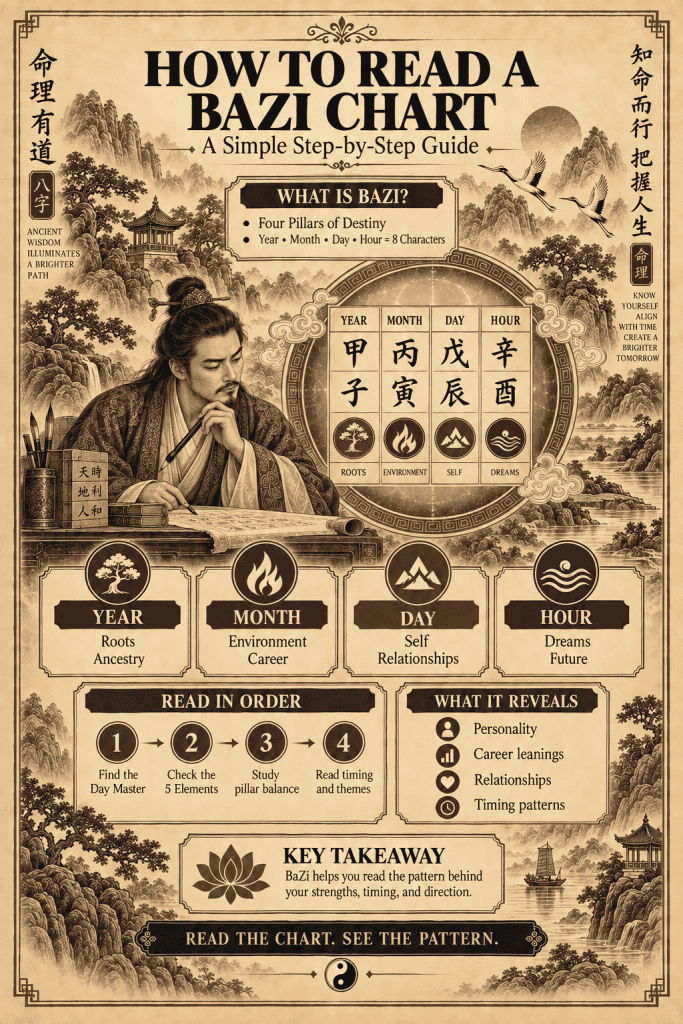
What is Bazi? Bazi, also called the Four Pillars of Destiny, turns your birth year, month, day and hour into eight characters. Those eight characters describe patterns: your personality, your career leanings, your relationships, your timing. This page is my step-by-step guide to reading a Bazi chart, written the way I teach it in class.
Want your own chart read rather than learning to read charts yourself? A BaZi consultation walks through your four pillars and what they mean for the timing of your next move.
Bazi is a traditional Chinese system, and like any divination tool it deserves a balanced, honest treatment: what it can tell you, what it can’t, and where beginners go wrong. I’ve read a lot of Bazi content over the years, and most of it either overpromises or hides the method. I’ll try to do neither here. Whether you’re completely new or you’ve already played with your own chart, this guide should get you reading with your own eyes.
1. What is Bazi and Bazi chart
Bazi, also called the Four Pillars of Destiny or Eight Characters, is an old Chinese metaphysical system. Its documented roots go back to the Tang Dynasty (618 to 907 CE), and its core ideas appear in Chinese texts even earlier. It absorbed a lot along the way, from Daoism, Confucianism, and Yin-Yang theory.
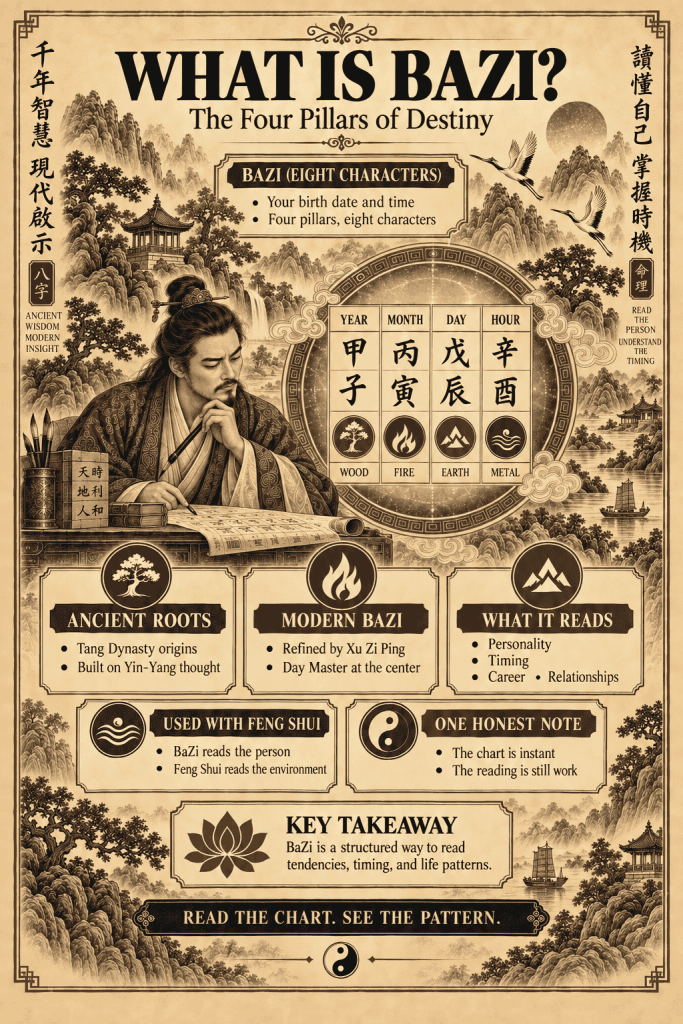
The version most practitioners use today was shaped substantially by Xu Zi Ping during the Song Dynasty (960 to 1279 CE). He reorganized the system around the day pillar, which is why your “Day Master” sits at the center of every modern reading. Generations of scholars and practitioners refined the technique from there, and it spread through Chinese culture into character analysis, life guidance, and fortune-telling of every flavor.
It’s still widely practiced in Chinese communities around the world, and it has traveled well beyond them. My own students come from dozens of countries, and most of them don’t have a Chinese cultural background. They come because Bazi works as a tool for self-knowledge and timing: career decisions, marriage compatibility, health tendencies, financial planning.
Business people use it too, and I say that as one of them. Before I taught metaphysics, I spent thirty years running companies, and I’ve seen owners consult Bazi practitioners on timing for ventures, hiring, and major decisions. Within the broader family of Chinese metaphysics, Bazi is often paired with Feng Shui for a fuller picture: Bazi reads the person, Feng Shui reads the environment.
Technology changed access more than it changed the method. Bazi software and online platforms now generate Bazi charts instantly, which used to require manual calculation and a good teacher standing next to you. The chart is free now. The reading is still work.
One honest note before we go further. Bazi is not universally accepted. Some people dismiss it as superstition, and I don’t get angry at that; I used to be skeptical myself. What I tell skeptics is simple: treat it as a structured language for describing tendencies, test it against real decisions, and then decide. You don’t have to believe anything to learn the method.
2. How to get ready to read the Bazi chart
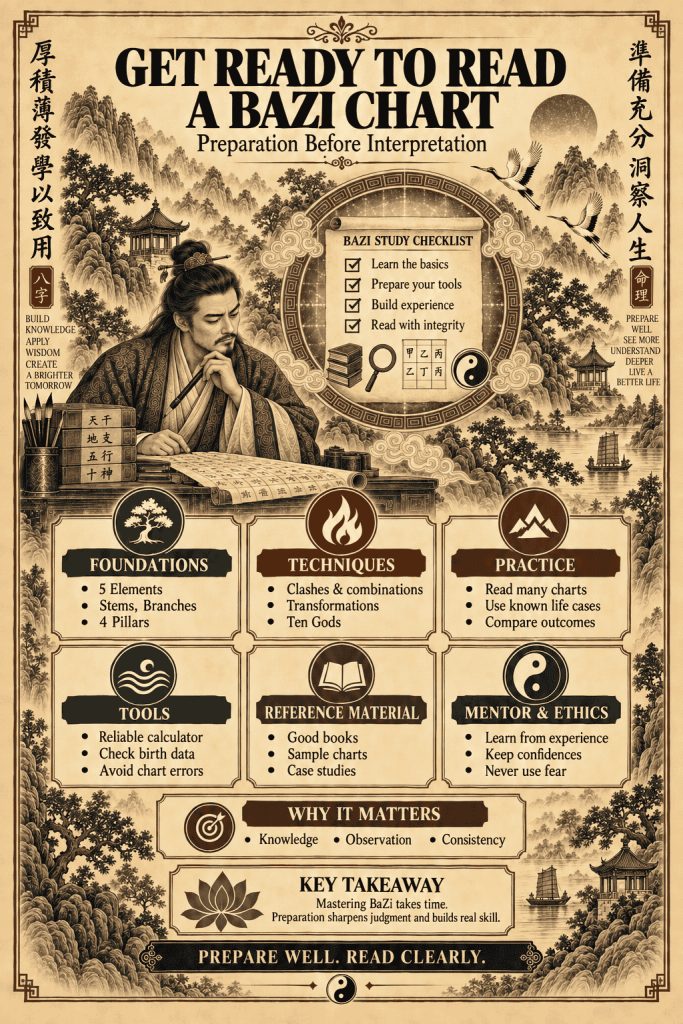
Reading a chart properly takes preparation, both knowledge and tools. Here’s the checklist I give my own students:
- Study the fundamentals: the five elements, the ten heavenly stems, the twelve earthly branches, how elements interact, and what each pillar represents. Read reputable books, take a proper course, and be careful with random internet material. There’s a lot of confident nonsense out there.
- Learn interpretation techniques: clashes, combinations, transformations, and the Ten Gods, the relationships between elements that carry most of the meaning in Bazi analysis. A chart is just symbols until you know how these pieces interact.
- Develop your analytical eye. This only happens one way: analyzing charts, lots of them, including charts of people whose life events you already know. Checking your reading against a known outcome is how your instincts develop.
- Use a reliable Bazi calculator for the plot itself. Manual calculation is a noble skill but an unnecessary one for beginners, and errors in the chart corrupt everything downstream. Pick a reputable tool, and double-check your birth data before you trust any chart.
- Collect reference material: good books, sample charts, case studies. You’ll revisit them constantly, and each one sharpens your eye a little further.
- Practice on real cases. This is the step everyone skips and it’s the one that matters most. Paper knowledge fades. A hundred practiced charts stays with you.
- Find a mentor or experienced practitioner to check your readings. The feedback loop matters. When I was learning, an experienced pair of eyes caught errors I couldn’t see, and every student I’ve taught has needed the same.
- Take the ethics seriously. When you read someone’s Bazi, you’re handling their hopes and fears. Keep confidences, read with empathy, and never use a chart to frighten someone into anything. If a practitioner leads with fear, walk away.
Mastering Bazi takes time, and I won’t pretend otherwise. What you get back scales with the effort you put in, which is true of anything worth learning.
3. How to read Bazi chart
Let me be straight with you: real chart reading takes months of study and practice. There’s no three-minute version. But plenty of people want to understand their own chart, and that’s a reasonable goal. So here is the step-by-step path I teach.
3.1. Understand the system and symbols in Bazi chart
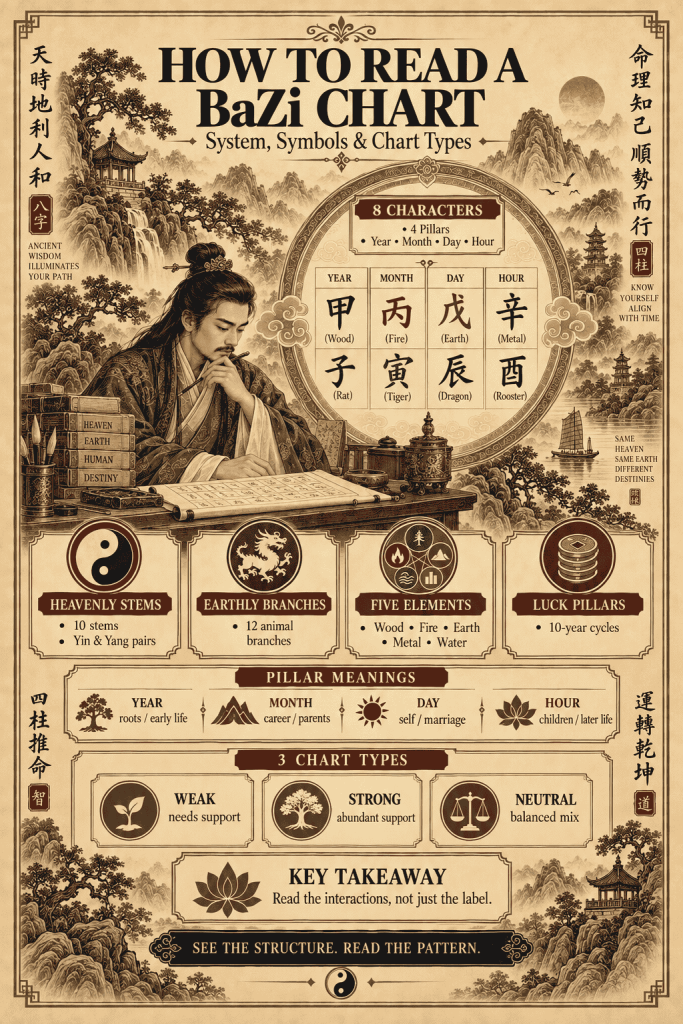
A Bazi chart is built from your birth year, month, day and hour. Each of those becomes a pillar, and each pillar carries one heavenly stem on top and one earthly branch below. Eight characters in total, four pillars: Year, Month, Day, Hour. That’s the “Eight Characters” in the name.
- Heavenly Stems: there are ten of them, five element pairs split into Yin and Yang (I cover them in depth in my guide to the ten heavenly stems). Jia (Yang Wood), Yi (Yin Wood), Bing (Yang Fire), Ding (Yin Fire), Wu (Yang Earth), Ji (Yin Earth), Geng (Yang Metal), Xin (Yin Metal), Ren (Yang Water), and Gui (Yin Water).
Each stem carries its own character, and after a while you start to feel them rather than memorize them:
- Jia, Yang Wood: growth, drive, the stubbornness of a tree pushing upward.
- Yi, Yin Wood: flexibility, nurturing, adaptability, grass that bends and survives.
- Bing, Yang Fire: charisma, openness, leadership, the sun that shines on everyone.
- Ding, Yin Fire: warmth, intuition, a candle flame, quieter and more personal.
- Wu, Yang Earth: steadiness, practicality, mountain energy.
- Ji, Yin Earth: organization, diligence, garden soil that grows things.
- Geng, Yang Metal: determination, hardness, the raw ore that becomes a blade.
- Xin, Yin Metal: precision, refinement, intelligence.
- Ren, Yang Water: communication, movement, the big river that connects everything.
- Gui, Yin Water: intuition, wisdom, quiet empathy, the mist that seeps in everywhere.
- Earthly Branches: twelve, the animal signs. Rat (Zi), Ox (Chou), Tiger (Yin), Rabbit (Mao), Dragon (Chen), Snake (Si), Horse (Wu), Goat (Wei), Monkey (Shen), Rooster (You), Dog (Xu), and Pig (Hai).
The branches carry the same flavors: the Rat’s adaptability and quick intelligence, the Ox’s persistence, the Tiger’s competitive fire, the Rabbit’s diplomacy, the Dragon’s ambition, the Snake’s strategic mind, the Horse’s drive, the Goat’s gentleness, the Monkey’s wit, the Rooster’s precision, the Dog’s loyalty, the Pig’s generosity. You already know these characters from everyday life; Bazi just tells you where they sit in your chart.
- Stem and branch combinations: within each pillar, the stem and branch interact, and across pillars they clash, combine, and transform. This is where most of the reading actually happens, and it’s why two charts that “look similar” can belong to completely different lives.
- Pillar meanings: the four pillars each speak to a domain of life, commonly read as the self, parents and early life, career and marriage, and children and later life, and each pillar also carries palace-style information about the people around you. Don’t treat these boundaries as rigid walls; they shade into each other.
- Luck Pillars: on top of the natal chart, everyone moves through ten-year luck pillars. Same person, same birth chart, different decade, different conditions. This is why a Bazi reading without the luck pillars is only half a reading.
- The Five Elements: Wood (growth, expansion, new beginnings), Fire (passion, energy, visibility), Earth (stability, grounding), Metal (structure, precision), Water (adaptability, wisdom). Every stem and branch maps to one, and the balance and flow between them is the grammar of the whole chart.
Put together, the chart is a framework for understanding a person’s character, potential and trajectory: career, relationships, health, wealth. It is a tool for self-awareness and better decisions, and I’ve watched it earn its keep in both roles.
3.2. Three types of reading Bazi chart
Beginners always want to know whether their chart is good or bad, and the first honest answer is: the question is wrong. Charts are usually classified by overall strength: weak, strong, or neutral. Here’s what those labels actually mean.
Weak chart: the Day Master lacks support. Too few helpful elements, or too much of what drains and attacks it. A weak chart usually means more friction in life, and often more effort for the same result. But before you feel sorry for yourself, some of the most determined people I know have weak charts. Struggle builds resilience, and a weak chart often carries exactly that.
Strong chart: the Day Master has abundant roots and support, all five elements present in reasonable balance. Favorable conditions, leadership energy, better odds of health and stability. The caution that comes with it: strength unused turns into arrogance and wasted momentum. I’ve seen strong charts underperform weak ones because the owners coasted.
Neutral chart: neither extreme, a moderate balance. Life hands these people a mix of openings and obstacles, and outcomes depend heavily on decisions and effort. Honestly, that’s most people, and it’s a perfectly good chart to have.
One more time, because it matters: these are broad brush strokes, not verdicts. The real reading lives in the interactions: clashes, combinations, luck pillars, and the specific question being asked. Never let anyone reduce your chart to one word.
4. Some case studies of Bazi chart
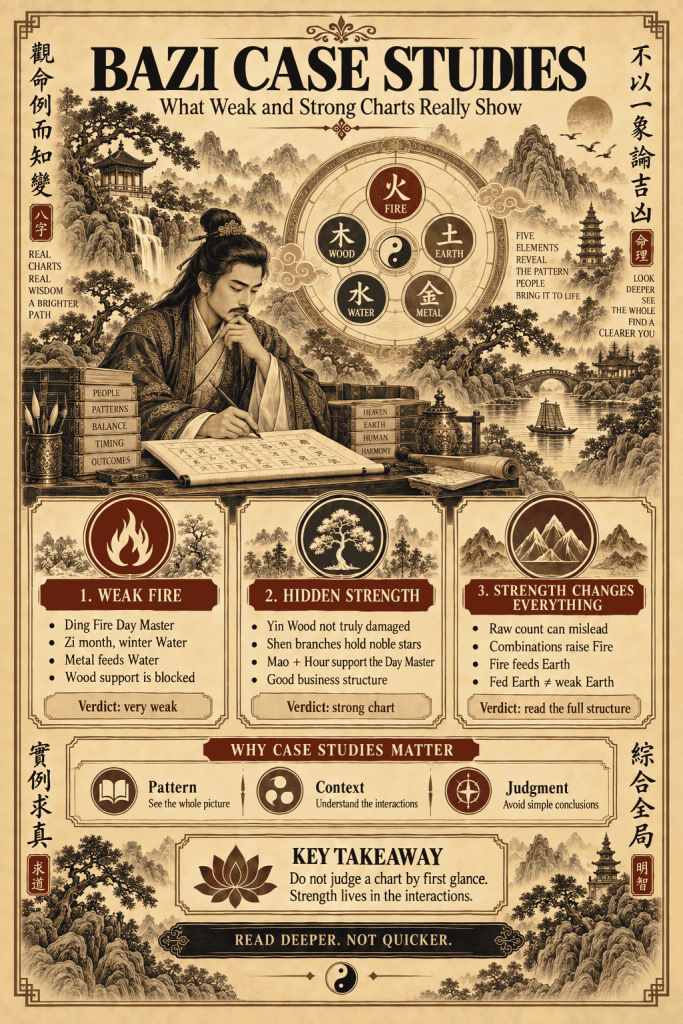
- A weak Bazi chart, analyzed step by step.
Here’s a weak chart worth studying closely, because the weakness isn’t obvious at first glance.
- Day Master: Ding Fire. A candle flame at the center of this chart.
- Month: born in the Zi month, deep winter. Winter belongs to Water.
- Seasonal influence: Fire born in winter is out of season. The friend star helps a little, but the season itself is working against the Day Master.
- Year stem: no Fire in the Year Stem, so the Fire has no roots there and stands weak.
- Heavenly Stems: two strong Water elements among the stems. Water controls Fire, and here the Water is abundant.
- Earthly Branches: two Metal elements in the branches, and Metal feeds Water, making the Water even stronger.
- Wood: there is Wood in the Hour Branch, which should feed the Fire, but Metal controls that Wood, so the support barely arrives.
Verdict: the Day Master is very weak. Strong Water, reinforced by Metal, presses on a small Fire with almost no support. A person like this typically needs to consciously protect and support their Fire energy, through elements, environment and choices. This is a simplified walkthrough, of course. A full reading adds the pillar interactions, the luck pillars, and the person’s actual circumstances, which is what I do in a consultation.
- A person with a Strong Bazi chart, and what “strong” really means
Now a chart that looks problematic at first and turns out to be strong. I like this one because it teaches the lesson I repeat most in class: don’t patch the chart on paper, read what it actually does. His Zi Wei Dou Shu chart tells the same story, by the way, and there’s a lot going for it.
- The Yin Wood Day Master looks weak at a glance, and the Yang Metal held by the two Shen branches looks like a threat. Look closer: that Metal isn’t actually damaging the Yin Wood much. The point of Bazi analysis isn’t to blindly prop up every weak-looking Day Master. That’s surface-level reading.
- Those same Shen branches hold three fortunate stars: Direct Officer, Direct Resource, and Direct Wealth. His Tian Yi Gui Ren, the most powerful Nobleman Star in Bazi, also sits inside these branches.
- The Yin Wood gets help from the Mao Day Branch and the Hour Pillar, so it isn’t standing alone.
- The chart carries the “Eating God Gives Birth to Direct Wealth” structure, which many successful business people and entrepreneurs share.
- The Ding-You Year Pillar is notable in its own right; the Yin Fire Eating God seated on You Metal is another positive indicator.
- His luck pillars are also genuinely helpful: six favorable phases in a row, uninterrupted.
- A Strong Bazi chart, and why element strength changes everything
This last case shows how much rides on getting element strength right. Same chart, three levels of analysis, three different conclusions.
First pass, the raw element count: one Water, two Earth (extremely weak), two Wood (the strongest), one Fire, two Metal. A quick reading says: weak Earth person, Water helps control the Fire that threatens the Earth. Reasonable-looking. Wrong.
Second pass, with combinations and clashes included: the Fire count goes up, the Water goes down. That reversal matters, because the Water was part of what kept the Fire in check, and the Fire was never Earth’s enemy in this chart in the first place.
Third pass, adding the House of Life and House of Conception: two more Fire elements, plus an additional Earth. The composition now reads: zero Water (weak), two Wood (strongest), five Fire (strong), two Earth (extremely weak), three Metal (weakest).
And here’s the twist. Five strong Fire elements feed Earth, and that Fire also exhausts the two dominant Wood elements. The “extremely weak” Earth turns out to be continuously fed. This person’s Earth is stronger than it first appeared, and that difference between “weak Earth” and “fed Earth” changes the entire reading: the favorable elements, the luck pillar sequence, the practical advice.
I keep this case in my teaching set because it shows what separates a real reading from a chart-counting exercise. Get the strength right, or everything built on top of it is guesswork.
5. The advantages of reading the Bazi chart
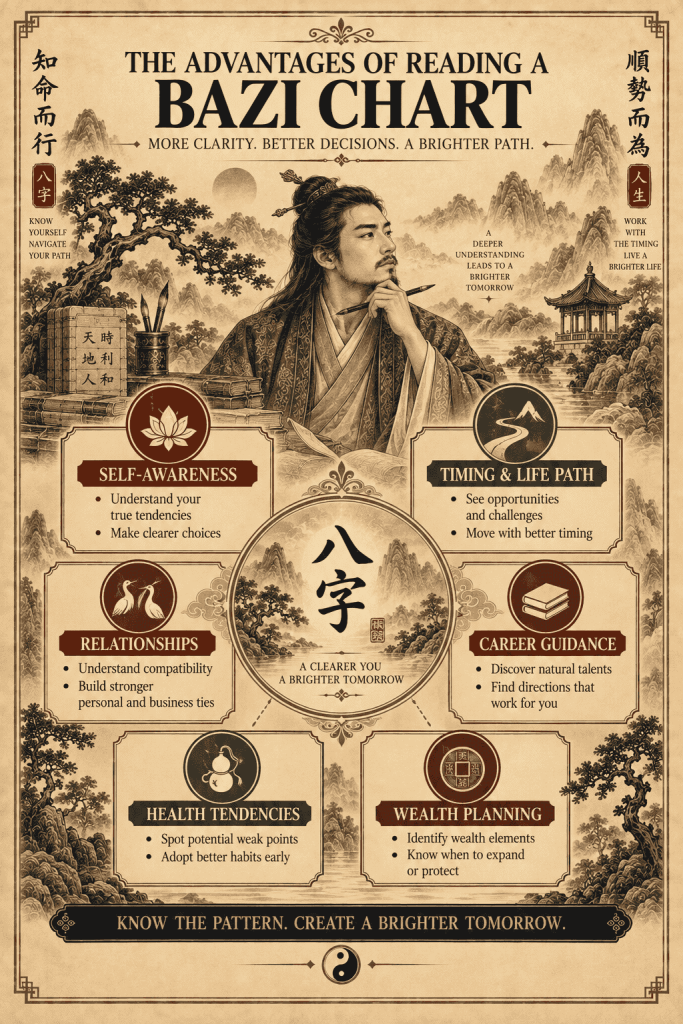
So why bother learning to read at all? These are the payoffs I see, in my students’ lives and in my own:
- Self-awareness: a good reading shows you your actual tendencies, not the ones you like to claim. That kind of clarity shapes decisions, careers and development in a way vague introspection can’t.
- Timing and life path: the chart plus the luck pillars map the terrain: where the openings are, where the hard stretches are. You still walk the road, but you walk it knowing where the hills are.
- Relationship compatibility: comparing two charts reveals where personalities and values align and where they grind. Useful for marriages, partnerships, and business collaborations alike.
- Career guidance: the elements point to natural talents and workable directions. I’ve watched students change lanes based on their chart and finally stop swimming upstream.
- Health tendencies: elemental imbalances often hint at weak spots. Not a diagnosis, but a useful early-warning nudge toward better habits and checkups.
- Wealth planning: the wealth elements and favorable periods help you time your pushes and know when to protect rather than expand. In business, that alone can be worth the effort of learning.
None of this is magic. It’s structured self-knowledge plus timing, applied consistently. The people who benefit most from Bazi are the ones who use it to make better decisions, not the ones who outsource their lives to it.
6. Q&As: How to read Bazi chart
These are the questions my clients and students ask me most. The answers are shorter than my classes, but they’re honest.
- Which type of Bazi chart is better, Strong or Weak?
Neither, and anyone who tells you otherwise is oversimplifying. Strong charts carry significant highs and lows; weak charts carry struggle and resilience. And no chart reads on its own: the ten-year luck pillars, the years you pass through, the pattern of the chart, and the supporting stems and branches all factor in. A modest chart in a favorable luck cycle can outperform a strong chart in a bad one.
- What can you do to improve your Bazi chart?
You can’t rewrite your birth data, but you can work with the chart you have. In my practice the honest levers are: choose names that fit your pattern (with expert help, not a random generator), lean on colors and accessories that support your favorable elements, grow in directions your chart supports, and fix the Feng Shui of your living and working space. Small things, done consistently.
- Where can I learn to read Bazi?
From a teacher, ideally one who lets you test what you learn. There’s a lot of free material on this site, including the free foundation material I keep on the main page, and I teach students from around the world online. Start with the free material, then decide if you want to go deeper.
- Do I need to calculate the Bazi chart by hand?
No, and you shouldn’t. Bazi calculators are free and accurate: you enter your birth data, the chart plots itself. Hand calculation is a historical skill, not a requirement. Spend your energy on learning to read instead.
- What can Bazi predict?
Most areas of life: health, wealth, career, marriage, children, favorable and unfavorable periods, the shape of your life stages. But “predict” is the wrong word for how I’d put it. Bazi maps conditions and tendencies. Reading it accurately is a skill, which is exactly why a careless chart reading does more harm than none at all. If a detail matters to you, get a proper reading rather than a rushed one.
- Can we change a Bazi chart?
The chart itself, no. What you do inside those conditions, absolutely. My advice is unglamorous but true: do charitable work, live gently, stay away from shady behavior. Fortune follows conduct. That’s not mysticism, that’s thirty years of business and life talking.
One last word: read your own chart slowly, check it twice, and be patient with yourself. The chart rewards the people who keep asking questions.
New here? Start with my step-by-step guide to BaZi reading for beginners before this page.
The Birth Year Library
If you want to check a specific year pillar quickly, every birth year from 1920 to 2030 now has its own page, with the jiazi pair, the nayin element, the exact Li Chun cutoff and a full reading. Start at the BaZi Birth Years Library.
A Worked Example: Reading One Chart Out Loud
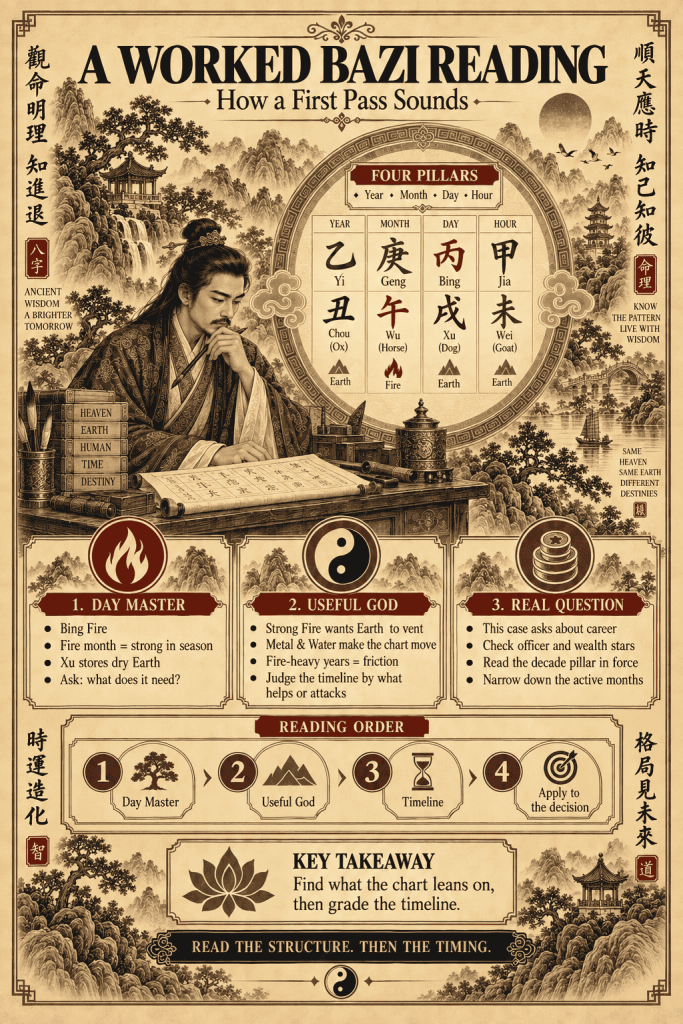
Let me show you how a first pass actually sounds, because the method only clicks when you watch someone do it. Picture a client born 12 June 1985, early afternoon, in Singapore. The four pillars come out as Yi Chou for the year, Geng Wu for the month, Bing Xu for the day, and Jia Wei for the hour. I am not going to read that chart for you here, it is not the point. The point is the order of questions.
First question: what does the day master need? A Bing day master is fire, sitting on Xu, a dry earth storage. June is a fire month, so the fire is strong in season. Strong fire wants earth to vent it and metal and water to use it. So already, before a single prediction, I know this chart leans on its metal and water, and I know the years that carry those elements are the years that move.
Second question: what is the useful god, and what does the chart do in a year that attacks it? If water is what the chart needs and a fire-heavy year arrives, that year is friction, and the reading softens its promises accordingly. This is the whole craft in two sentences: find what the chart leans on, then grade the timeline by how each year treats that thing. Everything else, the ten gods, the combinations, the palaces, decorates those two answers.
Third question: where does the chart actually ask for help? A client rarely wants the whole reading. This one came about a career decision, so the useful god question gets applied to the officer and wealth stars, the decade pillar in force, and the specific months in play. That is what a BaZi consultation is: the full arithmetic, pointed at one live decision.
If you want to run this on your own chart, the pillar calculator pages in the birth year library get you the four pillars, and this page has just shown you the order of questions that follows.
Questions People Ask About Reading a BaZi Chart
Can I read my own BaZi chart, or do I need a practitioner?
You can read your own chart to a genuinely useful level. The pillars are arithmetic, the element relationships are learnable in an afternoon, and this page teaches both. A practitioner earns their fee on the ambiguous cases: charts with clashing combinations, unusual hour pillars, or a decision big enough that a second pair of eyes is cheap insurance.
How long does a proper chart reading take?
The first pass takes minutes once the pillars are set. A full consult, where the chart is pointed at a live decision, runs about an hour. Be suspicious of anyone who needs three hours to tell you what your day master is.
Why do two people born in the same hour read differently?
They usually do not, and this is a fair criticism of sloppy readings. Charts within the same two-hour window share pillars. The differences come from gender (which flips the decade cycle direction), birthplace (which can shift the hour pillar near a boundary), and the questions each person brings. The pillars are the map, the questions are the weather.
What is the hardest part of a BaZi chart to read correctly?
The strength call. Whether the day master is strong or weak decides everything downstream, and near the boundary even experienced practitioners slow down. Charts with a dry earth month in summer or a waterlogged chart in winter are the classic trap cases.
Does BaZi predict, or does it describe tendencies?
Honestly: it describes structure and timing pressure. The chart tells you which years the useful god is fed and which years it is attacked. What you do inside that weather is the part you own. Anyone who promises events with dates is selling certainty the method never had.
Want to see these layers working together in one reading? The Qimen Destiny Chart: How to Read Your Natal Chart maps your whole chart, and the related guide Qimen Destiny Chart vs BaZi Four Pillars: Which Reading When goes deeper into this exact part.
Leave a Reply
You must be logged in to post a comment.