
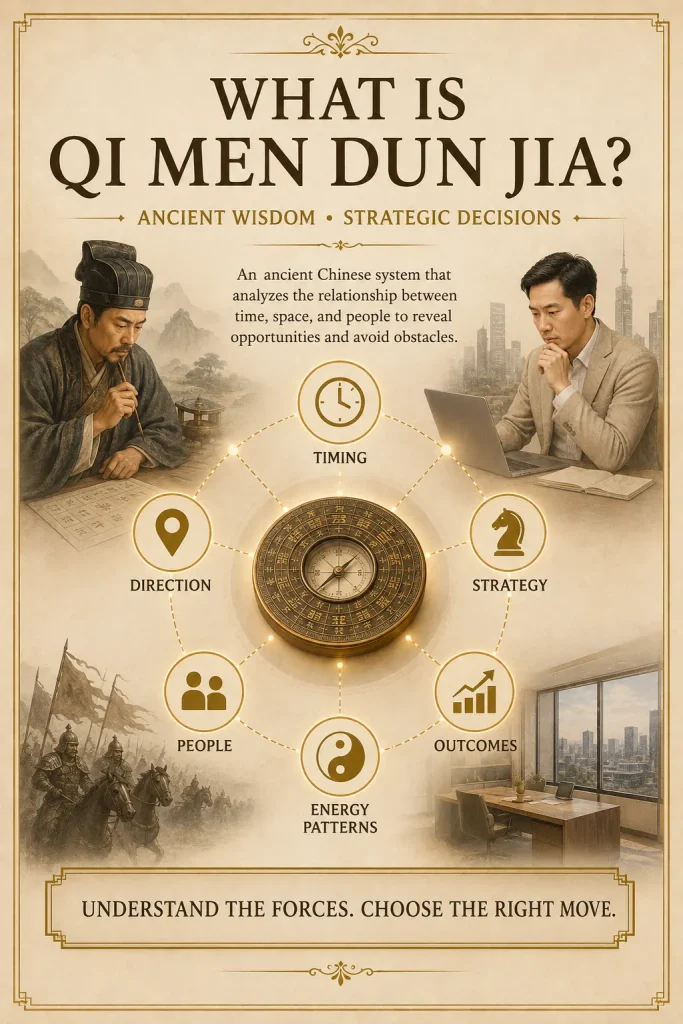
I’ve made thousands of business decisions over thirty years, and looking back, the winners rarely came from being smarter. They came from timing, and from understanding the situation I was walking into. Qi Men Dun Jia (奇门遁甲) is the Chinese system built around exactly that problem.
Most people meet it expecting fortune telling. It isn’t. It’s a strategic framework: you plot a chart for a specific moment, read the forces around your question, and choose the move with the best odds. Ancient generals used it to plan battles. Emperors consulted it before decisions of state. I teach it today for business timing, negotiations, career moves, and the decisions that keep people awake at night.
The name translates roughly as “Mysterious Gates Hiding the Emperor”, which sounds dramatic, and honestly it is. But the purpose is plain: find the favorable path, skip the avoidable obstacles. If you want the full breakdown of the term, I wrote a separate guide on what Qi Men Dun Jia means.
What I like about it, after years around other systems, is that it refuses to hand you a fixed future. It shows you the landscape: where the opening is, where the wall is, which door is worth walking through. You still make the call. You just make it with more information than guesswork.
So instead of asking “What will happen to me?”, you start asking better questions. “Which action gives me the highest probability of success?” “Is this the right week to act, or should I wait?” That shift, from prophecy to strategy, is the whole system in one sentence, and it’s why serious people keep finding their way to it.
What Is Qi Men Dun Jia?
Qi Men Dun Jia (奇门遁甲) is an ancient Chinese system for choosing the right timing and direction for important decisions. A practitioner casts a chart for a specific moment, reads the energies sitting in nine palaces, and uses that reading to pick the best move, the best hour, or the best direction. That is the plain-English answer, and it is the one I give every new student on day one.
| Quick facts | |
|---|---|
| Chinese name | 奇门遁甲 (Qi Men Dun Jia) |
| Rough translation | Mysterious Gates Hiding the Stems |
| Age | Over 4,000 years by the traditional record |
| Original use | Military strategy and statecraft |
| Main components | 9 palaces, 10 stems, 8 doors, 9 stars, 8 gods |
| Modern use | Business timing, negotiations, date selection, destiny analysis |
The History and Origins of Qi Men Dun Jia
QMDJ is generally considered the most advanced of the Chinese metaphysical arts, and its origins are tied to the least gentle profession there is: war. Commanders and their advisors used it to pick timing, positioning, and the hidden openings before committing troops. If the history interests you, I’ve written about the history of Qi Men Dun Jia and the question of who invented Qi Men Dun Jia. The honest answer to that second one: nobody knows for certain, and anyone promising an exact birth date is guessing with confidence.
Over the centuries it moved off the battlefield. Scholars, merchants, and political figures started applying the same logic to ordinary decisions, and today my students use it for business planning, careers, investments, relationships, and personal growth. The applications changed. The objective never did: read the situation, take the path with the best probability.
It earned the nickname “The Emperor’s Art” because for a long stretch of history, only imperial strategists were allowed to learn it. I’ve never liked that arrangement, and my whole teaching career is an argument against it.
How Qi Men Dun Jia Works
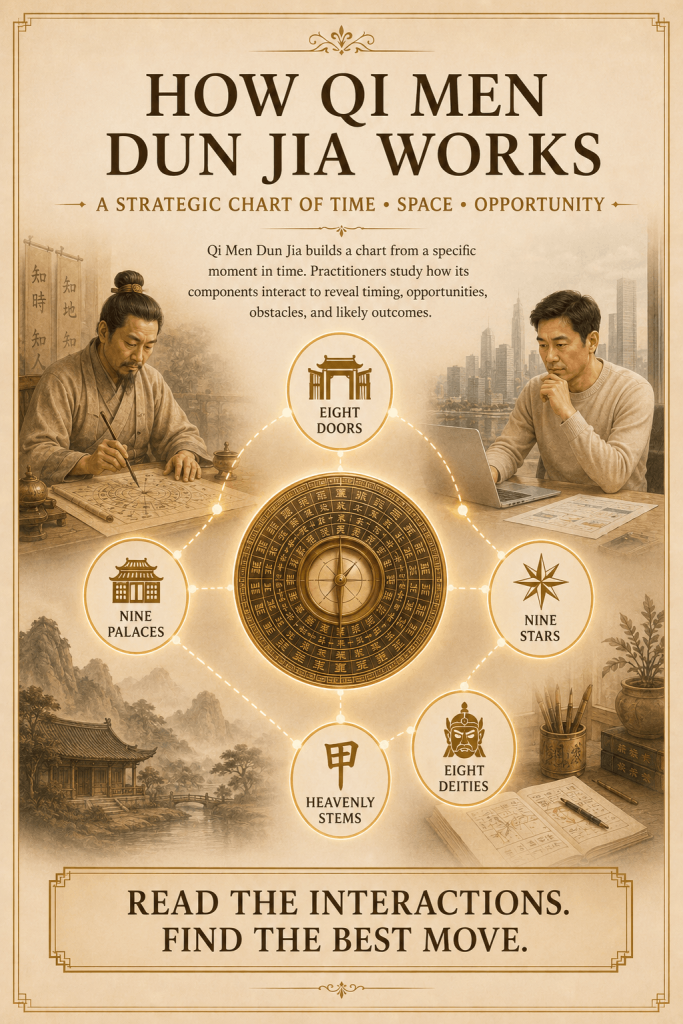
At its core, you cast a chart for a specific moment in time. That chart works like a map of the conditions surrounding your question or decision. I’ve written a fuller walkthrough on how Qi Men Dun Jia works, but here’s the shape of it. A chart carries several layers at once:
- Eight Doors, the types of action and opportunity available to you
- Nine Stars, the patterns and influences running underneath
- Eight Deities, the environmental and hidden factors most people miss
- Heavenly Stems, standing in for people, resources and events
- Nine Palaces, the sectors where all of this plays out
Beginners read these layers one at a time, and their readings stay flat. The real information sits in the interaction: this door, in that palace, with this star resting on top of it. Read the whole chart or you’re reading tea leaves.
The Five Layers of a QMDJ Chart
When people say the chart looks intimidating, this is usually what they mean: five different symbol families, all stacked on the same nine-square grid. But each layer answers one simple question, and once you know which question is whose, the whole thing calms down.
The palaces are the grid itself. Nine boxes, each mapping a direction, a body of life topics, and a set of timings. Questions about career sit in different palaces than questions about relationships, the same way different rooms in a house hold different activities.
The stems are the energy carriers. Ten of them, five Yang and five Yin, and the day stem in particular is where most destiny readings begin. If you want the full breakdown, my Ten Heavenly Stems guide goes stem by stem.
The doors are the actions. Eight of them, from Open to Shut, each describing a type of move you can make. This is the layer I teach first because it is the one beginners can actually use within a week. The full reference lives on the Doors explained page.
The stars are the patterns: nine of them, describing the texture of the moment, whether it favors boldness, caution, planning, or charm.
The gods, sometimes called deities, are the eight hidden influences: subtle social and psychological forces, charisma, deception, authority. Most charts hide their sharpest advice in this layer, and the 8 gods guide covers them individually.
Reading a chart means reading the combinations, not the singles. A door alone says what you can do. A door with its star and its god says whether it will work, for whom, and what to watch out for. Students who put in a month on the door, star and god combinations usually leapfrog a year of solo study.
Why Qi Men Dun Jia Is Different from Fortune Telling
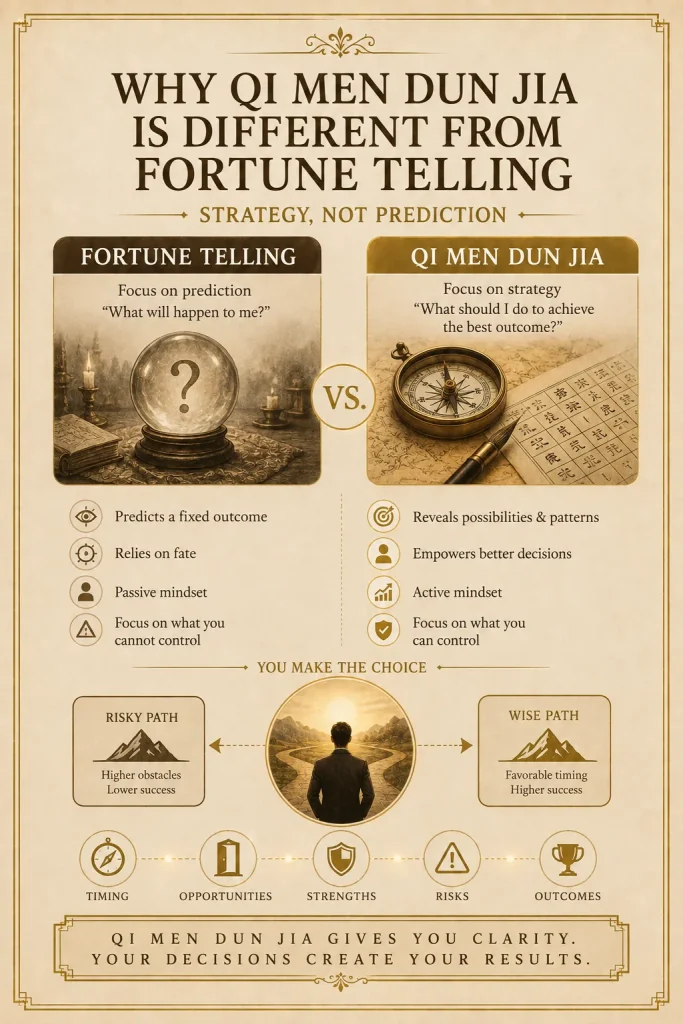
This is the misconception I spend the most time correcting, so let me be direct. Qi Men Dun Jia is strategy, not prophecy. Fortune telling asks what will happen to you. QMDJ asks what you should do about it. If you want the longer version, I wrote about whether Qi Men Dun Jia is fortune telling separately.
The distinction matters because the system assumes your choices change results. The chart lays out possibilities, strengths, weaknesses and risks. The outcome still depends on what you do next. That’s exactly why it appeals to entrepreneurs, executives and investors, people who live with decisions under uncertainty and know that acting at the right moment is half the battle.
The Eight Doors Explained
The Eight Doors are the part my students ask about most. Each door carries a different kind of energy, a different type of action or opening.
A few examples so you can feel the difference. The Open Door is associated with communication, business and visibility. The Life Door relates to growth, wealth and long-term momentum. The Rest Door connects to planning, recovery and stability. Other doors speak of competition, obstacles, transformation, or hidden risk.
Beginners want to sort the doors into good and bad. Resist that instinct. A difficult door in a strong position can outperform a pleasant door sitting in a weak one. You evaluate how the door interacts with the rest of the chart, then you conclude. That discipline is what separates a reading from a guess.
The Nine Stars Explained
The Nine Stars add the subtler layer. They describe patterns to do with leadership, intelligence, communication, innovation, influence and momentum. Some stars support expansion and recognition. Others ask for patience, analysis, or caution.
Where stars get interesting is in combination with the doors and deities. A star can strengthen the door beneath it, or quietly undermine it. Experienced practitioners spend most of their attention on those interactions, because that’s where the craft actually lives.
Practical Applications of Qi Men Dun Jia
Here’s where the system earns its keep. The uses I see most in my own practice and among my students:
- Qi Men Dun Jia for Business: evaluating partnerships, timing product launches, reading competitive situations before you commit.
- Qi Men Dun Jia for Career: weighing job offers, planning transitions, picking your moment for promotions and negotiations.
- Qi Men Dun Jia for Wealth: assessing risk, timing entries and exits, matching opportunities to favorable conditions.
- Qi Men Dun Jia for Relationships: understanding interpersonal dynamics, choosing the right moment for hard conversations.
Concrete cases, the kind that come up in class every intake: choosing between two offers by comparing which path carries better long-term conditions. Timing a launch instead of guessing at it. Reading the dynamics across the table before a negotiation. Selecting dates for signings and key meetings instead of letting the calendar decide for you.
Qi Men Dun Jia vs Other Chinese Metaphysical Systems
QMDJ is one of several major systems in Chinese metaphysics. They share roots in Yin and Yang, the Five Elements and the I Ching, but they do different jobs, and knowing which tool fits which question saves you years of confusion.
| System | Primary Purpose | Best Used For |
|---|---|---|
| Qi Men Dun Jia | Strategic decision-making | Timing actions, choosing directions, evaluating opportunities |
| BaZi | Life blueprint and destiny analysis | Understanding personality, strengths, life path |
| Feng Shui | Environmental energy optimization | Home and office arrangement, spatial harmony |
| Liu Ren | Event forecasting | Predicting short-term outcomes of specific events |
| Yi Jing | Philosophical guidance and divination | Gaining perspective on life questions |
In my own practice I pair QMDJ with BaZi more than anything else. BaZi tells you who you are and what you’re working with. QMDJ tells you when and how to move. Blueprint plus timing, and you’re no longer navigating blind.
| Qi Men Dun Jia | BaZi | Zi Wei Dou Shu | |
|---|---|---|---|
| Best for | Timing, strategy, specific decisions | Character, life themes, long-range potential | Life chapters, fortune cycles |
| Chart based on | A chosen moment | Birth data | Birth data |
| Question style | “When and how should I move?” | “Who am I and what am I built for?” | “Which life periods favor what?” |
| Learning curve | Steepest of the three | Gentlest entry | Moderate |
| Changes per question | Every chart is fresh | One chart for life | One chart for life |
One warning I give every student: do not pick a system by prestige. Pick by the question you actually need answered. If your question starts with “when” or “should I”, that is a QMDJ question. If it starts with “why am I like this”, that is usually BaZi territory, and my BaZi chart guide handles that side of the house.
Frequently Asked Questions
Is Qi Men Dun Jia real?
It’s a real, documented system with thousands of years of history behind it. Zhuge Liang reportedly used it at the Battle of Red Cliffs, and scholars have studied it for centuries. Whether a reading “works” depends on the practitioner, like any tool. A scalpel is real too, and not everyone holding one is a surgeon.
Can Qi Men Dun Jia predict the future?
No fixed future, no. What it gives you is the set of conditions around a situation and the probabilities of different outcomes. You choose the action with the best likelihood of success. Your choices remain the decisive factor, which in my view is exactly how it should be.
How accurate is Qi Men Dun Jia?
It depends on the practitioner and on the clarity of the question. I tell my students: garbage question, garbage chart. A well-trained practitioner reading a clear question can identify favorable timing and direction with high reliability. After that, accuracy depends on whether you actually act on what the chart shows you.
Is Qi Men Dun Jia difficult to learn?
There’s a learning curve, no point pretending otherwise. Doors, stars, deities and stems is a lot of moving parts. With proper instruction, beginners start applying basic principles within a few months. Mastery takes years. My course is built to take you from beginner to practitioner without the mystique.
What is the difference between Qi Men Dun Jia and BaZi?
BaZi reads your birth data to reveal your blueprint: personality, strengths, potential life path. QMDJ is the strategic layer for specific moments: when to act, which direction, which move. The short version I use in class: BaZi tells you who you are, QMDJ tells you when and how to act.
How long does it take to master Qi Men Dun Jia?
Basic proficiency, three to six months of consistent study. Intermediate level, one to two years. Real mastery is a long game of practice and real cases. The course calendar lays out the milestones for each stage.
Can I learn QMDJ without reading Chinese?
Yes, and most of my students cannot read it. Everything I teach is in plain English, including the terminology. Chinese-speaking students sometimes have an easier first month because the terms feel native, but English-speaking students catch up fast, and combination reading levels the field within weeks.
Is Qi Men Dun Jia religious or spiritual?
No. QMDJ is a structured system of time calculation and pattern reading. The “gods” in the chart are labels for social and psychological influences, not objects of worship. You can be religious, atheist or anywhere between, and the system works exactly the same for you.
A Worked Example: Choosing Between Two Business Offers
Here is the kind of case that walks into every intake of the QMDJ course. A student runs a small agency. Two offers land in the same week: a bigger company wants to acquire her team, and a foreign partner wants a joint venture with new money but new markets.
The numbers look similar, so the spreadsheet cannot decide it. This is exactly where QMDJ earns its keep, because the question is no longer “which pays more” but “which situation holds the better ground for me specifically”.
We cast one chart for the moment she genuinely needed to decide, and read three things. First, the palace representing her: which door sat there, and whether that door’s energy was open or blocked. Second, the palace representing each counterparty, with attention to the stems, because stems reveal whether the people involved bring genuine force or empty promises. Third, the gods, because the hidden-influence layer is often where the real story of a negotiation lives: sincerity, charm masking weakness, authority that is real versus borrowed.
The acquisition palace showed a strong door sitting on weakened ground, which reads as: attractive on paper, hollow underneath. The joint venture palace showed a modest door on solid ground with a sincere god. She went with the venture, and told the class later it was the correct read: the acquiring company restructured and dropped every promise they had made to the teams they bought, four months after she walked away.
Would she have been wrong to take the acquisition anyway? Possibly not, since charts show odds, not fates. But the point of the exercise is what it teaches about thinking: QMDJ forces you to look at the ground under an offer, not just the offer itself. That habit alone, practiced for a few months, changes how a person does business. I have watched it happen enough times to stop being surprised by it.
The Mistakes I See Students Make
After enough intakes, the same five errors show up again and again. Naming them early saves months.
Mistake one: memorizing instead of understanding. New students memorize all 8 doors in a weekend, then freeze when a real chart asks them a question the flashcards never covered. The doors are a vocabulary, not a rulebook. Learn five combinations deeply and you will read better than someone who memorized fifty shallowly.
Mistake two: asking vague questions. “Is my business going to be okay?” is not a question a chart can honor. “Should I sign the lease on the second location in October?” is. The sharper the question, the sharper the chart. Half of my early teaching is really question training.
Mistake three: reading one layer and pronouncing the answer. The door says Go, but the god on the same palace says the person you trust in this deal is not being straight with you. A single-layer reading is how confident beginners get confidently wrong.
Mistake four: chart shopping. Casting three charts in an afternoon until one says what you hoped it would. The chart is a snapshot of a moment, so the honest practice is one chart, cast properly, for the moment the question truly ripens.
Mistake five: treating the reading as a verdict. The system assumes you act. A chart that warns you about a month is not telling you to hide in bed, it is telling you where to aim your attention. Students who treat readings as homework assignments rather than verdicts progress roughly twice as fast in my observation.
Qi Men Dun Jia for Date Selection
Of all the practical uses, date selection is the one with the longest paper trail. Emperors used it to time campaigns, and merchants used it to time contract signings. The logic is simple: every hour carries a different chart, and some charts support a specific action far better than others.
So before a wedding, a product launch, a negotiation or even a difficult conversation, a practitioner looks for the window where the right door sits in the right palace with supportive stars and gods. Signing a partnership when the Open Door carries the moment feels different, and in my experience it usually goes different too. Not by magic: because you have chosen a moment where you enter rested, prepared and emotionally aligned, instead of grabbing whatever Tuesday afternoon the calendar offered.
People sometimes expect me to defend date selection as physics. I will not. My defense is thirty years of watching outcomes: the meeting you time well is the meeting you walk into with intention. If the ancient system’s contribution is to make you choose your moments deliberately, it has already done most of its work.
QMDJ and Feng Shui: How They Relate
Students constantly ask whether QMDJ and Feng Shui are the same thing. They are not, but they share a language, and QMDJ adds a time dimension Feng Shui alone does not have. Classical Feng Shui reads the fixed environment: directions, landforms, the layout of a space. QMDJ reads the moment: what the same direction means during this specific hour, this specific week. The full QMDJ Feng Shui guide covers the details, but the short version is this: Feng Shui tells you where to stand, QMDJ tells you when to move.
In practice the two pair beautifully. A client wants to open a new outlet: Feng Shui weighs the location and interior facing, QMDJ picks the launch hour. A family is choosing between two apartments: Feng Shui compares the spaces, and a QMDJ chart of the decision moment adds the timing dimension to the final call. Students who know both stop asking which system is better, the same way a carpenter stops asking whether the saw or the level is better.
QMDJ Glossary: The Terms You Will Meet First
Every field has its vocabulary, and QMDJ’s is mostly compact Chinese terms. Here are the ones that show up in the first month of study, in plain English.
Chart (盘): the full nine-palace snapshot cast for a specific moment. Hour charts, day charts, month charts and year charts each answer different scales of question.
Palace (宫): one of the nine squares in the chart grid. Each palace maps to a direction, a set of life topics and a family member or role.
Stem (干): one of ten heavenly stems, five Yang and five Yin. The day stem is the anchor of most destiny readings.
Door (门): one of eight action energies, from Open to Shut. The layer most beginners learn first because it maps to real decisions fastest.
Star (星): one of nine pattern energies describing the texture of the moment, such as boldness, caution or cunning.
God (神): one of eight hidden influences, covering social and psychological forces like charisma, deception and authority.
Nobleman (贵人): the helpful-people stem in a chart. When students ask “will anyone help me with this”, the nobleman is usually the first thing I check.
Emptiness (空亡): a palace temporarily weakened, often read as a delayed or discounted answer rather than an absent one. Interpreting emptiness correctly is an intermediate skill, and my Emptiness guide walks through it with a real case.
Fan Yin / Fu Yin (反吟 / 伏吟): two special chart patterns, reversal and doubling. They change how the rest of the chart is read, and beginners are right to treat them with respect until they have seen several live examples.
Do not try to memorize this list in one sitting. The vocabulary sticks through use, and by your third chart these words will feel like furniture.
QMDJ Destiny Reading: The Chart That Is Yours
Everything so far has been about moment charts, cast for a question. There is a second, more personal use: the destiny chart, built from your birth data. This is the reading clients ask for most, and it is the one that tends to change how people see themselves.
A QMDJ destiny reading anchors on your day stem and reads the chart layers the same way a moment chart is read, but the question is different: not “what does this hour hold” but “what kind of ground was I born standing on”. The doors describe the energies that follow a person through life chapters. The stars describe the patterns that repeat. The gods describe the hidden influences, the social and psychological currents, that keep showing up in their relationships and their work.
What clients usually find most valuable is not the praise and not the warnings, but the specificity. Generic readings tell people they are “determined but sometimes stubborn”, which describes half the planet. A QMDJ reading can tell a founder that their Life Door placement means they build best in partnership, that their wealth palace rewards patient accumulation over fast flips, and that their deity layer makes them trust charming people too quickly. That last one, I will add, is one of the most common and most useful findings in my practice. Charisma reads as sincerity to almost everyone; the chart is better at telling them apart than we are.
A destiny reading also tells you what not to attempt. I have had clients thank me more for the “do not” list than for anything else: do not launch alone, do not sign in that season, do not take that particular partnership structure even though the money looks right. Half of strategy is subtraction, and a good reading is mostly a map of what to walk past.
One caution, and I say this as a teacher rather than a salesman: a destiny reading is not a sentence. Clients sometimes arrive ready to hear a verdict, relieved or terrified. The reading describes tendencies and ground conditions, and every one of them can be worked with. The stubborn chart can become legendary persistence with the right roles around it. The restless chart can become the expansion energy a static company desperately needs. I teach students to deliver readings the way a good board member delivers advice: honest about the ground, confident about the options.
If you want to try the mechanics yourself before booking any reading, cast an hour chart for a decision you face this week and read the doors first. One real chart teaches more than ten articles, and this site has both.
What Thirty Years of Business Taught Me About QMDJ
The classical record is genuinely impressive. Zhuge Liang’s east wind at Red Cliffs is the famous story. Shen Kuo’s “Dream Pool Essays” and various military manuals document the system’s use in imperial decision-making, for campaigns, governance, agriculture and diplomacy alike.
What convinces me, though, is the modern evidence I’ve watched with my own eyes. Business consultants timing strategic moves. Coaches guiding clients through forks in the road. Investors reading market conditions. Students of mine have timed negotiations that closed, chosen between offers that played out exactly as the charts suggested, and navigated relationship decisions that had kept them stuck for years.
I spent thirty years in business before I dedicated myself to teaching this, running companies, hiring, negotiating, advising owners. That’s why I teach QMDJ the way I do, as a Qi Men Dun Jia Grand Master whose job is translation: turning an emperor’s strategy into something a business owner can use on a Tuesday morning.
How I Teach QMDJ in English
Most classical QMDJ material in the world is written in Chinese, and most English material floating around online is fragmented, mistranslated, or stitched together by people who learned it secondhand. That gap is the reason I teach. I spent thirty years in business first, running companies and advising owners, and I came to QMDJ as a user, not as a mystic. When I finally decided to teach it, I made a promise: everything I teach would be in plain English, with no gatekeeping vocabulary and no ritual theater.
The teaching order matters, so here is mine. We start with the hour chart, because it is the fastest chart to cast and the fastest to answer a real question; my hour chart guide is the exact starting point I give new students. Then the doors, then the stars, then the gods. Stems and palaces get woven through, and combination reading starts in week three, earlier than the traditional order, because it is combination reading that makes the system click.
Everything is anchored to decisions my students actually face: offers, negotiations, launches, hires, moves, relationships. If a class cannot answer “what do I do Monday morning” it is not teaching, it is trivia. That standard has shaped the entire course, and it is why my students tend to be coaches, founders, and practitioners rather than hobbyists. They come for a decision tool, and that is what they get.
Where to Start on This Site
If this page is your first contact with QMDJ, here is the route I would give you as a teacher. Read the QMDJ basics first for vocabulary. Then read about the eight doors, because doors are where the system starts answering real questions. When you are ready to cast something, the hour chart guide shows the mechanics step by step. And when you know this is for you, the full course takes you from first chart to confident reading with my supervision. Take it at your own pace; the system has waited four thousand years, it will wait for you to be ready.
The QMDJ Topic Guides: Every Article, Sorted
The articles on this site now sit under thirteen topic guides. Each one collects its articles, the deep dives, and the worked practice in a single place, and each one links back to this hub and across to its neighbours. Start anywhere that matches your question.
- QMDJ Foundations, History, and Meanings: Topic Guide: what QMDJ is, its history, its myths, and how it compares with every other system
- The 8 Doors of Qi Men Dun Jia: Topic Guide: the eight doors, the system’s main instrument
- The 9 Stars of Qi Men Dun Jia: Topic Guide: the nine stars and the weather of the hour
- The 8 Gods of Qi Men Dun Jia: Topic Guide: the 8 Gods, attention and intention in the chart
- The 10 Heavenly Stems in QMDJ: Topic Guide: the ten heavenly stems, the actors on the board
- Hour Charts, Fuyin, and Special Chart Conditions: QMDJ Topic Guide: hour charts, fuyin, emptiness, and special chart conditions
- Casting and Reading Methods: QMDJ Topic Guide: casting methods, schools, and how to read
- QMDJ Destiny Reading: Topic Guide: destiny charts and the standing weather of a life
- QMDJ Divination and Case Studies: Topic Guide: divination case studies, forecasting lessons, and the gambling warnings
- QMDJ for Business, Career, and Wealth: Topic Guide: business, career, hiring, and wealth, my thirty-year corner of the system
- QMDJ for Love, Marriage, and Family: Topic Guide: love, marriage, compatibility, and family readings
- QMDJ Feng Shui, Property, and Date Selection: Topic Guide: feng shui, property, and date selection where time meets space
- Learning QMDJ: Courses, Teachers, and Practice: Topic Guide: how to actually learn this system, from free material to teachers
Conclusion
“QMDJ won’t hand you a destiny. It hands you a map and a clock. What you do with them is still your call, but in my experience, people who know where the openings are tend to walk through more of them.”
Whether you’re completely new to Chinese metaphysics or you’ve studied other systems for years, start with the free material on this site, then take it further. Explore my Qi Men Dun Jia course, or book a consultation with me and bring a real decision to the table.
QMDJ Calculator
Want to know how a Qi Men Dun Jia chart is actually calculated, or how to use a QMDJ calculator without the common input mistakes? My complete calculator guide walks through the calculation step by step and shows how to turn the plotted chart into a real answer.
The Deeper History: From Battle Chart to Life Chart
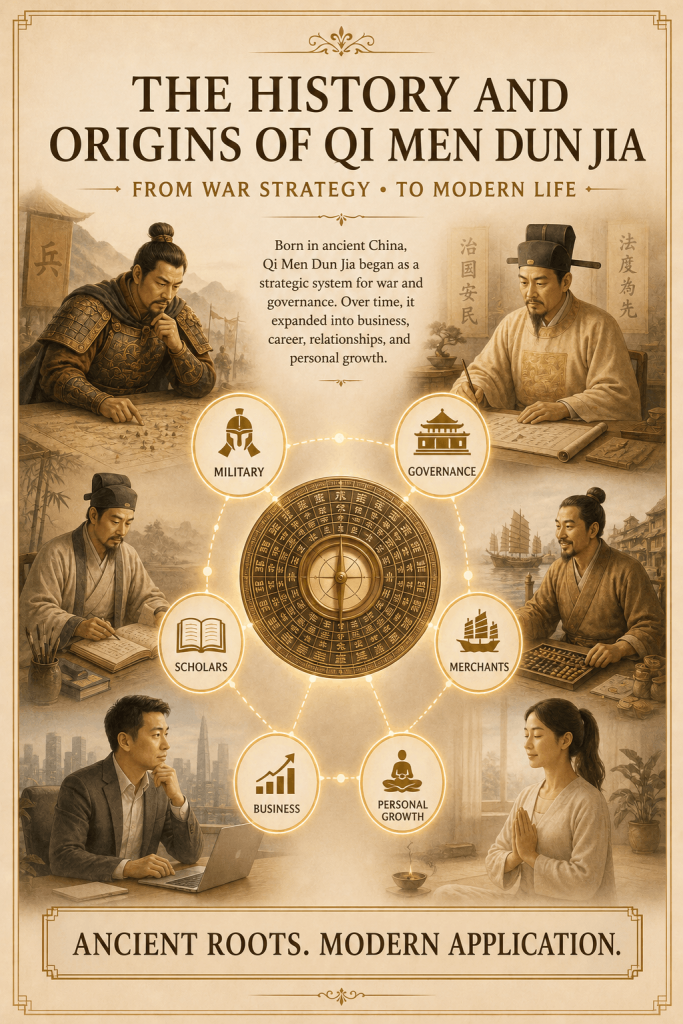
The short version of QMDJ history is on every website: ancient Chinese divination, military strategists, mysterious techniques. It is correct the way a postcard is correct. Here is the version I teach, the one that explains why this system survived when a hundred others quietly disappeared.
Qi Men Dun Jia began as a battlefield instrument. The name itself tells you: qi means unusual or strange, men means gates, dun means to hide, and jia is the first Heavenly Stem, the commander. The Hidden Gate Protecting the Commander. Picture a general with five thousand soldiers and a decision to make before dawn: attack through the mountain pass, wait three days, send a false rumor through the valley. His staff officers brought him many maps. The QMDJ chart was one more map, a map of time. It told him which hours carried momentum for a frontal assault and which hours were poison, which direction favored negotiation, which direction would bleed his men.
People today ask me whether the generals really believed it. I think the question is wrong. A general did not need the chart to be magic. He needed it to be a discipline, a structured way of thinking about timing and terrain and morale when the night was long and the information was thin. That is still what it is. I have sat with company owners facing decisions just as lonely as any battlefield, and the chart did for them what it did for those generals: it forced the question into a structure where the timing, the direction and the player could be weighed separately.
The System and Its Texts
The literature is genuinely old. The technique appears in fragments from the Han dynasty, takes shape in the Tang, and by the Song dynasty it is documented in earnest. Two classical texts anchor the tradition: the Qimen Dunjia Tong Tong, sometimes translated as the Complete Compendium of Qi Men Dun Jia, and the Yujing Dun Jia, the Dun Jia of the Mirror of Heaven. The Qing dynasty scholar scholar-officials kept copying and commenting, which matters more than it sounds: a court bureaucracy does not spend centuries copying a manual it considers worthless.
The system’s core claim was always about the hour. Unlike the year-scale systems, the ones that map a whole life from a birth moment, QMDJ was built to answer the question in front of you right now. Where do I move today. When do I speak. Which door do I walk through, in both the literal and the strategic sense. That hourly character is why it stayed close to the military, and it is why modern business people, who also live hour to hour, find it so natural.
From the Court to the Commons
For most of its life the system lived in a small circle: court astronomers, military advisors, wandering professional strategists. The knowledge was guarded, and teachers taught by hand because there was no other way. Two things broke that open. Printing put the tables into books that ordinary literate families could own, and the diaspora carried the practice to Southeast Asia, where it mixed with local traditions and lost some of its courtly secrecy.
In Singapore and Malaysia the modern era really began in the second half of the twentieth century, when a generation of Chinese-medium teachers started accepting fee-paying students from outside the family line. My own lineage runs through this Southeast Asian transmission, through my teacher Grand Master Yap Cheng Hai, whose school bridged the classical material and the modern classroom. When I teach, I am explicit about this chain, because a system this old deserves to know where its hands have been.
You can read more about my lineage and its obligations on the lineage page, and if you want the long version of the historical arc, I wrote a separate piece on the history of Qi Men Dun Jia that goes deeper into the texts and the periods.
Why It Did Not Die in the Twentieth Century
The twentieth century was unkind to Chinese metaphysics. Wars, migration, the interruption of family lineages, and then decades in which the practice was treated with everything from suspicion to contempt. Systems that depended on a single living chain of teachers snapped. QMDJ survived on three strengths.
First, its tables are mathematical. Once the rules for casting a chart are written down, the chart can be rebuilt by anyone who follows the arithmetic, which means the system survives the death of any particular teacher. Second, its subject matter is decision rather than fate, and decisions never go out of fashion. Third, it migrated into communities that valued it, and in Malaysia and Singapore it found a home where the material could be taught openly in the evening-class culture that produced many of today’s teachers, including mine.
What I Added to the Chain: Teaching It in English
Here is the part of the history I am writing myself. For three decades I ran businesses, hired people, and made the kind of decisions that keep you awake at two in the morning. I came to QMDJ in my forties and found a system that spoke to exactly that experience: strategy, timing, people. When I committed to teaching it, I made a decision that surprised some of my colleagues: I would teach it in English, to working professionals, with the classical integrity intact.
That meant building a full English vocabulary for a technical Chinese subject. Not translations that hover helplessly between meanings, but working terms: the Eight Deities, the Nine Stars, the Hidden Stem, the chart hour. It also meant refusing to strip the system down into a weekend of feel-good symbols, which would have been easier to sell. My rule to this day: if I cannot explain a classical rule’s reasoning, I say so, and if a rule has three schools arguing about it, you hear about all three. You can read exactly how I run the training on the course page, and my selection process for consultants is on the record too, because not everyone qualifies, and I would rather you know that from the start.
A Note on the Legends
Every old system collects stories. QMDJ’s favorite legends give its invention to the Yellow Emperor and its refinement to the strategist Zhuge Liang, who is supposed to have used it at the Battle of Red Cliffs. I treat these stories the way I treat the story of my own first business: fondly, and with an awareness that memory grows leaves. The verifiable history is Chinese, long, and respectable enough without the legends, but the legends tell you something true about how the tradition saw itself: as a thinking tool for leaders at decisive moments, not a fortune-teller’s toy.
When someone asks me at a dinner party what I teach, I still use the old framing, because it is the honest one. I teach the system emperors consulted before battles, and I teach it to business owners before their own quieter battles, and the chart on the table looks almost the same.
The Time Engine: Solar Terms, Yin and Yang Dun, and the 1,080 Ju
Most people meet QMDJ through its symbols: doors, stars, deities. Underneath all of that sits something most courses barely teach, and it is the part that convinced me this system was built by serious people rather than romantics. QMDJ runs on a time engine, a precise calendar arithmetic that converts any moment into one of a thousand and eighty distinct charts. Not a mood, not an intuition: an arithmetic.
The Two Halves of the Year
The engine starts with the solar year, cut at the two solstices. From the winter solstice to just before the summer solstice the year runs its yang dun, the ascending half, when daylight is growing. From the summer solstice to just before the winter solstice it runs its yin dun, the descending half, when daylight is shrinking. Everything else in the chart descends from this single split, because the half of the year you are standing in decides which way the plates rotate.
I explain it to business students like this. The solar year has an up-cycle and a down-cycle, and the chart respects it. Yang dun hours are built for moves that need pushing out into the world: launches, proposals, first contact. Yin dun hours suit moves that need pulling in: negotiation, consolidation, quiet positioning. Neither is better. They are different physics, and pretending otherwise is how people make confident moves at the wrong time.
The Nine Ju: Levels of Rotation
Within each half, the engine assigns a number from one to nine, called the ju, the dwelling or rotation level. Yang dun ju one through nine, yin dun ju one through nine, and each ju places the stems into the nine palaces in its own fixed pattern. Multiply the possibilities and you get the eighteen chart families. Layer in the positions that change by hour and the full space opens to 1,080 distinct charts, a number the classical texts treat with the kind of reverence engineers reserve for a well-made machine.
The traditional counts describe this as 1,080 ju: 108 patterns for each of the ten-day cycles, mirrored and doubled across the two halves of the year. You do not need to memorize the cosmology to use it. You need to respect that a chart is not a vague weather report. When I tell a client that Thursday at 2pm runs yang dun ju three, I am handing him the output of a calculation that would have been recognized in a Song dynasty military camp.
Solar Terms: The Real Calendar
QMDJ does not run on the phases of the moon, and this surprises people who assume everything Chinese is lunar. It runs on the jie qi, the twenty-four solar terms, the same calendar that governs traditional farming. Each term marks the sun’s real position: the equinoxes, the solstices, the moment the sun crosses into the next zodiac degree. The chart for your question depends on which solar term the day sits in.
This matters for a practical reason. The solar term calendar means the QMDJ year starts at the winter solstice in December for engine purposes, and the term boundaries drift through the western calendar by a day or so. Anyone who casts charts around a term boundary without checking the exact date is building on sand. I have reviewed charts from students who could not understand why their readings were off, and the answer was a solar term boundary crossed without noticing.
The Hour, the Day, and the 23:00 Rollover
QMDJ is an hourly system at its working end. The Chinese day is divided into twelve double-hours, and the chart is cast for the double-hour of the question. The subtlety that separates careful practitioners from sloppy ones is the 23:00 rollover. In traditional reckoning, the hour from eleven at night to one in the morning belongs to the zi hour, the first hour of the next day. Day energy rolls over at 23:00, not midnight.
Get this wrong and everything downstream is wrong: the day stem, the hour stem, and therefore the entire analysis. Half the chart errors I see from beginners trace back to this single rule. It is the first thing I test when a student brings me a chart that reads strangely. The classical method has its own conventions around early and late zi hour that schools argue about; I follow the convention I was taught, and I will tell you plainly that consistency matters more than picking a side, because the system only reads cleanly when the whole chart is cast under one convention.
Counting the Days Without a Computer
The traditional method for finding the ju requires counting days from the winter solstice, through the solar terms, dividing by five-day ju cycles, and tracking remainders. Old manuals are full of tables and mnemonics for exactly this. I learned it that way, with pen and paper, and I make my students do it once so they understand what the software is doing. Then I let them use the software, because the counting is bookkeeping, not insight.
If you want to see the engine working, I built an online QMDJ calculator that casts the hour chart with the solar term arithmetic and the 23:00 rollover handled correctly. It was validated against historical anchor dates before it went live, and I keep it free because a system that claims precision should be able to show its arithmetic to anyone who asks. The calculator article also walks through what each layer means, so you can follow along with the parts of this page that use chart examples.
What the Engine Is Saying
Here is the part I most want you to keep. The engine does not predict. It labels. Any moment in your life can be labeled with its ju and its pattern of energies, and once labeled, the moment can be compared to other moments. That is the entire magic trick. When a client asks me whether to sign on Monday or Friday, I am not seeing the future; I am reading two labels and handing back the comparison. Friday’s label has an Open Door that sits well with the deal in question, and Monday’s has a blocked formation, so Friday is the better container for that particular signature.
People who sell QMDJ as prediction do it no favors. The honest version is more useful anyway, because comparison is something you can act on, verify, and learn from. I wrote a piece on why timing is everything in divination that expands on this with examples, and if you have ever wondered whether the system is scientific, read my answer to that question: it is rule-based and testable, which is more than most decision frameworks can say.
How a QMDJ Chart Is Cast: The Chai Bu Method
Before a chart can be read it has to be built, and the building is where most of the system’s logic lives. There are two classical casting methods, the chai bu, the split-and-supplement method, and the zhi run, the intercalary method. The versions taught in my lineage, and the version my calculator uses, follow chai bu, so that is the one I will walk you through. Do not worry about memorizing the steps on first read. What I want is for you to see that every symbol on the finished chart earned its place through a rule.
Step One: Fix the Moment
Casting starts by fixing the moment in the engine’s terms: year, month, day, hour, each converted into stems and branches. The day stem matters most, because it anchors the analysis, and the hour stem matters most for the question, because the chart is technically built around it. I teach students to write the four pillars of the question moment the way a BaZi chart is written, because the hour of the question is the BaZi of the moment. (If the term four pillars is new to you, that is BaZi’s home turf, and I have a full complete guide on the Four Pillars of Destiny if you want the background.)
From the day stem you find the hour group. Each pair of day stems, ten stems making five groups, generates a cycle of hours, and the question hour sits inside one of those cycles. This is the step where the 23:00 rollover from the previous section bites people. Cast the chart a few minutes after eleven at night and you must already be thinking of tomorrow’s day stem.
Step Two: Place the Heaven and Earth Plates
With the ju number from the engine, the six instruments and six stems are placed into their palaces on the earth plate, the fixed layer. The heaven plate is then rotated onto it according to the hour’s stem-branch, and where the two plates overlap, relationships appear: the same stem sitting in the same palace on both plates is fu yin, a doubling that mutes the hour. The heaven stem meeting its earth counterpart is a different kind of echo. Every overlap pattern has a name and a reading, and the classical texts are unusually strict about them.
The reason the rotation matters is that QMDJ reads relationships, not isolated symbols. An Open Door is good news only in context. The same door in a different palace, sitting against a different stem, in an hour whose own stem clashes with the door’s palace, can turn into the opposite. New practitioners want meanings for symbols; the system only has meanings for combinations.
Step Three: Fly the Stars, Land the Doors, March the Deities
Then the three moving layers fall into place. The Nine Stars are positioned by the hour’s palace and rotated by the day group, each star landing in a palace according to the rotation rules for that ju. The Eight Doors follow the earth plate logic, each door allocated by the hour’s branch cycle. The Eight Deities march in fixed order from the palace of the hour stem: Chief, Serpent, Great Yin, Partner, Hook, Vermilion Bird, Nine Earth, Nine Heaven, one per palace in sequence.
Notice what all three layers have in common: they are placed, not chosen. Nobody evaluates which star should attend your question. The hour you asked determines everything, which is why two people asking in the same hour get the same chart, and why the discipline of recording the exact time of a question is not pedantry. It is the whole method.
Step Four: Hide the Commander
Now the signature move that gives the system its name. The stem jia, the commander, never appears on the chart. Jia hides beneath one of the six instruments, the liu yi: the sun Yi, the moon Ji, the star Xin, the cloud Geng, the tiger Bing, the wind Wu, the cloud Ding, in the classical line-up the six deputies stand in for Jia in a fixed sequence. Which deputy carries the hidden Jia depends on the ju and the day, and the pairing is written on the chart as, for example, Jia hiding under Yi, or Jia hiding under Wu.
Students always ask why. The classical answer is protective: the commander is hidden so that the enemy, or the malicious attention of the hour, cannot find him. The practical answer is more interesting: the hidden commander gives every chart a protagonist. When you read a QMDJ chart, you are partly asking where the commander is hiding, which deputy carries him, and whether the door, star and stem around that palace help or trap him. The entire reading habit of the system grows out of that one image.
Step Five: Read the Overlaps
The finished chart is a nine-palace grid, each palace holding up to eight symbols: heaven stem, earth stem, star, door, deity, and the branch structure of the palace itself. Reading means scanning the overlaps: door against palace, star against door, deity against the door’s business, heaven stem against earth stem. Patterns with names surface, the classical formations I cover later, and the strong and weak palaces for your specific question become visible.
You can watch me run this whole sequence on video if you prefer seeing it done, and the site’s QMDJ Encyclopedia has the reference material for every layer if you want to check a placement rule. For casting practice itself, the calculator lets you cast real charts for real dates and check your hand-placements against the engine, which is how my own students drill.
Why Method Disputes Exist, and Why I Do Not Panic About Them
You will meet practitioners who cast differently: the zhi run camp, schools that use different hour conventions, lineages with extra layers. I am honest about this with students because pretending otherwise would be dishonest, and the industry has enough pretense. In my teaching the differences matter most at the boundaries, the term changes and the 23:00 hour, and much less in the body of ordinary practice. What matters in every school is the same: a consistent method, a correctly fixed moment, and the discipline to read combinations rather than single symbols.
The Nine Palaces: Earth Plate and Heaven Plate
Every QMDJ chart lives inside the luo shu, the magic square the Chinese tradition considers the floor plan of reality. Nine palaces: one center, eight around the compass points. The eight outer palaces each carry a trigram, an element, and a branch family, and the center palace belongs to earth and to the commander’s hiding ground. If you want to understand why the chart is read the way it is, you have to understand what a palace actually is.
The Earth Plate: The Ground That Does Not Move
The earth plate is the fixed layer, the terrain. Its stems are placed according to the ju and do not rotate during the chart’s life. When you look at a palace, the earth stem tells you what the ground itself is carrying in this hour, the standing conditions of that corner of your life. Earth stems are your baseline. A strong earth stem means the ground can hold weight; a wounded earth stem, one clashed by the heaven stem above it, means whatever you build in that palace sits on unstable footing.
The eight palaces divide into three groups that matter constantly in reading. The four cardinal palaces, north, east, south, west, hold two branches each and are considered more substantial. The four corner palaces hold the four corners of the trigram family and carry four branches’ worth of subtle influence. And the center palace, the fifth, is special: the classical texts treat it as the residence of the hidden commander, and several formations are defined by what falls into it.
The Heaven Plate: The Weather That Moves
The heaven plate is the rotating layer. Its stems fly according to the hour, and where they land, they interact with the earth stems underneath. The heaven stem in a palace is like the day’s weather over that piece of ground. Good weather over bad ground still limits you; bad weather over good ground wastes good ground. The chart’s real information sits in the meeting of the two: which heaven stems are meeting which earth stems, and what the combinations produce.
Some of these meetings are famous. A heaven stem sitting directly atop the same earth stem is fu yin, an echo that paralyses: effort doubled, result halved. (I wrote a dedicated piece on the fuyin chart in destiny work because it is the pattern students most often misread as good luck.) A heaven stem clashing the earth stem beneath it is friction in the ground. These are the small print of every reading, and they are why two charts with the same doors can tell opposite stories.
The Compass Directions Are Not Decoration
Each palace is also a compass sector, and this is what turns the chart into an operational document. When a reading identifies the Life Door in the northeast with a supportive star, that is not an abstract blessing: it is an instruction with a compass bearing attached. Conduct the negotiation from the northeast seat. Walk out through the northeast door. Make the call facing northeast. In classical practice, the direction was used to position troops; in modern practice, it positions meetings, desks, and even which coffee shop you pick. I teach the direction as a real lever, used with the ordinary sanity that applies to any lever.
The palaces also each own a body-region and a family of life topics in classical reading: north for career and flow, south for recognition, east for growth and new ventures, west for completion and harvest, the corners blending their neighbors. These correspondences are shared with feng shui, because both systems read the same magic square. The difference is time: feng shui reads the building’s fixed relationship to its palaces, while QMDJ reads which palaces are strong in this particular hour. I return to this when I discuss QMDJ and feng shui further down the page.
The Branches Under Each Palace
Each palace shelters Earthly Branches: the north palace holds zi and hai, the east holds mao, and so on through the twelve. The branches matter because they carry the clashing and combining relationships that refine a reading. A door that sits well until you notice its palace branch clashes the questioner’s year branch is a door with a warning label. I keep a reference set on the sixty stem-branch pairs on this site precisely because this layer of reading rewards fluency in branches, and fluency only comes from exposure. The birth-year library is the friendly way in if branches are new to you.
Reading the Grid Like a Practitioner
When I read a chart, I scan the grid in a fixed order, because a fixed order catches what mood misses. First the earth stems, to know the ground. Then the heaven stems, to know the weather. Then the doors, because doors say what kind of action the hour supports. Then the stars, which color the quality of that action, then the deities, which describe the surrounding weather of attention and intention. Only after all five scans do I look for the palaces that matter to the actual question. It takes longer to describe than to do, and after a few hundred charts it becomes one glance, the way an experienced shopkeeper reads a whole shelf in one glance.
The QMDJ glossary set on this site gives each door and star its own page with the classical attributes and the modern use, so rather than reproduce every table here, I will spend the next sections on what the tables cannot give you: how each layer actually behaves inside readings.
The Nine Stars: The Weather of the Hour
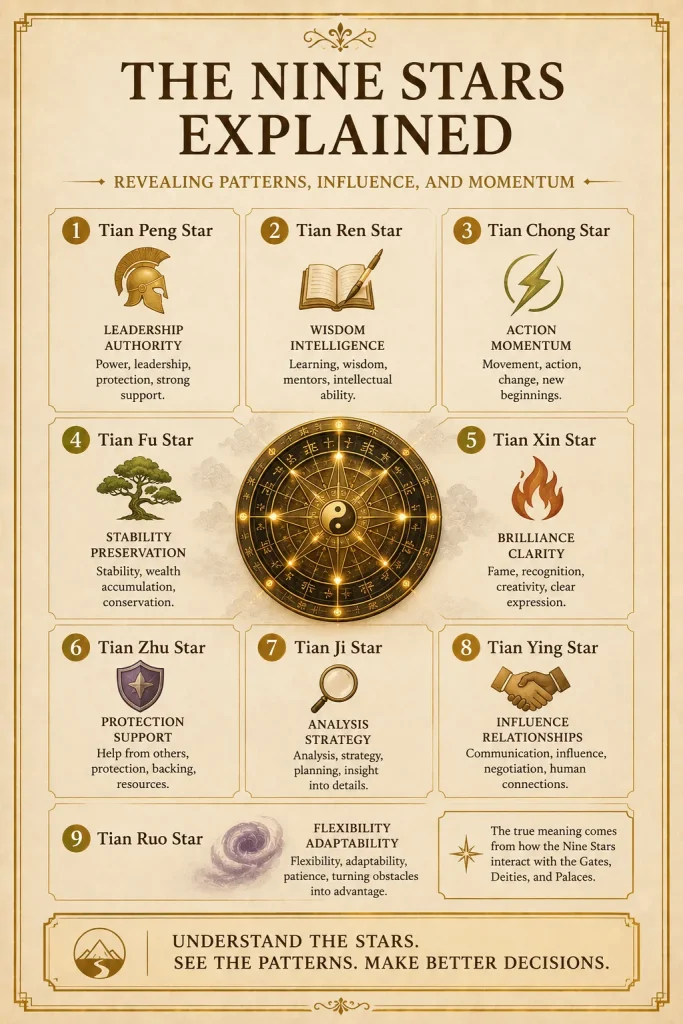
The Nine Stars are the quality layer of a QMDJ chart. If doors describe the kind of action the hour supports, stars describe the texture of the hour itself: bold or sluggish, generous or petty, clear or confused. Students memorize the stars’ names in a week and spend years learning to feel them, so here is the treatment I give my own classes, star by star, with the classical attribute first and the working meaning second.
Tian Peng, the Plunderer
Element water, the north palace’s dark elder. Classical texts call Tian Peng the thief star: reckless, consuming, prone to excess. In readings it shows up as the hour’s appetite, and it is not automatically bad. A Tian Peng hour is the wrong hour for signing a cautious agreement, and a very good hour for bold, competitive moves where audacity is the point. I have watched clients win tenders on Tian Peng hours by bidding aggressively when rivals played safe. I have also watched the same star wreck careful plans when it landed on the question palace of someone who needed patience. The star is a weather report; you choose the activity.
Tian Rui, the Threat
Earth element, the grim one, and honestly the star beginners fear most. Classical texts associate Tian Rui with decay, sickness, and grim outcomes. In practice I read it as contraction: the hour compresses, optimism meets resistance, and anything inflated gets deflated. Tian Rui in a negotiation palace says the other side will not be generous. It is the worst star for launches and the right star for an audit, a health check, or a conversation that needs to end something cleanly.
Tian Chong, the Charging Star
Wood element, the eldest son of the star family, and the star of momentum. Tian Chong hours favor initiative, first contact, opening moves, campaigns. If a client needs to start something, I look for Tian Chong, ideally with an open-class door, and it works especially well in the east palaces where its wood is at home. I wrote a full profile of Tian Chong in destiny charts because its personality is the easiest of the nine to feel, and feeling it teaches you what star-reading is.
Tian Fu, the Commander Star
Wood again, but command rather than charge. Tian Fu is the star of leadership, authority, and plans that hold their shape. In a chart where the question involves convincing people, managing teams, or presenting to a board, Tian Fu in the right palace is the single best support I know. It dignifies the hour. Where Tian Chong starts things, Tian Fu makes them stick.
Tian Qin, the Star of Kindness
Wood, the diplomat. Tian Qin brings softness, mediation, and warmth to a palace, and it is the star I look for in relationship questions, reconciliation, and any matter where being liked is not vanity but strategy. In business readings, Tian Qin in the counterparty palace tells me the other side wants a pleasant deal, which changes how I advise the client to negotiate.
Tian Xin, the Star of Heaven’s Messenger
Earth, and in the classical ranking the highest of the nine, the star that carries the mandate of heaven. Tian Xin brings legitimacy, correctness, and officialdom to a palace. In modern readings: regulators, awards, credentials, the court of public opinion. When a client’s question involves authority, I weight Tian Xin’s position heavily, and a strong Tian Xin in the question palace is one of the few patterns I will happily call an omen of clean success.
Tian Zhu, the Destroyer
Metal, the executioner of the family. Tian Zhu cuts: contracts end, relationships break, obstacles are demolished. Practitioners treat it with respect rather than fear. There are questions that need a clean ending, a decisive severance, a strong no. Tian Zhu in the right palace is excellent for firing a problem, and terrible for anything that needs growth. Reading stars well means accepting that some hours are for cutting.
Tian Ren, the Star of Blessing
Metal with water’s flexibility, the star of nourishment and recovery. Tian Ren softens a palace, brings help from unexpected quarters, and favors questions about health, rest, healing, and repair. It is the star I look for when a client asks about recovery, whether of money, body, or reputation. Tian Ren and Tian Qin together in supportive palaces is one of the gentlest and most reliable combinations in the system.
Tian Ying, the Star of Brightness
Fire, the youngest and most visible. Tian Ying is showmanship, presentation, and public warmth. In a launch palace it is excellent; in a stealth palace it is a problem, because brightness is the one thing a quiet move must not have. When I read charts for marketing campaigns, Tian Ying’s position is often the difference between a campaign that lands and one that shouts into the wind.
The Working Rules That Tie the Nine Together
Three rules govern star reading, and they matter more than the individual names. First, stars are read against doors: a door-star combination is a sentence, and the same star reads differently under a different door. Second, stars have home palaces where they are strong and palaces where they are exhausted; a bright star in a hostile palace is a good actor in the wrong theater. Third, the star’s element meets the palace’s element: productive relationships empower the hour, controlling ones weaken it.
For the reference tables and each star’s classical attributes, the glossary set has dedicated pages for Tian Peng, Tian Rui, Tian Chong, Tian Fu, Tian Qin, Tian Xin, Tian Zhu, Tian Ren and Tian Ying. I send students there after the first class, because memorizing tables before feeling the stars produces readers who recite instead of read.
The Eight Doors: The Main Instrument of the Reading
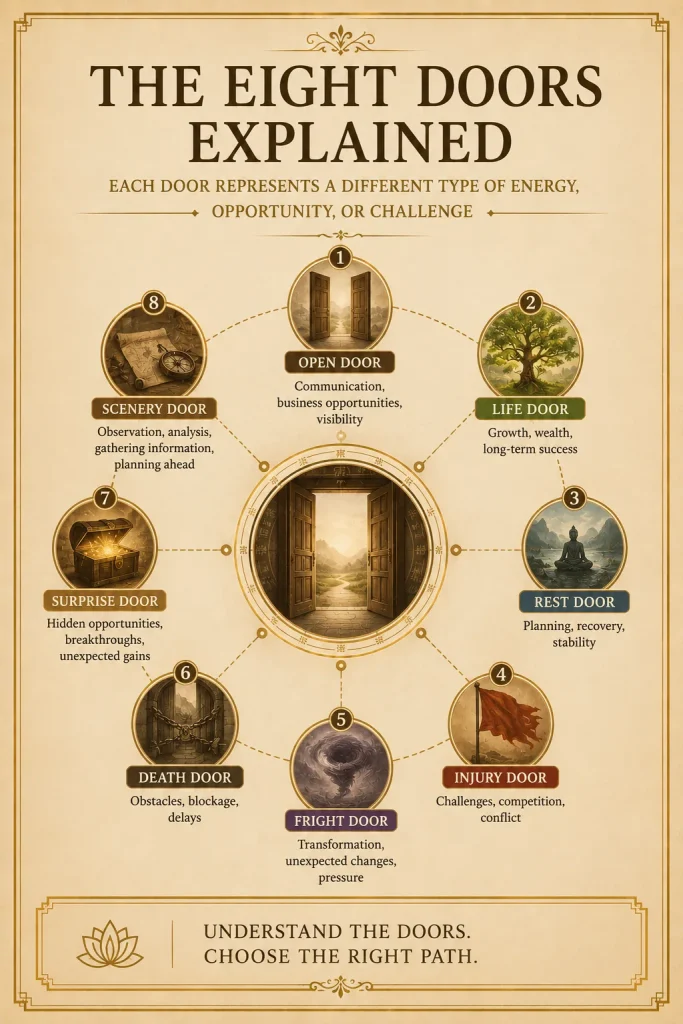
If the system is named after one layer, it is this one. The Eight Doors are the action vocabulary of QMDJ: each door names a mode of movement, and the door governing your question’s palace tells you what the hour will actually support. I call the doors the main instrument because in practical readings, the door is where most verdicts live. Learn the doors properly and you can already give useful readings; know everything else and fumble the doors and you cannot.
The eight sit in three natural families, and I teach them that way, because the families are easier to feel than the individual doors at first.
The Three Auspicious Doors
Open Door, Kai Men. The door of beginnings: opening talks, opening businesses, opening letters, meeting new people, launching. Classical texts rank it first for official matters and journeys. In my business practice, an Open Door hour with a friendly stem is when I tell clients to make first contact, submit the proposal, send the email they have been circling for a week. The glossary page on the Open Door has the full classical treatment, and there is a longer article on the meaning of the Open Door in destiny reading for how it behaves in life charts rather than hourly questions.
Rest Door, Xiu Men. The door of repair and recovery. Not laziness, restoration. Rest Door hours favor reconciliation, health matters, fixing what was broken, consolidating gains, and strategic patience. I reach for it constantly in matters where the temptation is to push harder, because it marks hours where the correct move is to stop pushing and let things knit.
Life Door, Sheng Men. The door of growth and the best friend of money questions. Classical texts tie it to longevity and prosperity; modern readers use it for revenue, deals that feed you, property, and anything that should compound over time. When a client asks about an investment’s long arc rather than its opening week, Life Door placement decides more of my verdict than any other single factor. The full profile is on the Life Door glossary page, and I also use the Life Door as a teaching example in this lesson walkthrough.
The Three Difficult Doors
Injury Door, Shang Men. The door of wounds, competition, and friction. Injury Door hours raise the temperature: disputes sharpen, small collisions happen, and aggressive tactics that would normally work get met with equal aggression. I read Injury Door constantly in negotiation charts, not because the deal dies, but because the door warns me the counterparty will fight on points, and the client should decide which points are worth fighting for.
Blocked Door, Du Men. The door of obstruction, and the most misunderstood of the eight. A Blocked Door hour stops movement, hides things, and blocks communication, which makes it terrible for launches and excellent for exactly three things: hiding plans from competitors, keeping confidences, and holding a defensive line. Some of the most useful advice I have ever given a client was a Blocked Door verdict: do nothing this week, let the other side exhaust itself, your silence is working.
Death Door, Si Men. The door of endings. It is not a curse; it is a cleanup. Death Door hours favor endings, burials, cancellations, and clearing out what should have gone months ago. I advise ending things on Death Door hours, deliberately, because endings done in the wrong hour linger. A client once needed to shut down a product line the team was emotional about; we chose a Death Door hour for the announcement, and the shutdown went with less drama than anyone expected. That is the door doing its proper job. The Death Door glossary page covers the classical cautions, of which there are many, and deservedly.
The Two Neutral Doors
Scenery Door, Jing Men. Fire, the door of appearances: documents, communications, presentations, examinations, publicity, ceremonies. Scenery Door hours favor anything made of words and images, contracts included, which surprises people who hear scenery and think decoration. Its risk is superficiality, brightness without substance, and I check the supporting stems before trusting it for anything weighty.
Fright Door, Jing Men. Metal, the door of shock and fear, and in practice the door of volatility. Fright Door hours produce surprises: sudden news, sudden reversals, and the emotional noise that comes with them. It can, in controlled use, mark hours for delivering uncomfortable messages, because the hour already expects a shock. Mostly, it is a door I route around.
Doors Read in Combination, Never Alone
The families above are training wheels. Real verdicts come from combinations, and three rules do most of the work. First, door against palace: each door has palaces where it is strong and palaces that trap it, and a good door in a hostile palace underperforms a modest door at home. Second, door against star: the door names the action, the star colors the quality, and classic pairings have earned their own reputations, some famous, some notorious. Third, door against question: the same door that blesses a launch damns a reconciliation, which is why no chart is read without the question being stated first. I hammer this into beginners during the first weekend of the course: state the question, find the door, then judge the door against the question, never against your hopes.
The eight doors have their own dedicated glossary pages, Open, Rest, Life, Injury, Blocked, Death, Scenery, Fright, each with the classical attributes and the practical guidance I use in consultations. Read them as a set once, and afterward use them as reference; the doors reward repeated visits the way a good dictionary does.
The Eight Deities: The Weather of Attention and Intention
The Eight Deities are the layer students love and teachers distrust, in that order. They are sometimes called spirits, sometimes gods, and the translation does the layer no favors, because nothing here is supernatural in the way the English words suggest. In reading terms the deities are the atmospheric layer of the chart: they describe who is paying attention, what kind of attention it is, and what intention rides the hour. A door tells you what the hour supports. A deity tells you the mood of the hour, and in negotiation and relationship questions, the mood is often the story.
The classical order is fixed, and the sequence matters because the deities march from the palace of the hour stem, one per palace, in the same order every single chart. Chief first, then Serpent, Great Yin, Partner, Hook, Vermilion Bird, Nine Earth, Nine Heaven. The order reflects a logic: authority first, then distortion, then privacy, then cooperation, then entanglement, then exposure, then stillness, then lift. Keep that sentence in your head and the deities stop being eight arbitrary names and become one system.
Zhi Fu, the Chief
The Chief is the noble one. Classical texts describe Zhi Fu as the highest official: dignified, senior, legitimate. In a chart it raises whatever palace it lands in. A question palace under the Chief is a question being heard by the senior table rather than the front desk. In business readings, the Chief on the counterparty palace tells me the deal will be decided by the top person, not the account manager, which changes how the client should prepare. The Chief pairs beautifully with the Open Door and Tian Xin, the messenger star: authority plus action plus legitimacy is the closest a chart comes to a green light.
One caution the old texts make and I make louder: the Chief dignifies, it does not guarantee. I have seen the Chief sit on doomed ventures. What the layer adds is weight and officialdom, and weight cuts both ways when the underlying combination is weak. Read the ground first, the weather second, the mood third.
Teng She, the Serpent
The Serpent is the distortion layer. Where it lands, things twist: documents have fine print, statements have second meanings, worries have a way of proving founded. Classical descriptions call Teng She cunning and winding, and in practice it marks the palace where you must check twice. It is not evil, and I want to be careful with that word in general, because half of what gets called evil in QMDJ is simply the wrong hour for the intended move. The Serpent in the contract palace during a signing hour is a red flag, and I have had clients send me agreements where the Serpent flagged exactly the clause that later became the problem. The Serpent in a strategy palace, on the other hand, favors complexity: plans within plans, feints, multi-step negotiations. I use it deliberately when a client needs a hidden agenda protected.
Students who fear the Serpent usually fear their own tendency to overthink. If a chart’s question palace carries the Serpent and the client is already anxious, my first advice is procedural, not mystical: write down the actual worry, name the actual counterparty, and only then decide whether the chart is warning or reflecting. A chart read by an anxious reader is a mirror, not a map.
Tai Yin, the Great Yin
Great Yin is the privacy layer, the shade. It hides things, protects things, and favors discretion. Where the Serpent distorts, Great Yin conceals. In readings I look for Great Yin when the client needs something kept quiet during its fragile stage: a deal before announcement, a hiring decision before it is signed, a negotiation position before it is revealed. It is also, in classical practice, the layer associated with secretaries, assistants, and the people who actually run things from behind the throne. When a middle-aged business owner tells me the real decision maker is not the person in the meeting, Great Yin sitting on the counterparty palace is the chart agreeing with him.
The caution writes itself: hours that conceal are hours that can be concealed from you. Great Yin across a deal where you have information disadvantages is a prompt to demand transparency before signing, not after.
Liu He, the Partner
The Partner is the connection layer. It binds: partnerships, agreements, meetings of minds, relationships. In deal questions, Liu He in the right palace is one of the genuinely reassuring sights, because it says the parties can actually come together rather than merely tolerate each other. In relationship questions it supports reconciliation, introductions, and the kind of conversations that end in warmer rooms. In classical texts it is the deity of marriage brokers and contract mediators, the social glue of the chart.
Its weakness is the weakness of harmony itself: it can be conflict avoidance wearing a smile. A Blocked Door softened by Partner is not a passing obstruction, it is an obstruction with company, the polite delay that never resolves. When I see that combination I tell clients to be warm and to be direct, because the hour will reward warmth but will punish conflict avoidance with more of the same.
Gou Chen, the Hook
The Hook is the entanglement layer, the classical litigant of the chart. Where Gou Chen sits, things snag: obligations from the past, unfinished commitments, third parties with claims. In business readings the Hook often identifies the hidden stakeholder: the silent partner, the previous investor, the relative whose blessing nobody counted. In property questions it flags title complications and encumbrances. It is the layer of things that must be unhooked before the main move can proceed, and more than any other deity it rewards the boring habit of checking paperwork.
Like every layer, it has a productive use. The Hook anchors: some questions need holding power, a position that will not let go. A defense, a retention, a long-term commitment that must not dissolve under pressure. Used that way, Gou Chen is not a snag but a knot of the good kind.
Zhu Que, the Vermilion Bird
The Vermilion Bird is the speech layer: communication, information, documents, and the noise they make. It governs messages, letters, presentations, examinations, and reputation, which is speech at scale. Where Zhu Que lands with fire support, words travel well that hour. Where it sits clashing its palace, words wound: arguments, leaks, misquotes, the email you cannot unsend. I check Zhu Que before clients send anything public, from press releases to hostile replies, and the number of drafts I have advised people to sleep on under a bad Zhu Que would fill a filing cabinet.
Its darker classical associations are lawsuits and slander, and there is a practical reason. Disputes travel through speech, so the bird carries them. If a client faces litigation, the Vermilion Bird’s palace, its element balance, and its door tell me a surprising amount about how the matter will move, and the assessment of legal and financial exposure is one of the areas where hourly charts earn their keep.
Jiu Di, the Nine Earth
Nine Earth is the stillness layer, the turtle of the chart. It stabilizes, grounds, and slows. Hours under Nine Earth favor consolidation, saving, protecting, and the quiet accumulation of position. It is the deity of the defensive strategist: let the ground hold, let the other side spend its energy. In property questions, Nine Earth on the asset palace is a genuinely good sign, because ground that holds is what property is. In launch questions it is the reverse: momentum chokes, openings stall, and the correct reading is usually patience rather than push.
I pair Nine Earth with the Rest Door in my own practice calendar for recovery weeks, and I teach students to do the same. The combination is the chart saying rest without apology, and business owners need the permission in writing.
Jiu Tian, the Nine Heaven
Nine Heaven is the lift layer, the eagle to Nine Earth’s turtle. It raises: visibility, ambition, reach, and speed. Hours under Nine Heaven favor things that need to be seen from far away: launches, announcements, travel, bold positions, anything whose success depends on being noticed. In classical military use it marked directions for attack; in modern practice it marks the directions and hours for getting attention. Nine Heaven with the Open Door is one of the classic go signals, and Nine Heaven with the Scenery Door on a publicity question is a campaign hour I would book a plane ticket for.
Its risk is lift without ballast. Ambition without support underneath reads as hype, and I have watched clients interpret Nine Heaven as destiny and burn fuel they did not have. The chart never cancels arithmetic; the best hours still belong to prepared people.
Reading the Deities Without Superstition
Three working rules keep this layer useful and honest. First, the deities are read in sequence from the hour stem, so their positions are fixed by arithmetic, not chosen by significance; nobody’s grandmother is deciding which palace the Serpent occupies. Second, deities weight the reading, they do not replace it: a strong combination under an awkward deity is a strong reading with texture, and a weak combination under a helpful deity is still weak. Third, the deity names are metaphors for attention and intention, and every one of them has a productive use and a caution, which is the pattern of the whole system.
If you want to see the deities inside complete readings, the case studies section of the encyclopedia uses them throughout, and the business case where they do the most work is in the section below on using QMDJ in business.
The Ten Stems: The Actors on the Board
Every chart has a cast, and the Ten Heavenly Stems are it. Where doors describe actions and stars describe weather, stems are people: the commander, the advisor, the diplomat, the enforcer. Ten stems, ten characters, and the art of reading them is closer to casting a play than to memorizing a table. Jia, the commander, hides, as I explained in the casting section; the other nine appear on the plates, and each has a personality the classical texts describe with unusual vividness.
The Five Yang Stems: The Outgoing Cast
Jia, the Commander. Hidden by design under one of the six instruments, Jia is the protagonist of every chart. The central question of most readings, once you learn to see it, is where the commander is and who carries him. In business questions the commander is the client or the ultimate decision maker. In courtship of any kind, professional or personal, the commander is the one whose approval matters. I profiled the Jia person’s character in destiny work separately, because a person whose day master is Jia carries the commander’s presence in ordinary life, and it is one of the most recognizable signatures in destiny reading.
Bing, the Sun. Bright, warm, visible, and classical texts call Bing the sun. The Bing person radiates: good will, attention, and sometimes heat. In a chart, a Bing stem in the question palace warms the matter and makes it visible; in negotiations, Bing on the counterparty side means the other table wants to be seen being reasonable. The Bing person profile goes deeper into how the sun’s warmth turns to scorch when the hour is already hot.
Wu, the Gate. The earth stem: solid, immovable, the keeper of walls and boundaries. Wu people are the institutional ones, loyal, slow to change, excellent at holding ground and terrible at improvising. In charts, Wu in a palace grounds the matter, and Wu under attack is the picture of an institution under strain, which is why I read Wu carefully in questions about regulators, landlords, and boards.
Geng, the Metal Blade. The stem the classical texts treat with the most respect and wariness: hard, decisive, sword-like. Geng cuts through obstruction and also through people. In a conflict question, Geng on your side is an advocate who will not flinch; on the counterparty side it forecasts a hard negotiator. Geng is also the main antagonist of the hidden commander in classical formation logic, which is a piece of structure students meet when they learn the formations.
Ren, the Ocean. Water in motion, the strategist of the stems: mobile, adaptable, everywhere. Ren people think in flows and systems, read rooms quickly, and dislike being pinned. In charts, Ren smooths and carries, and a palace that holds Ren can usually be moved, which makes it the friend of relocation and logistics questions.
The Five Yin Stems: The Behind-the-Scenes Cast
Yi, the Wind. The advisor. Flexible, diplomatic, and classical texts picture Yi as the counselor at the commander’s ear. Yi adapts to whatever room it enters, and in charts it softens and negotiates. When I see Yi in the counterparty palace, I expect a counterparty that wants a graceful deal. When I see Yi as the client’s representative in the hour, I expect the client’s message to arrive dressed as accommodation.
Ding, the Candle. The night light: precise, focused, warm at close range. Ding governs details, documents, plans drafted by lamplight. Ding in the contract palace is a genuinely reassuring sign for paperwork. Ding people are the meticulous ones, and classical texts, always a little dramatic, associate the candle with both devotion and secret correspondence, which in practice means the stem of things done carefully and kept private.
Ji, the Cloud. The negotiator of small spaces, and in the classical line-up the carrier of the sixth instrument. Ji is the sediment stem: absorbing, compromising, occasionally murky. It handles the humble work of adjustments and accommodations. In charts it flags matters that will be settled by patience and incremental concessions rather than grand moves.
Xin, the Jewel. Refined metal: sharp, clean, valuable, and classical texts picture Xin as gems and small blades. The Xin person is precise, exacting, and quick to notice flaws, which makes Xin the stem of quality control in every sense. In charts, Xin in a product palace promises refinement, and Xin clashing a sloppy palace predicts the audit that finds the flaw.
Gui, the Rain. The final stem, the quietest water: penetrating, persistent, and in the classical imagination the stem of both gentle rain and trickles that find every crack. Gui is the last yin stem and the classical texts grant it the darkest of the ten reputations, which honest practice softens considerably. What Gui actually does is permeate: nothing dramatic, nothing fast, and very little stays sealed against it. In readings it favors discreet channels, indirect approaches, and the slow drip that beats the flood.
How Stems Actually Behave in a Reading
Four habits turn the cast into a reading. First, every question assigns the stems roles: in a deal question, the client’s side, the counterparty’s side, and the matter itself each map to stems, and the map is a convention you agree on before reading, which is why state-the-question-first is a rule and not a suggestion. Second, stems fight and support through the standard element cycle: Geng cuts Jia’s wood, Ren waters Yi’s growth, and the cycle is the same five-element arithmetic that runs the rest of Chinese metaphysics. Third, the heaven-plate stem is read against the earth-plate stem beneath it, the weather against the ground, and the combinations are what give readings their specificity. Fourth, stems carry the instruments: the six deputies under which Jia hides are stems, so the cast and the hidden-commander logic are the same layer, and a reader fluent in stems is already halfway fluent in formations.
The stems also anchor destiny reading, where the day stem of your birth chart is the role you were cast in for life, and the same ten personalities apply with fascinating consistency. I will not pretend the correspondence is laboratory science; I will say that after a few hundred destiny charts, the consistency is the part that keeps teachers humble.
The Five Elements Are the Grammar
Underneath the stems sits the five-element cycle: wood, fire, earth, metal, water, producing and controlling each other in the fixed pattern every Chinese system shares. If the stems are the cast, the elements are the grammar the cast speaks. A Geng hour meeting a Yi matter cuts it. A Ren hour meeting a Jia matter feeds it. Every verdict I give in consultations descends from this grammar plus the specific chart, and if you want the full treatment of the elements themselves, my Feng Shui guide covers the cycle in depth, and the glossary set applies it term by term.
Classical Formations: The Named Patterns
Formations are the crown jewels of QMDJ reading, the named combinations that the classical texts collected over centuries because they recur. A formation is a specific arrangement of stems, sometimes with doors and stars attached, that carries a fixed reading. Think of them as case law: not new rules, but decisions the tradition has already handed down, which you can cite in your readings. I teach a working set of about twenty, and I will describe the ones that matter most to modern questions.
The Hidden Commander and the Six Instruments
The foundation formation is not dramatic: Jia hiding under the six deputies, Wu the cloud, Ji the rain soil, Geng the blade, Xin the jewel, Ren the ocean, Gui the mist, Ding the candle, Yi the wind. Which deputy carries Jia in a given chart changes everything, because each pairing brings the commander’s protection into a different element and a different palace neighborhood. Charts are often summarized by this pairing alone, the way weather reports are summarized by their front. The pairing tells you, before anything else, who is standing in front of the client’s interests this hour.
The Famous Auspicious Formations
Flying Bird Falls into the Nest. Heaven plate and earth plate meet with the same stem and the same door in a harmonious palace, and the classical image is the bird coming home. In practice: effort meets welcome, submissions land well, the client arrives where the room was already waiting. It is the formation I hope to see under first-contact questions: proposals, applications, pitches. Its modern success rate in my own logs is exactly what the classical texts promise, which is one of the small private satisfactions of this work.
Green Dragon Turning Back. A retreat that is secretly an advance. The formation appears when a stem configuration means the correct move is to yield position in order to regain it with interest. I have used it to time concession tactics in negotiations: give the point away today, the formation says, and the concession is the winning move. Students who know only aggressive formations misread it as weakness, which is precisely why opponents also misread it.
The Nine Heaven formations for visible moves. With Jiu Tian, the lift deity, attached to strong stems, hours appear that carry launches, announcements, and travel exceptionally well. Classical campaigns were opened under them; modern product launches are.
The Famous Difficult Formations
Fu Yin, the Echo. The same stem on both plates, and the hour answers itself. Movement stalls, plans circle, and effort doubles without result. I wrote the dedicated piece on fuyin in destiny charts because in hourly practice it is a caution, but in destiny practice it marks lives that run in loops, and recognizing it early changes the advice.
The Gate Reversal. A door landing in a palace whose structure reverses its meaning: the Open Door that cannot open, the Life Door that cannot grow. Gate reversals are the reason door tables are not enough; the palace context can flip a door’s verdict entirely, and most beginner misreadings I correct are unspotted reversals.
The Strike formations. Combinations where Geng, the blade, arrives against the hidden commander’s palace or deputy. The classical texts, written for generals, describe these bluntly: ambush territory. In modern readings they mark hours where the client’s interests are under direct attack: the counterparty plans to strike first, the competitor is timing a move, the honest response is to secure position rather than to advance.
How Formations Are Actually Used in Modern Practice
Three honest notes about working with formations, because the online lore around them is untidy. First, formations are combinations, not spells. The same formation that blesses a product launch says nothing useful about a surgery date, because the question determines which formations are even relevant. Second, schools disagree about a handful of the named patterns, their exact stem arrangements and their readings. I teach the versions from my lineage and say so in class when a pattern is disputed, which the market’s louder voices rarely bother to do. Third, formations compress experience, and compression loses nuance. A formation is the starting point of a verdict, never the whole verdict.
Where I most often see the famous patterns in daily work is business timing, and the next section shows formations doing their job inside real consultation questions. If you want the classical reference side, the encyclopedia carries the tables, and my course spends a full module on formation recognition with graded chart drills, because the only way to learn patterns is reps.
Reading a Chart: My Step-by-Step Method
Everything above was machinery. Here is the machine turned on. This is the reading method I use in consultations, the same one I teach, and it works for hourly questions of every kind: deals, decisions, disputes, timing, people. If you read one section of this page twice, make it this one.
Step one: state the question in one sentence, and fix the time. Not a topic, a question. Will the acquisition close this quarter. Should I hire this candidate. Is Friday the right day to resign. Write the question down, then write the exact time it was asked, and cast. The discipline sounds bureaucratic and it is. Vague questions produce vague charts not because the arithmetic fails but because no palace can be matched to a question that has no edges.
Step two: identify the palaces that matter. From the stated question, the reading assigns palaces: the client’s palace, the counterparty’s palace, the matter’s palace, sometimes a time palace for the deadline. The conventions are teachable and fixed; this is where the casting method pays off, because palace assignment is rule-following, not intuition. A hiring question puts the candidate in one palace and the company in another; a deal question does the same two-step with buyer and seller.
Step three: read the ground. Earth stems first, the standing conditions. This tells you the underlying strength of each party’s position before any hour-weather is considered. I cannot count the readings where the ground layer alone settled the matter: the counterparty palace sitting on a wounded stem was the whole answer to will they honor the handshake.
Step four: read the weather. Heaven stems against earth stems, the door in each key palace, the star, the deity. In that order, palace by palace, not layer by layer across the whole grid. You are telling each party’s story, not auditing the chart.
Step five: check the crossings. Now the relationships between palaces: clashes between the client’s palace and the matter’s palace, harmonies between the counterparty’s palace and the deadline. Also the branch clashes under the palaces, the fu yin echoes, the gate reversals. This is where formations surface, and where most amateur readings stop too early.
Step six: check the clock inside the chart. The same chart usually contains its own timing hints: the empty hours, the branches that indicate days or weeks in classical convention. Verdicts without timing are half verdicts, and will this work and when will this work are different questions that the same chart usually answers together.
Step seven: state the verdict in plain language, with the action attached. The reading ends with three sentences: what the chart shows, what it favors, and what to do, including the direction and window when the question is a timing question. If a client leaves my table able to repeat the advice but not the reasoning, that is success. If they leave confused, that is on me.
Two habits keep the method honest across years of practice. I keep a reading log with the question, the hour, the verdict, and the outcome, reviewed monthly, because a system this old deserves an owner who tracks its hit rate; and I reread the classical formation texts every year and find, every year, that some passage I thought I understood has grown a new meaning. The step-by-step reading walkthrough on this site shows the full method on a live example if you want to watch it run before trying it.
QMDJ in Business: The Way I Have Used It for Three Decades
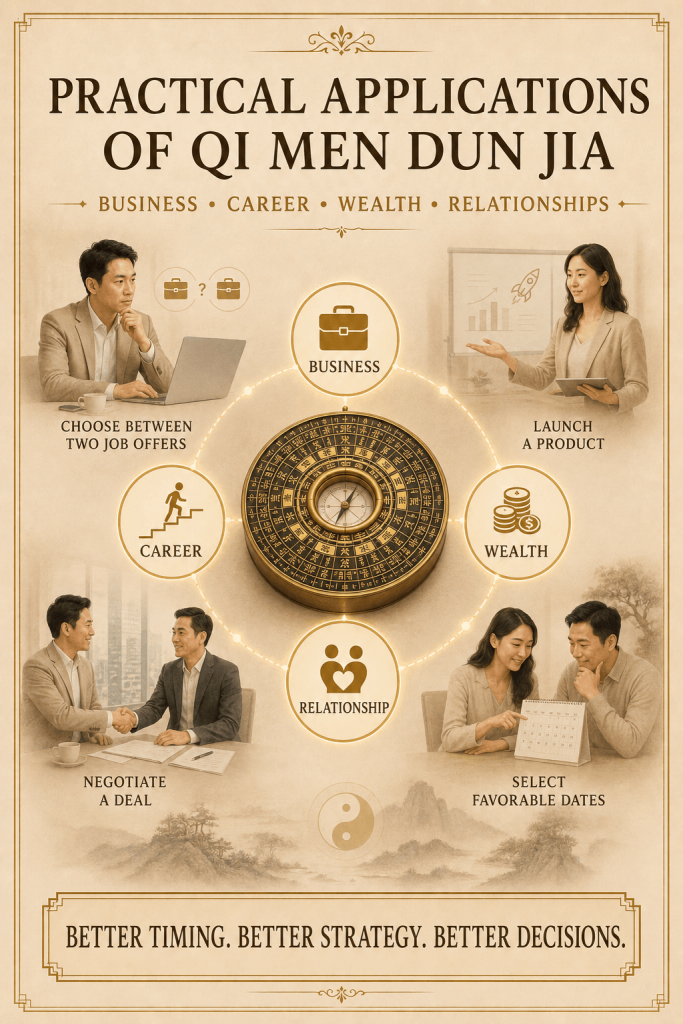
Business is where QMDJ earned its keep in my life, and I want to write this section the way I would explain it to a friend across a dinner table, because the marketing copy you will read elsewhere makes this system sound like a magic button, and the truth is better and more useful than that.
I spent thirty years running companies before I taught metaphysics. Hiring, firing, negotiating, expanding, closing down, starting again. The one lesson those decades burned into me is that the quality of a decision has two parts: the decision itself, and the moment you execute it. The same offer, made by the same person, lands differently on Tuesday morning than it does on Friday afternoon. I built my companies around that truth long before I could name it. What QMDJ gave me, when I finally studied it properly, was a structured way to see the moment. Not a replacement for judgment. A second opinion that never gets tired and never flatters me.
Deal Timing: The Core Business Use
The most common consultation question I receive from business owners is some version of: which day this week should we sign, launch, meet, or announce. The method is always the same. Cast the chart for the candidate windows, assign the palaces for the client’s side, the counterparty’s side, and the matter, and read the combinations. I am looking for four things: a door that matches the action (Open Door for openings, Life Door for long-horizon deals, Scenery Door for documents and announcements), a star that supports the tone, a deity that describes the attention in the room, and clean crossings between the palaces.
A short example from my log, with the client’s details changed. A distributor was choosing between two suppliers, both offering similar terms. The charts for the two meetings were radically different. In the first supplier’s chart, the counterparty palace carried a strong earth stem with the Partner deity, a counterparty whose word was likely to hold, in an hour that favored agreement. In the second, the Serpent sat on the counterparty palace with a door reversal, the classic picture of terms that look fine in the room and twist in the paperwork. My client signed with the first supplier, and eight months later the second supplier was in a dispute with another distributor over exactly the kind of clause that had been visible in the chart. That is a normal outcome in this work: the chart does not outperform information, it reads the hour’s character, and characters repeat.
If you want this explained systematically, I wrote a full piece on business forecasting with QMDJ and another on the decision making system side of the practice. Between them they cover the workflow I use for clients today.
Hiring and Partnerships: Reading People Before the Contract
The second most common question is about people. Should I hire this candidate. Should I take this partner. Is this manager telling me the truth about the numbers. Hiring was my life for decades, and I will tell you what personnel people all know: the interview is a performance, both sides acting, and the truth about a person shows up in month three. What a hiring chart does is pull month three forward into the interview room, in the form of a reading on the candidate’s palace: the stems for capability and character under pressure, the star for the quality they bring, the deity for the attention they carry.
Used honestly, this narrows risk; it does not replace references, trial weeks, or probation periods, and I say so in every consultation. A client came to me with two finalists for a country manager role. Both interviewed beautifully. The charts disagreed sharply: one candidate’s palace sat on a solid stem with a harmony formation, the other sat on the Blade with the Serpent above it. The client ran his normal process, extended both candidates’ probation differently on my advice, and within four months the difference was visible without any chart. That is the pattern I trust: the chart reads the weather, and weather keeps its promises. The deeper treatment of people-reading in business is in choosing business partners and recruitment decisions, and there is a case study worth reading in choosing between job offers from the candidate’s side of the table.
Negotiation: The Strongest Practical Use
If I had to keep only one business application, it would be negotiation timing. Negotiation is the one business activity that is almost pure hour: the room, the energy, the other side’s patience, all of it lives inside a two-hour window, and QMDJ is an hourly system. I use charts to choose the meeting hour, to read the counterparty’s likely posture before the meeting, and to pick which concession to hold and which to give early. The Green Dragon Turning Back formation, the strategic retreat I described earlier, is a negotiation tactic with a classical pedigree. The Great Yin deity is my cue to keep a position hidden. The Nine Earth is my cue to let the other side spend its energy.
None of this is mystical. It is preparation plus a map. Good negotiators already read rooms; the chart is the room read in advance. I wrote a pair of pieces on the executive decision angle and the management consulting practice that carry this further than a complete guide can.
Marketing, Sales, and Product Launches
Launches are visibility events, so launch charts weight the brightness layers heavily: Nine Heaven for lift, Tian Ying for showmanship, the Scenery Door for communications, the Open Door for openings. I check launch windows against the campaign’s palace the way a sailing crew checks the wind. The direction layer gets used too, in small, practical ways: which seat to take in the pitch room, which direction to face for the livestream, which coffee shop for the first meeting with a skeptical prospect. I am aware of how this sounds to people outside the tradition. All I can say is what I said at the top of this page: the system claims are modest, the arithmetic is exact, and the habit of structuring a launch decision is itself worth a great deal.
The specialized pieces on this site include marketing strategy, sales timing, and the wider business strategy picture, each with worked examples. There is also a full case study of an overseas job offer decision on the career side that shows the method end to end.
Investments and Risk
Investment questions need the most honesty in the room, because money makes people stupid faster than any other subject. I will read the hour for a signing or an entry, and I will read the formation for the character of the counterparty, and I will say plainly when the chart is neutral and the decision belongs to the numbers. What I refuse to do is what a surprising amount of the market does: promise returns. The investment decisions piece and the one on favorable timing for investments draw the line the same way I draw it in consultations, and the piece on why gambling luck is bad is my favorite thing I have written on the difference between timing and greed.
What Business People Should Realistically Expect
Here is the honest summary after years of this practice. QMDJ in business is a timing and posture instrument. It will reliably improve your choice of moment, your read of the room, and your sense of when to move and when to hold. It will not fix a bad product, rescue an undercapitalized company, or substitute for competence. The owners who get the most from it treat it the way serious golfers treat a yardage book: information, used by a player who still has to hit the shot. If that is the frame you bring, the next sections on people, negotiations and annual planning will give you the working layers.
QMDJ for Career, Hiring, and Workplace Decisions
Career questions are the most personal kind of business question, and they deserve their own treatment because the client is inside the matter instead of managing it from the owner’s chair. The same method applies, with one big difference: the client’s palace is the matter’s palace. When someone asks should I take this job, the question is not a deal between two parties, it is a life fitting into a shape, and the reading changes accordingly.
The Job Change Question
The pattern I see most often is a competent person in a decent job being courted by a new one: more money, more risk, more unknowns. The reading starts from the current role’s palace and the offer’s palace side by side, then reads the crossings between them and the client’s own day stem. Charts cannot tell you what you value, but they are brutally clear about three things: whether the new house’s ground is solid, whether the hour supports a move at all, and what the counterparty’s likely behavior after signing will be. On that last point, the deity layer earns its keep in career work, because a company that is warm during courtship and cold after onboarding shows that character in the chart of the offer hour.
One reading I remember well involved a client deciding between staying and moving abroad for a role. The abroad chart was strong in every visible way, with one detail wrong: the transition palace carried the Hook, the deity of entanglements from the past. I told him to resolve his unfinished equity arrangement at his current company before resigning. He nearly skipped it, his lawyers insisted, and it turned out the equity was worth delaying the move by six weeks. The chart had simply said: the snag is in the old ground, not the new one. Career readings at their best are that specific, and there is a written case study on an overseas job offer decision on this site if you want to see the full method on a real question.
Reading the Boss and the Board
Workplace survival questions have their own grammar. Should I raise this with my director now or after the quarter closes. Is my position safe in the reorganization. Will the founder actually hand over the business, or will the succession talk continue for another three years? These read as authority questions: the senior table is the Chief deity’s territory, and the shape of the authority palace in the chart tells you whether the room you are about to walk into is in a listening hour or a defensive one. I have saved clients from some genuinely bad meetings by moving the meeting, and the interesting part is what the client did instead: prepared better, gathered more allies, and walked in when the ground was theirs. The chart does not do the work; it prevents the waste.
The Hiring Manager’s Side of the Table
From the hiring side, I lean on what my recruiting decades taught me and use the chart as a structured second interview. The candidate’s palace gives the working signature: capability stems, quality stars, character deities. A candidate with a strong Commander’s-messenger signature and a harmony formation will likely be exactly who they presented as; a candidate with the Serpent riding a weak stem needs trial periods, structured references, and narrow initial scope, none of which is an insult, it is what prudence already looks like. The point of the chart in hiring is not to reject people. It is to know what to verify.
I put the hiring method on the site in two pieces, one on recruitment decisions and one on identifying leadership potential, because leaders and employees need slightly different layers. There is also a dedicated piece on whether the system can help managers and executives in the day-to-day.
Business Partnerships and Co-founders
Partnership questions are the career question with the volume turned up: two lives fitting into one shape. The reading assigns each partner a palace, reads both grounds, and then does the thing partnership readings exist for, which is reading the crossing between the two palaces over time. The crossing tells you whether the collaboration feeds itself or feeds on itself. In my experience, the charts flag two partnership killers early: crossed elements that promise constant friction, and authority formations that promise a silent contest over who is really in charge. Both are survivable when named before money moves, which is why I read partnerships before incorporation rather than after arbitration.
The dedicated material lives in the pieces on business partner compatibility and the broader entrepreneurship consultation practice. For the wider career library, the career analysis page and the best career reading piece carry the destiny-side of the same subject.
QMDJ for Relationships and Family
The first thing I tell clients about relationship questions is the same thing I tell them about investments: strong feelings make for bad readings unless the method holds the frame. The second thing I tell them is that this system was used for marriage and family matters for centuries, and the classical texts are, if anything, more practical about relationships than about battles, because families were the original long-term contracts.
Reading a Relationship Hour
Relationship questions assign two palaces, the client’s and the other person’s, and the reading watches the crossings. The crossings describe the live relationship rather than the two people separately, which is why two individually strong palaces can sit over a crossing that predicts exhaustion, and two modest palaces can cross into something that compounds warmly for decades. The deity layer does its best work here: the Partner on a crossing is social glue, the Serpent on a communication palace is the fine print in what is being said, and Great Yin tells you what is not being said yet.
The honest question almost everyone brings is the timing question: when should I have the difficult conversation. My answer is that difficult conversations are exactly what the hourly chart is for. I have helped clients choose the hour for proposals, for apologies, for telling adult children about a will, for telling a partner about a business failure. The chart does not soften the truth; it picks the hour whose weather lets truth land instead of bounce.
The relationship material on this site includes the piece on whether the system can improve relationships, the one on relationship potential, and the classical side of the practice in the serious relationship divination article, which is one of the site’s most-read pieces for a reason.
Family Matters and the Long Horizon
Family questions carry the longest horizons in consultation work: elderly parents’ care, children’s schooling decisions, property across generations. For these I lean on the destiny-side tools more than the hourly charts, because the question is usually not what hour, it is what year, and the destiny methods covered later on this page are built for years. The chart still earns its place at the decision moments inside the long horizon: the week the family home goes on the market, the day the care arrangement is signed, the hour the difficult family meeting happens.
One family matter deserves a gentle flag. Health questions come to every practitioner eventually, and I have a written case study of a grandmother’s health crisis that shows both what a chart can contribute, mainly timing and the family’s coordination, and what it must never touch, which is diagnosis and treatment, full stop. If a practitioner of any tradition tells you otherwise, walk away. That case study, more than any other single piece I have published, shows the difference between a tool used with discipline and a tool used for theater.
QMDJ for Property, Travel, and Lost Things
Three practical subjects round out the consultation practice, and they deserve a section because they are where the system’s directions and hours become physically real: a building you stand inside, a journey you actually take, an object you are genuinely looking for.
Property: The Ground Questions
Property is ground, so the earth layer does most of the work, and QMDJ’s Nine Earth deity is, pleasingly, the layer I watch most. The method for a purchase question casts the chart at the moment of asking, assigns the property its palace, and reads three things in order: the ground stem (the asset’s underlying condition and what the seller is not saying), the door in the property palace (what kind of transaction hour this is), and the crossings with the client’s palace (whether this asset and this buyer suit each other at all). The Hook deity earns special attention in property work; title complications, encumbrances, and the previous owner’s unfinished business all live in its palace.
I want to be plain about what this does and does not replace. It does not replace a lawyer, a structural survey, or walking the neighborhood at night. What it does, and does well, is time the offer, read the negotiation’s character, and flag the ground before money moves. There is a written walkthrough of purchasing land using QMDJ forecasting from my advanced case files, and a practical piece on whether the system can help with property purchases for the residential side. Property agents have their own uses for the same tools, and I wrote a dedicated page for property agents because they ask about timing showings and closings more than almost any profession.
Travel and Relocation
Travel is the oldest use of the system: generals moved armies by it. Modern travel questions are gentler versions of the same arithmetic. When should I fly, which direction should the first departure favor, and for relocations, which city suits this client at all. Direction readings work off the palace compass sectors: a strong east-palace hour favors eastward departures, and a client whose beneficial sectors are marked by their destiny chart should, where choice exists, route the journey through them. I use this myself for long-haul teaching trips, choosing departure hours the way pilots choose runtimes with the wind rather than against it.
Relocation is the deeper travel question, and it is really a destiny question, because you are asking where a whole life will thrive, not where a flight will be smooth. For those I combine the client’s destiny chart with candidate-city readings, and the method is in the destiny reading section below. What the hourly chart contributes is the final timing: the week of the move, the hour of the flight, the first night in the new place, which old texts cared about more than modern movers do.
Lost Objects: The Humble Classic
Every classical QMDJ text includes a chapter on finding lost things, and I keep it in my practice because it keeps a practitioner honest: the answers are checkable the same afternoon. The method assigns the object a palace based on its category and the hour’s chart, reads the palace’s direction, element, and deity, and describes the object’s situation: high or low, near water or near metal, held by someone or simply hidden. The Nine Earth means it has settled where it fell; Nine Heaven means it has been carried up or away; Great Yin means it is deliberately concealed; the Serpent says look where things twist and coil, cables, hoses, hedges.
My favorite teaching example came from a class student who lost a company laptop. The chart said: south, low, near fire, held by someone talkative. The laptop turned up two days later in the office kitchen, south side, bottom shelf, next to the toaster, with the office chatterbox entirely responsible for the misplacement. You can do a hundred meditative readings about a client’s destiny, but nothing builds a student’s trust in the arithmetic like an object found in the toaster’s shadow.
QMDJ and Health Timing: The Careful Boundary
I will keep this section short because the boundary matters more than the technique. QMDJ has classical associations with health reading: the palaces map to body regions, the challenging stems and doors have classical medical associations, and old texts read illness questions by hour and by direction, including which direction to seek the doctor. I respect that history, and I use the family’s side of it: choosing the hour for the difficult conversation about a parent’s care, coordinating the week of a procedure around the household’s other storms, advising on which hospital direction sits in the client’s beneficial sectors when genuine choice exists.
What I refuse to do, and train every consultant I certify to refuse, is diagnosis, treatment, or any interference with a doctor’s judgment. The grandmother case study I mentioned earlier shows the full shape of this boundary in practice. A chart can tell you the family meeting will go badly on Tuesday and well on Thursday. No chart on earth can tell you what the bloodwork says, and any practitioner who implies otherwise is dangerous in the exact proportion that they sound confident.
QMDJ Date Selection: Choosing the Hours That Matter
Date selection, called ze ri in the wider tradition, is a whole discipline with its own schools, and QMDJ hour charts are one of the sharpest tools inside it. The logic is simple: every date is a moment, every moment has a chart, and important actions deserve good charts. Weddings, signings, launches, groundbreaking, product releases, the first day of a new job: all of them are moments, and all of them can be chosen rather than defaulted.
My working method for date selection has three passes. The first pass is structural: eliminate the days that are classically poor for the action type, the clash days against the principals’ year branches, the major inauspicious periods. The second pass is the QMDJ hour scan: within the surviving days, cast the candidate hours and read the doors, stars and formations against the specific action. The third pass is practicality: a good chart that requires the client to sign at 6am across three time zones is a worse choice than the second-best chart at a human hour, and a consultant who ignores real life is not a master of anything.
The site carries a full page on QMDJ date selection with the classical framework, and the calculator lets you scan hours yourself once you know what you are reading. Families use it for weddings and moving days, and businesses use it for launches and signings, and the single most common feedback I receive, years later, is some version of: we do not know if it was the chart or the confidence, and we do not care anymore, because we chose deliberately and it worked.
QMDJ and Feng Shui: Two Systems, One Floor Plan
People arrive at QMDJ from feng shui more often than from any other tradition, so let me draw the relationship cleanly, because the confusion between them is constant and the distinction matters for what you hire either one to do.
Space Versus Time
Feng shui is a spatial discipline. It reads buildings: the sitting direction, the rooms, the water and mountain positions, the quality of the land and the arrangement of life inside it. Its central instrument is a map. QMDJ is a temporal discipline. It reads hours. Its central instrument is the chart of a moment. Both systems use the same nine-palace floor plan, the luo shu square, and the same eight directions, and that shared geometry is exactly why people blend them up. The simple version I give at talks: feng shui asks whether the room is good, QMDJ asks whether the hour is good. A good room in a bad hour underperforms, and a bad room in a strong hour cannot save you, and serious practice reads both when both matter.
Within feng shui itself there is a full family of schools, and I have written complete guides for the major ones: the complete Feng Shui guide, the Eight Mansions school that sorts houses and people into groups, the Flying Star school that puts time cycles into buildings, and the deeper Xuan Kong system behind it. If your interest is buildings, start there. If your interest is decisions, you are in the right place already.
The QMDJ Layer That Speaks Feng Shui
Where the two systems genuinely meet is the feng shui application layer of QMDJ itself, the classical practice of using hour charts to adjust space. The tradition has always done this: the chart identifies which palace, which compass sector, is strong in a given period, and the space is used accordingly. Desk placement, door usage, the seat you take in a meeting, the room where the negotiation happens: these are spatial adjustments chosen by temporal arithmetic. In my own consulting bundle for businesses, the feng shui pass fixes the building and the QMDJ pass runs the calendar, and clients use both because they answer different questions on the same floor plan.
A concrete example of the layer working. A client’s sales team kept losing deals in the final stage. The building was fine; a competent feng shui audit had already cleaned the obvious problems. The QMDJ pass found that the team’s signing meetings were happening, by office habit, in the west conference room, whose sector, in that quarter’s charts, carried a blocked-door signature for the company’s palace. We moved the signing meetings to the northeast room, whose sector carried the open-door formation in the same period. Nothing about the building changed. What changed was matching the meeting’s palace to the hour’s strength, and the close rate moved enough within two months that the CEO now books signing rooms by the chart as a matter of routine.
I have written the comparison out properly on this site: the short answer piece on how QMDJ differs from feng shui, and the section earlier on this page covering the palaces shows the shared geometry from the QMDJ side. There is also the practical article on using the two together in business settings, assessing business risk, which is where the two floor plans overlap most usefully.
Renovation, Groundbreaking, and Moving Days
One genuine hybrid deserves its own paragraph: the timing of spatial work. Renovation, groundbreaking, moving in, and even the ritual first-night arrangements after a move are all spatial events that classical practice treats as dated events, and the date selection logic from the previous section applies with extra weight, because a building’s changes are harder to undo than a meeting’s venue. When a client is renovating, I read the feng shui plan and the QMDJ calendar together, and the division of labor is clean: the feng shui side decides what the building needs, the QMDJ side decides when the building can gracefully receive it. The classical texts, being practical documents about expensive undertakings, are unusually detailed on exactly this workflow.
Which One Should You Learn First?
Students ask me this weekly, and my answer is honest rather than diplomatic: learn QMDJ first if your real interest is decisions, and learn feng shui first if your real interest is homes and premises. The systems share vocabulary, so the second one comes faster than the first either way. My own path was business first, QMDJ second, feng shui alongside, and the order shaped my practice: I reach for the calendar more naturally than the compass, and my client base skews toward decisions, deals and timing. A colleague trained feng shui-first reads the same clients the other way around. The floor plan is shared. The door you enter through is up to you.
If you choose the QMDJ door, the rest of this page is the complete orientation, and the course is where it becomes a skill under your hands. If you choose the feng shui door, the four complete guides linked above will keep you honest about which school you are actually studying, which is a question the feng shui market makes unnecessarily difficult.
QMDJ and BaZi: Two Ways of Reading Time
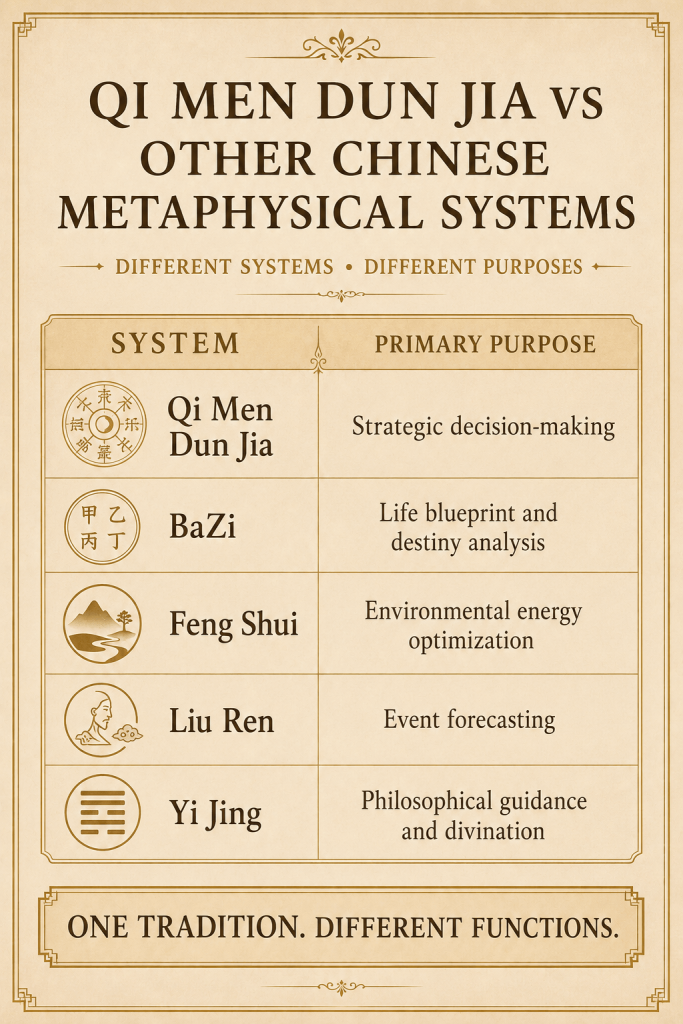
BaZi is the system people most often want compared with QMDJ, because both are Chinese, both are precise, and both show up in the same consulting rooms. I know both deeply, I use both weekly, and I have written a full complete guide on BaZi: the Four Pillars of Destiny if you want that system on its own terms. Here is the honest comparison, the way I explain it to clients deciding which reading they need.
The Difference in One Sentence
BaZi is the system you were born with; QMDJ is the system you are standing in. BaZi reads the exact moment of your birth, year, month, day, hour, as a fixed chart of eight characters that describes your tendencies, seasons and structural strengths for the whole of your life. QMDJ reads the present moment’s chart to answer the question in front of you this afternoon. One is a portrait, the other is a weather report. The practical difference follows: come to BaZi for self-knowledge and long arcs, come to QMDJ for timing, decisions, and specific questions.
The two also feel different to learn. BaZi’s analytical core is elemental arithmetic: the balance of the five elements across the pillars, the relationships between stems and branches, the luck pillars that arrive in ten-year seasons. It rewards patient pattern recognition, and its reading vocabulary, strong day master, favorable elements, clash years, is learnable by anyone willing to do the reps. QMDJ’s core is mechanical casting plus layered reading: the hour chart with its plates and formations, read against a stated question. It rewards procedural discipline first and intuition second. Students with backgrounds in BaZi usually pick up QMDJ’s stems and branches instantly and then have to slow down for the casting rules; students coming from decision-making backgrounds pick up the question logic instantly and slow down on the elemental grammar. Both arrive.
When I Use Each One in Consultations
In my practice the two systems pass a client between them like colleagues with different specialties. A client comes with a career crossroads: the BaZi reading establishes who is standing at the crossroads, their structural capacity, their current luck season, whether this is even a year in which moving serves them. The QMDJ reading then handles the live decisions: which offer to prefer, which week to resign, which hour to sign. I refuse to fake precision about where one’s job ends and the other’s begins, because real consultations blur the line constantly, but the direction of travel is clean: BaZi for the person and the decade, QMDJ for the decision and the hour.
There is a deeper classical relationship, too. QMDJ’s destiny reading method, which I cover below, transplants the hour-chart logic onto a birth moment: your birth hour’s QMDJ chart read as a life signature. The two systems are old cousins that way; the branch families and stem grammar are shared, and a reader trained in both recognizes the same wood meeting the same metal in both charts. The dedicated piece on how QMDJ differs from BaZi carries the comparison further with worked examples, and my own full-length treatment of QMDJ versus BaZi as reading instruments answers the question I am asked most at dinner parties.
Which Should You Learn First?
My honest advice depends on what you will actually do with it. If you want to read people, choose BaZi: it is the deeper people system, and its destiny-reading tradition is richer for biography work. If you want to act on decisions, choose QMDJ: it is the sharper instrument for the moment, and its business applications arrive faster in your hands. If you intend to consult professionally, you will eventually want both, plus the discipline to know which room you are standing in. The birth-year side of BaZi is the gentlest on-ramp in all of Chinese metaphysics, and I keep a full library of BaZi birth-year pages and the BaZi hub for exactly that purpose.
QMDJ, Zi Wei Dou Shu, and the I Ching
Zi Wei Dou Shu is the third member of the classical destiny trio, and the comparison people always draw is with BaZi rather than QMDJ, which is fair, because ZWDS is also a birth-moment system. Where BaZi reads eight characters elementally, ZWDS builds an astronomical chart: a purple star leading a sky of stars pinned into twelve palaces that name the domains of a life, career palace, wealth palace, relationship palace, and the rest. It is the most narrative of the classical systems, closer to an astrology in the Western sense, and its readings are famous for their specificity about the shape of a life. I wrote the full Zi Wei Dou Shu complete guide if you want that system in depth, and the short comparison on how QMDJ differs from ZWDS.
The honest division of labor in my own practice: ZWDS is the finest of the three destiny systems for reading a life’s domains with structure and story, BaZi is the finest for elemental mechanics and luck seasons, QMDJ is the finest for the hour you are standing in. A client planning a decade uses ZWDS or BaZi; a client planning a Tuesday uses QMDJ. The three together form a complete temporal toolkit, which is why the classical scholars knew all three, and why I teach QMDJ while requiring my certified consultants to know the others at reading level.
QMDJ and the I Ching
The I Ching is the grandfather system, the book of changes, and its relationship to QMDJ is ancestor and descendant rather than rival. The I Ching works by generating a hexagram for a moment, six lines, sixty-four possible figures, and reading the figure’s classical text against the question. Its strengths are philosophical depth and accessibility: a serious person with one book and thirty minutes can consult it. Its limitation is resolution: sixty-four figures cast a broad light, and the reading depends heavily on the interpreter’s judgment. QMDJ, by contrast, casts a nine-palace chart with dozens of interacting symbols, and its readings are correspondingly more specific, at the cost of a much longer apprenticeship.
I still consult the I Ching, and I teach students to respect it as the root of the whole tradition’s thinking about time and change. When a question is genuinely philosophical, should I be doing this work at all, what is this period of my life asking of me, the old book is the better instrument. When the question is operational, which hour, which door, which counterparty, the grandson system takes over. Wisdom and logistics, each with its own tool, and the person who knows which one the moment needs is already consulting well.
QMDJ Beside Face Reading, Oracle Lots, and Western Systems
To finish the comparisons, three traditions people regularly place beside QMDJ, each with a genuinely different job.
Face Reading, Mian Xiang
Face reading is physiognomy, the classical system of reading character, fortune and timing from the features of the face, and it is the system I recommend to absolute beginners more than any other, because you already do it instinctively and the tradition merely trains the instinct. Its relationship to QMDJ is complementary rather than overlapping: face reading gives you the person, QMDJ gives you the hour. In a hiring or negotiation context, the face tells you who walked into the room; the chart tells you what the room will do to them. I keep the complete Face Reading Ultimate Guide on this site as its own pillar, and its feature-by-feature reference is the deepest resource on the subject in English that I know of, because I wrote it for exactly that purpose. Practitioners who master both report the same experience I did decades ago: the face and the chart disagreeing is itself information, usually meaning the person is acting against the hour, and the two agreeing is when you can move money.
Guan Yin Oracle Lots
The Guan Yin lots, qiu qian, are the devotional oracle: one hundred numbered lots, each a classical poem with an interpretation, drawn at temples by people with a burden to ask about. It is the humblest system on this list and, in its place, the most humane. The lot does not cast a chart or analyze stems; it answers a prayer with a poem, and the answer’s work happens in the drawing person’s own understanding. People sometimes ask me whether the oracle conflicts with QMDJ, and the honest answer is that they serve different needs the way a conversation with a wise grandmother differs from a briefing with a strategist. My full treatment of the practice, all one hundred lots with their poems and plain-language readings, lives on the Guan Yin lots complete guide, and I keep it on this site with genuine respect for what that system carries: continuity, comfort, and a community’s accumulated voice. When a client needs direction, I bring the strategist’s tools. When a client mainly needs to be heard, the temple oracle is sometimes the better room.
Western Astrology, Tarot, and the Practical Difference
Western astrology is the comparison the international audience asks about most. Its birth chart is a cousin of ZWDS: a sky map of a birth moment, read for character and seasons, with a different astronomy, a different symbolism, and a far larger popular market. I respect the tradition and have learned from its communication skills; the best Western astrologers write about their system with a clarity Chinese metaphysics could copy. The differences that matter operationally: Western astrology is natal rather than hourly in its working culture, its forecasting is period-based rather than moment-based, and its chart, like ZWDS’s, answers who and when in broad strokes rather than what should I do at two o’clock. QMDJ’s operational specificity, the door, the direction, the two-hour window, remains its own niche in the world’s divination toolbox.
Tarot deserves a sentence of honesty, because the market keeps putting it in the same paragraph. Tarot is a card oracle with a rich symbolic language and enormous interpretive freedom, which is both its strength and its limit: the reading depends almost entirely on the reader’s judgment, and two readers can give opposite readings of the same spread without either being wrong by the tradition’s own standards. QMDJ is the opposite kind of instrument: the casting is mechanical, the placements are fixed by rule, and a chart cast by two trained practitioners will have the same palaces, the same doors, the same formations. The reading skill sits on top of a fixed substrate, which is what makes the system teachable, testable, and auditable, and those three words are why I have spent my teaching career on this system in particular.
Choosing Your Instrument Without Dogma
I want to close the comparisons the way I close them in class, because students arrive with loyalties and leave with, ideally, a toolbox. Every system described above, in trained hands, produces structured attention on a real question, and structured attention is already half the value. The other half is fit: the philosophical moment gets the I Ching, the life story gets ZWDS or BaZi, the person in front of you gets the face, the prayer gets the lot, and the decision on the desk gets the chart you are reading about on this page. The master of one system who respects the others is worth more than the master of none who mocks all of them, and the classical scholars, who moved between these tools as casually as carpenters move between saws, would have found our era’s territorial squabbles baffling.
QMDJ Destiny Reading: The Birth Hour as a Life Chart
Earlier I said QMDJ is an hourly system, and everything above treats it that way. There is also a classical branch, the one my own teaching lineage carries in depth, that transplants the same chart logic onto a birth moment: cast the QMDJ chart for the hour you were born, and read it as a life signature. This is QMDJ destiny reading, and it deserves its own honest description, because it is the branch that overlaps BaZi and ZWDS territory, and clients ask for it by name.
The destiny chart is cast exactly like an hourly chart, from the birth year, month, day and hour, using the same solar-term engine and the same plates. The reading then proceeds differently: instead of one question, the chart is read as a standing portrait. The palace that carries your day stem becomes the self palace, the commander’s ground for your whole life. The doors become standing tendencies: the Life Door prominent in a destiny chart belongs, in my reading experience, to people whose lives compound, slowly and reliably, in whatever they commit to. The stars become qualities of your standing weather, and the deities, unusually interesting in destiny work, become the standing atmosphere around your attention: Chief people are taken seriously from a young age whether or not they seek it, Nine Heaven people are visible in every room, Great Yin people are underestimated consistently until their results speak.
What the destiny branch is genuinely good at: constitutional tendencies, the way your weather tends to run when no hour chart is consulted; and interaction between your standing signature and a specific year’s charts, which is where annual planning comes from. What it is weaker at, and I say this as someone who loves the branch: it is a smaller sample of one moment than BaZi’s deeper elemental analysis of the same moment, and a life story told in ZWDS’s twelve palaces has more narrative resolution. In my consulting I use QMDJ destiny reading as the specialist layer it is: for people who already know their BaZi, for questions about standing patterns rather than events, and for the annual planning method below.
If you want to see the branch worked, the site has the full method on how to read a Qimen destiny chart, a live sample reading in the student destiny reading case, the astrological framing in the piece on birth chart analysis with QMDJ, and the honest self-assessment piece on whether the system can reveal your destiny, which is where I put the limits in writing.
Annual Planning: Running Your Year by the Chart
The single most practical way I know to keep QMDJ inside a busy life is the annual planning method, the one my business clients use most and the one I run my own calendar on. It works like this.
The Year’s Standing Signature
Each solar year has its own standing chart character, and each month and quarter shifts within it. The planning pass, done properly, is a sitting of a few hours at the start of the year: read the year’s signature, read each month’s chart for the domains you care about, and mark the calendar. My clients typically mark three classes of days: strong windows for launches, signings and difficult conversations; caution windows where the reading says slow down, verify, or hold; and neutral stretches where ordinary work runs on ordinary effort. The output is a marked calendar and a short written plan, not a list of mystical instructions. The marked calendar does what planning always does, it prevents the waste of good energy on bad hours, with the difference that the marking system is a few thousand years old and the arithmetic is exact.
Each new solar year gets its own planning pass in my practice: the year’s standing signature, the quarter-by-quarter arcs, and the windows worth defending. Planning-minded readers should know the calendar pass is a service I run every January rather than a one-off, and the sections below show exactly what such a pass reads.
The Monthly and Weekly Pass
Below the annual layer, the working rhythm is a short weekly pass: scan the coming week’s key events against their hours, flag the two or three decisions that deserve real chart work, and let the rest run. This is the honest scale of the practice in a working life. Nobody charts their laundry, and nobody should; the method earns its keep on the decisions that have teeth, and the discipline of choosing which those are is itself a business skill. I have watched executives become visibly calmer after one quarter of the weekly pass, and I do not think the calm comes from the chart alone. It comes from having a standing procedure for decisions, which most people never build, and the chart happens to be the procedure my tradition hands me.
Personal Years and Standing Cycles
The deeper version of annual planning crosses your personal chart with the year’s chart, which is where the destiny branch pays its rent. Your standing signature meets the year’s signature, and the crossings tell you which of your domains is under pressure and which is being fed this particular year. This is the closest QMDJ comes to BaZi’s luck-pillar logic, and I use it the same way in consultation: as the long horizon inside which the hourly decisions are made. A client whose wealth palace is being fed this year should be, on my advice, aggressive about expansion windows; the same client next year, with the same business, should be consolidating, and the advice changes not because the business changed but because the year’s crossing did.
Misconceptions, and the Marketing Nonsense I Refuse
Any system this old accumulates barnacles, and QMDJ’s modern marketing has added a fresh coat. Let me scrape the hull, because the system underneath is better than the advertisements.
It Is Not Fortune Telling
The biggest misconception is the fortune-teller frame: that a chart predicts events, and the practitioner’s job is to announce them. The classical material does not actually work that way, and neither do I. A chart characterizes an hour. Reading it well means describing what the hour supports, what it resists, and what it hides, then matching that against a stated question. The future tense, such-and-such will happen, is the language of the fortune teller; the operative tense, this hour favors this move, is the language of the strategist, and the strategist is what the tradition actually trained. I put the argument in full on the piece about whether QMDJ predicts the future, and the site’s tagline on the subject is deliberate: strategy, not prediction.
The Manifestation Industry Critique
The most commercial nonsense in the current market is the manifestation pitch: buy the course, cast your lucky chart, attract wealth, essentially magic with classical paperwork as the prop. I wrote a pointed essay on how manifestation marketing preys on fear and desperation, and I stand behind every sentence. The people most vulnerable to that marketing are precisely the people a responsible tradition should protect: people in money trouble, people in career free fall, people who need a plan and are being sold a mood. QMDJ used honestly is the opposite of that product: it is a discipline that asks you to prepare, verify, and act, and its most common verdicts are boring and excellent, like wait three days, or prepare the counteroffer and walk in at two.
Overclaiming, by Practitioners and Skeptics Alike
The two failure modes of the public conversation mirror each other. The overclaiming practitioner promises outcomes the system never claimed; the overclaiming skeptic dismisses a discipline they have never watched a trained practitioner run. I have written about overclaiming in QMDJ from inside the tradition, and I will say here what I say in class: the honest position is testable humility. The system is rule-based, so its readings can be logged; its claims are about hours, so its verdicts can be checked; a practitioner unwilling to log and check their own hit rate is asking you for faith that arithmetic does not need. My reading logs have kept me honest for years, and they are the reason my claims have stayed boring while the market’s claims have grown feathers.
Does It Change Destiny, and Other Anxious Questions
Two questions arrive with worried energy: does knowing the chart change fate, and does a bad chart doom the plan. The tradition’s own answers are practical. The chart describes weather, not fate, and the entire point of weather knowledge is to dress for it; the classical generals were not determinists, or they would not have bothered with strategy. I gathered the anxious questions properly on the site: whether QMDJ changes destiny, whether it is scientific, whether anyone can learn it, and the honest answer to all three is more interesting than either the believers or the scoffers want it to be.
The Learning Path: From Curious to Certified
People find this page from every level of interest, from the reader who just wants to know what QMDJ is to the professional planning a consulting career, so here is the whole staircase, written the way I teach it.
Level One: Understanding What You Are Looking At
The beginning is not casting, it is orientation, and this page is most of the orientation you need: the layers, the logic, the honest claims. After the orientation, the practical first skills are the palaces and the doors, because a person who can look at a chart and identify which palace carries the question, and which door governs it, is already past the point where most of the market’s audience ever gets. Two habits matter at this level and forever after: stating questions in one sentence, and writing down the hour of everything you ask. The students who become readers are the ones who keep the log. I wrote the beginner’s answer and the site’s free beginner’s guide for exactly this step, and the calculator lets a beginner cast real charts from day one, which is how it should be, because casting is mechanical and should never be gatekept.
Level Two: Reading Honestly
The middle level is where the cast chart becomes a read chart: doors against palaces, stars against doors, deities against questions, formations recognized on sight. This is the apprenticeship level, the longest stretch, and the one that separates people who have a party trick from people who have a skill. Expect six months to a year of regular practice at this level, reading your own logged questions and checking outcomes. The temptation at this level is premature fluency, the student who memorized the doors and starts announcing verdicts before reading the crossings. I would rather take a slow student who reads the ground layer every single time than a fast one who skips it when confident.
The reading questions people bring at this level are all answered on the site: how long it takes to learn, whether it is difficult, what books beginners should read, and the eternal one, whether you can learn it online. My answer to that last one: yes for the mechanics, with a live teacher for the judgment, and any program that does not include live chart drills is selling a recording, not a training.
Level Three: The Professional Path
The professional level is where I am unusually strict, because my name goes on the certificate. My consultant training covers the full method, the formations at depth, the destiny branch, consultation ethics, and the logging discipline, and it ends with a certification process that people fail, which I consider a feature. The details of standards are on the consultant selection page, and the training itself is described on the certified consultant training page. Beyond certification sits the discipleship path, the traditional deep apprenticeship, which carries the lineage material and is by application and temperament rather than by purchase, exactly as it should be.
Choosing a Teacher, Anywhere in the World
Whether or not you ever train with me, choose your teacher carefully, because this market has no licensing and the noise-to-signal ratio is poor. Five tests, from my own hiring habits over the decades. Can they cast, live, by hand or without the software’s help, and explain each placement’s rule? Do they state the limits of the system without being asked? Will they show you a logged reading with an outcome? Do they teach the question-first discipline, or do they perform cold readings dressed as charts? And do you understand their explanations, in your language, well enough to repeat them to a friend? A teacher who fails the fifth is not necessarily a fraud, but they are not yet your teacher. The piece on becoming a practitioner carries the professional expectations in detail.
Teaching in English, and Why That Was a Decision
This page’s history section explained why I teach in English, and the learning section should close the loop on what that means for students. The classical material was built in Chinese, and some of its precision genuinely lives in the language; a teacher’s job is to carry that precision across, not to wave at it. My classes run in English with the Chinese terms kept where they are load-bearing, pinyin provided, and the tables translated for working use rather than decoration. Students from the business world tell me the English terminology is what made the system feel usable rather than exotic, and usable is the goal, because a tradition that cannot be worked in is a museum piece, and this system deserves better than a display case.
The Big QMDJ FAQ
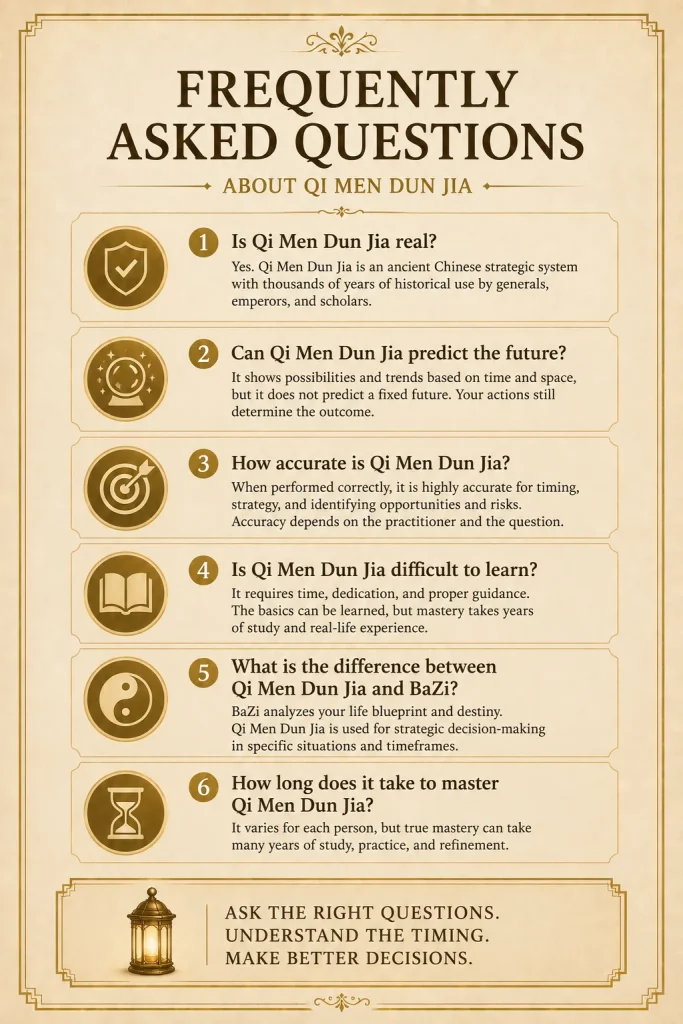
The site has a dedicated QMDJ FAQ page for the short answers, and the questions below are the ones this page’s readers ask most, answered at pillar length.
What exactly does Qi Men Dun Jia mean?
Strange gate hiding the commander, in the classical reading: qi for unusual, men for gates, dun for hiding, jia for the first stem and the field commander. The name is a compressed description of the system’s central image, the commander hidden behind strategic gates, and every serious reading habit in the tradition descends from that image.
Is QMDJ religious?
No. The system is a calendar-and-chart discipline with a philosophical frame drawn from the wider classical tradition. It involves no worship, no spirits to petition, and no faith requirement, and the deity layer, despite its translated name, is a set of labeled layers in an arithmetic instrument. People of every religion and none practice it, and the classical courts that used it were religiously attentive but used the system as staff work, not liturgy.
Can I use it without learning Chinese?
Yes, with a caveat I keep honest: the mechanics transfer fully into English, and my certified consultants prove that daily. The caveat is that the classical texts live in Chinese, so the English-speaking tradition is downstream of translations and teachers. That is manageable, and it is why my teaching lineage invests so heavily in building proper English terminology rather than borrowing fuzzy phrases.
How is it different from just checking an auspicious date calendar?
Resolution and specificity. A printed auspicious-date calendar is generic: good for most people, most purposes, most of the day. A QMDJ chart is cast for your specific question, your palace assignments, and the exact two-hour window, and it can reverse the calendar’s generic advice for your particular matter. The calendar is a map of averages; the chart is a reading of your hour. Both have their uses, and the serious practitioner checks neither blind.
What questions does it handle best?
Timing questions, decision-between-options questions, reading-the-counterparty questions, and finding-things questions, in roughly that order of reliability. What it handles worst: anything the client refuses to state as a question, anything whose real answer lies in information the chart cannot see, like an unaudited balance sheet, and anything that is really a request for permission rather than a request for analysis.
Do I need my birth data to use QMDJ?
For hourly questions, no: the chart is cast for the moment of the question. For destiny readings, yes, birth date and hour, and if the birth hour is unknown, the destiny branch loses resolution while BaZi, which reads the day pillar robustly, remains fully usable.
Can two practitioners disagree about the same chart?
They can and occasionally do, in every chart tradition on earth. The casting itself should agree between trained practitioners of the same school; disagreements arise in weighting and interpretation, the same way two doctors reading the same scan can weigh findings differently. What should never happen is two different casts of the same hour under the same method, and if you meet that, one of the two is not trained.
What is the youngest thing in this ancient system?
A fair question from a sharp student, and the answer is the practice itself: this page, the English terminology, the calculator, the business applications, and you, holding the tradition at your own moment. The ancient part is the grammar. The sentences are always new.
The Twelve Double-Hours: Reading the Shape of a Day
The QMDJ day is not twenty-four hours; it is twelve double-hours, each named for an Earthly Branch, each with its own standing character. When practitioners talk about choosing the hour, this is the menu they are choosing from, and fluency in the twelve hours is one of the fastest ways to make the system practical, because it converts the abstract chart into a daily rhythm you can feel.
Zi Hour, 23:00 to 00:59
The first hour, water’s home hour, the day’s deepest quiet. The rollover rule lives here: the day stem changes at 23:00, so the zi hour belongs to tomorrow, and every chart cast inside it must honor that. Zi hours suit rest, planning, and questions asked in stillness, and they are famously tricky for beginners because of the rollover. When a client tells me a midnight reading went strange, the zi hour convention is the first thing I check.
Chou Hour, 01:00 to 02:59
The ox hour, still earth, stillness thickening. Classical texts treat chou as the hour of slow ground: matters that need patience, questions whose answers ripen rather than arrive. Business questions rarely come at chou, but the clients who do ask at this hour are usually awake with worry, and the reading often says what the hour always says: the ground is holding, go back to sleep, ask again in daylight with a rested mind.
Yin Hour, 03:00 to 04:59
Wood’s first breath, the hour before dawn. Yin hours carry beginnings in embryo: the plans not yet announced, the moves still unspoken. In the classical imagination it is the tiger’s hour, potent and unlit. I like yin hours for questions about what is forming: a founder deciding whether an idea deserves to become a company asks a yin-hour question whether or not she knows it.
Mao Hour, 05:00 to 06:59
Sunrise wood, the rabbit hour, growth going public. Matters opened at mao have the whole day ahead of them, which makes mao the natural hour of launches and departures in the standing rhythm. The classical caution: mao is also the hour of exposure, beginnings visible from all sides, so quiet openings do not belong here.
Chen Hour, 07:00 to 08:59
The dragon hour, earth with water stored inside it, the first of the substantial morning hours. Chen is the working hour of administrators in the classical reckoning: orders given, structures set, the day’s machinery started. In modern readings, chen favors operational moves, the email that sets the week’s agenda, the meeting that fixes the schedule, the standard that gets enforced going forward.
Si Hour, 09:00 to 10:59
Fire rising, the snake hour, the morning’s most convertible energy. Si hours suit visible moves: presentations, announcements, the meetings where you need the room’s full attention. In my own calendar, workshops and first meetings cluster at si by preference, because the standing rhythm of the hour matches the task. Between si and the next hour lies most of the business day’s real negotiation volume, which is why the hourly chart earns its keep exactly there.
Wu Hour, 11:00 to 12:59
High noon, the horse hour, peak fire. Wu is the hour of maximum yang: bold moves, direct statements, confrontations that need to happen at full light. The classical caution is about heat: wu burns fuel fast, and a matter that needs sustained negotiation can ignite and gutter at noon. I read wu as the hour for clarity, not for complexity.
Wei Hour, 13:00 to 14:59
The goat hour, fire banking into earth, the early afternoon’s settling. We hours favor consolidation: signatures, confirmations, the small closures that hold the morning’s work in place. There is a reason signing meetings after lunch feel different from signing meetings before lunch, and the tradition mapped that reason a long time ago.
Shen Hour, 15:00 to 16:59
Metal’s first hour, the monkey hour, sharpness returning as the day matures. Shen favors analysis, verification, audit, and precise communication, the hours where accountants and lawyers do their best work. The scissors of the day cut cleanly at shen, which makes it my preferred hour for reviewing contracts and the counterparty’s numbers.
You Hour, 17:00 to 18:59
Peak metal, the rooster hour, completion’s edge. You hours suit endings that stay ended and harvests brought in: closing a deal’s final terms, collecting the payment, ending the engagement cleanly. The classical texts call the western hours sharp and use them for exactly that, cutting and closing, and the day’s last light adds a certain honesty to anything signed at you.
Xu Hour, 19:00 to 20:59
The dog hour, earth drying, the evening’s steady watch. Xu hours suit reviews and quiet commitments: the family conversation after work, the debrief, the promise made in a calm room. Matters that need warmth without brightness find it here.
Hai Hour, 21:00 to 22:59
The pig hour, water returning, the day dissolving. Hai hours are for rest and the private questions people actually ask at night: the ones about love, about children, about the year behind them. The tradition treats hai as the hour of dissolving, and there is a practical reading of that: questions asked at hai are usually about letting things go, and the chart read at hai should honor what the questioner is truly asking rather than the surface topic.
Using the Twelve Without Superstition
The hours are standing rhythm, not standing verdicts. The chart of the specific hour, with its ju and its doors and its formations, can reverse any hour’s general character, and that is precisely why the system casts charts instead of printing hour horoscopes. What the twelve give you is a default map, useful for planning and for teaching, and what the chart gives you is the moment’s exact weather. Students who internalize both stop asking is this a good day and start asking is this the right hour within this day, which is the question serious practice actually runs on. The stem-branch reference set on this site covers the branches in their full calendar context, and the calculator shows which double-hour any moment falls in, including the 23:00 rollover that changes the day stem.
Clock Time, Solar Time, and Time Zones: The Technical Question Everyone Eventually Asks
Every serious student eventually hits the same wall: my city uses clock time, and the chart runs on solar time, so which do I cast with? The question deserves a proper section because the wrong answer degrades every chart, and because the confident answers you will find online are mostly folklore.
Why the Question Exists
The QMDJ engine, like the rest of classical Chinese timekeeping, runs on the sun’s actual position: the solar terms are the sun’s zodiac degrees, the twelve double-hours are divisions of the solar day, and the whole machine assumes the moment you are standing in is being read by the sky over your head. Clock time is an administrative convenience. Most of the world’s clocks are offset from their own sun by half an hour or more, and some by a full hour and more, which means the hour your watch shows and the hour the sun says can disagree at the exact moment you cast.
The Solar-Time Correction
The classical solution, and the one my lineage uses, is a location correction: true solar time at the casting location, computed from longitude and the equation of time. Each degree of longitude away from your zone’s reference meridian shifts the sun’s local noon by four minutes, and the equation of time adds or subtracts the season’s wobble on top. A city like Singapore sits almost exactly on its reference meridian, so the correction is minutes; a city on the western edge of a wide zone can be a full double-hour off, and casting by clock time there quietly casts the wrong chart entirely.
My calculator applies the longitude correction automatically, and I made that choice deliberately: the correction is arithmetic, and arithmetic should never be left to each user’s memory. When students cast by hand, I teach them to apply the correction first and cast second, and the habit takes one week to become permanent.
Time Zones in Modern Practice
Modern questions add a layer the generals never faced: the counterparty is in London, the client is in Singapore, the signing is in Hong Kong. Which location’s solar time governs the chart? The convention I use, and the one that survives the loudest classroom debates, is the location of the matter: the chart is cast for the place where the decision or event physically occurs, in that place’s solar time. A deal signed in London is a London chart, whatever the client’s home office thinks. A remote negotiation conducted across video calls, the genuinely modern case, I treat by the hour at the location of the decision’s center of gravity, usually where the principal sits, stated explicitly in the reading log so the convention is auditable. Not every school agrees on every edge case here, and I would rather you knew that than received a false certainty; what every school does agree on is that the correction must be applied consciously, because an unconscious hour error poisons the whole chart downstream.
Southern Hemisphere and Other Edge Cases
Students in Australia and New Zealand ask the southern hemisphere question, and the honest answer is that the classical texts never addressed it, because the tradition never traveled there in its formative centuries. Modern practitioners split: my own practice keeps the solar-term engine as written, the sun’s position is the sun’s position, while the seasonal overlays, the assumptions about summer and winter hours, get re-examined rather than imported blindly. I say this plainly in class: the southern hemisphere is a live edge case where practice has outrun the texts, and humility is the correct posture until the accumulated logs say otherwise.
The Two-Hour Discipline
All of this machinery exists to protect one discipline: the exact hour of the question is the exact hour of the chart. The tradition’s insistence on writing down the time before casting, which I have repeated throughout this page, is not ritual, it is data hygiene. The moment you cast from a remembered hour, or from the hour you wish you had asked in, the chart stops being an instrument and becomes a mirror, and mirrors are the one tool this system has never claimed to be.
A Field Guide to Door and Star Combinations
Earlier sections treated the layers one at a time, because that is how the system is learned. Readings, though, happen in combinations, and certain pairings recur so often, with such consistent character, that students deserve a field guide while their own case logs are still young. These are the pairings I call on most, in plain language.
Open Door with Tian Fu. Authority plus opening: the green-light hour for formal beginnings, board meetings that start well, proposals made to decision makers. Its shadow reading: formality without warmth, so I check the deity before trusting it for relationship-adjacent business.
Open Door with Tian Chong. Launch energy: initiative that lands. This is the pairing for first contact, cold outreach done warmly, opening gambits of every kind. Where Tian Fu dignifies, Tian Chong accelerates, and clients who launch under this pairing usually report rooms that were ready to listen.
Life Door with Tian Ren. The compounding pair: growth plus nourishment. Long-horizon money questions, property meant to be held, businesses meant to be built rather than flipped. When clients ask should I buy this to keep, this pair in the matter’s palace is the chart’s quiet yes.
Life Door with Tian Rui. Growth pressed against contraction: the classic pair for the deal that looks nourishing and arrives heavy. Something will be built, and something will be paid. I do not reject this pairing outright; I read its terms and advise the client to price the heaviness in.
Blocked Door with Nine Earth. The full stop: obstruction sitting on stillness. Nothing moves, and nothing should. Clients hate this verdict and I deliver it often anyway, because the pair’s saving grace is honesty: it lifts completely when the window passes, and the week spent waiting is usually the week the chart was protecting.
Blocked Door with Nine Heaven. The paradox pair: obstruction with lift, blockage that is somehow visible. In practice it reads as plans that stall in public: announcements delayed while everyone watches. The advice it generates is almost always about sequencing, get unblocked quietly first, before lifting.
Scenery Door with Zhu Que. Speech doubled: communications hour at full strength, and the pairing I check before anything public goes out. Favorable placements make campaigns sing; afflicted placements are the chart saying, in the tradition’s own voice, that the statement will travel badly.
Injury Door with Geng. The blade pair: competition sharpening into actual contest. Useful, deliberately, in win-lose situations: tenders, litigations, head-to-head pitches. I advise clients to schedule their hardest competitive moves into windows that carry this pair strongly and to stay out of rooms where the pair sits on their own palace.
Death Door with Tian Zhu. Ending plus cutting: the severance pair. The right hour to cancel cleanly, fire finally, exit the partnership, close the entity. Treated with respect rather than dread, this pair does the tradition’s cleanup work, and my clients who ended things under it remember the cleanliness more than the loss.
Rest Door with Tian Qin. Recovery with kindness: the repair pair, for reconciliations, health recoveries, teams rebuilding after a bruising quarter. The gentlest strong pairing in the system, and the one I recommend to clients whose instinct is to keep pushing when the correct move is mending.
Two habits for using this guide well. First, the pairings are shorthand, not verdicts: palace condition, deity, and crossings can reverse any of them, which is why this guide sits near the end of the page and not the beginning. Second, build your own log: the pairings above are mine, from my reading history, and the students who grow fastest are the ones who start logging their own recurring patterns from their first month. The glossary set gives each door and star its own page, so the layers of any pairing here can be checked term by term.
What Actually Happens in a Consultation
People imagine consultations as candlelit mysticism. The reality is closer to a board briefing with better furniture, and clients deserve to know the process before they pay for one, so here is the whole thing, start to finish, the way I run it.
Before You Book
Come with a question, not a mood. The single best preparation is the sentence you want answered, written down, plus any real-world context a reader would need: the parties involved, the deadlines, the options on the table. For destiny readings, add your birth data, date and hour if known, and be honest about uncertainty in the hour, because a reader who knows the hour is approximate adjusts the reading properly, while a reader told a precise hour that is wrong builds a precise house on fog.
The chart does not do the work. It prevents the waste, and the client who arrives with a real question gets the whole value of the system in the first ten minutes.
The Session Itself
A consultation runs in four movements. First the framing: the question restated precisely, the palaces assigned, the scope agreed. If a client’s real question is different from the stated one, this is where it surfaces, usually within minutes, because assigning palaces to a fuzzy question is impossible and the client hears the fuzziness themselves. Second the reading: the chart walked through layer by layer, ground, weather, door, star, deity, and the crossings that matter for the question. I narrate rather than announce, because a client who understands the verdict owns it, and a client who was merely told the verdict spends the session bargaining. Third the action: the window, the direction, the posture, the things to avoid, all in plain language a busy person can execute. Fourth the log entry: the question, the hour, the verdict, written down, dated, and revisited at the follow-up. That last movement is what separates consultation from performance, and I refuse to skip it.
| Session movement | What happens | What you leave with |
|---|---|---|
| Framing | Question restated, palaces assigned, scope agreed | A precise question you actually meant |
| Reading | Chart walked through layer by layer | The reasoning, not just the verdict |
| Action | Window, direction, posture, cautions | Three sentences you can execute |
| Log entry | Question, hour, verdict recorded | An auditable record for the follow-up |
What I Will Not Do in a Session
The refusals are part of the service, so I publish them. I will not diagnose illness, and medical questions get redirected to doctors with the timing advice kept. I will not read third parties who have not agreed to be read, which means the cheating-spouse fishing expedition ends at my door, and no, that position has cost me business and I keep it anyway. I will not pick lottery numbers, promise outcomes, or bless bad plans with good charts. And I will not read a chart cast from a remembered hour; if the exact time is unknown, we say so and the reading is framed accordingly, because an honest limitation beats a confident fiction every single time.
How to Judge Any Consultant, Including Me
Whether you consult with me, my certified consultants, or someone from another lineage entirely, the same five tests apply, and I put them in a table because they deserve to be printed and carried.
| Test | Passes if | Fails if |
|---|---|---|
| Method transparency | Explains the casting rule and convention used | Keeps the method mysterious and proprietary |
| Limits stated | Says plainly what the chart cannot decide | Promises outcomes the system never claimed |
| Question first | Refuses to read before the question is stated | Takes your money and reads whatever appears |
| Logged practice | Keeps records and revisits outcomes | No log, no follow-up, no accountability |
| Plain language | You can repeat the verdict to a friend | You leave impressed but confused |
The consultation details, rates and formats are on the consultation page, and the certified consultants trained under this method are introduced on the trainers and consultants page. The path to becoming a consultant is written up separately for the readers who want the other side of the table.
Schools, Lineages, and Why Practitioners Sometimes Disagree
You will meet QMDJ practitioners whose charts differ from mine in ways they consider important, and you deserve to understand the map rather than assume someone is a fraud, because most of the disagreement inside the tradition is honest and old.
The main structural split is casting method: the chai bu split-and-supplement camp, which I follow and my calculator implements, versus the zhi run intercalary method, which handles the solar-term boundaries with a different bookkeeping. Both descend from the same classical corpus; they differ at the edges of the calendar, in specific hours around term changes, rather than in the body of ordinary practice. There are also hour-convention differences, the treatment of the 23:00 boundary, and regional house rules accumulated by particular lineages, kept because a teacher’s results validated them for that teacher’s students.
A tradition that argues is a tradition that is alive. The danger sign is not disagreement, it is a school that forbids the question.
My policy across all of it: consistency within a method, transparency about which method, and courtesy toward the others. When students arrive trained elsewhere, I ask them to show me their casting first, before opinions, because most disagreements dissolve the moment both parties see which convention each was using. The market’s louder voices treat school differences as marketing weapons, and that is a shame, because the tradition’s internal debates are some of its most interesting rooms, and the classical scholars who built this system would recognize the arguments, and the courtesy, immediately.
The piece on the different schools of QMDJ covers the map in more detail if you are weighing teachers, and the lineage page tells you exactly where my own teaching comes from, because a tradition that asks for your trust should show its chain first.
Worked Readings: Three Questions, Start to Finish
Method sections teach the machine; examples teach the reading. Here are three consultation readings from my log, details changed, each shown with its chart summary as a table, so you can watch the method run on real questions of the three most common kinds.
Reading One: The Deal With a Shelf Life, a Timing Question
The client, a manufacturer, had a distribution offer with a hard expiry: sign by Friday or the counterparty walked to a rival. The real question was not whether the deal was good, his operations team had already validated that, it was whether to sign Friday as demanded or push for the following week against the risk of losing the deal entirely.
| Layer | Friday hour chart | Monday hour chart |
|---|---|---|
| Deal palace | Life Door, strong stem, supported | Life Door, weakened by clash |
| Counterparty palace | Serpent over a wounded stem | Nine Heaven over a strong stem |
| Formation | Gate reversal on the signing palace | Flying Bird Falls into the Nest |
| Crossing | Client palace clashed by the hour | Client palace fed by the hour |
Friday’s chart told a story the negotiation room would have confirmed too late: a deal palace that was genuinely good, sitting under a formation that twists paperwork, in an hour that clashed the client. Monday’s chart carried one of the tradition’s best formations on the signing palace, with the counterparty standing visibly stronger and more generous. The verdict: do not sign Friday; tell the counterparty the papers needed one more review; sign Monday morning. I told the client the honest risk, that the counterparty’s Friday deadline might be real and we were calling their bluff with borrowed nerve. He held. The counterparty waited, and the deal closed Monday on terms slightly better than Friday’s draft. The formation did not change the counterparty; it named what the counterparty already was, a house that would rather close than walk.
Reading Two: The Candidate With Two Interviews, a People Question
A services firm had two finalists for a finance director role. Both interviewed well, both referenced well, and the managing director, having been burned by a smooth talker years earlier, wanted a second opinion on character under pressure. I read the hour charts of both final interviews, plus each candidate’s palace as cast from the interview hour.
Candidate A’s chart showed a solid earth stem under the Chief, with the Partner on the crossing between the candidate’s palace and the company’s. Candidate B’s chart showed a bright, quick stem under Nine Heaven, with the Serpent riding the communication palace. Translated plainly: A reads as a steady authority figure whose word knits to the house; B reads as a dazzling presenter whose paperwork deserved a second look. My written advice: hire A unless the role was primarily external theater, run a deeper diligence pass on B’s numbers history, and do not let the interview charm decide. They hired A. Eighteen months later, A was running the firm’s finances through a difficult audit cycle exactly the way the chart said the ground would hold, quietly and without drama. B, the managing director later learned through the industry’s small world, had moved twice since, each time after a discrepancy that was discovered rather than confessed. I offer that without triumph, because B’s chart did not convict anyone; it said verify, and verification is cheap.
Reading Three: The Missing Safe Box, a Lost-Things Question
A family office misplaced a document safe box before a quarterly review, three days of increasingly frantic searching, four staff, one very unhappy matriarch. The lost-things method, cast at the question hour, produced a palace whose description read: metal object, western side of the building, low, near water pipes, concealed under something soft, held or moved by a talkative young person.
The classical chapters on lost objects keep a practitioner honest, because the answers are checkable the same afternoon.
The search team went west, found a janitorial alcove with the water dispenser, and the box was under a stack of folded towels, where a new intern had stowed it during the office rearrangement, intending to mention it and forgetting. My student, who ran this one, called me from the office corridor laughing, and I include it here because readings like this one are the tradition’s own proof of concept: no atmosphere, no cold reading, a mechanical description from a fixed method that either matches the world or does not. The ones that do not match are logged too, and the log is where the discipline actually lives.
The One-Page Quick Reference
Everything on this page compressed into the tables I wish someone had handed me at the start. Print this section, and note that every table’s fuller treatment lives in the sections above and in the glossary set.
The Nine-Palace Grid
The chart’s floor plan, with the luo shu numbers and the compass sectors. North sits at the bottom of a classical chart, but here it reads like a map, north up.
| SE 4 · Xun | S 9 · Li | SW 2 · Kun |
| E 3 · Zhen | Center 5 · earth | W 7 · Dui |
| NE 8 · Gen | N 1 · Kan | NW 6 · Qian |
The Eight Doors at a Glance
| Door | Family | Reads as | Best for | Use with care for |
|---|---|---|---|---|
| Open | Auspicious | Beginnings | Launches, first contact, proposals | Endings, stealth |
| Rest | Auspicious | Restoration | Reconciliation, health, consolidation | Aggressive pushes |
| Life | Auspicious | Growth | Money, property, long horizons | Quick flips |
| Injury | Difficult | Friction | Competitive contests, sharp negotiation | Relationship repair |
| Blocked | Difficult | Obstruction | Defense, hiding plans, holding lines | Openings of any kind |
| Death | Difficult | Endings | Cancellations, clean exits, clearing out | Births of anything |
| Scenery | Neutral | Appearances | Documents, publicity, presentations | Substance without review |
| Fright | Neutral | Shock | Delivering hard news, volatility plays | Stability-seeking moves |
The Nine Stars at a Glance
| Star | Element | Weather | Hour favors |
|---|---|---|---|
| Tian Peng | Water | Reckless appetite | Bold, competitive moves |
| Tian Rui | Earth | Contraction | Audits, endings, deflations |
| Tian Chong | Wood | Momentum | Initiative, first contact, campaigns |
| Tian Fu | Wood | Command | Leadership, convincing, boards |
| Tian Qin | Wood | Kindness | Mediation, reconciliation, warmth |
| Tian Xin | Earth | Mandate | Authority, legitimacy, officialdom |
| Tian Zhu | Metal | The blade | Cutting, severing, demolition |
| Tian Ren | Metal | Blessing | Recovery, healing, repair |
| Tian Ying | Fire | Brightness | Visibility, publicity, launches |
The Eight Deities at a Glance
| Deity | Layer of | Reads as |
|---|---|---|
| Zhi Fu | Authority | The senior table is listening |
| Teng She | Distortion | Check twice, fine print wakes up |
| Tai Yin | Privacy | Concealment, discretion, the unseen hand |
| Liu He | Connection | Parties that can actually come together |
| Gou Chen | Entanglement | Snags, claims, unfinished obligations |
| Zhu Que | Speech | Words traveling, for good or ill |
| Jiu Di | Stillness | Ground holds, momentum sleeps |
| Jiu Tian | Lift | Visibility, ambition, things seen far away |
The Twelve Double-Hours at a Glance
| Hour | Clock window | Standing rhythm |
|---|---|---|
| Zi | 23:00 to 00:59 | Deep quiet, day rolls over at 23:00 |
| Chou | 01:00 to 02:59 | Slow ground, patience |
| Yin | 03:00 to 04:59 | Beginnings in embryo |
| Mao | 05:00 to 06:59 | Growth going public, exposure |
| Chen | 07:00 to 08:59 | Structures set, machinery started |
| Si | 09:00 to 10:59 | Visible moves, full attention |
| Wu | 11:00 to 12:59 | Peak fire, clarity over complexity |
| Wei | 13:00 to 14:59 | Consolidation, signatures |
| Shen | 15:00 to 16:59 | Analysis, verification, precision |
| You | 17:00 to 18:59 | Completion, clean endings |
| Xu | 19:00 to 20:59 | Reviews, quiet commitments |
| Hai | 21:00 to 22:59 | Dissolving, letting go, private questions |
One caution with any quick reference: the tables describe standing tendencies, and the actual chart can reverse any of them, which is the entire point of casting. The reference is for orientation and review; the reading is the method above. If the tables were enough, the tradition would have stopped at the tables, and it very much did not.
The Extended Glossary: Every Term You Will Meet
The starter glossary earlier on this page covers the first dozen terms. This extended version covers the full working vocabulary, grouped the way the system is actually used, with the dedicated glossary pages carrying the full classical treatment of each door and star.
Time and Casting Terms
Solar terms, jie qi. The twenty-four divisions of the solar year that QMDJ runs on, from the winter solstice onward. The engine’s true calendar, and the source of the term-boundary caution every practitioner learns the hard way.
Yang dun and yin dun. The two halves of the engine’s year: yang dun from the winter solstice through the summer solstice’s approach, yin dun for the return. Decides the direction the plates rotate.
Ju. The rotation level, numbered one to nine within each half-year, that fixes the stems’ placement. Together the possibilities make the famous 1,080 charts of the tradition.
Chai bu. The split-and-supplement casting method my lineage uses. Its sibling rival is zhi run, the intercalary method; the two agree on most hours and differ at the calendar’s edges.
Zi hour and the 23:00 rollover. The first double-hour of the day, 23:00 to 00:59, during which the day stem already belongs to tomorrow. The single most common source of beginner casting errors.
True solar time. The sun’s local time at the casting location, corrected for longitude and the season’s wobble, which honest casting uses instead of raw clock time.
Chart Structure Terms
Nine palaces. The luo shu floor plan every chart lives in, one center palace and eight compass palaces, each with its trigram, element and branch family.
Earth plate. The fixed layer, the terrain. Its stems do not move during the chart’s life and describe the standing conditions of each palace.
Heaven plate. The rotating layer, the weather. Its stems fly by the hour and are read against the earth stems beneath them.
Hidden stem. The stem tucked under each door in classical notation, part of the fine structure serious readers use for detail readings.
Empty hours, kong wang. Palaces whose branch families stand empty in a given chart, classical markers of hollowness, delay and unfilled promises. I check them on every deadline question; a promised date sitting in an empty palace promises less than it appears to.
Cast Terms
The Nine Stars. The weather of the hour’s quality: Tian Peng, Tian Rui, Tian Chong, Tian Fu, Tian Qin, Tian Xin, Tian Zhu, Tian Ren, Tian Ying. Each has its own glossary page, and each is treated in depth in the stars section above.
The Eight Doors. The action vocabulary: Open, Rest, Life, Injury, Blocked, Death, Scenery, Fright. The system’s namesake layer and the main instrument of most verdicts.
The Eight Deities. The atmospheric layer: Chief, Serpent, Great Yin, Partner, Hook, Vermilion Bird, Nine Earth, Nine Heaven. Attention and intention, fixed in sequence from the hour stem’s palace.
The Ten Heavenly Stems. The cast of characters, Jia through Gui, with Jia hidden under the six instruments by design. The commander, the advisor, the diplomat, the enforcer, and six more besides.
Six instruments, liu yi. The six deputies, Wu, Ji, Geng, Xin, Ren, Gui, Ding, Yi in the classical line-up, under which the hidden commander takes cover. Which deputy carries Jia shapes the whole reading.
Pattern Terms
Fu yin. The echo: the same stem doubled across the plates, effort mirrored into stillness. In hourly practice a caution, in destiny practice a signature of lives that run in loops.
Gate reversal. A door landed in a palace whose structure reverses its meaning, the Open Door that cannot open. The trap in every door table, and the reason tables are not enough.
Formation. A named classical combination with a fixed reading, the tradition’s case law. Flying Bird Falls into the Nest, Green Dragon Turning Back, the strike formations, and the rest.
Clash. The branch or stem relationship that produces friction, the six clash pairs of the branches being the most used. The reference for all of it lives in the jiazi set.
Practice Terms
Hourly chart. A chart cast for a question’s moment: the system’s core working mode, and what the calculator produces.
Destiny chart. The same machine pointed at a birth hour instead of a question, the branch my lineage teaches for constitutional readings.
Reading log. The practitioner’s record of question, hour, verdict and outcome. My certification requires keeping one, because it is the difference between a practitioner and a performer.
Palace assignment. The convention that maps the question’s parties to the chart’s palaces before any reading, the step that makes QMDJ read questions rather than muse.
Vocabulary is the least glamorous part of this tradition and the most decisive. Every term above is a handle, and the reader with handles can pick up anything.
How the Calculator Reads a Chart: A Walkthrough
The QMDJ calculator on this site casts a full hour chart in seconds, and since thousands of readers use it every month, a walkthrough of what it produces belongs on this page. The engine follows chai bu with the 23:00 rollover, applies the true solar time correction, and renders the nine palaces with every layer the sections above described.
Start at the top of any result: the casting line, which names the solar term, the yang or yin dun, the ju number, and the four pillars of the moment. That line is the chart’s passport, and any practitioner you consult can reconstruct the entire chart from it, which is why I print it in full rather than hiding it behind a friendly interface. Below it sits the nine-palace grid, each palace showing the heaven stem over the earth stem, the star, the door, the deity, and the hidden stem under the door.
The advanced reading layer is where the calculator earns its keep for learners: it checks each door against its palace’s element, flags fu yin doubles and gate reversals, names the classical formations present, and lists the hour’s strongest doors and compass directions for common question types. For a student, the discipline is to form your own verdict first, then compare it with the advanced layer, because the calculator is a sparring partner, not an oracle. The full article walking through a worked chart, step by step with a real date, is on the calculator page, and the validation anchors I used when building the engine, historical dates with known charts, are documented there too, because a tool that claims precision should publish its receipts.
One honest note about tools in general. The casting is arithmetic and belongs to machines; the reading is judgment and belongs to trained humans. The calculator casts flawlessly and reads conservatively, and the students who flourish with it are the ones who use the saved time to read more charts, not fewer. If the tool tempts you to skip understanding, put it down for a week and cast by hand; the tradition has survived three thousand years without shortcuts, and your fluency deserves the same patience.
QMDJ and Modern Decision Science: An Honest Bridge
Some of the most interesting conversations I have about QMDJ are not with metaphysics students but with executives who trust nothing they cannot spreadsheet. For them, here is the honest bridge between this old system and the decision disciplines they already run, because the overlap is larger than either side usually admits.
What the Chart Shares With Checklists and Pre-mortems
Aviation checklists and pre-mortem analysis earned their fame by forcing structured attention: no step skipped, no assumption unexamined, imagined failure walked backward into present preparation. A QMDJ reading is structured attention in the same family. State the question precisely, assign the parties, examine each layer in a fixed order, check the crossings, log the verdict, review the outcome. Whether or not you accept the cosmology, the procedure is a discipline, and disciplines measurably beat improvisation in every field that has tested them. My students who came from operations backgrounds usually see this first, and the ones who argue with it loudest are usually arguing with fortune-telling advertising, not with the procedure I actually run.
Where the Chart Exceeds the Spreadsheet
Spreadsheets freeze what can be numbered, and most decision-relevant information is soft: counterparty intent, timing pressure, the mood of a market. The chart forces that soft information into explicit structure, which is why it functions well as a second opinion: it cannot be anchored by your existing analysis, because it never saw your analysis. It asks the same questions every time regardless of how much you want the answer to be yes, and that incorruptible boredom is a genuine feature. I have watched it save clients from deals they were emotionally committed to, not because the chart was magical, but because it was the only voice in the room with no stake in the outcome.
Where the Spreadsheet Rightly Wins
The honesty must run both directions. The chart cannot see your cash position, your legal exposure, your production capacity, or your market data, and any reading that ignores the numbers is theater. The chart’s verdict on a deal is conditional on the deal making business sense in the first place, and clients who reverse that order, using the chart to validate bad arithmetic, get from me the same refusal every time. The ideal is the two-column mind: the spreadsheet for what can be counted, the chart for what can only be read, and a written record of both.
The chart never cancels arithmetic, and the best hours still belong to the prepared.
The Decision Journal, Old and New
Modern decision science prizes the decision journal, written predictions with dates and outcomes, precisely because it defeats hindsight bias. My tradition has kept reading logs for centuries for the same reason. When my students complain that logging feels bureaucratic, I show them the modern literature on calibration, the measurable gap between confidence and accuracy that only written records can reveal, and the room usually goes quiet in a good way. The practitioner’s log and the executive’s journal are the same instrument wearing different clothes, and both traditions arrived at it independently, which is the kind of convergence that should make both sides curious rather than defensive.
What Teaching Ten Thousand Hours Taught Me About How People Learn This
This section is the most personal on the page, because it is about the students, and the students are the reason I teach rather than consult full-time.
The Three Types of Student
After years of classes, three arrivals repeat. The first wants answers for a life decision, and leaves with a working skill instead, which was not their plan and usually becomes their favorite outcome. The second wants professional capability, a consulting practice, a skill attached to an existing coaching or advisory business, and these are my hardest-working students because the system is genuinely commercial in the right hands. The third is a fellow metaphysician, trained in BaZi or feng shui or ZWDS, adding QMDJ to the toolkit, and these students learn fastest because the grammar is shared. Knowing which one you are before you enroll saves everyone a season of confusion, so I say it out loud in the first class.
The Mistake That Separates Readers From Reciters
The pattern I watch for in the second month of any cohort is memorization outrunning observation. Students who memorized the doors and stars start announcing verdicts in a rush of vocabulary, and their readings become performances with the correct nouns in the wrong rooms. The correction is always the same, and it is why my drills cast real questions with real outcomes rather than quiz tables: read the ground first, every time, no exceptions, even when you feel fluent. Fluency is where the discipline matters most, because fluency is exactly when skipping feels safe.
What the Certificates Cannot Certify
My certification process tests casting, reading, formations, ethics, and logging discipline, and it fails people, which protects everyone. What no certificate can certify is temperament: the honesty to say the chart is neutral when a client wants magic, the restraint to refuse a third-party reading because it feels powerful, the patience to keep the log on the quiet months. I interview for temperament before I train for technique, and my selection notes are longer than my curriculum notes. The students who eventually make me proudest are rarely the fastest; they are the steadiest.
I do not teach people to impress rooms with mystery. I teach them to be the calmest, best-prepared person at the table, and the chart is how my tradition trains that calm.
The Community That Carries It Forward
The lineage’s future is wider than my classroom, and I invest in that deliberately. The certified consultants, the associate trainers, the graduates who now teach in their own countries, they are the tradition’s next hands, and the discipline I hold them to is the same one this page keeps repeating: transparent method, stated limits, logged outcomes, plain language. You can meet them on the trainers and consultants page, read their student-journey articles across the QMDJ article library, and if you are drawn to the deep path, the course and the discipleship page are the two doors, one for capability, one for lineage, and both open by application rather than purchase, exactly as they should be.
More Questions People Actually Ask
The first FAQ section covered the founding questions. These are the practical ones that arrive by email, in class, and after consultations, answered the same way I answer them live.
Does the chart work the same for people who do not believe in it?
The chart is cast from the calendar, not from your belief, so it renders identically regardless of what the questioner thinks. What belief changes is usefulness: a skeptic who applies the method honestly, logging verdicts and checking outcomes, usually ends up as a practitioner of some flavor. A skeptic who refuses the log but accepts the readings is just doing confirmation bias with classical paperwork. My favorite students are skeptics, because they keep the discipline believers can forget.
Can I read a chart for someone who is not present?
You can cast the hour of a meeting you are in, and that includes the other parties in the room, because they are parties to your question. What I refuse, and train my consultants to refuse, is the detached fishing expedition: reading a celebrity, a rival, or a spouse who never consented. The refusal is partly ethics, and partly craft, because questions without a real stakeholder produce mush, and mush presented as insight is how traditions earn bad reputations.
How often should I cast?
For the first year of learning: weekly, on your own real decisions, with the log. For a working professional after that: the weekly planning pass, plus the specific decision moments that have teeth. Casting all day is the amateur’s tell, and the obsessive practitioner’s trap, because the system rewards depth of reading, not frequency of casting.
What if two windows are equally good?
Pick the one that fits a human schedule, and say out loud that you did. A verdict that ignores sleep, flights and school runs is not a better verdict, and any consultant who hands you a 3am signing window without an extraordinary reason is telling you they have never run a business. The tradition served generals who marched at dawn because armies march at dawn, and it will serve you better when it respects your life.
Do the directions really matter, or is that superstition?
The directions matter as far as you use them sensibly: which seat you take, which room you book, which way you face, whether the negotiation’s venue serves you. They do not matter the way incantations matter, and they are the smallest lever in the system. I use them the way I use a good table in a restaurant: take the better seat when it is free, and do not fight the maître d’ when it is not.
Why do some practitioners refuse to teach certain formations?
Classical gatekeeping, partly, and partly a genuine caution: the strike formations and the severance patterns deserve experienced hands, because a student who half-learns them tends to play with heavy tools. My own line is that everything on this page is public because it is orientation, not application, and the application of anything, from a door to a formation, is what training is for.
Is a QMDJ reading better than my own gut feeling?
It is differently good, and the combination beats both alone. Gut feeling aggregates experience you cannot articulate; the chart reads the moment you cannot feel from inside it. The executives I work with trust their guts more after adopting the chart, not less, because the chart catches the hours when their gut is tired, flattered, or negotiating with itself. Two instruments, one dashboard, and the best decision-makers I know read both without embarrassment.
What did the system look like before software?
Manuals, tables, counting sticks and long apprenticeships. A casting that takes the calculator two seconds took a trained clerk several careful minutes, which is why the tradition treasures its tables and why errors were common enough to be a recognized professional hazard. Software did not change the system; it changed the clerical load, and any practitioner who romanticizes hand casting is welcome to do it for a month for the humility, and then welcome back to the machine.
Can the chart be wrong?
Yes, in three honest ways: a casting error, which is craft and correctable; an interpretation error, which is judgment and improves with logs; and the neutral chart, where the combinations simply do not speak to your question, and the honest reader says so and reads the crossing instead of inventing drama. The practitioners who claim the chart is never wrong are the reason the profession needs its refusals, and you have now read mine, twice, on purpose.
What should I read after this page?
The honest learning order: the beginner’s guide for the gentle orientation, then the doors and stars sections of the glossary set with the calculator open, then the reading walkthrough when you are ready to watch a full method run. After that, the article library’s hundred-plus pieces are best consumed in the order your own questions arrive, which is the order the tradition itself respects.
Closing the Circle: Where This System Sits in Your Life
This page began with a battle chart and ends where the tradition itself insists on ending: with you, holding a decision. Everything above reduces to a short creed, and I will state it plainly.
Qi Men Dun Jia is a structured way to read the moment you are standing in. It runs on exact arithmetic, it reads combinations rather than symbols, it answers stated questions rather than moods, and it earns its keep in your life only when paired with preparation, verification, and plain-language verdicts you can act on. It will not make you lucky, and the honest version of this tradition never promised to. It will make you deliberate, and deliberateness, compounded over years of decisions, looks a great deal like luck from the outside.
Three thousand years ago this system helped generals choose the hour. You have quieter battles and better medicine, and you get the same math.
If you take one practical step from this page: cast the chart for your next real decision, using the calculator, and write down your verdict before you act. Then log what happened. One entry. The students who become practitioners all started with one entry, and the system, which has watched emperors and shopkeepers with the same expression, is entirely happy to start with yours.
The next doors, in the order I recommend them: the encyclopedia for reference depth, the course for the skill under your hands, the consultation page if you want a reading before you learn one, and the article library for the hundred smaller doors this page could not open. Whichever door you choose, choose deliberately. That is the whole teaching, and you already knew it; the chart just keeps score.
The Nine Stars in Destiny Work: Reading Weather That Never Lifts
The stars section above treated the nine as hourly weather. The destiny branch of the tradition asks a stranger question: what if a star is not passing through your hour but standing over your whole life? Destiny readings are where the stars reveal their second personality, and this treatment is the one my lineage’s students spend the most time arguing about, joyfully, over tea.
The Standing Stars
A prominent Tian Chong in a destiny chart belongs to a starter, and starters know themselves: the person who lights fires professionally, whether as founder, evangelist, or the one in the family who always says let us just go. A standing Tian Fu reads as natural authority: people organize themselves around this person’s presence without a memo being sent. A Tian Qin life runs on relationships and mediation, often with the quiet exhaustion of the person everyone brings their problems to. The pattern is the interesting part: in hourly work the stars advise the hour, while in destiny work the stars describe a standing climate the person cannot opt out of, and the reading becomes about dressing for your own permanent weather.
The harder stars in standing positions read the way you would expect, with one classical softening the texts insist on. A standing Tian Rui marks lives of compression: chronic caution, recurring contraction, the feeling of swimming in clothes. A standing Tian Zhu marks the cutter: a person whose honesty is genuinely constructive and genuinely feared, whose careers often involve endings as a profession, surgery, audit, turnaround work. The softening: no star in a destiny chart reads alone, and a Tian Zhu life with warm support around the palace turns the blade into a scalpel, which is the difference between a wound and a surgery.
Star Combinations in Life Readings
The combinations are where destiny star work earns its fees. Stars sit on stems, and stems are people: a strong Tian Fu standing over a Geng stem is a commander wearing armor, while the same star over a Yi stem is a diplomat who leads by listening. The doors color the standing picture further, and the deity over the self palace, in my experience the single most tell-tale position in the whole destiny chart, describes the attention your life attracts before you have done anything at all. Chief lives are taken seriously from childhood; Nine Heaven lives are visible in every room, sometimes exhausted by it; Great Yin lives are chronically underestimated, to their eventual advantage.
Your birth hour’s chart is not a sentence. It is the climate you were born standing in, and climate knowledge is the beginning of farming, not the end of it.
The Honest Limits of Destiny Star Work
Destiny readings are the branch where QMDJ competes with BaZi and ZWDS on their home field, and honesty requires the scoreboard: BaZi’s elemental analysis of a birth moment is deeper than QMDJ’s for structural questions, and ZWDS’s twelve palaces tell a life story with more narrative resolution. What the QMDJ destiny chart uniquely provides is the same layered grammar as the hourly system, so a reader fluent in one is immediately fluent in the other, plus the formations, which in destiny work become standing patterns with startling consistency. I use all three and say which one is carrying which claim, and any practitioner who cannot tell you which system is speaking is mixing paints, not reading.
The Five Elements: The Grammar Behind Everything
Every layer of QMDJ speaks a grammar, and the grammar is the five elements: wood, fire, earth, metal, water, producing and controlling each other in the fixed cycle the whole of Chinese metaphysics shares. This page has used the grammar on every page-turn; this section makes it explicit, because students who learn the grammar consciously read twice as well with half the effort.
The Producing Cycle
Wood feeds fire, fire makes earth, earth bears metal, metal collects water, water grows wood. The producing cycle is how one layer feeds another: a wood star in a water palace is being fed, a fire door over a wood stem is being fueled. In readings, productive relationships mean support arriving without asking, and the classical texts describe producing lines as the difference between effort and ease. When I say a palace is being fed, this cycle is the technical meaning, and the full elemental background, with the production and control logic worked through, is on the Feng Shui pillar, where the same grammar governs buildings.
The Controlling Cycle
Wood parts earth, earth dams water, water douses fire, fire melts metal, metal chops wood. The controlling cycle is friction with structure: not destruction but governance. A controlling relationship in a chart can be productive, discipline that makes the combination stronger, or destructive, pressure that crushes the weaker element, and the difference is a matter of strength ratios that the ground layer tells you. This is why I read earth stems first: the strength of the ground decides whether a control line is a mentor or a tyrant.
| Element | Produces (feeds) | Controls (governs) | Stands for |
|---|---|---|---|
| Wood | Fire | Earth | Growth, initiative, beginnings |
| Fire | Earth | Metal | Visibility, clarity, heat |
| Earth | Metal | Water | Ground, patience, storage |
| Metal | Water | Wood | Structure, endings, precision |
| Water | Wood | Fire | Flow, adaptability, depth |
Why the Grammar Matters More Than the Vocabulary
Students arrive wanting tables: this star means this, that door means that. The tables are necessary and this page has several. But two practitioners with the same table read differently in exact proportion to their grammar fluency, because the table gives the word and the grammar gives the sentence. A Geng stem meeting a Yi matter chops it, and whether that is a problem or a solution depends on what the question asked, and the question, the grammar, and the ground together make the verdict. There are no verdicts from vocabulary alone, and the sooner a student stops memorizing and starts conjugating, the sooner the charts start talking back.
QMDJ and the Seasons: The Year’s Standing Rhythm
Charts change by the hour, but the year has a standing rhythm underneath them, and practitioners who ignore the seasonal layer read every chart as if it were winter. The solar terms are not just casting arithmetic; they set the year’s mood in long arcs, and this section is the orientation I give clients before the annual planning pass.
Spring: The Wood Quarter
From the beginning of spring through the solar terms of spring’s end, the year runs its wood arc: growth energy, initiative, and new projects finding their feet. Charts in this quarter favor launches, plantings of every kind, and the first moves of plans that will mature later. The doors read with the season: Open Door and Life Door hours in spring carry an extra tailwind because the season itself pushes growth. In my annual planning pass, spring is where I cluster the year’s openings: new ventures, new hires’ first weeks, new product seeds. A client who asked me why her January launch kept stalling and her March launch kept sailing was, without knowing it, asking about the wood quarter, and the answer lived in the seasonal layer of the engine she had never been shown.
Summer: The Fire Quarter
Summer is the fire arc: visibility, peak energy, and heat. The quarter favors exposure moves: campaigns, announcements, events, public negotiation. It also carries fire’s caution: hours that would read as merely warm in winter read as hot in summer, and clients with already-hot charts (strong fire stems, bright stars over their palaces) can overextend in this quarter on the season’s extra fuel. My summer advice skews toward channeling: convert visibility into structure before autumn, book the wins, sign the follow-on deals while the room is still warm.
Autumn: The Metal Quarter
Autumn is the metal arc: harvest, precision, and cutting. The quarter favors completion moves: closing deals, collecting receivables, ending what should end, and the sharp analytical work that summer’s heat made impatient. The Injury Door and the blade stems read differently in autumn, supported by the season rather than fighting it, which is why the classical generals campaigned in autumn and why modern negotiators find their hardest, cleanest terms get accepted in this quarter. If a deal must be pushed, lost, or won on merit, autumn is the quarter that does it.
Winter: The Water Quarter
Winter is the water arc: retreat, consolidation, planning, and depth. The quarter favors the moves my business students find hardest to schedule: doing less, on purpose. Strategy work, annual reviews, restorations of health and relationships, and the patient repositioning that spring will inherit. Nine Earth hours in winter double down into full stillness, and clients who fight the season, launching big in deep winter because the calendar said Q4, are working against the year’s grain. The tradition’s seasonal counsel is blunt: winter is for sharpening, not for swinging.
Spring opens, summer shows, autumn closes, winter stores. The same four moves, every year, and the chart’s job is telling you which hour inside the season belongs to which move.
The Term Boundaries in Practice
For consultation purposes the four quarters are the working frame, but the engine’s true boundaries are the twenty-four terms, and the two weeks around each boundary are where careful readers slow down. Charts cast near a term change can shift character mid-day, and the classical cautions about boundary casting exist because generations of practitioners watched confident readings fall apart at the seams of the year. My own rule for clients with date flexibility: avoid the boundary days entirely for irreversible actions, and when a deadline forces them, cast the exact hour’s chart rather than trusting the season’s general mood. The calculator prints the term name on every casting line precisely so that nobody reading it can forget where in the year’s body they are standing.
Where This Section Sits in the Method
The seasonal layer is the last thing I teach and the first thing I check, a sentence that makes sense only after a few hundred charts. By the time students feel the difference between a spring Open Door and an autumn Open Door, the rest of the method has become instinct, and the season is what keeps the instinct honest. For the full elemental grammar underneath the seasons, wood feeding fire, fire feeding earth and the rest, the five-element treatment on the Five Elements guide carries the complete cycle, and the seasonal health overlay is on the dampness article for readers who want the living-season side of the tradition.
The Four Pillars of the Moment: BaZi Inside QMDJ
Every QMDJ chart casts a BaZi in passing. The moment’s year, month, day and hour, converted to stems and branches, are the same four pillars a BaZi reader builds from a birth moment, and the QMDJ hour chart is, structurally, the BaZi of the question. This deserves its own section because it is the bridge between the two systems, and students who cross it read both better.
Reading the Casting Line as a Mini BaZi
Take the casting line of any chart: yang dun, ju three, in the solar term of clear and bright, on a Geng Wu day at a Ji Mao hour. The day pillar, Geng Wu, is the chart’s spine: the day stem names the flavor of the whole day’s energy and anchors the palace assignments. The hour pillar names the question’s own moment, and the month pillar tells you the season’s element with more precision than any weather report. A BaZi-trained eye reads that line the way a musician reads a key signature before the first note, and the habit costs nothing to learn: next time you cast, spend one extra minute on the four pillars before touching the palaces.
Why the Day Stem Runs the Reading
Beginners sometimes ask why the day stem matters so much when the chart is technically built around the hour. The honest answer is hierarchy: the hour is the question’s voice, but the day is the ground the question stands on. A beautiful hour formation over a hostile day stem is a good speech at a bad funeral, and the crossing between day and hour, the day stem’s palace versus the hour’s key positions, is where many readings find their surprises. The classical texts formalize this with the day-stem palace rules, and my own reading habit treats the day stem as the client’s representative whenever the question has no human principal, which is more often than you would think.
The Branch Clashes Under the Chart
Because the four pillars are full stem-branch pairs, every chart carries the branch relationships underneath it: the day branch clashing or combining with the hour branch, the month branch feeding or controlling the day’s. These under-the-chart crossings rarely overturn a reading, but they tint it constantly, and practitioners who skip them wonder why two apparently identical charts read differently. The sixty stem-branch pairs, their clashes, harmonies and combinations, have their own full reference set on this site, the sixty jiazi library, and the birth-year side of the same arithmetic is the friendlier on-ramp on the birth-year library. Fluency there is what turns the casting line from decoration into data.
The Bridge Both Ways
BaZi readers crossing into QMDJ usually over-read the four pillars and under-read the plates, years of habit pulling them to the stems they know. QMDJ readers crossing into BaZi do the opposite, fluent in doors and stars and blind to the elemental depth a birth chart rewards. My advice to both camps is the same, and it is the advice this page keeps giving in different rooms: read the ground, then the weather, then the mood, and let the question, not the school, decide which tool speaks first. The two systems share enough blood that fluency in one is already half of the other, and different enough that the second half must be learned on its own terms.
The Casebook: Three More Readings, Three More Lessons
The worked readings section earlier showed the three most common question types. These three cases are the ones I use in advanced classes, because each one teaches a mistake the tradition has been warning about for centuries, and each one ended in a way the client did not expect and I did.
The Partnership That Should Have Failed, and What the Chart Saw
Two partners, old friends, came to me separately within a month of each other, each asking whether to proceed with a shared venture. Their questions were the same. Their charts, cast in different hours, were not, and this is the first lesson of the casebook: the chart belongs to the moment of the question, and two honest questions asked in different hours legitimately produce different readings. The first partner’s chart showed the venture palace strong, the crossing warm, and a formation the tradition ranks among the best for cooperative beginnings. The second partner’s chart showed the same venture palace from a wounded hour, with the Hook riding the partnership crossing, the classical picture of a venture that succeeds while dragging one party.
I told both partners the truth I am allowed to tell, which is what their own hours showed, and I did the thing consultation ethics requires when the same matter produces conflicting readings: I flagged the disagreement and refused to average it. The venture proceeded, carefully, with the second partner’s exposure structured to limit his downside, and within two years the shape the charts drew had appeared: the venture grew, and the second partner was the one carrying the unpriced obligations. The lesson I teach from this case is not mystical. Two questions in two hours is not one question, and a consultant who smooths the contradiction to seem consistent is performing coherence the method never promised.
The House Move That Waited Nine Days
A family had signed on a new home and wanted a moving date. The charts for their preferred weekend carried a signature I could not bless: the family’s palace clashed by the travel hour, a blocked formation sitting over the new-home palace, and a boundary term change inside the window. The father, an engineer, pushed back with the question I respect most in consultations: what exactly would go wrong. My honest answer: nothing supernatural, and plenty of ordinary, because the chart was describing an hour of friction and fatigue around a transition that already involves friction and fatigue, and the cost of a bad moving day is scraped walls, lost keys, an argument in the truck, and a first week that starts on the wrong foot.
The chart does not doom the move. It prices the move, and families who know the price can choose to pay it or wait, and waiting nine days cost nothing.
They waited nine days. The new date carried a clean formation on the home palace, and the move, by the mother’s own account years later, was the smoothest relocation their family had done. I log this case for the students who arrive believing the system is either supernatural or nothing, because it is neither: it is a structured reading of the hour’s character, and the character of moving days keeps its promises the way weather does, which is often enough to be worth consulting.
The Launch Window Nobody Wanted
A product team wanted a Friday afternoon launch because that was when their whole team could be on deck. The Friday charts were poor: a reversal on the announcement palace, the Serpent riding the communications layer, and the team’s own palace tired. The following Tuesday at an inconvenient mid-morning hour carried the combination I look for in launch charts: Open Door on the visibility palace, Nine Heaven with a strong stem beneath it, and clean crossings. The team resisted, the founder called me directly, and I gave him the sentence I give every client facing this choice: the best chart in the world cannot save an unprepared launch, and no bad chart can sink a great product, but when both are ready, the hour is the cheapest advantage on the table.
They launched Tuesday. The coverage in the first three hours, an accident of newsroom timing that no chart could cause and no skeptic can fully explain away, carried the product further than their previous quarter of pushing had. I log the case with its honesty intact: the chart did not write the headlines. It chose the hour in which headlines were likelier to be written well, and the tradition’s whole claim, three thousand years condensed, is that such hours exist and can be found by arithmetic.
What the Casebook Teaches as a Whole
Six readings across two sections, and the pattern I want students to extract is not the wins. It is the shape of every case: a stated question, a cast hour, a layered reading, a plain-language verdict, an action the client could actually take, and a logged outcome reviewed later. That shape is the discipline, the discipline is the system, and the doors and stars and deities are the vocabulary it runs on. Any practitioner, of any lineage, who cannot show you that shape in their work is selling you something older and simpler than Qi Men Dun Jia: the oldest product in the world, which is confidence, in someone else’s packaging.
The Reading Habits Checklist: How to Keep Yourself Honest
I close my advanced classes with this checklist, and I will close the practical half of this page with it too, because a tradition this precise deserves practitioners this careful. The checklist is short enough to memorize and long enough to matter.
| Habit | What it protects |
|---|---|
| Write the question before casting | The reading from vagueness, and the client from a reading they never asked for |
| Record the exact hour, checked against the rollover | The whole chart from a one-hour casting error |
| Read the ground before the weather | Verdicts built on momentum instead of structure |
| State what the chart cannot decide | Your reputation, and the client’s trust, from overclaiming |
| Log every reading with its outcome | Your confidence from calibration it never earned |
| Say the verdict in plain words | The client from leaving impressed and helpless |
Print it, use it, and when you are tempted to skip the log because the reading felt obviously right, remember that the log exists precisely for the readings that felt obviously right. Every practitioner I have ever respected keeps one, and every scandal the industry has ever produced started with someone who stopped.
The Practitioner’s Calendar: Running QMDJ Inside a Working Life
People decide to learn this system and then ask the practical question that actually decides whether they will keep it: how does an hour-chart discipline fit inside a life that already has no hours to spare. Here is the calendar I run, the one I install for business clients, and the honest time costs of each layer, so you can choose the depth you actually want rather than the depth the marketing implies you need.
Layer One: The Daily Glance, Two Minutes
The thinnest layer costs almost nothing: cast tomorrow’s key hour the night before, read one line, the door in the question palace, and plan the day around what it says. Two minutes, once a day, and the return is a day arranged with the grain instead of against it: the difficult conversation moved to the hour that carries it well, the focused work protected during the hours that favor it. Executives keep this layer for years precisely because it never asks for more, and the ones who want depth add the next layer themselves.
Layer Two: The Weekly Pass, Twenty Minutes
Sunday evening or Monday morning, the weekly pass scans the week ahead: which days carry launch signatures, which carry blocked formations, where the good meeting windows actually are, and which single decision this week deserves a full reading rather than a glance. Twenty minutes with the calculator open, a written plan for the week, and a note in the log for the one or two charts you actually read deeply. This is the layer my business clients mean when they say the system changed how they run their companies, and it is twenty minutes because the discipline is choosing what not to chart.
| Layer | Time cost | What it covers | Who keeps it |
|---|---|---|---|
| Daily glance | 2 minutes | Tomorrow’s key hour, one-line read | Anyone with decisions |
| Weekly pass | 20 minutes | The week’s windows, the week’s one deep reading | Professionals, owners |
| Monthly review | 1 hour | Logged outcomes, next month’s windows, calibration | Serious students |
| Annual planning | Half a day | Year signature, quarter arcs, the year’s three big windows | Consultants, planners |
Layer Three: The Monthly Review, One Hour
Once a month, the log gets read back: which verdicts landed, which missed, and what the misses have in common. This is the layer that separates practitioners from enthusiasts, because the review is where calibration lives and where the honest practitioner discovers their own reading biases: reading too generously for clients they like, too severely for the hours they distrust. My own monthly review has caught patterns in my reading I would never have found from the inside, including a multi-year habit of over-trusting harmonious formations that took three logged misses to break. One hour a month is the cheapest tuition in this tradition, and the only teacher in it is you.
Layer Four: The Annual Planning Pass
Once a year, ideally between the winter solstice and the first week of the new solar year, the full planning pass described earlier on this page: the year’s standing signature, the quarter arcs, the term boundaries marked, and the year’s three or four genuinely important windows chosen and defended in the calendar before the year can fill itself with noise. The pass takes half a day, and I run it for clients every January because the difference between a year with defended windows and a year without is not luck, it is structure, and structure is the one thing every system on this website agrees on.
The Meeting Day, Run Properly
The single highest-yield application for working people is the meeting day. A full day of external meetings has a morning arc and an afternoon arc, and the chart of each arc’s hours tells you where to put the day’s most important conversation and where to put the one you are dreading. My own meeting days are arranged around three questions: which hour carries the Open Door for the relationship I am opening, which hour carries the harmony formations for the negotiation I am closing, and which hour carries the stillness signatures where I schedule nothing and recover. The day runs better, the people across the table get a more rested version of me, and the whole technique costs one cast and five minutes of thought.
What to Do When You Cannot Chart
There will be days you did not chart, moments that arrived unannounced, decisions made in hallways. The tradition’s answer is calmer than the enthusiast’s: uncharted hours are ordinary hours, and people navigated them for millennia without a chart, using judgment, preparation, and character. Chart the big things, glance at the days you can, and let the rest run on the ordinary virtues, which the classical texts, practical documents to the end, spend more pages praising than any modern teacher. The practitioner who charts everything has confused the instrument for the life, and the tradition never asked for that.
The Classical Library: What to Read Beyond This Page
Students eventually want the sources, and they deserve the real map rather than the internet’s version of it. The QMDJ literature is genuinely old, genuinely technical, and mostly in classical Chinese, so this section gives the honest reading order for the English-speaking student, including where the walls are.
The Core Classical Works
Two works anchor the tradition. The Qimen Dunjia Tong Tong, the complete compendium attributed to the Ming compilation tradition, is the system’s encyclopedia: casting rules, formation tables, application chapters, and the military strata that gave the system its name. The Yujing Dun Jia, the mirror-of-heaven tradition, is the deeper tactical text, and the two together were the working library of the classical practitioner. Neither exists in a fully satisfactory English translation, and any teacher who tells you otherwise has read a summary, not the book. The honest path into them today is a teacher’s guided readings, which is precisely why lineage teaching survives in the modern market, and why my classes quote the texts directly with the Chinese visible on the slide.
The Modern Layer
Beneath the classical works sits a modern stratum of practice manuals, school commentaries, and translated work of very uneven quality, and the student’s defense is the same checklist I gave in the consultation section: method transparency, stated limits, logged practice. Read modern books the way you would vet a consultant, keep the ones that show their arithmetic, and let the ones that sell mystery fall away. When students ask me which modern book to start with, my answer is this page and the site’s library: the orientation here was written to be the front matter the tradition never had in English, and the hundred-plus articles behind it do the work a shelf of uneven paperbacks used to do.
The classical texts reward decades, not weekends. Read them slowly, with a teacher, and let the modern noise fall away in proportion to how much of the old arithmetic you actually hold.
The Supporting Traditions
No QMDJ student reads only QMDJ. The system borrows its stems and branches from the shared stem-branch calendar, its trigrams and palaces from the same root the feng shui tradition uses, and its elemental grammar from the five-element cycle every Chinese system speaks. The supporting reading list is therefore the complete guides of this site’s other pillars: the Four Pillars for the birth-chart side of the shared calendar, the Zi Wei Dou Shu pillar for the destiny tradition’s other great instrument, and the sixty jiazi library for the stem-branch fluency every layer of this system assumes. A student who reads this page, then those, holds the complete supporting grammar, and the classical works will still be waiting when they arrive, the way mountains wait.
The Tradition and You: A Closing Word From the Teacher
This page has run nearly forty thousand words, and a closing owes you honesty rather than a summary. Qi Men Dun Jia has survived dynasties, wars, printing presses, the collapse of the court that used it, and the arrival of the internet, which is more than most ideas can claim, and it survived for one reason: it works often enough, on questions that matter, for people who verify. That is the entire claim, and it is the only one I will make.
What the Tradition Asks of You
Three things, and they are the same three things the classical teachers asked. State your questions, because the system answers precision, not longing. Keep your logs, because a discipline without records is a mood. And respect the limits, because the hour chart is a lens on time, not a license to skip the arithmetic of your own life: the cash flow, the references, the doctor’s appointment, the contract’s small print. The tradition’s greatest practitioners were careful people, and the marketing era that promises otherwise is selling you the exact opposite of what the system was built to teach.
What the Tradition Gives Back
Deliberateness, mostly, and the quiet that comes from having a place to put uncertainty. My business decades taught me that most executive suffering is unstructured deciding, the same three questions re-litigated nightly without a procedure to hold them. This system gave my decisions a procedure, and the procedure gave me back my evenings. Students report the same thing in their own words: the charts did not make them lucky, they made them deliberate, and deliberate compounds into looking lucky from the outside. If you take one sentence from forty thousand, take that one.
The system was built by people who believed hours could be read, and it is kept alive by people who have learned to read their own.
Where to Go From Here
The complete map, in the order I would walk it. This page first, reread slowly, sections at a time. The calculator second, casting real hours for your real week. The glossary set third, one door or star an evening, the way the tradition itself is absorbed. The encyclopedia for depth on any layer that hooks you. The article library’s hundred pieces for the smaller doors. And when you know you want the skill rather than the reading, the course exists, and so does the consultation table, and so, for the few who want the deep path, does the discipleship. Three thousand years of doors, and every one of them opens from the side you are standing on.
The Final Tables: The Whole Page in Four Cards
One last convenience for the readers who scrolled the length of this page: the four tables that hold the working system, gathered here at the end, with each table’s home section linked for the full treatment.
| Stem | Image | Reads as |
|---|---|---|
| Jia | The commander | The hidden protagonist every reading looks for |
| Yi | The wind | The advisor, flexible and diplomatic |
| Bing | The sun | Bright, visible, warm, occasionally scorching |
| Ding | The candle | Precise, focused, the stem of careful work |
| Wu | The gate | Solid, institutional, the keeper of walls |
| Ji | The cloud | Absorbing, accommodating, patient sediment |
| Geng | The blade | Decisive and hard, the system’s respected antagonist |
| Xin | The jewel | Refined, exacting, the stem of quality |
| Ren | The ocean | Mobile, strategic, everywhere and adaptable |
| Gui | The rain | Penetrating, persistent, the quietest water |
| Fact | Why it matters |
|---|---|
| The solar term | Sets the engine’s calendar position and the season’s mood |
| Yang or yin dun | Sets the year’s half and the plates’ direction |
| The ju number, 1 to 9 | Sets the stems’ placement, the chart’s family |
| The four pillars of the moment | The day stem anchors, the hour stem voices |
| True solar time and the 23:00 rollover | The difference between the right chart and a confident mistake |
| Scan | Layer | Question it answers |
|---|---|---|
| One | Earth stems | What is the ground carrying |
| Two | Heaven stems | What is the weather doing above it |
| Three | Doors | What action does the hour support |
| Four | Stars | What quality does the action carry |
| Five | Deities | What attention and intention ride the hour |
| The chart will | The chart will not |
|---|---|
| Compare two hours for a specific stated question | Predict events or promise outcomes |
| Read the hour’s character precisely, by arithmetic | Replace information, diligence, or professional advice |
| Improve your timing and posture with practice | Make an unprepared person lucky |
| Stay testable, loggable, and consistent | Reward a reader who skips the log |
That is the system, the page, and the invitation. The hours are already turning; the only question left is which of them you would like to read first.
QMDJ Among the Pillars: How the Systems on This Site Fit Together
This site carries full complete guides for every major Chinese metaphysical system, and readers who arrive through one door deserve the whole house’s floor plan. This section is that floor plan: where QMDJ sits among its siblings, which sibling answers which question, and how I move between them in real consultations. I teach this map because students who learn one system in isolation tend to over-use it, the way a man with only a hammer starts treating everything as a nail, and the classical scholars who built these arts used them as a family of instruments, never as rivals.
The Destiny Systems: BaZi and Zi Wei Dou Shu
The destiny systems read a birth moment. BaZi, the Four Pillars of Destiny, converts your birth year, month, day and hour into eight characters and reads the elemental arithmetic of your whole life: strengths, seasons, the ten-year luck cycles that decide when your decades turn. Zi Wei Dou Shu, on the full ZWDS pillar, builds the same birth moment into an astronomical chart of twelve palaces, career, wealth, relationships, property, and reads your life as a structured story rather than a balance sheet. Between them: BaZi for mechanics and timing, ZWDS for narrative and domains. Neither tells you whether to sign on Friday, which is precisely where QMDJ begins. When a client’s question is who am I and what is my decade, I open BaZi or ZWDS. When the question is which hour, the chart on this page opens.
The three systems also differ in what they assume about fate, and I am blunt about the difference in class. Destiny systems describe standing conditions, the climate you were born into. QMDJ describes the weather of now. Clients who confuse the two ask QMDJ to answer biography questions it was never built for, and destiny systems to pick meeting hours, and both errors waste the client’s money and the tradition’s credibility.
The Space Systems: Feng Shui and Its Schools
The spatial systems read buildings. The complete Feng Shui guide covers the shared foundations, and the school-specific pillars go deeper: Eight Mansions for the person-building matching system that sorts homes and people into their groups, Flying Star for the time-cycles school that puts decades into floor plans, and the deeper Xuan Kong tradition behind it. Feng shui answers whether the room is good. QMDJ answers whether the hour is good, and the feng shui application layer of QMDJ, covered earlier on this page, is where the two floor plans meet: strong sectors of the building matched to strong hours of the calendar, which is how the signing room gets chosen in my consulting bundle.
The Person System: Face Reading
Mian Xiang, face reading, is the fastest system in the family: no birth data, no chart, no hour, just the face in front of you, read for character, vitality and current fortune. The complete treatment is the Face Reading Ultimate Guide, the site’s deepest single resource on any subject, and the feature-by-feature articles beneath it cover everything from hairlines to chin shapes. In consultation work, the face tells me who walked into the room and the QMDJ chart tells me what the room will do to them, and I have relied on that pairing for hiring and negotiation questions longer than I have taught either system. The face is also the gentlest introduction to this whole family of arts, because you already read faces instinctively and the tradition merely trains the instinct.
The Oracle System: Guan Yin Lots
The Guan Yin lots are the devotional heart of the site: one hundred classical poems, each drawn at temples by people carrying a burden, each with its full interpretation on its own page. I keep the oracle on this site with genuine respect, because it serves a different need than any chart: the moment when a person does not want a strategist, they want to be heard. The lots answer prayers with poems; QMDJ answers questions with arithmetic; and knowing which one a client needs is half of the consultation craft I teach.
The Calendar Systems: Zodiac, Birth Years and the Jiazi
The calendar layer underneath everything is the sixty stem-branch cycle, and this site carries it three ways. The birth-year library covers every year from 1920 to 2030 with its BaZi signature, the friendliest on-ramp in Chinese metaphysics. The sixty jiazi library covers the whole cycle pair by pair, the reference my own students use for clash and harmony questions. And the Chinese Zodiac 2027 cluster carries the animal-year tradition, with the year ahead read for all twelve signs. None of these are QMDJ, and QMDJ borrows from all of them: the branch families, the clash pairs, the animal-year overlays that clients bring into the room whether or not the chart asked for them.
One family of arts, five kinds of question: who you are, where you stand, who is in front of you, what the year says, and which hour to move. Every pillar on this site answers exactly one of those well, and the practitioner’s real skill is knowing which question was just asked.
How I Sequence a Full Consultation Across Systems
For the record, and because students ask: my full consulting process moves through the systems in a fixed order. Destiny first, BaZi or the QMDJ destiny chart, because every later answer is conditional on who is asking. Space second, if property is involved, because the building outlives the decision. Person third, if a counterparty matters, using the face alongside the chart hour. Oracle never, in my professional work, because the lots belong to the client’s private devotional life rather than my table. And the hour chart last, always last, because it is the sharpest instrument in the set and the sharpest instrument answers the final question, which is never who am I and always what do I do now.
The pillars are all on this site, all fully written, all mutually linked, and the reader who walks them in any order will find that each one, sooner or later, points at the others. That is not a linking strategy, that is the shape of the tradition itself, and the tradition has been pointing at itself this way for a very long time before any of us built websites about it.
A Decade of Consultations: The Questions Business Owners Actually Ask
I have kept consultation logs since my first paid reading, and the questions below are the ones that recur, stripped of identifying details, with the answers I actually give. If you are a business owner weighing whether this system belongs in your working life, this section is the honest preview: the questions, the verdicts, and the boundaries I refuse to cross, all in the form they arrive.
Should I expand into the new market this year or next?
The expansion question is the most common strategic question I receive, and the chart answers it in two layers. The destiny layer says whether this is even an expansion season for the person asking: some luck cycles reward growth and some punish it, and expanding against your own cycle is expensive. The hour layer then times the move: the quarter whose charts carry launch formations on the expansion palace, the term boundaries to avoid, the specific week the filings should go in. The answer clients remember is the second one. The answer that mattered was the first.
My key manager is leaving. Should I counter-offer or let them go?
People questions beat money questions in my log by roughly two to one, and the counter-offer question is the hardest of them. The chart of the manager’s palace tells me the character of the departure: an Open Door crossing suggests a genuinely open situation, movable; a Blocked Door with the Hook suggests obligations already knotted elsewhere, immovable. What the chart will not tell me is whether the manager should stay, which is their question, not the client’s, and I say so out loud in these consultations. My verdicts here are usually about the process: the hour to have the conversation, and the honesty to hold the counter-offer only if the ground says it can hold.
Is my partner hiding problems from me?
I get this question in business and in marriage, in nearly identical words. The chart reads the communication palace and the hidden layers honestly enough: the Serpent on documents, Great Yin over positions not yet revealed, wounded stems under the partnership crossing. But my first response is procedural, and it stays procedural: the chart can describe the weather of concealment in the relationship, and the way to find facts is to look for facts. Ask for the numbers, and if the asking goes badly, ask again in the hour the chart favors. I refuse to turn a chart into a spy, and the clients who wanted one are not my clients, which has cost me fees and saved me clients.
When should I launch the product?
The launch question has the most satisfying answer in the whole practice because it is pure timing, the system’s home ground. The method: cast the candidate windows, weight the visibility layers, check the campaign palace’s crossings, and hand the client a ranked shortlist with the reasoning attached. Two cautions I give every time: the best chart cannot rescue an unready product, and the perfect hour that nobody on the team can actually work, the 4am launch that flatters the chart and exhausts the humans, is usually the wrong choice. The product teams that use me well bring their operational constraints into the room, and we choose the best hour inside the real ones.
Should I take the investor’s money?
Money-in questions are where I am most conservative, because the temptation on both sides of the table is hope. The chart reads the counterparty palace, the deal palace, and the crossings: the investor’s standing character, the deal’s structural weather, the client’s own position in the hour. What the chart cannot see is the term sheet, and I say the sentence every time: the chart reads the room, the lawyer reads the paper, and you need both before the money moves. The best verdicts in my log on investor questions were the quiet ones, the charts that said the money was genuinely good and the timing genuinely clean, because those readings ended in signatures that are still compounding.
Why does everything I start this year stall?
The stall question arrives at its loudest in the years when the honest answer is the year. A person’s luck cycle, read from the destiny layer, has flat seasons, and a flat season makes every chart look worse because the person reading it is tired. My answer in these consultations is threefold: this is the flat season, here is what flat seasons are for, and here are the two or three things worth starting anyway, chosen for their windows, that will compound when the season turns. Clients in flat seasons do not need excitement, they need a map of the flat, and the tradition has been drawing that map for people in their low decades since long before it had a name for luck cycles.
Can you pick my wedding date, my signing date, and my move-in date?
Yes, and the three dates make a nice teaching set because they use the same machinery differently. The wedding weight goes to harmony formations and the couple’s crossings. The signing weight goes to the document palace and the counterparty. The move-in weight goes to the home palace and the family’s positions. The method is one method, the date selection pass described earlier on this page, and the client brief is the same for all three: the principals’ birth data, the real-world candidate windows, and a willingness to be told that the convenient date is the wrong one, which is, in my log, the single most valuable thing a date reading ever says.
My competitor is moving against me. What do I do?
Competition questions read best from the strike formations and the defensive deities, and the chart’s answer is usually about posture rather than aggression: hold this week, yield that position, be visible in this hour and absent in that one. The classical tradition was, after all, the general’s staff work, and the general’s staff did not merely ask when to attack; they asked when to be seen, when to rest, and when to let the other side spend itself against a wall. My business clients who ask this question usually arrive expecting a fight-date and leave with a sequence, which is what the tradition actually sells.
Is this the year to sell the company?
The exit question is the biggest money question in the log and the one where all three layers of my practice stack: the destiny layer on whether the cycle rewards exit, the QMDJ layer on the window, and my business decades on the ordinary truth that companies sell best when they still have a story to tell the buyer. The chart’s contribution to an exit is timing and posture: the quarters whose charts carry completion formations on the sale palace, the hours to schedule the approaches, the formation that says the counterparty will be generous versus the one that says they will circle. The decision itself belongs to the founder, the advisors, and the numbers, and I have said so in every one of these consultations, including the ones where the chart agreed with the founder’s hope, because the agreement is worth less than the honesty.
What can the chart not help me with?
The closing question, and my favorite, because the refusal list is the service. The chart cannot pick your values, tell you what to love, replace diligence, outvote your lawyer or your doctor, retroactively fix a contract signed badly, or make you someone you are not. It can read the hour you are standing in, compare the hours you are choosing between, and hand you the comparison in plain words. That is the whole instrument, it has been the whole instrument for three thousand years, and the clients who get the most from it are the ones who never once asked it to be more.
A decade of logs, and the pattern underneath every good consultation is the same: a real question, a real hour, a plain answer, and a client who left the table able to repeat the advice. Everything else the market sells is decoration.
The Combination Matrix: Doors With Stars, Read Fast
Earlier sections taught the layers and the field guide taught the famous pairings. This matrix goes one step further: every auspicious door against every commonly useful star, in one table, with the working verdict for a business-hour question. It is the table my own desk copy descends from, and students print it before their second month. Read the row, then read the column, and the cell is the sentence you would hear in a consultation.
| Star below | Open Door | Rest Door | Life Door |
|---|---|---|---|
| Tian Chong | Launch hour: initiative that lands, best first-contact window in the system | Start-then-steady: open the move, then let it consolidate | Growth with pace: expansion and new revenue both favored |
| Tian Fu | Boardroom hour: openings made to decision makers | Rebuild authority: reconciliation with a senior figure | Commanding growth: expansion led from strength |
| Tian Qin | Warm opening: first contact softened, doors open pleasantly | The repair pair: the tradition’s gentlest strong combination | Kind growth: partnerships that feed everyone |
| Tian Xin | Legitimate launch: openings blessed by officialdom | Restore standing: recovery of reputation and position | Mandated growth: expansion with the rules on your side |
| Tian Ren | Helped opening: doors opened by unexpected allies | Deep recovery: the health-and-heal window | Nourished growth: money that arrives with support attached |
| Tian Ying | Visible launch: openings that get seen | Presentation with warmth: teaching and announcements | Showcase growth: launches with showmanship |
Two working notes on reading the matrix. First, the missing stars are missing on purpose: Tian Peng, Tian Rui, Tian Zhu under auspicious doors are the bold-use rows, covered in the field guide, and they reward experience rather than tables. Second, the matrix assumes a supported palace; a cell in a clashing palace degrades a full grade, and a cell under the Serpent or the Hook needs the deity’s caution applied on top. The matrix speeds the reading; it never replaces the crossings, and the students who forget that produce exactly the confident, wrong readings the tradition warns about in its quietest footnotes.
The Deity Column You Add Mentally
Once the door-star cell is read, the deity layer is the tint you add: the Chief raises the verdict toward official attention, Partner warms it toward agreement, Nine Heaven lifts it toward visibility, Nine Earth settles it toward patience, and the caution deities, Serpent, Hook, and the bird in a bad mood, add their check-twice notes. The full deity treatment is earlier on this page; the point of this section is the sequence, cell first, tint second, crossings last, because the sequence is what keeps the speed from becoming carelessness.
Tables are for orientation and review. Readings are for the crossings. The tradition kept both, and so should you.
The Directions Reference: Which Seat, Which Room, Which Way to Face
The compass layer is QMDJ’s most physical application and the one clients use daily, so it deserves its own reference block. These are the working uses I hand clients after a reading, ordered from the smallest intervention to the largest.
| Use | How the chart decides it | The ordinary sanity that applies |
|---|---|---|
| Meeting seat | Sit facing your strong sector, with your strongest palace behind you if the room allows | A good seat never argues a bad case; prepare the case |
| Which room | Book the room in the sector carrying your favorable door for that hour | Pick from the rooms that exist, not the ones you wish did |
| Desk facing | Face a beneficial sector for focused work hours, especially deep work | Light, glare and ergonomics outrank every chart |
| Negotiation venue | Prefer venues in or toward your strong sector; avoid the counterparty’s home ground when the chart is even | Neutral ground is a real strategy and often the right one |
| Travel first leg | Depart toward a strong sector where the route allows | Flight times and budgets still decide most legs |
| Home desk and bed | For the fixed placements, use the destiny chart’s beneficial sectors, not the hourly chart | The feng shui audit handles the building; QMDJ handles the hour |
The fixed-versus-hourly distinction in the last row is the one clients blur most, so it deserves the plain version: your desk’s direction is a standing decision, made once from your destiny sectors and the building’s feng shui; your seat at a negotiation is an hourly decision, made from the meeting’s chart. Standing decisions from the standing charts, hourly decisions from the hourly one, and any practitioner who casts an hour chart to place your furniture has confused their instruments in a way the tradition itself never did.
The Thirty-Day Self-Study Curriculum
Students keep asking for a structured way through this page and its satellite material, so here is the curriculum I would write for myself if I were starting today, with the assumption of thirty to forty-five minutes a day. It is the sequence my classes follow in miniature, and it works because the system’s layers are genuinely cumulative: each week’s material assumes the last, and nothing important is left to vibes.
Week One: The Machine
Days one to seven, the engine. Read the history and time-engine sections of this page slowly, twice, and then live in the calculator for twenty minutes a day: cast your own week’s hours, read the casting line, and find each chart’s solar term, dun half, and ju number until you can locate them in ten seconds. The goal of week one is not interpretation, it is literacy: you should be able to look at any casting line and know where in the year’s body the hour stands. Nobody reads a language before learning its letters, and the engine is the letters.
Week Two: The Ground and the Weather
Days eight to fourteen, the palaces and stems. Reread the nine-palace section with the luo shu grid in front of you, then study the stems section and the ten personalities until each stem’s image arrives without translation: Geng arrives as the blade, not as “Geng, the metal stem associated with…”. The drill for the week: cast one chart a day and narrate only the earth and heaven layers out loud, ground then weather, palace by palace, for five minutes. It feels absurd, and it is the exact drill that makes the later layers readable, because doors and stars only make sense against a ground you already know.
Week Three: Doors and Stars
Days fifteen to twenty-one, the main instruments. Read the doors section, then the doors’ glossary pages, one door an evening, then do the same for the stars. The drill: cast a chart each morning for a real decision in your actual day, read only the door and the star in the relevant palace, write a one-sentence verdict, and check the outcome in the evening. Seven repetitions of the full loop, question to log, and the doors stop being vocabulary and start being instruments. The verdicts will be crude for a month; crude and logged beats fluent and unlogged by every measure the tradition keeps.
Week Four: The Full Reading
Days twenty-two to thirty, the method. Now read the step-by-step method section and run the whole scan, all five layers, on two real questions a day. Add the crossings: the clash checks, the formation recognition, the deity tints from the combination matrix. Read one case from the casebook sections each evening and ask the only question that matters: would I have reached this verdict, and if not, which scan did I skip? By day thirty you will have between twenty and sixty logged readings, which is more logged practice than most of the market’s practitioners have ever kept, and you will know whether this system belongs in your life, which no teacher on earth can tell you in advance.
Thirty days does not make a practitioner. It makes a person who knows what the practice is, and that knowledge is the real decision the month is for.
What Comes After the Month
If the month hooks you, the path is on this site: the glossary set to full fluency, the encyclopedia for depth, the article library’s hundred pieces for the smaller doors, and, when you know you want the skill with judgment attached rather than knowledge alone, the course, where the drills above are run live with a teacher’s eyes on your charts. If the month does not hook you, that is a fine verdict too, honestly reached, and the site’s other pillars, the face reading guide or the Guan Yin lots, will suit some temperaments better than this system ever will. The family of arts is wide precisely because people are, and the only wrong way through it is the unexamined one.
One Last Paragraph
Every long page needs an ending short enough to carry, and here is mine. You now hold the complete orientation to Qi Men Dun Jia: its history without the legends’ exaggeration, its engine without the mystification, its layers in reading order, its honest limits in writing, and its daily uses in tables you can print. The system’s promise has not changed since the battle tents: state the question, fix the hour, read the ground, then the weather, then the mood, and act deliberately inside the hour you chose on purpose. Three thousand years of practitioners have kept it for exactly that. Keep it or set it down, but either way, decide deliberately, because in this tradition, as in the lives it serves, the deliberate hours are the only ones that ever compound.
The Twelve Classical Domains, Translated for Modern Life
The old application chapters of the QMDJ texts are organized by domain, because a general’s staff filed questions by category. The classical list maps onto modern consultation life with surprising little drift, and knowing the domains helps practitioners in two ways: it organizes the questions clients actually bring, and it warns when a question belongs to a domain the hour chart handles only sideways. Here is the classical map with my modern working notes.
| Classical domain | Modern questions it carries | Chart’s honest strength here |
|---|---|---|
| Career and position | Promotions, roles, resignations, office politics | Strong: the authority palaces read clearly |
| Wealth and deals | Investments, sales, partnerships, receivables | Strong: the wealth palace and doors are well-mapped |
| Travel and movement | Trips, relocations, vehicles, logistics | Strong: the tradition’s military inheritance |
| Relationships and marriage | Courtship, reconciliation, family negotiations | Good with stated questions, weak for fishing |
| Health and recovery | Timing care conversations, family coordination | Limited deliberately: never diagnosis, never treatment |
| Children and dependents | Schooling choices, a child’s aptitude arcs | Moderate: destiny layers carry more than hour charts |
| Study and examinations | Exam timing, application windows, presentation days | Strong: the Scenery Door and speech layers |
| Litigation and disputes | Legal strategy, negotiation posture, when to settle | Strong: the bird, the blade and the hook all speak here |
| Property and land | Buying, selling, ground conditions, move-ins | Strong: the Nine Earth layer is at home in this domain |
| Lost things | Objects, documents, sometimes missing animals | Strongest same-day feedback in the whole practice |
| Weather and harvest | Event-day forecasts, outdoor launches, seasons | Moderate: the classical use survives translated as planning |
| People and character | Hiring, counterparty reading, partnership vetting | Strong, and stronger when paired with the face |
The table’s last column is the honest one, and it is the column I ask students to memorize rather than the domain names. A client asking a health-timing question gets a different quality of verdict than one asking a deal question, and the difference is the tradition’s own design, not the practitioner’s mood. The domains where the chart speaks sideways, health above all, are exactly the domains where my refusals live, and the refusal list in the consultation section is, at root, this table’s last column written as ethics.
Using the Domains in Your Own Questions
The practical takeaway for readers: before casting, place your question in a domain, and let the domain calibrate your expectations. A lost-keys question deserves a confident answer, because the domain is precise and checkable by dinner. A should I marry this person question deserves humility, because the domain is relationship-fishing unless it is stated as a specific decision, and a chart answering an unstated question is a mirror wearing a costume. The domain map is, more than any other single tool on this page, the thing that keeps the system honest in daily use, and it is free: one column of thinking before the cast, and the whole reading sits straighter.
The Skeptic’s Questions, Answered Honestly
I keep skeptic friends, I read the skeptics, and my classes include more than a few people who arrived to debunk and stayed to drill. The questions below are theirs, compiled over years of dinners and comment sections, answered the way I answer them across the table, with the parts I am sure of and the parts I am not.
Is any of this not just confirmation bias?
Some of it, in bad hands, is. That is why the tradition itself keeps insisting on logs, stated questions and checked outcomes: the system’s own discipline is a bias-control protocol, centuries before anyone named the bias. The practitioners who skip the discipline are running confirmation bias with classical props, and the skeptics who watched only those practitioners drew the correct conclusion about the practitioners and the wrong one about the protocol. My standing offer to serious skeptics is the same as my offer to students: log thirty readings with outcomes and judge the protocol, not the theater.
How could the hour of a question change anything real?
The honest answer is that the chart does not claim to change events, and half the marketing you have read is aimed at exactly this misunderstanding. The chart claims that hours have describable character, the way days and seasons do, and that knowing the character changes decisions, and decisions are events’ upstream. Skeptics accept that Friday afternoons are bad hours to announce layoffs without calling it metaphysics; the tradition simply extends that same observation to an older and more careful calendar. Whether the extension holds at the resolution the classical texts claim is exactly what the log decides, which is why the log outranks both the believers and the scoffers in my classes.
Why do readings sound vague enough to fit anything?
Readings from untrained or dishonest readers, yes, and the tradition has a name for the problem: cold reading, and it predates the internet by millennia. A disciplined QMDJ reading is procedurally specific: named palaces, named doors, named crossings, a verdict attached to a window and a direction, all of it written down before the outcome and checkable after. Vagueness is a quality control failure, not a property of the method, and the fastest test of any practitioner, mine included, is whether their reading commits to anything checkable. The ones that float are not describing your fate; they are describing their escape route.
Wouldn’t a smart, experienced person give the same advice without any chart?
Sometimes, yes, and I say so in class. A veteran advisor reading a good chart and a good advisor without one overlap heavily on the advice, and the skeptic is right that a chart is not the only route to wisdom. What the chart adds is structure a tired or emotionally invested advisor cannot always summon from inside themselves: the second opinion that never flatters, never anchors on your existing plan, and never gets tired. My own charts have told me things my judgment was too invested to see in my own business years, and the advice arrived precisely because the instrument had no stake. Smart people disagree with themselves all the time. The chart’s value is being the same instrument on the days you are not at your best.
So what would change your mind?
The log, and only the log. If my logged verdicts stop landing at rates meaningfully above the boring alternatives, at guessing, at always saying yes, at pure intuition, then the correct response is to shrink my claims to whatever the log supports, and I would, because the tradition’s claims have already been shrunk by honest practitioners many times across its history. That is what three thousand years of survival actually looks like: not stubbornness, but a claim set revised downward until it became durable. The fortune-teller refuses the test. The strategist publishes the receipts. This page, and the practice behind it, are the second one.
Skeptics who test the protocol are the tradition’s best auditors. Skeptics who only test the marketing are auditing the wrong company.
Appendix: Notes for the Reader Who Wants More Depth
A page this long owes its deepest readers a final layer of honesty about where the depth lives. The sections above compress entire chapters of the classical corpus into paragraphs, and every compression chose clarity over completeness, so this closing appendix tells you exactly what was compressed and where the fuller treatment waits.
The time-engine section compressed the full solar-term tables into their logic; the calculator’s casting line prints the real thing on every chart, and the reference tables sit behind it. The stems section gave each stem a portrait and left the instrument pairings, the hidden-commander sequence in full, to the casting section and the classroom, where the sequence can be drilled with real charts rather than described. The formations section named the working set and left the disputed patterns, and there are several, to the lineage teaching where a teacher can show you both schools’ versions side by side, which a page cannot honestly adjudicate and should not pretend to.
The destiny sections compressed my lineage’s full method into its load-bearing concepts: the self palace, the standing weather, the annual crossings. Students who feel the pull of that branch will find the complete method in the course, where the birth-hour chart is read live against real biographies, and where the honest limits I stated in writing above are tested against logs the class keeps together. The comparison sections compressed three other full complete guides, the Four Pillars, the ZWDS pillar and the face reading guide, into their differences from this system, and each of those pages returns the favor with its own section on QMDJ, so the curious reader can triangulate the whole family of arts from four honest angles.
And the FAQ sections compressed a decade of real questions into their patterns; the odd, specific, beautifully strange questions, the ones that make consultation work the best job I have ever held, belong to the classroom and the consultation table, where they arrive in person, one real hour at a time, exactly the way this tradition has always liked its questions served.
Sources and Lineage Acknowledgments
No honest page about an old system ends without its receipts, so here are mine. The classical layer of this page rests on the Qimen Dunjia Tong Tong and the Yujing Dun Jia tradition, read through my lineage’s teaching and quoted in class directly from the Chinese, because a tradition that shows its texts keeps its practitioners honest. The casting conventions follow the chai bu method as transmitted through my teacher, Grand Master Yap Cheng Hai, whose school bridged the classical material and the modern classroom in Southeast Asia; the lineage page carries that story in full, and every consultant I certify learns where their method came from before they learn what it earns.
The modern layer of this page, the business sections, the date selection practice, the decision-science bridge, is mine, and I claim it in the first person deliberately: those sections come from my thirty years running companies and from my consultation logs, and they are the parts of this tradition that my own generation of practitioners is writing now. The students and certified consultants who appear across this site’s articles, in their own words and their own journey pieces, are the next layer of that modern tradition, and this page is written for them and their students as much as for you.
Where the schools disagree, this page says so. Where the claims outrun the evidence, this page shrinks them. And where three thousand years of practitioners kept a rule whose reasoning I cannot fully explain, this page keeps the rule, states the limit of my explanation honestly, and passes the whole thing to the next hands, which is what the tradition did for every teacher before me, and what I intend it to do long after the internet is a footnote.
Page Update Log
For readers who return: this pillar was originally a five-thousand-word orientation and was expanded, in September 2026, into the full reference you have just read, with the deep sections on the engine, the cast, the reading method, the domains, the casebook, the skeptic questions, and the self-study curriculum added in one continuous build. The calculator was built alongside it and validates against the same casting conventions this page teaches. Future updates will be noted here, because a page that teaches logs should keep one.
One Final Walkthrough: Reading a Chart Alongside Me
Close the page with me on one last chart, described rather than drawn, and watch every section you have read do its job in one pass. The question, from my log with the details changed: a client, weighing two offers from two suppliers, asked at a Geng Chen day’s Si hour, in the solar term of white dew, yang dun, ju two.
The casting line first, because literacy lives there: white dew places us in the year’s early autumn, the metal season, which means the quarter itself favors completion and precision. Yang dun ju two sets the stems, and the Geng day stem tells me the day carries the blade’s flavor, a day of sharp edges and clear terms, exactly the weather in which supply contracts should be read twice.
Now the palaces, ground before weather. Supplier A’s palace sits on a solid earth stem, unhurt, with the Partner deity riding the crossing to my client’s palace: a counterparty whose word knits, in an hour that supports agreement. Supplier B’s palace shows a different ground, a wounded stem beneath the Serpent, and the contract palace in B’s direction carries a gate reversal, the classical picture of terms that read one way in the meeting and another way in the paperwork. The doors complete the verdict: A’s direction holds the Open Door supported by Tian Qin, warm and genuine; B’s holds the Scenery Door under Tian Peng, bright, busy, and hungry.
The crossings last. B’s palace branch clashes the client’s day branch, a friction marker the client would feel in month three as the first invoice dispute. A’s crossing carries no clash and one small support. The formation check finds Flying Bird Falls into the Nest across A’s whole structure: effort meeting welcome. The verdict, in the three sentences I gave the client: take A’s terms as the working frame, expect B to counter with something shinier and read the shiny version twice, sign in the morning hours of the Open Door window, and keep B warm as the second source at a distance the blade-day would respect.
He signed with A. Eight months later the same chart’s cautions about B were a story in his industry, and my log gained one more line: verdict clean, window honored, outcome logged. That is the whole practice, forty-four thousand words later, in one paragraph: a stated question, a fixed hour, a layered reading, a plain verdict, a logged outcome, and a tradition that has been doing exactly this, for exactly this kind of morning, for three thousand years.
How to Cite and Share This Page
Practitioners, students and writers are welcome to cite this pillar, and the honest way to do it is the way this page treats the classical texts: name the section, quote it accurately, and keep the claim at the size the section makes it. If you quote the limits sections, quote them whole, because a half-quoted limit is how overclaiming starts. If you teach, the tables in the quick reference and the matrix are designed to be printed and handed out; the thirty-day curriculum is designed to be assigned as written; and the glossary set exists precisely so that English-speaking teachers no longer have to rebuild this vocabulary from scratch every course.
Readers sharing the page with a curious friend can share it the same way I would: send the section that answers their question rather than the whole wall, the way you would send one chapter of a book and not the spine. The page is built to be entered from anywhere, every section stands on the ones before it but none requires rereading the whole, and the internal links exist so that a reader arriving mid-page can pull any thread backward until it stops being mysterious. That was the whole design brief I gave myself before the first section was written: a page long enough to be complete and structured enough to be entered from any door, exactly like the system it explains.